| |
CDJ 2026 MPHC 058


|
| Court : High Court of Madhya Pradesh (Bench at Gwailor) |
| Case No : Writ Petition No. 34579 Of 2024 |
| Judges: THE HONOURABLE MR. JUSTICE ASHISH SHROTI |
| Parties : Kapil Kotiya Versus State Of MP & Others |
| Appearing Advocates : For the Petitioner: Nirmal Sharma, K.K. Sharma, Advocates. For the Respondents: K.S. Tomar-GA. |
| Date of Judgment : 23-02-2026 |
| Head Note :- |
Criminal Procedure Code - Section 482 -
|
| Summary :- |
1. Statutes / Acts / Rules / Orders Mentioned:
- Section 376(2)(n) of IPC
- Section 323 of IPC
- Section 506 of IPC
- Section 482 of Cr.P.C.
- Regulation 228 of Police Regulations
- Regulation 64(3) of M.P. Police Regulations
- Regulation 64(4) of M.P. Police Regulations
- Regulation 64(11) of M.P. Police Regulations
- M.Cr.C. No.15646/2023 (order)
- M.Cr.C. No.31509/2023 (order)
2. Catch Words:
misconduct, dismissal, reinstatement, departmental enquiry, quashment, FIR, criminal proceedings, standard of proof, departmental punishment, regulation, appeal, mercy appeal, benefit of doubt, abuse of process, consent, false promise, financial transaction, back wages
3. Summary:
The petitioner, a police constable, was dismissed after a departmental enquiry that relied on a FIR alleging sexual offences, which was later quashed by this Court. He challenged the dismissal, the appellate dismissal, and the mercy appeal, contending that the quashment of the FIR nullified the basis of the disciplinary action. The State argued that departmental proceedings are independent of criminal ones and the quashment does not affect the enquiry’s findings. The Court examined the distinction between criminal and departmental standards of proof, citing precedents that generally uphold disciplinary findings despite criminal acquittals, but also noted recent jurisprudence allowing relief where the criminal and departmental charges are identical and the evidence is the same. Finding that the enquiry’s adverse findings were largely predicated on the now‑quashed FIR and ignored material statements, the Court held the dismissal unsustainable. Consequently, the orders dismissing the petitioner were quashed and he was ordered reinstated with consequential benefits, except back wages.
4. Conclusion:
Petition Allowed |
| Judgment :- |
|
1. Petitioner has filed this writ petition challenging the order dated 21/12/2021 (Annexure P/1), whereby, he has been dismissed from service on account of misconduct established in the enquiry. He has also challenged the order dated 6/10/2023 (Annexure P/6) and 6/3/2024 (Annexure P/7), whereby, his appeal and the mercy appeals have been dismissed. Petitioner has also prayed for his reinstatement in service with all consequential benefits.
2. Facts necessary for decision of this case are that the petitioner was initially appointed as Constable (GD) on 09/12/2013 and at the relevant time, he was posted at Police Station Janakgaj, Gwalior.
3. On 21/8/2020, one "X" (complainant) lodged a FIR alleging that the petitioner, suppressing his existing marriage, entered into wedlock with her and established physical relationship. It was alleged that later on when she came to know about the petitioner's existing marriage, the dispute arose between them and petitioner started assaulting her and refused to keep her with him. A criminal case for offence punishable under Section 376(2)(n), 323 & 506 was accordingly registered against the petitioner. He was arrested on 25/12/2020 and thereafter, challan was filed by Police on 12/01/2021. The petitioner was released on bail on 18/01/2021.
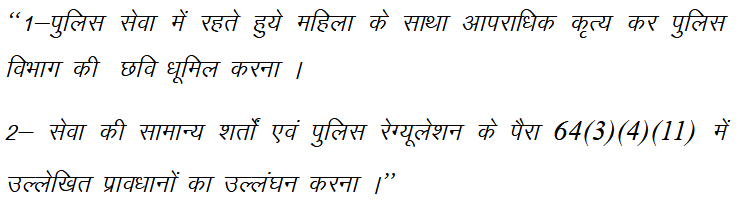
4. On account of registration of the criminal case, petitioner was suspended on 25/08/2020. He was attached to Police line, Gwalior. A preliminary enquiry was conducted by City Superintendent of Police, Lashkar, Gwalior, wherein, vide report dated19/1/2021, the petitioner was prima-facie found involved in the aforesaid complaint. Accordingly, a charge-sheet was issued to the petitioner on 8/3/2021 (Annexure P/2), whereby, following charges were levelled against him:
5. Since, the petitioner denied the charges, respondents decided to conduct a regular departmental enquiry against the petitioner. In furtherance of enquiry, the Additional Superintendent of Police (Rural), Gwalior was appointed as enquiry officer, while Subedar (Traffic Police), Gwalior was appointed as presenting officer. The enquiry was conducted, wherein, apart from the documentary evidence, five persons were examined as prosecution witnesses. After concluding the enquiry, the enquiry officer submitted his report before respondent no.4. Both the charges were found proved against the petitioner.
6. The respondent no.4, thereafter, issued a show cause notice to the petitioner on 30/11/2021 (Annexure P/3), thereby, forwarding a copy of enquiry report to the petitioner and asking him to submit his explanation to the findings recorded by the enquiry officer. Petitioner however, failed to submit his reply despite reminders sent on 7/12/2021. Notably, in the writ petition, the petitioner has averred that he submitted reply to the show cause notice which has been brought on record as Annexure P/5. However, a perusal of Annexure P/5 shows that it is not the explanation to the show cause notice but the brief note submitted by the petitioner before the enquiry officer.
7. The respondent no.4, thereafter, passed the impugned order on 21/12/2021, whereby, the petitioner is dismissed from service on account of the aforesaid charges having been found proved in the enquiry.
8. Challenging the criminal case registered against him, the petitioner filed a petition under Section 482 of Cr.P.C. before this Court seeking quashment of FIR. Same was subject matter of M.Cr.C. No.15646/2023. This Court vide order dated 14/06/2023 (Annexure P/4) has quashed the FIR holding that the offence as alleged against the petitioner is not made out and registration of FIR is an abuse of process of law.
9. Being aggrieved by the punishment order, the petitioner filed an appeal before respondent no.3. Since, by this time, the FIR was also quashed by this Court, he placed order of this Court also before the appellate authority as an additional ground for setting aside of punishment. The appellate authority vide order dated 06/10/2023 (Annexure P/6) dismissed the appeal holding that the act of petitioner has tarnished the image of department. It is gathered from appellate order that the effect of quashment of FIR is not considered by the Appellate Authority. The mercy appeal filed by petitioner before respondent no.2 also suffered dismissal vide order dated 06/03/2024 (Annexure P/7). That is how, petitioner is before this Court.
10. Challenging the impugned orders, learned counsel for the petitioner vehemently argued that the petitioner was falsely implicated in the criminal case, which is evident from the order dated 14/6/2023 passed by this Court in M.Cr.C. No.15646/2023). It is his submission that, since the very foundation of initiation of departmental enquiry was the aforesaid FIR, the FIR having been quashed by this Court, the petitioner cannot be held guilty of the charge levelled against him in the charge-sheet. Learned counsel further submitted that the allegations made by the complainant to the department are not established even by her statement. Referring to the enquiry report, wherein, the statement of complainant is discussed, learned counsel submitted that the allegations made by the complainant are ex- facie incorrect and false. As per statement of complainant, the learned counsel submitted, the relationship between the petitioner and the complainant were consensual. She made an incorrect statement before the Police that she is pregnant, which is found to be incorrect in the medical examination. He further submitted that the complainant has accepted that there was financial transaction between the petitioner and her father, and the implication of petitioner in the criminal case is because of the financial transaction. Learned counsel for the petitioner pointed out that except the statement of complainant, the other witnesses examined in the enquiry, were the departmental witnesses who are not relevant for establishing the allegations made against the petitioner. Referring to Regulation 228 of Police Regulations, learned counsel submitted that the punishment imposed upon the petitioner is harsh and disproportionate. He, therefore, submitted that the punishment imposed upon the petitioner is ex-facie illegal and deserved to be set aside. In support of his submissions, learned counsel for the petitioner relied upon the decision of Apex Court in the case of Ram Lal Vs. State of Rajasthan and Ors. reported in (2024)1 SCC 175. He thus prayed for setting aside of the impugned orders and for reinstatement of the petitioner will all consequential benefits.
11. On the other hand, learned counsel for the State supported the impugned action of the respondent. It is his submission that even though the FIR against the petitioner has been quashed by this Court, the petitioner would not be absolved of the allegations made against him in the charge-sheet. He submitted that the departmental proceedings are independent of the criminal proceedings and mere quashment of FIR would not invalidate the concluded enquiry. Learned counsel further pointed out that the order was passed by this Court in M.Cr.C. No.15646/2023 without notice to the complainant, and therefore, she has filed an application for recalling of the said order before this Court, which is subject matter of M.Cr.C. No.31509/2023. Same is pending consideration, and therefore, it cannot be said that the order passed by this Court is final. Learned counsel for the State also submitted that the findings have been recorded in the departmental enquiry after appreciating the evidence that has come on record during the enquiry and such factual findings do not warrant interference of this Court in exercise of powers of judicial review. In support of his submissions, he placed reliance upon the decision of Apex Court in the case of B.C. Chaturvedi vs. Union of India & ors. reported in (1995)6 SCC 749.
12. No other point was raised.
13. Considered the arguments and perused the record.
14. The very foundation for initiation of departmental enquiry against the petitioner was registration of FIR against him at the instance of complainant. Challenge to the impugned order of punishment has been made on the ground that when the FIR itself has been quashed by this Court, the punishment order also does not survive. It is settled legal proposition that standard of proof criminal procedure and the departmental enquiry is entirely different. In criminal proceedings, the charges are required to be proved beyond reasonable doubt while in the departmental proceedings they can be established on the basis of preponderance of probability. Thus, the fact that FIR has been quashed, would not ipso-facto result in exoneration of petitioner in the concluded departmental enquiry. This has been so held by the Apex Court in the case of State Bank of Bikaner & Jaipur v. Nemi Chand Nalwaya reported in (2011)4 SCC 584.
The observations made by Apex Court in para 10 as under:
"10.The fact that the criminal court subsequently acquitted the respondent by giving him the benefit of doubt, will not in any way render a completed disciplinary proceedings invalid nor affect the validity of the finding of guilt or consequential punishment. The standard of proof required in criminal proceedings being different from the standard of proof required in departmental enquiries, the same charges and evidence may lead to different results in the two proceedings, that is, finding of guilt in departmental proceedings and an acquittal by giving benefit of doubt in the criminal proceedings. This is more so when the departmental proceedings are more proximate to the incident, in point of time, when compared to the criminal proceedings. The findings by the criminal court will have no effect on previously concluded domestic enquiry. An employee who allows the findings in the enquiry and the punishment by the disciplinary authority to attain finality by non-challenge, cannot after several years, challenge the decision on the ground that subsequently, the criminal court has acquitted him."
Similarly, in the case Inspector General of Police vs. S. Samuthiram reported in (2013)1 SCC 598 the Apex Court held that judgment passed in criminal case has no impact if acquittal is on account of flawed prosecution but departmental enquiry is based on adequate evidence.
15. However, recently in the case of Ram Lal (supra), the Apex Court took a different view considering the facts of the case. This was a case where the petitioner was charged of securing employment by altering his date of birth in the mark sheet. He was tried departmentally as also a criminal case was also registered. He was acquitted of the charge in criminal proceedings in appeal but was dismissed from service on account of misconduct established in departmental enquiry. Noting that the charge in criminal case as also departmental enquiry is identical and also the findings are based on same set of evidence, the Apex Court set aside the dismissal order. It held thus:
"Legal position
10. We have examined both the questions independently. We are conscious of the fact that a writ court's power to review the order of the disciplinary authority is very limited. The scope of enquiry is only to examine whether the decision- making process is legitimate. (See: SBI v. A.G.D. Reddy, (2023) 14 SCC 391 : 2023 SCC OnLine SC 1064 : 2023 INSC 766] .) As part of that exercise, the courts exercising power of judicial review are entitled to consider whether the findings of the disciplinary authority have ignored material evidence and if it so finds, the courts are not powerless to interfere. (See: United Bank of India v. Biswanath Bhattacharjee [United Bank of India v. Biswanath Bhattacharjee, (2022) 13 SCC 329 : (2023) 2 SCC (L&S) 705 : 2022 INSC 117] .)
11. We are also conscious of the fact that mere acquittal by a criminal court will not confer on the employee a right to claim any benefit, including reinstatement. (See: State of T.N. v. S. Samuthiram, (2013) 1 SCC 598 : (2013) 1 SCC (Cri) 566 : (2013) 1 SCC (L&S) 229] .)
12. However, if the charges in the departmental enquiry and the criminal court are identical or similar, and if the evidence, witnesses and circumstances are one and the same, then the matter acquires a different dimension. If the Court in judicial review concludes that the acquittal in the criminal proceeding was after full consideration of the prosecution evidence and that the prosecution miserably failed to prove the charge, the Court in judicial review can grant redress in certain circumstances. The Court will be entitled to exercise its discretion and grant relief, if it concludes that allowing the findings in the disciplinary proceedings to stand will be unjust, unfair and oppressive.
Each case will turn on its own facts. (See G.M. Tank v. State of Gujarat, (2006) 5 SCC 446 : 2006 SCC (L&S) 1121] ,State Bank of Hyderabad v. P. Kata Rao, (2008) 15 SCC 657 : (2009) 2 SCC (L&S) 489] and State of T.N. v. S. Samuthiram, (2013) 1 SCC 598 : (2013) 1 SCC (Cri) 566 : (2013) 1 SCC (L&S) 229] .)"
16. Thus, it is to be considered as to whether the punishment imposed on petitioner is based on adequate material or not. In the departmental proceedings, the petitioner was charged of committing criminal offence with a woman while remaining in police service which tarnished the image of the department. He was further charged of violating provisions of Regulation 64(3), (4), (11) of M.P. Police Regulations."
17. The disciplinary authority in impugned order has not recorded independent finding regarding petitioner's guilt but has agreed to the findings recorded by enquiry officer. From the report submitted by enquiry officer, it is found that the findings regarding both the charges have been recorded based upon the fact that the petitioner married to complainant suppressing factum of his existing marriage and that an FIR was registered against petitioner and the challan was filed in Court. This was stated to be damaging the image of Police department. However, material statement of complainant has not been discussed while recording adverse findings against the petitioner.
18. By the time appeal was decided, the FIR was already quashed by this Court. The order was placed before the Appellate Authority. However, the effect of the same was not considered by Appellate Authority.
19. The complainant alleged against the petitioner that suppressing the fact of his earlier marriage, petitioner entered into relationship with her. This fact has not been found established as is apparent from the findings recorded by this Court in M.Cr.C. No.15646/2023. Para 8 & 9 of the order are reproduced hereunder:-
"8. On going through the law laid down by the Hon'ble Apex Court it is evident that there is a distinction between "mere breach of promise'' and ''giving a false promise to marry''. Only a false promise to marry made with an intention to deceive a woman would vitiate the woman's consent being obtained under misconception of fact, but mere breach of promise cannot be said to be a false promise. In the present case at hand, the complainant- prosecutrix was in physical relationship with applicant for a long period. Thus, it cannot be said that her consent was obtained by misconception of fact.
9. Under these circumstances, the prosecution of the applicant for offence under Sections 376, 376(2)(N), 323 and 506 of IPC would be nothing but abuse of process of law and, therefore, no case is made out warranting prosecution of applicant. As a consequence thereof, FIR registered as Crime No.540/2020 at Police Station- Janakganj, DistrictGwalior (M.P.) for the offence punishable under Sections 376, 376(2)(N), 323 and 506 of IPC and further proceedings pending before 6th Additional Session Judge, Gwalior in S.T. No.92/2021 are hereby quashed. Applicant is discharged from all the charges of the present case."
20. The aforesaid findings recorded by this Court also support the contention of petitioner that relationship between him and the complainant were consensual. In fact this has been accepted by the complainant also. The allegation of assault is also not established in the enquiry. Thus, after going through the entire enquiry report, submitted by the enquiry officer, the only allegation which can be said to have been established against the petitioner is that he indulged in relationship with the complainant while in subsistence of his earlier marriage. Pertinently, the complainant herself was a married woman when the alleged incident took place. She stated in enquiry that she was separated in Panchayat, and after FIR she has taken divorce from her husband from Court. Thus, when the petitioner as also complainant both were married, the question of petitioner's making false promise of marriage does not arise. This falsifies her allegation that the petitioner entered into relationship with the complainant under false promise of marriage.
21. The only independent witness to establish the charges against the petitioner is the complainant herself. In her statement, she has accepted that the relationship was consensual. She alleged in the FIR that she is pregnant, however, the same was found to be incorrect in the medical report. The fact that the complainant made incorrect statement creates suspicion about the allegations made by her against the petitioner. She has further accepted that there was financial transaction between petitioner and her father. Thus, the enquiry officer failed to take into account this material part of statement of complainant and got influenced by the fact that an FIR has been registered against the petitioner for offence against woman. From the statement of complainant, it comes out that her relationship with petitioner were consensual. The allegations have not been established in enquiry. The subsequent quashment of FIR by this Court also has material impact on the disciplinary proceedings inasmuch as the findings recorded by enquiry officer on both the charges were solely based upon registration of FIR. The Appellate Authorities failed to take this important aspect into account. Thus, the findings recorded against the petitioner in enquiry are unsustainable in law.
22. Consequently, impugned order dated 21/12/2021 (Annexure P/1), order dated 6/10/2023 (Annexure P/6) and order dated 6/3/2024 (Annexure P/7) are found to be unsustainable in law and are accordingly quashed. The respondents are directed to reinstate the petitioner in service with all consequential benefits except the back wages. The back wages are denied to the petitioner in view of the facts that initiation of departmental proceeding was on account of his involvement in criminal case for which department is not responsible.
23. Let needful be done within a period of 90 days from the date of submission of certified copy of this order.
|
| |

