| |
CDJ 2026 Kar HC 134


|
| Case No : Writ Petition No. 200529 Of 2026 (GM-POLICE) |
| Judges: THE HONOURABLE MR. JUSTICE PRADEEP SINGH YERUR |
| Parties : Bilwa Patri Basaveshwar (Trust) Seva Samiti (R) Hattigudda, Represented By Its President, Karibasavanagouda, Raichur & Others Versus The State Of Karnataka, Represented By Its Principal Secretary, Revenue Department, Bengaluru & Others |
| Appearing Advocates : For the Petitioners: Mahantesh Patil, Advocate. For the Respondents: Malharao, AAG, Mallikarjun Sahukar, AGA. |
| Date of Judgment : 10-02-2026 |
| Head Note :- |
Constitution of India - Articles 226 & 227 -
Comparative Citation:
2026 KHC-K 1263,
|
| Summary :- |
| Mistral API responded but no summary was generated. |
| Judgment :- |
|
(Prayer: This Writ Petition is filed under Articles 226 and 227 of the Constitution of India, praying to issue a writ in the Nature of Certiorari to quash the impugned order Bearing No.  dated 02-02-2026 vide Annexure-F passed by the 2nd Respondent, B) issue a writ in the Nature of Mandamus with direction to respondents, allow/permit the petitioners and devotees to conduct fair of Sri. Bilwa Patri Basaveshwar Temple from 04-02-2026 to 16-02-2026 in the Hattigudda Village: of Sindhanur Tq.) dated 02-02-2026 vide Annexure-F passed by the 2nd Respondent, B) issue a writ in the Nature of Mandamus with direction to respondents, allow/permit the petitioners and devotees to conduct fair of Sri. Bilwa Patri Basaveshwar Temple from 04-02-2026 to 16-02-2026 in the Hattigudda Village: of Sindhanur Tq.)
Oral Order
1. Heard learned counsel for the petitioners.
2. Learned Additional Government Advocate is directed to take notice for respondents.
3. This petition is filed seeking the following reliefs:
"a) Issue a writ in the nature of certiorari to quash the impugned order bearing no. dated 02-02-2026 vide Annexure-F passed by the 2nd respondent,
b) issue a writ in the nature of mandamus with direction to respondents, allow/permit the petitioners and devotees to conduct fair of Sri. Bilwa Patri Basaveshwar Temple from 04-02-2026 to 16-02- 2026 in the Hattigudda village: of Sindhanur tq.
c)Pass such other orders or directions as this Hon'ble Court deems just and proper under the facts and circumstances of the case and allow this writ petition"
4. Petitioner No.1 is a registered trust namely Sri Bilwa Patri Basaveshwar (Trust) Seva Samiti (R), Hattigudda, Taluk: Sindhanoor, District: Raichur. It is contended that Sri Bilwa Patri Basaveshwar temple is 300 to 400 years old temple, having the deity of Lord Basaveshwar (Nandi). Said deity is worshipped by devotees of Hattigudda and surrounding villages irrespective of their caste. The devotees have belief in the deity and every year in the month of Shivaratri, they carry out several religious activities, so also mass weddings in the premises of the temple. The petitioner/trust along with its devotees conduct the Mahashivaratri Festival every year, which is scheduled on 16.02.2026, where several functions and religious activities are conducted, such as preaching purana and other religious activities including conducting mass weddings in the temple. The religious activities ought to have commenced on 05.02.2026 and several mass weddings are arranged and fixed during this period.
5. This being the state of affairs, petitioner/trust made a representation to the authorities seeking permission to hold religious activities from 04.02.2026 to 16.02.2026 in the temple premises. Respondent Nos.5 and 6 after considering their representation, accorded permission on 28.01.2026 for conducting religious function from 04.02.2026 to 16.02.2026 with certain conditions. In obedience of the said permission, petitioner No.1 executed a bond for compliance of conditions to respondent No.6. After receiving the said permission, which was accorded on 28.01.2026, the petitioners, along with all the devotees, made preparations for conducting religious activities from 04.02.2026 in the temple premises by printing wedding invitation cards for participation of mass wedding in the temple and other religious activities. It is further contended that suddenly respondent No.2 has passed the impugned order on 02.02.2026, under Section 35 of the Police Act, 1963 prohibiting the general public and petitioners to conduct the fair from 04.02.2026 to 16.02.2026 in Hattigudda Village, with regard to the eve of the fair of Sri Bilwa Patri Basaveshwar temple. It is this order of the respondent No.2 which is questioned before this Court, on several grounds, inter-alia contending that the impugned order passed by respondent No.2 is arbitrarily, illegal and violative of Articles 25 and 26 of the Constitution of India. It is also contended that there is absolutely no circumstance to pass a prohibitory order, as there is no breach of public peace or tranquility in the village. It is further contended that respondent No.2 has relied upon Crime No.188/2025 and Crime No.189/2025 registered on 19.11.2025. These crime numbers were registered for different reasons and cannot be a ground to pass prohibitory order under Section 35 of the Karnataka Police Act. It is a flimsy reason, only with an intent to prohibit the petitioners from conducting religious activities of the temple, that such an order is passed. It is contended that the same is violative of Articles 14, 19, 25 and 26 of the Constitution of India. If at all there is any apprehension of the police with regard to law and order, they can monitor the situation and if anybody is creating such a scene, they can well be prohibited personally, but they cannot stop the entire event organized by the petitioners of religious activities. On these grounds, he seeks to quash the impugned order and grant a writ of mandamus with a direction to the respondent authorities to allow the petitioners to conduct the fair of Sri Bilwa Patri Basaveshwar Temple. It is also contented that earlier permission was granted on 28.01.2026 and due to the interference of respondent No.2, 8 days have already passed by, which has caused infringement of the personal rights of the movement and following a religious practice as contemplated under Articles 14, 19, 25 and 26 of the Constitution of India.
6. Learned Additional Advocate General appearing on behalf of the respondent-State contends that at the intervention of the Court, as per order passed dated 06.02.2026, directing to conduct a meeting with the petitioners and the respondents to amicably resolve the issue and to come out with a proposal, where the religious activities could be conducted and along with it how the law and order situation could be maintained by way of mutual consent from the villagers, the stakeholders, the devotees, including the police, was conducted and accordingly, the report is submitted.
7. Learned Additional Government Advocate has placed a memo along with the report for having conducted the meeting on 09.02.2026. In the meeting held the following points are enumerated, which read as under:
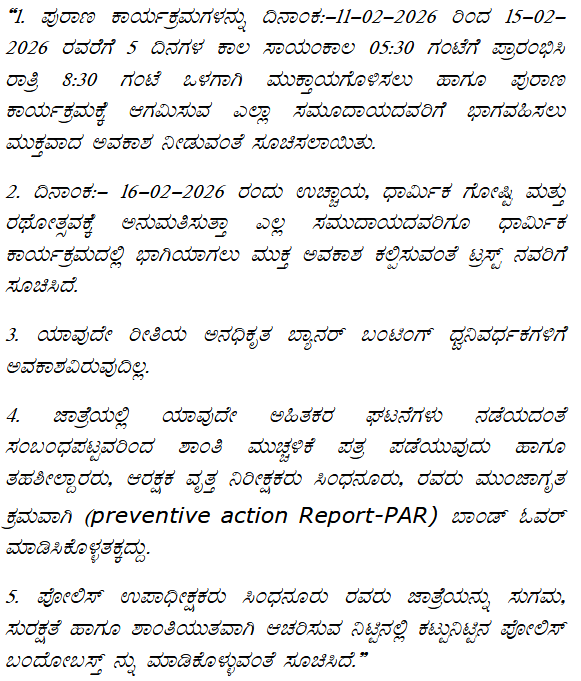
8. Coming to the present facts on hand, the petitioners based on the permission granted earlier were supposed to conduct the program from 04.02.2026. Accordingly, they put up a pamphlet and other details, fixed arrangements of weddings and other religious activities, as permission was granted on 28.01.2026, based on which the petitioners had prepared certain calendar of events over a period spanning from 04.02.2026 to 16.02.2026 to conduct activities all being religious in nature, including preachings of propagation of the religious activities, puranas and Bhakti geetas etc., related to religious activities of Sri Bilwa Patri Basaveshwar deity. Such being the case, the apprehension of the respondents by reducing the time from 05.30 p.m. to 08.30 p.m. of the Purana Pravachana i.e. preaching and teachings of the lord, is not accepted by learned counsel for the petitioners, as he contends that such restrictions cannot be ordered by the respondent authorities unless there is some apprehension, which is not narrated or stated in the memo. It is seen that vide the earlier order dated 28.01.2026, the permission was duly granted by respondent Nos.5 and 6. Subsequently, the permission has been withdrawn by respondent No.2, which is politically motivated and only passed the impugned order to prevent the petitioners to perform the religious activities, which is in blatant violation of the Articles enshrined in the Constitution of India. It is relevant to extract the fundamental rights guaranteed under the Constitution under Article 19, which reads as under:
"19. Protection of certain rights regarding freedom of speech, etc. (1) All citizens shall have the right-
(a) to freedom of speech and expression;
(b) to assemble peaceably and without arms;
(c) to form associations or unions [or co-operative societies];
(d) to move freely throughout the territory of India;
(e) to reside and settle in any part of the territory of India; [and] [***]
(g) to practise any profession, or to carry on any occupation, trade or business."
9. It is also relevant to rely upon the Articles 25 and 26, which read as under:
"25. Freedom of conscience and free profession, practice and propagation of religion.-(1) Subject to public order, morality and health and to the other provisions of this Part, all persons are equally entitled to freedom of conscience and the right freely to profess, practise and propagate religion.
(2) Nothing in this article shall affect the operation of any existing law or prevent the State from making any law-
(a) regulating or restricting any economic, financial, political or other secular activity which may be associated with religious practice;
(b) providing for social welfare and reform or the throwing open of Hindu religious institutions of a public character to all classes and sections of Hindus.
26. Freedom to manage religious affairs.-
Subject to public order, morality and health, every religious denomination or any section thereof shall have the right-
(a) to establish and maintain institutions for religious and charitable purposes;
(b) to manage its own affairs in matters of religion;
(c) to own and acquire movable and immovable property; and
(d) to administer such property in accordance with law"
10. The Constitution of India, as per the fundamental rights guaranteed and enshrined, has provided a right to freedom of speech and expression, to assemble peacefully, without arms, to form associations or unions, to move freely throughout the territory of India, to reside in and settle in any part of the India, to practice any profession, carry on occupation, trade or business. Article 25 clearly specifies with regard to free profession, practice and propagation of religion and the freedom of conscience. Therefore, any citizen of this country is entitled to practice or propagate his religion and also religious activities associated with his religion. Article 26 deals with freedom to manage religious affairs. Therefore, when such articles are enshrined in the Constitution of India, it is a fundamental right of every citizen to practice and profess the religion of his choice and in the manner he wants, unless there is a breach of morality or public order and tranquility and peace. Article 25 has been considered in several catena of judgments of the Hon'ble Apex Court. In the Judgment rendered by the 7 Judges Bench of the Hon'ble Apex Court in the case of The Commissioner, Hindu Religious Endowments, Madras v. Sri Lakshmindra Thirtha Swamiar of Sri Shirur Mutt reported in AIR 1954 SC 282, it was held that what has been guaranteed was freedom not only to entertain such religious beliefs as may be approved by one's judgment and conscience but also to exhibit his belief in such outward acts as he thinks proper. It is also held that religion is a matter of faith with individuals or communities. In the case of Ratilal Panachand Gandhi v the State of Bombay, reported in AIR 1954 SC 388, (Five Judges Bench), it was reiterated that every person has a fundamental right to exhibit his belief and ideas in such overt acts as are enjoined or sanctioned by his religion. In the case of Sardar Syedna Taher Saifuddin Saheb v. State of Bombay, reported in AIR 1962 SC 853, Shirur Mutt (supra) view was upheld and held that what constitute an essential part of religion or religious practice has to be decided by the Courts with reference to the doctrine of particular religion and include practices which are regarded by the community as a part of its religion. This again was followed by another judgment of five Judges bench of the Hon'ble Apex Court in the case of E. R. J. Swami v. State of Tamil Nadu, reported in AIR 1972 SC 1586.
11. Coming back to the present case on hand, initially the petitioners were granted permission and thereafter respondent No.2 revokes it and imposes prohibitive orders for conducting any such religious events. The Karnataka Police Act, 1963 permits the police to regulate the public assemblies and processions. It is no doubt true that the respondent-police can prohibit the assembly if there is apprehension of disturbances, threat to public peace, morality, tranquility, and breach of any terms and conditions. There cannot be an arbitrary order of stopping or restricting the freedom of movement or conducting religious activities or religious ceremonies during religious festivals. Such restrictions should be borne out from the records with proper and cogent reasoning.
12. In the present case on hand, except for citing two crime numbers having registered in the village, no reasons are assigned by the respondent No.2 for passing the impugned order. This Court made an attempt to see that the petitioners, the devotees, the villagers, the police authorities and the respondents could come to an amicable settlement, whereby peace and tranquility could be adhered to, by the imposition of certain conditions by the respondents. But it is seen that the respondents have restricted the time limit from 05.30 p.m. to 08.30 p.m., further restricting the dates of the religious ceremonies from 11.02.2026 to 15.02.2026. It is also contended by learned counsel for the petitioners that the villagers are told that no activities could be conducted beyond 8:30 p.m., in the joint meeting and hence, they are not agreeable to the same.
13. Having perused the order of the respondent No.2, I do not find any good ground or cogent reason for having passed such an order, as the reasons made out for prohibiting the petitioners to conduct religious activities does not stem out from any cogent material or reason to apprehend any public peace and tranquility being disturbed, merely because of a crime being registered and stray sentence of rival group/sect being enemical to each other may cause law and order situation.
14. It is apparently seen that the Karnataka Police Act has the necessary mechanism to curtail any such unruly trouble mongers and also the Karnataka Police Manual contains the relevant provisions to apprehend persons, who are creating breach of public peace and tranquility. Under such circumstances, the respondent- State would be at liberty to apprehend any person or any individual, who creates any breach of public peace and tranquility and creates any threat to the society, including the performance of the religious activities by the petitioners, during the period, when they are intending to do.
15. In view of the fact that the prohibitive orders were passed and the religious activities have not commenced from the day it was to commence i.e. from 04.02.2026 till today i.e., 10.02.2026, this Court is of the opinion that such order passed by the respondent No.2 would not be sustainable and the same requires to be quashed. Accordingly, I pass the following:
ORDER
i. The petition is allowed.
ii. The impugned order dated 02.02.2026 is hereby quashed.
iii. A writ of mandamus is issued with a direction to the respondents to permit the devotees, petitioner-Trust namely Sri Bilwa Patri Basaveshwar (Trust) Seva Samiti (R), Hattigudda and the members to continue their religious activities as per the brochure printed and produced at Annexure-C.
iv. The respondents shall not prohibit the petitioners from conducting the religious activities from today i.e., 10.02.2026, in accordance to the pamphlet at Annexure-C, till 16.02.2026 in the Hattigudda village, Tq.Sindhanoor, Dist. Raichur.
v. However, this Court deems it appropriate to frame the following guidelines for adherence and maintaining proper public peace, tranquility and order:
(a) The petitioners shall perform the poojas, purana pravachane and other religious activities, as per the calendar of events published at Annexure-C. However, the petitioners shall not make any loudspeaker announcements or activities in the loudspeakers post 09.00 p.m. beyond certain prescribed decibel and stop all activities through public announcements and loudspeakers at 09.00 p.m. Other religious activities could be carried on till 10.30 p.m. and close the religious activities and other activities by 10.30 p.m. on each day till 16.02.2026.
(b) The respondent-police are at liberty to monitor the events of the petitioners, while performing of their religious functions and activities.
(c) Respondents are also at liberty to apprehend any persons involved in untoward activities causing a law and order situation in the village or in the neighbourhood.
(d) It is made clear that the petitioners shall not carry any of the arms or ammunition and any weapons which are barred under the Arms Act, without there being proper permission from the concerned authorities.
vi. In view of the peace meeting arrived between the petitioners and the respondent-State and other stakeholders, the parties who have signed the peace meeting are cautioned not to create any untoward incident and law and order situation, during the religious activities commencing from 10.02.2026 to 16.02.2026.
Ordered accordingly.
|
| |

