| |
CDJ 2026 MPHC 094


|
| Court : High Court of Madhya Pradesh (Bench at Gwailor) |
| Case No : Writ Petition No. 13184 Of 2021 |
| Judges: THE HONOURABLE MR. JUSTICE ASHISH SHROTI |
| Parties : Dharu Singh Bheel Versus State Of Madhya Pradesh & Others |
| Appearing Advocates : For the Petitioner: Umesh Kumar Singh Chauhan, Advocate. For the respondents: B.M.Patel, GA. |
| Date of Judgment : 12-01-2026 |
| Head Note :- |
M.P. Civil Services (Classification, Control & Appeal) Rules, 1966 - Rule 14 -
Comparative Citation:
2026 Lab IC 902,
|
| Summary :- |
1. Statutes / Acts / Rules Mentioned:
- Rule 14 of M.P. Civil Services (Classification, Control & Appeal) Rules, 1966
- Article 226 of Constitution of India
2. Catch Words:
- dismissal
- departmental enquiry
- admission
- natural justice
- unauthorized absence
- misconduct
- reinstatement
- appeal
- mercy appeal
- review
- procedural irregularity
- CCA Rules
3. Summary:
The petitioner challenged his dismissal for prolonged unauthorized absence, alleging violations of Rule 14 of the CCA Rules, non‑issuance of show‑cause notices, and coercion to admit charges. The court observed that the petitioner unequivocally admitted all charges on 18‑7‑2019 and never raised any objection thereafter. It held that such admission is conclusive evidence and the enquiry officer was justified in concluding the enquiry without further proceedings. The court rejected claims of procedural irregularities, noting that non‑supply of preliminary reports or documents did not affect the validity of the order. It affirmed that dismissal for repeated unauthorized absence is proportionate and consistent with precedent. Accordingly, the impugned orders were upheld.
4. Conclusion:
Petition Dismissed |
| Judgment :- |
|
1. Petitioner has filed this writ petition being aggrieved by order dated 5/1/2020 (Annexure P/1), whereby, he was dismissed from service on account of misconduct, of remaining unauthorizedly absent from duty, was held established in departmental enquiry. He has also challenged the order dated 2/6/2020 (Annexure P/2), 8/12/2020 (Annexure P/3) & 23/1/2021 (Annexure P/10), whereby, his appeal, mercy appeal and review application were rejected by the respective authorities. The petitioner has also prayed for his reinstatement in service with all consequential benefits.
2. Facts necessary for decision of this case are that the petitioner was initially appointed as Constable vide order dated 29/4/2011 and was posted in Police Line, Shivpuri.
3. It is alleged against the petitioner that he was sent for training in 68 th Basic Training Course held at Tighara, Gwalior during the year 2015-16. During training, he absented himself w.e.f. the night of 30 th October, 2015 without any intimation to his superiors. Because of his absence, he was deputed back to his unit at Shivpuri on 2/1/2016. Notices were issued to him on 6/4/2016, 27/4/2016, 24/5/2026, 16/8/2016 & 27/10/2016 asking him to report on duty immediately. However, even though the said notices were received by him or his family members, the petitioner did not report on duty nor sent any intimation regarding his absence.
4. Looking to the continued long absence of the petitioner, respondent no.4 directed for a preliminary enquiry on 17/1/2017. The preliminary enquiry report was submitted on 27/6/2017, whereby, it was reported that the petitioner is absent unauthorizedly w.e.f. 30/10/2015 without any intimation and permission. Again the petitioner absented himself from duty for a period of 68 days from 7/4/2018 to 11/6/2018.
5. A charge-sheet was issued to the petitioner on 31/1/2019 (Annexure R/1), whereby, following three charges were levelled against him:-
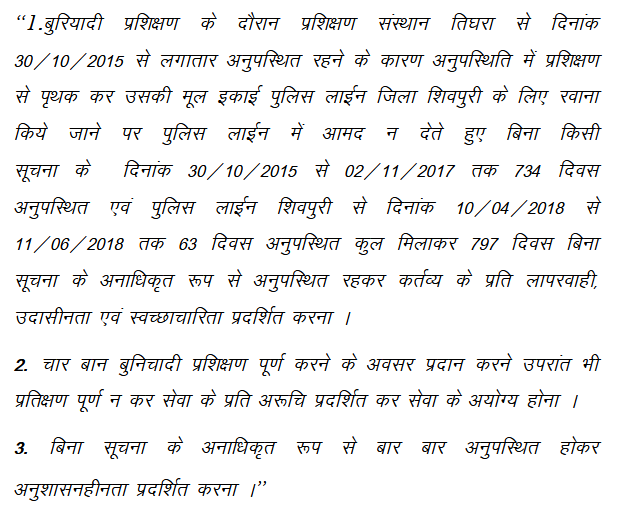
6. As per respondents, petitioner submitted reply to the charge-sheet but same was not found satisfactory. However, the petitioner disputes that he submitted reply to the charge-sheet. The Sub Divisional Officer (Police) was appointed as enquiry officer to conduct the enquiry. The enquiry commenced on 18/7/2019. On being asked, the petitioner admitted all the three charges vide his application dated 18/7/2019 (Annexure R/2). Accordingly, the enquiry officer concluded the enquiry and submitted the report before respondent no.4.
7. The respondent no.4 asked the petitioner to submit his explanation vide memo dated 22/7/20919 and reminders thereof were given on 17/8/2019 & 3/10/2019. It is alleged by respondents that despite having received the aforesaid memos, the petitioner did not submit any explanation.
8. The impugned order dated 5/1/2020 (Annexure P/1) was thereafter passed by respondent no.4, thereby, dismissing the petitioner from service. A perusal of this order shows that earlier also at about 10 occasions, the petitioner has remained unauthorizedly absent from duty. It is also gathered that earlier also, on account of his absence for 232 days, the petitioner was removed from service, but in appeal, a lenient view was taken and he was reinstated by imposing punishment of stoppage of increment with cumulative effect. It is observed in the impugned order that despite the aforesaid, the petitioner did not learn a lesson and again absented himself from duty for about 734 days and 68 days.
9. Being aggrieved by the aforesaid punishment order, the petitioner filed an appeal before respondent no.3, which came to be dismissed on 2/6/2020 (Annexure P/2). Mercy appeal filed by him before respondent no.2 also suffered dismissal vide order dated 8/12/2020 (Annexure P/3) and the review application filed before respondent no.1 was also rejected vide order dated 23/1/2021 (Annexure P/10). Against these orders, the petitioner has filed present writ petition.
10. The learned counsel for the petitioner vehemently argued that the respondents completely failed in adopting the procedure prescribed under Rule 14 of M.P. Civil Services (Classification, Control & Appeal) Rules, 1966 (hereinafter referred to as "CCA Rules") for conducing enquiry. It is his submission that the petitioner was pressurized to admit the charges and contents of application dated 18/7/2019 (Annexure R/2) were in fact dictated by the enquiry officer to the petitioner. As per his submission, because of the poor social status of petitioner, he could not agitate against such conduct of enquiry officer and was compelled to admit the charges. Learned counsel also submitted that the petitioner requested for supply of documents vide application dated 25/6/2021, however, those documents were also not supplied to him. He further argued that respondent no.4 as also the appellate authorities failed to consider the social status of the petitioner, who belongs to Adiwasi Tribe and was not in a position to defend himself in the enquiry and have mechanically passed the impugned orders.
11. Learned counsel for the petitioner also submitted that a preliminary enquiry was conducted before issuance of charge-sheet, however, despite demand, copy of preliminary enquiry report was not supplied to the petitioner. He further argued that no show cause notice was issued to the petitioner before issuing the charge-sheet. He thus, submitted that action taken by the respondents against the petitioner suffers from material illegality and is in violation of principles of natural justice. He thus prayed for setting aside of the impugned orders and reinstatement of the petitioner.
12. On the other hand, learned counsel for the State supported the impugned orders and argued that the petitioner admittedly remained absent from duty for 734 days, for which, he has not submitted any plausible explanation. Thus, even if there is some irregularity in conducting enquiry, that would not give any benefit to the petitioner, in view of admitted facts. He also argued that the petitioner voluntarily admitted the charges before the enquiry officer which is apparent from the fact that he never made anyu complaint before Appellate Authorities, of any pressure put on him by the enquiry officer. The said allegation has been made by the petitioner for the first time in the present writ petition, presumably, based upon the advice given to him. It is his submission that the scope of interference by this Court under Article 226 of Constitution of India is very limited and the factual findings recorded during enquiry are not open to interference. He thus submitted that no interference is warranted in the present writ petition.
13. Considered the arguments and perused the record.
14. Certain facts which are not disputed by the petitioner are that:-
(i) he was absent from duty from 30/10/2015 to 2/11/2017 for 734 days;
(ii) he again absented himself from duty for 68 days from 10/4/2018 to 11/6/2018, out of which 5 days were regularized as leave; and
(iii) earlier also, he was removed from service on his absence from duty for 232 days, however, taking a lenient view, the appellant authority reinstated him by substituting punishment to stoppage of increment with cumulative effect.
15. The impugned punishment has been challenged by the petitioner primarily on the ground that the enquiry as prescribed under Rule 14 of CCA Rules was not conducted. In this regard, it is noted that on the first date of enquiry, petitioner unequivocally admitted the charges vide his application dated 18/7/2019 (Annexure R/2). A perusal of this application shows that after reproducing the three charges levelled against him, he admitted the charges in following terms:-

16. The petitioner's counsel though tried to convince this Court that the aforesaid admission of charges by the petitioner was not voluntary but was dictated by the enquiry officer. However, it is seen that said objection was never taken by the petitioner either in the appeal, mercy appeal or in review application filed before respondents no.3, 2 & 1 respectively. Thus, this factual assertion cannot be accepted made for the first time in the present writ petition. There is no factual foundation laid in this regard during course of enquiry.
17. The petitioner's counsel also argued that despite petitioner having admitted the charges, the enquiry officer was obliged to conduct the enquiry. However, such contention of petitioner's counsel is not acceptable. It is settled in law that admission is the best evidence. Thus, once the charges were admitted by the petitioner, the enquiry officer was justified in concluding the enquiry. This has been so held by Apex Court in the case of Coal India Ltd. vs. Mukul Kumar Choudhuri reported in (2009)15 SCC 620. Dealing with the similar case of admission of charge by delinquent, the Court held as under:
"10.The delinquent admitted the charges before the inquiry officer. He stated:
"I admit the charges. However, I desire to state reasons for my absence and are given below:
(i) I did not have any intention nor desire of disobeying order of higher authority or violate any of the Company's rule and regulations, and
(ii) The reason is purely personal which cannot be produced by any evidence to prove and is beyond my control."
The admission on the part of delinquent before the inquiry officer leaves no manner of doubt that the charges against the delinquent stood fully proved. He was given second show- cause notice and a copy of the enquiry report was annexed thereto. He sent his written response to the second show cause on 15-7-2000."
In the aforesaid case before Apex Court, the admission of charge by delinquent was with an explanation. However, in the case in hand, the petitioner has not even given any explanation of his absence in his application.
18. The issue has been dealt with again by the Apex Court in the case of Manoj H. Mishra v. Union of India, reported in (2013)6 SCC 313, wherein, the Apex Court held in para 34 and 35 as under:-
"34. We have noted in detail the submissions made by Mr Bhushan, though strictly speaking, it was not necessary in view of the categorical admission made by the appellant before the enquiry officer. Having admitted the charges understandably, the appellant only pleaded for reduction in punishment before the High Court. The learned Single Judge has clearly noticed that the counsel for the appellant has only submitted that the punishment is disproportionate to the gravity of the misconduct admitted by the appellant. The prayer made by the appellant before the Division Bench in the letters patent appeal for amendment of the grounds of appeal to incorporate the challenge to the findings of guilt was rejected.
35. In our opinion, the learned Single Judge and the Division Bench have not committed any error in rejecting the submissions made by the learned counsel for the appellant. We are not inclined to examine the issue that the actions of the appellant would not constitute a misconduct under the Rules. In view of the admissions made by the appellant, no evidence was adduced before the enquiry officer by either of the parties. Once the enquiry officer had declined to accept the conditional admissions made by the appellant, it was open to him to deny the charges. But he chose to make an unequivocal admission, instead of reiterating his earlier denial as recorded in preliminary hearing held on 26-12-1994. The appellant cannot now be permitted to resile from the admission made before the enquiry officer. The plea to reopen the enquiry has been rejected by the appellate as well as the revisional authority. Thereafter, it was not even argued before the learned Single Judge. The learned counsel had confined the submission to the quantum of punishment. In letters patent appeal, the Division Bench declined to reopen the issue. In such circumstances, we are not inclined to exercise our extraordinary jurisdiction under Article 136 for reopening the entire issue at this stage. Such power is reserved to enable this Court to prevent grave miscarriage of justice. It is normally not exercised when the High Court has taken a view that is reasonably possible. The appellant has failed to demonstrate any perversity in the decisions rendered by the Single Judge or the Division Bench of the High Court."
19. In view of the aforesaid, since the petitioner had admitted the charges without any explanation, the action of the enquiry office in concluding the enquiry at this stage itself, cannot be said to be illegal.
20. Petitioner's counsel next argued that the petitioner had requested for supply of various documents vide application dated 25/6/2021 (Annexure P/8), however, those documents were not supplied to him, and therefore, the enquiry is illegal. In this regard, it is noted that the application dated 25/6/2021 is actually a legal notice given on petitioner's behalf by his counsel. This has been done after the rejection of even the review application. Meaning thereby, on such demand of documents was made during the course of enquiry. Even otherwise, looking to the nature of charges, which relates to unauthorized absence of petitioner, no document was relevant and it was for the petitioner to have explained his absence. Non-supply of any document would not be material in such circumstances. Thus, this argument raised by petitioner's counsel is also unsustainable and is accordingly, rejected.
21. Petitioner's counsel then argued that the copy of preliminary enquiry report was not supplied to petitioner. In this regard, it is seen that the impugned orders are not based upon any finding recorded in the preliminary enquiry. Thus, non-supply of preliminary enquiry report would also not vitiate the action taken by the respondents. This has been so held by Apex Court in the case of S. Janaki Iyer vs. Union of India reported in (2025)8 SCC 696 wherein the court held as under:
"20.The aspect with regard to non-supply of the copy of the preliminary inquiry report again would not hold for long for the simple reason that it was never made the basis for coming to a conclusion in the regular departmental inquiry with regard to the guilt of the appellant. It is an admitted fact that after the preliminary inquiry, charge-sheet was issued to the appellant and thereafter a regular departmental inquiry was held where both the parties had led their respective evidence and on that basis the enquiry officer has returned his findings."
The objection regarding non-supply of charge sheet alongwith statement of imputations of misconduct and a list of documents/witnesses, is also found to be incorrect inasmuch as in his application dated 18/7/2019, the petitioner has duly referred to charge sheet in question. Further, at no point of time, such objection was raised by petitioner and it is for the first time the objection is taken in the present petition. Thus, this objection regarding non-service of charge sheet to petitioner is also not acceptable.
22. Petitioner's counsel then argued that no show cause notice was given to him in relation to charge no.2 & 3 before issuance of charge-sheet. This again is not the requirement of law. It is seen that before issuance of charge- sheet, the petitioner was given various notices filed collectively as Annexure P/4 asking him to report for duty. Thereafter, after having joined service on 2/11/2017, the petitioner again absented from duty from 10/4/2018 to 11/6/2018. Thus, non-issuance of show cause notice before issuing the charge-sheet is also not an illegality warranting interference by this Court.
23. The petitioner's counsel next contended that the enquiry officer did not fix any date, time and place for holding enquiry and as such no enquiry proceedings were recorded in petitioner's presence. He also contended that the Presenting Officer was not appointed and the Enquiry Officer performed the job of Presenting Officer also, which vitiated the enquiry. In this regard, it is noted from the opening para of his application, dated 18/7/2019 that the petitioner was called by enquiry officer on 18/7/2019 and was asked to admit or deny the charges. Thus, it is also incorrect on the part of petitioner to say that no proceeding was conducted by enquiry officer. Further, since the enquiry was concluded on the very first day based upon admission of charges by petitioner, the non-appointment of Presenting Officer, even if accepted to be true, does not cause any prejudice to the petitioner.
24. Petitioner was a member of disciplined force. Thus, remaining absent from duty for a long period of time without any intimation and permission is a serious misconduct. The punishment of dismissal from service on account of unauthorized absence, therefore, cannot be said to be disproportionate or incommensurate with the nature of the charges. The punishment of dismissal from service on account of unauthorized absence was upheld by the Apex Court in the cases of L&T Komatsu Ltd. Vs. N.Udayakumar, reported in (2008) 1 SCC 224, Chennai Metropolitan Water Supply and Sewerage Board and Ors. Vs. T.T.Murali Babu, reported in (2014) 4 SCC 108 and again in the case of Ex. Sepoy Madan Prasad Vs. Union of India and Ors., reported in (2023) 9 SCC 100.
25. The petitioner has raised various technical objections to say that the action taken against his is illegal. The objections have been dealt with hereinabove. Even otherwise, the charge against the petitioner was remaining absent unauthorizedly. His absence for the period in question is not disputed by the petitioner. Thus, the burden was on him to bring material on record to show that his absence was not willful and was justified. The petitioner has miserably failed to do so, not only during course of enquiry but also in the present writ petition. Neither before the enquiry officer nor before the appellate/review authority, the petitioner tried to explain his absence. In the present petition also, no plausible explanation is given in this regard. The petitioner has only tried to gain sympathy by referring to his adiwasi caste and poor social status. However, based on the same, his act of remaining absent from duty cannot be held to be justified.
26. It is observed in the impugned order that earlier also petitioner had remained absence for 232 days for which he was removed from service. However, taking a lenient view, the appellate authority reinstated him in service by imposing punishment of stoppage of increment with cumulative effect. Still, the petitioner absented from duty for which the present enquiry was conducted. It is also mentioned in the order that earlier on 10 occasions, he went absent from duty without any information. It is thus seen that the petitioner is habitual of remaining unauthorizedly absent from duty. The charge no.3 levelled against the petitioner thus aggravates the act of petitioner. Thus, in the facts and circumstances of the case, the punishment of dismissal from service imposed upon the petitioner can be said to be disproportionate or harsh.
27. In view of the discussion made above, this Court does not find any ground to interfere with the action taken by the respondents. The impugned orders are accordingly upheld. Petition fails and is hereby dismissed.
|
| |

