| |
CDJ 2026 Ch HC 198


|
| Court : High Court of Chhattisgarh |
| Case No : CRA No. 891 of 2016 |
| Judges: THE HONOURABLE MR. JUSTICE RAVINDRA KUMAR AGRAWAL |
| Parties : Babli Singh @ Bablu @ Bodh Singh Versus State Of Chhattisgarh Through Station House Officer, Chhattisgarh |
| Appearing Advocates : For the Appellant: Kishore Narayan, Gayatri Chouhan, Advocates. For the Respondent: Malay Jain, Panel Lawyer. |
| Date of Judgment : 09-10-2026 |
| Head Note :- |
Criminal Procedure Code, 1972 - Section 374(2) -
Comparative Citation:
2026 CGHC 43899,
|
| Summary :- |
1. Statutes / Acts / Rules / Orders / Regulations, and Sections Mentioned:
- Section 374(2) of the Code of Criminal Procedure, 1972
- Section 306 of IPC
- Section 107 of the IPC
- Section 161 of CrPC
- Section 313 of CrPC
- Code of Criminal Procedure, 1972
- IPC
- CrPC
2. Catch Words:
- abetment of suicide
- harassment
- instigation
- criminal appeal
- conviction
- sentencing
3. Summary:
The appellant challenged his conviction under Section 306 IPC for abetment of suicide. The prosecution relied on a suicidal note, the deceased’s signature verified by a handwriting expert, and testimonies indicating continuous harassment and threats by the appellant. The defence argued lack of direct evidence of instigation and alleged identification errors. The Court examined the relevance of the note, corroborative witness statements, and legal standards for instigation under Sections 107 and 306 IPC. It held that the cumulative evidence established a continuous course of conduct, intent, and nexus sufficient for conviction. The Court found no perversity in the trial Court’s findings and affirmed the conviction and sentence.
4. Conclusion:
Appeal Dismissed |
| Judgment :- |
|
C.A.V. Judgment
1. The present criminal appeal has been filed by the appellant under Section 374(2) of the Code of Criminal Procedure, 1972, against the impugned judgment of conviction and sentence dated 14.06.2016 passed by the learned 4th Additional Sessions Judge, Raipur, in Sessions Case No. 176/2013, whereby the appellant has been convicted for the offence under Section 306 of IPC and sentenced R.I. for 05 years with fine of Rs. 2,000/- in default of payment of fine further S.I. for 03 months.
2. Case of the prosecution is that on 24.05.2013, the deceased Manju Sharma had consumed Salphas (pesticide tablet) at 36 City Mall Cinema Hall, Raipur. She was taken to Dr. B.R. Ambedkar Memorial Hospital, Raipur where she died during treatment. The death information exhibit P/10 was sent by doctor to the jurisdictional police station, Moudhapara, Raipur where merg intimation exhibit P/11 was recorded. Inquest exhibit P/13 of the dead body of the deceased was prepared in presence of the witnesses, and the dead body was sent for its post-mortem to Ambedkar Hospital, Raipur, where PW-18 S.K. Bagh conducted the post-mortem of the dead body of the deceased and gave his report exhibit P/20. The doctor has opined that the death was due to cardio-respiratory failure as a result of poisoning; hence, viscera have been preserved for confirmation. A lady's purse of the deceased was seized vide seizure memo exhibit P/1 from the brother of the deceased, in which a suicidal note, one pouch of Salphas tablet, one photograph and one voter ID card were found and seized. In the suicide note she alleged that she was being harassed by one Babli and therefore, she is committing suicide. The vomit have also been scratched and seized from the cinema hall vide seizure memo exhibit P/2. Spot Map exhibit P/4 was prepared by the Police and exhibit P/6 was prepared by the patwari. The viscera of the deceased was seized vide seizure memo exhibit P/14, FIR exhibit P/22 was registered against the appellant for the offence under Section 306 of IPC. The bank account opening form of the deceased was also seized from Punjab National Bank, Mana, Raipur branch vide seizure memo exhibit P/15. The suicidal note exhibit P/9 was seized from the purse of the deceased, and the natural signature of the deceased which was in the bank account opening form seized from Bank National Bank, Raipur were sent for its examination to the State Examiner of questioned document, Government of Chhattisgarh, who gave his report exhibit P/29 and opined that the person who wrote the red enclosed signatures stamped and marked N-1 to N-5 also wrote the red enclosed signature similarly stamped and marked Q-1. The viscera of the deceased was also sent for its chemical examination to the State FSL Raipur from where report exhibit P/31 was received and the viscera the contents of aluminium phosphide was found. The accused was arrested on 25.05.2013. Statements of the witnesses under Section 161 of CrPC have been recorded and after completion of the usual investigation charge-sheet was filed against the appellant for the offence under Section 306 of IPC before the learned Chief Judicial Magistrate, Raipur.
3. The case was committed to the Court of learned Sessions Judge, Raipur from where it was transferred to the learned trial Court for its trial. The learned trial Court framed charge against the appellant for the offence under Section 306 of IPC. The appellant denied the charge and claimed trial.
4. In order to prove the charge against the appellant, the prosecution has examined as many as 20 witnesses. Statement of the appellant under Section 313 of CrPC have also been recorded in which he denied the circumstances that appears against him, pleaded innocence and have submitted that he has been falsely implicated in the offence. Two defence witnesses, Bhuneshwar Sen DW-1 and Govind Yadav DW-2, have been examined by the defence.
5. After appreciation of oral as well as documentary evidence led by the parties, the learned trial Court convicted and sentenced the appellant as has been mentioned in the earlier part of this judgment. Hence this appeal.
6. Learned counsel for the appellant would submit that the prosecution has failed to prove its case beyond reasonable doubt. There is material omission and contradictions in the evidence of prosecution witnesses. The deceased was a married lady and had a matrimonial dispute with her husband. She was depressed by the behaviour of her husband and having suicidal tendency who earlier also tried to commit suicide and subsequently she committed suicide. The appellant and the deceased had gone to see movie where she consumed poison. There is no allegation that in the cinema hall there was a dispute arose between the appellant and the deceased. Had there been any previous dispute between them, the deceased would not have gone with the appellant to see the movie. The appellant took her to hospital and immediately provided medical aid to her and therefore the appellant neither harassed her nor intended to harass nor instigate her to commit suicide. There is clear evidence of instigation or abetment to commit suicide. The contents of suicidal note exhibit P/9 has not been examined by the State Examiner of questioned document and it is only the signature over the suicidal note has been examined and thus the contents cannot be accepted against the appellant that he abetted the deceased to commit suicide. The husband of the deceased PW-8 have also not recognised the hand-writing of the deceased over the said suicidal note
7. He would further submit that the appellant informed the family members of the deceased about consuming poison and called them to the hospital. The family members of the deceased raised an allegation that the deceased informed them that 2-3 months back the appellant used to harass her. However, that part of their evidence is exaggerated from their 161 CrPC Statement.
8. He would also submit that there is no harassment by the appellant to the deceased and she was not treated with cruelty at any point of time. There is no specific instance alleged against the present appellant that he committed the offence of abetment of suicide or instigated the deceased to commit suicide. The ingredients required under Sections 107 and 306 of IPC are completely missing in the present case, and in the absence of any material with respect to abetment or instigation to commit suicide, the appellant cannot be convicted on the basis of general allegations. Therefore, the appellant is entitled to acquittal. In support of his submissions he would reply upon the judgment of Hon'ble Supreme Court reported in Ramesh Kumar vs. State of Chhattisgarh, 2001 (9) SCC 618, Chitresh Kumar Chopra vs. State (Govt. of NCT of Delhi), 2009 (16) SCC 605, Amlendu Pal alias Jhantu vs. State of West Bengal, 2010 (1) SCC 707, Gangula Mohan Reddy vs. State of Andhra Pradesh, 2010(1) SCC 750 and Madan Mohan Singh vs. State of Gujarat and Another, 2010(8) SCC 628.
9. On the other hand, learned counsel appearing for the State opposes the submissions made by learned counsel for the appellant and submitted that the prosecution has proved its case beyond reasonable doubt. The appellant developed relation with the deceased as the relationship between the deceased and her husband was not cordial and thereafter he started exploiting her and harassing her and thereby the deceased was fled up and ultimately she committed suicide. The suicidal note exhibit P/9 clearly demonstrate the sexual exploitation of the deceased by the appellant and threatening given by him to her. There is specific allegation against the appellant that due to his harassment she committed suicide. Though the handwriting could not be examined for want of her original handwriting but her signature has been examined by the handwriting expert and found that the signature found in the suicidal note exhibit P/9 is the signature of the deceased and thus the suicidal exhibit P/9 has duly been proved by the prosecution and the said suicidal note has been recovered from the purse of the deceased along with pouch of Salphas tablet. The viscera of the deceased contains with Alumins Phosphide which does corroborated with the allegation that she consumed Salphas tablet. From the evidence of the witnesses, it has also come that the deceased was continuously harassed by the appellant and such continuous course of harassment with the aid of sexual exploitation drag the deceased to commit suicide for which the appellant is liable. Therefore, the learned trial Court has rightly convicted the appellant and sentenced him for the alleged offence. The judgment passed by the learned trial Court does not suffers from perversity or illegality and the same is liable to be maintained.
10. I have heard learned counsel for the parties and perused the record of the trial Court.
11. PW-1, Ramesh Kumar Dubey is the brother of the deceased. He stated in his evidence that he know the appellant Bablu Singh alias Bablu, he resides near his house. The deceased has been residing with him since last two months and prior to that she was residing at Delhi because her matrimonial house was at Delhi. On the date of incident, the appellant informed him through mobile phone that his sister had consumed poison and she is at City Mall. He asked him to come at Mekahara Hospital. He immediately informed to his brother, and then his brother and mother had gone to hospital. At about 05::00 PM when he reached to hospital, till that time his sister has already died. The appellant was also there in the hospital. The police has seized a purse from Shubham Sharma, from which pouch of Salphas tablet and a suicidal note was seized through seizure memo exhibit P/1. The vomit from the Cinema Hall was also seized vide seizure memo exhibit P/2. The police asked him to give the handwriting note of the deceased and he provided them certain note of the deceased. The bank account opening form of the deceased, Article-A, was also seized by the Police from Punjab National Bank. On the date of the incident, when his sister was in his shop, the appellant was also present outside of the shop and when he asked about the purpose for which he came there, he evaded the answer, thereafter, his sister left the shop and had gone towards the house. At this stage, he declared hostile, and when he was cross-examined by the prosecution, he admitted that he disclosed in his police statement that the appellant Babli Singh was harassing his sister, but due to shame they had not lodged any complaint with anyone. ******* In cross-examination he admitted that his sister had married since years back and they shifted to Raipur since 10 years back. His sister used to visit his house at Raipur regularly. He denied that the age difference between his sister and his brother-in-law was about 20 -25 years and thereby his sister was unhappy. He also denied that the relationship between his sister and her husband was not good. On the next day of the incident his mother informed him that the appellant used to harass his sister, and before that, he was unaware about harassment of his sister by the appellant. He further denied that the purse Salphas Tablet and suicidal note were not seized in his presence.
12. PW-2, Shubham Sharma is the son of the deceased. He stated in his evidence that on the date of incident at about 03:00 PM when he was in the house of his maternal grand-mother, his maternal uncle informed through mobile phone about the incident and asked them to go hospital. When they reached the hospital, his mother was under treatment and after some time she died. In the hospital, when he asked about the incident from the appellant Babli, he handed over him the purse of his mother. He took it and came back to his house. At about 07:00 he was being called by his maternal uncle and thereafter had gone to Telibandha Police Station when he handed the purse to them and seizure memo exhibit P/1 was prepared. At this stage, he too has been declared hostile and leading question was asked by the prosecution. Then he admitted that the handwriting in the suicidal note was of his mother's handwriting. He further admitted that his maternal grandmother had also informed him that the appellant, Bablu Singh used to tease his mother regularly by which his mother has committed suicide.
In cross-examination he stated that, he has the knowledge that the marriage of the accused is settled somewhere else. After death of his mother, he came to know that the accused was having love affair with his mother, which was told to him by the persons of the vicinity. He also stated that the extra marital affair of a married lady is wrong. He further admitted that her mother want to live at Raipur with them. He did not know the reason for which his mother was willing to reside at Raipur. He further admitted that his maternal uncle and maternal grand mother were having knowledge of the suicidal note of his mother in her purse. They had seen the suicidal note in the purse. He admitted that the said suicidal note was shown to him for a distance therefore, he could not tell as to whose writing was there in the said suicidal note. The said purse was given to police on the date of incident itself at about 8:00 PM. In the purse, the cash amount of Rs. 50-60/-, Salphas tablet and suicidal note, her ID card was also there.
13. PW-3, Arjun Kumar Jaiswal is the employee of INOX Cinema Hall at 36 Mall. He stated in his evidence that on 25.05.2013, the appellant had come to the cinema hall No.3 to watch movie along with a lady and they were allotted the seat No. F-1 and F-2. They watched the movie for about half an hour, thereafter, they came to the lobby and then the walked away. At about 7:00-7:30 PM, the police came there along with the appellant. The vomit lying in the cinema hall was cleaned up by them. He came to know from others that the lady who was with the appellant was taken to hospital by ambulance. The police has seized the remains of vomit from there and he informed the police that they saw the appellant and the deceased in the cinema hall. In the evening the police informed him that the said lady has died due to poisoning. At this stage, he was declared hostile and leading question was asked from him, but he denied by giving his police statement (exhibit P-5).
In cross-examination, he stated that he identified the appellant by his face. Before coming to police in the cinema hall, they have got cleaned the vomit lying there. He admitted that the appellant came with a lady, they appeared to be in a romantic relationship. He denied that he informed the police about the names of the appellant and the deceased and deceased consumed Salphas tablet. He also deviated from his police statement (exhibit P-5). In further cross-examination, he admitted that, when he saw the appellant and the deceased together, they appeared to be in a romantic relationship.
14. PW-4, Mahendra Yadav is the friend of the appellant. He also know the deceased. The deceased and her mother purchased the powder used to protect wheat from insects, which he had supplied after purchasing it from the shop of Rameshwar Patel. The appellant informed him in his mobile phone that the the deceased is not feeling well and asked him to connect with her brother, at that time the appellant was at Mekahara and then he informed her brother. This witness has also declared hostile and when the leading question was being asked he admitted that he purchased Salphas tablet from the shop of Rameshwar Patel and he instructed him, not to open the packet. He denied that the accused Babli Singh informed him that the deceased has consumed Salphas. He voluntarily stated that he informed him that the deceased consumed some substance, but had not disclosed that she consumed Salfaz. He shown his ignorance about any suicidal note and denied his police statement (exhibit P-7). In cross-examination, he stated that the shopkeeper has sold the tablets as medicine and he also instructed the mother of the deceased that she has to keep the packet safely.
15. PW-5, Pawan Patel is the shopkeeper. He stated in his evidence that Rameshwar is his brother and he also know Mahendra Yadav. Mahendra Yadav purchased Salphas powder from his shop to keep the wheat safe from the insect. He did not know for whom he purchased the said Salphas powder. Letter on, he came to know that the deceased has died due to consumption of Salphas. He too has been declared hostile and on leading question he stated that Mahendra Yadav had informed him that the mother of the deceased has called the said Salphas insecticide. He denied by giving his police statement (exhibit P-8) that the mother of the deceased informed him that the accused Bablu used to harass the deceased for which the deceased consumed Salphas and committed suicide. In cross-examination he admitted that the deceased was residing with her mother since 8-10 years. He did not know about her family affair. He further admitted that the deceased was running a mobile shop since 4-5 years.
16. PW-6, Pratima Dubey is the mother of the deceased. She also know the appellant. On the date of incident, she was being informed by her son that the deceased had consumed poison, she reached to Mekahara Hospital, but by that time, her daughter has already died. 2-3 months back, her daughter had informed her that the appellant used to harass her and threatened her that he will kidnap her son. Her daughter was fed up by the harassment of the appellant. At the time, when was in her shop along with her daughter, the appellant came there and started assaulting the deceased by chair and then she convinced him. Since her daughter was fed up by the harassment of the appellant, she consumed poison. The son of the deceased Shubham Sharma informed her that a suicidal note was found. In cross-examination, she stated that the appellant is the resident of the same vicinity her daughter used to met with the appellant Babli. She is residing with her son, daughter-in-law and the son of the deceased. The deceased was married since 30 years back, there was a age gape of 5-6 years between the deceased and her husband. She denied that there was big age difference between them and therefore, she was not liking her husband. After her death when her husband came from Delhi, he returned back after her 13 th day ritual. After 2-4 days, police has recorded her statement. She was a member of Bramhkumari center, but she denied that she was in depression. She further denied that the appellant has not harassed or teased her daughter. Before the incident she was not in knowledge of their affairs and she came to know about the same from the newspaper. She had gone to purchase clothes along with the appellant. In further cross-examination, she stated that a week before the date of incident the appellant Babli had married. She denied that by the marriage of the appellant Babli, her daughter was in distress. She also denied that due to the marriage of the appellant, he wants to break up the relationship, therefore, her daughter was going to Delhi. She denied that the suicidal letter was written by her son and she planted it in the purse of the deceased. She denied the earlier instances of quarrel between the appellant, his sister-in-law and the deceased. She admitted that she did not know as to what were seized from the purse of the deceased.
17. PW-8 Gyanesh Kumar Sharma is the husband of the deceased. He stated in his evidence that he has got married with the deceased on 04.03.1983 at Delhi. At the time of incident, on the occasion of marriage of her cousin sister, the deceased came to Raipur and he was at Delhi at the time of incident. His brother in law Ramesh informed him in mobile phone that the deceased had gone to Mall to watch mobile along with Babli Singh @ Bablu, where she consumed Salphas tablet and due to which she died. He reached to Raipur after 2 days. He personally did not know the appellant Babli Singh @ Bablu, but his wife had informed him that the appellant appellant Babli Singh @ Bablu regularly harassing her and forcefully kidnapped her and committed rape upon her and left her wherever he wanted to live. He also threatened her that if she would not go with him, he will throw the acid upon her. Due to his continuous harassment, his wife has committed suicide. He identified the handwriting and signature of his wife. The document (exhibit P-9) is in the handwriting of his wife and signature is also there in its B to B part. In cross-examination, he stated that his in-laws had shifted from Delhi to Raipur since 8-10 years back and his wife used to visit them time to time. In the month of April 2013, his wife was with him at Delhi. He denied that he was in habit of consuming liquor and suffering from Diabetes and due to which, he became impotent. He also denied that the relationship between him and his wife was not good. He also denied that he was not having sufficient income at Delhi and was unable to maintain them, therefore, his wife and son used to reside at Raipur for most of the time. He used to talk her in the regular intervals of 2-3 days. It was his second marriage as his first wife had died due to some complication during her pregnancy. Her statement was recorded by the Raipur police. He had not disclosed in his police statement (exhibit D-1) about harassment given by the appellant to his wife. He could not reach Raipur in the cremation of his wife due to the distance between Delhi and Raipur. The suicidal note of the deceased was shown to him by the police. He denied that he was being tutored by his counsel. He also denied that he had not seen his wife writing of anything. He voluntarily stated that, she was a member of Om Shanti and used to write there. He could identify her writing. He did not know as to whether his wife had eloped with the appellant and resided with him or not. He also denied that the deceased voluntarily accompanied the appellant and stated that even on the pressure or to avoid her defame she may accompany the appellant.
18. PW-12 is the witness of seizure of the bank account opening form of the deceased (article-A). He stated that the police has seized the document (article-A) through seizure memo (exhibit P-15) and his signature is there over the seizure memo. In cross-examination, he stated that the police has seized the document in the bank. He is a permanent employee of the Punjab National Bank, Mana Branch. Though he stated that at the time when he signed the document, it was blank, but from the entire evidence of this witness it transpires that, he was the witness of seizure of bank account opening form of the deceased.
19. PW-13, Nagraj Narayan Upadhyay is the Branch Manager of Punjab National Bank, Mana Branch, Raipur. He proved the seizure of bank account opening form (article A-1) of the deceased vide seizure memo (exhibit P-15). In cross-examination, certain discrepancies have been asked in filling up the bank account application form, but he denied that, it was prepared by the bank authorities on the pressure of the police. From the evidence of this witness. The defence could not be able to rebut that on the said bank account opening form, the bank account was opened in the bank and it was running by the deceased. Though certain discrepancies have been pointed out, but the said bank account opening form is seized only for the purposes of specimen signature of the deceased to examine the handwriting and signature of the deceased with that of her suicidal note (exhibit P-9).
20. PW-15, S.L. Bandhe is the Sub-Inspector of Police and conducted part of the investigation. He stated in his evidence that on the date of incident, he seized the remains of vomit from the cinema hall vide seizure memo (exhibit P-2). On the same day, a lady purse of the seized from Shubham Sharma, in which suicidal note was also there, which disclosed the harassment to the deceased by the accused Babli Singh @ Bablu and it was signed by the deceased. From the purse, one pouch of Salphas, one photograph and ID card was also seized through seizure memo (exhibit P-1). The suicidal note is exhibit P-9. He brought the rojnamcha register dated 24.05.2013 with him which is exhibit P-16 and its attested true copy is exhibit P-16C. In cross-examination, he stated that the seizure was made through seizure memo (exhibit P-1) at police station. Since, the seized articles were included the suicidal note and it was to be sent for its examination, he has not sealed it after its seizure. He explained the overwriting in the seizure memo (exhibit P-1) that he made his initial on the overwriting. He admitted that he has not taken any fingerprint from the suicidal note. He denied that, he has falsely prepared the document to implicate the appellant in the offence. He admitted that the brother of the deceased Ramesh Dubey, the appellant Babli Singh @ Bablu and other persons of the vicinity had come to police station to inform about the incident.
21. PW-16, Dr. Dev Kumar Tandan was the Medical Officer at Dr. B.R. Ambedkar Memorial Hospital, Raipur. He stated in his evidence that on 24.05.2013 at 4:35 PM, the deceased was admitted to the hospital as a case of Salphas poising, who died at 5:10 PM on the same day. He informed it to the police through the memo (exhibit P-10).
22. PW-17, Mohammad Nishar Khan is the Police Constable, who had taken the dead body of the deceased for its postmortem and also the seizure witness of viscera of the deceased vide seizure memo (exhibit P-14). He also deposited the viscera of the deceased to FSL Raipur for its chemical examination.
23. PW-18, Dr. S.K. Bagh is the doctor at Medical College, Raipur who conducted the postmortem of the dead body of the deceased and gave his report (exhibit P-20). While conducting the postmortem, he noticed the symptoms of poisoning and opined that the death was due to cardio-respiratory failure as a result of poisoning. Viscera was preserved for its confirmation.
24. PW-19, H.C. Mishra is the investigating officer, who conducted the investigation. He recorded the statements of the witnesses, seized the bank account opening form from the Punjab National Bank, Mana Branch, Raipur (article A) through seizure memo (exhibit P-15). The seized suicidal note and the bank account opening form was forwarded to the State Examiner of questioned document Raipur for handwriting expert's report through the memo (exhibit P-24). He also sent the viscera of the deceased, vomit seized from the cinema hall, pouch of Salphas to FSL Raipur through memo (exhibit P-26) and he arrested the accused. After completion of investigation, charge sheet was filed before the learned trial Court. In cross-examination, he admitted that the deceased was admitted in the hospital by the appellant Babli. He further stated that during investigation he seized certain documents from the brother of the deceased, but the same has not been annexed in the case, for the reason that it was not in the handwriting of the deceased. The family members of the deceased were also not identified her handwriting over the said documents. The authentic proof of her handwriting and signature, he seized the bank account opening form of the deceased from Punjab National Bank, Mana Branch, Raipur. He remained firm in his cross- examination with respect to the evidence of conducting the investigation by him.
25. PW-20, M.N. Pandey is the handwriting expert and posted at disputed documents examiner at State FSL Raipur. He received the suicidal note (exhibit P-9) along with the specimen handwriting. The disputed document was marked as Q-1, which is the document (exhibit P-9) and the standard handwriting was marked as N-1 to N-5, which is the document (article A-1). After having minute examination of the documents, he found that the person, who wrote the red enclosed signature, stamped and marked, N-1 to N-5 also wrote the red enclosed signature, similarly stamped and marked Q-1. His report is exhibit P-29. In his detailed cross-examination, he remained firm in his report (exhibit P-29), but for natural difference in the handwriting of a person, the signatures in both the documents (exhibit P-9 and article A-1) are found similar. The defence could not be able to elicit any substantive material, which makes his evidence doubtful or to hold that the signature found over the suicidal note was not the signature of the deceased.
26. DW-1, Bhuneshwar Sen is also a person of the vicinity. He stated in his evidence that on the date of incident the deceased had gone to City Mall with one Babli Singh, where she consumed poison and thereafter she was being taken to Mekahara Hospital by Babli Singh, where she died. She also appeared in her funeral. He heard the rumor that the deceased was having affair with other persons also and she earlier also tried to commit suicide, but she could be saved. The deceased was having love affair with Babli Singh and she came back from Delhi 15-20 days back. Till that time, Babli Singh already married and due to which she committed suicide. In cross- examination, she shown his ignorance about threatening given by Babli Singh to the deceased that he would kidnap her son. The accused who was present in the court is not Babli Singh, but it is one Budhlal Pal. When the question put by the court, he stated that he identified Babli Singh, who is resident of the village at outer sphere. He further stated that the accused present in the court is not Babli Singh, but is Bundlal Pal.
27. DW-2, Govind Yadav has also stated in his evidence that, the accused present in the court is Bundlal Pal. The deceased was having love affair with Babli, who has married. When the deceased came back from Delhi, she came to know about the marriage of Babli and due to the said reason, she committed suicide. The deceased had also tried to commit suicide earlier, when she failed to continue the relation with other two persons. Babli Singh was used to visit places along with the deceased and helped her in domestic work also. Their relation was known to her family members. In cross- examination, he stated that he knew the accused since 10-12 years. He heard the rumor that the deceased had also tried to commit suicide on earlier two occasions. He denied the threatening the given by the accused to the deceased and stated that the name of the accused is Bundlal Pal.
28. The defence taken by the appellant that he is not Babli, but his name is Bundlal Pal have not taken, when the other prosecution witnesses were examined and he has not raised any objection regarding identify of the accused Babli @ Bablu. They are the hearsay witness and their evidence does not rebut the suicidal note (exhibit P-9). From the evidence of these defence witnesses, it also transpires that the deceased was having affair with Babli, which is the allegation in the prosecution's case also. Therefore, the evidence of defence witnesses do not advance any benefit to the appellant.
29. The most important evidence in the present case is the suicidal note (exhibit P-9) which was seized from the purse of the deceased. The signature of the deceased was also found proved that it was the deceased's signature. The contents of the suicidal note (exhibit P-9) is as under:-
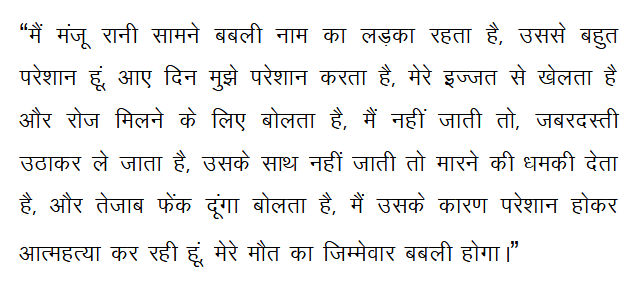
30. The main question which arises for consideration in the present appeal is whether the conduct of the appellant, as established from the evidence available on record, amounts to abetment of suicide within the meaning of Section 107 of the IPC so as to attract the offence punishable under Section 306 of the IPC. It is well settled that "instigation" involves a mental process of provoking, inciting or encouraging a person to do an act. It is not necessary that there should be an express command by the accused to the deceased to commit suicide. In Ramesh Kumar v. State of Chhattisgarh, (2001) 9 SCC 618, the Hon'ble Supreme Court has held that where the accused, by his acts or omissions or by a continued course of conduct, creates such circumstances that the deceased is left with no other option except to commit suicide, an inference of instigation may arise. At the same time, the requisite intention and a reasonable nexus between the conduct of the accused and the suicide are essential ingredients of the offence. The said principle has subsequently been reiterated in Chitresh Kumar Chopra v. State (Govt. of NCT of Delhi, (2009) 16 SCC 605. Para 19 and 20 of the judgment passed in Chitresh Kumar Chopra (supra) reads as under:-
"19. As observed in Ramesh Kumar (2001) 9 SCC 618, where the accused by his acts or by a continued course of conduct creates such circumstances that the deceased was left with no other option except to commit suicide, an "instigation" may be inferred. In other words, in order to prove that the accused abetted commission of suicide by a person, it has to be established that:
(1) the accused kept on irritating or annoying the deceased by words, deeds or wilful omission or conduct which may even be a wilful silence until the deceased reacted or pushed or forced the deceased by his deeds, words or wilful omission or conduct to make the deceased move forward more quickly in a forward direction; and
(ii) that the accused had the intention to provoke, urge or encourage the deceased to commit suicide while acting in the manner noted above. Undoubtedly, presence of mens rea is the necessary concomitant of instigation.
20. In the background of this legal position, we may advert to the case at hand. The question as to what is the cause of a suicide has no easy answers because suicidal ideation and behaviors in human beings are complex and multifaceted. Different individuals in the same situation react and behave differently because of the personal meaning they add to each event, thus accounting for individual vulnerability to suicide. Each individual's suicidability pattern depends on his inner subjective experience of mental pain, fear and loss of self-respect. Each of these factors are crucial and exacerbating contributor to an individual's vulnerability to end his own life, which may either be an attempt for self-protection or an escapism from intolerable self."
31. In the present case, the most significant piece of evidence is the suicidal note exhibit P/9, which was recovered from the purse of the deceased immediately after the incident. The signature appearing on the said suicidal note has been proved to be that of the deceased by PW-20 M.N. Pandey, the handwriting expert, upon comparison with her admitted signature contained in the bank account opening form (article A-1). The contents of the said note are also of considerable significance. The deceased has stated that the appellant was continuously harassing her, that he used to harass her every day and play with her honour, and repeatedly asked her to meet him; that on her refusal he would forcibly take her with him; and that if she did not accompany him, he threatened to kill her and to throw acid upon her. She thereafter specifically stated that she was committing suicide because of him and that the appellant would be responsible for her death. Thus, the suicidal note does not contain a vague or general allegation of harassment; rather, it records a continuous course of specific conduct and threats attributed to the appellant and expressly connects such conduct with the extreme step taken by the deceased.
32. The contents of exhibit P/9 receive material corroboration from the oral evidence on record. PW-6 Pratima Dubey, mother of the deceased, has stated that about 2-3 months prior to the incident, the deceased had informed her that the appellant used to harass her and had threatened that he would kidnap her son. She further stated that the deceased had become fed up with the harassment caused by the appellant and also narrated an incident in which the appellant had assaulted the deceased with a chair at the shop. PW-1, though declared hostile, admitted that he had disclosed to the police that the appellant was harassing his sister. PW-2 also admitted that his maternal grandmother had informed him that the appellant used to tease his mother regularly, due to which she had committed suicide. PW-8, husband of the deceased, also stated that the deceased had informed him about the appellant's continuous harassment and threats. Therefore, notwithstanding certain omissions and deviations in the testimony of some witnesses, the material part of the prosecution case regarding continuous harassment stands corroborated by the suicidal note and the evidence of the aforesaid witnesses.
33. The submission that there was no specific act of instigation immediately preceding the suicide cannot be accepted in the facts of the present case. The Hon'ble Supreme Court in M. Vijayakumar v. State of Tamil Nadu, 2024 SCC OnLine SC 238, after considering Madan Mohan Singh (supra) and Chitresh Kumar Chopra (supra), reiterated that specific abetment as contemplated under Section 107 IPC, coupled with the intention to aid, instigate or abet the deceased to commit suicide, is necessary. However, the present case is not one of mere ordinary harassment or a solitary quarrel. The evidence establishes a continuous course of conduct involving repeated harassment, threats to kill, threat of throwing acid and forcible taking of the deceased against her wishes. The Hon'ble Supreme Court has also recognized that where the accused, by his acts and continuous course of conduct, creates a situation in which the deceased perceives no other option except to commit suicide, the case may fall within the ambit of Section 306 IPC. The question of mens rea has to be examined from the actual acts and conduct of the accused and the surrounding circumstances.
34. In the totality of the circumstances, this Court is of the considered opinion that the conduct of the appellant cannot be characterized as a mere act of annoyance or an isolated instance of harassment. The deceased herself, in her suicidal note written with the incident, narrated the continuing harassment and threats and specifically held the appellant responsible for her death. The said circumstance is further supported by the oral evidence regarding the harassment suffered by her over a period of time. The proximity between such conduct and the suicide, coupled with the nature and gravity of the threats attributed to the appellant, establishes the requisite nexus and mens rea contemplated under Sections 107 and 306 of the IPC. The cumulative effect of the evidence establishes beyond reasonable doubt that the continuous conduct of the appellant had the effect of goading and driving the deceased to commit suicide.
35. The judgments relied upon by learned counsel for the appellant do not render any assistance to the appellant in the peculiar facts and circumstances of the present case. In Ramesh Kumar (supra), the Hon'ble Supreme Court considered the question of "instigation" and held that a casual remark or an act committed in a fit of anger, without any intention to provoke or incite the deceased to commit suicide, would not by itself constitute abetment. Similarly, in Chitresh Kumar Chopra (supra), the emphasis was on the existence of a clear mens rea and a reasonable nexus between the conduct of the accused and the suicide. In Amlendu Pal alias Jhantu (supra), the Hon'ble Supreme Court reiterated that mere harassment, without anything more to show that the accused intended to provoke, incite or encourage the deceased to commit suicide, would not attract Section 306 of the IPC. Likewise, in Gangula Mohan Reddy (supra), the conviction was found unsustainable in the absence of positive acts or conduct proximate to the occurrence demonstrating the requisite intention to instigate the deceased. In Madan Mohan Singh (supra) the Hon'ble Supreme Court, on the facts of that case, found that the allegations did not disclose the necessary mens rea or a proximate nexus between the alleged conduct and the suicide. The ratio of the aforesaid judgments, therefore, is that every act of harassment or every quarrel cannot automatically be treated as abetment of suicide; the prosecution must establish the requisite intention, instigation and nexus between the conduct of the accused and the suicide. In the present case, however, the evidence stands on a materially different footing. The prosecution has not relied upon a solitary quarrel, a casual remark or a general allegation of harassment. The suicidal note exhibit P/9, whose signature has been duly proved to be that of the deceased, specifically records a continuing course of harassment by the appellant, his repeated insistence upon meeting her, forcible taking of her against her wishes, threats to kill her and threats to throw acid upon her, and, significantly, the deceased herself expressly stated that she was committing suicide on account of the appellant and held him responsible for her death. This is further corroborated by the evidence of PW-6, who stated that the deceased had disclosed the appellant's harassment and threats to her about 2-3 months prior to the incident, as well as by the material admissions of PW-1 and PW-2 and the evidence of PW-8 regarding the continuous harassment. Thus, the present case is founded upon a sustained and specific course of conduct, extending over a period preceding the suicide, coupled with grave threats and a direct causal connection recorded by the deceased herself. Hence, the aforesaid authorities, being distinguishable on their facts and having been rendered in the absence of such compelling and cumulative circumstances, do not advance the case of the appellant.
36. In Ude Singh v. State of Haryana, (2019) 17 SCC 301, the Hon'ble Supreme Court has held that where the accused, by his acts and continuous course of conduct, creates such a situation as a consequence of which the deceased is left with no other option except to commit suicide, the active acts of the accused may constitute abetment of suicide. The Court further emphasized that the question whether the conduct amounts to instigation has to be determined from the facts and circumstances of each case, having regard to the intention of the accused and the proximity between his conduct and the suicide. The said principle, when applied to the facts of the present case, assumes significance in view of the continuous harassment and threats specifically attributed to the appellant and recorded by the deceased in her suicidal note.
37. Accordingly, this Court finds no perversity or illegality in the finding recorded by the learned trial Court and the conviction of the appellant for the offence punishable under Section 306 of the Indian Penal Code is liable to be maintained.
38. Consequently, the appeal filed by the appellant is dismissed. The conviction and sentence imposed upon the appellant under Section 306 of IPC is hereby affirmed.
39. The appellant is reported to be on bail. He shall be taken into custody to serve the sentence as awarded by this Court. The appellant is directed to surrender before the concerned trial Court within a period of 04 weeks from today to serve the sentence imposed upon him by this Court, failing which the trial Court shall take him into custody for execution of the sentence.
40. Let a copy of this judgment and the original records be transmitted to the trial Court concerned forthwith for necessary information and compliance.
|
| |

