| |
CDJ 2026 Kar HC 1170


|
| Court : High Court of Karnataka |
| Case No : Commercial Appeal No.175 Of 2026 |
| Judges: THE HONOURABLE CHIEF JUSTICE MR. VIBHU BAKHRU & THE HONOURABLE MRS. JUSTICE K.S. HEMALEKHA |
| Parties : Bangalore Development Authority, Rep. By Executive Engineer K.M. Niranjan, Bengaluru Versus M/s. NCC Limited, Bangalore |
| Appearing Advocates : For the Appellant: K. Arvind Kamath, Senior Advocate, M. Ajay Kumar, Advocate. For the Respondent: S. Sriranga, Senior Advocate, Sumana Naganand, N. Supriya, Advocates. |
| Date of Judgment : 30-09-2026 |
| Head Note :- |
Commercial Courts Act, 2015 - Section 13(1A) -
|
| Summary :- |
1. Statutes / Acts / Rules / Orders / Regulations / Sections Mentioned:
- Arbitration and Conciliation Act, 1996
- Section 37(1)(C) of the Arbitration and Conciliation Act, 1996
- Section 13(1A) of the Commercial Courts Act, 2015
- Commercial Courts Act, 2015
- Section 34 of the Arbitration and Conciliation Act, 1996
- Section 28(3) of the Arbitration and Conciliation Act, 1996
- Section 34(2A) of the Arbitration and Conciliation Act, 1996
- Section 37 of the Arbitration and Conciliation Act, 1996
- Section 28(1)(a) of the Arbitration and Conciliation Act, 1996
- Section 28(2) of the Arbitration and Conciliation Act, 1996
- Section 23 of the Indian Contract Act, 1872
- Sections 55 and 73 of the Indian Contract Act, 1872
- Indian Contract Act, 1872
2. Catch Words:
- Arbitration
- Section 34 (challenge to arbitral award)
- Section 37 (commercial appeal)
- Commercial Courts Act
- Contractual exclusion clause
- Loss of profit
- Overheads
- Idle plant and machinery
- Interest (deferred payment, pendente‑lite)
- Patent illegality
- Evidence of loss
- Re‑interpretation of contract
3. Summary:
The Bangalore Development Authority (BDA) appealed against a Commercial Court order that dismissed its Section 34 petition challenging an arbitral award. The award had partially allowed NCC’s claims, including amounts for idle plant, site overheads and loss of profit, despite Clause 7 of the Special Conditions expressly excluding such compensation. The Court examined precedents on contractual exclusion clauses, noting conflicting Supreme Court decisions but emphasizing that an arbitrator cannot award damages contrary to a clear contractual bar. It held that the award’s awards for claims 7, 8 and 9 violated the express exclusion and lacked evidentiary support. The Court upheld the interest award under claim 2 but set aside the award to the extent of claims 7‑9. Consequently, the Commercial Court’s judgment was partially reversed.
4. Conclusion:
Appeal Allowed |
| Judgment :- |
|
(Prayer: This Commercial Appeal is filed under Section 37(1)(C) r/W Section 13(1A) of the Commercial Courts Act, 2015, praying to call for records; allow the appeal and set aside the judgment dated 24.02.2026 in Com.A.P.No.161/2024 on the file of the LXXXII Additional City Civil & Sessions Judge, Bengaluru and consequently set aside the arbitral award dated 05.08.2024 passed by the Arbitral Tribunal of Hon'ble Chief Justice (Retd.) Manmohan Sarin.)
C.A.V. Judgment
K.S. Hemalekha, J.
1. The appellant, Bangalore Development Authority (BDA), has preferred the present appeal under Section 37 (1) (C) of the Arbitration and Conciliation Act, 1996 [A&C Act] read with Section 13 (1A) of the Commercial Courts Act, 2015, impugning the judgment dated 24.02.2026 [the impugned judgment] passed by the learned LXXXII Additional City Civil and Sessions Judge, Bengaluru [Commercial Court] in Com. A.P No. 161/2024. By the impugned judgment, the learned Commercial Court dismissed the petition filed by the BDA under Section 34 of the A&C Act and consequently declined to interfere with the arbitral award dated 05.08.2024 [the impugned award] passed by the learned Sole Arbitrator [the Arbitral Tribunal].
Brief facts
2. The BDA entrusted the respondent, (M/s. NCC) with the work of renovation and reconstruction of the "Puttanna Kanagal Theatre" and adjoining shopping complexes at 4th Block, Jayanagar, Bengaluru. Pursuant there to, the parties entered into an agreement dated 27.06.2012 (agreement) for a contract price of Rs. 252.27 crores.
3. The work comprised demolition and reconstruction of 4 blocks, namely, blocks 1 to 4. Under the contract data, possession of Block No.1 was required to be handed over within 7 days from the date of work order. Insofar as Blocks 2 to 4 were concerned, clause 8 of the contract data contemplated that they were to be handed over upon completion and rehabilitation of Block No.1.
4. The existing premises in Block Nos.2 to 4 were occupied by vendors/lessees. The arrangement contemplated under the agreement, required such occupants to be relocated to the rehabilitated Block No.1 before possession of Block Nos.2 to 4 could be made available for execution of the remaining work.
5. Clause 7 of the Special Conditions of Contract [SCC] contained provisions governing claims for compensation on account of delay in commencement or execution of the work and stipulated that the employer would not accept liability towards claims for overheads and profits, except to the extent specifically contemplated under the contract.
6. The work relating to Block No.1, which was stipulated to be completed within 8 months from the date of the notice to proceed, was completed only in December 2014/January 2015. Possession of Block No.1 was thereafter handed over to the Bruhat Bengaluru Manahanagara Palike [BBMP] on 06.01.2018. The relocation of the vendors/lessees occupying Block Nos.2 to 4 and consequential handing over the said blocks for execution of the remaining work did not take place within the time period originally contemplated. In the interregnum, proceedings were initiated before the Lokayukta concerning the relocation of the occupants, and the process of shifting the vendors and making the remaining blocks available for execution was further delayed. These circumstances ultimately resulted in disputes between the parties concerning the execution of the balance work and the financial consequences arising there from.
7. M/s NCC invoked the arbitration clause, and on 28.09.2018 commenced arbitral proceedings. The learned Arbitrator was appointed to adjudicate the disputes between the parties.
8. Before the Arbitral Tribunal, M/s. NCC raised 10 claims, aggregating to Rs. 117,29,36,970, apart from the applicable taxes under various head. The claims made by M/s. NCC and the amount claimed are extracted below in a tabular form :
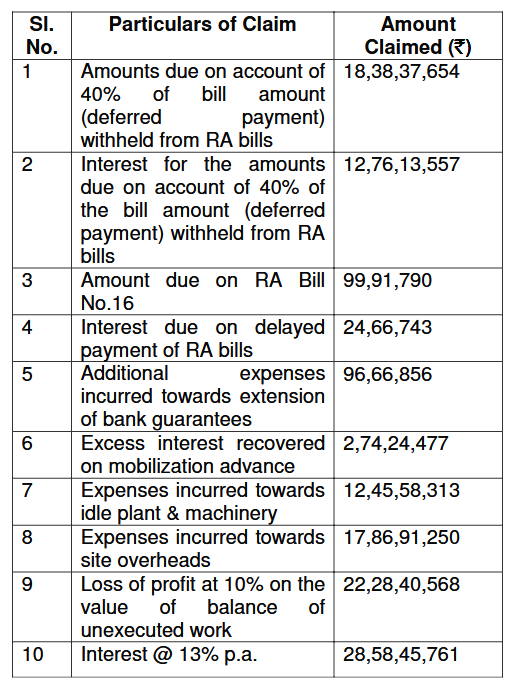
9. The Arbitral Tribunal, after completion of the arbitral proceedings, passed the arbitral award dated 05.08.2024 partly allowing the claims. The BDA being aggrieved by the said award instituted proceedings under Section 34 of the A&C Act before the Commercial Court. The said petition came to be dismissed by the judgment resulting in the present appeal. By the impugned award dated 05.08.2024, the Arbitral Tribunal partly allowed the claim Nos.1 to 4 and 7 to 9, while claim Nos.5 and 6 were rejected. In addition to claim No.1, an amount awarded under claim Nos.2, 3, 4, 7, 8 and 9 aggregated to Rs. 26,86,80,705. With respect to claim No.1, Rs. 18,38,37,654 had already been allowed pursuant to an interim award dated 16.01.2021. The Arbitral Tribunal awarded pendente lite interest on claim Nos.4, 7 and 8, future interest at 11% per annum on the amount awarded and cost of Rs. 15,00,000.
Reasons by the Arbitral Tribunal
Claim Nos.1 and 2 - Deferred payment and interest
10. As regard claim No.1, the Arbitral Tribunal noted that the claim of release of 40% of the bill amount retained as a deferred payment had already been allowed by an interim award dated 16.01.2021 and that the award had been complied with. The Arbitral Tribunal accordingly treated the principal amount as payable. In respect of claim No.2, the Arbitral Tribunal held that the deferred payment had become payable in terms of the contract and the interest was payable for the period during which the amount remained unpaid. It accordingly awarded Rs. 4,91,72,794 towards interest for the period from 01.02.2019 to 22.02.2021. Claim Nos. 3 and 4 - RA Bill No. 16 and delayed RA bills
11. In relation to claim No.3, the Arbitral Tribunal noted that the principal amount under RA Bill No. 16 had been reconciled and paid. It therefore awarded Rs. 53,059 towards interest for the period from 07.06.2022 to 24.08.2022. Under claim No.4, the Arbitral Tribunal found that there had been a delay in payment of running account bills and awarded Rs. 5,15,760 towards interest together with pendente lite interest at 11% per annum.
Claim Nos.5 and 6 - bank guarantee charges and mobilization advance
12. The Arbitral Tribunal rejected claim No.5 relating to additional expenses towards extension of the bank guarantees and claim No.6 relating to excess interest recovered on the mobilization advance. No amount was consequently awarded under these heads.
Claim No.7 - Idle plant and machinery
13. The Arbitral Tribunal considered the contractual requirement regarding the deployment of plant and machinery and the evidence produced by M/s NCC concerning the machinery maintained for execution of the work. The Arbitral Tribunal found that the commencement and progress of the works were affected by the failure to obtain an encumbrance free site, particularly on account of the continued occupation of the premises by vendors. It noted that even after completion of Block No.1, M/s. NCC was unable to proceed with Block Nos.2 to 4 because the occupants had not been shifted and the remaining site had not been made available. The Arbitral Tribunal also took note of M/s. NCC's correspondence and its efforts to continue with the work. On that basis, the Arbitral Tribunal accepted that M/s. NCC incurred expenditure towards idle plant and machinery, but restricted the amount recoverable to Rs. 61,12,080 with pendente lite interest at 11% per annum. Claim No. 8 - Site overheads
14. The Arbitral Tribunal proceeded on the basis that the prolonged delay in making the remaining site available had resulted in continuation of the project beyond the original stipulated period and consequently caused additional site overheads. It therefore partly allowed claim No.8 and awarded Rs. 78,83,437 with pendente lite interest at 11% per annum.
Claim No. 9 - loss of profit
15. The Arbitral Tribunal treated the inability to proceed with Blocks 2 to 4 as having resulted in M/s.NCC losing the opportunity to execute the balance work. The Arbitral Tribunal recorded that notwithstanding the difficulties, M/s.NCC had remained willing to proceed with the construction of Block Nos.2 to 4 and even offered to do so on basis of the proposal placed before the parties. It found that no concrete steps had been taken by the BDA after completion of Block No.1 to obtain requisite consent of the State Government and to enable M/s.NCC to proceed with the balance work. The Arbitral Tribunal consequently held that M/s.NCC was entitled to 10% loss of profit on the balance unexecuted work. Taking the value of the balance work as Rs. 204,94,35,755, it awarded Rs. 20,49,43,575 towards loss of profit.
Cost and fee
16. The Arbitral Tribunal held that M/s NCC is entitled to the legal fee amounting to Rs. 15,00,000.
Submissions
17. Sri K Arvind Kamath, learned Senior Counsel appearing for BDA, would essentially reiterate the contentions urged before the learned Commercial Court in the proceedings under Section 34 of the A&C Act. The principal submission is with regard to clause No. 7 of the SCC. It is contended that clause 7 expressly stipulates that the contractor shall not be entitled to any compensation for any loss suffered on account of delay, in commencing or executing the work, irrespective of the cause of such delay. The clause further provides that the employer would not accept liability towards any amount on account of the overheads or profits of the contractor, except to the extent specifically contemplated under the contract. According to the learned Senior Counsel, notwithstanding the express contractual prohibition, the Arbitral Tribunal proceeded to award substantial amount under claim Nos.7 to 9. Such an approach, it is submitted, amounts to rewriting the bargain between the parties and travelling beyond the terms of contract. The learned Arbitrator, being a creature of the contract could not have awarded amounts expressly excluded by the contract.
18. Reliance is placed upon the judgment of the Hon'ble Supreme Court in Oil and Natural Gas Corporation vs Wig Brothers Builders and Engineers Private Limited (2010) 13 SCC 377, to contend that where the contract contains an express bar against payment of compensation for delay, the Arbitrator cannot award such compensation contrary to the contractual stipulation, even where the delay is alleged to be attributable to the employer. It is further submitted that the reliance placed by the Arbitral Tribunal upon K.N.Sathyapalan (Dead) by LRs vs State of Kerala and Another (2007) 13 SCC 43 is misplaced. According to the learned Senior Counsel, the said decision concerned reimbursement of actual additional costs incurred by the contractor, including extra expenditure attributable to interference with the work, escalation during an extended period of completion and additional transportation costs occasioned by non-availability of the suitable dumping yard for dumping excess earth. The said decision, it is submitted as rendered in the context of specific findings regarding the actual additional expenditure incurred and did not lay down any general proposition permitting an Arbitrator to award notional loss of profit calculated at the percentage of the value of the unexecuted work.
19. It is submitted that the decision in K.N Sathyapalan (supra) followed the principles stated in P.M. Paul vs Union of India 1989 Supp (1) SCC 368 and T.P George vs State of Kerala (2001) 2 SCC 758, where the claims related to additional costs and escalation arising from identified defaults. Those decisions, according to BDA cannot be treated as an authority for awarding loss of profit in the present case. Learned Senior Counsel submits that the clause 7 of the SCC is a stand alone substantive term of the contract and is not merely a clause prescribing rates or methodology for computation. Consequently, claims 7, 8 and 9 which relate respectively to the idle plant and machinery, site overheads and loss of profit were expressly excluded by the contractual bargain. It is submitted that the Arbitral Tribunal could not have ignored the said clause and awarded compensation by resorting to general principle of damages.
20. Reliance is placed upon the judgment of the Delhi High Court in M/S Plus91 Security Solutions vs NEC Corporation India Private Ltd. (FAO(OS)(COMM) 36/2024, DD 29.07.2024) wherein it was held that a construction of the contract falls within the domain of the Arbitrator. The submission, however, is that while the Arbitral Tribunal may interpret the contract, it cannot alter, rewrite or disregard any express contractual stipulation and thereby confer upon a party an entitlement which the contract itself excludes. According to the BDA, the errors identified above go to the root of the award and constitute a patent illegality within the meaning of Section 34(2A) of the A&C Act warranting interference by this Court under Section 37.
21. Sri Sriranga S, learned Senior Counsel appearing for M/s. NCC, would support the impugned judgment of the learned Commercial Court as well as the arbitral award. It is submitted that BDA is in substance seeking a re-appreciation of the evidence and re-interpretation of the contractual provision, which is impermissible in proceedings under Sections 34 and 37 of the A&C Act. The learned Arbitrator being the chosen adjudicator of the parties, has considered the contractual provisions, the correspondence exchanged between the parties and evidence placed before him and had therefore recorded findings on each of the claims.
22. As regards clause 7 of the SCC, it is contended that the clause cannot be read in isolation or as an absolute immunity to the BDA from the consequences of its own breaches or failures. The Arbitral Tribunal was required to consider the agreement as a whole and determine whether the circumstances which prevented M/s. NCC from proceeding with the work fell within the contractual prohibition relied upon by BDA. It is submitted that the Arbitral Tribunal recorded the specific finding that M/s. NCC could not proceed with Blocks 2 to 4 because the site was not made available in the condition in which the remaining work could be executed. The continued occupation of the premises by vendors and failure to complete this rehabilitation materially affected M/s. NCC's ability to proceed with the balance work. M/s. NCC had, despite these impediments, remained willing to complete the contract and had made proposals for proceeding with the balance of construction. It is therefore contended that the Arbitral Tribunal did not rewrite the contract but merely applied its terms to the factual matrix established before him.
23. Insofar as claim Nos.7 and 8 are concerned, it is submitted that the Arbitral Tribunal had considered the prolonged detention of M/s.NCC's resources and continuation of the project beyond the stipulated period. The amounts awarded were substantially lower than the amounts claimed, demonstrating that the Arbitral Tribunal has scrutinized the claim and has not mechanically accepted M/s. NCC's computation. The Arbitral Tribunal awarded only Rs. 61,12,080 towards idle plant and machinery and Rs.78,83,437 towards site overheads along with pendente lite interests.
24. With regard to claim No.9, learned Senior Counsel would submit that the Arbitral Tribunal recorded a specific finding that M/s.NCC had remained ready and willing to execute the balance work, but that no concrete steps were taken by the BDA to enable commencement of the remaining work after completion of Block No.1. The Arbitral Tribunal consequently concluded that M/s.NCC had lost opportunity to earn profit on the balance unexecuted work and awarded 10% of the value thereof.
Reasons and conclusions
25. It is settled law that jurisdiction under Section 37 of the A&C Act is limited. The court does not sit as an appellate court over the arbitral award and is not expected to re-appreciate the evidence merely because another view is possible. At the same time, the limited scope of interference cannot mean that an award which disregards an express and binding contractual stipulation or ignores material evidence bearing directly upon the entitlement to a claim, or awards damages without any evidentiary foundation is immune from scrutiny. The Supreme Court in Ssangyong Engineering and Construction Ld. vs National Highway Authority of India (2019) 15 SCC 131 has held that an Arbitrator cannot award anything contrary to an express term of the contract and that an award, ignoring such stipulation, may constitute patent illegality.
26. In the present case, the principal difficulty with the award under claim Nos.7, 8 and 9 arises from clause 7 of the SCC. The said clause expressly stipulates that the contractor shall not be entitled to compensation for the loss. The clause reads thus :
"7. The Contractor shall not be entitled to any compensation for any loss suffered by him on account of delays, in commencing or executing the work, whatever the cause of delays may be, including delays arising out of modifications to the work entrusted to him or in any sub- contract connected therewith or delays in awarding contracts for other trades of the project or in commencement or completion of such works or in procuring Government controlled or other building materials or in obtaining water and power connections for construction purposes or for any claim in respect thereof. The Employer does not accept any liability for any sum towards loss of overheads and profits of the contractor, besides the tender amount subject to such variations as are provided for herein and subject to Certification by the Architect/Engineer for payment post work."
27. The aforesaid clause expressly stipulates that the contractor shall not be entitled to compensation for loss suffered on account of delay in commencing or executing the work, irrespective of the cause of delay, and further provides that the employer would not accept liability towards loss of overheads and profits of the contractor, except as specifically contemplated by the contract.
28. M/s NCC has sought to sustain the award notwithstanding clause 7 of the SCC by contending that an exclusion clause cannot absolve the employer from the consequences of a breach attributable to itself. In this context, it is necessary to consider the decisions concerning contractual stipulation which restrict or exclude the contractor's entitlement to compensation on account of delay. In Ramnath International Construction (P) Ltd. v. Union of India (2007) 2 SCC 453 clauses 11 (A) to (C), which governed delay in execution of the works and extension of time, fell for consideration before the Supreme Court. The Supreme Court held that where the delay is attributable to the employer (Union of India), the award of damages is barred construing the contractual stipulations. A different approach was adopted by the Supreme Court in Asian Techs Limited vs Union of India and Others (2009) 10 SCC 354. The Supreme Court construed that the clauses 11 (A) to (C) restricted the departmental authorities from entertaining a claim for compensation, but not as denuding the Arbitrator of the power to award damages otherwise recoverable on account of breach by the employer and held that the contractual stipulation did not constitute an absolute bar to the Arbitrator awarding damages.
29. The Delhi High Court in Simplex Concrete Piles (India) Limited vs Union of India 2010 SCC OnLine Del 821 while examining whether a contractual stipulation which disentitles a contractor from claiming damages otherwise recoverable under Sections 55 and 73 of the Indian Contract Act, 1872 could withstand the scrutiny under Section 23 of the Contract Act. In the said decision, the learned Judge observed that there was conflict of decisions of co-equal Benches of the Supreme Court in Ramnath (supra) and Asian Techs (supra), concerning the effect of an award of damages notwithstanding such a clause. However, in Simplex Concrete Piles there was no distinction made between a clause excluding an entire liability of contracting party and a clause excluding compensation only for a specified category of breach.
30. The Division Bench of the Delhi High Court in M/S Plus91 Security Solutions (supra) (of which one of us i.e. Hon'ble Vibhu Bakhru C. J. is a member of the Bench, is instructive on this aspect) considered an arbitral award granting loss of profit notwithstanding an express contractual provision excluding liability for loss of revenue or profit. It was held at paras 64, 65, 67 as under :
"64. It is essential to maintain the bargain entered into between the parties. The parties agreed that they would not be liable for (i) any indirect, special, or consequential loss or damage; (ii) any loss or damages due to loss of goodwill; and, (iii) loss of revenue or profit arising from or in connection with the MOU. If the MOU is accepted as a binding agreement, this is clearly a part of the bargain struck by the parties. Disregarding the said stipulation would in effect amount to re-writing the bargain between the parties.
65. This Court has some reservations as to the decision rendered by the learned Single Judge in Simplex Concrete Piles (India) Ltd. v. Union of India. However, it is not necessary to examine the same as it is not applicable to the facts in the present case. Reliance on the said decision is clearly misplaced. In that case, the Court was considering a clause, which precluded a contractor from claiming loss on account of delay in execution of the contract even though the delay in execution of the contract was for the reasons attributable to the employer. The learned Single Judge observed that there was a conflict of decision between the Supreme Court in regard to award of damages notwithstanding such a clause. The learned Single Judge noted that whereas, in the case of Ramnath International Construction (P) Ltd. v. Union of India, the Supreme Court had held that even if the employer (Union of India) is at fault, the award of damages is barred. However, in a latter decision in Asian Techs Limited v. Union of India & Ors., the Supreme Court had held in the context of a similar clause, that it only prevented the department from granting damages but did not prevent the arbitrator from awarding damages. After noting the said conflicting decision, the learned Single Judge held that the decision in the case of Asian Techs Limited v. Union of India & Ors. furthered the object of the Contract Act. However, the learned Single Judge also observed that "To permit a contractual clause having the object to defeat the very contract itself, is a matter of grave public interest. If such a clause is allowed to stand, then, the same will defeat the basis and existence of the Contract Act." For the aforesaid reasoning the learned Single Judge held that the contractual clauses such as the Clauses in question in the said case [Clause 11(A) to 11(C)] which disentitle a party to the benefits of Sections 55 and 73 of the Contract Act would be violative of Section 23 of the Contract Act.
x x x
67. It is essential to understand the contract between the parties. A clause limiting the liability is clearly a part of the contractual bargain and the same cannot be disregarded. The question whether a liability on account of breach of a contract can be limited in terms of the contract is not res integra. The decision of the Supreme Court in Asian Techs Limited. v. Union of India & Ors. rested on the interpretation of the relevant clauses. The Supreme Court had read the relevant clauses in that case as well as the facts of that case. The clause in question - which was similar to the clause considered by the Supreme Court in Ramnath International Construction (P) Ltd. v. Union of India - stipulated hat "no claim in respect of compensation or otherwise, howsoever arising, as a result of extension granted under Conditions (A) and (B) above shall be admitted." Notwithstanding the said clause, the concerned officials of the respondent had represented that separate rates would be negotiated. The Supreme Court held that on the said specific assurance held out by the respondent, the contractor was persuaded to continue the work. In the given facts, the Supreme Court held that it was not open to the respondent to now contend that no further claim could be made due to Clause 11(C) of the contract in question and the Arbitrator had no jurisdiction to entertain such claims. The Supreme Court also interpreted Clause 11 of the contract in that case to mean that it only prohibited the department from entertaining a claim and did not curtail the jurisdiction of the arbitrator. Plainly, the decision in Asian Techs Limited. v. Union of India & Ors. rested on the interpretation of the relevant clause of the contract. It is also material to note that the earlier decision in the case of Ramnath International Construction (P) Ltd. v. Union of India was not brought to the notice of the Supreme Court."
31. Further in M/S Plus91 Security Solutions (supra), the Oil and Natural Gas Corporation (supra) was referred where the Supreme Court faulted the Arbitral Tribunal for awarding compensation by ignoring the express provisions of the contract and paras 6 and 7 of the said judgment was referred which reads as under :
"6. ..........But Clause 5-A of the contract pertains to extension of time for completion of work and specifically bars any claim for damages. The said clause is extracted below:
"In the event of delay by the Engineer-in-Charge to hand over to the contractor possession of land/lands necessary for the execution of the work or to give the necessary notice to the contractor to commence work or to provide the necessary drawing or instructions or to do any act or thing which has the effect of delaying the execution of the work, then notwithstanding anything contained in the contract or alter the character thereof or entitle the contractor to any damages or compensation thereof but in all such cases the Engineer-in-Charge may grant such extension or extensions of the completion date as may be deemed fair and reasonable by the Engineer-in Charge and such decision shall be final and binding."
7. In view of the above, in the event of the work being delayed for whatsoever reason, that is, even delay which is attributable to ONGC, the contractor will only be entitled to extension of time for completion of work but will not be entitled to any compensation or damages. The arbitrator exceeded his jurisdiction in ignoring the said express bar contained in the contract and in awarding the compensation of Rs.9.5 lakhs........."
[Emphasis added]
32. The court held that the Arbitrator derives his jurisdiction from the contract and must act within the confines of the bargain struck by the parties. This principle is of direct relevance here.
33. The Supreme Court in Oil and Natural Gas Corporation (supra) while relying on Ramnath (supra) observed that where the contractual clause constituted a clear bar against any claim for compensation arising from delays in respect of which extension of time had been sought and obtained by the contractor from the employer, the contractor could not claim damages contrary to the express terms of the contract.
34. In Oil and Natural Gas Corporation (supra) it was observed at para 10 as under :
"10. In Ramnath International Construction (P) Ltd. v. Union of India [(2007) 2 SCC 453] a similar issue was considered. This Court held that Clause 11(C) of the general conditions of contract (similar to Clause 5-A under consideration in this case) was a clear bar to any claim for compensation for delays, in respect of which extensions had been sought and obtained. This Court further held that such a clause amounts to a specific consent by the contractor to accept extension of time alone in satisfaction of claims for delay and not to claim any compensation; and that in view of such a bar contained in the contract in regard to award of damages on account of delay, if an arbitrator awards compensation, he would be exceeding his jurisdiction."
35. We came across an article titled 'Commercial Law monologues : Does Section 23 of the Indian Contract Act void limitation of liability clauses?' (Pachnanda G (2026) Commercial Law Law monologues : Does Section 23 of the Indian Contract Act void limitation of liability clauses?, Bar and Bench - Indian Legal News Available at : https://www.barandbench.com/columns/commercial-law-monologues-does-section-23-of-the-indian-contract-act-1872-void-limitation-of-liability-clauses.) which emphasise the contours of limitation and exclusion of liability clauses under Indian Contract law. The article draws distinction between clauses which limit or exclude liability in respect of specified breaches and those which purport to exclude liability altogether. The said Article referred to Bharathi Knitting Company vs DHL Wordlwide Express Courier Division of Airfreight Limited (1996) 4 SCC 704, Ramnath and ONGC (supra). The author notes that the Supreme Court had in appropriate cases recognized and given effect to contractual stipulations limiting or excluding the employer's liability for specified breaches including delay.
36. In this case, the contractual provision under Clause 7 states that in respect of compensation arising on account of delay in the commencement or execution of the work, the employer shall not be liable for claims towards overheads or profits, except to the extent that such compensation is specifically contemplated elsewhere under the contract. Therefore, the clause explicitly excluded specific types of damages, such as claims for overheads and profits, while maintaining any right that may have been specifically specified in the terms of the contract.
37. The Arbitral Tribunal was undoubtedly entitled to interpret the contract. However, the power of interpretation does not extend to neutralizing an express exclusion contained in the contract. The Arbitral Tribunal was required, at the threshold to determine the applicability and effect of clause 7 before examining whether claim Nos.7, 8 and 9 could at all be awarded. An award which proceeds to grant compensation towards idle plant and machinery, site overheads and loss of profit, notwithstanding the express contractual exclusion, without first recording a sustainable finding as to why the exclusion was inapplicable, cannot be sustained merely on the ground that the Arbitral Tribunal had adopted one possible interpretation of the contract. The statutory obligation under Section 28 (3) of the A&C Act also requires the Arbitral Tribunal to take into account the terms of contract while making the award.
38. The reliance placed by the Arbitral Tribunal on K.N.Sathyapalan (supra), does not in our view advance the case of M/s NCC. The principle emerging from the said decision, as relied upon before us, concerns reimbursement of additional expenditure actually incurred and established by evidence on account of circumstances attributable to the employer. It cannot be treated as an authority for awarding notional loss of profit calculated at 10% of the value of the balance unexecuted work, particularly when the contract contains an express stipulation excluding liabilities towards overheads and profits. In the present case, the Arbitral Tribunal awarded Rs. 61,12,080/- under claim No.7 towards idle plant and machinery and Rs. 78,83,437 under claim No.8 towards site overheads. The BDA had specifically disputed the actual deployment of machinery and actual expenditure towards additional overheads. The distinction between a contractor being required under the contract to maintain certain machinery at site and the contractor actually establishing that such machinery was kept idle for the period claimed, resulting in a quantifiable loss is material. The latter required proof.
39. The same infirmity is more pronounced in claim No. 9 under which the Arbitral Tribunal awarded Rs. 20,49,43,575 towards loss of profit, calculated at 10% of the value of balance unexecuted work. The award does not disclose a satisfactory evidentiary foundation for adopting 10% as the measure of M/s NCC's alleged loss. There is also no adequate finding demonstrating the actual loss of profit suffered by M/s NCC. The Arbitral Tribunal proceeds from the fact that the balance work remained unexecuted to the conclusion that M/s NCC had thereby lost 10% profit on such work. Such an approach, in the absence of proof and in the face of the contractual exclusion contained in clause 7, cannot be sustained.
40. The fact that M/s NCC was unable to proceed with Blocks 2 to 4 may furnish the factual background to its grievance. However the existence of delay or obstruction does not, by itself create an entitlement to compensation contrary to an express contractual bar. The contract data under clause 8 further stipulates the time and sequence for possession of different blocks, providing that the first block was to be handed over within 7 days from the date of the work order, whereas Blocks 2, 3 and 4 were to be handed over on completion and rehabilitation of the first block. These are not incidental provisions. They constitute express terms of the bargain struck between the parties. If the agreement is accepted as a binding contract, as it undisputedly is, the aforesaid clauses form a clear and substantive part of the bargain. The parties, while entering into the contract, consciously agreed to the consequences of delay and in particular, agreed that the contractor would not claim compensation for the loss on account of delay and the employer could not be liable for overheads and profits. Therefore, it was required that these provisions be given effect while determining their claims.
41. An Arbitrator can certainly interpret the terms of contract. But interpretation is not synonymous with rewriting. Where the contract contains an express prohibition against a particular claim, the Arbitral Tribunal cannot create an entitlement which the parties themselves have expressly excluded. This principle is also consistent with Section 28(3) of the A&C Act, which requires the Arbitral Tribunal while deciding and making an award to take into account the terms of contract and trade usages applicable to the transaction. Thus, the question before us is not whether the Arbitral Tribunal was entitled to interpret clause 7. It undoubtedly was. The question is whether having noticed clause 7, it could nevertheless award an amount which falls squarely within the contractual exclusion. In our considered opinion, the answer must be 'no'.
42. The reliance placed upon M/s. A. T. Brij Paul Singh and Others vs State of Gujarat (1984) 4 SCC 59 does not advance the case of M/s NCC. The principle recognized in M/s A.T. Brij Paul Singh is that, in an appropriate case, a contractor may be entitled to damages towards loss of profit on the unexecuted portion of the contract, where the contract has been wrongfully terminated or contractor has otherwise been deprived of an opportunity to execute the work. The principle cannot, however, be divorced from the terms of contract governing the parties. The present case stands on a materially different footing. Here the parties have expressly agreed by clause 7 that the contractor could not be entitled to compensation for loss occasioned by delay and that the employer would not accept liability towards overheads and profits.
43. The question, therefore, is not merely whether the loss of profit can, as a matter of general contract law, constitute recoverable head of damages. The question is whether the parties had contractually excluded that entitlement. The Delhi High Court in M/s Nandi Infratech Pvt. Ltd. vs M/s. R. K. Bararia and Another (FAO (COMM) 49 of 2023 and CM No. 9287/2023), wherein one of us i.e., Hon'ble Vibhu Bakhru C. J was a member of the Bench, the court observed that A.T. Brij Paul Singh (supra) does not constitute an authority for the proposition that an express contractual bar against a claim for overheads on profits can simply be discarded. It emphasized that a contractor claiming damages must establish the loss suffered by it. A percentage built into a rate or a standard formula cannot, by itself establish that the contractor actually suffered the corresponding loss or that such percentage represents the profit which the contractor would have earned. The same principle was applied in relation to the use of the formula such as Hudson Formula. A formula cannot substitute the evidentiary foundation required for a claim for damages. The claimant must establish the factual basis for the loss and the nexus between the breach and alleged loss and held at paras 55, 56 and 57 as under :
"55. Second, an inclusive allowance of 15% on the item of rates translates to an allowance of 13.04% on the value of item rate. This can be clearly illustrated by assuming the costs of a component of extra item at 100/-, a 15% inclusive allowance would translate to an item rate of 115/-. A profit mark up of 15/- on the item rate of 115/- would translate into 13.04% ( 15/115). Thus, if it is assumed that the balance work was akin to an extra item, the same would include an allowance of 13.04% on the value of the work as mark up on account of overheads, profits and establishment expenses. Thus, the assumption that the loss of profits is 15% of the remaining value of the work is ex facie erroneous.
56. Third, all inclusive allowance of 15% includes an allowance for overheads and establishment expenses in addition to an allowance for profits. RKB's claim was confined to loss of profits alone. Thus, in any event, it would not be apposite to assume a profit margin of 15% on the basis of analysis of rates for extra items. The said analysis would inapposite as the all inclusive allowance of 15% of costs also includes establishment expenses and overheads.
57. In Edifice Developers and Projects Engineers Ltd. v. Essar Projects (India) Ltd. (supra), a Division Bench of the Bombay High Court had upheld the decision of the learned Single Judge faulting the Arbitral Tribunal in awarding the claims for overhead losses without any evidence. In the said case, the Arbitral Tribunal, following the decision in the case of AT Brij Paul Singh v State of Gujarat: AIR 1984 SC 1703 had allowed the claims for overhead losses. In the said context, the Division Bench held as under:
"10. Brij Paul Singh's case therefore does not stipulate as a doctrine of law that the formula which has been prescribed in Hudson's treatise must invariably be accepted in all cases as a measure of damages sustained on account of loss of overheads. On the other hand in the subsequent decision of the Supreme Court in McDermott International (supra), the Supreme Court has relied upon the following observations contained in the earlier decision in M.N. Gangappa v. Atmakur Nagabhushanam Setty & Co. (1973) 3 SCC 406.
"In the assessment of damages, the court must consider only strict legal obligations, and not the expectations, however reasonable, of one contractor that the other will do something that he has assumed no legal obligation to do."
11. The judgment in McDermott International (supra) considers various formulae including Hudson's Formula, Emden Formula and Eichleay Formula. As regards Hudson's Formula the Supreme Court has noted, in the following extract, that although it has received judicial support in many cases, it has been the subject matter of criticism:
"(a) Hudson Formula : In Hudson's Building and Engineering Contracts, Hudson formula is stated in the following terms:
"Contract head office overhead & contract sum period of delay" profit percentage x ----------------
----- x
contract period
In the Hudson formula, the head office overhead percentage is taken from the contract. Although the Hudson formula has received judicial support in many cases, it has been criticized principally because it adopts the head office overhead percentage from the contract as the factor for calculating the costs, and this may bear little or no relation to the actual head office costs of the contractor."
(emphasis supplied)
12. In McDermott International (supra) the Supreme Court has held that it is an accepted position that different formulae can be applied in different circumstances and the question as to whether damages should be computed by taking recourse to one or other formula, having regard to the facts and circumstances of a particular case, would fall within the domain of the Arbitrator. In the present case no other formula other than Hudson's formula has been considered in the arbitral award. In the present case the Arbitrator proceeded on the basis that it was only Hudson's Formula which was to be applied and that even though no direct evidence had been adduced on behalf of the Appellant, nonetheless the Appellant would be entitled to damages measured with reference to the aforesaid formula. This approach of the Arbitrator is manifestly in the teeth of the law laid down by the Supreme Court in McDermott International. Section 28(1)(a) requires that the Arbitral Tribunal shall decide a dispute submitted to arbitration in accordance with the substantive law for the time being in force in India. Section 28(3) requires the Arbitral Tribunal to decide in accordance with the terms of the contract and take into account the usages of the trade applicable to the transaction. The Arbitral Tribunal under Section 28(2) can act as amiable compositeur and can decide ex aequo et bono only if parties have expressly authorized it to do so. In the present case, the Learned Single Judge was correct in coming to the conclusion that the award of the Arbitrator proceeds on the manifestly misconceived notion that a contractor is entitled to claim overhead losses even in the absence of evidence on the basis of Hudson's Formula. Similarly, the Arbitral Tribunal proceeded on a misconceived premise that this formula is invariably adopted for quantification of claims for overhead losses in India. In the present case the Appellant produced no evidence in support of its claim; this has been so stated in the Award. The award of the claim is on the misconceived basis that the Hudson's Formula must be applied despite the absence of evidence. Since the fundamental basis that has permeated the award is contrary to law, the judgment of the Single Judge cannot be faulted in setting aside the arbitral award on that aspect."
44. The Division Bench of the Bombay High Court in Edifice Developers and Projects Engineers Ltd. vs Essar Projects (India) Ltd. 2013 SCC OnLine Bom 5 found fault with the Arbitral Tribunal in awarding the claims for overhead losses without any evidence.
45. In M/s N.N.Constructions vs Union of India and Others (Commercial Appeal 177 of 2026, DD 02.07.2026) similar emphasis has been laid down that loss of profit is not a presumptive entitlement and requires cogent evidence of financial injury. This principle assumes particular significance in the present case. It is held at paras 36 to 38 as under :
"36. The decision of the Supreme Court in M/s AT Brij Paul Singh (supra) is not an authority for the proposition that no evidence is required to be led to prove the measure of damages on account of loss of profits. It would be erroneous to proceed on the basis that in all cases where the arbitral tribunal or court finds that the contracts have been terminated illegally, a loss of profits quantified at 15% of the balance works would be payable as damages.
37. In M/s AT Brij Paul Singh (supra), the Supreme Court had found that the respondent had breached the contract and thus, the appellant in the said case (M/s. AT Brij Paul Singh) was entitled to claim damages on account of loss of profits. Insofar as measure of damages is concerned, the Supreme Court noted that in another proceeding relating to a similar contract between the same parties, the High Court had accepted a claim for loss of profits computed at the rate of 15% of the value of the unexecuted works. It is on the facts of that case, that the Supreme Court concluded that the appellant therein was entitled to 15% of the value of the unexecuted works as damages.
38. In Edifice Developers and Projects Engineers Limited V. Essar Projects (India) Limited, the Division Bench of the Bombay High Court considered a challenge to an arbitral award where the arbitral tribunal had relied on the decision of M/s. AT Brij Paul Singh (supra) and had awarded a claim relating to overhead losses, even though the claimant had not produced evidence to establish the same. The learned Single Judge of the Bombay High Court had set aside the arbitral award, and the said decision was challenged before the Division Bench. In the aforesaid context, the Division Bench rejected the contention that award of overhead losses could be sustained without producing evidence. In the said case, the arbitral tribunal had awarded a claim of loss of profits at the rate of 10% of the value of the remaining works. The Bombay High Court faulted the arbitral tribunal for awarding a claim for loss of profits without any evidence to support the same. We consider it apposite to set out the following extract from the said decision:
"7. Learned senior counsel appearing on behalf of the Appellant submits that in the present case the Appellant had relied upon documentary material consisting of correspondence exchanged between the parties. It was urged that if the Appellant had sought to establish the claim for overhead losses on the basis of that correspondence, it would have become necessary to lead evidence in support of the claim set out by the Appellant in its letters. However, the Appellant sought to claim a lesser amount. Hence, it was urged that the Arbitrator was justified in taking recourse to Hudson's Formula. Moreover it was sought to be urged that the reliance which was placed on the judgment of the Supreme Court in Brij Paul Singh's case by the Arbitrator cannot be faulted.
8. The arbitral award, ex facie, demonstrates that the Arbitrator proceeded on the basis that the Appellant had not produced either the basis of the account or any oral evidence to prove the overhead losses caused to or suffered by it. Despite that finding the Arbitrator held that in the construction industry a contractor becomes entitled to overhead losses on the basis of Hudson's Formula, even in the absence of direct evidence to prove such losses when resources are mobilized and delay is caused in the execution of the work not attributable to the contractor. In holding this the Arbitrator relied upon the judgment of the Supreme Court in Brij Paul Singh's case (supra).
9. The Learned Single Judge, in our view, was justified in coming to the conclusion that the Arbitrator was manifestly in error in awarding the claim for overhead losses in spite of the fact that no oral evidence was adduced on behalf of the Appellant. In Brij Paul Singh's case the Supreme Court noted that it was not disputed that where in a works contract a party entrusted with the work commits a breach of the contract, the contractor would be entitled to claim damages for loss of profit which he expected to earn by undertaking the contract. The Supreme Court, however, noted that what must be the measure of the profit and what evidence should be tendered to sustain the claim are different matters. The judgment of the Supreme Court adverts to the fact that in that case the High Court had referred to Hudson's treatise on Building and Engineering Contracts. Hudson states there that in major contracts subject to competitive tender on a national basis, the evidence given in litigation on many occasions suggests that head office overheads and profits are between 3 to 7% of the total price of cost which is added to the tender. The High Court in that case had rejected the claim of the contractor. The Supreme Court noted that in an identical contract with regard to another portion of the same road and for the same type of work the High Court had accepted loss of profit at 15% of the price of the balance of work as a reasonable measure of damages if the State is guilty of a breach of contract. It was on this basis that the Supreme Court came to the conclusion that since for the same type of work, between the same parties involving a nearby portion of the same road a certain measure of damages had been adopted by the High Court, the same measure ought to have been adopted in that case as well.
10. xx xx
11. xx xx
12. xx xx
13. The Arbitrator, as noted earlier, also awarded claims in respect of loss of profit, for under utilized plant and equipment and for reimbursement of infrastructure expenses. In respect of loss of profits, the Arbitrator merely held that a measure of 10% on the value of the remaining part of the works contract cannot be said to be unreasonable. The Arbitrator observed that a percentage representing 10% of the rate of profit is invariably accepted in the construction industry. Evidently save and except for an priori assumption, no evidence whatsoever was led before the Arbitrator in that regard. In P.R. Shah, Shares and Stock Brokers Private Limited v. B.H.H. Securities Private Limited the Supreme Court has held that while an Arbitral Tribunal cannot make use of its personal knowledge of the facts of the dispute, which is not a part of the record, the Tribunal can certainly use its expert or technical knowledge or the general knowledge about the particular trade in deciding a matter. That is why in many arbitrations, persons with technical knowledge are appointed since they may be well-versed with the practices and customs in the respective fields. The Arbitrator in the present case was not an arbitrator drawn from the trade. No basis whatsoever has been indicated in the award for accepting 10% as a measure representing loss of profits. No material was produced before the Arbitrator on the nature of the practice in the trade. During the course of the hearing no basis has been indicated to the Court from the record to suggest that any practice of that nature in the construction industry was brought to the notice of the Arbitral Tribunal. In the circumstances, the arbitral award to the extent that it allows the claim for loss of profits is based on pure conjecture and in the absence of any evidence whatsoever was correctly set aside. Similarly, in regard to the claim for underutilized plant and equipment and for reimbursement of expenses of infrastructure, it is evident that the Arbitrator has merely awarded a sum which he considered to be reasonable. No evidence whatsoever was led before the Arbitral Tribunal.""
46. When considering claim Nos. 7 and 8 relating respectively to the idle plant and machinery and site overheads, the Arbitral Tribunal awarded Rs. 61,12,080 towards idle plant and machinery and Rs. 78,83,437 towards site overheads. The BDA had specifically disputed whether machinery was actually kept idle at site during the relevant period and whether M/s NCC had actually incurred the additional overhead expenditure claimed. There is no evidence demonstrating actual expenditure and the cash expenditure and in the absence of any evidence, an award based merely upon a formula, rates or assumption cannot be sustained.
47. When considering claim No.9, the Arbitral Tribunal awarded Rs. 20,49,43,575 towards loss of profit calculated at 10% on the value of the balance unexecuted work. There is no satisfactory evidentiary foundation for calculating 10% as a measure of the NCC's loss of profit. There is neither material demonstrating that NCC's actual profit margin on this particular contract was 10% nor is there any material demonstrating that M/s NCC did suffer loss of profit to that extent as a consequence of the alleged delay. The award does not adequately address the express exclusion contained in clause 7. Thus, on two independent infirmities in claim No. 9, (i) the claim is hit by express contractual prohibition contained in clause 7 and (ii) even otherwise, the quantum of loss of profit has not been established by evidence. The reliance on M/s A.T.Brij Paul Singh (supra) cannot cure the either defect. The Edifice Developers and Projects Engineers Limited (supra) which has been relied consistently by this Court and by the different High Courts is that a formula cannot itself constitute proof of loss. Consequently, even assuming that M/s NCC was entitled in principle to claim loss of profit, it was still required to establish the factual basis and quantum of the alleged loss and applying 10% to the value of the unexecuted work by the Arbitral Tribunal is unpersuasive.
48. In so far as claim No.2 is concerned, the Arbitral Tribunal awarded interest from 01.02.2019 to 22.02.2021, after the expiry of 48 month period, as contemplated under clause 37.1 of the General Conditions of Contract. Clause 37.1 reads thus :
"37.1. The employer shall pay the contractor 60% of the bill amount within 60 days of submission of the bill certified by the engineer in charge of the work. Balance 40% of the bill amount will be released after the completion of the work up to 48 months (inclusive of defect liability period of 24 months) from the certified date of completion. Payment shall be in 16 (Sixteen) equal installments payable on quarterly basis from the date of certified completion of works."
49. BDA did not dispute this liability towards the principal deferred amount. The learned Senior Counsel appearing for the BDA placed considerable reliance on Exs.R10 and R11. Ex.R10 is the resolution dated 09.06.2017, whereby the BDA resolved to release the outstanding deferred amount subject to M/s NCC furnishing a bank guarantee for 40% of the deferred payment. Ex.R11 is a consequential communication calling upon M/s NCC to furnish the bank guarantee and collect the deferred amount. It is therefore contended that the BDA had offered to release the amount as early as in June 2017 and that M/s NCC, having failed to furnish the bank guarantee cannot claim interest for the subsequent period.
50. We are unable to accept the said contention. The liability to pay the principal amount being undisputed, the BDA cannot avoid consequences of a delayed payment. Exs.R10 and R11 by themselves do not establish either of the circumstances. We do not find any ground to interfere with the award under claim No.2 and the BDA's challenge to award interest on the deferred payment is rejected.
51. For the foregoing reasons, we are of the considered view that the BDA has made out a case, the appeal merits acceptance in part. Accordingly, the appeal is partly allowed. The judgment of the Commercial Court is set aside to the extent that it upholds the arbitral award under claim Nos.7, 8 and 9. Consequently, the arbitral award is set aside to the extent of the amount awarded under claim Nos.7, 8 and 9. The direction of future interest shall correspondingly operate only on the amounts which survive after the aforesaid severance. The award of costs is not disturbed.
52. The pending interlocutory application stands disposed of.
|
| |

