| |
CDJ 2026 Kar HC 986


|
| Court : High Court of Karnataka |
| Case No : Writ Appeal No. 1229 Of 2026 (GM-RES) |
| Judges: THE HONOURABLE CHIEF JUSTICE MR. VIBHU BAKHRU & THE HONOURABLE MRS. JUSTICE K.S. HEMALEKHA |
| Parties : A.V.L. Srinivas Versus State Of Karnataka, Represented By The Additional Chief Secretary, Bangalore & Others |
| Appearing Advocates : For the Appellant: Sameer Sharma, Advocate. For the Respondents: R1, K.S. Harish, Government Advocate, R2, B. Pramod, CGC. |
| Date of Judgment : 13-08-2026 |
| Head Note :- |
Karnataka High Court Act - Section 4 -
|
| Summary :- |
1. Statutes / Acts / Rules / Orders / Regulations, Sections Mentioned:
- Section 4 of the Karnataka High Court Act
- Karnataka Legal Metrology (Enforcement) (Amendment) Rules, 2021
- Schedule IX of the Karnataka Legal Metrology (Enforcement) Rules, 2011
- Karnataka Legal Metrology (Enforcement) Rules, 2011
- Rule 7 of the Amendment Rules
- Rule 2 of the Amendment Rules
- Rule 4 of the Amendment Rules
- Rule 8 of the Amendment Rules
- Schedule X of the Rules
- Legal Metrology Act, 2009
- Section 53 of the LM Act
- Section 23 of the LM Act
- Section 25 of the LM Act
- Section 8(3) of the LM Act
- Rule 6 of the Karnataka Legal Metrology (Enforcement) (Amendment) Rules, 2014
- Schedule I to the Rules
- Schedule VI to the Rules
- Article 14 of the Constitution of India
2. Catch Words:
- constitutional validity
- fee enhancement
- discrimination
- Article 14
- delegation of legislation
- licensing
- suspension
- cancellation
- compounding fees
3. Summary:
The appeal challenges three provisions of the Karnataka Legal Metrology (Enforcement) (Amendment) Rules, 2021 – the fee increase in Schedule IX, the insertion of a sub‑rule on licence suspension/cancellation, and the differentiated compounding fees in Schedule X. The Court held that fee increases need only a broad correlation with services, not exact cost matching, and upheld the inflation‑based rise. It found that the State’s rule‑making power under Section 53 of the LM Act validly includes provisions for licence suspension and cancellation. The classification of compounding fees based on economic capacity was deemed a reasonable distinction, not violative of Article 14. Consequently, none of the appellant’s grounds succeeded.
4. Conclusion:
Appeal Dismissed |
| Judgment :- |
|
(Prayer: This Writ Appeal is filed under Section 4 of the Karnataka High Court Act praying to set aside the order dated 04.02.2026 modified order dated 16.03.2026 passed by the Leared Single Judge in W.P.No.1529/2023 (GM-RES), only insofar as the findings rendered in respect of the following are concerned I) Qua Rule 8 (Sic Rule 7) of the Karnataka Legal Metrology (Enforcement) (Amendment) Rules, 2021 (Annexure-A - Impugned Rules), brought into force vide notification Bearing No. FCS 15 EBT 2020 (E-Office), dated 03.12.2022, by Respondent No. 1, which substitutes Schedule IX of the Karnataka Legal Metrology (Enforcement) Rules, 2011 (Annexure-B) with the New Schedule IX as contained therein & etc.)
C.A.V. Judgment
Vibhu Bakhru, CJ.
1. The appellant has filed the present intra-court appeal impugning an order dated 04.02.2026 as modified by an order dated 16.03.2026 [impugned order], passed by the learned Single Judge of this Court in W.P.No.1529/2023 (GM-RES).
2. The appellant along with respondent No.3, had filed the said petition, inter alia, challenging the constitutional validity of the Karnataka Legal Metrology (Enforcement) (Amendment) Rules, 2021, as notified on 03.12.2022 [the Amendment Rules].
3. The petitioners therein, inter alia, challenged the validity of Rule 7 of the Amendment Rules whereby Schedule IX of the Karnataka Legal Metrology (Enforcement) Rules, 2011 [the Rules] was substituted. By virtue of the said amendment, the schedule of fees payable for verification and stamping of weights and measures was enhanced. The appellant also questioned Rule 2 of the Amendment Rules, whereby a proviso was introduced in Rule 3 (1) of the Rules; Rule 4 of the Amendment Rules, whereby a new Sub- rule was introduced in Rule 3 of the Rules; and Rule 8 of the Amendment Rules whereby Schedule X of the Rules, which sets out the compounding fee payable for certain offences, was substituted.
4. The appellant's challenge to substitution of Schedule X of the Rules was on the basis that different compounding fees has been stipulated in respect of different persons for the same offence. The appellant claimed that the same is violative of Article 14 of the Constitution of India. The learned Additional Advocate General appearing for the State before the learned Single Judge stated that the classification is made considering the economic strata of the persons or the offenders. He further stated that the said Schedule would be reviewed by the department concerned and that an appropriate notification/clarification would be issued. In view of the said statement made by the learned AAG, the learned Single Judge did not pass any orders on the said challenge.
5. At the outset, the learned counsel appearing for the appellant submitted that the challenge in the present appeal is confined to three grounds. First, that Rule 7 of the Amendment Rules, which substitutes Schedule IX of the Rules, is invalid as it substantially increases the fees for stamping and verification without any corresponding enhancement in the nature and quality of the service rendered by the concerned authorities. It is contended that the charges specified in Schedule IX are in the nature of a fee and therefore there could be no enhancement in the fees without the respondents demonstrating a link or a nexus between enhancement and the services.
6. Second, he submitted that Rule 4 of the Amendment Rules inserts a new Sub-rule (13) in Rule 3 of the Rules, which provides for suspension and cancellation of licences. He contended that the Rules being delegated legislation could not provide for cancellation of licences. He submitted that the said Sub-rule travels beyond the rule-making power conferred by the Legal Metrology Act, 2009 [the LM Act].
7. Third, he submitted that Rule 8 of the Amendment Rules, which substituted Schedule X of the Rules is invalid as violative of Article 14 of the Constitution of India. He submitted that the said schedule provides for different compounding fees for the same offence in respect of different persons. Thus, the said Rule suffers from vice of discrimination and arbitrariness. He submitted that the learned Single Judge accepted the said contention, but no orders were passed in view of the statement made by the learned AAG that further notification would be issued.
REASONS AND CONCLUSION
Re. Challenge to Schedule IX of the Rules
8. The learned counsel appearing for the appellant referred to the decision of the Supreme Court in A.P. Paper Mills Limited v. Government of A.P. and another (2000) 8 SCC 167 and the decision of the Calcutta High Court in Allied Resins & Chemicals Ltd. and another v. Deputy Secretary, Government of West Bengal, Department of Excise and others 2010 SCC Online Cal 619. On the strength of the said decisions, he submitted that the enhancement of fee for stamping and verification would be invalid unless the respondents could establish that enhancement in fee is commensurate with an enhanced level of service.
9. It is relevant to note that Schedule IX of the Rules was substituted by virtue of Rule 6 of the Karnataka Legal Metrology (Enforcement) (Amendment) Rules, 2014, notified on 23.01.2016. The said schedule sets out the fee payable for verification and stamping of weights and measures including weighing and measuring instruments. There was no increase in the specified fees till the notification of the Amendment Rules. In the aforesaid background, the respondent No.1/State filed its statement of objections, inter alia, stating that the increase is on account of inflation and does not impose any undue economic burden on the traders.
10. It is the appellant's case that in certain cases, the fees have been increased almost twice the amount. Illustratively, the counsel referred to the verification charges for a measure of 10 kgs for bullion weights from Rs.50 to Rs.100. It is contended that the enhancement is liable to be set aside on the ground that there is no corresponding enhancement in the services rendered by the respondents. We find little merit in the contentions advanced by the learned counsel appearing for the appellant.
11. There is no cavil that the charges specified in Schedule IX of the Rules are in the nature of a fee. However, it is erroneous to suggest that there could be no increase in the fees without the respondents establishing an enhanced level of service corresponding to the increase in fees.
12. The learned counsel appearing for the appellant also earnestly contended that the fee could not be enhanced or increased on the ground of inflation, unless the respondents had produced material to establish the same. He strongly relied on the decision of the Calcutta High Court in Allied Resins (supra) in support of his contention.
13. Concededly, the charges in question are not regulatory fees. They are in the nature of compensatory fees. Indisputably, there is an element of quid pro quo insofar as the said fees are concerned. However, it is not necessary that there has to be any mathematical accuracy in the fee charged and the cost of services rendered to the person paying the fees. There has to be an overall broad correlation between the services rendered generally and the fees charged. In the given context, the contention that the fees cannot be increased on account of inflationary pressures, is plainly erroneous. We may also note that the increase in the fees is not to the extent that would lead this Court to conclude that the same are ex-facie arbitrary or unreasonable. Illustratively, a fee of Rs.100 for certifying a 10 kg weight for bullion is not exorbitant so as to justify a challenge on the ground of arbitrariness.
14. In the case of Allied Resins (supra), the Court was concerned with the pass fee for methyl alcohol, which was increased 15 fold. In that context, the Court found merit in the contention that the increase was arbitrary and disproportionate to the nature of service. The Court had also noted that the State is only required to establish a correlation between the rate of fees and the quantum of expenditure and it is not to provide any precise calculation.
15. We may also note that the facts in the present case are materially different. In the present case the fees in respect of several of the weights and measures in question has been increased by about 100% over the fees that was fixed by the Karnataka Legal Metrology (Enforcement) (Amendment) Rules, 2014, which were published on 23.01.2016.
16. We also consider it apposite to refer to the decision of the Supreme Court in Municipal Corporation of Delhi v. Md. Yasin (1983) 3 SCC 229. The following observations made by the Supreme Court are instructive:
"What do we learn from these precedents? We learn that there is no generic difference between a tax and a fee, though broadly a tax is a compulsory exaction as part of a common burden, without promise of any special advantages to classes of taxpayers whereas a fee is a payment for services rendered, benefit provided or privilege conferred. Compulsion is not the hallmark of the distinction between a tax and a fee. That the money collected does not go into a separate fund but goes into the consolidated fund does not also necessarily make a levy a tax. Though a fee must have relation to the services rendered, or the advantages conferred, such relation need not be direct, a mere causal relation may be enough. Further, neither the incidence of the fee nor the service rendered need be uniform. That others besides those paying the fees are also benefited does not detract from the character of the fee. In fact the special benefit or advantage to the payers of the fees may even be secondary as compared with the primary motive of regulation in the public interest. Nor is the court to assume the role of a cost accountant. It is neither necessary nor expedient to weigh too meticulously the cost of the services rendered etc. against the amount of fees collected so as to evenly balance the two. A broad correlationship is all that is necessary. Quid pro quo in the strict sense is not the one and only true index of a fee; nor is it necessarily absent in a tax."
17. In view of the above, we find no merit in the appellant's challenge to the amendment to Schedule IX of the Rules.
Re. Challenge to Rule 4 of the Amendment Rules
18. By virtue of Rule 4 of the Amendment Rules, Sub-rule (13) has been inserted in Rule 3 of the Rules.
19. Rule 3 provides for licensing of manufacturers, repairers and dealers of weights and measures. Sub-rule (1) of Rule 3 provides that a person who requires a manufacturer's licence or a repairer's licence or a dealer's licence in weights and measures shall make an application for issue of a licence to the Controller of Legal Metrology or such officer as may be authorised by him, in the form as set out in Schedule I to the Rules.
20. The Rules also provide for the fees to be paid for obtaining a licence. Under Sub-rule (8) of Rule 3, every repairer licenced under the LM Act and the Rules is required to furnish a security deposit in terms of Schedule VI to the Rules.
21. Sub-rule (13) of Rule 3 of the Rules as introduced by the Amendment Rules, sets out the provisions for suspension and cancellation of licences granted. The said Sub-rule (13) is set out below.
"4. In rule 3 of the said rules after the sub rule 12 a new sub-rule 13 shall be inserted as follows; Suspension and cancellation of licence granted:
(1) The Controller or such other officer authorized by him on his behalf may, if he has any reasonable cause to believe that the holder of any licence issued, renewed or continued under this Act has made any statement in, or in relation to, any application for the issue, renewal or continuance of the licence, which is - incorrect of false in any material particular or has contravened any provision of the Act or any rule or order made thereunder, suspend such licence, pending the completion of any inquiry against the holder of such licence:
PROVIDED that no such licence shall be suspended unless the holder thereof has been given a reasonable opportunity of showing cause against the proposed action:
PROVIDED FURTHER that where the inquiry referred to in this sub-section is not completed within a period of three months from the date of suspension of a licence, such suspension shall, on the expiry of the period aforesaid, stand vacated.
(2) The Controller or such other officer authorized by him on behalf may, if he is satisfied, after making such enquiry as he may think fit, that the holder of a licence has made a false or incorrect statement of the nature referred to in sub- rule (1), or has contravened any law or order referred to in that sub-section, cancel such licence;
PROVIDED that no such licence shall be cancelled unless the holder thereof has been given a reasonable opportunity of showing cause against the proposed action.
(3) Every person whose licence has been suspended shall, immediately after such suspension, stop functioning as such licencee and shall not resume business as such licencee until the order of such suspension has been, or stands, vacated.
(4) Every licencee whose licencee has been suspended or cancelled shall, after such suspension or cancellation, as the case may be, surrender such licence to the authority by which such licence was issued.
(5) Every licencee whose licence has been cancelled shall, within a period of thirty days from the date of such cancellation, or within such further period, not exceeding three months from such date, as the Controller or such other officer authorized by him on behalf may, on sufficient cause being shown, allow, dispose of the weights or measures which were in his possession, custody or control on the date of such cancellation and in the event of his failure to do so, the Controller or any other officer authorized by him, in writing, in this behalf, may seize and dispose of the same and distribute the proceeds thereof in such manner as may be prescribed."
22. As noted above, according to the appellant, Sub-rule (13) is beyond the legislative powers delegated to the State Government. In this regard, it is relevant to refer to Section 53 of the LM Act which sets out the power of the State Government to make Rules. The said Section is set out below:
"53. Power of State Government to make rules.--(1) The State Government may, by notification, and after consultation with the Central Government, make rules to carry out the provisions of this Act.
(2) In particular and without prejudice to the generality of the foregoing power, such rules may provide for all or any of the following matters, namely:--
(a) the time within which the weight or measure may be got verified under proviso to sub-section (1) of section 16;
(b) registers and records to be maintained by persons referred to under sub-section (1) of section 17;
(c) the form, manner, conditions, period, area of jurisdiction and fees for issuance of licence under sub-section (2) of section 23;
(d) fee for verification and stamping of any weight or measure under sub-section (1) of section 24;
(e) manner of notifying Government approved Test Centre, terms and conditions and fee to be paid under sub-section (3) of section 24;
(f) fee for compounding of offences under sub-section (1) of section 48.
(3) In making any rule under this section, the State Government may provide that a breach thereof shall be punishable with fine which may extend to five thousand rupees.
(4) The power to make rules under this section shall be subject to the condition of the rules being made after previous publication in Official Gazette.
(5) Every rule made under this section shall, as soon as may be after it is made, be laid before each House of State Legislature, where there are two Houses and where there is one House of State Legislature, before that House."
23. Clause (c) of Sub-section (2) of Section 53 of the LM Act expressly empowers the State Government to frame rules regarding the form, manner, conditions, period, area of jurisdiction and fees for issuance of licence under Sub-section (2) of Section 23 of the LM Act. The power to prescribe, by rules, the conditions subject to which a licence may be granted, necessarily subsumes within it the power to prescribe the consequence of a breach of these conditions, including the power to make rules for the suspension and cancellation of such licence.
24. It is also relevant to refer to Sub-section (3) of Section 53 of the LM Act, which expressly provides that in making any rule under that Section, the State Government may provide that a breach thereof shall be punishable with fine, which may extend to Rs.5,000/-. Therefore, the rule-making power also includes the power to levy a fine/penal consequences for breach.
25. We may also note that the matter as set out in Sub-section (2) of Section 53 is without prejudice to the generality of the power to make rules to carry out the provisions of this Act.
26. Section 23 of the LM Act prohibits any person from manufacturing, repairing, selling, offering, exposing, or possessing for repair or sale any weights or measures unless he holds a licence issued by the Controller. Under Sub-section (2) of Section 23, the Controller has been conferred the power to issue a licence in such form and manner, on such conditions, for such period and such area of jurisdiction and on payment of such fee as may be prescribed. In this context, the power to grant licence would also include a power to cancel the same in the event any conditions are breached.
27. In the given facts, we are unable to accept that Sub-rule(13) of Rule 3 of the Rules is beyond the scope of the rule-making power delegated to the State Government under the LM Act.
Re. Challenge to Schedule X of the Rules
28. Schedule X of the Rules prescribes the compounding fees payable for certain offences. Schedule X does draw a distinction between classes of persons liable to pay compounding fees insofar as the quantum of such fees is concerned.
29. Chapter-V of the LM Act contains provisions regarding offences and penalty. Illustratively, Section 25 of the LM Act provides for penalty for use of non-standard weights and measures. And Section 8(3) of the LM Act provides that no weight, measure or numeral other than the standard weight, measure or numeral shall be used as a standard weight, measure or numeral.
30. Entry (1) in Schedule X of the Rules sets out the compounding fees in respect of the penalty under Section 25 of the LM Act in the context of Section 8(3) of the LM Act. For the purpose of addressing the challenge to Schedule X, we may set out the first entry, which specifies different compounding fees for the different classes of persons in respect of the penalty under Section 25 of the LM Act.
"SCHEDULE-X
[see rule 7]
Compounding fees for various offences
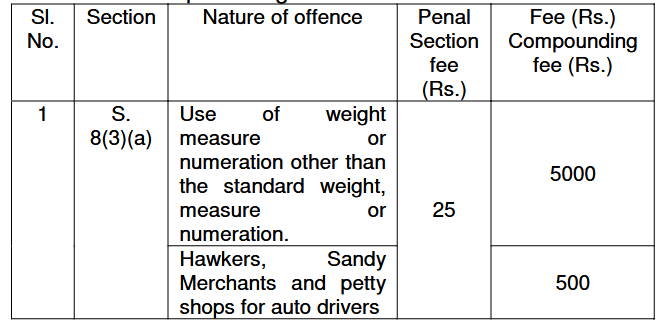
31. As is apparent from the above, different compounding fees are payable in respect of the offences covered under Sections 8(3) read with Section 25 of the LM Act. For hawkers, sandy merchants and petty shops for auto drivers, a compounding fee of Rs.500/- is provided. But for other persons, the compounding fees has been specified at Rs.5,000/-. Although a different compounding fee is prescribed for the same offence, we are unable to accept that the same falls foul of Article 14 of the Constitution of India. It is well settled that a reasonable classification does not offend Article 14 of the Constitution of India if it is founded on intelligible differentia and bears a rational nexus with the object sought to be achieved. The provisions for compounding in the context of offences under the LM Act set out a statutory mechanism of providing the offender an opportunity to settle the dispute to avoid the rigours of prosecution and penalty. Given the said object, the scheme of providing different compounding fees for different classes of persons depending on their capacity has a nexus with fixing a reasonable settlement amount.
32. A hawker or a petty shop owner may feel the pinch of parting with Rs.500/- significantly more than a more affluent trader would on parting with a sum of Rs.5,000/-. Thus, providing a lesser compounding fee of Rs.500/- for hawkers and petty shopkeepers cannot be considered discriminatory.
33. In the aforesaid view, the prescription of different amounts of compounding fees for persons belonging to different classes, cannot be held to be violative of Article 14 of the Constitution of India.
34. In view of the above, we find no merit in the present appeal. The same is, accordingly, dismissed.
|
| |

