| |
CDJ 2026 Kar HC 833


|
| Court : High Court of Karnataka |
| Case No : Writ Petition No. 17588 Of 2024 (GM-RES) c/w Writ Appeal No. 200260 Of 2025 (GM-RES) |
| Judges: THE HONOURABLE CHIEF JUSTICE MR. VIBHU BAKHRU & THE HONOURABLE MR. JUSTICE C.M. POONACHA |
| Parties : Narayanamma & Another Versus The State Of Karnataka, Through Its Principal Secretary Department Of Parliamentary Affairs & Legislation, Bangalore |
| Appearing Advocates : For the Petitioners: K.N. Phanindra, Senior Advocate, Vivek Reddy, Senior Advocate, D.R. Ravishankar, Senior Advocate, Rohith R. Kumar, Advocate, Ameetkumar Deshpande, Senior Advocate, Ameet J. Hatti., Advocate. For the Respondent: Kiran V. Ron, AAG, Niloufer Akbar, AGA. |
| Date of Judgment : 08-07-2026 |
| Head Note :- |
Karnataka High Court (Amendment) Act, 2023 -
|
| Summary :- |
Statutes / Acts / Rules / Orders Mentioned:
- Karnataka High Court (Amendment) Act, 2023
- Karnataka Civil Courts (Amendment) Act, 2023
- Karnataka Civil Courts Act, 1964 (Karnataka Act 21 of 1964)
- Karnataka High Court Act, 1961
- Section 4 of the Civil Courts Amendment Act
- Section 13 of the 1964 Act
- Section 5 of the 1964 Act
- Sections 17 and 19 of the 1964 Act
- Sections 2 and 5 of the Principal Act (The Karnataka High Court Act, 1961)
- Section 4 of the High Court Amendment Act
- Karnataka Act No. 33 of 2024
- Karnataka Act No. 32 of 2024
- Section 6 of the Karnataka General Clauses Act, 1899
- Section 5 of Act 26 of 2007
- Articles 226 and 227 of the Constitution of India
- Article 14 of the Constitution of India
- Article 21 of the Constitution of India
- Article 19(1) of the Constitution of India
- Part III of the Constitution of India
- Order dated 24.06.2024 (under Section 4 of the Civil Courts Amendment Act)
- Order dated 03.07.2024 (interim stay)
- Order dated 19.11.2025 (referencing the coordinate bench)
- Order dated 24.09.2025 (impugned order)
Catch Words:
retrospectivity, arbitrariness, consultation, jurisdiction, discrimination, forum of appeal, reading down, vested right, procedural law, substantive right
Summary:
The Karnataka High Court examined the constitutional validity of the Karnataka Civil Courts (Amendment) Act, 2023 and the Karnataka High Court (Amendment) Act, 2023, which sought to transfer regular first appeals from the High Court to district courts and to redefine “first appeal.” The Court held that the State Legislature had competence to enact the statutes and that lack of prior consultation with the High Court did not render them void. It affirmed that the amendments are substantive but, owing to their explicit retrospective language, they would apply to pending appeals unless read down. Employing purposive interpretation and the doctrine of reading down, the Court limited the retrospective operation to pending matters, saved judgments rendered before the amendment, and upheld the remaining provisions. Consequently, the retrospective effect of Section 4 of the Civil Courts Amendment Act was set aside, while the rest of the amendments were confirmed, and pending appeals were ordered transferred to the appropriate district courts.
Conclusion:
Appeal Allowed |
| Judgment :- |
|
(Prayer: This Writ Petition is filed under Articles 226 and 227 of the Constitution of India praying to declare the notification issued by the Government Of Karnataka dtd. 19.06.2024 for implementation of the Karnataka High Court (Amendment) Act, 2023 published in the Part IVA of Karnataka Special State gazette dtd. 19.06.2024 at No. 292 and notified at No.Dpal 46 Shasana 2023, Bengaluru dtd 19.06.2023 vide Annexure-A as unconstitutional and Ultra Vires to Article 14 & etc.
This Writ Appeal is filed under Section 4 of the Karnataka High Court Act praying to allow present appeal and modify the final order dated: 24.09.2025 passed by the Learned Single Judge of High Court of Karnataka, Kalaburagi Bench, in W.P.No 201536/2024 (GM-RES) to the extent of holding the impugned amendment I.E the Karnataka Civil Courts (Amendment) Act, 2023 (Act No.33 of 2024) and the Karnataka High Court (Amendment) Act, 2023 (Act No. 32 Of 2024) published in Part IVA of Karnataka State Special Gazette dated 19th June 2024 at No. 291 and No.292 respectively are Ultra-Virus the Constitution of India and consequently are void and ineffective.)
C.A.V. Judgment
Vibhu Bakhru, CJ.
INDEX
PREFATORY FACTS ................................................................... 4
THE IMPUGNED LEGISLATIONS.................................................... 7
SUBMISSIONS: ...........................................................................11
I. ON BEHALF OF THE APPELLANTS AND THE PETITIONER .......................11
II. ON BEHALF OF THE RESPONDENT-STATE.......................................20
REASONS AND CONCLUSION ..........................................................23
I. RE: SCOPE OF JUDICIAL REVIEW AND LEGISLATIVE COMPETENCE..........23
II. RE: LACK OF CONSULTATION............................................................29
III. RATIONALE FOR ENACTING THE IMPUGNED LEGISLATION .....................30
IV. LEGISLATIVE WISDOM NOT AMENABLE TO JUDICIAL REVIEW..................34
V. RE: RETROSPECTIVITY............................................38
VI. FORUM OF APPEAL - A MATTER OF PROCEDURAL LAW ...............................40
VII. EXPRESS RETROSPECTIVE OPERATION - SECTION 4 OF THE CIVIL COURTS AMENDMENT ACT...........................................................48
VIII. RULE OF PURPOSIVE INTERPRETATION ....................................................49
IX. RETROSPECTIVE OPERATION OF SECTION 4 EXCLUDES PRIOR PROCEEDINGS 66
X. RE: DOCTRINE OF READING DOWN..........................................77
XI. RE: DISCRIMINATION .......................................................85
XII. RE: ORDER DATED 24.06.2024 ......................................86
CONCLUSION ..................................................................86
*************
1. The Appellants have filed the present appeal (W.A.No.200260/2025) impugning the judgment dated 24.09.2025 ['impugned order'] passed by the learned Single Judge of this Court in W.P.No.201536/2024 (GM-RES). Appellant No.2 is similarly aggrieved. His appeal, RFA No.200009/2025, arising from the judgment and decree dated 27.09.2024 passed by the learned Senior Civil Judge & JMFC, Sedam in O.S.No.49/2018, is stated to be pending before the Kalaburagi Bench of this Court. He was impleaded in the present appeal by an order dated 30.10.2025.
2. The Appellants and Writ Petitioner have filed their respective appeal and petition, inter alia, praying that the Karnataka Civil Courts (Amendment) Act, 2023 ['Civil Courts Amendment Act'] and the Karnataka High Court (Amendment) Act, 2023 ['High Court Amendment Act'] be declared as ultra vires the Constitution of India. The Civil Courts Amendment Act and the High Court Amendment Act are collectively referred to as 'the impugned legislations'.
PREFATORY FACTS
3. The Appellant No.1's writ petition, W.P.No.201536/2024, was filed in the context of the Appellant No.1 being relegated to agitate his appeal before the competent District Court. The Appellant No.1 had filed a suit, being O.S.No.98/2016, before the II Additional Senior Civil Judge, Raichur, which was dismissed by a judgment and decree dated 23.04.2021 passed by the II Additional Senior Civil Judge & JMFC, Raichur. Appellant No.1 preferred an appeal against the said judgment and decree (which was numbered as RFA No.200060/2021). The Defendants in the suit had also filed a cross-appeal (numbered as RFA CROB. No.200005/2022). These appeals were pending before the Kalaburagi Bench of this Court when the impugned legislations were published on 19.06.2024 resulting in Appellant No.1 filing W.P.No.201536/2024 on 22.06.2024 before a Single Judge of this Court.
4. The Civil Courts Amendment Act and the High Court Amendment Act were published in the Karnataka Gazette (Extraordinary) on 19.06.2024. By virtue of the said amendments, the appeals pending before the High Court (RFA No.200060/2021 and RFA CROB. No.200005/2022) would be transferred to the competent District Court.
5. By the impugned order, the learned Single Judge partly allowed the said petition. Whilst the learned Single Judge upheld the constitutional validity of the impugned legislations, the retrospective effect given to the amendments to the Karnataka Civil Courts Act, 1964 ['the 1964 Act'] with effect from 28.08.2007 was set aside and the said amendments were held to operate prospectively. The learned Single Judge further held that the judgments rendered under the unamended provisions would remain valid and the impugned legislations would not affect such proceedings that were already concluded. However, the pending Regular First Appeals were directed to be transferred to the competent appellate courts in accordance with the impugned legislations.
6. The Writ Petitioner in W.P.No.17588/2024 (GM-RES) also seeks to impugn the impugned legislations as being ultra vires Article 14 of the Constitution of India. It is relevant to note that by an order dated 03.07.2024 passed in W.P.No.17588/2024, the operation and implementation of the impugned legislations was stayed.
7. The controversy in W.P.No.17588/2024 (GM-RES), is covered by the judgment dated 24.09.2025, which is impugned in W.A.No.200260/2025. However, another learned Single Judge of this Court, by an order dated 19.11.2025, while examining the challenge in W.P.No.17588/2024, expressed reservations as to the correctness of the Co-ordinate Bench's decision in W.P.No.201536/2024, formulated points for reference to a Larger Bench and referred the matter for posting before a Larger Bench. Accordingly, the said writ petition came to be tagged along with W.A.No.200260/2025.
THE IMPUGNED LEGISLATIONS
8. A tabular statement setting out Sections 17 and 19 of the 1964 Act, as they stood prior to the amendment, and the corresponding amendments introduced by the Civil Courts Amendment Act, is set out below:
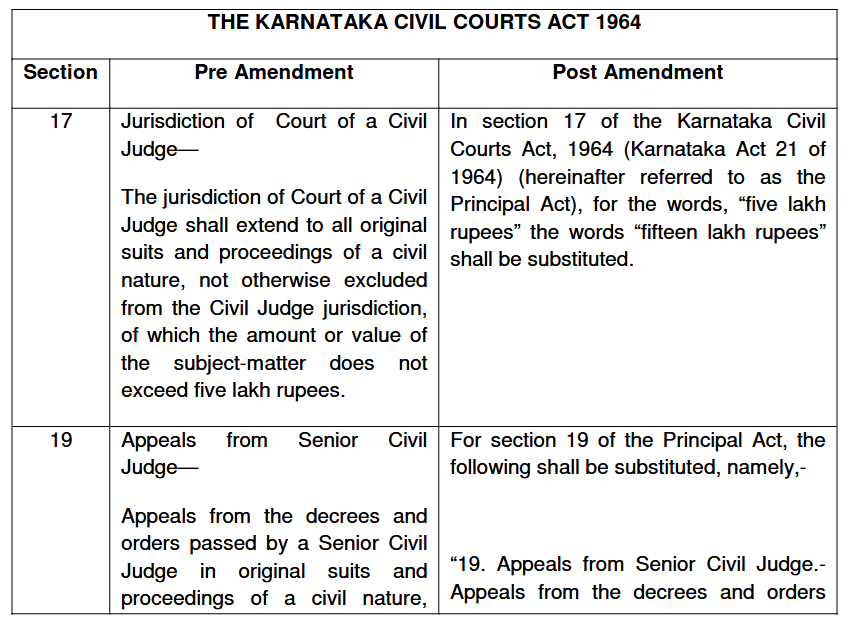
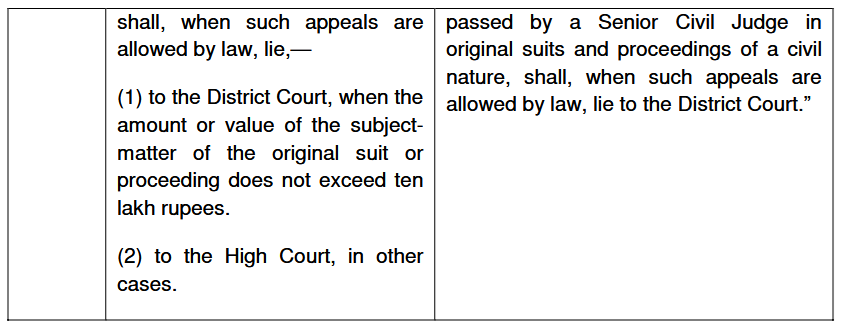
9. It is also relevant to refer to Section 4 of the Civil Courts Amendment Act, which reads as under:
4. Power to remove difficulty. All amendments made to the Karnataka Civil Courts Act, 1964 (Karnataka Act 21 of 1964), by this amendment Act shall come into force retrospectively with effect from 28.08.2007. If any difficulty arises in giving effect to the provisions of the Karnataka Civil Courts Act, 1964, as amended by this Act, the State Government may, as occasion arises, by an order published in the Official Gazette, do anything, not inconsistent with the provisions of the Karnataka Civil Courts Act, 1964 amended by this Act, which appears to it to be necessary or expedient for the purpose of removing the difficulty:
Provided that, no such order shall be made after the expiry of a period of two years from the date of commencement of this Act."
10. By virtue of the Karnataka High Court (Amendment) Act, 2023, Sections 2 and 5 of the Principal Act (The Karnataka High Court Act, 1961) ['the 1961 Act'] were amended. The said sections, as they stood prior to and post amendment, are set out in the following tabular statement:
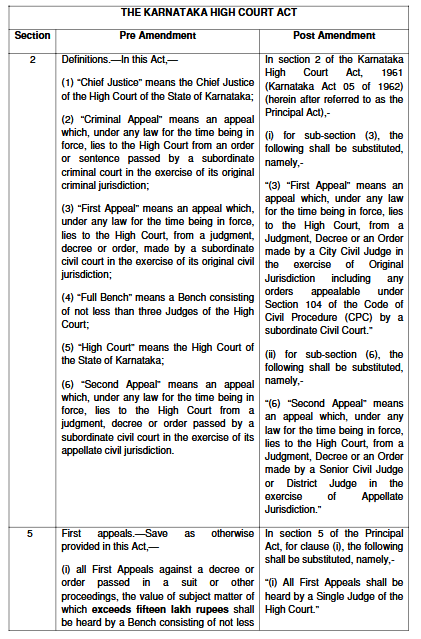
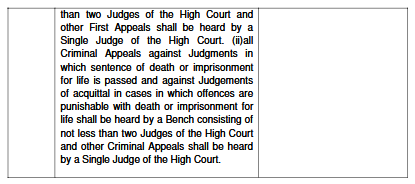
11. It is also relevant to refer to Section 4 of the High Court Amendment Act. The same is reproduced below:
"4. Power to Remove Difficulty.- If any difficulty arises in giving effect to the provisions of the Karnataka High Court Act, 1961, as amended by this Act, the State Government may, as occasion arises, by an order published in the Official Gazette, do anything, not inconsistent with the provisions of the Karnataka High Court Act, 1961, amended by this Act, which appears to it to be necessary or expedient for the purpose of removing the difficulty:
Provided that, no such order shall be made after the expiry of a period of two years from the date of commencement of this Act."
12. The effect of the amendments to the 1964 Act has been summarised in the impugned order as under:
"i. All appeals from the decrees and orders of Senior Civil Judges will now lie to District Court without any pecuniary limits.
ii. This removes the earlier distinction where appeal from suits valued above Rs.10,00,000/- had to be filed in the High Court.
iii. The amendment is given retrospective effect from 28.08.2007."
13. The import of the amendments to the 1961 Act is has been observed by the impugned order as under:
"i. First Appeal to the High Court will now mean only those appeals arising from the judgment and decree passed by City Civil Judges and excludes the judgment and decree passed from Senior Civil Judges in Districts.
ii. All First Appeals to High Court shall now be heard by a Single Judge, irrespective of the pecuniary limits."
14. It is in the aforesaid background that we have heard the learned counsel for the parties.
SUBMISSIONS:
I. On behalf of the Appellants and the Petitioner
15. Mr. K.N. Phanindra, learned Senior Counsel and Mr. Vivek Reddy, learned Senior Counsel, advanced arguments on behalf of the writ Petitioner while Mr. Ameetkumar Deshpande, learned Senior Counsel, advanced arguments on behalf of the Appellants. They contended that the impugned legislations violate Article 14 of the Constitution of India as they are manifestly arbitrary. It is also contended that the impugned amendment to the 1964 Act is manifestly arbitrary as it divests the High Court of its jurisdiction to entertain Regular First Appeals and confers the same on the competent District Courts with retrospective effect. They pointed out that the impugned legislations do not have any saving clause and therefore, the import of the said enactments would render all the Regular First Appeals decided by the High Court from 28.08.2007 as without jurisdiction. They state that this rendered the impugned legislations manifestly arbitrary and therefore, the same are liable to be set aside.
16. It is also contended that although the State Government had issued an order dated 24.06.2024 purportedly in exercise of powers under Section 4 of the Civil Courts Amendment Act, clarifying that the amended provisions would be operative prospectively with effect from 19.06.2024, the same was without jurisdiction as the State Government has no power to amend a legislative enactment by any executive or administrative order.
17. Next, they contended that the impugned enactments would not address the issue of expeditious disposal of Regular First Appeals pending before this Court. The only effect would be to overburden the District Judiciary (Karnataka Higher Judicial Service). It was further submitted that the impugned legislations were made without any consultation with the High Court on the administrative side and, therefore, the impugned legislations are liable to be set aside.
18. The learned Counsel referred to Section 13 of the 1964 Act, which requires the State Government to consult the High Court for any change in the local limits of jurisdiction of any District Court or a Court of any Civil Judge. It is contended that similar consultation would also be required for changing the appellate jurisdiction or for varying the pecuniary jurisdiction of the Courts. They also submitted that the failure to engage in prior consultation strikes at the foundation of constitutional governance and, therefore, the impugned legislations must be struck down as violative of the Constitution of India.
19. Mr. Vivek Reddy, learned Senior Counsel appearing for the writ Petitioner, contended that the right of an appeal is vested with the parties on the institution of the suit or, if not, on the date of filing the appeal. He referred to the decision of the Supreme Court in Shyam Sunder and Others v. Ram Kumar and Another ((2001) 8 SCC 24) in support of his contention that an appeal is the continuation of the suit and that any statutory amendment that amends substantive rights during the pendency of the suit would not affect the vested rights of the parties. He referred to the decision of the Supreme Court in Neena Aneja and Another v. Jai Prakash Associates Limited (2022) 2 SCC 161 and submitted that the change in jurisdiction during the pendency of the proceedings would not affect the pending proceedings. He also referred to the decision of the Supreme Court in National Agricultural Co-operative Marketing Federation of India and Another v. Union of India and Others (2003) 5 SCC 23 and drew attention to paragraph 15 of the said decision which reads as under:
"The Legislative power either to introduce enactments for the first time or to amend the enacted law with retrospective effect, is not only subject to the question of competence but is also subject to several judicially recognized limitations with some of which we are at present concerned. The first is the requirement that the words used must expressly provide or clearly imply retrospective operation. The second is that the retrospectivity must be reasonable and not excessive or harsh, otherwise it runs the risk of being struck down as unconstitutional. The third is apposite where the legislation is introduced to overcome a judicial decision. Here the power cannot be used to subvert the decision without removing the statutory basis of the decision."
20. The learned Senior Counsel submitted that retrospective application of the impugned legislations is harsh and onerous. And, on the strength of the aforesaid decisions, contended that the impugned legislations, to the extent that they are implemented with retrospective effect, are liable to be struck down.
21. Mr. Phanindra, learned Senior Counsel appearing for the writ Petitioner referred to the decision of the Supreme Court in Securities and Exchange Board of India v. Classic Credit Limited (2018) 13 SCC 1 and contended that a change in forum would cease to be a matter of procedural law in the context of pending appeals; therefore, retrospective operation of the impugned legislations would deprive the litigants of their vested rights.
22. He submitted that not only the right to appeal, but also the right to pursue an appeal before the given forum, is a vested right. And, any change in the forum with retrospective effect would affect vested rights. He earnestly contended that, in view of the aforesaid, the impugned legislations are liable to be struck down.
23. We also consider it apposite to set out the submissions of Mr. S.M. Chandrashekar, learned Senior Counsel, who was appointed as Amicus Curiae by an order dated 18.07.2024, as encapsulated in the order dated 19.11.2025. The same are set out below:
"7. Learned Amicus Curiae, would submit that the impugned Legislation is arbitrary, illegal and illogical and violative of Article 14 of the Constitution of India. He would elaborate his submissions as under:
a) The judgment of the co-ordinate Bench of this Court in W.P.No.201536/2024, the co-ordinate Bench has not assigned valid or cogent reasons for the purpose of upholding the impugned amendments. It was also pointed out that having come to the conclusion that the subsequent order dated 24.06.2024 purporting to exercise the powers of removal of difficulties was illegal, the co-ordinate Bench would not have given prospective effect by setting aside the retrospective effect of the said provision which is tantamounts to legislating which is impermissible in law.
b) The amendments by way of substitution, if construed as being retrospective, all judgments rendered by courts prior to the amendments would be rendered void and in the absence of a saving clause / provision, the impugned Amendments were impractical and deserves to be quashed.
c) If the amendments were upheld, the same would result in carving out two categories of appeals under Section 96 CPC i.e., appeals arising from Senior Civil Judges would lie to the respective District Courts while appeals arising from decrees passed by the City Civil Court, Bangalore, would lie to the High Court, that too only at the Bangalore Bench which amounts to discrimination and violative of Article 14 of the Constitution of India.
d) Merely because the respondents - State admitted before the Co-ordinate Bench that they had committed a mistake, it was not permissible in law for the courts to correct the mistakes, albeit admitted by the respondents.
e) The impugned Amendments are manifestly arbitrary and do not sub-serve the object to be achieved, particularly when before ousting the jurisdiction of the High Court to deal with First Appeals arising out of decrees of the Senior Civil Judge, the important consultation procedure has been deviated from inasmuch as there has not been effective consultation with the High Court on the administrative side on an important jurisdiction exercised by the High Court thereby affecting the principle of independence of judiciary which is now recognised as a basic feature of the Constitution of India.
f) It was therefore submitted that since the issues involved in the present petition would affect larger public interest, the matter may be referred to a Larger Bench of this Court for consideration.
8. Similarly, learned Senior Counsel for the petitioner would assail the impugned Amendments and make the following submissions:-
(i) That the amendment brought about to the City Civil Courts Act under the impugned Amendment Act by giving it retrospective effect from 28/08/2007, is totally arbitrary in nature and takes away the vested right of the petitioner and other similarly situate litigants in prosecuting their appeal / right of legal remedy and is hence liable to be set aside. Judicial Review will extend to scrutinizing whether the law is manifestly arbitrary in its encroachment of fundamental liberties. The concept of vested right is not confined to a property right. A right of action, should conditions otherwise exists, can also be a vested right.
(ii) That the impugned Karnataka City Civil Courts Amendment Act, 2023 is discriminatory in nature and offends Article 14 of the Constitution in that while First Appeals under Sec.96 of CPC provided directly to the Karnataka High Court from those Judgments and decrees passed in Bengaluru Urban (in view of Bangalore City Civil Courts Act, 1979), the First Appeals, irrespective of pecuniary value, in respect of the remaining Urban & Rural Areas in Karnataka State, are provided to District Judges which is not a case of reasonable classification and hence the amendment is liable to be set aside.
(iii) The law enacted by the Legislature may apparently seem to be within its competence but yet in substance, it is an attempt to interfere with the judicial process and hence, the impugned amendments are liable to be invalidated.
(iv) Manifest Arbitrariness is a ground to invalidate a Legislation as being violative of Article 14 of the Constitution of India. The principle of reasonableness is an essential element of equality or non-arbitrariness.
(v) Every human being is entitled to arrange his affairs by relying on existing law and should not find that his plans have been retrospectively upset. The principle of fairness is basis of the principle against retrospectively.
(vi) It is a well settled principle of interpretation of Statutes that 'Substitution' always has to be understood as an existing one in the parent Act. When a Section or a Statute is amended, the original ceases to exist and new Section supersedes it and becomes a part of the law just as if the amendment had always been there.
(vii) If substitution provision contains substantive provisions, it cannot be retrospective in nature. Nature of Amendment to be seen to determine if amendment is procedural or substantial.
(viii) The reading of the impugned Amendments would clearly reveal that there is no Saving Clause provided in the send Amendments. Thus, not only pending Regular First Appeals shall stand transferred to the District Courts but the Impugned Amendments would also render the judgments already passed in Regular First Appeals as being void and without jurisdiction since the impugned amendments have been declared to have come into effect from 28.08.2007.
(ix) The co-ordinate Bench has rendered the Final Order dated 24.09.2025 in W.P.No.201536/2024 and has upheld the validity of the impugned Amendment Acts. The co-ordinate Bench has set aside the retrospective effect given to amendment from 28/08/2007 to the Karnataka Civil Courts Act and declared that the amendment shall be given prospective effect; declared as 'Invalid' the Notification dated 24/06/2024 issued by the State Government (Removal of Difficulties), giving prospective effect to the impugned Amendment by holding that the same amounts to amendment to Statute and is impermissible; directed that pending First Appeals shall be transfer the jurisdictional Court as per the impugned Amendment Act; declared that all judgments rendered under un amended provisions shall be saved and acted upon. "
24. It is also noted that the learned Senior Counsel for the petitioner had relied on the following decisions in support of his submissions; Manish Kumar v. Union of India (2021) 5 SCC 1; Secretary to Government of Kerala v. James Varghese (2022) 9 SCC 593; Association for Democratic Reforms v. Union of India (2024) 5 SCC 1; Natural Resources Allocation in Special Reference No.1 of 2012 (2012) 10 SCC 1; Andhra Pradesh Dairy Development Corporation Federation v. B. Narasimha Reddy (2011) 9 SCC 286; CIT v. Vatika Township Pvt. Ltd. (2015) 1 SCC 1; Sangappa v. State of Karnataka ILR 2002 KAR 3603;Katta Sujatha Reddy v. Siddamsetty Infra Projects Pvt. Ltd. (2023) 1 SCC 355; Child in Conflict with Law v. State of Karnataka (2024) 8 SCC 473 and State of Uttar Pradesh v. Subhash Chandra Jaiswal (2017) 5 SCC 163.
II. On behalf of the Respondent-State
25. Mr. Kiran V. Ron, learned Additional Advocate General advanced submissions on behalf of the State. He contended that the impugned legislations were enacted pursuant to the observations made by this Court in Smt Thirakavva and another v. Smt Ratnavva and others 2023 SCC OnLine Kar 15. He contended that this court had noted the alarming pendency of the Regular First Appeals and had suggested certain changes, including that the first appeals be heard and adjudicated by the competent district courts. He submitted that a copy of the said judgment was forwarded to the Chief Secretary of the State Government and the Principal Secretary, Department of Law and Parliamentary Affairs, Government of Karnataka. Thereafter, an opinion was sought from the Karnataka Law Commission. The Karnataka Law Commission concurred with the court's suggestions in Smt Thirakavva (supra) and, based on the said opinion, the bills for enacting the impugned legislations were introduced before the State Legislature. He contended that the object of the legislation was to provide "Justice at the doorstep". He also referred to the legislative history regarding increase in the pecuniary value. He pointed out that Section 4 of the Civil Courts Amendment Act expressly provided that the amendments would come into force retrospectively with effect from 28.08.2007 to harmonise with the text of Section 5 of the Amendment Act 26 of 2007 which expressly provided that pending cases as on 28.08.2007 would not be affected by the Amendment Act 26 of 2007.
26. Next, he contended that there was a presumption as to the constitutional validity and reasonableness, and unless it was established that the impugned legislations were beyond the legislative competence or violated the fundamental rights guaranteed under Part III of the Constitution of India, the impugned legislations could not be set aside. He referred to the decisions of the Supreme Court in Karnataka Bank Ltd. v. State of Andhra Pradesh (2008) 2 SCC 254; Union of India v. Elphinstone Spinning and Weaving Co. Ltd. (2001) 4 SCC 139; Hamdard Dawakhana (Wakf) Lal Kuan and another v. Union of India and others 1959 SCC OnLine SC 38; Seth Nand Lal and another v. State of Haryana and others 1980 Supp SCC 574; Murthy Match Works v. Assistant Collector of Central Excise (1974) 4 SCC 428; and Hari Prasad Mulshanker Trivedi v. V.B. Raju (1974) 3 SCC 415.
27. Next, he contended that enacting a law with retrospective effect does not, by itself, infringe the fundamental rights. He submitted that there was no vested right in the forum of an appeal. He contended that while the right of an appeal is a matter of a substantive law, the forum of appeal is a part of procedural law and, therefore, it is presumed that the same would be applicable retrospectively.
28. He contended that Section 4 of the Civil Courts Amendment Act ought not to be interpreted to mean that all concluded proceedings would become null and void in the absence of any savings clause. He referred to the decision of the Supreme Court in Union of India v. Hansoli Devi (2002) 7 SCC 273 and British Airways PLC v. Union Of India 2002 (2) SCC 95 as well as the decision of the Constitution Bench of the Supreme Court in Bengal Immunity Co. Ltd. v. State of Bihar and others AIR 1955 SC 661 (7J) in support of his contentions. He submitted that even if it is held that there is anomaly in the impugned legislations which have the effect of nullifying a final and concluded proceedings by another court, the Court is not powerless to correct the obvious error as it is not the legislative intent to reopen the proceedings that have been finally concluded. He submitted that the impugned legislations are applicable retrospectively only to pending proceedings.
REASONS AND CONCLUSION
I. Re: Scope of Judicial Review and Legislative Competence
29. It is well settled that the constitutional validity of a legislative enactment can be challenged only on limited grounds. First, that it lacks legislative competence; and second, that it violates the fundamental rights guaranteed under Part-III of the Constitution of India or falls foul of any other provision of the Constitution of India. The legislation cannot be struck down merely because the court does not concur with the wisdom of enacting it or doubts its efficacy. It is equally impermissible for the court to test the validity of the legislation on the ground that there may be measures which would perceivably better serve the object of the legislation.
30. In State of A.P. v. McDowell & Co. (1996) 3 SCC 709, the Supreme Court observed that:
" the power of Parliament or for that matter, the State Legislatures is restricted in two ways. A law made by Parliament or the legislature can be struck down by courts on two grounds and two grounds alone, viz., (1) lack of legislative competence and (2) violation of any of the fundamental rights guaranteed in Part III of the Constitution or of any other constitutional provision. There is no third ground. It is enough for us to say that by whatever name it is characterised, the ground of invalidation must fall within the four corners of the two grounds mentioned above. In other words, say, if an enactment is challenged as violative of Article 14, it can be struck down only if it is found that it is violative of the equality clause/equal protection clause enshrined therein. Similarly, if an enactment is challenged as violative of any of the fundamental rights guaranteed by sub-clauses (a) to (g) of Article 19(1), it can be struck down only if it is found not saved by any of the clauses (2) to (6) of Article 19 and so on."
31. The Supreme Court also held that "no enactment can be struck down by just saying that it is arbitrary". However, in a later decision in Shayara Bano v. Union of India (2017) 9 SCC 1, the Supreme Court did not concur with the said view, as it found that the view disregarded earlier binding precedents. The court held that legislation could be struck down if it was manifestly arbitrary. We consider it apposite to refer to the following passage from the opinion authored by Justice R.F. Nariman :
"101. It will be noticed that a Constitution Bench of this Court in Indian Express Newspapers (Bombay) (P) Ltd. v. Union of India [Indian Express Newspapers (Bombay) (P) Ltd. v. Union of India, (1985) 1 SCC 641: 1985 SCC (Tax) 121] stated that it was settled law that subordinate legislation can be challenged on any of the grounds available for challenge against plenary legislation. This being the case, there is no rational distinction between the two types of legislation when it comes to this ground of challenge under Article 14. The test of manifest arbitrariness, therefore, as laid down in the aforesaid judgments would apply to invalidate legislation as well as subordinate legislation under Article 14. Manifest arbitrariness, therefore, must be something done by the legislature capriciously, irrationally and/or without adequate determining principle. Also, when something is done which is excessive and disproportionate, such legislation would be manifestly arbitrary. We are, therefore, of the view that arbitrariness in the sense of manifest arbitrariness as pointed out by us above would apply to negate legislation as well under Article 14."
32. There is no cavil that the State Legislature has the competence to enact the impugned legislations. The extent of the legislative competence of the State to enact laws affecting jurisdiction of the courts, fell for consideration of the Constitution Bench of the Supreme Court in Jamshed N. Guzdar v. State of Maharashtra and Others (2005) 2 SCC 591 in the context of a challenge to the validity of the Bombay City Civil Court and Bombay Court of Small Causes (Enhancement of Pecuniary Jurisdiction and Amendment) Act, 1986 ['the 1987 Act'] and the Maharashtra High Court (Hearing of Writ Petitions by Division Bench and Abolition of Letters Patent Appeals) Act, 1986 ['the 1986 Act'], and also the decision of the Madhya Pradesh High Court striking down the Madhya Pradesh Uchcha Nyayalaya (Letters Patent Appeals Samapti) Adhiniyam, 1981, whereby the said Acts abolishing the Letters Patent Appeal were declared as invalid. The Supreme Court referred to the relevant entries in the Seventh Schedule of the Constitution of India and rejected the contention that Parliament alone had exclusive competence to invest the High Court with general jurisdiction referable to the Constitution and the organisation of the High Court. The Supreme Court also referred to a decision of the Division Bench of the Mysore High Court in Shivarudrappa Girimallappa Saboji and another v. Kapurchand Meghaji Marwadi and Others AIR 1965 Mys 76, and noted that in the said decision, the High Court had, inter alia, observed that "it is for the legislature of the State to define the frontiers of the power or jurisdiction exercisable by its High Court."
33. The Supreme Court also referred to various earlier decisions and held as under:
"72. In the light of the various decisions referred to above, the position is clear that the expression "administration of justice" has wide amplitude covering conferment of general jurisdiction on all courts including High Court except the Supreme Court under Entry 11-A of List III. It may be also noticed that some of the decisions rendered dealing with Entry 3 of List II prior to 3-1-1977 touching "administration of justice" support the view that conferment of general jurisdiction is covered under the topic "administration of justice". After 3-1-1977 a part of Entry 3 namely "administration of justice" is shifted to List III under Entry 11-A. This only shows that the topic "administration of justice" can now be legislated both by the Union as well as the State Legislatures. As long as there is no Union legislation touching the same topic, and there is no inconsistency between the Central legislation and State legislation on this topic, it cannot be said that the State Legislature had no competence to pass the 1987 Act and the 1986 Act.
73. It may be added that the State Legislature was also competent to enact the 1987 Act under Entry 13 read with Entry 46 of List III. Entry 13 of List III relates to the Civil Procedure Code. The jurisdiction of civil court, particularly pecuniary jurisdiction of civil courts, was specially (sic specifically) covered by the Civil Procedure code on the date of commencement of the Constitution. Entry 46 of List III relates to jurisdiction and power of all courts except the Supreme Court i.e. including the City Civil Court and High Court with respect to any matter in List III including the Civil Procedure Code in Entry 13. The contention that merely constituting and organising High Courts without conferring jurisdiction to deal with the matters on them does not serve any purpose, cannot be accepted. The Constitution itself has conferred jurisdiction on High Courts, for instance, b under Articles 226 and 227. This apart, under various enactments, both Central and State, certain jurisdiction is conferred on High Courts. The High Courts have power and jurisdiction to deal with such matters as are conferred by the Constitution and other statutes. This power of "administration of justice" has been included in the Concurrent List after 3-1-1977 possibly to enable both the Centre as well as the States to confer jurisdiction on High Courts under various enactments passed by the Centre or the State to meet the needs of the respective States in relation to specific subjects. Thus, viewed from any angle, it is not possible to agree that the 1987 Act and the 1986 Act are beyond the competence of the State Legislature.
74. We are, therefore, of the view that there is no merit in the contention that the State Legislature did not have competence to enact the two legislations, the constitutionality of which has been challenged before us."
34. As noted hereinbefore, there is no serious challenge to the competence of the State Legislature to enact the impugned legislations. An oblique challenge is, however, raised on the ground that the enactment of the impugned legislations is vitiated for want of prior consultation with the High Court.
II. Re: Lack of consultation
35. As noted above, one of the contentions as recorded in the order dated 19.11.2025 (Order dated 19.11.2025 in W.P No.17588/2024 (GM-RES)), which the learned Single Judge found persuasive, was that the impugned legislations had been enacted without consultation with the High Court. The learned Single Judge referred to Section 13 of the 1964 Act, which requires the State Government, in consultation with the High Court, to fix, and from time to time vary, the local limits of the jurisdiction of any District Court or Court of a Civil Judge. It is argued that the rationale underlying Section 13 of the 1964 Act would compel the State Legislature to consult the High Court in regard to any legislation regarding the pecuniary jurisdiction or appellate jurisdiction of the Courts within the State.
36. Undeniably, it would be apposite to hold a wider consultation, including with the High Court, in respect of any legislation that affects the administration of justice in the State. However, it is difficult to accept that the absence of such a consultation would vitiate the enactment. There is no express constitutional or statutory requirement of prior consultation with the High Court for enacting the impugned legislations.
37. In view of the above, and as the question of whether the State Legislature had the legislative competence to enact the impugned legislations is, as noticed earlier, beyond the pale of controversy and the said issue is fully covered by the decision of the Constitution Bench of the Supreme Court as referred above. It is also relevant to bear in mind the reasons for the enactment of the impugned legislation.
III. Rationale for Enacting the Impugned Legislations
38. The suggestion to confer jurisdiction to hear First Appeals on the competent District Courts originated from the decision of this Court in Smt. Thirakavva (supra). The Court had noted that there were a large number of First Appeals pending in this Court and had observed as under:
"If the jurisdiction to deal with First appeal under Section 96 arising from the judgment and decree in suits from Senior Civil Judges is conferred on the District Judges, it will serve the following objectives:
The First Appeals will nearer to the parties to the lis, which is the primary goal of the concept of 'Justice to doorstep'.
More courts (nearly 200 courts, excluding Judges officiating in City Civil Courts and OOD) will be available to decide Regular Appeals and those courts comparatively have less number of cases to deal with, compared to the pendency in High courts.
The workload on the High Court gets reduced and the High Court can focus its attention on the matters which exclusively fall within the jurisdiction of the High Court.
The statistics would also reveal a good number of additional district courts have been established at the district level and taluka level, and the number of pending Regular Appeals under Section 96 of the Code is also quite low or moderate and they will be better equipped to absorb more appeals under Section 96 of the Code.
All parties to the original suits will have an opportunity to file a regular second appeal on a question of law which is now denied to the parties to the suit whose value of the suit is more than 10 lakhs. The unintended anomaly gets obliterated.
More Courts/judges at the district level adjudicating the appeals will ensure speedy and cost-effective justice for the parties. The existing Section 5 of the Act of 1961 and Section 19 of the Act of 1964 stand as a big obstacle to the concept of justice at the doorstep. The concept of 'justice at the doorstep' flows from Articles 14 and 21 of the Constitution of India and the same is not an empty formality. The amendment to Section 5 of the Act of 1964 and Section 19 of Act of 1961 conferring jurisdiction on the District courts to decide all appeals under Section 96 of the Code, from the decree passed in Senior Civil Judges' court, likely to be a significant step forward in achieving the noble object of speedy and cost-effective justice at the doorstep.
27. Though the above-suggested measures are likely to increase the number of Regular Second Appeals, one cannot be oblivious to the possibility that quite a few cases may get settled or attain finality at the District Courts level. Excluding those cases if all other contested matters come to the High Court in the form of Regular Second Appeals, given the scope of the Regular Second Appeals, quite a few of them may not get admitted and are likely to be decided in a comparatively less period."
39. This Court is informed that the aforesaid judgment was forwarded to the Chief Secretary of the State Government as well as the Principal Secretary, Department of Law and Parliamentary Affairs, Government of Karnataka and thereafter, draft legislations were prepared and an opinion was sought from the Law Commission of Karnataka. The Law Commission had opined that the proposed amendments were a step in the right direction for a speedy disposal. The Law Commission had opined as under:
"Taking into consideration the large pendency of cases in the High Court and District Judiciary, the proposed amendment to Sec. 19 appears to be right step in the direction of the Government Policy for speedy disposal. As such, the amendment can be carried out. However, as the proposed amendment will have a bearing on the present day classification of the appeals before the High Court of Karnataka as per the Karnataka High Court Act, 1961 and as such if the proposed amendment is carried out, there has to be corresponding amendments to the Karnataka High Court Act, 1961"
40. Apart from observing that the proposed statutory amendments were a step in the right direction, the Law Commission also suggested that the amendment be made retrospective. The relevant portion of the opinion reads as under:
"The proposed amendment is not clear as to whether the amendment is retrospective or prospective. According to the statistics there are 22698 FA's pending in the High Court (in principal and other two benches). It is to be noted that, there are 336 District Judges functioning on the judicial side. The Commission is of the view that, the amendment if made retrospective, all old pending Regular First Appeals (22698) can be transferred to the Jurisdictional District Courts and it will lessen the burden of heavy pendency in the High Court and there will be speedy disposal."
41. It is also relevant to refer to the statement of objects and reasons for introducing the bill for enacting the Civil Courts Amendment Act. The same is reproduced below:
"Amendment Act 33 of 2024: The Law Commission of Karnataka has recommended certain amendments to the Karnataka Civil Act, 1964 (Karnataka Act 21 of 1964).
Hence, it is considered necessary further to amend the Karnataka Civil Courts Act, 1964 (Karnataka Act 21 of 1964) to :-
(i) Increase the pecuniary jurisdiction of the Court of Civil Judge; and
(ii) lessen the burden of heavy pendency in the High Court.
Hence, the Bill."
42. We are unable to accept that the impugned legislations can be struck down as ultra vires the Constitution of India for want of wider consultation. Absent any procedural requirement for consultation, the question of wider consultation may be relevant in the context of a challenge on the ground of manifest arbitrariness, which we examine later in this decision.
IV. Legislative Wisdom Not Amenable to Judicial Review
43. We note that some of the contentions advanced by the learned counsels for the writ Petitioner, including the contentions as noted in the order dated 19.11.2025, are more in the nature of questioning the wisdom of the State Legislature in enacting the impugned legislations. Some of the points for consideration as noted in the order dated 19.11.2025 also relate to the wisdom of the Legislature in enacting the impugned legislations and seek to articulate possible reservations as to the efficacy of the impugned legislations. Undeniably, there are contrary opinions as to whether the First Appeals ought to be adjudicated by District Judges. It is earnestly contended on behalf of the Appellants that the Judges of this Court would be better equipped to hear the First Appeals. However, an opinion as to the wisdom of the Legislation cannot be ground to challenge its constitutional validity. The doctrine of Separation of Powers is firmly established in our constitutional framework, and the question of whether a legislation should be enacted does not fall within the realm of examination by constitutional courts.
44. It is relevant to refer to the following passages from the decision of the Supreme Court in the State of A.P. v. P. Laxmi Devi (2008) 4 SCC 720:
"41. We have observed above that while the court has power to declare a statute to be unconstitutional, it should exercise great judicial restraint in this connection. This requires clarification, since, sometimes courts are perplexed as to whether they should declare a statute to be constitutional or unconstitutional.
** ** **
43. Thus, according to Prof. Thayer, a court can declare a statute to be unconstitutional not merely because it is possible to hold this view, but only when that is the only possible view not open to rational question. In other words, the court can declare a statute to be unconstitutional only when there can be no manner of doubt that it is flagrantly unconstitutional, and there is no way of avoiding such decision. The philosophy behind this view is that there is broad separation of powers under the Constitution, and the three organs of the State--the legislature, the executive and the judiciary, must respect each other and must not ordinarily encroach into each other's domain. Also the judiciary must realise that the legislature is a democratically elected body which expresses the will of the people, and in a democracy this will is not to be lightly frustrated or obstructed.
** ** **
56. In our opinion adjudication must be done within the system of historically validated restraints and conscious minimisation of the judges' personal preferences. The court must not invalidate a statute lightly, for, as observed above, invalidation of a statute made by the legislature elected by the people is a grave step. As observed by this Court in State of Bihar v. Kameshwar Singh [(1952) 1 SCC 528 : AIR 1952 SC 252] : (AIR p. 274, para 52)
"52. ... The legislature is the best judge of what is good for the community, by whose suffrage it comes into existence...."
57. In our opinion, the court should, therefore, ordinarily defer to the wisdom of the legislature unless it enacts a law about which there can be no manner of doubt about its unconstitutionality."
45. The examination must necessarily be confined to whether the Legislature has the competence to enact legislation; whether it falls foul of Part III or any other provision of the Constitution of India; or whether the statute is manifestly arbitrary. In a case involving civil liberties, a statute may also be challenged on the ground of proportionality; that is, it curtails liberties incommensurate with the legislation's objective. However, the court cannot question the wisdom of the statute unless it crosses the threshold of constitutional limits. We may also refer to the aforesaid principle as articulated by the Privy Council in Shell Co. of Australia v. Federal Commr. Of Taxation 1930 All ER Rep 671 (PC), and as noted by the Supreme Court in State of A.P. v. P. Laxmi Devi (supra):
"Unless it becomes clear beyond reasonable doubt that the legislation in question transgresses the limits laid down by the organic law of the Constitution, it must be allowed to stand as the true expression of the national will."
46. The following passage from the decision of the Supreme Court in Binoy Viswam v. Union of India (2017) 7 SCC 59 is instructive:
"83. It is, thus, clear that in exercise of power of judicial review, the Indian courts are invested with powers to strike down primary legislation enacted by Parliament or the State Legislatures. However, while undertaking this exercise of judicial review, the same is to be done at three levels. In the first stage, the Court would examine as to whether impugned provision in a legislation is compatible with the fundamental rights or the constitutional provisions (substantive judicial review) or it falls foul of the federal distribution of powers (procedural judicial review). If it is not found to be so, no further exercise is needed as challenge would fail. On the other hand, if it is found that legislature lacks competence as the subject legislated was not within the powers assigned in the List in Schedule VII, no further enquiry is needed and such a law is to be declared as ultra vires the Constitution. However, while undertaking substantive judicial review, if it is found that the impugned provision appears to be violative of fundamental rights or other constitutional rights, the Court reaches the second stage of review. At this second phase of enquiry, the Court is supposed to undertake the exercise as to whether the impugned provision can still be saved by reading it down so as to bring it in conformity with the constitutional provisions. If that is not achievable then the enquiry enters the third stage. If the offending portion of the statute is severable, it is severed and the Court strikes down the impugned provision declaring the same as unconstitutional."
V. Re: Retrospectivity
47. That brings us to the principal controversy, the retrospective operation of the impugned legislations. The Appellants'/Petitioner's case that the impugned legislations are manifestly arbitrary is premised on the following propositions:
(i) Since the impugned legislations amend the provisions of the 1961 Act and 1964 Act by substitution of those provisions, the amended provisions would come into force ab initio, that is, from the date the 1961 Act and the 1964 Act came into force. Since the impugned legislations do not contain a savings clause, the effect of the impugned legislations is that they would nullify all concluded appeals. Since this is ex facie unreasonable and not an intended effect of the impugned legislations, the same must be declared as invalid;
(ii) that the retrospective amendments take away vested rights regarding the forum of the appellate remedy, ergo the impugned legislations are unreasonable and thus liable to be set aside; and
(iii) there is no scope for interpreting Section 4 of the Civil Courts Amendment Act restrictively to exclude concluded appeals, as there is no ambiguity in the language of the said section.
48. It is common ground that the concluded appeals cannot be reopened, and it is not the legislative intent to render the decisions delivered in Regular First Appeals a nullity or without jurisdiction. The dispute in this regard is considerably narrowed to whether the court can interpret or read down the provisions of the impugned legislations, to mean that the retrospective operation of the impugned legislations is applicable only to pending cases. It is contended on behalf of the Appellants/Petitioner that the Court cannot now read into a statute what is not provided. The learned Senior Counsel had referred to the rule of casus omissus and emphasized that what has not been provided in the statute cannot be supplied by Courts. It is stated that since the impugned legislations do not include a savings clause, the Courts cannot read such a clause into the impugned legislations. It is urged that, consequently, the impugned legislations, to the extent that they operate retrospectively, be set aside. Resultantly, the impugned legislations would apply prospectively and not to pending cases. The learned Senior Counsels appearing for the Appellants/Petitioner sought to strengthen the said contention by further contending that the right of an appeal and the forum of an appeal are matters of substantive law, and that litigants who have already filed suits and parties to pending suits or pending appeals, have a vested right that their First Appeals would be heard by the High Court.
VI. Forum of Appeal - a Matter of Procedural Law
49. There is no cavil that a right of appeal is a statutory right, not an inherent one (Gujarat Agro Industries Co. Ltd. v. Municipal Corporation of the City of Ahmedabad (1999) 4 SCC 468).
50. In Gangabai v. Vijaykumar (1974) 2 SCC 393, the Supreme Court had explained the distinction between original and appellate proceedings in the following words:
"15. ...There is a basic distinction between the right of suit and the right of appeal. There is an inherent right in every person to bring a suit of civil nature and unless the suit is barred by statute one may, at one's peril, bring a suit of one's choice. It is no answer to a suit, howsoever frivolous to claim, that the law confers no such right to sue. A suit for its maintainability requires no authority of law and it is enough that no statute bars the suit. But the position in regard to appeals is quite the opposite. The right of appeal inheres in no one and therefore an appeal for its maintainability must have the clear authority of law. That explains why the right of appeal is described as a creature of statute."
51. There is also no cavil that the statutory right of appeal accrues to the litigant on the date the original suit is instituted. In Garikapati Veeraya v. N. Subbiah Choudhry (1957) 1 SCC 180 the Supreme Court held as follows:
"32. From the decisions cited above the following principles clearly emerge:
32.1. That the legal pursuit of a remedy, suit, appeal and second appeal are really but steps in a series of proceedings all connected by an intrinsic unity and are to be regarded as one legal proceeding.
32.2. The right of appeal is not a mere matter of procedure but is a substantive right.
32.3. The institution of the suit carries with it the implication that all rights of appeal then in force are preserved to the parties thereto till the rest of the career of the suit.
32.4. The right of appeal is a vested right and such a right to enter the superior court accrues to the litigant and exists as on and from the date the lis commences and although it may be actually exercised when the adverse judgment is pronounced such right is to be governed by the law prevailing at the date of the institution of the suit or proceeding and not by the law that prevails at the date of its decision or at the date of the filing of the appeal.
32.5. This vested right of appeal can be taken away only by a subsequent enactment, if it so provides expressly or by necessary intendment and not otherwise."
52. It is well settled that legislation is presumed to be prospective unless otherwise provided, either expressly or by necessary intendment. As explained by the Supreme Court in Commissioner of Income Tax (Central)-I, New Delhi v. Vatika Township Private Limited (2015) 1 SCC 1, "the rule against retrospective operation is a fundamental rule of law that no statute shall be construed to have a retrospective operation unless such a construction appears very clearly in terms of the Act or arises by necessary and distinct implication".
53. It is also well settled that legislation would not be presumed to apply retrospectively to take away vested rights. The Appellants'/Petitioner's case that the impugned legislations must be held to apply prospectively essentially rests on the assumption that not only the right of appeal but also the forum in which such an appeal would lie would accrue to the litigant upon institution of the suit or original proceeding. The principle that all statutes, other than declaratory and procedural laws, are presumed to be prospective unless indicated otherwise, is stated in Halsbury's Laws of England (3rd Edn, Vol.36), in the following words:
"all statutes other than those which are merely declaratory or which relate only to matters of procedure or of evidence are prima facie prospective and retrospective operation should not be given to a statute so as to affect, alter or destroy an existing right or create a new liability or obligation unless that effect cannot be avoided without doing violence to the language of the enactment. If the enactment is expressed in language which is fairly capable of either interpretation, it ought to be construed as prospective only."
54. The aforesaid principle has been reiterated in various decisions. In Govind Das v. Income Tax Officer (1976) 1 SCC 906, the Supreme Court had referred to the aforesaid passage from Halsbury's Laws of England and observed as under:
"11. Now it is a well-settled rule of interpretation hallowed by time and sanctified by judicial decisions that, unless the terms of a statute expressly so provide or necessarily require it, retrospective operation should not be given to a statute so as to take away or impair an existing right or create a new obligation or impose a new liability otherwise than as regards matters of procedure."
55. It is also apparent from the above that whilst statutes are presumed to apply prospectively, the said presumption does not hold good in respect of laws that are merely declaratory or procedural.
56. This prompts us to examine whether the law governing the forum of appeal is part of procedural law, and whether a change in the forum of appeal affects any vested rights.
57. Mr. Phanindra, learned Senior Counsel appearing for the Petitioner, had earnestly contended that the forum of appeal is part of substantive rights of a litigant and cannot be considered part of procedural law. He advanced the said contention on the strength of the observations made by the Supreme Court in Securities and Exchange Board of India v. Classic Credit Limited (supra), in paragraph 51 of the said decision. The said paragraph is set out below:
"51. Whilst accepting the contentions advanced on behalf of the learned counsel for SEBI pertaining to "forum" (with reference to which inferences have been drawn in the foregoing paragraph), it is not possible for us to outrightly reject the contentions advanced by Mr C.A. Sundaram, learned Senior Advocate, while projecting the claim of the accused. We are not oblivious of the conclusions recorded by this Court in CIT v. Dhadi Sahu, wherein it was held that (SCC p. 262. para 18) a law which brings about a change in the "forum" does not affect pending actions, unless an intention to the contrary is clearly shown. One of the modes in which such intentions can be shown is by making a provision for change for a proceeding from the court or the tribunal where it was pending, to the court or tribunal under which the new law gets jurisdiction. In the said judgment, this Court also observed, that it was true that no litigant had any vested right in the matter of procedural law, but where the question is of the change of "forum", it ceases to be a question of procedure only, with reference to pending matter. The "forum" of appeal or proceedings, it was held, was a vested right as opposed to pure procedure o be followed before a particular "forum". It was therefore concluded that a right becomes vested when the proceedings are initiated in spite of change of Jurisdiction/forum by way of amendment thereafter."
58. It is apparent from the above that the observations of the Supreme Court to the effect that a change in forum ceases to be a question of procedure rest on the conclusions in an earlier decision of the Supreme Court in CIT v. Dhadi Sahu (1994) Supp (1) SCC 257. However, the said conclusions are no longer good law in view of the subsequent decision in Neena Aneja (supra), which held that the said view had been rendered without noticing binding precedents.
59. In Neena Aneja (supra), the Supreme Court considered whether an amendment changing the forum would affect pending proceedings. After referring to earlier decisions, the Court concluded that a change in forum lies in the realm of procedure and that repeals or amendments effecting a change of forum would ordinarily affect pending proceedings, unless a contrary intention appears from the repealing or amending statute. The Court found that the decision in Dhadi Sahu (supra), and the line of cases following it, which suggested that the change in the forum of appeal was not a matter of procedural law, had been rendered without considering the binding precedents. The relevant extract of the said decision is set out below:
"C.23. Conclusion on the position of law
72. In considering the myriad precedents that have interpreted the impact of a change in forum on pending proceedings and retrospectivity - a clear position of law has emerged: a change in forum lies in the realm of procedure. Accordingly, in compliance with the tenets of statutory interpretation applicable to procedural law, amendments on matters of procedure are retrospective, unless a contrary intention emerges from the statute. This position emerges from the decisions in New India Assurance, Maria Cristina, Hitendra Vishnu Thakur, Ramesh Kumar Soni and Sudhir G. Angur. More recently, this position has been noted in a three-Judge Bench decision of this Court in Manish Kumar v. Union of India. However, there was a deviation by a two-Judge Bench decision of this Court in Dhadi Sahu, which overlooked the decision of a larger three - Judge Bench in New India Assurance and of a coordinate two-Judge Bench in Maria Cristina. The decision in Dhadi Sahu propounded a position that: (Dhadi Sahu case, SCC p. 262, para 21)
"21. ... no litigant has any vested right in the matter of procedural law but where the question is of change of forum it ceases to be a question of procedure only. The forum of appeal or proceedings is a vested right as opposed to pure procedure to be followed before a particular forum. The right becomes vested when the proceedings are initiated in the tribunal."
(emphasis supplied)
In taking this view, the two-Judge Bench did not consider binding decisions. Dhadi Sahu failed to consider that the saving of pending proceedings in Mohd. Idris and Manujendra Dutt was a saving of vested rights of the litigants that were being impacted by the repealing Acts therein, and not because a right to forum is accrued once proceedings have been initiated. Thereafter, a line of decisions followed Dhadi Sahu, to hold that a litigant has a crystallised right to a forum once proceedings have been initiated. A litigant's vested rights (including the right to an appeal) prior to the amendment or repeal are undoubtedly saved, in addition to substantive rights envisaged under Section 6 of the General Clauses Act. This protection does not extend to pure matters of procedure. Repeals or amendments that effect changes in forum would ordinarily affect pending proceedings, unless a contrary intention appears from the repealing or amending statute."
(emphasis added)
60. In view of the above, the question whether the forum of appeal is a matter of procedural law is no longer res integra. Once we find that the law regarding the forum of appeal is a matter of procedural law, it would follow that, unless the legislation indicates to the contrary, the law amending the forum of appeal must be presumed to apply retrospectively. Thus, the change in the forum of appeal would also apply to all pending appeals. It would be incongruous that the pending appeals follow a procedure separate from those that are preferred after the enactment of the impugned legislations.
VII. Express Retrospective operation - Section 4 of the Civil Courts Amendment Act
61. Having stated the above, we also note that the language of Section 4 of the Civil Courts Amendment Act makes it expressly clear that it is applicable retrospectively. Even if it were accepted that the law relating to the forum of appeal is not a procedural law - which we cannot accept in view of the decision of the Supreme Court in Neena Aneja (supra) - the impugned legislations are applicable retrospectively as the language of Section 4 of the Civil Courts Amendment Act expressly states so.
62. It is trite that the power to legislate includes the power to legislate retrospectively, as laid down by the Supreme Court in Government of Andhra Pradesh v. Hindustan Machine Tools Ltd. (1975) 2 SCC 274, wherein it was held as follows:
"10. We see no substance in the respondent's contention that by re-defining the term "house" with retrospective effect and by validating the levies imposed under the unamended Act as if notwithstanding anything contained in any judgment, decree or order of any court, that Act as amended was in force on the date when the tax was levied, the Legislature has encroached upon a judicial function. The power of the Legislature to pass a law postulates the power to pass it prospectively as well as retrospectively, the one no less than the other. Within the scope of its legislative competence and subject to other constitutional limitations, the power of the Legislature to enact laws is plenary. In United Provinces v. Atiqa Begum [AIR 1941 FC 16 : 1904 FCR 110] Gwyer, C.J. while repelling the argument that Indian Legislatures had no power to alter the existing laws retrospectively observed that within the limits of their powers the Indian Legislatures were as supreme and sovereign as the British Parliament itself and that those powers were not subject to the "strange and unusual prohibition against retrospective legislation". The power to validate a law retrospectively is, subject to the limitations aforesaid, an ancillary power to legislate on the particular subject."
63. In the present case, Section 4 of the Civil Courts Amendment Act expressly provides that all amendments made to the 1964 Act by the Civil Courts Amendment Act shall come into force retrospectively with effect from 28.08.2007. Thus, undeniably, the presumption that statutes operate prospectively and exclude the pending appeals cannot apply.
VIII. Rule of Purposive Interpretation
64. The rule of purposive interpretation (also known as 'purposivism') requires that a statute be interpreted to further its intent; the Court must bear in mind the underlying purpose and the legislative intent rather than relying on the literal meaning of the words used.
65. Although plain language cannot be disregarded, the rule of statutory interpretation provides sufficient play in the joints to interpret statutes to aid and implement the legislative intent.
66. In given circumstances, the Court is not powerless to read in words to make sense of a statutory provision in conformity with its object, instead of adopting a literal interpretation that may lead to absurdity or inconsistency that invalidates the statutory provision.
67. In Shailesh Dhairyawan v. Mohan Balkrishna Lulla (2016) 3 SCC 619, the Supreme Court explained the rule of purposive interpretation as under:
"31. ... The principle of "purposive interpretation" or "purposive construction" is based on the understanding that the court is supposed to attach that meaning to the provisions which serve the "purpose" behind such a provision. The basic approach is to ascertain what is it designed to accomplish? To put it otherwise, by interpretative process the court is supposed to realise the goal that the legal text is designed to realise. As Aharon Barak puts it:
"Purposive interpretation is based on three components : language, purpose, and discretion. Language shapes the range of semantic possibilities within which the interpreter acts as a linguist. Once the interpreter defines the range, he or she chooses the legal meaning of the text from among the (express or implied) semantic possibilities. The semantic component thus sets the limits of interpretation by restricting the interpreter to a legal meaning that the text can bear in its (public or private) language." [ Aharon Barak, Purposive Interpretation in Law (Princeton University Press, 2005).]
32. Of the aforesaid three components, namely, language, purpose and discretion "of the court", insofar as purposive component is concerned, this is the ratio juris, the purpose at the core of the text. This purpose is the values, goals, interests, policies and aims that the text is designed to actualise. It is the function that the text is designed to fulfil.
33. We may also emphasise that the statutory interpretation of a provision is never static but is always dynamic. Though the literal rule of interpretation, till some time ago, was treated as the "golden rule", it is now the doctrine of purposive interpretation which is predominant, particularly in those cases where literal interpretation may not serve the purpose or may lead to absurdity. If it brings about an end which is at variance with the purpose of statute, that cannot be countenanced. Not only legal process thinkers such as Hart and Sacks rejected intentionalism as a grand strategy for statutory interpretation, and in its place they offered purposivism, this principle is now widely applied by the courts not only in this country but in many other legal systems as well.
68. Francis Bennion (Bennion F, Bennion on Statutory Interpretation (6th edn) 810 ) explains the rule of purposive construction as under:
"A purposive construction of an enactment is one which gives effect to the legislative purpose by--
(a) following the literal meaning of the enactment where that meaning is in accordance with the legislative purpose (in this Code called a purposive-and-literal construction), or
(b) applying a strained meaning where the literal meaning is not in accordance with the legislative purpose (in the Code called a purposive-and- strained construction)."
69. In a recent decision of the Supreme Court in Vivek Narayan Sharma v. Union of India (Demonetisation Case - 5 J.) (2023) 3 SCC 1, the Constitution Bench of the Supreme Court held as under:
"137. A statute must be construed having regard to the legislative intent. It has to be meaningful. A construction which leads to manifest absurdity must not be preferred to a construction which would fulfil the object and purport of the legislative intent."
70. As noted above, the bedrock of the Appellants'/Petitioner's contention is that the retrospective operation of the impugned legislations is invalid, as it renders all judgments and orders in appeals passed since 28.08.2007 without jurisdiction. It is contended that since the impugned legislations do not contain a savings clause, the import of the retrospective operation of the impugned legislations is to nullify orders that have attained finality and reopen concluded appeals.
71. There is no contest that the judgments and orders rendered prior to the impugned legislations coming into force cannot be nullified or declared as without jurisdiction, thus reopening proceedings that may have attained finality. It is not the legislative intent to do so. Further, it is not disputed that if the impugned legislations are read in a manner so as to nullify past judgments and reopen the concluded cases, the same would be harsh and unreasonable. This would render the impugned legislations vulnerable to challenge on the ground of manifest arbitrariness.
72. Having stated the above, we are unable to accept that the impugned legislations cannot be interpreted or read down to exclude the concluded appeals and orders passed in pending proceedings. The contention that the Court is powerless to read into provisions what is not expressly enacted is unmerited. We are reminded of the oft-quoted decision in Seaford Court Estates Ltd v. Asher [1949] 2 All ER 155 (CA). In this decision, the Court of Appeal observed as under:
"When a defect appears a Judge cannot simply fold his hands and blame the draftsman. He must set to work on the constructive task of finding the intention of Parliament, ... and then he must supplement the written word so as to give 'force and life' to the intention of the legislature. ... A Judge should ask himself the question how, if the makers of the Act had themselves come across the ruck in the texture of it, they would have straightened it out? He must then do as they would have done. A Judge must not alter the material of which the Act is woven, but he can and should iron out the creases."
73. Francis Bennion articulates the aforesaid principle of statutory interpretation as under:
"Insofar as in its Act Parliament does not convey its intention clearly, expressly and completely, it is taken to require the enforcement agencies who are charged with the duty of applying legislation to spell out the detail of its legal meaning. This may be done either -- (a) by finding and declaring implications in the words used by the legislator, or (b) by regarding the breadth or other obscurity of the express language as conferring a delegated legislative power to elaborate its meaning in accordance with public policy (including legal policy) and the purpose of the legislation."
74. In Bengal Secretariat Coop. Land Mortgage Bank & Housing Society Ltd. v. Aloke Kumar (2024) 14 SCC 466 the Supreme Court also referred to the following passage from Bennion on statutory interpretation:
"The truth is that courts are inescapably possessed of some degree of legislative power. Enacted legislation lays down rules in advance. The commands of Parliament are deliberate prospective commands. The very concept of enacted legislation postulates an authoritative interpreter who operates ex post facto. No such interpreter can avoid legislating in the course of exercising that function. It can be done by regarding the breadth or other obscurity of the express language as conferring a delegated legislative power to elaborate its meaning in accordance with public policy (including legal policy)." Bennion (n 41) 137
75. In M.Pentiah v. Muddala Veeramallappa 1960 SCC OnLine SC 37 the Supreme Court referred to the aforesaid passage from the decision in Seaford Court Estates Ltd. (Supra) with approval. The Court also observed that the principle enunciated in the following passage from Maxwell on the Interpretation of Statutes Maxwell on the Interpretation of Statutes (10th edn) 229 was well established:
"27. Where the language of a statute, in its ordinary meaning and grammatical construction, leads to a manifest contradiction of the apparent purpose of the enactment, or to some inconvenience or absurdity, hardship or injustice, presumably not intended, a construction may be put upon it which modifies the meaning of the words, and even the structure of the sentence....Where the main object and intention of a statute are clear, it must not be reduced to a nullity by the draftsman's unskilfulness or ignorance of the law, except in a case of necessity, or the absolute intractability of the language used. Nevertheless, the courts are very reluctant to substitute words in a statute, or to add words to it, and it has been said that they will only do so where there is a repugnancy to good sense."
76. It is instructive to refer to the decision of the Supreme Court in Ahmedabad Municipal Corporation and another v. Nilaybhai R.Thakore and another (1999)8 SCC 139. In the said case, the Court considered a challenge to the constitutional validity of Rule 6(i) and Rule 7 of the Rules for Admission to N.H.L. Municipal Medical College ('the said rules') on the ground that the said rules which define the expression "the local student" are unreasonable, illegal, illogical, irrational and thus violative of Articles 14 and 15 of the Constitution of India. Under Rule 7 of the said rules, which was impugned in the said case, a local student was defined as a student who had passed their SSC/New SSC examination and the qualifying examination from any of the high schools or colleges situated within the Ahmedabad Municipal limits. The students, who were permanently residing in Ahmedabad City but had obtained their qualifications from educational institutions situated just outside the municipal limits but within the Ahmedabad Urban Development Area, would not be eligible for admission to the N.H.L. Municipal Medical College as local students. The Supreme Court was of the view that confining the definition of a local student to students who had acquired the qualifications from educational institutions within the Ahmedabad Municipality created an artificial distinction amongst the students who are residents of Ahmedabad City and those who may not be the residents of Ahmedabad City, but had studied in educational institutions situated within the Ahmedabad Municipal Corporation. The Supreme Court held the said definition to be arbitrary and violative of Article 14 of the Constitution of India and held that the High Court was justified in its conclusion that Rule 7 of the said rules suffered from the vice of arbitrariness.
77. However, the Supreme Court held that instead of striking down the said rules, the same could be interpreted bearing in mind the objective of providing education to local students. Accordingly, the Supreme Court interpreted Rule 7 of the said rules to also include a permanent resident student of the Ahmedabad Municipality who acquires the qualifications from any high schools or colleges situated within the Ahmedabad Urban Development Area.
78. The relevant extract of the Supreme Court's decision is as under:
"10. But the question in this case is slightly different from the law laid down in the above-cited cases. Under Rule 7 of the impugned rules, "a local student" is defined as a student who has passed SSC/New SSC Examination and the qualifying examination from any of the high schools or colleges situated within the Ahmedabad municipal limits. As per this rule, it is only those students who qualify from educational institutions situated within the municipal limits who will be eligible to be treated as local students. While the permanent resident students of Ahmedabad city who for fortuitous reasons, as stated above, happen to acquire qualification from educational institutions situated just outside the municipal limits, namely, AUDA, will not be eligible for being treated as local students. The object of the rule is to provide medical education to the students of Ahmedabad who have acquired the necessary qualification, their selection being based on merit. If that be the object, can it be said that a classification based only on the location of the educational institution within or outside the municipal area is a reasonable classification? In our opinion, the answer should be in the negative. In the counter-affidavit filed on behalf of the Ahmedabad Municipality in the writ petition, it is stated that the Medical College in question was established to cater to the needs of the students of Ahmedabad city. If that be the object, in our opinion, the same would be defeated by restricting the definition of "local student" to those students who have acquired their qualification from institutions situated within the Ahmedabad municipal area, because as has happened in this case, the actual resident students of the Municipality whose parents would have contributed towards the revenue of the Ahmedabad Municipality who for reasons beyond their control or otherwise, had acquired their qualification from institutions situated just outside the Ahmedabad municipal area i.e. within AUDA, would be denied the benefit of admission to the College which is run by the Ahmedabad Municipality. In our opinion, confining the definition of "local student" to only those students who acquired the qualification from educational institutions situated within the local area creates an artificial distinction from amongst the students who are residents of Ahmedabad city and those who may not be the residents of Ahmedabad city but who have studied in educational institutions situated in the Ahmedabad Municipal Corporation limits. We do not find any nexus in this type of classification with the object to be achieved. Let us test the logic of this rule with reference to a permanent resident of Ahmedabad who resides within the Ahmedabad municipal limits but is employed within AUDA. Can the Municipality refuse the benefit of its services to such a resident of the city only on the ground that he is employed in AUDA? The answer again can only be no. Similarly, if the object of the rule is to provide medical education to the students of Ahmedabad because of its municipal obligations then a differentia within the class of students of Ahmedabad on the basis of their acquiring qualifications from schools within the Ahmedabad municipal limits or within the limits of AUDA would be arbitrary and violative of Article 14.
11. By this conclusion of ours we do not mean that a student who claims to be an original resident of Ahmedabad studying anywhere in the State of Gujarat or outside can claim the benefit of a "local student" because that case does not fall within the classification discussed by us hereinabove.
12. Therefore, we are of the opinion that the High Court was justified in coming to the conclusion that the classification made under Rule 7 of the impugned rules amounts to an arbitrary classification, hence, cannot be sustained in law.
13. Though the High Court was right in coming to the conclusion that the rule in question does suffer from an element of arbitrariness, we are of the opinion that the remedy does not lie in striking down the impugned rules the existence of which is necessary in the larger interest of the institution as well as the populace of the Ahmedabad Municipal Corporation. The striking down of the rule would mean opening the doors of the institution for admission to all the eligible candidates in the country which would definitely be opposed to the very object of the establishment of the institution by a local body. It is very rarely that a local body considers it as its duty to provide higher and professional education. In this case, the Municipality of Ahmedabad should be complimented for providing medical education to its resident students for the last 30 years or more. It has complied with its constitutional obligation by providing 15% of the seats available to all-India merit students. Its desire to provide as many seats as possible to its students is a natural and genuine desire emanating from its municipal obligations which deserves to be upheld to the extent possible. Therefore, with a view to protect the laudable object of the Municipality, we deem it necessary to give the impugned rule a reasonable and practical interpretation and uphold its validity.
14. .... Thus, following the above rule of interpretation and with a view to iron out the creases in the impugned rule which offends Article 14, we interpret Rule 7 as follows:
"Local student means a student who has passed HSC (sic SSC)/New SSC Examination and the qualifying examination from any of the high schools or colleges situated within the Ahmedabad Municipal Corporation limits and includes a permanent resident student of the Ahmedabad Municipality who acquires the above qualifications from any of the high schools or colleges situated within the Ahmedabad Urban Development Area."
79. Juxtaposing Rule 7 of the said rules as framed and as interpreted by the Supreme Court, we find that the Supreme Court significantly altered the literal meaning of the said Rule and interpreted it expansively by applying the rule of purposive interpretation. The Court added the words, "and includes a permanent resident student of the Ahmedabad Municipality who acquires the above qualifications from any of the high schools or colleges situated within the Ahmedabad Urban Development Area."
80. Thus, in cases where there appears to be an apparent lacuna in the drafting of the legislation, the Courts are not powerless to read in words and interpret the legislation in conformity with the legislative intent.
81. In High Court of Judicature at Madras v. M.C. Subramaniam and others (2021) 3 SCC 560, the Supreme Court applied the rule of purposive interpretation in interpreting Section 69A of the Tamil Nadu Court Fees and Suits Valuation Act, 1955 and Section 89 of the Code of Civil Procedure, 1908 ('CPC'). Section 69A of the Tamil Nadu Court Fees and Suits Valuation Act, 1955, reads as under:
"69A. Refund on settlement of disputes under section 89 of Code of Civil Procedure.--
Where the Court refers the parties to the suit to any of the modes of settlement of dispute referred to in section 89 of the Code of Civil Procedure, 1908 (Central Act V of 1908), the fee paid shall be refunded upon such reference. Such refund need not await for settlement of the dispute." (emphasis supplied)
82. In view of the above, the court fee was required to be refunded where the Court had referred the parties to any of the modes of settlement referred to in Section 89 of the CPC. Under Section 89(1) of CPC, the Court could refer the parties to (a) Arbitration, (b) Conciliation (c) Judicial Settlement including settlement through Lok Adalat or Mediation.
83. Consequently, the parties who settle the disputes privately outside Court, would not be entitled to refund of the court fee under Section 69A of the Tamil Nadu Court Fees and Suits Valuation Act, 1955.
84. In the aforesaid context, the Court observed that the provisions of Section 89 CPC must be understood in the backdrop of long-standing proliferation of litigation in civil courts which had placed a new burden on the judicial system. The Supreme Court observed that the purpose of Section 89 was clearly to facilitate private settlements to reduce the burden on the docket.
85. Considering the legislative policy underlying Section 69A of the Tamil Nadu Court Fee and Suits Valuation Act, 1955, the Supreme Court concurred with the view of the High Court in extending the benefit to litigants who settle their disputes privately outside the Court. It is relevant to set out the following extract from the said decision in M.C. Subramaniam (supra).
"17. In light of these established principles of statutory interpretation, we shall now proceed to advert to the specific provisions that are the subject of the present controversy. The narrow interpretation of Section 89 CPC and Section 69-A of the 1955 Act sought to be imposed by the petitioner would lead to an outcome wherein the parties who are referred to a mediation centre or other centres by the Court will be entitled to a full refund of their court fee; whilst the parties who similarly save the Court's time and resources by privately settling their dispute themselves will be deprived of the same benefit, simply because they did not require the Court's interference to seek a settlement. Such an interpretation, in our opinion, clearly leads to an absurd and unjust outcome, where two classes of parties who are equally facilitating the object and purpose of the aforesaid provisions are treated differentially, with one class being deprived of the benefit of Section 69-A of the 1955 Act. A literal or technical interpretation, in this background, would only lead to injustice and render the purpose of the provisions nugatory -- and thus, needs to be departed from, in favour of a purposive interpretation of the provisions.
25. Thus, even though a strict construction of the terms of Section 89 CPC and Section 69-A of the 1955 Act may not encompass such private negotiations and settlements between the parties, we emphasise that the participants in such settlements will be entitled to the same benefits as those who have been referred to explore alternate dispute settlement methods under Section 89 CPC. Indeed, we find it puzzling that the petitioner should be so vehemently opposed to granting such benefit. Though the Registry/State Government will be losing a one-time court fee in the short term, they will be saved the expense and opportunity cost of managing an endless cycle of litigation in the long term. It is therefore in their own interest to allow Respondent 1's claim."
86. We may note that the exercise of interpreting a statutory provision in the textual context necessarily entails a determination, with some certainty, of the legislative intent. Normally, the language of the provision communicates the legislative intent. Therefore, any departure from the rule of literal interpretation must be founded on a firm determination that the unmistakable intent of the legislature is at variance with the textual meaning, thus presenting a compelling reason for construing the provision in aid of the legislative intent rather than subjecting those governed by it to the consequences of ill drafting.
87. It is apposite to refer to the following observations of the Supreme Court from the decision in Hansoli Devi (supra):
"It is no doubt true that if on going through the plain meaning of the language of statutes, it leads to anomalies, injustices and absurdities, then the Court may look into the purpose for which the statute has been brought and would try to give a meaning, which would adhere to the purpose of the statute. ... But before any words are read to repair an omission in the Act, it should be possible to state with certainty that these words would have been inserted by the draftsman and approved by the legislature had their attention been drawn to the omission before the Bill had passed into a law."
88. We may also refer to the decision of the Supreme Court in K.P. Varghese v. Income Tax Officer, Ernakulam (1981) 4 SCC 173. In this decision, the Supreme Court observed as under:
"6. The primary objection against the literal construction of Section 52 sub-section (2) is that it leads to manifestly unreasonable and absurd consequences. It is true that the consequences of a suggested construction cannot alter the meaning of a statutory provision but they can certainly help to fix its meaning. It is a well-recognised rule of construction that a statutory provision must be so construed, if possible, that absurdity and mischief may be avoided. ... We must therefore eschew literalness in the interpretation of Section 52 sub- section (2) and try to arrive at an interpretation which avoids this absurdity and mischief and makes the provision rational and sensible, unless of course, our hands are tied and we cannot find any escape from the tyranny of the literal interpretation. It is now a well-settled rule of construction that where the plain literal interpretation of a statutory provision produces a manifestly absurd and unjust result which could never have been intended by the legislature, the court may modify the language used by the legislature or even 'do some violence' to it, so as to achieve the obvious intention of the legislature and produce a rational construction (vide Luke v. Inland Revenue Commrs. [Luke v. Inland Revenue Commrs., 1963 AC 557 : (1963) 2 WLR 559] ). The court may also in such a case read into the statutory provision a condition which, though not expressed, is implicit as constituting the basic assumption underlying the statutory provision...."
[emphasis added]
89. Our jurisprudence is rich with instances where Courts have opted not to strike down statutory provisions. Instead, judicial interpretations have sought to align these provisions with the legislation's underlying objectives. This approach often involves adding clarifying words or imposing necessary restrictions to ensure that the law fulfils its intended purpose. By doing so, the judiciary demonstrates a commitment to the principle of harmonious construction, allowing the spirit of the law to prevail over its literal wording. This practice not only preserves legislative intent but also reinforces the role of the Courts in shaping the legal framework, ensuring that statutory provisions serve their rightful purpose.
IX. Retrospective Operation of Section 4 Excludes Prior Proceedings
90. It is in the light of the aforesaid principles that the retrospective operation of Section 4 of the Civil Courts Amendment Act falls to be examined. The contention that the Court must examine the constitutional validity of the retrospective operation of the impugned legislations on the basis of the literal language of Section 4 of the Civil Courts Amendment Act and bearing in mind that neither of the impugned legislations contain a savings provision, is unpersuasive. The contention that there is no scope of interpreting the provisions of the impugned legislations to limit the retrospective operation so as to save judgments and orders passed in appeals prior to the impugned legislations coming into force is equally unmerited.
91. Indisputably, the legislative intent is not to nullify the judgments delivered and orders passed in First Appeals since 28.08.2007. As noted hereinbefore, the rationale of enacting the impugned legislations can be ascertained from the judgment in Smt Thirakavva (supra), the opinion of the Karnataka Law Commission, and the Statement of Objects and Reasons of the impugned legislations. Bearing the same in mind, Section 4 of the Civil Courts Amendment Act must be read restrictively to exclude judgments and orders passed prior to the impugned legislations coming into force.
92. The contention that such a restrictive reading of Section 4 of the Civil Courts Amendment Act, so as to exclude past proceedings, is impermissible and is unpersuasive. The rule of purposive interpretation compels us to read Section 4 of the Civil Courts Amendment Act restrictively.
93. It is also necessary to note the relevance of the date of 28.08.2007. The impugned legislations are operative retrospectively from the said date. It has been explained that Section 5 of the Amendment Act 26 of 2007 (Second Amendment) came into force from the said date. By virtue of the said Act, the pecuniary jurisdiction of the Court of a Civil Judge under Section 17 of the 1964 Act was enhanced from 50,000/- to 5,00,000/-, and the limit for appeals lying to the District Court under Section 19(1) was enhanced from 1,00,000/- to 10,00,000/-. Act 26 of 2007 was published in the Gazette, and Section 5 thereof came into force, on 28.08.2007. It is thus relevant to refer to Section 5 of the Act 26 of 2007 which reads as under:
"Section 5. Pending cases not to be affected. - Notwithstanding anything containing in this Act, all suits, appeals or revision and other proceedings connected therewith pending before the High Court, District Court, Court of Civil Judge (Senior Division), Civil Judge Junior Division) and Small Causes Court. On the date of commencement of this Act shall be continued and disposed of by the respective Courts in which they are pending as if the amendment made under this Act has not been made."
94. As is apparent from the above, Section 5 expressly provided that the pending cases would not be transferred on account of a change in the pecuniary jurisdiction. The purpose and intent of enacting that the amendments shall apply retrospectively from 28.08.2007, is to make the impugned legislations operate retrospectively to all appeals from the decrees and orders passed by a Senior Civil Judge in original suits and proceedings of a civil nature, irrespective of whether the said proceedings were pending on the said date or instituted after the said date. These proceedings, unlike under Section 5 of Act 26 of 2007, would be affected.
95. As noted above, it is contended on behalf of the State that the object is to harmonise the Civil Courts Amendment Act with Act 26 of 2007. The said contention appears persuasive.
96. The principal question to be addressed is whether the judgments and orders passed in the appeals arising from the decrees and orders passed by a Senior Civil Judge are saved notwithstanding that the same were passed by this Court, which has ceased to be vested with jurisdiction. The essence of the Appellants'/Petitioner's contention is that the effect of Section 4 of the Civil Courts Amendment Act is that this Court never (or at least since 28.08.2007) had jurisdiction to adjudicate first appeals from decrees and orders of the Senior Civil Judge and therefore all judgments and orders passed in such proceedings are a nullity. However, the said interpretation militates against the legislative intent and concededly leads to a completely unacceptable result. This compels us to examine the legislative intent behind stipulating that all amendments under the Civil Courts Amendment Act shall be effective retrospectively from 28.08.2007. Plainly, it is to make it explicit that the amendments would apply to all appeals pending as on that date and instituted thereafter. But it is not to nullify the orders passed in those proceedings prior to the impugned legislations coming into force. Those orders and judgments must be construed as saved.
97. As explained by the Supreme Court in State of Rajasthan v. Mangilal Pindwal (1996) 5 SCC 60, amendment of a statute by the process of substitution of statutory provisions consists of two parts: (i) the old rule ceases to exist; and (ii) the new rule is brought into existence in its place.
98. The import of substituting the amended provisions (Sections 17 and 19 of the 1964 Act) by virtue of the Civil Courts Amendment Act is to repeal those sections and replace them by the amended provisions. By virtue of Section 6 of the Karnataka General Clauses Act, 1899, the repeal does not affect the previous operation of the provisions so repealed or anything duly done or suffered thereunder. It does not affect any right, privilege, obligation or liability acquired, accrued or incurred. All judgments and orders passed by courts remain unaffected by the repeal of the provisions. Thus, keeping apart the issue of the effect of the retrospective provision, the substitution of the relevant provisions conferring appellate jurisdiction on the district court (in place of this Court) does not nullify the orders already passed. Plainly, the pending proceedings would be affected by such substitution, as this Court would cease to have jurisdiction.
99. It is relevant to refer to the decision of the Supreme Court in Gottumukkala Venkata Krishamraju v. Union of India (2019) 17 SCC 590. In the said case, the Supreme Court considered the amendments to the Recovery of Debts Due to Banks and Financial Institutions Act, 1993 (which was renamed as the Recovery of Debts and Bankruptcy Act, 1993). Section 3 of the said Act provided for the establishment of tribunals known as Debt Recovery Tribunals. Section 6 of the Act contains provisions regarding the term of the office of the Presiding Officer of the Debt Recovery Tribunal. The said Section 6 as in force, prior to its substitution by Act No.44 of 2016, read as under :
"6. Term of office.--The Presiding Officer of a Tribunal shall hold office for a term of five years from the date on which he enters upon his office or until he attains the age of sixty-two years, whichever is earlier."
100. By virtue of Act No. 44 of 2016, Section 6 of the Act was substituted with effect from 01.09.2016, to read as under:
"6. Term of office of Presiding Officer.--The Presiding Officer of a Tribunal shall hold office for a term of five years from the date on which he enters upon his office and shall be eligible for reappointment:
Provided that no person shall hold office as the Presiding Officer of a Tribunal after he has attained the age of sixty-five years."
101. Persons who had been appointed as a Presiding Officer under the unamended provisions filed petitions. They were appointed for a term of 5 years or till attaining the age of 62 years, whichever is earlier. Although the said officers had not completed 5 years of service, they had either attained 62 years or were on the verge of attaining that age.
102. In the aforesaid context, the question that fell for consideration before the Supreme Court was whether the petitioners would be entitled to complete their 5-year term by taking advantage of the amended provision, which had raised the age bar to 65 years.
103. The Supreme Court concluded that the provision of Section 6 of the Recovery of Debts and Bankruptcy Act, 1993, as amended with effect from 01.09.2016, would be applicable to the presiding officers serving at the material time, notwithstanding that they had been appointed prior to 01.09.2016. The Supreme Court found strength in the said interpretation as the amended provision had been substituted in place of the earlier one, thereby obliterating the unamended provisions. It is relevant to refer to the following extract from the said decision:
"18. Ordinarily wherever the word "substitute" or "substitution" is used by the legislature, it has the effect of deleting the old provision and make the new provision operative. The process of substitution consists of two steps : first, the old rule is made to cease to exist and, next, the new rule is brought into existence in its place. The rule is that when a subsequent Act amends an earlier one in such a way as to incorporate itself, or a part of itself, into the earlier, then the earlier Act must thereafter be read and construed as if the altered words had been written into the earlier Act with pen and ink and the old words scored out so that thereafter there is no need to refer to the amending Act at all. No doubt, in certain situations, the Court having regard to the purport and object sought to be achieved by the legislature may construe the word "substitution" as an "amendment" having a prospective effect. Therefore, we do not think that it is a universal rule that the word "substitution" necessarily or always connotes two severable steps, that is to say, one of repeal and another of a fresh enactment even if it implies two steps. However, the aforesaid general meaning is to be given effect to, unless it is found that the legislature intended otherwise. Insofar as present case is concerned, as discussed hereinafter, the legislative intent was also to give effect to the amended provision even in respect of those incumbents who were in service as on 1-9-2016.
19. The effect, thus, would be to replace Section 6 as amended with the intention as if this is the only provision which exist from the date of introduction and the earlier provision was not there at all. The effect of this would be that all those incumbents who are holding the post of Presiding Officer on 1- 9-2016 would be governed by this provision.
** ** **
22. Our view is also in accord with the purport and objective behind the amendment which were reflected while carrying out the amendment itself. The purpose of amending Section 6 was to reduce the burden of pendency by enhancement of age of the Judges concerned..
** ** **
24. In order to fulfil the aforesaid objective of reducing the arrears and tackle the issue of pendency of cases in various Debts Recovery Tribunals, "purposive interpretation" is to be given. In RBI [RBI v. Peerless General Finance & Investment Co. Ltd., (1987) 1 SCC 424] , the Court explained this principle in the following manner : (SCC p. 450, para 33) "33. Interpretation must depend on the text and the context. They are the bases of interpretation. One may well say if the text is the texture, context is what gives the colour. Neither can be ignored. Both are important. That interpretation is best which makes the textual interpretation match the contextual. A statute is best interpreted when we know why it was enacted. With this knowledge, the statute must be read, first as a whole and then section by section, clause by clause, phrase by phrase and word by word. If a statute is looked at, in the context of its enactment, with the glasses of the statute-maker, provided by such context, its scheme, the sections, clauses, phrases and words may take colour and appear different than when the statute is looked at without the glasses provided by the context. With these glasses we must look at the Act as a whole and discover what each section, each clause, each phrase and each word is meant and designed to say as to fit into the scheme of the entire Act. No part of a statute and no word of a statute can be construed in isolation. Statutes have to be construed so that every word has a place and everything is in its place. ...." (emphasis supplied)
25. We are, thus, of the opinion that while carrying out the aforesaid amendment with the intention to substitute the amended provision with that of unamended, Parliament desired that the benefit of this provision is extended even to those who are serving as Presiding Officers on the date when the amendment became enforceable. This seems to be just, reasonable and sensible outcome."
104. The principles enunciated in the aforesaid decision are applicable in the present case as well. The substitution of the amended provisions would clearly apply to the pending proceedings.
105. In the present case, the legislature has expressly provided that the amended provisions would be retrospectively applicable. This view clearly expresses the legislative intent that all amendments, as introduced by the Civil Courts Amendment Act, would cover the pending proceedings even though the said proceedings were instituted prior to the impugned legislations coming into force.
106. The view that the legislative amendments introduced by impugned legislations are applicable to the pending proceedings is established for two reasons. First, the forum of appeal is a matter of procedural law, and thus, unless the legislative intent appears otherwise, the said provisions would be presumed to apply retrospectively and govern the pending proceedings. Second, that Section 4 of the Civil Courts Amendment Act expressly provides that the amendments shall come into force retrospectively from 28.08.2007.
107. The High Court Amendment Act received the assent of the Governor on 20.03.2024 and was first published in the Karnataka Gazette Extra-ordinary on 19.06.2024. Section 1(2) of the said Act expressly provides that it shall come into force "at once". Unlike, the Civil Courts Amendment Act, there is no provision in the High Court Amendment Act that posits that it is applicable retrospectively. The definitions of 'First Appeal' and 'Second Appeal' in the 1961 Act were substituted by the High Court Amendment Act. The reasoning in Gottumukkala Venkata Krishamraju v. Union of India (supra) is squarely applicable in this case as well. The amendment by substitution would clearly imply that the said amendments would also apply to pending proceedings.
108. The controversy, thus, narrows down considerably to whether the judgments and orders passed in appeals prior to the enactment of the impugned legislations are saved, absent any savings provision. According to the learned Senior Counsels appearing for the Appellants/Petitioner, the absence of a savings clause in the Civil Courts Amendment Act is a fatal error in drafting, which is incurable. According to them, the literal interpretation of the impugned legislations leaves no scope for reading in a savings provision.
X. Re: Doctrine of Reading Down
109. We are unable to concur with the aforesaid contention. It is well settled that a legislative enactment must be presumed to be constitutionally valid. Thus, the Courts must choose an interpretation that sustains the legislation's validity rather than one that renders it invalid. To that end, the Courts will, where possible, read down a provision to preserve its validity.
110. In M.Rathinaswami and others v. State of T.N. (2009) 5 SCC 625, the appellants were persons promoted to the post of Assistant under the Tamil Nadu Ministerial Civil Services from the post of Junior Assistant in the Revenue Department of the State. They had joined the services as Junior Assistants after clearing the competitive examinations conducted by the Tamil Nadu Public Service Commission. Their minimum educational qualification for being eligible for the post of Junior Assistant was SSLC but, most of them were graduates or postgraduates. Some of them had completed their graduation after joining service. Aspirants could also be directly recruited to the post of Assistant through a competitive examination. The minimum qualification for a directly recruited Assistant was Graduation. The controversy arose in the context of further promotion to the post of Deputy Tahsildar. The Government had issued an order placing directly recruited Assistants who had completed five years of service above the promotee Assistants. This order was challenged as violative of Articles 14 and 16 of the Constitution of India. The High Court upheld the said Government Order on the ground that there was an intelligible differentia between graduates and non-graduates. Since the minimum qualification for a direct recruit to the post of Junior Assistant was SSLC and those to the post of Assistant was Graduate, placing the directly recruited assistants above the promotee assistants, was held to be neither arbitrary nor discriminatory.
111. The Supreme Court found no fault with according preference to graduates over non-graduates for promotion to the posts of Deputy Tahsildar. However, the Court found no rational basis for giving preference to directly recruited Assistants over the promotee Assistants. The Court applied the Doctrine of Reading Down and read the impugned rule to apply only to non-graduate promotees, but not to graduate promotees. The relevant extract of the said decision is set out below:
"25. However, the question whether the difference in the educational qualifications is sufficient to give preferential treatment to one class of candidates against another, should in our opinion be ordinarily left to the executive authorities to decide. The executive authorities have expertise in administrative matters, and it is ordinarily not proper for this Court to sit in appeal over their decisions unless it is something totally arbitrary or shocking.
26. Whether graduate degree is a sufficient basis for classification for promotion vis-à-vis non- graduates, and whether such classification has rational relation to the nature of duties of a Deputy Tahsildar, is, in our opinion for the State Government to decide, and not the Court. Hence, we uphold the validity of the impugned Rule to the extent that it gives preference to the directly recruited Assistants over the promoted Assistants who are non-graduates.
27. However, we cannot find any rational basis for giving preference to the direct recruits over those promotee Assistants who are graduates, since the very basis for the distinction sought to be drawn by the respondents is that the direct recruits are graduates and hence intellectually superior to non- graduates. Hence we have to read down the impugned rule in order to save it from becoming violative of Articles 14 and 16 of the Constitution.
** ** ** **
29. Sometimes to uphold the constitutional validity the statutory provision has to be read down. Thus, in Umayal Achi v. Lakshmi Achi [AIR 1945 FC 25 sub nom Hindu Women's Right to Property Act, In re] , the Federal Court was considering the validity of the Hindu Women's Right to Property Act, 1937. In order to uphold the constitutional validity of the Act, the Federal Court held the Act intra vires by construing the word "property" as meaning "property other than agricultural land". This restricted interpretation of the word "property" had to be given otherwise the Act would have become unconstitutional.
30. Similarly, in Kedar Nath Singh v. State of Bihar [AIR 1962 SC 955] this Court had to construe Section 124-A of the Penal Code which relates to the offence of sedition which makes a person punishable who "by words, either spoken or written, or by signs, or by visible representation, or otherwise, brings or attempts to bring into hatred or contempt, or excites or attempts to excite disaffection towards, the Government established by law". This Court gave a restricted interpretation to the aforesaid words so that they apply only to acts involving intention or tendency to create disorder or disturbance of law and order or incitement to violence. This was done to avoid the provisions becoming violative of Article 19(1)(a) of the Constitution which provides for freedom of speech and expression.
31. Several other decisions on the point have been given in Justice G.P. Singh's Principles of Statutory Interpretation (7th Edn., 1999, pp. 414- 17).
32. For the reasons given above these appeals are partly allowed and the impugned judgment is partly set aside, and it is held that the impugned rule so far as it places directly recruited Assistants above the promotees for promotion as Deputy Tahsildar shall only apply to those promotees who are non-graduates, but it is inapplicable to those promotees who are graduates."
112. The aforesaid decision is yet another decision where the application of the rule had been interpreted to exclude a class of persons in variance with its literal interpretation. The Court had read words into an otherwise unambiguous rule to sustain its validity.
113. In yet another instance, in State of Maharashtra and Others v. Ravdeep Singh Sohal (2000) 9 SCC 184, the Supreme Court upheld the reading down of a rule. In the said case, the Court considered Rule 5.2.2.3.1 of the Rules for admission to MBBS and BDS Courses framed by the Government of Maharashtra, which provided reservation for the children of defence personnel and ex-defence service personnel. The said rule, inter alia, provided that the concerned defence personnel ought to have been transferred to Maharashtra, in the public interest, on or after 01.07.1994 in order to avail the benefit of the said rule. The Supreme Court upheld the reading down of the provisions of the rule so as not to exclude service personnel being transferred to Maharashtra prior to the cut- off date of 01.07.1994. The relevant extract of the said decision is set out below:
"3. ..The respondent, taking note of the prospectus issued by Appellant 1 for admission to MBBS/BDS courses for the year 1995-96 and finding himself eligible, submitted his application for admission to the MBBS course as per the prescribed procedure. The respondent had sought admission both in the Open Merit Category as well as in the reserved Defence 3 Category. In the provisional merit list, displayed on 27-6-1995 by the College, the name of the respondent appeared at Sl. No. 517 in the Open Merit Category and at Sl. No. 1 in Defence 3 Category. In the final merit list, which was displayed on 3-7-1995, while the name of the respondent was shown at Sl. No. 518 in the Open Merit Category, it had been removed from Defence 3 Category and another candidate was shown at Sl. No. 1, who had less marks than the respondent. The respondent was not apprised of the reasons for the removal of his name from the merit list at Sl. No. 1 reserved for Defence 3 Category. He, through his father, filed a writ petition in the High Court and sought striking down of the provisions of Rule 5.2.2.3.1 of the Rules for Admission to MBBS and BDS Courses, 1995-96 framed by the Government of Maharashtra on the ground that the cut-off date (1-7-1994) given in that Rule would render all other Rules meaningless and inoperative. Rule 5.2.2.3.1 inter alia provides that the defence service person concerned ought to have been transferred to Maharashtra, in public interest, on or after 1-7- 1994. The Division Bench of the High Court, after a detailed discussion, and keeping in view the peculiar situation in which defence personnel are placed and the exigencies of their transfer, in public interest, during an academic year, instead of striking down the said Rule, read it down to harmonise it with other Rules and opined that the respondent having passed the qualifying examination from a recognised school/college situate in the State of Maharashtra itself could not be denied admission on the ground that his father had been transferred to the State of Maharashtra in October 1993, i.e., before the cut-off date given in the Rule. We agree with the opinion expressed by the High Court that if the cut-off date of 1-7- 1994 was strictly made applicable, the object of providing reservation to the category of students belonging to Defence 3 Category, who come to the State of Maharashtra from outside on account of transfers of their parents in public interest, would be virtually defeated because transfers of defence personnel are made in public interest not at any fixed period of time. The High Court, as a matter of fact, has harmonised the Rule by reading it down and saved it from the vice of irrationality or arbitrariness. In our opinion, the view taken by the High Court in the peculiar facts and circumstances of this case is unexceptionable. We see no reason to interfere. The appeal, therefore, fails and is dismissed. No costs."
114. There are several instances where the Courts have read down the provisions to save their validity. However, it is necessary that the provisions as read down serve the legislative intent.
115. We find no difficulty in reading down Section 4 of the Civil Courts Amendment Act so as to exclude from its retrospective operation (i) all appeals that stand concluded by final judgments and orders; and (ii) all orders passed in proceedings that are pending. The retrospective operation of the amendments is thus confined to pending appellate proceedings, which shall be governed by the amended provisions from the current stage till the disposal of the appeals. This is in conformity with the legislative intent, as is unmistakably discernible from (i) the rationale for enacting the impugned legislations; (ii) the opinion of the Karnataka Law Commission; and (iii) the Statement of Objects and Reasons of the impugned legislations. Consequently, the pending proceedings will continue from the stage at which they are transferred to the competent court. The proceedings already conducted prior to the enactment of the impugned legislations and as continued by virtue of the interim order dated 03.07.2024, passed by this court, shall not be construed as non-est, illegal or a nullity.
XI. Re: Discrimination
116. It is contended that the impugned legislations are discriminatory inasmuch as the First Appeals arising from the decisions of the Bengaluru City Civil Court continue to be heard by the High Court, while the first appeals from the decrees of Senior Civil Judges in other districts of the State would be heard by the competent District Court. The said contention is also unmerited.
117. There is a clear distinction between the Courts of Senior Civil Judges functioning in the districts under the 1964 Act and the judges functioning under the Bangalore City Civil Court Act, 1979 and the Karnataka Small Cause Courts Act, 1964. In Bengaluru, it is Judges in the cadre of District Judges who function as the City Civil Judges exercising original jurisdiction in the Bengaluru City Civil Court. Thus, the High Court Amendment Act cannot be faulted for confining the first appeals that lie to the High Court and the appeals arising from orders, judgments and decrees passed by City Civil Judges in exercise of original jurisdiction. It is well settled that Article 14 of the Constitution of India permits reasonable classification and as noted above, there is sufficient reason for excluding appeals arising from Courts of the Bengaluru Urban District.
XII. Re: Order dated 24.06.2024
118. The State Government issued an order dated 24.06.2024 under Section 4 of the Civil Courts Amendment Act, declaring that the amended provisions of the Act shall apply prospectively with effect from 19.06.2024. The learned Single Judge had observed that the said order would not affect the retrospective effect of the Civil Courts Amendment Act as the power under Section 4 of the Civil Courts Amendment Act did not empower the State Government to amend the statutory provisions.
119. Neither of the parties contested the said conclusion. Plainly, the State Government cannot issue an order to amend the language of the statutory provision.
CONCLUSION
120. The learned Single Judge held that the retrospective effect given to the amendments under the Civil Courts Amendment Act had to be regarded as a mistake on the part of the legislature and was arbitrary and unreasonable, leading to confusion and absurdity, as well as being repugnant to other provisions of the Act. The operative part of the impugned order is set out below:
"i. The writ petition is allowed-in-part.
ii. The retrospective effect given to the amendment from 28.08.2007 to the Karnataka Civil Courts Act as per Karnataka Act No.33 of 2024 is hereby set aside, and the amendment shall be given prospective effect.
iii. All other amendments to the Karnataka Civil Courts Act, 1964 (Karnataka Act 21 of 1964), amended by way of Karnataka Civil Courts (Amendment) Act, 2023 (Karnataka Act No.33 of 2024) are upheld.
iv. Amendments to the Karnataka High Court Act, 1961 (Karnataka Act No.5 of 1962) amended by way of Karnataka High Court (Amendment) Act, 2023 (Karnataka Act No.32 of 2024) are upheld.
v. The pending first appeals shall be transferred to the jurisdictional Court as per the Karnataka Civil Courts (Amendment) Act, 2023 as expeditiously as possible and the judgments rendered till then by the Courts of competent jurisdiction as per un- amended provisions shall be valid.
vi. Similarly, all judgments rendered by Division Bench of the High Court of Karnataka under the un- amended provisions shall be saved till the Karnataka High Court (Amendment) Act, 2023, is given effect to and acted upon.
vii. Pending interlocutory applications, if any, stand disposed of."
121. We concur with the conclusions of the learned Single Judge in the impugned order, except to the extent that the retrospective effect given to the amendments under Section 4 of the Civil Courts Amendment Act has been set aside. In our view, the said provision is required to be read down, as indicated above, to exclude the concluded matters as well as the orders passed in the pending proceedings from its retrospective operation. The impugned order is modified to the aforesaid extent.
122. We also concur with the consequential directions issued by the learned Single Judge for the implementation of the impugned legislations. The impugned legislations were stayed, and therefore the matters were not transferred to the competent courts. Thus, it is also necessary to direct that further proceedings shall be undertaken from the stage as of the date of transfer, and all judgments and orders passed prior to the said date are saved.
123. The writ appeal (W.A No.200260/2025) is disposed of in the aforesaid terms. The writ petition (W.P No.17588/2024) is dismissed.
124. The pending interlocutory applications also stand disposed of.
|
| |

