| |
CDJ 2026 DHC 429


|
| Court : High Court of Delhi |
| Case No : CS(COMM). No. 177 of 2021 & I.A. No. 13748 of 2021 |
| Judges: THE HONOURABLE MR. JUSTICE TUSHAR RAO GEDELA |
| Parties : Novamax Industries LLP Versus Prem Appliances & Another |
| Appearing Advocates : For the Plaintiff: Umesh Mishra, Satish Kumar, Yashodhara Raina, Aakash Bhambri, Advocates. For the Defendants: D1, Arnav Goyal, Advocate. |
| Date of Judgment : 19-06-2026 |
| Head Note :- |
Civil Procedure Code, 1908 - Order XIII -
Comparative Citation:
2026 DHC 5149,
|
| Summary :- |
1. Statutes / Acts / Rules Mentioned:
- Code of Civil Procedure, 1908 – Order XIII‑A
- Code of Civil Procedure, 1908 – Order XXXIX Rule 4
- Designs Act, 2000 – Sections 2(d), 4(b), 11, 19(1)(b), 19(2), 22(3)
- Trade Marks Act, 1999 – Section 2(zb), Section 27(1), Section 28(1)
- Copyright Act, 1957
- Designs Act, 2000 – Section 27(2) (as quoted)
2. Catch Words:
- summary judgment
- infringement
- passing off
- design registration
- prior publication
- cancellation
- punitive damages
- goodwill
- interim injunction
- ex‑parte stay
3. Summary:
The defendant filed an Order XIII‑A application seeking summary dismissal of the plaintiff’s suit for design infringement and passing off, and punitive damages. The court examined the plaintiff’s design registration and found that the design had been publicly sold and advertised before the filing date, constituting prior publication under Section 19(1)(b) of the Designs Act, rendering the registration vulnerable to cancellation. Consequently, the infringement claim was held to have no real prospect and was dismissed. However, the court held that the passing‑off claim required evidence of goodwill and misrepresentation and could not be dismissed at the summary‑judgment stage. The defence on passing off was deemed a matter for trial. Accordingly, the application was allowed in part: the infringement portion dismissed, the passing‑off portion retained.
4. Conclusion:
Suit Dismissed |
| Judgment :- |
|
I.A.14299/2025 (Under Order XIII-A of CPC)
1. The present application has been filed under Order XIII A of the Code of Civil Procedure, 1908 ("CPC") on behalf of the defendant no.1 seeking a summary judgment dismissing the suit of the plaintiff.
2. Before adverting to the application, some reference to the facts alleged in the plaint may be necessary.
3. The plaintiff had instituted the present suit claiming infringement and passing off of the design bearing no.322384-002, alongwith damages, delivery up, rendition of accounts, etc. It is stated that the defendant no.2, during the pendency of the suit has already settled the dispute with the plaintiff, and a decree qua defendant no.2 already stands passed as recorded in the order dated 08.07.2022.
4. Plaintiff claims to have been incorporated on 11.07.2018 and commenced the business of manufacturing, marketing and selling electrical goods such as fan, cooler, etc. Between August, 2018 and December, 2018, the plaintiff claims to have engaged the services of a company Hongyi JIG Rapid Technologies for the purposes of designing and developing unique designs for products such as cooler etc.
5. Plaintiff had applied for and became the registered proprietor of the designs bearing no.322384-001, 322384-002, 323421-001, 330044-004, 330044-002, 331964-001 falling in Class 23-04 in respect of "Coolers", and also became the copyright owner of the artistic works in the design.
6. Plaintiff claims that sometime in the third week of March, 2021, it gained knowledge that the defendant no.1 in connivance with defendant no.2 is manufacturing/marketing and selling coolers (impugned goods) bearing identical or same design as the registered design no.322384-02 of the plaintiff. On further inquiries, the plaintiff learnt that the defendant no.1 is selling the impugned goods under the impugned design by using the mark "AROKING" alongwith the sub-mark "NOVA", which is the prominent part of the plaintiff's trademark/trade name.
7. Plaintiff claims that the impugned design of the defendant's impugned goods/cooler is the exact replica of the plaintiff's registered design for its coolers. Plaintiff also states that defendant no.2 is selling the impugned goods bearing identical design in Delhi as well as other parts of the country. It is also stated that further inquiries revealed the defendant no.1 is also displaying and selling its products through e-commerce websites like JustDial, IndiaMart, etc.
8. Predicated on the above, the accompanying suit seeking the reliefs as mentioned hereinabove was instituted.
9. The defendant no.1 has filed the present application seeking a summary judgment and dismissal of the suit alongwith grant of punitive damages of Rs.50 Lakhs against the plaintiff and in favour of the defendant towards loss of goodwill and reputation and financial loss on account of period of ex-parte stay.
CONTENTIONS OF THE DEFENDANT NO.1:
10. Mr. Arnav Goyal, learned counsel for the defendant no.1 stated that this Court had passed an ex-parte ad-interim injunction order restraining the defendants from use of the suit design on 16.04.2021. An application under Order XXXIX Rule 4, CPC was preferred by the defendant no.1 seeking vacation of the said interim order. It is stated that this Court vide order dated 16.01.2023 had vacated the ex-parte ad interim injunction order.
11. The primary contention of the learned counsel for the defendant no.1 is with respect to the invalidity of the registered design under the provisions of Section 19 and 22 of the Designs Act, 2000. He forcefully contended that the said registered design of the cooler is neither new nor original as the same design had been published and disclosed to the public by the plaintiff itself prior to filing of the application for registration of the design on 19.10.2019. In order to demonstrate the said contention, learned counsel has referred to invoices of the plaintiff which demonstrate sales of goods under the mark "ZEPHYR", which was based on the design no.322384-002, the list of such invoices is reproduced hereunder:-
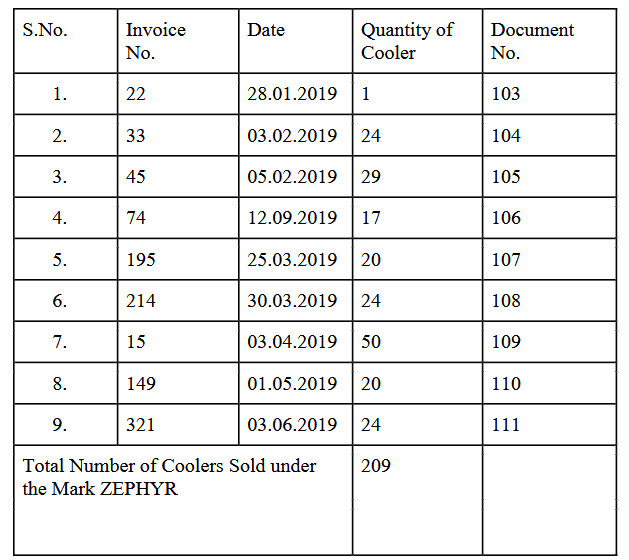
12. According to him, the aforesaid invoices clearly demonstrate that the goods were already being sold even prior to the date of application, thus the design could not have been registered. In furtherance to such contention learned counsel would also submit that the plaintiff in para 14 of the plaint has admitted that the goods under the registered design were publically available for sale and were advertised through various mediums such as print and electronic media, etc. In particular, learned counsel had referred to documents of the plaintiff wherein a screenshot of plaintiff's website displayed the products pertaining to the suit design and the review therein on 24.03.2019. He contended that the said date of publication being prior to the date of application seeking registration of the design, the said design is liable to be cancelled, and the suit for infringement and passing off, which is completely predicated on the suit design, is liable to be dismissed.
13. Learned counsel referred to various paragraphs of the order dated 16.01.2023 vacating the interim order particularly to the observation that the prior publication of the suit design has been made out by defendant no.1, and the said ground would be available to the defendant as its defence under the provisions of Section 22(3) of the Design Act, 2000.
14. In the aforesaid context, learned counsel relies upon the judgment of this Court in Carlsberg Breweries A/S vs. Som Distilleries and Breweries Ltd., (2019) 256 DLT 1 (FB).
15. Dilating the issue further, learned counsel also would submit that though the plaintiff has also instituted the suit based on allegations of passing off, neither the averments in the plaint nor the prayer clause support any such claim. According to the learned counsel, the entire suit as also the prayers sought therein essentially and fundamentally revolve around the alleged infringement of the suit design and there is no element which would disclose any cause of action for passing off. In particular, he referred to Clause (a) of para 35 of the prayer clause to contend that a holistic reading and understanding of the said prayer clause clearly brings to fore the fact that even for a claim of passing off the plaintiff has referred only to infringement of the impugned design, and thus, the essentials of passing off are missing.
16. Referring to Section 2(d) of the Design Act, 2000, learned counsel would contend that there is no averment in respect of the features of shape, configuration, the composition of lines or colours at all, either in the plaint or in the prayer clause. Learned counsel also referred to Section 2 of the Trade Marks Act, 1999, particularly Clause (zb), which provides for the definition of "Trademark" which means, amongst others "the shape of Goods, their packaging, combination of colours", to contend that the plaintiff nowhere in his plaint or even in the prayer clause has remotely referred to the defendant no.1 violating or infringing the shape of goods, their packaging or combination of colours. In such circumstances, the necessary concomitant for a case of passing off has not been made out. He would contend that these lacunae coupled with the provisions of Section 4(b) of the Designs Act, 2000 clearly demonstrate that the plaintiff has no real prospect of succeeding even on the claim of passing off.
17. In view of the above, learned counsel contended that the application be allowed and a summary judgment dismissing the suit of the plaintiff alongwith grant of punitive damages in favour of the defendant no.1 be passed.
CONTENTIONS OF THE PLAINTIFF:
18. Per contra, Mr. Mishra, learned counsel for the plaintiff vehemently refuted the submissions made on behalf of the defendant no.1.
19. To the extent of invalidity of the suit design, he would contend that this Court in the order dated 16.01.2023 has made observations, qua which he does not have any material arguments to address. However, so far as the issue of passing off is concerned, learned counsel submits that not only the necessary averments are available in the suit plaint, but the prayer clause itself is sufficiently worded, and quite clearly conveys a valid claim of passing off. Learned counsel also contended that apart from the registration of the suit design, the plaintiff has also asserted copyrights in the artistic works embodied in the said design within the meaning of Section 2(c) and 11 of the Designs Act, 2000.
20. Learned counsel referred to para 18 of the plaint to state that the essential concomitants for the purposes of demonstrating and establishing a case of passing off are clearly averred therein. He also referred to Clause b of para 33 of the plaint suit to state that not only the prayer for passing off was stated, but Court Fees in respect thereto, was also affixed to the plaint. According to him, when read together, para 18 and para 33(b) of the plaint clearly indicate the intention of the plaintiff to sue the defendants for passing off their goods as that of the plaintiff. He also referred to various paragraphs of the reply to the present application to support the aforesaid contentions.
21. In order to sustain his submissions and contentions, learned counsel copiously read through various paragraphs of the judgment of the learned Division Bench of this Court in Crocs Inc. USA vs. BATA India and Ors., (2025) SCC Online Del 4626 wherein the Full Bench judgment of this Court in Carlsberg Breweries (supra) was extensively referred and relied.
22. Predicated on the aforesaid judgment, learned counsel contended that a composite suit for infringement of the design as also for passing off is maintainable and the plaintiff is entitled to lead evidence to demonstrate and establish a pure case of passing off even if the case of infringement is not made out or fails. He contended that unlike infringement, passing off can be established by the plaintiff by leading evidence. Thus, according to him, the application is not only premature, but is bereft of reasons, and ought to be dismissed.
ANALYSIS AND FINDINGS:
23. This Court has heard Mr. Arnav Goyal, learned counsel for the defendant no.1, Mr. Mishra, learned counsel for the plaintiff, and with their assistance, perused the pleadings and the documents on record.
24. So far as the case of infringement of the suit designs is concerned, Mr. Mishra, learned counsel for the plaintiff was unable to defend as to how such a claim against the defendant no.1 would be maintainable as observed by this Court in the order dated 16.01.2023 while vacating the ex-parte ad-interim injunction order dated 16.04.2021. The relevant paragraphs of the order dated 16.01.2023 is extracted hereunder:
"16. Mr. Goyal has also invited my attention to invoices filed by the plaintiff at pages 103 to 111 of the plaintiffs document, which are also in respect of ZEPHYR cooler and which are prior in point of time to the date of application for registration of the suit design by the plaintiff, which is 9th October 2019. These invoices, submits Mr. Goyal, also serve to indicate that the ZEPHYR cooler of the plaintiff, bearing the suit design, was in fact even being sold in the market prior to 9th October 2019.
xx xx xx
21. Having seen the aforesaid pages and examined the contentions of Mr. Malhotra, I fail to understand how they can help the case of the plaintiff in any way, insofar as Mr. Goyal's contention, based on the document filed by the plaintiff at page 85, is concerned. Page 85 is, in my opinion, prima facie fatal to the plaintiff's case.
22. The question is not whether the plaintiff is, or is not, selling coolers of different designs under the brand name ZEPHYR. That issue is entirely tangential to the controversy at hand. The fact of the matter remains that the internet advertisement filed by the plaintiff itself at page 85 and reproduced in para 13 supra, indicates that the cooler of the plaintiff, bearing the suit design, was available online for sale, on the plaintiffs own website, prior to 24th March 2019.
23. I may note, here, that Mr. Malhotra, very fairly, did not seek to dispute the fact that the design of the cooler advertised for sale at the afore- extracted page 85 from the documents filed by the plaintiff was in fact the suit design.
24. The brand name of the cooler is, in fact, really irrelevant. What has to be seen is whether the coolers bearing the suit design were available online prior to the date of application, by the plaintiff, for registration of the design. Whether the design was being sold under the brand "ZEPHYR" or the brand "MIST", or, for that matter, any other brand, makes no difference to the controversy. Page 85 of the documents-filed by the plaintiff clearly indicates that, on the plaintiffs own website, coolers bearing the suit design were actually put up for sale prior to 24th March 2019. That itself amounts to prior publication within the meaning of Section 19(1)(b) of the Designs Act.
25. In that view of the matter, it is not necessary for me to enter into other aspects of the controversy. At the very least, Defendant 1 has been able to make out a credible challenge to the vulnerability of the suit design to cancellation within the meaning of Section 19(1)(b) of the Designs Act. The said ground is, therefore, validly available as a ground of defence to Defendant 1 by way of Section 22(3) of the Designs Act and, prima facie, has merit.
26. The plaintiff cannot, therefore, be said, on the face of the material on record, to have a prima facie case in its favour, as would justify continuance of the ad interim order dated 16th April 2021 any further.
27. Accordingly, the order dated 16th April 2021 stands vacated."
25. Even before this Court, Mr. Mishra was unable to explain as to how the suit design would be registrable once, admittedly, invoices pertaining to the sales of goods under the mark "ZEPHYR" manufactured on the basis of the suit design, were dated prior to the date of application seeking registration on 19.10.2019. He was also at loss to explain as to how the website of the plaintiff i.e. www.novamaxindustries.com had displayed the goods pertaining to the suit design under the mark "ZEPHYR" on 24.03.2019, which too was prior to the date of the application seeking registration of the design. In other words, the plaintiff had no explanation, muchless a reasonable or cogent explanation as to how a design could be registered once it is already published and in the present case, the goods manufactured based on the said design were put to sale even before the application seeking registration of the suit design was filed.
26. It is pertinent to note that the defendant no.1 claims to have raised the issue of invalidity of the suit design in its written statement, particularly in paras 7 and 13. That apart, plaintiff has not been able to deny the invoices which have been filed along with its list of documents demonstrating sales of products under the mark "ZEPHYR" in respect of the suit design, which pre- date the date of application of the suit design. The table of such invoices has already been reproduced hereinabove. Additionally, it also appears that the plaintiff in para 14 of the plaint has stated that the goods under the suit design were also being advertised and sold through its website as noted above which include the invoices referred to above as proof of substantial goodwill the plaintiff has achieved. Thus, it is clear and admitted that the products were being sold even prior to the date of application seeking registration of the design.
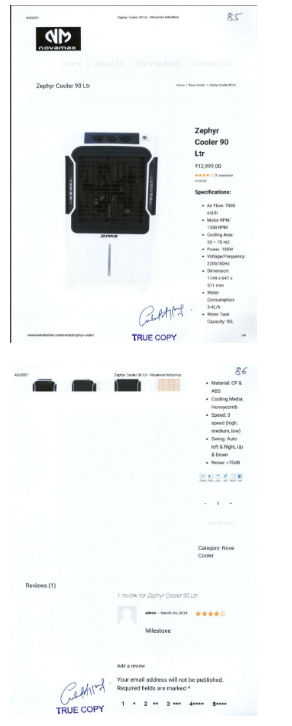
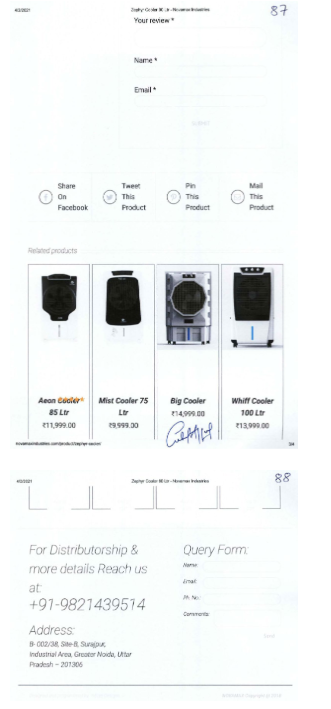
27. It is also relevant to note that the website of the plaintiff itself had published the said design as far back as on 24.03.2019, which too is prior to the application seeking registration of the design. The screenshot of the publication dated 24.03.2019 is reproduced hereunder:
28. Having regard to the aforesaid factual aspect, it may be relevant to consider the provisions of Section 19 of the Designs Act, 2000 and its impact. Section 19 provides that any person interested, may present a petition for cancellation of the registration of a design at any time after the registration of the design to the Controller on various grounds. The Section 19 is extracted hereunder for convenience:
"19. Cancellation of registration.--(1) Any person interested may present a petition for the cancellation of the registration of a design at any time after the registration of the design, to the Controller on any of the following grounds, namely:-- (a) that the design has been previously registered in India; or (b) that it has been published in India or in any other country prior to the date of registration; or (c) that the design is not a new or original design; or (d) that the design is not registrable under this Act; or (e) that it is not a design as defined under clause (d) of section 2.
(2) An appeal shall lie from any order of the Controller under this section to the High Court, and the Controller may at any time refer any such petition to the High Court, and the High Court shall decide any petition so referred."
29. Clause (b) of Section 19 clearly provides that cancellation of registration is permissible in case the said design has been published in India or in any other country prior to the date of registration apart from other grounds. Having regard to the fact that plaintiff is unable to deny prior publication in terms of (i) the invoices pre-dating the date of application as also the date of registration placed on record by the plaintiff itself and; (ii) display/publication of the goods/cooler manufactured on the basis of the suit design on 24.03.2019 in its website novamaxindustries.com, it is well nigh impossible for this Court to conclude that the plaintiff has any real prospect of succeeding on the claim of infringement of the suit design.
30. Thus, on a cumulative appreciation of the aforesaid facts and law as it stands, it appears that the suit instituted by the plaintiff on the allegation of infringement of the suit design would not be maintainable and this Court is unable to fathom any real prospects of the plaintiff succeeding on such claim.
31. In view of the above, this Court is of the considered opinion that the suit of the plaintiff qua the infringement has no real prospect of succeeding and therefore, the suit, to that extent, is dismissed.
32. However, so far as the contention regarding dismissal of the suit even on the basis of claim of passing off has no real prospect of succeeding is concerned, this Court is unable to accede to such contentions.
33. It is necessary to understand that a plaint is a pleading where facts are to be averred in order to provide an opportunity to the defendant to raise its defence by way of a written statement and also, simultaneously, file either a counter-claim or claim a set off. The plaint by itself is not evidence. Evidence is necessary to be adduced and be proved in accordance with law during trial.
34. Learned counsel for the defendant had vociferously contended that the necessary concomitants, for example features of shape, compositions of lines or colours as per the Designs Act; and shape of goods, their packaging and combination of colours as per the Trade Marks Act, 1999, are conspicuous by their absence in the plaint. Similarly, even the prayer clause of the plaint, insofar as passing off is concerned, suffers from a similar lack of essential elements. Based on such contentions, learned counsel sought dismissal of the suit under Order XIII-A of the CPC.
35. In order to appreciate the aforesaid contention, it is felt necessary to extract the relevant paragraphs of the suit in this context, which are as under:
"10. That the plaintiff is the proprietor of its said designs bearing no. 322384-001, 322384-002, 323421-001, 330044-004, 330044-002, 331964- 001 under the statutory law by virtues of the aforesaid registration and under the common law. The plaintiff has the exclusive rights to apply its said designs to the said article and to manufacture and sell the said good bearing the said designs including the distinctive features of its shapes and configuration. The plaintiff enjoys copyright in the said design within the meaning of Section 2 (c) and 11 of the Designs Act, 2000 and is the creator, registered proprietor and the prior, senior and continuous user thereof since after the date of the registration. Nobody can be permitted to violate the plaintiffs said rights and nobody can be permitted to use the same/similar design or any other design being an obvious or fraudulent imitation thereto without the leave and license of the plaintiff. Nobody can be permitted to pirate and infringe the plaintiff's said registered designs under the common law rights therein and indulge in any activities as set our under Section in the Designs Act, 2000.
xx xx xx
18. That in third week of March, 2021, plaintiff through its marketing team came to know that the defendant no. 1 with the connivance of defendant no. 2 is manufacturing/marketing and selling coolers bearing the same/identical design no. 322384-02 of the plaintiff. The uses of the said design by the defendants are fraudulent and obvious imitation of registered design no. 322384-02 of the plaintiff. Upon inquiry it also came to the knowledge of the plaintiff that the defendant no.1 is selling the impugned goods under the impugned design by using the mark AROKING along with sub mark NOV A which is the prominent part of the plaintiff's trademark/trade name. The impugned design of the defendants' cooler is exact replica of the plaintiff's cooler design. The defendant no. 2 is also selling the impugned goods bearing the identical design with the connivance of the defendant no. 1 in Delhi as well as other parts of the country. That thereafter the office of the plaintiff made inquiries and upon inquiries made through different websites it came to the knowledge of the plaintiff that the defendant no. 1 is also displaying and selling its products through e-commerce websites i.e. https:llwww.justdial.comllaipurlPrem- Appliances-Attach-Oflndira-Bazar-Indira-Bazar, https:llwww.indiamart.comlpremappliances-jaipur. The defendant no.1's through the above said interactive websites are targeting the customers of the plaintiff as well as general public in different parts of country including in Delhi. The printouts of status of the abovesaid websites are being filed herewith for kind perusal of this Hon'ble Court.
19. The Defendants are manufacturing, marketing and selling impugned article and are applying impugned design which includes features of shape and configurations (hereinafter referred to as the "impugned design") thereto which is identical/similar and a fraudulent and obvious imitation to the plaintiffs said design. The Defendants have pirated the entire range of plaintiff's said design. Colored Printouts of the impugned article bearing the impugned design are filed herewith.
xx xx xx
26. The Defendants are manufacturing and selling the impugned article bearing the impugned design and are doing so without the leave and license of the plaintiff. The Defendants by adopting and using the impugned design are committing acts of passing off and pirating and infringing the plaintiffs aforesaid designs and its registration.
27. The Defendants are carrying on their impugned activities with a view to take advantage and to trade upon the reputation of the plaintiff and further with a view to calculate deception and confusion in the markets and to pass off its spurious goods as that of the plaintiff and to infringe, pass off and pirate the plaintiff's said designs and their registration. The impugned adoption and user by the Defendants are and are likely to deceive perspective purchasers and if the Defendants are allowed to market their products bearing the impugned designs there is likelihood of and in fact there is diversion of trade from the plaintiff to the Defendants. The plaintiffs goods and business are and will suffer from an injurious association with the Defendants' goods. The Defendants have pre-empted commercial exploitation of plaintiffs goodwill and reputation. The Defendants have preempted plaintiff capacity to extend their business under the said design. The Defendants, as such, is guilty of misappropriation of the business reputation of the plaintiff and violating the statutory and common law rights in the said design of the plaintiff. The impugned acts and activities of the Defendants amount to passing off and infringement."
36. A cumulative and holistic reading of the averments in the aforesaid paragraphs of the plaint bring to fore that the plaintiff has asserted not only the infringement of the suit design but also has unequivocally referred to the defendants selling their goods as those of the plaintiff and have based their claim for passing off on the said assertion. Plaintiff has used words like 'features of shape and configurations' and 'imitation', etc., and also has asserted its right based on the provisions of the Designs Act, 2000, the Trade Marks Act, 1999, and the Copyright Act, 1957. As observed earlier, the plaint has to only carry averments intending to convey the facts on which claims are predicated. In the opinion of this Court, the plaintiff has given sufficient material facts and necessary concomitants to constitute a suit for cause of action based on allegations of passing off. It is another matter that such facts or allegations are to be proved during trial after adducing relevant evidence.
37. Though the defendant has raised objections in the present application in regard to the viability of the claim for passing off, it is deemed necessary to peruse the defence raised by the defendant in its written statement in the context of the averments and allegations referred to hereinabove in respect of paras 18 and 19. The reply to paras 18 and 19 of the plaint is contained in para 9 of the parawise reply in the written statement of the defendant no.1 which reads thus:
"9. That the contents of paragraph nos. 17-19 of the plaint are absolutely false and frivolous, the averments made by the plaintiff are solely for the purpose of misguiding this Hon'ble Court. According to the plaintiff, the defendant No. 1 with the connivance of the defendant No. 2 is manufacturing/marketing and selling coolers of the infringing designs of registered design no. 322384-002, while the truth is, the defendant no. 1 never sold a single piece of cooler to the Defendant no. 2 under the claimed registered design. Thus, it is predominantly established that the plaintiff intentionally, dishonestly and deliberately impleaded Defendant No. 2 in the present suit only for invoking territorial jurisdiction of this Hon'ble Court. Furthermore, the plaintiff falsely mentioned that the defendant no. 1 is selling coolers through various commercial websites under the infringing designs throughout India, while it is undoubtedly confirmed that the Defendant No.1 never sold a single piece of cooler through commercial websites within the local limits of this Hon'ble Court, hence, this Hon'ble Court does not have territorial jurisdiction to adjudicate this suit and the plaintiff shall be held liable for misguiding this Hon'ble Court, and therefore, the present suit shall be dismissed upon the ground alone."
38. A plain reading of para 9 of the written statement above clearly indicates that the defendant had never denied or raised any defence or offered any explanation in respect of the allegations contained in paras 18 and 19 of the plaint. Other than simply denying selling coolers to the defendant no.2 under the suit design and raising an objection that this Court does not have territorial jurisdiction on account of lack of sale of any impugned goods in Delhi or even being available within the local limits of this Court's jurisdiction, the averments in relation to passing off have not been traversed.
39. Thus, in the absence of any such defence or clarifications, it appears to this Court that the contention regarding lack of essential averments for the purposes of basing the claim on passing off would best be kept for trial and evidence to be led thereon.
40. In the aforesaid context, it would be necessary, rather, imperative to appreciate the law laid down by the Full Bench of this Court in Carlsberg Breweries (supra). In the opinion of this Court, the learned Full Bench had categorically held that a suit for infringement and passing off are maintainable as a composite suit. The learned Full Bench had also held that one of the relevant considerations for concluding that a composite suit for infringement and passing off under the Designs Act, 2000 is maintainable, is for the reason that the evidence to prove infringement as also passing off may be common. The Full Bench judgment in Carlsberg Breweries (supra) was considered in great detail in Crocs Inc. USA (supra) by the learned Division Bench of this Court. Having appreciated and considered the judgment of the Full Bench in Carlsberg Breweries (supra), the learned Division Bench in Crocs Inc. USA (supra) held as under in para 22, which relates to a claim for passing off.
"22. On first principles - ingredients of passing off
22.1 We would arrive at the same conclusion if we were to approach the matter from first principles, unshackled by precedential fetters. Section 27(2) of the Trade Marks Act specifically excepts, from its statutory constraints, the right to sue for passing off. Passing off is a distinct right, which resides in its own common law space, apart from and independent of, the confines and constraints of the Trade Marks Act, or the Designs Act, or, for that matter, any other statute. In fact, there appears to be no justifiable reason to limit passing off to the use of one's trade mark, or even trade dress, by another. Black's Law Dictionary defines "passing off" as "the act or an instance of falsely representing one's own product as that of another in an attempt to deceive potential buyers".
22.2 There is a fundamental, and well recognized, distinction between infringement and passing off. Infringement merely involves a mark to mark comparison, and the right to infringement arises the moment a trade mark, or design, is registered. The plaintiff, in an infringement action, is not required to prove goodwill. A plaintiff who is the proprietor of a registered trade mark, or registered design, is entitled, statutorily, to injunct the rest of the world from using an identical, or deceptively similar, trade mark. This right comes into being immediately upon registration. The right to relief against infringement, therefore, arises from registration, not user. Section 28(1) {28. Rights conferred by registration.- (1) Subject to the other provisions of this Act, the registration of a trade mark shall, if valid, give to the registered proprietor of the trade mark the exclusive right to the use of the trade mark in relation to the goods or services in respect of which the trade mark is registered and to obtain relief in respect of infringement of the trade mark in the manner provided by this Act.} of the Trade Marks Act is clear on the point. Of course, the right is subject to the statutorily restraints in the Trade Marks Act, with which we need not concern ourselves.
22.3 Similarity, or even identity, of trade marks, or trade dress does not, by itself, however, provide a valid cause of action for passing off. Proof of the existence of goodwill, in the plaintiff, is an indispensable sine qua non. Sans goodwill, no action for passing off can sustain. The Supreme Court has identified the ingredients of passing off thus, in its recent decision in Birhan Karan Sugar Syndicate (P) Ltd. v. Yashwantrao Mohite Krushna Sahakari Sakhar Karkhana {(2024) 2 SCC 577}:
"12. There is a finding recorded by the High Court in the impugned judgment that the labels used on the bottle of country liquor sold by the appellant and the labels on the bottle of country liquor sold by the respondent are similar. At this stage, we may note the legal position regarding the factual details which are required to be proved in a passing off action. Firstly, we may refer to a decision of this Court in Satyam Infoway Ltd. v. Siffynet Solutions (P) Ltd. {(2004) 6 SCC 145}, Paras 13 to 15 of the said decision read thus:
"13. The next question is, would the principles of trade mark law and in particular those relating to passing off apply? An action for passing off, as the phrase "passing off" itself suggests, is to restrain the defendant from passing off its goods or services to the public as that of the plaintiff's. It is an action not only to preserve the reputation of the plaintiff but also to safeguard the public. The defendant must have sold its goods or offered its services in a manner which has deceived or would be likely to deceive the public into thinking that the defendant's goods or services are the plaintiff's. The action is normally available to the owner of a distinctive trade mark and the person who, if the word or name is an invented one, invents and uses it. If two trade rivals claim to have individually invented the same mark, then the trader who is able to establish prior user will succeed. The question is, as has been aptly put, who gets these first? It is not essential for the plaintiff to prove long user to establish reputation in a passing off action. It would depend upon the volume of sales and extent of advertisement.
14. The second element that must be established by a plaintiff in a passing off action is misrepresentation by the defendant to the public. The word "misrepresentation" does not mean that the plaintiff has to prove any mala fide intention on the part of the defendant. Of course, if the misrepresentation is intentional, it might lead to an inference that the reputation of the plaintiff is such that it is worth the defendant's while to cash in on it. An innocent misrepresentation would be relevant only on the question of the ultimate relief which would be granted to the plaintiff [Cadbury-Schweppes (Pty) Ltd. v. PUB Squash Co. (Pty) Ltd.{1981 RPC 429 : [1981] 1 WLR 193}; Erven Warnink Besloten Vennootschap v. J. Townend & Sons (Hull) Ltd. {[1979] A.C. 731 : [1979] 3 WLR 68 : 1980 RPC 31 (HL)}]. What has to be established is the likelihood of confusion in the minds of the public (the word "public" being understood to mean actual or potential customers or users) that the goods or services offered by the defendant are the goods or the services of the plaintiff. In assessing the likelihood of such confusion the courts must allow for the "imperfect recollection of a person of ordinary memory" [Aristoc Ltd. v. Rysta Ltd. {[1945] A.C. 68 (HL)}].
15. The third element of a passing off action is loss or the likelihood of it."
(emphasis supplied)
13. Thus, the volume of sale and the extent of advertisement made by the appellant of the product in question will be a relevant consideration for deciding whether the appellant had acquired a reputation or goodwill.
14. At this stage, we may also refer to the decision of this Court in Toyota Jidosha Kabushiki Kaisha v. Prius Auto Industries Ltd. { (2018) 2 SCC 1}. In this decision, this Court approved its earlier view in S. Syed Mohideen v. P. Sulochana Bai { (2016) 2 SCC 683} that the passing off action which is premised on the rights of the prime user generating goodwill, shall remain unaffected by any registration provided in the Act. In fact, this Court quoted with approval, the view taken by the House of Lords in Reckitt & Colman Products Ltd. v. Borden Inc. {[1990] 1 WLR 491 (HL)}. The said decision lays down triple tests. One of the tests laid down by the House of Lords was that the plaintiff in a passing off action has to prove that he had acquired a reputation or goodwill connected with the goods. Thereafter, in para 40 of Toyota, this Court held that if goodwill or reputation in a particular jurisdiction is not established by the plaintiff, no other issue really would need any further examination to determine the extent of the plaintiff's right in the action of passing off.
15. Coming to the facts of the case, the appellant examined only two witnesses. The first witness was Mr. K.K. Kalani and the second one was Mr. Sudhir Pokhale. Mr. Sudhir Pokhale was examined on an altogether different issue regarding the approval of labels sought by the respondent. The impugned judgment contains a list of the exhibited documents produced by the appellant. Exts. 73, 73.1 to 73.4 are the statement of sales as well as advertisement and sale promotion expenses certified by a Chartered Accountant. However, we find that the Chartered Accountant was not examined to prove the statements. In the examination-in-chief of Shri K.K. Kalani, in para 10, only the figures of sales and marketing expenses have been quoted.
16. Prima facie, it appears to us that at the time of the final hearing of the suit, it was incumbent upon the appellant-plaintiff to actually prove the figures of sales and expenditure incurred on the advertising and promotion of the product. Only by producing the statements without proving the contents thereof, the appellant could not have established its reputation or goodwill in connection with the goods in question. According to the witness, the statements produced were signed by a Chartered Accountant Mr. Natesh. This aspect surely makes out a prima facie case for grant of stay to the execution of the decree in favour of the respondent as regards the passing off action.
17. For establishing goodwill of the product, it was necessary for the appellant to prove not only the figures of sale of the product but also the expenditure incurred on promotion and advertisement of the product. Prima facie, there is no evidence on this aspect. While deciding an application for a temporary injunction in a suit for passing off action, in a given case, the statements of accounts signed by the Chartered Accountant of the plaintiff indicating the expenses incurred on advertisement and promotion and figures of sales may constitute a material which can be considered for examining whether a prima facie case was made out by the appellant-plaintiff. However, at the time of the final hearing of the suit, the figures must be proved in a manner known to law.
18. Even assuming that the allegation of deceptive similarity in the labels used by the respondent was established by the appellant, one of the three elements which the appellant was required to prove, has not been proved. Therefore, we find that the High Court was justified in staying that particular part of the decree of the trial court by which injunction was granted for the action of passing off."
22.4 Over six decades ago, the Supreme Court identified the features of distinction between infringement and passing off thus, in Kaviraj Pandit Durga Dutt Sharma v. Navaratna Pharmaceuticals Laboratories {AIR 1965 SC 980}:
"28. The other ground of objection that the findings are inconsistent really proceeds on an error in appreciating the basic differences between the causes of action and right to relief in suits for passing off and for infringement of a registered trade mark and in equating the essentials of a passing off action with those in respect of an action complaining of an infringement of a registered trade mark. We have already pointed out that the suit by the respondent complained both of an invasion of a statutory right under Section 21 in respect of a registered trade mark and also of a passing off by the use of the same mark. The finding in favour of the appellant to which the learned counsel drew our attention was based upon dissimilarity of the packing in which the goods of the two parties were vended, the difference in the physical appearance of the two packets by reason of the variation in the colour and other features and their general get-up together with the circumstance that the name and address of the manufactory of the appellant was prominently displayed on his packets and these features were all set out for negativing the respondent's claim that the appellant had passed off his goods as those of the respondent. These matters which are of the essence of the cause of action for relief on the ground of passing off play but a limited role in an action for infringement of a registered trade mark by the registered proprietor who has a statutory right to that mark and who has a statutory remedy for the event of the use by another of that mark or a colourable imitation thereof. While an action for passing off is a Common Law remedy being in substance an action for deceit, that is, a passing off by a person of his own goods as those of another, that is not the gist of an action for infringement. The action for infringement is a statutory remedy conferred on the registered proprietor of a registered trade mark for the vindication of the exclusive right to the use of the trade mark in relation to those goods" (Vide Section 21 of the Act). The use by the defendant of the trade mark of the plaintiff is not essential in an action for passing off, but is the sine qua non in the case of an action for infringement. No doubt, where the evidence in respect of passing off consists merely of the colourable use of a registered trade mark, the essential features of both the actions might coincide in the sense that what would be a colourable imitation of a trade mark in a passing off action would also be such in an action for infringement of the same trade mark. But there the correspondence between the two ceases. In an action for infringement, the plaintiff must, no doubt, make out that the use of the defendant's mark is likely to deceive, but where the similarity between the plaintiff's and the defendant's mark is so close either visually, phonetically or otherwise and the court reaches the conclusion that there is an imitation, no further evidence is required to establish that the plaintiff's rights are violated. Expressed in another way, if the essential features of the trade mark of the plaintiff have been adopted by the defendant, the fact that the get-up, packing and other writing or marks on the goods or on the packets in which he offers his goods for sale show marked differences, or indicate clearly a trade origin different from that of the registered proprietor of the mark would be immaterial; whereas in the case of passing off, the defendant may escape liability if he can show that the added matter is sufficient to distinguish his goods from those of the plaintiff."
22.5 Passing off is, therefore, a sui generis common law remedy, aimed at protecting one's hard-earned goodwill and reputation from others who may deceitfully seek to capitalize on it. It resides pristinely in its own universe, and is one of the very few non-statutory remedies, available in law, which is accorded statutory recognition in Section 27(1) of the Trade Marks Act. Indeed, we are unable, offhand, to recollect any other such common law remedy which is granted statutory protection in our country. It is a precious right, therefore, and has to be sedulously protected. Its availability, as a cause of action, cannot, therefore, be denied, unless the law denies it. To our mind, no law does so.
22.6 Whether, on facts, a case of passing of is, or is not, made out, is another matter altogether. If it is, however, the Court cannot decline protection to the plaintiff on the sole ground that the subject matter of the passing off action happens to be a design in respect of which the plaintiff has a registration under the Designs Act. As para 46 of Carlsberg clarifies, even if a design infringement case is not made out, for whatever reason, the Court can, on the same facts and evidence, find a case of passing off to be made out, and grant relief."
41. Thus, it can be seen that the learned Division Bench has held that even if a design infringement case is not made out, for whatever reason, the Court can, on the same facts and evidence, adjudicate the claim for passing off and grant or refuse the relief as sought.
42. Apart from the above, undoubtedly, a claim for passing off is clearly based on evidence unlike a case for infringement where the registrations of the marks under the Trade Marks Act may have to be compared, in order to ascertain infringement. Thus, without affording an opportunity to the plaintiff to prove or establish the allegation of passing off against the defendant no.1, it cannot be said or held with conviction, that too in an application under Order XIII-A, CPC seeking summary judgment, that the plaintiff has no real prospect of succeeding on its claim for passing off.
43. In view of the above and in the considered opinion of this Court, the application qua the claim of passing off is rejected.
44. Resultantly, the application insofar as the claim of the plaintiff in the suit qua the infringement of the suit design is allowed, while the objection in respect of the claim for passing off, is rejected.
45. The application is allowed in part and disposed of accordingly.
CS(COMM) 177/2021
46. List on 17.09.2026.
|
| |

