| |
CDJ 2026 GHC 274


|
| Court : In the High Court of Gujarat at Ahmedabad |
| Case No : R/Special Civil Application No. 3972 of 2024 |
| Judges: THE HONOURABLE MR. JUSTICE N.S. SANJAY GOWDA & THE HONOURABLE MR. JUSTICE J.L. ODEDRA |
| Parties : Ayar Gitaben Dineshbhai Versus Election Commissioner & Others |
| Appearing Advocates : For the Petitioner: Dharti P. Ratani, Advocate. For the Respondents: Shruti Dhruve, AGP. |
| Date of Judgment : 18-06-2026 |
| Head Note :- |
Gujarat Panchayats Act, 1993 - Section 31 -
|
| Summary :- |
1. Statutes / Acts / Rules / Orders / Regulations, and Sections Mentioned:
- Section 31 of the Gujarat Panchayats Act, 1993
- Gujarat Panchayats Election Rules, 1994
- Rule 60 of the Gujarat Panchayats Election Rules, 1994
- Rule 61 of the Gujarat Panchayats Election |
| Judgment :- |
|
CAV Judgment
N.S. Sanjay Gowda, J.
1. This writ petition is filed challenging the dismissal of the election petition filed by the petitioner challenging the election of 2nd respondent as the Sarpanch of the Madhutra Gram Panchayat.
2. On 19.12.2021, elections were conducted to the post of Sarpanch of Madhutra Gram Panchayat, which was reserved for a woman candidate. In the said election, a total of 2,863 votes were cast.
3. On 21.12.2021, the votes cast were counted, and after four rounds of counting, it was found that 2nd respondent (hereinafter referred to as "the returned candidate") had secured 1,086 votes, while the petitioner had secured 1,021 votes.
4. After the counting was completed, the results were declared and the returned candidate was declared elected.
5. The petitioner thereafter filed an election petition, as permitted under Section 31 of the Gujarat Panchayats Act, 1993 (hereinafter referred to as "the Act") challenging the election of the returned candidate.
6. The petitioner contended that the entire process of counting of votes was conducted illegally in order to favor the returned candidate and, consequently, the declaration of the returned candidate as having been duly elected was erroneous. It was alleged that the Returning Officer had favoured the returned candidate by permitting the Election Supervisor to retain a mobile phone and, by using police force, had ensured that the petitioner's agents were forcibly removed from the counting venue and in their absence, the returned candidate was declared elected by a margin of 65 votes.
7. The petitioner also contended that the rejection of 221 votes was illegal inasmuch as it was not disclosed to the agents as to why the said votes had been rejected. It was contended that out of these 221 votes, 80 votes were in fact liable to be counted in favor of the petitioner, but the same had been wrongly treated as rejected. It was also alleged that the ballot papers were not shown to any of the agents and were directly placed in the respective bundles, and mobile phones had been used to leak the election results. In short, it was alleged that the entire process of counting was illegal and had vitiated the declaration of the returned candidate as the elected candidate.
8. This petition was contested by the elected candidate and also by the Returning Officer.
9. The trial court thereafter proceeded to frame 12 issues. On consideration of the evidence adduced during the trial, the issues were answered against the petitioner and the election petition came to be dismissed.
10. Being aggrieved by the dismissal of the election petition, the present writ petition has been filed.
11. Learned counsel for the petitioner has placed on record a copy of the translated judgment rendered by the trial court.
12. Ms. Dharti P. Ratani, learned counsel appearing for the petitioner contended that the order of the trial court insofar as it related to the aspect of the refusal of the trial court to take cognizance of the fact that a recount was demanded but not granted, had vitiated the judgment. She submitted that though a specific request for recount was made, the same had not been considered by the Returning Officer, and this had vitiated the declaration of the result. She argued that oral objections were raised to the counting on 21.12.2021 when the counting was completed, and on the following day, i.e., on 22.12.2021, written objections seeking a recount were also filed, but the same were not considered on the ground that they were belated, which had also vitiated the judgment.
13. Learned counsel appearing for the returned candidate supported the judgment and contended that there were no allegations of corrupt practices and there was also no evidence adduced to prove the allegations made in this regard.
14. It was argued that the only the contention that a request for recount was made on 21.12.2021 and the non-consideration of this request by the Election Officer had vitiated the entire counting process was being advanced in this petition. It was contended that, admittedly, no written request for recount had been made on 21.12.2021, as statutorily required, and therefore, the question of Returning Officer even entertaining such an oral request would not arise.
15. It was contended that as a matter of fact, no oral request was made on 21.12.2021. It was contended that a request for recounting was made only on the following day, i.e., on 22.12.2021, and since the statute did not permit the filing of an objection or seeking a recount after the election results were declared, the argument that the counting process stood vitiated cannot be accepted.
16. It may be pertinent to state here that the entire arguments advanced in these proceedings relate only to the demand made by the petitioner for a recount and the non-consideration of this request. No other arguments have been advanced regarding the other aspects of the election, and therefore, we are restricting our consideration only to the aspect of counting of votes and the demand for recount.
17. The manner in which an election to the post in the Panchayat is conducted is governed by the provisions of the Gujarat Panchayats Election Rules, 1994 (hereinafter referred to as "the Rules"). Part VII of the said Rules contains the provisions relating to the counting of votes. Rule 60 specifically provides for the manner in which votes are to be counted, and the same reads as follows:-
"Rule - 60. Counting of votes.
(1) Subject to such general or special directions if any, given by the Election Commission in this behalf, the ballot papers taken out of all ballot boxes used in an electoral division shall be mixed together and then arranged in convenient bundles and scrutinised by the counting assistants and the supervisors under the supervision of the returning officer.
(2) The returning officer shall reject a ballot paper if -
(a) it bears any mark or writing by which the voter can be identified; or
(b) it bears no mark at all or, to indicate the vote bears a mark elsewhere than on or near the symbol of one of the candidates on the face or the ballot paper or it bears a mark made otherwise than with the instrument supplied for that purpose, or
(c) voters are given on it in favour of more than one candidate: or
(d) the mark indicating the vote thereon is placed in such manner as ro make it doubtful as to which candidate the vote has been given; or
(e) It is spurious ballot paper; or
(f) if is so damaged or mutilated that its identify a genuine ballot paper cannot be established; or
(g) it bears a serial number, or is of a design, different from the serial numbers, or, as the case may be, design, of the ballot papers authorised for use at the particular polling station; or
(h) it does not bear both the mark and the signature which it should have borne under the provisions of sub-rule (1) and sub-rule (2) of rule 40;
Provided that where the returning officer is satisfied that any such defect as is mentioned in clause (g) or clause (h) has been caused by any mistake or failure on the part of a presiding officer or polling officer, the ballot paper shall not be rejected merely on the ground of such defect;
Provided further that a ballot paper shall not be rejected merely on the ground that the mark indicating the vote is indistinct or made more than once, if the intention that the vote shall be for a particular candidate clearly appears from the way the paper is marked.
(3) Before rejecting any ballot paper under sub-rule (2) the returning officer shall allow each counting agent present a reasonable opportunity to inspect the ballot paper but shall not allow him to handle it or any other ballot paper.
(4) the returning officer shall endorse on every ballot paper which he rejects, the word "Rejected" and the grounds of the rejection in abbreviated form either in his own hand or by means or a rubber stamp and shall initial in ink such endorsement.
(5) All ballot papers rejected under this rule shall be bundled together.
(6) Every ballot paper which is not rejected under this rule shall be counted as one valid vote;
Provided that no cover containing tendered ballot papers shall be opened and no such paper shall be counted.
(7) After the completion of counting the returning officer shall record in the result sheet in Form 27 the total number of votes polled by each candidate and announce the same."
18. As could be seen from the above Rules, specifically Rule 60(7), on completion of the counting of votes, the Returning Officer is required to record in the result sheet, i.e., Form No.27, the total number of votes polled by each candidate and announce the same. The Form No.27 is extracted below for the sake of clarity:-
"FORM 27
(See Rules 58(10) and 60(7))
FINAL RESULT SHEET
Election to the _____________________________village/taluka/district panchayat from _________________________________electoral division/election of Sarpanch of ______________________village panchayat.
(Strike off whichever is not applicable)
(a) Total No. of voters in the electoral division
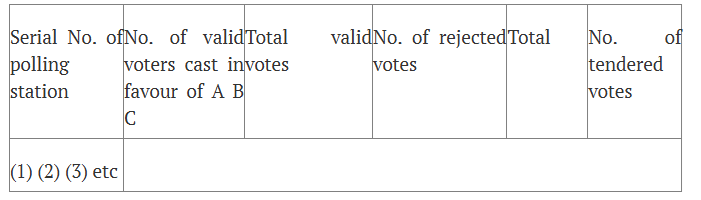
(b) Total number of votes recorded at Polling Stations. Number of votes recorded by postal ballot papers: _________
Place: _________________
Date: __________________
Returning Officer
(Electoral Division)
Strike off whichever is not applicable."
19. As could be seen from Form 27, the Returning Officer is required to record the number of valid votes cast in favor of each candidate, the total number of valid votes, and the number of rejected votes. He is also required to record the total number of votes recorded through postal ballot papers. This record is basically meant to inform the candidates and their agents about the number of votes secured by the respective candidates.
20. After the votes are recorded in Form No.27, the Returning Officer is required to announce the same, thereby informing the candidates and their agents about the number of votes received by each of the candidates. This is obviously to enable the candidates or their agents to raise any objection, if they so desire. This becomes clear from Rule 61 of the Rules, which reads as follows:-
"Rule - 61. Recount of votes.
(1) After an announcement of the total number of votes polled by a candidate has been made under sub-rule (7) of rule 60, a candidate, or, in his absence, his election agent or any of his counting agents may apply in writing to the returning officer to recount the votes either wholly or in part stating the grounds on which he demands such recount.
(2) On such an application being made the returning officer shall decide the matter and may allow the application whole or in part or may reject it in toto if it appears to him to be frivolous or unreasonable.
(3) Every decision of the returning officer under sub-rule (2) shall be in writing and contain reason therefore.
(4) If the returning officer decide under sub-rule (2) to allow a recount of the votes either wholly or in part, he shall-
(a) do the recounting in accordance with rule 58 or, as the case may be, 60;
(b) amend the result sheet in form 27 to the extent necessary after such recount; and
(c) announce the amendment so made by him.
(5) After the total number of votes polled by each candidate has been announced under sub-rule (7) of rule 60 nor sub-rule (4) the returning officer shall complete and sign the result sheet in Form 27 and no application for a recount shall be entertained thereafter;
Provided that no step under this sub-rule shall be taken on the completion of the counting until the candidates and election agents present at the completion thereof have been given a reasonable opportunity to exercise the right conferred by sub-rule (1)."
21. As could be seen from Rule 61 sub-clause (1), the moment an announcement is made under Rule 60(7), i.e., on publication of the votes recorded in Form No.27, a candidate is given the right to apply in writing to the Returning Officer demanding a recount of the votes, either wholly or in part. The written application is also required to state the grounds on which such a demand for recount is made.
22. The fact that Rule 61(1) specifically states and emphasizes that an application in writing is to be given by the candidate seeking for recount of the votes would clearly imply that an oral request for recount is impermissible. The further requirement that the written application is required to state the grounds for demanding a recount also indicates that no oral request is permissible under the Rules.
23. It is clearly stated here that if a written application is made, under Rule 61 sub-clause (2), the Returning Officer is required to decide the application either by granting a recount or by rejecting the claim for recount. The decision taken by the Returning Officer is also required to be in writing and should contain the reasons for such decision.
24. Rule 63 of the Rules stipulates that on the completion of the counting of votes, the Returning Officer is forthwith required to declare the result of the election in Form No.28 by affixing a signed copy of the result in Form No.28 on the notice board of his office. This would, however, be subject to the condition that there was no direction by the Election Commission requiring the declaration of the result to be made at a subsequent time. The Returning Officer is also required to send a copy of the declaration of the result to the seven authorities mentioned in Rule 63 of the Rules.
25. The use of the term "forthwith" in Rule 63(1), following the phrase "counting of votes has been completed", would clearly indicate that the results are to be declared immediately after the counting has been completed, i.e., the counting as contemplated under Rule 60 sub-clause (7) and the Form No 27 is published.
26. The right to seek a recount exists during the interregnum between the announcing of the results under R. 60 (7) and the declaration of the result under R. 61 (1). In other words, the right to seek for a recount is available only after the recording of the number of votes polled is notified by the publication of Form No.27 and subsists only till the declaration of the result under T. 61 (1).
27. This would basically mean that a demand for recount under Rule 61 is required to be made immediately after the results are recorded in Form No.27, and such a demand is required to be made in writing.
28. Admittedly, in the instant case, no written application was filed by the petitioner setting forth the grounds on which she demanded a recount. Even according to the petitioner, only an oral request was made for recount. Assuming that such an oral request was made, the Returning Officer could not, obviously, entertain the oral request in the light of the specific requirement of the Rule, which mandates an application in writing stating the grounds on which the recount was made. It is, therefore, clear that even if a demand was made orally, the same would be of no consequence.
29. Furthermore, in the instant case, admittedly, the written application raising objections and seeking a recount was made only on the following day, i.e., on 22.12.2021. To put it differently, the written application for written objections and application for recount was made after the results had been declared under Rule 63 of the Rules. It is obvious that once the results were declared and notified as permitted under Rule 63 of the Rules, the right to seek a recount had lapsed. Since the petitioner admittedly did not file an application in writing seeking a recount after the votes were recorded and announced through the publication of Form No.27, the petitioner cannot contend that a subsequent application made on the following day ought to have been entertained. As a further consequence, the contention that the rejection of her written request dated 22.12.2021 had vitiated the counting process and thereby rendered the declaration of the result invalid is also untenable.
30. In law, the consequence of non-filing of an application in writing for the recount and stating the grounds for seeking a recount before the declaration of the result in the said application is that the candidates are deemed to have accepted the counting of votes as being proper. This legal inference will have to be drawn because the Rule categorically stipulates that an application for recount is to be made in writing immediately after the publication of Form No.27, i.e., after the Returning Officer records the votes polled upon completion of counting. If this window provided for seeking recount, i.e., the period between the publication of Form No.27 and the declaration of result by the publication of Form No.28, is not availed of, the law deems that the other candidates had no objection to the entire counting process and, therefore, the counting process will have to be accepted.
31. As noticed above, the only contention advanced by the learned counsel for the petitioner in this case is that the application for recount had been made and was wrongly rejected, and therefore, the declaration of the result stood vitiated. Since it is clear that, admittedly, no written application seeking a recount was filed before the declaration of the result, it is obvious that the entire argument advanced by the learned counsel is without any substance.
32. The trial court has also considered this aspect of the matter and has recorded a finding in the very same terms. We are, therefore, of the view that the judgment of the trial court dismissing the election petition cannot be found fault with. The petition is, therefore, dismissed. Rule is discharged.
|
| |

