| |
CDJ 2026 Ch HC 083


|
| Court : High Court of Chhattisgarh |
| Case No : CRA No. 261 of 2017 |
| Judges: THE HONOURABLE MRS. JUSTICE RAJANI DUBEY |
| Parties : Prakash Narayan Kaumarya Versus State Of Chhattisgarh |
| Appearing Advocates : For the Appellant: Sangeeta Mishra, Advocate. For the Respondent: Jitendra Shrivastava, GA. |
| Date of Judgment : 18-06-2026 |
| Head Note :- |
Prevention of Corruption Act, 1988 - Section 13(2) -
|
| Summary :- |
1. Statutes / Acts / Rules Mentioned:
- Prevention of Corruption Act, 1988
- Section 7 of Prevention of Corruption Act, 1988
- Section 13(1)(d) read with Section 13(2) of Prevention of Corruption Act, 1988
- Section 20 of the Prevention of Corruption Act
- Section 313 of the Code of Criminal Procedure, 1973
- Indian Evidence Act
- Section 114(g) of the Indian Evidence Act
- Section 437‑A of Cr.P.C. (481 of the B.N.S.S.)
2. Catch Words:
- demand of illegal gratification
- bribe
- trap
- phenolphthalein test
- sanction
- General Provident Fund (GPF)
- voice recorder
- recovery of tainted currency
3. Summary:
The appellant, an accountant, was convicted under Sections 7 and 13(1)(d) read with 13(2) of the Prevention of Corruption Act for allegedly demanding and receiving a bribe of Rs 1,000 in a trap operation. The prosecution relied on the complainant’s testimony, a recorded conversation, and the recovery of tainted notes that turned pink on phenolphthalein test. The defence challenged the absence of direct evidence of demand, lack of call records, voice samples, and the fact that the sanction order had already been issued, rendering any motive doubtful. The Court examined the credibility of witnesses, noting that none corroborated the demand and that the recovered notes were merely found on the table. Consistent with Supreme Court precedents, the Court held that proof of demand is indispensable for conviction under the Act. Consequently, the conviction was set aside and the appellant acquitted.
4. Conclusion:
Appeal Allowed |
| Judgment :- |
|
C A V Judgment
1. The present appeal is directed against the judgment dated 04.02.2017 passed by the learned Special Judge (Prevention of Corruption Act), Rajnandgaon, in Special Criminal Case No. 1/2015, whereby the appellant has been convicted and sentenced in the following manner:-
Conviction
| Sentence
| U/s 7 of Prevention of Corruption Act, 1988
| R.I. for 2 years and to pay fine of Rs. 2,000/- in default of payment of fine amount to undergo additional R.I. for 6 months
| U/s 13(1)(d) read with Section 13 (2) of Prevention of Corruption Act, 1988
| R.I. for 2 years and to pay fine of Rs. 2,000/- in default of payment of fine amount to undergo additional R.I. for 6 months (Both the sentences to run concurrently)
|
2. The prosecution case, in brief, is that the complainant, Vinod Kumar Bagde, aged about 40 years, working as Rural Health Coordinator at Dongargarh, District Rajnandgaon (C.G.), had submitted an application for withdrawal of Rs.50,000/- from his General Provident Fund (GPF) account for the medical treatment of his wife. The application was forwarded through the competent authority and submitted before the office of the Chief Medical and Health Officer, Rajnandgaon. It is alleged that on 24.01.2014, accused Prakash Narayan Kaumarya, who was working as Accountant in the office of the Chief Medical and Health Officer, Rajnandgaon, demanded illegal gratification of Rs.1,000/- from the complainant for processing and passing the GPF withdrawal application. Unwilling to pay the bribe, the complainant lodged a written complaint before the Anti-Corruption Bureau (ACB), Raipur on 25.01.2014. After verification of the complaint and recording of the conversation regarding demand of bribe, a trap was organized by the ACB on 29.01.2014 in the presence of independent panch witnesses. The complainant was provided with tainted currency notes amounting to Rs.1,000/- treated with phenolphthalein powder and was instructed to hand over the same to the accused only on demand. Pursuant to the trap proceedings, the complainant met the accused in his office at Rajnandgaon and, on the accused's demand, paid the tainted amount of Rs.1,000/-. After receiving the predetermined signal from the complainant, the trap team immediately entered the office and apprehended the accused. During the proceedings, the hand-wash of the accused in sodium carbonate solution turned pink, indicating contact with the tainted currency notes. The tainted amount of Rs.1,000/-, consisting of ten currency notes of Rs.100/- denomination, was recovered from the table under the exclusive control and custody of the accused and the serial numbers of the recovered notes matched those recorded in the pre-trap panchnama. The seized articles and wash solutions were sent to the Forensic Science Laboratory, Raipur and the chemical examination report confirmed the presence of phenolphthalein. After completion of investigation, obtaining the requisite sanction for prosecution and collecting relevant documentary evidence, the prosecution submitted a charge-sheet against the accused, Prakash Narayan Kaumarya, alleging commission of offences punishable under Sections 7 and 13(1)(d) read with Section 13(2) of the Prevention of Corruption Act, 1988. Pursuant thereto, the learned Trial Court framed charges against the accused for the aforesaid offences, to which the appellant denied the charges, pleaded not guilty and claimed to be tried.
3. In order to substantiate the charges levelled against the accused/appellant, the prosecution examined as many as 11 witnesses. Thereafter, the statement of the accused/appellant was recorded under Section 313 of the Code of Criminal Procedure, 1973, in which he denied all the incriminating circumstances appearing against him in the prosecution case, pleaded innocence and false implication. In his defence, he examined one witness namely Manmohan Giri as D.W.-1.
4. The learned trial Court, upon appreciation of the entire oral as well as documentary evidence available on record, found the prosecution case to be credible and trustworthy. Accordingly, vide judgment dated 04.02.2017 the trial Court convicted and sentenced the accused/appellant as detailed in para 1 of the said judgment. Hence, this appeal.
5. Learned counsel for the appellant assailed the impugned judgment of conviction and order of sentence dated 04.02.2017, contending that the prosecution has failed to establish the foundational and indispensable ingredient of "demand" of illegal gratification, which is a sine qua non for sustaining a conviction under Sections 7 and 13 of the Prevention of Corruption Act, 1988. It was submitted that the prosecution case rests upon the allegation that a demand for bribe was made telephonically by the appellant on 24.01.2014. However, the Investigating Officer failed to collect and produce the call detail records (CDRs) of either the appellant or the complainant. In the absence of such vital evidence, the alleged telephonic conversation remained unsubstantiated and, therefore, an adverse inference ought to have been drawn against the prosecution in terms of Section 114(g) of the Indian Evidence Act.
Learned counsel further submitted that the complainant (PW-5), in his cross-examination, categorically admitted that his G.P.F. sanction work had already been completed on 27.01.2014 and that he had received the sanction order prior to the trap proceedings conducted on 29.01.2014. It was, therefore, argued that no official work of the complainant was pending with the appellant on the date of the alleged trap and, consequently, there existed neither any occasion nor any motive for the appellant to demand illegal gratification. Reliance was also placed upon the dispatch register (Exhibit D-2), which, according to the defence, conclusively establishes that the sanction order had already been dispatched prior to the trap.
It was further contended that no voice recorder or trap recorder was provided to the complainant during the verification proceedings and that neither the mobile phone, SIM card, landline details nor the IMEI particulars of the concerned devices were seized or investigated to establish the alleged telephonic conversation dated 24.01.2014. In the absence of such material evidence, the prosecution story becomes highly doubtful. It was also submitted that no voice sample was obtained and no forensic examination or expert opinion was secured to prove that the alleged recorded conversation, if any, contained the voice of the appellant. Consequently, the alleged demand and acceptance of bribe remained wholly uncorroborated. Learned counsel further argued that the tainted currency notes were not recovered from the conscious possession of the appellant but were found lying on the table. Such circumstances, according to the defence, are inconsistent with the conduct of a person voluntarily accepting illegal gratification. It was also contended that the independent witnesses did not support the prosecution case regarding the alleged demand and acceptance of bribe and failed to corroborate the conversation allegedly exchanged between the complainant and the appellant at the time of the trap. The learned Trial Court failed to properly appreciate the material contradictions, omissions and deficiencies in the prosecution evidence. Therefore, the impugned judgment of conviction and sentence is unsustainable in law and liable to be set aside.
Reliance has been placed on the decision of Hon'ble Supreme Court in the matter of Krishan Chander Vs. State of Delhi; AIR 2016 S.C. 298, Sanjaysingh Ramrao Chavan Vs. Dattatray Gulabrao Phalke and others; 2015 (3) SCC 123, Rakesh Kapoor Vs. State of Himachal Pradesh; 2012 (13) SCC 552 and this Court's judgment dated 10.02.2015 passed in Criminal Appeal No. 313 of 1998 in the matter of Shiv Kumar Vs. State of M.P. (Now C.G.).
6. Per contra, learned State counsel supported the impugned judgment and submitted that the prosecution has successfully established the demand, acceptance and recovery of illegal gratification through the cogent and reliable testimony of the complainant and other prosecution witnesses. Thus, the appeal being devoid of merits deserves to be dismissed.
Reliance has been placed on this Court's decision dated 16.02.2026 passed in ACQA No. 260 of 2019 in the matter of State of Chhattisgarh Vs. Tobius Xaxa.
7. Heard counsel for the parties and perused the material available on record.
8. A perusal of the record reveals that the learned Trial Court framed charges against the appellant for the offences punishable under Sections 7 and 13(1)(d) read with Section 13(2) of the Prevention of Corruption Act, 1988. Upon appreciation of the oral and documentary evidence adduced by the parties, the learned Trial Court found the appellant guilty and convicted him for the aforesaid offences.
9. It is not in dispute that at the relevant point of time, the appellant was serving as an Accountant in the office of the Chief Medical and Health Officer, Rajnandgaon, whereas the complainant was posted as Rural Health Coordinator at Community Health Centre, Dongargarh, District Rajnandgaon.
10. The complainant, Vinod Kumar Bangde (PW-5), deposed that while serving as Rural Health Coordinator at Community Health Centre, Dongargarh, he had applied for part-final withdrawal of Rs.50,000/- from his GPF account for the medical treatment of his wife. He further stated that after processing of his application through the concerned authorities, he contacted the appellant on 24.01.2014 regarding the sanction of the amount, whereupon the appellant allegedly demanded illegal gratification at the rate of two percent of the sanctioned amount. Being unwilling to pay the bribe, he lodged a written complaint (Ex.P/11) before the ACB on 25.01.2014. He further stated that, pursuant to the complaint, a voice recorder was provided to him for recording the conversation with the appellant and a preliminary panchnama (Ex.P/12) was prepared. Thereafter, on 27.01.2014, he met the appellant, recorded their conversation regarding the alleged demand of bribe and handed over the recording to the investigating officer. He further deposed that on 29.01.2014, he appeared before the ACB office, where a second complaint (Ex.P/13) was submitted, the voice recorder was seized vide Ex.P/14 and a transcript of the recorded conversation was prepared and marked as Ex.P/15.
He further deposed that, after completion of the preliminary proceedings, he accompanied the trap party to the office of the accused. A pre-trap memorandum (Panchnama) detailing the proceedings conducted at the Anti-Corruption Bureau (ACB), Raipur, was prepared and marked as Ex.P/18. Thereafter, he handed over the tainted currency amounting to Rs. 1,000/- to the accused, who accepted the same and placed it on the table. Upon completion of the transaction, the complainant gave the predetermined signal to the trap team. The trap team immediately entered the office, disclosed their identity to the accused. Subsequently, both hands of the accused were subjected to a phenolphthalein test by dipping them into a sodium carbonate solution, which turned pink, thereby indicating contact with the tainted currency notes. The entire post-trap proceedings were duly recorded in the recovery memorandum marked as Ex.P/19.
11. Upendra Datt Bhargava (P.W.-6), the panch witness, admitted his signatures on the complaint application (Ex.P/13), transcription memo (Ex.P/15), seizure memo of the digital voice recorder (Ex.P/14), memorandum relating to the personal search of the complainant (Ex.P/16), tape recorder memorandum (Ex.P/17) and the pre-trap proceedings memorandum (Ex.P/18). He deposed that he was a member of the trap party and had accompanied the complainant during the trap proceedings. He further stated that, after the complainant gave the predetermined signal, the trap team entered the room where the tainted currency notes were found lying on the table. Thereafter, the hands of the accused were subjected to the phenolphthalein test. He identified the personal search memorandum prepared in respect of the complainant as Ex.P/21 and of the accused as Ex.P/22. He also proved the seizure memorandum relating to the recovery of the tainted currency notes, which was marked as Ex.P/23.
12. The prosecution did not examine the other panch witness, namely Lalaram Verma, before the learned Trial Court.
13. Budheshwar Sai Painkra (P.W.-11), the Investigating Officer, deposed in detail regarding the entire course of investigation and trap proceedings in his examination-in-chief.
14. Manmohan Giri (D.W.-1), the defence witness, deposed that at the relevant time he was posted as Assistant Grade-III in the office of the Chief Medical and Health Officer, Rajnandgaon. He stated that the part-final sanction order for an amount of Rs. 50,000/-pertaining to the complainant, Vinod Kumar Bagde, RHO, Community Health Centre, Dongargarh, dated 27.01.2014, was received by him in the outward branch. According to him, on the same day, i.e., 27.01.2014, he delivered the said sanction order to the complainant and obtained his acknowledgment thereof. He further deposed that the relevant outward register had been seized during the course of investigation. As per his testimony, the acknowledgment evidencing delivery of the sanction order was recorded at page No. 63 of the said register, which was exhibited as Ex.D/2. He identified the signature of the complainant, Vinod Kumar Bagde, appearing at portion 'A' of Ex.D/2 as acknowledgment of receipt of the sanction order.
He further stated that upon receipt of the sanction order, the amount covered thereunder was payable from the office/place where the complainant was posted and, therefore, no further action was required from the office of the Chief Medical and Health Officer for disbursement of the sanctioned amount.
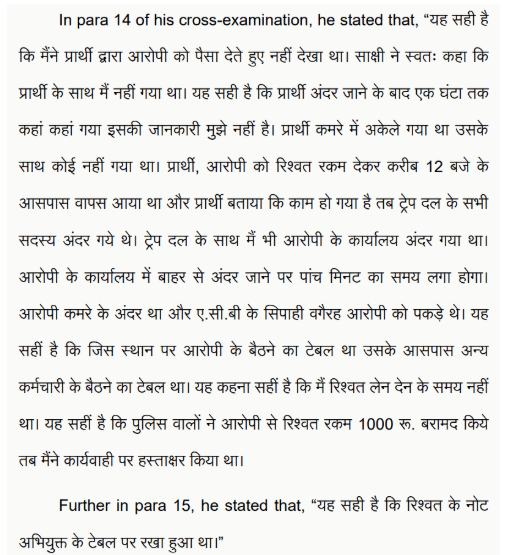
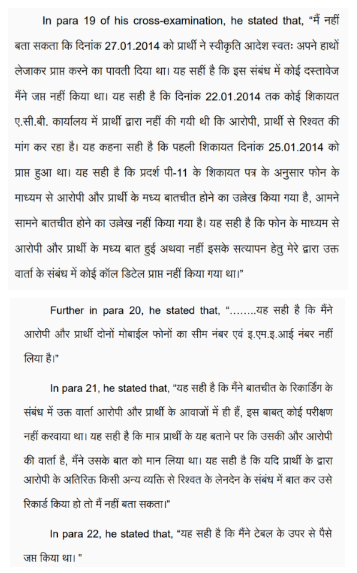
15. A close scrutiny of the testimonies of the prosecution witnesses reveals that there is no direct evidence on record establishing the alleged demand of illegal gratification by the accused. The complainant deposed that the accused had demanded money from him over a telephonic conversation; however, it is noteworthy that neither the mobile phone of the complainant nor that of the accused was seized or examined during the course of investigation.
16. The complainant stated that he had recorded the conversation with the accused in a voice recorder on 27.01.2014. However, the testimony of Manmohan Giri (D.W.-1) indicates that the complainant had already received the part-final sanction order on the very same date, i.e., 27.01.2014, thereby creating a material circumstance requiring consideration.
17. Budheshwar Sai Painkra (P.W.-11), the Investigating Officer, in his cross-examination, admitted that he had accepted the complainant's version regarding the alleged conversation with the accused solely on the basis of the complainant's statement. He further conceded that he was unable to state whether the conversation recorded by the complainant in the voice recorder was with the accused or with some other person in relation to the alleged demand of bribe.
18. Upendra Datt Bhargava (P.W.-6), the panch witness, also admitted in his testimony that he was not present at the time when the alleged conversation took place between the complainant and the accused. Consequently, his evidence does not provide any direct corroboration regarding the alleged demand of illegal gratification.
19. In the matter of Krishan Chander (supra), Hon'ble Apex Court held in paras 29 and 34 as under:-
"29. As far as the evidence of Panch witness- Anoop Kumar Verma (PW-6) is concerned, in his examination-in-chief, he stated thus:
"...Thereafter, the complainant and the accused walked for 15-20 steps and had some talk with the complainant and the complain-ant took out those GC notes from his pocket and gave in the right hand of accused which he kept in the left pocket of his shirt..."
Anoop Kumar Verma (PW-6) in his examination-in-chief has not deposed as to the exact conversation that took place between the appellant and the complainant- Jai Bhagwan at the time when he had approached him to give bribe money. He has simply mentioned about "some talk" had taken place between them but has failed to bring to light the factum of demand of bribe money by the appellant from the complainant- Jai Bhagwan. Thus, it is amply clear that panch witness- Anoop Kumar Verma did not hear the conversation between the appellant and the complainant-Jai Bhagwan. Therefore, there was no occasion for both the courts below to reach the conclusion that the appellant demanded any bribe from the complainant-Jai Bhagwan.
30. XXXX XXXX XXXX
31. XXXX XXXX XXXX
32. XXXX XXXX XXXX
33. XXXX XXXX XXXX
34. It is well settled position of law that the demand for the bribe money is sine qua non to convict the accused for the offences punishable under Sections 7 and 13(1)(d) read with Section 13(2) of the PC Act. The same legal principle has been held by this Court in the case of B. Jayaraj (AIR 2014 SC (Supp) 1837) (supra), A. Subair (2009 AIR SCW 3994) (supra) and P. Satyanarayana Murthy (supra) upon which reliance is rightly placed by the learned senior counsel on behalf of the appellant. The relevant paragraph 7 from B. Jayaraj case (supra) reads thus:
"7. Insofar as the offence under Section 7 is concerned, it is a settled position in law that demand of illegal gratification is sine qua non to constitute the said offence and mere recovery of currency notes cannot constitute the offence under Section 7 unless it is proved beyond all reasonable doubt that the accused voluntarily accepted the money knowing it to be a bribe. The above position has been succinctly laid down in several judgments of this Court. By way of illustration reference may be made to the decision in C.M. Sharma v. State of A.P. (AIR 2011 SC 608) and C.M. Girish Babu v. CBI." (AIR 2009 SC 2022) (Emphasis supplied)
In the case of P. Satyanarayana Murthy (supra) (AIR 2015 SC 3549, Paras 19, 20, 21 & 22), it was held by this Court as under:
"21. In State of Kerala and another v. C.P Rao (AIR 2012 SC (Supp) 393), this Court, reiterating its earlier dictum, vis-a-vis the same offences, held that mere recovery by itself, would not prove the charge against the accused and in absence of any evidence to prove payment of bribe or to show that the accused had voluntarily accepted the money knowing it to be bribe, conviction cannot be sustained.
22. In a recent enunciation by this Court to discern the imperative pre-requisites of Sections 7 and 13 of the Act, it has been underlined in B. Jayaraj (AIR 2014 SC (Supp) 1837) in unequivocal terms, that mere possession and recovery of currency notes from an accused without proof of demand would not establish an offence under Sections 7 as well as 13(1)(d)(i)&(ii) of the Act. It has been propounded that in the absence of any proof of demand for illegal gratification, the use of corrupt or illegal means or abuse of position as a public servant to obtain any valuable thing or pecuniary advantage cannot be held to be proved. The proof of demand, thus, has been held to be an indispensable essentiality and of permeating mandate for an offence under Sections 7 and 13 of the Act. Qua Section 20 of the Act, which permits a presumption as envisaged therein, it has been held that while it is extendable only to an offence under Section 7 and not to those under Section 13(1)(d) (i)&(ii) of the Act, it is contingent as well on the proof of acceptance illegal gratification for doing or forbearing to do any official act. Such proof of acceptance of illegal gratification, it was emphasized, could follow only if there was proof of demand. Axiomatically, it was held that in absence of proof of demand, such legal presumption under Section 20 of the Act would also not arise.
23. The proof of demand of illegal gratification, thus, is the gravamen of the offence under Sections 7 and 13(1) (d) (i)&(ii) of the Act and in absence thereof, unmistakably the charge therefore, would fail. Mere acceptance of any amount allegedly by way of illegal gratification or recovery thereof, dehors the proof of demand, ipso facto, would thus not be sufficient to bring home the charge under these two sections of the Act. As a corollary, failure of the prosecution to prove the demand for illegal gratification would be fatal and mere recovery of the amount from the person accused of the offence under Sections 7 or 13 of the Act would not entail his conviction thereunder." (Emphasis supplied)
20. In the matter of Sanjaysingh Ramrao Chavan (supra), Hon'ble Apex Court held in para 16 as under:-
"16. It is to be noted that in the first complaint filed by the second respondent, the de facto complainant, there is no allegation for any demand for bribe by the appellant. The allegation of demand is specifically against Accused 2 only. That allegation against the appellant is raised only subsequently. Be that as it may, the only basis for supporting the allegation is the conversation that is said to be recorded by the voice recorder. The Directorate of Forensic Science Laboratories, State of Maharashtra vide Annexure B Report has stated that the conversation is not in audible condition and, hence, the same is not considered for spectrographic analysis. The learned counsel for the respondents submit that the conversation has been translated and the same has been verified by the panch witnesses. Admittedly, the panch witnesses have not heard the conversation, since they were not present in the room. As the voice recorder is itself not subjected to analysis, there is no point in placing reliance on the translated version. Without source, there is no authenticity for the translation. Source and authenticity are the two key factors for an electronic evidence, as held by this Court in Anvar PV. v. P.K. Basheer."
21. In the matter of Shiv Kumar (supra), this Court held in paras 23, 24 and 26 as under:-
"23. In the case of V. Venkata Subbarao Vs. State represented by Inspector of police, A.P.6, it has been held that in order to prove the charges Under Section 7, 13(1) (d) of the Prevention of Corruption Act, it is obligatory on the part of the prosecution to prove that the accused made any demand of bribe and the statutory presumption under Section 20 of the Prevention of Corruption Act that the accused has accepted the money towards bribe cannot be accepted unless and until it is proved that there was some motive or reward for which the demand of bribe was made and the demand of bribe is proved. In the case of T. Subramanian Vs. State of T.N7., it has been held that mere proof of receipt of money by the accused in absence of proof of demand and acceptance of money as illegal gratification would not be sufficient to establish the guilt of the accused. In the case of Sita Ram Vs. State of Rajasthan8, the Supreme Court held that when story of demand of bribe by the accused appellant from the complainant was not proved and even story of demand of money by the complainant was not established beyond reasonable doubt, the rule of presumption that the money was accepted as bribe could not be resorted in order to convict the accused. In the case of Suraj Mal Vs. State (Delhi Administration)9, it has been held that in case of bribery, mere recovery of money divorced from the circumstances under which it is paid, it would not sufficient to convict the accused when the substantive evidence in the case, is not reliable. In Jagdish Chandra Makhija Vs. State of Madhya Pradesh10, it has been held that in a trap case when initial part of the story of demand and offer is found to be untrustworthy, testimony of the complainant cannot be accepted.
24. In the case of A. Subair Vs. State of Kerala11, it has been held that:
"The legal position is no more res integra that primary requisite of an offence under Section 13(1 )(d) of the Act is proof of a demand or request of valuable thing or pecuniary advantage from the public servant. In other words, in the absence of proof of demand or request from the public servant for a valuable thing of pecuniary advantage, the offence under Section 13(1)(d) cannot be held to be established."
"Mere recovery of currency notes (Rs.20/- and Rs.5/-) denomination, in the facts of the present case, by itself cannot be held to be proper or sufficient proof of the demand and acceptance of bribe. When the evidence produced by the prosecution has neither quality nor credibility, it would be unsafe to rest conviction upon such evidence."
26. The analysis of evidence on record, as above, in the circumstances of the case, renders the entire story of the prosecution with regard to demand is highly doubtful and it would be not safe to convict the appellant without independent corroboration of demand of bribe."
22. In the light of above, in the present case also, it is evident that the prosecution failed to collect any voice sample of the accused for comparison with the alleged recorded conversation. Furthermore, neither the mobile phone numbers nor the mobile handsets of the complainant and the accused were seized or subjected to investigation. The Investigating Officer, Budheshwar Sai Painkra (P.W.-11), admitted during cross-examination that he had accepted the complainant's version regarding the alleged telephonic conversation solely on the basis of the complainant's statement. He further conceded that he could not state whether the conversation recorded by the complainant in the voice recorder was with the accused or with any other person concerning the alleged demand of illegal gratification. Further, the prosecution has failed to establish that the accused possessed any authority or role in sanctioning the amount in question. The evidence on record merely proves that the accused was posted as an Accountant. On the contrary, Manmohan Giri (D.W.-1) deposed that the sanction order had already been delivered to the complainant on 27.01.2014. Thus, the prosecution has failed to establish any nexus between the accused and the sanction of the amount allegedly sought to be released.
23. Ghanshyam Thakur (P.W.-1), Shivsharan Sahu (P.W.-4) and Ram Pravesh Mishra (P.W.-7), all members of the trap party and official witnesses, supported the prosecution case only to the extent of the pre-trap proceedings and the recovery of tainted currency notes from the table of the accused. However, none of these witnesses furnished any evidence regarding the alleged demand of illegal gratification by the accused.
24. It is pertinent to note that the complainant initially lodged a complaint dated 25.01.2014 (Ex.P/11), wherein it was alleged that the accused had demanded a bribe over a telephone conversation on 24.01.2014. Subsequently, the complainant submitted another complaint dated 29.01.2014 (Ex.P/13), stating that he had recorded the conversation on 27.01.2014. Significantly, in Ex.P/13, the complainant omitted to disclose that he had already received the sanction order on 27.01.2014. This omission constitutes a material circumstance which casts doubt upon the veracity of the prosecution case and renders the conduct of the complainant suspicious.
25. Although the tainted currency notes were recovered from the table of the accused, there is no independent witness, apart from the complainant himself, who has deposed that the accused accepted or received the alleged bribe amount from the complainant.
26. The panch witnesses as well as other prosecution witnesses admitted the defence suggestion that the tables of other employees were situated in close proximity to the table of the accused. It is a settled principle of law, repeatedly affirmed by the Hon'ble Supreme Court, that mere recovery of tainted currency is insufficient to sustain a conviction under the Prevention of Corruption Act unless the foundational facts regarding demand and acceptance of illegal gratification are proved beyond reasonable doubt.
27. In the present case, the prosecution has failed to adduce cogent, reliable and convincing evidence to establish the essential ingredient of demand of illegal gratification. Consequently, the recovery of tainted currency by itself cannot give rise to a presumption of guilt. In the absence of satisfactory proof of demand and voluntary acceptance of the alleged bribe amount, the prosecution has failed to establish its case against the appellant beyond reasonable doubt. The learned Trial Court, while recording the impugned conviction, failed to properly appreciate the aforesaid material inconsistencies, omissions and deficiencies in the prosecution evidence. Accordingly, the findings recorded by the learned Trial Court are unsustainable in law and liable to be set aside.
28. Accordingly, the appeal is allowed. The judgment of conviction and order of sentence passed against the appellant for the offences punishable under Sections 7 and 13(1)(d) read with Section 13(2) of the Prevention of Corruption Act, 1988, are hereby quashed and set aside. The appellant stands acquitted of all the charges levelled against him.
29. The appellant is reported to be on bail. Keeping in view the provisions of Section 437-A of Cr.P.C. (481 of the B.N.S.S.), the appellant is directed to forthwith furnish a personal bond in terms of Form No. 45 prescribed in the Code of Criminal Procedure of sum of Rs.25,000/- with one surety in the like amount before the Court concerned which shall be effective for a period of six months along with an undertaking that in the event of filing of Special Leave Petition against the instant judgment or for grant of leave, the aforesaid appellant on receipt of notice thereof shall appear before the Hon'ble Supreme Court.
30. The trial Court record along with a copy of this judgment be sent back immediately to the trial Court concerned for compliance and necessary action.
|
| |

