| |
CDJ 2026 Ch HC 074


|
| Court : High Court of Chhattisgarh |
| Case No : WPS Nos. 4381, 4393, 4397, 4396, 4391, 4482, 4514 of 2019 etc., |
| Judges: THE HONOURABLE MR. JUSTICE NARESH KUMAR CHANDRAVANSHI |
| Parties : Jyoti Versus South Eastern Coalfields Limited Through Chairman Cum Managing Director, South Eastern Coalfields Limited, Chhattisgarh & Another |
| Appearing Advocates : For the Petitioners: Chandresh Shrivastava, Advocate. For the Respondents: Sudhir Kumar Bajpai, Atul Kumar, Kesharwani, Advocates. |
| Date of Judgment : 17-06-2026 |
| Head Note :- |
Coal Bearing Areas (Acquisition and Development) Act, 1957 - Section 4 -
Comparative Citation:
2026 CGHC 24192,
|
| Summary :- |
1. Statutes / Acts / Rules / Orders Mentioned:
- Coal Bearing Areas (Acquisition and Development) Act, 1957
- Section 4 of the Coal Bearing Areas (Acquisition and Development) Act, 1957
- Section 7 of the Coal Bearing Areas (Acquisition and Development) Act, 1957
- Section 9 of the Coal Bearing Areas (Acquisition and Development) Act, 1957
- Section 11 of the Coal Bearing Areas (Acquisition and Development) Act, 1957
- Model Rehabilitation Policy 2007
- Rehabilitation and Resettlement Policy 2012 of Coal India
- State Policy 2007 (Chhattisgarh Rehabilitation and Resettlement Policy, 2007)
- Clause 11.2.6 of the State Policy 2007
- Clause 7.1(f) of the State Policy 2007
- Clause 7.1(g) of the State Policy 2007
- Clause 10 of the State Policy 2007
- Coal India Limited (CIL) Policy 2008
- Coal India Limited (CIL) Policy 2012
- National Rehabilitation and Resettlement Policy 2007
- Land Acquisition (Rehabilitation and Resettlement) Bill, 2011
- Office Memorandum No. 490191/2011‑PRIW‑1
- Article 14 of the Constitution of India
- Article 15 of the Constitution of India
- Article 21 of the Constitution of India
- Article 166 of the Constitution of India
2. Catch Words:
employment, rehabilitation, resettlement, land acquisition, policy, constitutional rights, entitlement, representation, cut‑off area, priority, displacement, compensation, statutory force, arbitrariness.
3. Summary:
The batch of writ petitions challenges SE CL’s rejection of employment representations filed by land‑oustees of Village Pali, arguing that the State’s Model Rehabilitation Policy 2007, not the Coal India Policy 2012, should govern eligibility. The Court notes that the petitioners’ entire land was acquired under the Coal Bearing Act, 1957, and that earlier orders directed SE CL to decide representations in light of the Ku Rattho Bai judgment, which gave precedence to the State policy. SE CL contends that the Central Government’s policy applies to coal projects and that the petitioners do not meet the 0.54‑acre cut‑off. The Court rejects this, emphasizing that the State policy provides employment priority to families whose whole land is acquired, irrespective of acreage, and that the State policy has statutory backing over the CIL policy. Consequently, the impugned rejection orders are quashed and SE CL is directed to reconsider and grant suitable employment within 45 days.
4. Conclusion:
Petition Allowed |
| Judgment :- |
|
C.A.V. Order
1. Since all the above writ petitions involve common question of fact and law, they are being disposed of by this common order. For the sake of brevity and clarity WPC No.4381/2019 will serve as the lead case, and its facts and evidence shall be read as the primary basis for the adjudication of this batch of matters.
2. By way of present writ petition, the petitioners have challenged the impugned rejection order of representation (Annexure-P/1) of the petitioners which were filed for grant of employment. Though they were passed on different dates, however, they arise from a common factual matrix and involve identical questions of law concerning the grant of employment in South Eastern Coalfields Limited (henceforth the "SECL") in lieu of acquisition of their land.
3. Before proceeding in the matter it will be apposite to mention the particulars of land and case related details as per pleadings submitted by the petitioners which are mentioned below:-
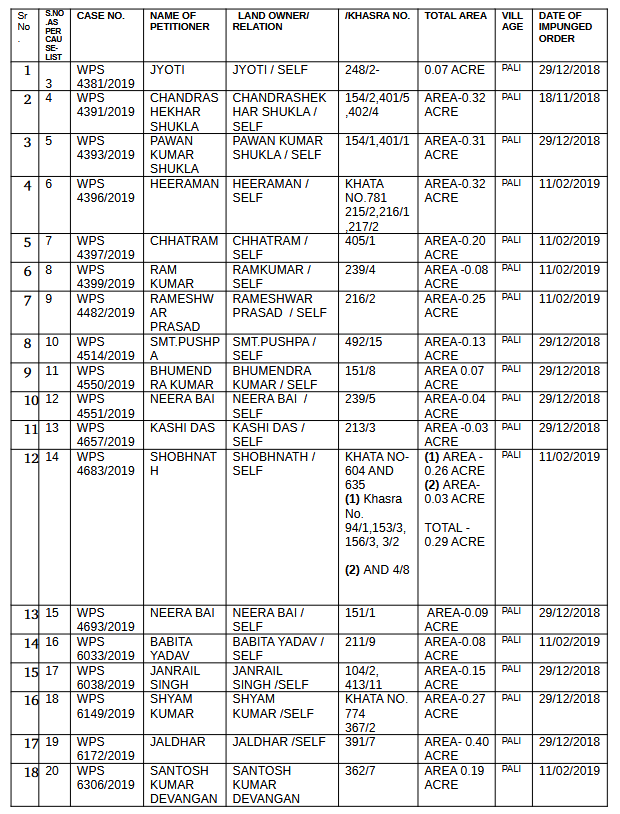
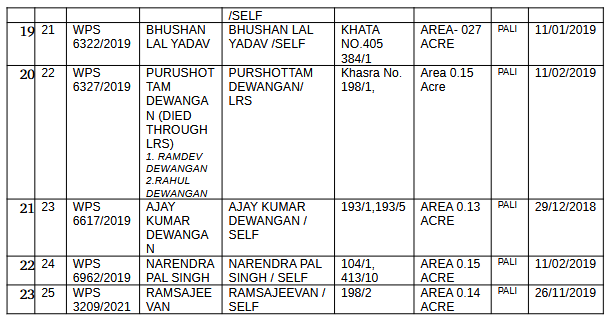
4. The facts of the case, as projected by the petitioners, are that they are the owners of land bearing different Khasra numbers (as mentioned above), with an area of less than 0.54 acres situated in Village Pali. The respondent authorities issued a notification under Section 4 of the Coal Bearing Areas (Acquisition and Development) Act, 1957 (henceforth "Coal Bearing Act, 1957"), showing their intention to prospect for coal in the said area via a notification dated 08.06.2009. Subsequently, the respondent authorities issued a notification under Section 7 of the Coal Bearing Act, 1957, regarding the acquisition of the land situated in Village Pali on 26.11.2009, which also included the land of the petitioners. Ultimately, the proceedings concluded following the acquisition of land via notification under Section 9 of the Coal Bearing Act, 1957, on 29.03.2010. As per the notification issued by the respondent authorities, the entire land of Village Pali has been acquired, including the land of the petitioners; however, the respondent authorities have not considered their cases for employment in accordance with the Model Rehabilitation Policy 2007 (Annexure-P/3) of the State. As a result, the petitioners previously preferred writ petitions, which were disposed of with a direction to the respondent authorities to consider the case of the petitioners in view of the order passed in the case of Ku. Rattho Bai & Another Vs. South Eastern Coalfields Limited & others WPS No.432/2011 decided on 23.07.2015. Respondent No. 2, ignoring the law laid down in said case regarding the applicability of the Rehabilitation Policy of the State, has passed the impugned orders rejecting the respective representations of the petitioners by making the Rehabilitation and Resettlement Policy 2012 of Coal India applicable. This occurred whereas earlier, this Court had specifically held that the policy issued by the State Government would prevail over the policy of S.E.C.L. Hence, this petition.
5. Shri Chandresh Shrivastava, learned counsel for the petitioners has made following submissions:-
5.1) That this is the second round of litigation. In the earlier round of litigation, this Court, in WPC No. 2432/2018 (Jyoti Vs. UOI & Ors) by order dated 04.09.2018, directed the respondents to decide the representation of the petitioner with regard to the applicability of the rehabilitation policy. It further directed them to decide the representation by a reasoned order expressly dealing with the issue as to whether the order passed by this Court in Ku. Rattho Bai & Another Vs. South Eastern Coalfields Limited & others WPS No.432/2011 decided on 23.07.2015., is applicable or not.
5.2) Learned counsel for the petitioners further submits that the petitioners are the owners of land situated in Village Pali. In compliance with the earlier order passed by this Court, the petitioners filed a representation for the grant of employment before the SECL, however, the same has been rejected by the impugned order dated 29.12.2018 (Annexure-P/1). The order applied the Coal India Limited Rehabilitation and Resettlement Policy, 2012 (henceforth the "Coal India Policy 2012"), whereas the SECL ought to have decided the representation by applying the Chhattisgarh Model Rehabilitation Policy, 2007 (henceforth the "State Policy 2007"). He further submits that the law has been settled in this regard by this Court in the case of Ku. Rattho Bai (Supra), holding that the State Policy 2007 shall prevail over the policy of SECL. This law has been reiterated by this Court in another case of Pyarelal Vs. SECL and others and other connected matters (WPC No.3076/2016 & connected matters delivered on 11.09.2017.) and in recent order passed in Ishwarilal Sahu Vs. State of CG and others (WPC No.6013/2024 delivered on 27.01.2026.). He further submits that since the aforesaid orders/judgments passed by this Court have never been challenged by the SECL before the Hon'ble Apex Court, as such the aforesaid judgments have attained finality.
5.3) Learned counsel further submits that the similar was issue reached to the Hon'ble Supreme Court in case of SECL Vs. Naresh Singh and others along with other connected matters (Special Leave to Appeal (C) No.2915/2009 and other connected matters deiced on 12/08/2014) (Annexure-P/9) arising out of final judgment passed by the Hon'ble High Court of Madhya Pradesh at Jabalpur. The said batch of cases were disposed of by the Hon'ble Supreme Court in view of contention made by counsel appearing for SECL that they would follow the policy set up by the State of Madhya Pradesh with regard to giving employment to the persons whose lands have been acquired. It was also contended by the counsel for SECL therein that even as per the policy laid down in the Rehabilitation and Resettlement Policy of Coal India Ltd 2012 (henceforth referred to as the "Coal India Policy 2012"), all the 899 persons will be given employment.
5.4) Learned counsel also submits that the petitioners' entire land was acquired after the final notification, and a policy cannot be applied retrospectively to take away vested rights. Nowhere does the policy deprive a person of employment when the acquired land is below a cut-off point, rather, only the priority has been fixed, wherein the petitioners are entitled to relief, having lost their entire land holding to the acquisition. He also submits that under the State's rehabilitation scheme, any person whose entire means of livelihood (land) is taken is entitled to employment. The respondents rejected the claim on the ground that the land was below the cut-off point i.e. 0.54 acre, which is illegal and arbitrary, as the State policy does not prescribe any minimum land requirement when the entire land is acquired.
5.5) He would submit that this Court has already held that the policy of the State Government carries statutory force and the same will be applicable as held in the cases of Rattho Bai, Pyarelal, and Ishwari Lal, as mentioned above. All these petitions represent a second round of litigation wherein, in the first round, the Hon'ble Court had specifically directed the respondents to consider the cases in light of the judgment passed in the case of Rattho Bai, wherein the policy of the State Government was made applicable. In all the petitions, the impugned order has been passed relying on the Coal India Policy 2012, thereby denying employment on the grounds that the area of land is below the cut-off point as determined by the respondents, which is completely illegal and arbitrary.
5.6) Learned counsel next submits that the respondents, while on one hand are denying the applicability of the Chhattisgarh Rehabilitation Policy 2007, on the other hand, as per the pleadings, are relying on a DRRC meeting which was constituted under the same Chhattisgarh Rehabilitation Policy 2007. He also submits that the respondents contended that, as per the notification, lands of five villages were acquired where the policy of Coal India was made applicable, however, in those villages itself, the respondents have picked and chosen the eligibility criteria. This is evident from the representation preferred by the villagers of Jatraj (Annexure P-10), who have categorically stated with names that in their village, some of the land oustees were given employment as per the State Rehabilitation Policy. Further, the respondents relied on the minutes of the meeting stating that the villagers agreed to the application of the Coal India policy 2012, whereas in the minutes itself, there was a specific objection by the villagers with regard to the applicability of the above 2012 policy. The respondents have argued regarding the ineligibility of the petitioners in terms of the Chhattisgarh Rehabilitation Policy 2007, however, till date, they have not even verified the claims of the petitioners in terms of the said policy.
5.7) In view of such submissions, learned counsel submits that the petitioners are poor persons and their entire lands have been acquired by the respondents; therefore, as per the State Policy 2007, all the petitioners are entitled to employment. Therefore, the respondents may be directed to provide employment to the petitioners.
6. In reply, Mr. Sudhir Kumar Bajpai and Mr. Atul Kumar Kesharwani, learned counsel for respondents/SECL vehemently opposed the submission made by the petitioners and referring to their reply made following submissions:-
6.1) After the preliminary notifications issued by the Central Government under Section 9 of the Act of 1957 on 29.03.2010, the petitioners' lands were acquired. Thereafter, in terms of Section 11 of the Act of 1957, the lands of the petitioners were handed over by the Central Government to the SECL in the year 2010. Learned counsel, referring to Clause 11.2.6 of the State Policy 2007, submits that since the mining of coal and iron ore is done mostly by undertakings of the Government of India, the Government of India is required to issue an order to public sector mining companies regarding compliance with the rehabilitation policy of the State and, if necessary, ask them to make the necessary amendments in the Central Law. The said provision specifically says that the State Policy 2007, in general, could not be made applicable to coal mine projects undertaken by the Government of India, i.e., SECL. Hence, in the absence of any notification or direction issued by the Central Government, the petitioners cannot take the benefit of the State Policy.
6.2) Learned counsel further submits that even if it is assumed that the State Policy 2007 is applicable to the case of the petitioners, the petitioners still do not fulfill the conditions mentioned in Para 7 or its sub-clauses, which deal with employment and other facilities. Further, employment is not a compulsory right of the land oustees; rather, Clause 7.1(f) provides for employment on a priority basis. The petitioners have also not filed any documents to demonstrate the priority under which their case falls regarding Clause 7.1 (f) & (g).
6.3) Learned counsel, further referring to Clause 10 of the State Policy 2007, submits that the policy itself says that in each acquisition of land for a public undertaking, a separate rehabilitation scheme shall be created; however, no separate scheme for rehabilitation has been created for the land oustees of Village Pali.
6.4) Learned counsel further refers to the minutes/resolution of the meeting dated 28.03.2016 (Annexure-R/1) held under the District Level Rehabilitation and Resettlement Committee with regard to land acquired for the Kusmunda Extension Project. He submits that the minutes/resolution of the said meeting was agreed upon by the officers of the State Government, SECL, and the Sarpanchs of various Gram Panchayats, including the Sarpanch of Village Panchayat Pali, stating that eligible land oustees will be provided compensation and employment as per the Coal India Policy 2012 issued by Coal India Limited. The said resolution has neither been challenged by the petitioners nor any objection has been raised by them. Therefore, in view of such a resolution agreed upon by the authorities and members of the Village Panchayat(s), the representations of the petitioners were rightly rejected.
6.5) Learned counsel further submits that the Coal India Policy 2012 has been framed and passed based on the deliberations of the Inter-ministerial Committee set up vide Office Memorandum No. 490191/2011-PRIW-1, dated 01/07/2011 of the Ministry of Coal; and while framing the Policy of 2012, the National Rehabilitation and Resettlement Policy 2007 and the Land Acquisition Rehabilitation and Resettlement Policy 2012 have also been kept in mind.
6.6) Learned counsel next submits that for the Kusmunda Extension Project, lands of total five villages have been acquired and the total land oustees of said villages were about 2,570, out of which 801 persons have been provided employment in descending order of the total area. Since the acquired lands of the petitioners were not found within the cut-off area i.e. 0.54 acre up to which employment has to be provided, hence in view of the resolution Annexure-R/1 and R/2, the petitioners are not entitled to get employment.
6.7) It is also submitted by counsel for the SECL that the total sanctioned manpower for the Kusmunda Project Extension is 1,975 and at present, about 2,453 persons are working in relation to said project; therefore, there is no vacancy to provide employment to the petitioners.
6.8) Counsel further submits that the judgments and orders relied upon by the petitioners in the cases of Rattho Bai (Supra), Pyarelal (Supra), Ishwarilal Sahu (Supra) rendered by this Court and Naresh Singh and Others (Supra) rendered by the Hon'ble Supreme Court were related to different projects and different schemes, and their facts are distinguishable; therefore, they are not helpful to the petitioners in the instant case(s).
6.9) Lastly, to buttress their submissions, learned counsel for the SECL placed reliance on the cases of SECL Vs. Prem Kumar Sharma AIR 2006 SC 2727, Punjab State Electricity Board Vs. Malkiat Singh AIR 2004 SC 5061, Staya Dev Bhagaur Vs. State of Rajasthan AIR ONLINE 2022 SC 168, Narmada Bachao Andolan Vs. State of MP AIR 2011 SC 1989 and Mahanadi Coalfields Ltd. Vs. Mathias Oram (2023) 16 SCC 11 to submit that the Hon'ble Supreme Court upheld the criteria of holding minimum 3 acres non-irrigated land or 2 acres irrigated land to be valid and also submit that employment in lieu of land acquisition is of nature of concession and cannot be claimed as a matter of right.
6.10) In view of such submission, learned counsel for respondents/SECL submit that the respondents/Authorities have not committed any error in rejecting the representations of the petitioners and they are not entitled for employment and prayed to reject all the writ petitions.
7. Heard learned counsel for the parties and perused the record(s) carefully.
8. Undisputedly, the petitioners are land oustees of Village Pali, and their lands, as has been mentioned in paragraph 3, have been acquired by respondents/SECL for coal extraction. It has further been stated in the reply filed by respondents/SECL that compensation for the said acquisition to be paid to the petitioners has already been assessed; however, the petitioners have not received the same as they are also seeking employment.
9. This is the second round of litigation initiated by the petitioners. Earlier, Writ Petition (Civil) No. 2432/2018 (filed by petitioner Jyoti in WPS No.4381/2019) was disposed of by a Co-ordinate Bench of this Court observing therein in paragraph 5 & 6 as under :-
"5. For other relief in respect of applicability of rehabilitation policy and grant of employment under the said policy to a member of the petitioner's family or her dependents, the petitioner may move fresh representation before the respondent/SECL within a period of one month, who in turn, shall decide the same, in accordance with law within a period of 3 months thereafter. The representation shall be decided by a reasoned order expressly dealing with the issue as to whether the order passed by this Court in Ku. Rattho Bai (referred to above) is applicable or not.
6. The Writ Petition stands disposed of in the above stated terms."
10. In compliance with the aforesaid order passed by this Court, the petitioner submitted a fresh representation seeking employment which was rejected by the respondents/SECL vide Annexure-P/1 on the ground that : "Ku. Rattho Bai was found eligible for employment pursuant to the order passed by the High Court in respect of Articles 14, 15 & 21 of the Constitution of India. Her eligibility was determined on the basis of the 'Clubbing Concept' under the Coal India Limited (CIL) Policy, 2008. However, in your case, (i.e. case of the petitioner), the area of acquired land measuring 0.07 acres is less than the prescribed area of 0.54 acres, as approved by the District Rehabilitation and Resettlement Committee under the list of decreasing areas for employment in Village Pali (CIL R/R Policy, 2012). Hence, you are not eligible for employment. Therefore, your case is different from that of Ku. Rattho Bai, as you do not fulfill the eligibility criteria for employment under the applicable Rules.........."
11. Learned counsel for the respondents/SECL vehemently argued that the CIL Policy, 2012 has been framed after due approval of the recommendations made by the Central Government Ministerial Committee constituted by the Government of India. It was further contended that the provisions of the National Rehabilitation and the Resettlement Policy, 2007 and the Land Acquisition (Rehabilitation and Resettlement) Bill, 2011 have also been considered while formulating the CIL Policy, 2012. He further contended that, in the meeting of the District Level Rehabilitation and Resettlement Committee (for short the "DRRC"), the Committee headed by the Collector, comprising officers of respondents/SECL as well as representatives of various Gram Panchayats, resolved that the CIL Policy, 2012 was more beneficial to the land oustees. Accordingly, it was decided that matters relating to employment and compensation would be governed by the CIL Policy, 2012. In the said meeting, it was also resolved that employment would be provided on the basis of decreasing order of the list, with the cut off area prescribed as 0.54 acres. Therefore, the petitioners are not entitled to get employment as the area of their acquired land is less than the prescribed cut-off area of 0.54 acres.
12. In the case of Ku. Rattho Bai (supra), the Co-ordinate Bench of this Court has categorically held that, to consider the eligibility of land oustees to provide employment, the State Government Rehabilitation Policy would prevail upon the Policy of CIL. Relevant paragraphs 6 and 7 are reproduced as under :-
"6. The Rehabilitation Policy of the erstwhile State of Madhya Pradesh issued on 25.09.1991 (Annexure P/2) provides in para (3) (ga) that such families whose entire agricultural land and/or residential land has been acquired, one candidate of such family shall be entitled for employment as third preference category. Thus, the said provision in the Policy nowhere mentions that for seeking employment, a minimum 2 acres of land has to be acquired from the family.
7. The policy issued by the SECL in the year 2002 makes such provision, however, a reading of the Policy would indicate that the said policy does not have any statutory force, whereas, the Rehabilitation Policy issued by the State of Madhya Pradesh has been issued for and on behalf of the Governor of Madhya Pradesh. Since there is no legislation covering the said field, the Policy has statutory backing in terms of Article 166 of the Constitution of India. Thus, the Rehabilitation Policy issued by the State Government would prevail upon the Policy of the SECL."
13. The aforesaid view taken by the learned single Bench has consistently been followed by this Court in a series of cases, namely, Pyarelal Vs. SECL and others (WPC No.3076 of 2016 and other connected cases); Ishwarilal Sahu Vs. State of CG and others (WPC No.6013 of 2024 and other connected cases); and Udal Ram Vs. SECL and Others (WPS No.1545 of 2018 and other connected cases) which has also been upheld by learned Division Bench in South Eastern Coalfields Limited and Others Vs. Udal Ram (WA No.424 of 2025 and other connected matters). Therefore, the contention raised by learned counsel for the respondents/SECL that the issue of providing employment to the petitioners should be considered as per the CIL Policy, 2012 instead of State Rehabilitation and Resettlement Policy, 2007 is not found to be sustainable at all.
14. A similar issue arising from the State of MP came up for consideration before the Hon'ble Supreme Court in the case of South Eastern Coalfields Limited Vs. Naresh Singh and others {SLP (C) No.2915/2009 and other connected matters}. The said cases were disposed of by the Hon'ble Apex Court vide order dated 12.08.2014 in light of the submissions made by learned counsel for petitioners/SECL that they would follow the policy set up by the State of Madhya Pradesh with regard to giving employment to the persons whose lands have been acquired. In addition thereto, it has further been submitted by him that even as per the policy laid down in the Rehabilitation and Resettlement Policy of Coal India Limited, 2012, all the 899 persons will be given employment. The issue of cases in hand is also pertaining to grant of employment, therefore, the respondents cannot be permitted to deviate from the aforesaid contention made by learned counsel for SECL before the Hon'ble Apex Court.
15. Clause 7 of the State Rehabilitation and Resettlement Policy, 2007, (english version of the same was published in the Chhattisgarh Gazette on 15.05.2008), is reproduced hereinunder :-
"7. Employment and other facilities:- 7.1 Such displaced family will be eligible for employment who has been land owner or lease holder of acquired land undependably or jointly three year prior to the date of publication of Notification under, section 4 of land acquisition act.
An one member of such displaced family providing employment shall be made agreement whose more than 75% of the land, is acquired for commercial project and whose land is acquired for industrial/mining project, one member of affected families will be provided employment as per their eligibility and appropriateness.
(a) At the time of providing employment at project work displaced family will be given priority.
(b) The eligible educated young people shall be made arrangement of training to provide them better employment in project as per their educational qualification.
(c) In the project of Govt. Department/public under taking shall be relaxed for 2 years in the appointment on grade III post.
(d) Displaced family in the project shall be made special arrangement to provide necessary transiting to make availability of beneficiary work to them.
(d) Training of Fishermen will be provided to flood affected area If there is given opportunity of fishermen in the project then society of affected people/fishermen will be preferred for tender ship.
(e) The Priority of employment shall be given in following order:-
(i) whose 100% of agricultural land and house is acquired.
(ii) Whose 100% of agricultural land is acquired.
(iii) Whose more than 75% of agricultural land is acquired.
(iv) Whose more than 50% of agricultural land is acquired.
(v) Whose more than 25% of agricultural land is acquired.
(vi) Other displaced family.
(G) If opportunity of regular employment in Commercial/Industrial/Mining project and Allied work is less than number of displaced families, then in that condition following alternatives shall be provided for them :-
(1) One member of displaced family will be given a shop (as he wants), in projects area adjacent to that or near block head office or in the area of Nagar panchayat /Municipality. Company will bear all the expenditure, In head office of the Jnpad panchyat Nagar panchyat / Municipality area company will be allotted land on the basis of sale rates by the collector. After constructing shop company will be allotted them to the displaced.
(2) Such displaced family who have an alternative of self employment in transport business whether it is related to the carriage of product or raw material use in project or passenger transport they will be given priority in transport constructs of project by the institution and to serve the purpose transport vehicle will be made available for them.
7.2 Those member of displaced families who are eligible for getting employment in projects but do not possess any necessary/ required technical qualification, then in that condition they shall be made to train them as per their educational qualification by concerned institution in case of big projects and in other cases by govt. department / Institution training will be arranged independably or by using available training facilities of state govt., as case may be.
7.3 Project affected other people specially land less people will be given training by the govt. dept. to develop new skills in them and they shall be endeavored to provide them employment in small project. Those persons will be provided work in such project generated /created by the State Government.
7.4 Displaced families shall be endeavored made to give privilege by marking them for self employment rooted plans (development of dairy, poultry, fisheries, short college industry etc.) to be executed by the state govt. and by making loan arrangements for them from financial agencies.
7.5 Government projects like Irrigation projects, Road projects, School projects or Hospital project is Public welfare projects. After there is no opportunity of employment there so there is no need to given employment to govt. projects displaced people but they shall be made legitimate provision for giving priority in employment in Government/Semi government Organization establishment.
7.6 The self help groups working in project area will be taken to join them to the activities /work in industries. To serve this purpose steps will be taken for organizing workshop/training by the concern Department /establishment."
16. A bare perusal of the Chhattisgarh Rehabilitation and Resettlement Policy, 2007 shows that it nowhere provides that a person whose land has been acquired for any Industrial/Mining project, would be eligible for employment only if he possesses any specific area of land. Rather, para 7(e) of the State Policy, 2007 provides priority in employment to those families: (i) whose 100% of agricultural land and house has been acquired; (ii) whose 100% of agricultural land has been acquired; (iii) whose more than 75% of agricultural land is acquired; (iv) whose more than 50% agricultural land is acquired; and (v) whose more than 25% of agricultural land is acquired. And as per the case(s) projected/contended by the petitioners, their entire agricultural lands have been acquired by the Respondents/SECL. As such, their cases very much fall under the category 7(e)(ii) of the State Policy 2007. Therefore, the objection raised by learned counsel for respondents that, since the area of land acquired from the petitioners is less than the prescribed cut-off area of 0.54 acres, as such, the petitioners are not entitled to get employment, is not sustainable at all.
17. The Hon'ble Supreme Court in the case of Narmada Bachao Andolan Vs. Union of India reported in (2000) 10 SCC 664, noticed that displacement of people living on the proposed project sites and the areas to be submerged is an important issue, therefore, their rehabilitation and resettlement plan would be drafted properly so that it would improve the living standards of displaced persons after displacement, and held in paragraph 241 as under: -
"241. Displacement of people living on the proposed project sites and the areas to be submerged is an important issue. Most of the hydrology projects are located in remote and inaccessible areas, where local population is, like in the present case, either illiterate or having marginal means of employment and the per capita income of the families is low. It is a fact that people are displaced by projects from their ancestral homes. Displacement of these people would undoubtedly disconnect them from their past, culture, custom and traditions, but then it becomes necessary to harvest a river for the larger good........Realising the fact that displacement of these people would disconnect them from their past, culture, custom and traditions, the moment any village is earmarked for take over for dam or any other developmental activity, the project implementing authorities have to implement R&R programmes"
18. The Hon'ble Supreme Court in the matter of N.D. Jayal and another v. Union of India and others reported in {(2004) 9 SCC 362} has observed that the land oustees have a right under Article 21 of the Constitution of India to lead a decent life and earn livelihood in the rehabilitated locations, and further held that rehabilitation of the land oustees is a logical corollary of Article 21. Paragraph 60 of the judgment reads as follows: -
"60. Rehabilitation is not only about providing just food, clothes or shelter. It is also about extending support to rebuild livelihood by ensuring necessary amenities of life. Rehabilitation of the oustees is a logical corollary of Article 21. The oustees should be in a better position to lead a decent life and earn livelihood in the rehabilitated locations. Thus observed this Court in Narmada Bachao Andolan case (2000) 10 SCC 664). The overarching projected benefits from the dam should not be counted as an alibi to deprive the fundamental rights of oustees. They should be rehabilitated as soon as they are uprooted. And none of them should be allowed to wait for rehabilitation. Rehabilitation should take place before six months of submergence. Such a time-limit was fixed by this Court in B.D. Sharma v. Union of India 1992 Supp (3) SCC 93 and this was reiterated in Narmada. This prior rehabilitation will create a sense of confidence among the oustees and they will be in a better position to start their life by acclimatizing themselves with the new environment."
19. Though employment in lieu of land acquisition is provided in nature of a concession and cannot be claimed as a matter of right, but when the State Government has framed a specific policy for the rehabilitation and resettlement of land oustees, which also contains provisions of providing employment to displaced persons, the respondents are duty-bound to consider the cases of the petitioners in accordance with the applicable Rehabilitation and Resettlement Policy, 2007. While dealing with the similar issues, the said policy has consistently been followed/upheld by this Court in a catena of judgments. Therefore, it is not supposed from respondents/SECL to deprive petitioners from getting employment by applying their own policy i.e. CIL Policy. Having considered the fact situation of instant case, as well as the consistent view taken by this Court, the case laws relied upon by learned counsel for respondents/SECL are of no assistance to him in the facts of the instant case.
20. During the course of submission, learned counsel appearing for respondents given much stress to the minutes of meeting (Annexure-R/1) held on 28.03.2016, wherein the DRRC resolved that the issues realting to employment and compensation would be governed by the CIL Rehabilitation Policy, 2012. However, learned counsel for respondents failed to disclose the project cost of Kusmunda Extension Project of Coal India that the project cost was less than Rs.100 crores. Whereas, from the facts brought by the respondents/SECL, it appears that project cost of said Extension Area was more than Rs.100 crores. Therefore, DRRC has no right to take any decision or override or substitute the provisions contemplated under the State Policy, 2007. Hence, the petitioners cannot be deprived of getting benefit of employment under the State Policy, 2007 merely on the basis of the aforesaid decision taken by the DRRC. In that view of the matter, contention of learned counsel for the respondents/SECL that Rattho Bai (Supra) was found eligible for employment as per the 'Clubbing Concept' of the CIL Policy 2008, but case of petitioner(s) of instant case is not found alike of Rattho Bai (Supra), therefore, their representation(s) have rightly been rejected, is also not found to be sustainable/defendable.
21. Right of the land losers to get employment as per the rehabilitation policy is extremely important right and that has to be considered in accordance with law and in accordance with the policy in force on the date of acquisition of their land and subsequent change in policy will not take away their accrued right, if any, that has accrued to them by acquisition of their lands. No valid agreement or consent overrides the statutory policy, and any reliance on CIL Policy, 2012, in preference to the State policy is legally untenable. Despite specific observation made by this Court in earlier round of litigation to consider the petitioners' claim in accordance with law laid down in the case of Ku. Rattho Bai (supra), respondents have unlawfully rejected the claim(s) of petitioners.
22. Thus, the benefit of rehabilitation and employment to land oustee is logical corollary of Article 21 of the Constitution of India and denial of employment is violative of Articles 14 and 15 of the Constitution of India as well as Article 21.
23. Therefore, in view of the above discussion, the impugned order(s) (Annexure-P/1) are quashed and the respondents/SECL are directed to re- consider the case(s) of the petitioners to provide suitable employment to the petitioners or family members nominated by land oustee depending upon his/her educational qualification and other eligibility in any part of its establishment. It is further observed that such consideration should be made by respondents/SECL within 45 days from the date of production of a copy of this order.
24. Accordingly, the writ petitions are allowed to the extent indicated herein- above leaving the parties to bear their own cost(s).
25. Pending application(s), if any, stand disposed of.
|
| |

