


I.A. 12495/2019 & I.A. 12496/2019
1. The present petition has been filed under Section 34 of the Arbitration and Conciliation Act, 1996 ("Arbitration Act"), seeking to set aside the impugned interim Arbitral Award dated 28th January, 2019, to the extent of findings therein which are against the petitioner.
2. I.A. 12495/2019 has been filed by the petitioner seeking condonation of delay of 30 days in filing the present petition, and I.A. 12496/2019 has been filed seeking condonation of delay of 90 days in re-filing the present petition.
3. The disputes between the parties herein had arisen in relation to the Memorandum of Understanding dated 12th March, 2015 ("MoU"), which was entered into for construction of 288 residential units at Shubh Ashray Bhiwadi at Village Ishroda, Tehsil Tijara, Rajasthan.
4. In view of the several disputes between the parties, in terms of Clause 33 of the MoU containing an arbitration clause, the parties proceeded with arbitration, wherein, the petitioner herein was the Claimant.
5. The impugned interim Award dated 28th January, 2019 came to be passed, by way of which the learned Arbitrator partly allowed the claims of the petitioner, along with the Counter Claims of the respondent, awarding an amount of Rs. 6,31,674/- with 9 % simple interest per annum, in favor of the petitioner.
6. Thus, the present petition has been filed challenging the findings of the learned Arbitrator, to the extent of denial of claims of the petitioner, on the ground that the impugned Award is perverse, illegal and in contravention to the agreed terms of contract between the parties.
7. It is the case of the petitioner that there was a delay of 30 days in initial filing of the petition, on the grounds that the Arbitrator had suo motu divided the claims into two parts, i.e., Claims 2 to 18 and Claim 1. Since the impugned interim Award was passed only in respect of Claims 2 to 18, the petitioner was waiting for the Award to be passed qua the other part also. Thus, due to no fault of the petitioner, there was a delay of 30 days in the initial filing of the present petition.
8. Further, it is the case of the petitioner that there was a delay of 90 days in re-filing the petition, on the ground that the petitioner had been removing defects from the bulky documents, within seven days of the same being raised by the Registry, which took a substantial period of time, therefore, there was a delay of 90 days in re-filing of the present petition.
9. Per Contra, it is the case of the respondent that the petitioner had acted with utter lack of due diligence in removal of defects, and several of the defects did not have anything to do with there being any bulky documents, and could have been easily rectified by the petitioner.
10. It is also the case of the respondent that the original filing of the petitioner was non-est, on account of the cumulative procedural defects, and the filing was only with a view to stop the limitation period from running. Further, no sufficient cause was shown by the petitioner to substantiate the delay in filing of the present petition. Therefore, the present petition has been filed with a non-condonable delay of 30 days.
11. I have heard learned counsels for the parties and perused the record.
12. At the outset, this Court notes the various dates and the details of filing and re-filing by the petitioner, upon the objections raised by the Registry to the present petition, on the basis of log details of filing/re-filing provided by the Registry of this Court. The relevant information necessary for the present adjudication is reproduced in a tabulated form, as follows:
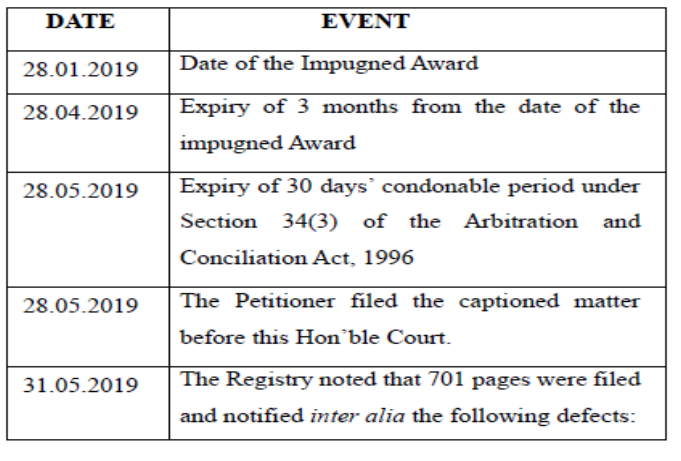
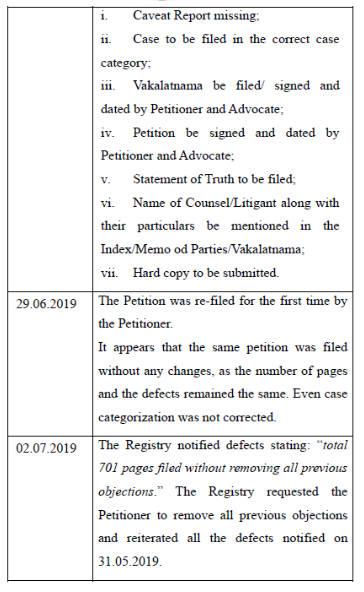
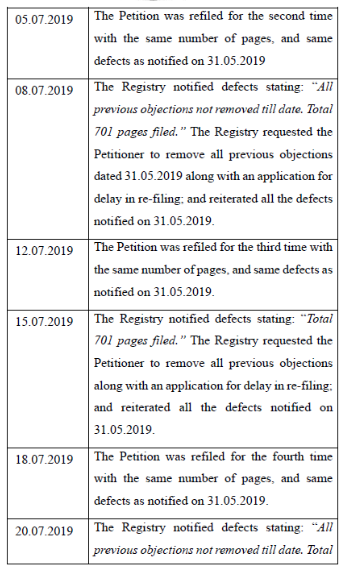
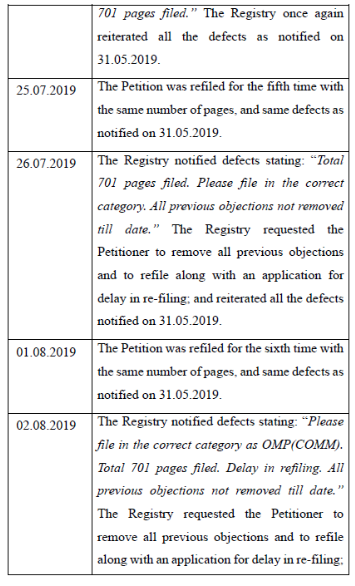
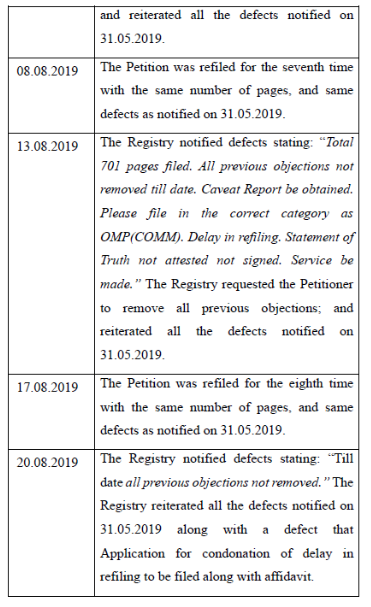
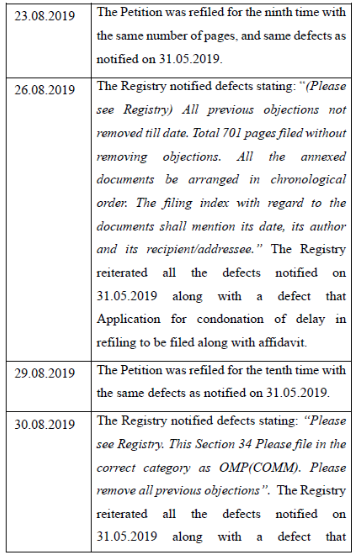
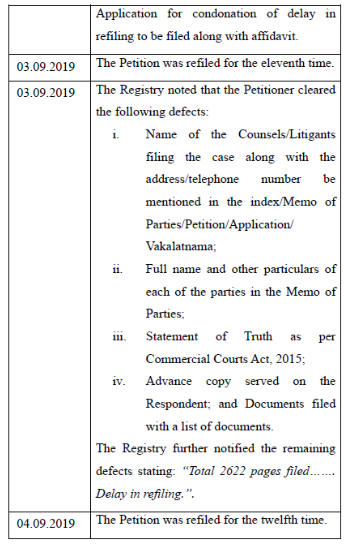
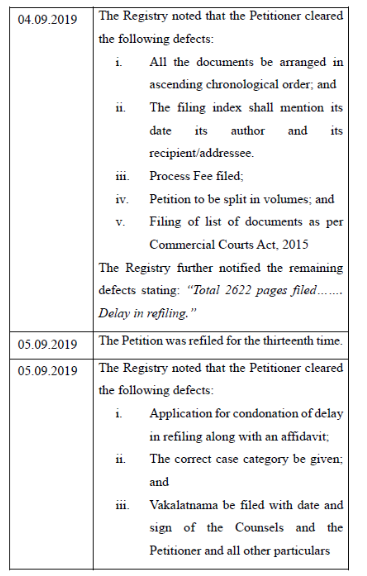
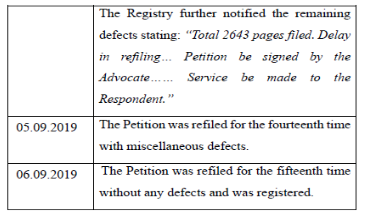
13. Perusal of the aforesaid tabular information demonstrates that the petitioner has filed the present petition on the last day of filing in the extended time period as provided by the statue.
14. As envisaged in Section 34 (3) of the Arbitration Act, a petition challenging an arbitral award has to be filed within a period of three months from the receipt of the award, and if sufficient cause is shown, the period can be further extended to 30 days. Section 34 (3) of the Arbitration Act, is reproduced as under:
"xxx xxx xxx
34. Application for setting aside arbitral award. xxx xxx xxx (3) An application for setting aside may not be made after three months have elapsed from the date on which the party making that application had received the arbitral award or, if a request had been made under Section 33, from the date on which that request had been disposed of by the arbitral tribunal:
Provided that if the Court is satisfied that the applicant was prevented by sufficient cause from making the application within the said period of three months it may entertain the application within a further period of thirty days, but not thereafter.
xxx xxx xxx"
15. The petitioner has filed the present petition beyond the statutory period of three months. Moreover, the present petition has been filed on the last day of filing in the extended time period, as provided by the statute.
16. Initially the present petition was filed with 701 pages on 28th May, 2019, to which the Registry of this Court notified 19 defects on 31st May, 2019. In this regard, the relevant portion of the ‘Log Information’ as provided by the Registry, is reproduced as under:
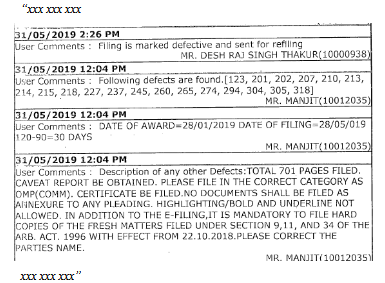
17. Thereafter, in the first nine re-filings of the petition by the petitioner on 29th June, 2019, 5th July, 2019, 12th July, 2019, 18th July, 2019, 25th July, 2019, 01st August, 2019, 08th August, 2019, 17th August, 2019 and 23rd August, 2019, the Registry of this Court had informed and noted that the exact number of pages initially filed, i.e., ‘701’, were filed on all these occasions as well, and that till said dates of respective re-filings, all of the previous objections as raised in the initial filing of the petition, had not been removed by the petitioner.
18. Further, the petitioner had initially filed the petition as an ‘Arbitration Petition’, which ex-facie is a glaring defect, and despite the information and objections raised by the Registry, i.e., ‘File in correct category as OMP (COMM)’, the same was not rectified by the petitioner till the tenth re-filing of the present petition.
19. The ‘Defects Information’, showing the details of the defects marked by the Registry of this Court and various re-filings done by the petitioner, also shows that the first date on which any defect was removed by the petitioner was on 03rd September, 2019, that too the petition was then filed with ‘2622’ pages in comparison to the ‘701’ pages filed earlier. Thus, it is evident that the same petition, with exactly the same number of pages and same defects, was filed on nine occasions over a period of three months by the petitioner, merely to create pretence of re-filing, within the period of seven days, from the date of the objections raised by the Registry.
20. It is to be noted that the only reasoning provided by the petitioner for seeking condonation of delay of thirty days in filing the present petition, is that the petitioner was awaiting the Award for the other claim raised by the petitioner, on account of the impugned Award being an interim Award.
21. Even if it is taken that the impugned Award is an interim Award, nevertheless, the aforesaid contention cannot be considered to be an acceptable justification for condoning delay, as the impugned Award had decided all but one of the claims raised by the petitioners, which decided the disputes substantially between the parties.
22. It is settled law that even if the impugned award is an interim award, if the same decides a substantial issue between the parties, the said award becomes amenable to challenge under Section 34 of the Arbitration Act, in effect, imposing the period of limitation as is applicable to any award which is challenged under Section 34 of the Arbitration Act. Thus, the Supreme Court in the case of Indian Farmers Fertilizer Cooperative Limited Versus Bhadra Products, (2018) 2 SCC 534, held as follows:
"xxx xxx xxx
13. In Satwant Singh Sodhi v. State of Punjab [Satwant Singh Sodhi v. State of Punjab, (1999) 3 SCC 487], an interim award in respect of one particular item was made by the arbitrator in that case. The question before the Court was whether such award could be made the rule of the Court separately or could be said to have been superseded by a final award made on all the claims later. This Court held: (SCC p. 491, para 6)
"6. The question whether interim award is final to the extent it goes or has effect till the final award is delivered will depend upon the form of the award. If the interim award is intended to have effect only so long as the final award is not delivered it will have the force of the interim award and it will cease to have effect after the final award is made. If, on the other hand, the interim award is intended to finally determine the rights of the parties it will have the force of a complete award and will have effect even after the final award is delivered. The terms of the award dated 26-11-1992 do not indicate that the same is of interim nature."
..........
It is, thus, clear that the first award that was made that finally determined one issue between the parties, with respect to Item 1 of the claim, was held to be an interim award inasmuch as it finally determined Claim 1 between the parties and, therefore, could not be re-adjudicated all over again.
14. In McDermott International Inc. v. Burn Standard Co. Ltd. [McDermott International Inc. v. Burn Standard Co. Ltd., (2006) 11 SCC 181], under the heading "validity of the partial award", this Court held: (SCC pp. 211-12, paras 68-70) "..........
70. We cannot also lose sight of the fact that BSCL did not raise any objection before the arbitrator in relation to the jurisdiction of the arbitrator. A ground to that effect has also not been taken in its application under Section 34 of the Act. We, however, even otherwise do not agree with the contention of Mr Mitra that a partial award is akin to a preliminary decree. On the other hand, we are of the opinion that it is final in all respects with regard to disputes referred to the arbitrator which are subject-matters of such award. We may add that some arbitrators instead and in place of using the expression "interim award" use the expression "partial award". By reason thereof the nature and character of an award is not changed. As, for example, we may notice that in arbitral proceedings conducted under the Rules of Arbitration of the International Chamber of Commerce, the expression "partial award" is generally used by the arbitrators in place of interim award. In any view of the matter, BSCL is not in any way prejudiced. We may state that both the partial award and the final award are subject-matter of challenge under Section 34 of the Act."
15. Tested in the light of the statutory provisions and the case law cited above, it is clear that as the learned arbitrator has disposed of one matter between the parties i.e. the issue of limitation finally, the award dated 23-7-2015 is an "interim award" within the meaning of Section 2(1)(c) of the Act and being subsumed within the expression "arbitral award" could, therefore, have been challenged under Section 34 of the Act.
xxx xxx xxx"
(Emphasis Supplied)
23. Likewise, in the case of State of Arunachal Pradesh Versus Damani Constructions Co., (2007) 10 SCC 742, Supreme Court clarified that the limitation period qua an interim award operates in terms of Section 34(3) of the Arbitration Act, where the said award is final in respect of the claims adjudicated therein. Accordingly, the plea of the petitioner that it was awaiting the award in other part of the claim raised by it, is wholly unacceptable, and does not provide a valid explanation for delay in filing the petition.
24. In relation to the aspect of condonation of delay in re-filings, the petitioner has sought to justify the delay on the ground that the documents were bulky and that there were many defects in the petition. However, mere fact that the documents were bulky/ voluminous, is not a justifiable ground in seeking condonation of delay, especially, considering the fact that the petition was re-filed by the petitioner time and again, without removing any defects. The plea raised by the petitioner in this regard is completely frivolous, and is untenable.
25. Pertinently, despite the defects being first notified on 31st May, 2019, the petitioner made no attempts to remove even the most basic defects such as correcting the case category, till 5th September, 2019, which evidently had nothing to do with bulky documents.
26. Further, when re-filing was done by the petitioner for the eleventh time on 3rd September, 2019, ‘2622’ pages were filed by the petitioner, in comparison to the initial ‘701’ pages which were filed on 28th May, 2019, i.e., at the time of first filing. This variance in the number of pages in the initial and subsequent filings, unequivocally brings forth that the initial filing by the petitioner, and that too on the last day of the outer limit as provided in the statute, was merely an attempt by the petitioner to circumvent the rigors of limitation.
27. It is pertinent to note that the defects in the petition were ultimately removed by the petitioner only when the petition was re-filed for the fifteenth time on 6th September, 2019. Further, on the said date, i.e., 06th September, 2019, at the time of the fifteenth re-filing of the petition, hundred days had already passed, counted from the last day of extended filing as per the statute, i.e., 28th May, 2019.
28. Such conduct of the petitioner constitutes a flagrant misuse and abuse of the process of Court, and demonstrates that the petitioner acted with willful neglect, in reckless disregard to the timelines set out for removing the defects and objections, as raised by the Registry of this Court.
29. From the aforesaid narrative, it is evident that the petitioner has been grossly negligent in filing the present petition belatedly on the last day of the extended outer limit as provided by the statute, and in re-filing the petition without removing the defects in the petition. No proper or justifiable reasons have been advanced by the petitioner for delay in filing and re-filing of the present petition. The reasons and explanation given by the petitioner for delay in filing and re-filing, in that the record was voluminous or that the petitioner was waiting for passing of the award in another part of the petitioner’s claim, are far from satisfactory and woefully inadequate.
30. The period of limitation as prescribed under Section 34 (3) of the Arbitration Act is strict and inflexible. The statutory scheme unequivocally provides that no party can file a petition under Section 34 of the Arbitration Act, beyond the period of three months as provided therein, except where the Court is satisfied that sufficient cause has been shown and in that eventuality, a Court may entertain the petition for a further period of 30 days, but not thereafter. Thus, it is clear that as per the statutory scheme, no petition can be entertained under Section 34 of the Arbitration Act, beyond the outer limit of further extended period of thirty days after expiry of three months from the date of receipt of the award.
31. Considering the inelastic period of limitation under Section 34 (3) of the Arbitration Act, it is imperative that a party gives sufficient cause for delay in filing and re-filing and would have to show that the delay was occasioned for reasons beyond the control of the said party, despite due diligence.
32. The aspect of ‘sufficient cause’ requires that a party should not have acted in a negligent manner or there was a want of bona fide on its part in view of the facts and circumstances of a case, or it cannot be alleged that a party has ‘not acted diligently’ or ‘remained inactive’. Thus, the Supreme Court in the case of Basawaraj and Another Versus Special Land Acquisition Officer, (2013) 14 SCC 81, held as follows:
"xxx xxx xxx
9. Sufficient cause is the cause for which the defendant could not be blamed for his absence. The meaning of the word "sufficient" is "adequate" or "enough", inasmuch as may be necessary to answer the purpose intended. Therefore, the word "sufficient" embraces no more than that which provides a platitude, which when the act done suffices to accomplish the purpose intended in the facts and circumstances existing in a case, duly examined from the viewpoint of a reasonable standard of a cautious man. In this context, "sufficient cause" means that the party should not have acted in a negligent manner or there was a want of bona fide on its part in view of the facts and circumstances of a case or it cannot be alleged that the party has "not acted diligently" or "remained inactive".
However, the facts and circumstances of each case must afford sufficient ground to enable the court concerned to exercise discretion for the reason that whenever the court exercises discretion, it has to be exercised judiciously. The applicant must satisfy the court that he was prevented by any "sufficient cause" from prosecuting his case, and unless a satisfactory explanation is furnished, the court should not allow the application for condonation of delay. The court has to examine whether the mistake is bona fide or was merely a device to cover an ulterior purpose. xxx xxx xxx"
(Emphasis Supplied)
33. In the present case, the petitioner has failed to give any plausible explanation and justification, which can be termed as a ‘sufficient cause’. Mere bulky record or waiting for award in other claims to be passed, can hardly be countenanced as a ‘sufficient cause’ for condoning delay, especially, in cases governing Section 34 (3) of the Arbitration Act, wherein, the limitation period has been held to be strict and inflexible by Courts, time and again.
34. Due to blatant negligence and want of diligence during the course of the filing and re-filing, the petitioner has failed to establish ‘sufficient cause’, to warrant the invocation of discretionary jurisdiction of this Court to condone the delay in filing and re-filing of the present petition.
35. In this regard, reference may be made to the judgment in the case of Shivamma (Dead) by Lrs Versus Karnataka Housing Board and Others, 2025 SCC OnLine SC 1969, wherein, while dealing with the aspect of ‘sufficient cause’, the Supreme Court has held as follows:
"xxx xxx xxx
125. The expression "sufficient cause" is not itself a loose panacea for the ill of pressing negligent and stale claims. The expression is to be construed with justice-oriented flexibility so as not to punish innocent litigants for circumstances beyond their control.
126. Courts must not condone gross negligence, deliberate inaction, or casual indifference, for to do so would undermine the maxim interest reipublicae ut sit finis litium and destabilise the certainty that limitation law seeks to secure.
127. The expression "sufficient cause" must be construed in a manner that advances substantial justice while preserving the discipline of limitation. The courts are not to be swayed by sympathy or technical rigidity, but rather by a judicious appraisal of whether the applicant acted with reasonable diligence in pursuing the remedy. Where explanation is bona fide, plausible, and consistent with ordinary human conduct, courts have leaned towards condonation. Where negligence, want of good faith, or a casual approach is discernible, condonation has been refused.
xxx xx xxx
235. An application seeking condonation of delay is to be decided only within the parameters laid down by this Court. In case there was no sufficient cause to prevent a litigant to approach the court on time condoning the delay without any justification, on lofty ideals amounts to passing an order in violation of the statutory provisions and it tantamounts to showing utter disregard to the statute.
xxx xxx xxx
259. We are of the view that the question of limitation is not merely a technical consideration. The rules of limitation are based on the principles of sound public policy and principles of equity. We should not keep the ‘Sword of Damocles’ hanging over the head of the respondent for indefinite period of time to be determined at the whims and fancies of the appellants.
xx xxx xxx"
(Emphasis Supplied)
36. Accordingly, in the absence of any reasons in the applications for condonation of delay in filing and re-filing the present petition, which can be termed as ‘sufficient cause’, there is no occasion for this Court to exercise its discretion to condone the delay in the present case.
37. Further, considering the facts and circumstances of the present case, even on the parameters of ‘non-est’ filing, the petition is liable to be dismissed. The defects in the present petition, when cumulatively considered, render the present petition as non-est.
38. In the light of the above discussion, this Court finds no merit in the applications seeking condonation of delay in filing and re-filing the present petition. The same are accordingly dismissed.
39. Consequently, the present petition stands dismissed, as barred by limitation.

 |
This Product is Licensed to , |