


Oral Judgment
R.T. Vachhani, J.
1. Being aggrieved and dissatisfied with the judgment and order dated 07.08.2013 passed by learned Sessions Court, Bhavnagar Camp at Botad in Sessions Case No.53 of 2012, the present appeals being Criminal Appeal No.1220 of 2013, has been preferred by the appellant-accused No.2 and Criminal Appeal No.621 of 2014, has been preferred by the appellant-accused No.1.
2. The appellants-accused have been sentenced for the offence punishable under Section 302 of the Indian Penal Code ("IPC" for short), to undergo rigorous imprisonment for life, as well as fine of Rs.5000/- each, in default of which, to undergo 1 year simple imprisonment. The appellant-accused No.1 has further been sentenced for the offence under Section 135 of the Bombay Police Act, to undergo 1 year simple imprisonment and a fine of Rs.500/-, in default of which, to undergo 15 days simple imprisonment. As both the appeals arise out of common judgment, the same is being decided by a common judgment.
3. The brief facts leading to the filing of the present appeals are as under:
3.1. The prosecution case, in brief, is that the marriage of the sister of accused No.1 Rajubhai (namely Dharmishtha) was fixed with Pravinbhai Talshibhai residing at Than, which was arranged by the deceased Dhirubhai Zaverbhai Satani. Accused No.1 Rajubhai was informed by the deceased that it was the second marriage of Pravinbhai, however, subsequently, accused No.1 came to know that it was the fourth marriage of Pravinbhai, keeping grudge on this count, on 20.12.2011 between 17:00 hours and 17:15 hours, accused No.1 called the deceased Dhirubhai Zaverbhai at Botad Swaminarayan Gurukul City Bus Stop on Gadhada Road, inflicted knife blows on his abdomen and chest, causing his intestines to protrude, resulting in his death. Accused No.2 assisted by taking the appellant-accused No.1 on motorcycle from the scene of offence and helping accused No.1 to escape.
3.2. On the same day i.e. 20.12.2011, the complainant Maheshbhai Dhirubhai gave information regarding the offence, pursuant to which Botad Police registered First Information Report being C.R. No.171 of 2011. Investigation was carried out by the police officer concerned, during which evidence was collected and accused persons were arrested.
3.3. After completion of investigation, charge-sheet was filed before learned Judicial Magistrate First Class, Botad, being Criminal Case No.110 of 2012. Since the offences were exclusively triable by the Court of Session, learned Judicial Magistrate First Class, Botad committed the case to learned Sessions Court, where it was registered as Sessions Case No.53 of 2012.
3.4. Upon framing of charge for the aforesaid offences, the accused pleaded not guilty and claimed trial. The prosecution adduced evidence in support of its case. The learned Sessions Court after completion of trial and upon scrutinizing the evidence at length, convicted the appellants- accused. Hence, the present appeal is preferred.
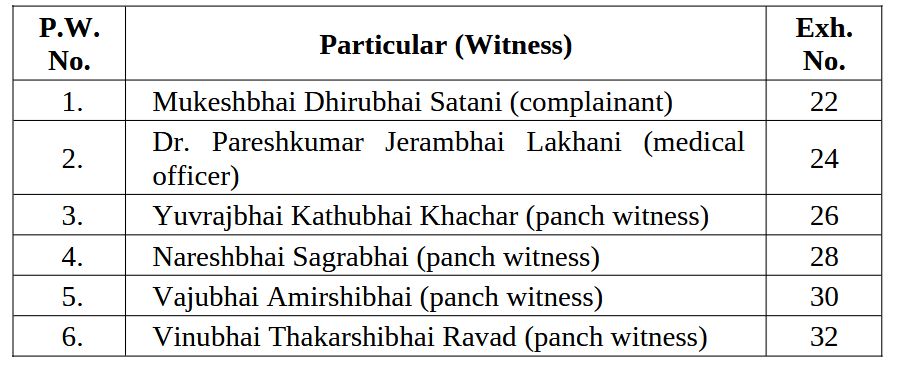
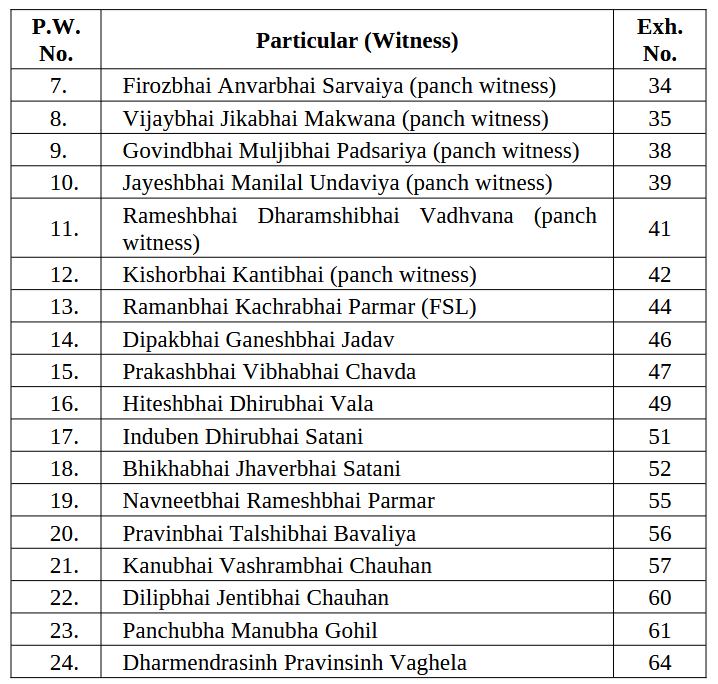
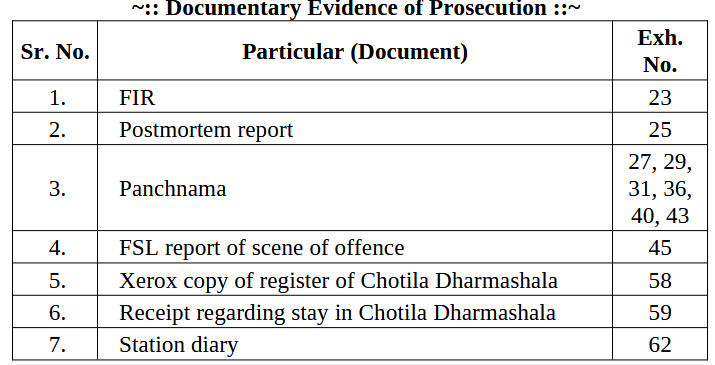
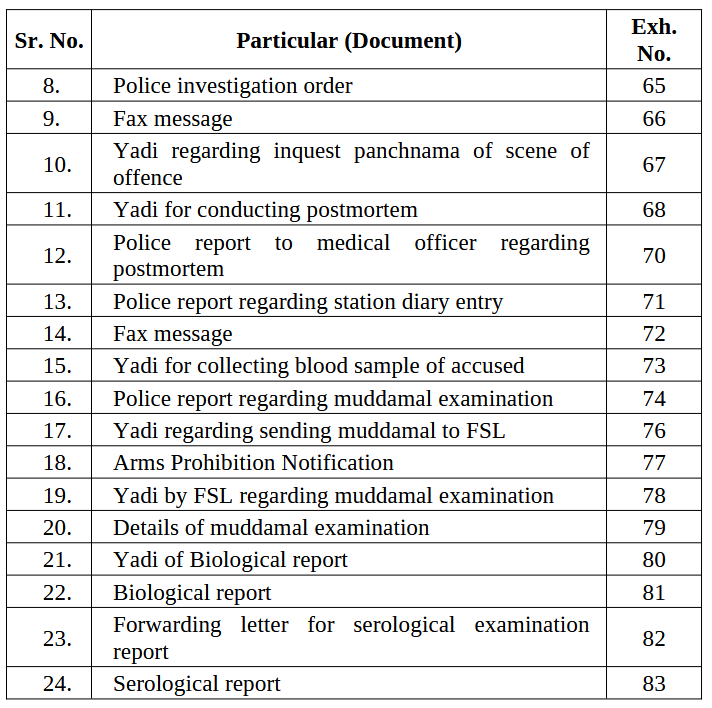
4. We have heard learned advocates for the respective parties and carefully examined the oral and documentary evidence adduced before learned Sessions Court. During the course of the trials, the prosecution examined witnesses and produced documents as detailed below:
~:: Oral Evidence of Prosecution ::~ P.W. Exh.
5. Submissions on behalf of the Appellant in Criminal Appeal No.1220 of 2013:
5.1. Learned advocate Mr.K J Panchal for the appellant-accused No.2 in Criminal Appeal No.1220 of 2013 challenged the impugned judgment and order dated 07.08.2013 passed by learned Sessions Court, Bhavnagar Camp at Botad in Sessions Case No.53 of 2012. He submitted that learned Sessions Court committed a serious error in convicting the appellant under Section 302 read with Section 34 IPC by relying on weak and incomplete circumstantial evidence, when the entire direct evidence had already failed.
5.2. He submitted that the panch witness PW-3, Yuvarajbhai Kathubhai Khachar, at Exh.-26 to the scene-of-offence panchnama, whom learned Sessions Court treated as an independent witness, clearly admitted during cross-examination that he had never seen the complainant before the panchnama was prepared and that the complainant had not dictated its contents. According to him, these important admissions destroy the independent nature of the document and create a reasonable doubt as to whether the panchnama was prepared at the instance of the police or the complainant. He submitted that in the absence of any incriminating material recovered from the spot directly connecting the appellant with the offence, this evidence cannot support the prosecution case.
5.3. Learned advocate further submitted that the 3 alleged eye- witnesses - PW-14 Dipakbhai Ganeshbhai Jadav, at Exh.-46, PW- 15 Prakashbhai Vibhabhai Chavda and PW-16 Hiteshbhai Dhirubhai, at Exh.-49 - who had earlier given detailed statements under Section 161 CrPC stating that they had seen the stabbing, completely turned hostile during the trial and did not support the prosecution case. Their general statements that they saw the deceased lying in pool of blood and that they knew the appellants do not establish that the appellant-accused No.2 was involved in committing the offence.
5.4. He further submitted that the oral evidence of PW-19 Navneetbhai Rameshbhai Parmar, at Exh.-55 is weak and neutral in nature. The witness never stated that he had seen the deceased or any stabbing, he only claimed that he had seen both accused standing with Dilip and later passing on a motorcycle. During cross-examination by the appellant's side, he admitted that he did not know who passed on the road and that he had not actually seen the appellants. According to him, such unreliable evidence cannot form a link in the chain of circumstances.
5.5. Mr.Panchal submitted that the oral evidence of PW-21 Kanubhai Vashrambhai Chauhan, at Exh.-57, and the documents namely the register (Exh-58) and receipt (Exh-59) contain clear inconsistencies. The witness stated orally that the person brought by the police had stayed there about one-and-a-half years earlier, whereas the documents are dated 20.12.2011. He submitted that even if this evidence is accepted, staying for a night in a public dharamshala is a neutral and natural circumstance and does not prove that accused No.2 had fled or was involved in the offence.
5.6. Regarding discovery/recovery of the knife, it is submitted that both panch witnesses (PW-35 and PW-38) did not support the discovery panchnama (Exh-36) and turned hostile. It is further submitted that the learned Sessions Court committed an error in relying only on the statement of the Investigating Officer, because when independent panch witnesses do not support the discovery hence, the recovery under Section 27 of the Evidence Act cannot be treated as proved. He further submitted that there was a delay of 12 days in sending the knife to the FSL and there is no explanation regarding its sealing or custody during that period, which creates serious doubt about the article. The FSL reports showing blood group 'B' and stating that the injuries "could have been caused" by the knife have no value when the recovery and custody of the knife itself are doubtful.
5.7. It is therefore prayed that the conviction of the appellant-accused No.2 is clearly perverse, the chain of circumstances is incomplete at every stage, and therefore the appellant deserves to be acquitted.
6. Submissions on behalf of Appellant in Criminal Appeal No.621 of 2014:
6.1. Learned advocate Mr.Ashish M Dagli for the appellant-accused No.1 in Criminal Appeal No.621 of 2014 adopted the submissions made by learned advocate Mr.K J Panchal and further challenged the impugned judgment. He submitted that learned Sessions Court committed a serious error in relying on the same weak and incomplete circumstantial evidence to convict the appellant- accused No.1 not only under Section 302 IPC but also under Section 135 of the Bombay Police Act.
6.2. Mr.Dagli submitted that the evidence of the scene-of-offence panch, the 3 hostile eye-witnesses and the testimony of PW-19 Navneetbhai suffer from the same defects already pointed out earlier. He specifically submitted that the admissions made by Navneetbhai during cross-examination completely destroy the inference drawn by learned Sessions Court that the appellants immediately fled from the place. Regarding the dharamshala evidence, he pointed out the clear inconsistency between the oral statement of Kanubhai that the person had stayed there about one- and-a-half years earlier and the documents which are dated 20.12.2011. He submitted that, this evidence contradicts itself and therefore cannot be relied upon. He further submitted that even if the alleged stay is accepted, it does not prove that the appellant fled from the place of offence or that he had any guilty intention.
6.3. Regarding discovery/recovery of the knife, Mr.Dagli submitted that both panch witnesses having turned hostile, the discovery cannot be proved only on the basis of the statement of the Investigating Officer. He further submitted that the delay in sending the weapon to the FSL on 06.01.2012 has not been explained and there is no evidence showing that the weapon was properly sealed and safely kept during that period, which makes the article doubtful. The FSL biological and serological reports showing blood group 'B' similar to that of the deceased and the tool-mark opinion stating that the injuries "could have been caused" by the knife are inconclusive and have no value when the basic fact of recovery of the knife at the instance of the appellant itself is not proved. Therefore, the additional conviction under Section 135 of the Bombay Police Act, which is based on the same knife, also cannot stand.
6.4. He submitted that the entire prosecution case is based only on circumstantial evidence which is neither complete nor clearly points towards the guilt of the appellant. When all the direct witnesses have failed to support the prosecution and every circumstance relied upon by learned Sessions Court is either unreliable, contradictory or not proved, the conviction cannot be sustained. He therefore prayed that the appellant-accused No.1 be acquitted from all the charges.
7. Submissions on behalf of learned APP for the State in both appeals:
7.1. Learned APP for the respondent-State in both the appeals supported the impugned judgment and order dated 07.08.2013 passed by the learned Sessions Court. He submitted that learned Sessions Court has correctly convicted both the appellants on the basis of clear, reliable and consistent circumstantial evidence which clearly points towards their guilt.
7.2. He submitted that the panch witnesses of the scene-of-offence panchnama supported the prosecution and properly described the place of offence near the City Bus Stand on Gadhada Road beside Swaminarayan Gurukul. He further submitted that the contradictions in the statements made by the witness in cross- examination are minor and do not affect their credibility. He further submitted that the defence never disputed that the incident had taken place at that very spot.
7.3. It is further submitted that although the 3 eye-witnesses turned hostile regarding the actual stabbing, they clearly admitted that they were present at the place of incident at the relevant time, that they saw the deceased lying in pool of blood and that they knew both the appellants as they belonged to the same village. He submitted that learned Sessions Court rightly concluded that these witnesses were trying to protect the accused, but their presence at the scene of offence is clearly proved.
7.4. Regarding PW-19 Navneetbhai Rameshbhai Parmar, at Exh.-55, he submitted that the witness proved that both the appellants were present near the Gurukul at the relevant time and that they left immediately thereafter on a motorcycle. It is further submitted that, this is an important circumstance showing their presence and their immediate departure from the place, and the cross-examination does not destroy the important part of his evidence.
7.5. Regarding stay in the dharamshala at Chotila, learned APP submitted that the register (Exh-58) and receipt (Exh-59) dated 20.12.2011 clearly prove that accused No.1 stayed there on the same night of the incident. He submitted that the dharamshala is a public trust and had no reason to create false records, and the defence has not suggested any enmity against the accused. According to him, this circumstance clearly shows that the accused fled from the place after the incident and indicates a guilty mind.
7.6. Regarding the discovery/recovery of knife, it is submitted that even though the panch witnesses turned hostile, the discovery of the knife at the instance of accused No.1 is clearly proved by the evidence of PW-24 Investigating Officer PI D.P. Vaghela, at Exh.- 64. He submitted that the legal position is well settled that if the recovery is otherwise proved, the fact that the panch witnesses turned hostile does not make the discovery invalid. He further submitted that the delay of 12 days in sending the article to the FSL is not fatal because no suggestion was made that the delay affected the blood stains on the article.
7.7. He further submitted that the FSL reports are strong evidence. Human blood of group 'B', which matches the blood group of the deceased, was found on the knife and its sheath, and the tool-mark examination shows that the cuts on the shirt could have been caused by that very knife. According to him, these scientific findings, along with the other circumstances, complete the chain of evidence and prove beyond reasonable doubt that both the appellants, acting with common intention, committed the murder of the deceased. Learned APP therefore prayed that both the appeals be dismissed and that the conviction and sentence imposed by learned Sessions Court be confirmed, in the interest of justice.
8. Heard learned Advocates for the appellants and learned APP for the respondent - State and perused the deposition of witnesses as also documentary evidence placed on record as well as the order passed by learned Sessions Court.
9. The deposition of the panch witness to the panchnama of the scene of offence, PW-3 Yuvarajbhai Kathubhai Khachar, at Exh.-26, supports the prosecution case as he has stated that he was called to the place of the incident near the City Bus Stand on Gadhada Road beside the Swaminarayan Gurukul, Botad. He further stated that he went there along with another panch, Ishwarbhai Valjibhai Kalathiya, and the complainant, and he has also wholly described the place of incident. The learned Sessions Court, held that this witness has clearly supported the prosecution case and that his evidence gives full support to the prosecution. The learned Sessions Court further observed that although during detailed cross-examination the witness admitted that he had not seen the complainant before the panchnama and that the complainant had not dictated the contents of the panchnama, there was still no reason to disbelieve him because the defence had not claimed that the incident had not occurred at that place, and the witness was an independent person and not a friend or relative of the complainant.
10. After carefully and independently examining the evidence, we find that the admissions made by the witness in cross-examination are important and they affect the independence and reliability of the witness. The fact that the witness did not know the complainant earlier and that the panchnama was not prepared according to the complainant's dictation creates a reasonable doubt about whether the panchnama was truly an independent document or whether it was influenced by the complainant. In the absence of any incriminating material from the place of the incident directly connecting the appellants-accused with the offence, the testimony of this witness cannot be said to meaningfully support the prosecution case. Therefore, the finding recorded by learned Sessions Court cannot be accepted, and this evidence does not prove the guilt of the appellants-accused beyond reasonable doubt.
11. The depositions of the three witnesses PW-14 Dipakbhai Ganeshbhai Jadav, at Exh.-46, PW-15 Prakashbhai, at Exh.-47 and PW- 16 Hiteshbhai Dhirubhai Vala, at Exh.-49, in brief, show that although in their police statements they had stated that they had seen the entire incident in which the appellant-accused No.1 stabbed the deceased at the City Bus Stand near the Swaminarayan Gurukul on Gadhada Road, Botad, they did not support the prosecution case when they gave their evidence before the Court and were therefore declared hostile after cross- examination, so also while being contradicted with their earlier version, by the prosecution, they only admitted that they had gone to the Gurukul on one motorcycle to meet the principal for work, had come out and seen the deceased lying in a pool of blood, and that they knew the appellants- accused as all of them were from Gadhada village.
12. The learned Sessions Court, held that even though these witnesses did not support the main facts of the prosecution, their evidence still proved that they were present at the place of the incident at the relevant time and also showed the presence of the appellants-accused, and since they belonged to the same village and knew the accused, it could reasonably be inferred that they were trying to protect the appellants-
accused and therefore the argument of the defence raised therein that their evidence stood rejected by learned Sessions Court, while turning down the same requires to be interfered with.
13. It transpires from the record that the complete failure of these three witnesses to support the main prosecution story of the stabbing, despite having given detailed police statements earlier, makes their evidence wholly unreliable and creates a serious doubt about the very origin of the prosecution case, the conclusion of the learned Sessions Court that they were trying to protect the accused is only speculation and is not supported by any material on record, and their general statements about being present at the place after the incident are vague and neutral and do not connect the appellants-accused with the actual commission of the offence, therefore no reliance can be placed on their depositions.
14. The deposition of PW-19 Navneetbhai Rameshbhai Parmar, at Exh.-55, states that he had gone with one Dilip on a Splendor motorcycle towards Botad and had stopped near the Gurukul to buy pan-masala where he saw the appellants-accused Rajubhai and Sanjaybhai standing with Dilip, and thereafter they left for Gadhada, and on the way they stopped and at that time, Dilip cleaned the spark plug of the motorcycle, and at that time he saw the appellants-accused passing on a motorcycle towards Gadhada at some speed with one of them saying "chalo", and that on the next day he came to know at Dilip's shop that the deceased had been murdered at Botad, he has not stated that he saw the incident itself.
15. The learned Sessions Court, held that this evidence clearly proved the presence of the appellants-accused at the place of offence at the relevant time and also showed that they left immediately afterwards, which according to the Court was a strong circumstantial circumstance showing their involvement, particularly when the direct witnesses had admitted their presence but had not supported the main facts, and it was also observed that the important parts of this evidence were not effectively challenged in cross-examination.
16. We find that this deposition does not show that the deceased was present at the place when Navneetbhai was there, nor does it show that the appellants-accused had any interaction with the deceased or committed any act against him, the statement that the appellants-accused were merely standing with Dilip and were later seen passing on a motorcycle is a neutral circumstance and does not in any manner connect them with the murder. Further, in cross-examination by advocate for accused No.2 the witness has clearly admitted that while he was urinating he does not know who passed on the road and that it is true that he did not see Sanjaybhai and Rajubhai on the road, and this admission completely weakens the reliability of his evidence about the alleged act of leaving the place, the limited cross-examination by advocate for accused No.1 does not remove these basic weaknesses, and the so-called circumstantial evidence is too weak and uncertain to prove the guilt of the appellants- accused beyond reasonable doubt when the direct evidence has completely failed. Therefore, the manner in which learned Sessions Court has appreciated this evidence is incorrect and such evidence cannot be made the basis for conviction.
17. As per the deposition of PW-21 Kanubhai Vashrambhai Chauhan, at Exh.-57 clerk at the Talpada Koli Jati Seva Samaj Trust dharamshala at Chotila, in brief, states that after the incident, the appellant-accused No.1 stayed at the said dharamshala on the night of 20.12.2011. To support this, he produced the original register of the dharamshala (Exh-58) which shows an entry at serial No.585 in the name of the appellant-accused No.1 with a note that Rs.20/- was received, and he also produced the receipt (Exh-59) issued to the appellant-accused No.1 mentioning the address Bhadli Jhampa, Gadhada. He further stated that when the police brought the appellant-accused No.1 for inquiry, he identified him as the person who had stayed in the dharamshala about one-and-a-half years earlier.
18. The learned Sessions Court, held that this evidence along with the register (Exh-58) and receipt (Exh-59), both dated 20.12.2011, clearly proved that accused No.1 had stayed in the dharamshala on the very night of the incident at Botad. The Court also observed that during cross- examination the appellants-accused did not challenge the fact that the appellant-accused No.1 had stayed there or the identification of the appellant-accused No.1 when he was brought by the police. The learned Sessions Court further held that the defence claim that these documents were created later had no substance because the dharamshala belongs to a public trust which had no reason to prepare false records, no enmity with the accused was suggested, and the accused also did not explain why a person from Gadhada, who could return home within 4 to 5 hours, would stay overnight there. On this basis the learned Sessions Court held that this circumstance strengthened the chain of evidence against the appellants-accused.
19. However, we find that the entire evidence of this witness is unreliable and does not prove any incriminating circumstance. The witness has stated in his oral evidence that the person brought by the police, i.e., the appellant-accused No.1, had stayed in the dharamshala about one-and-a-half years earlier, but the register and receipt produced by him relate to the date 20.12.2011, and this creates a clear and serious inconsistency between the oral evidence and the documents, which affects the credibility. Further, even if it is accepted that the appellant- accused No.1 stayed overnight at the dharamshala, this fact by itself is neutral and does not in any way connect him with the murder at Botad which allegedly took place several hours earlier, nor does it show that he fled from the place or tried to hide, especially when the direct evidence of eye-witnesses has already failed and the prosecution must prove its case by positive evidence and not by relying on the absence of an explanation from the accused. Therefore, the conclusion of the learned Sessions Court that this circumstance strengthens the chain of evidence is only based on speculation and this evidence has no value for sustaining the conviction. Accordingly, the manner in which learned Sessions Court relied upon the deposition of PW-21 Kanubhai Vashrambhai Chauhan, at Exh.-57 and the documents (Exh-58 and Exh-59) is doubtful and cannot be accepted.
20. As per the depositions of the two panch witnesses PW-8 Vijaybhai Jivabhai Makwana, at Exh.-35 and PW-9 Govindbhai Muljibhai, at Exh.- 38, do not support the prosecution case regarding the discovery of the knife at the instance of the appellant-accused No.1 from the place where he had allegedly hidden it, the panchnama of this discovery is at Exh-36. The learned Sessions Court, held that even though both panch witnesses did not support the prosecution, the discovery was still clearly proved through the testimony of the Investigating Officer PI D.P. Vaghela. The learned Sessions Court relied on the legal principle that the mere fact that panch witnesses have turned hostile is not a sufficient ground to reject the prosecution case if the discovery is otherwise proved by the evidence of the police officer under Section 27 of the Indian Evidence Act, and therefore concluded that the prosecution had proved beyond doubt that the knife used in the offence was recovered at the instance of the appellant-accused No.1.
21. It appears from the record that the complete failure of both independent panch witnesses to support the panchnama seriously affects the reliability of the alleged discovery. When two independent witnesses selected for the purpose do not support the alleged disclosure and recovery, the sole testimony of the police officer, even if otherwise reliable, cannot by itself be treated as sufficient proof of a fact which is expected to be proved through independent evidence under Section 27. The prosecution has also not produced any other supporting material to show the exact place where the knife was hidden or the manner in which it was recovered. In the absence of such evidence, the alleged discovery remains unproved and cannot be treated as a circumstance against the appellants-accused.
22. The muddamal knife which was allegedly recovered on 24.12.2011 was sent to the Forensic Science Laboratory for examination only on 06.01.2012 through the forwarding letter at Exh-75. The learned Sessions Court held that the delay of about 12 days was not such a delay that would create any doubt about the result of the analysis, particularly when the defence had not brought out in cross-examination that such delay could affect the result regarding the blood stains, and therefore the learned Sessions Court rejected the defence argument.
23. We find that the unexplained delay in sending the alleged weapon for scientific examination, without any evidence showing proper sealing, safe custody, or the reason for the delay, seriously affects the reliability and authenticity of the muddamal article. The prosecution was required to explain every link in the chain of custody of the object claimed to be the weapon of offence, and the mere fact that the defence did not specifically questioned the reason of delay, does not remove that responsibility. When the direct evidence has already failed and the discovery itself has not been proved, this additional defect makes the entire FSL process unreliable and without any evidentiary value. Therefore, neither the alleged discovery of the knife nor the FSL analysis can be relied upon for maintaining the conviction of the appellants-accused.
24. The FSL reports at Exh-79 (biological analysis), Exh-83 (serological analysis) and Exh-81 (tool mark examination), in brief, state that human blood of group 'B' was found on the muddamal knife (Mark D/1) and its sheath (Mark D/2), and that this blood group matches the blood group of the deceased as well as the blood found on his clothes (Mark G), while the blood groups of both the appellants-accused are 'A' and 'AB' respectively. The reports further state that on microscopic examination, the cut marks found on the shirt of the deceased when compared with the blade of the said knife show that the cut marks "could have been caused" by the knife (D/1). The learned Sessions Court held that this scientific evidence clearly proves that the blood found on the knife was that of the deceased and that the same knife had caused the injuries on his body, and therefore it formed another strong and reliable link in the chain of circumstantial evidence which proves the guilt of the appellants-accused beyond reasonable doubt.
25. However, after independently examining the record, it transpires that this scientific evidence has no real evidentiary value. The basic fact that the knife was recovered at the instance of the appellant-accused No.1 has already been held not proved because the panch witnesses did not support the prosecution and the only evidence regarding recovery is the statement of the Investigating Officer. Further, the considerable delay in sending the knife to the FSL has already raised serious doubt about the safety and custody of the article. The mere fact that blood group 'B' was found on the knife does not prove that the blood was deposited by the appellants-accused at the time of the incident, especially when 'B' is a common blood group and no other supporting evidence has been produced. In addition, the opinion regarding the tool mark examination only states that the injuries "could have been caused" by the knife, which is not a definite or conclusive opinion. When there is no independent evidence connecting the knife either with the appellants-accused or with the actual act of committing the offence, this scientific evidence remains unsupported and cannot be treated as a link, in the chain of circumstantial evidence.
26. The learned Sessions Court, after considering the entire evidence on record, held that although the eye-witnesses did not support the prosecution case, the circumstantial evidence consisting of the deposition of PW-19 Navneetbhai Rameshbhai Parmar, at Exh.-55 the oral and documentary evidence of PW-21 Kanubhai Vashrambhai Chauhan, at Exh.-57 from the dharamshala at Chotila, along with the muddamal knife and the FSL reports, clearly and beyond reasonable doubt proved that both the appellants-accused, acting with common intention, had given two knife blows to the deceased which resulted in his death.
27. However, we find that the circumstances relied upon by learned Sessions Court are unreliable, contradictory, inconclusive or not proved beyond reasonable doubt. The evidence of PW-19 Navneetbhai is vague and does not connect the appellants-accused with the offence, the evidence relating to the dharamshala contains a clear inconsistency between the oral evidence of PW-21 and the documents produced, the alleged discovery of the knife has not been proved, and the FSL reports cannot be relied upon when the basic recovery itself has not been established. As a result, the alleged chain of circumstantial evidence is broken at several places and is not sufficient to prove the guilt of the appellants-accused beyond reasonable doubt. Therefore, the appreciation of evidence and the conclusion reached by learned Sessions Court cannot be sustained.
28. Learned advocate Mr.Dagli has placed reliance upon the decision of the Hon'ble Supreme Court in State of Rajasthan v. Hanuman reported in 2025 Supreme (SC) 1024 : 2025 KLT(Online) 2294, which states that the mere recovery of a blood-stained weapon, matching FSL reports or a vague motive is not sufficient to sustain a conviction when the links in the chain of circumstantial evidence are not clearly proved or remain uncertain. Therefore, the appreciation of evidence made by the learned Sessions Court, cannot be sustained.
29. Thus, the whole case of the prosecution rests on the circumstantial evidence; however the prosecution has also failed to place on record any such circumstances to link the chain so as to surface the implication of the accused in commission of the crime in question. It is pertinent to note that even as per the case of the prosecution, in absence of any motive, that itself is sufficient to dislodge the case of prosecution if other proven circumstances could form a chain so complete as to indicate that in all human probability it is accused and no one else who committed crime yet, in a case based on circumstantial evidence, motive plays an important part.
30. Now, reverting back to the facts of the present case, nothing sort of any such material seems to be placed on record to indicate as to motive behind the commission of the offence in question and therefore, admittedly the whole case rests on the circumstantial evidence and considering the way in which the entire incident have been described, followed by the investigation carried out by the IO and to convict the accused in absence of any direct evidence though dealing with the case based on circumstantial evidence, the important aspect which requires to be considered are such as (i) whether circumstances relied by prosecution have been proved beyond reasonable doubt; (ii) whether those circumstances are of a definite tendency unerringly pointing towards guilt of accused; (iii) whether those circumstances taken cumulatively form a chain so far complete that there is no escape from conclusion that within all human probability crime was committed by accused; (iv) whether they are consistent only with hypothesis of accused being guilty; and lastly (v) whether they exclude every possible hypothesis except one to be proved.
31. In a case of circumstantial evidence, the chain is required to be completed as mandated under the law so as to indicate the guilt of the accused while discarding any other theory of the crime. If one of the link goes missing and not proved, in view of the settled law on the point, the conviction is required to be interfered with. At this stage, with profit, we may refer to the decision in case of Laxman Prasad Alias Laxman (supra) where the Hon'ble Apex Court after referring to Sharad Birdhichand Sarda vs. State of Maharashtra [(1984) 4 SCC 116] and Shailendra Rajdev Pasvan vs. State of Gujarat [(2020) 14 SCC 750] has quashed the conviction by making observations in paragraph 2 to 4 as under:
"2. The present one is a case of circumstantial evidence. The prosecution led evidence to establish three links of the chain: (i) motive, (ii) last seen, and (iii) recovery of weapon of assault, at the pointing out of the appellant. The High Court, while dealing with the evidence on record, agreed with the finding of motive and the last seen, however, insofar as the recovery of the weapon of assault and bloodstained clothes were concerned, the High Court in para 18 of the judgment held the same to be invalid and also goes to the extent to say that the recovery which has been made does not indicate that the appellant has committed the offence. Still, it observed that looking to the entire gamut and other clinching evidence against the appellant of last seen and motive, affirmed the conviction.
3. We do not find such conclusion of the High Court to be strictly in accordance with law. In a case of circumstantial evidence, the chain has to be complete in all respects so as to indicate the guilt of the accused and also exclude any other theory of the crime. The law is well settled on the above point. Reference may be had to the following cases:
(i) Sharad Birdhichand Sarda v. State of Maharashtra,
(ii) Shailendra Rajdev Pasvan v. State of Gujarat.
4. Thus, if the High Court found one of the links to be missing and not proved in view of the settled law on the point, the conviction ought to have been interfered with."
32. We place reliance on the judgment dated 19.05.2023 of the Hon'ble Supreme Court in the case of Prakash Nishad @ Kewat Zinak Nishad Vs. State of Maharashtra in Criminal Appeal Nos.1636-1637 of 2023. The relevant paragraphs are as under:
"61. In the present case, the delay in sending the samples is unexplained and therefore, the possibility of contamination and the concomitant prospect of diminishment in value cannot be reasonably ruled out. On the need for expedition in ensuring that samples when collected are sent to the concerned laboratory as soon as possible, we may refer to "Guidelines for collection, storage and transportation of Crime Scene DNA samples For Investigating Officers- Central Forensic Science Laboratory Directorate Of Forensic Sciences Services Ministry Of Home Affairs, Govt. Of India"7 which in particular reference to blood and semen, irrespective of its form, i.e. liquid or dry (crust/stain or spatter) records the sample so taken "Must be submitted in the laboratory without any delay."
62. The document also lays emphasis on the 'chain of custody' being maintained. Chain of custody implies that right from the time of taking of the sample, to the time its role in the investigation and processes subsequent, is complete, each person handling said piece of evidence must duly be acknowledged in the documentation, so as to ensure that the integrity is uncompromised. It is recommended that a document be duly maintained cataloguing the custody. A chain of custody document in other words is a document, "which should include name or initials of the individual collecting the evidence, each person or entity subsequently having custody of it, dated the items were collected or transferred, agency and case number, victim's or suspect's name and the brief description of the item."
63. Indisputably, these "without any delay" and "chain of custody" aspects which are indispensable to the vitality of such evidence, were not complied with. In such a situation, this court cannot hold the DNA Report Ext.85 to be so dependable as to send someone to the gallows on this basis. We have carefully perused FSL as well as DNA report forming part of the record. "
33. In view of the above discussion, we find that the prosecution has completely failed to establish a clear and continuous chain of circumstantial evidence which directly proves the guilt of the appellants- accused. Therefore, the findings recorded by the learned Sessions Court, cannot be upheld.
34. The appeals are accordingly allowed, and the judgment and order dated 07.08.2013 passed by the learned Sessions Court, Bhavnagar Camp at Botad in Sessions Case No.53 of 2012, by which the appellants- accused were convicted and sentenced under Section 302 IPC (and under Section 135 of the Bombay Police Act for accused No.1), is quashed and set aside. The bail bonds are discharged forthwith.

 |
This Product is Licensed to , |