


(Prayer: This Criminal Petition is filed under Section 528 of Bharatiya Nagarik Suraksha Sanhita, 2023, praying to quash the first information report in Crime No.0146/2024 registered by the Respondent, on 29th October 2024 for alleged offences, under Section 504 and 584 of IPC and Section 3(1)(R), 3(1)(S) of Sc and St Act, 1989, as the same is arbitrary, baseless, and does not disclose any prima facie case against the petitioner/accused Nos.1 to 3 on the file of II Additional District and Sessions Judge, Dharwad, sitting at: Hubballi registered against the petitioner by the 1st Respondent Procedued at Annexure-A and etc.)
CAV Order
1. This criminal petition is filed by the petitioners/accused Nos.1 to 3 under Section 482 of Code of Criminal Procedure (Cr.P.C)/528 of Bharatiya Nagarika Suraksha Sanhita, 2023 (BNSS) praying to quash the entire proceedings initiated against the petitioners/accused Nos.1 to 3 with the following prayer:
"PRAYER
A. Quash the First Information Report in Crime No. 0146/2024 registered by the Respondent, on 29th October 2024 for alleged offenses, under Section 504 and 584 of IPC, and Section 3(1)(r), 3(1)(s) of SC and ST Act, as the same is arbitrary, baseless, and does not disclose any prima facie case against the petitioners/accused Nos.1 to 3 registered on the file of II Additional District and Sessions Judge, Dharwad sitting at Hubballi, registered against the Petitioner by the 1st Respondent produced at ANNEXURE-A.
B. direction, restraining the Respondent Police from conducting any further investigation in Crime No.146/2024.
C. Grant the cost of this Petition.
D. Pass any other appropriate order/direction as the Hon'ble Court may deem fit to grant under the present facts and circumstances of the case, in the interest of justice and equity."
2. It is the brief case of prosecution as per the FIR and complaint averments that the complainant and another person, namely Hanumanth Gurugunti, belong to the Scheduled Castes and Scheduled Tribes Community and were working for 20 years in the "SWIMS TECHNOLOGY PRIVATE LIMITED FACTORY" ('the factory' for short). On 06.02.2024, at about 3.30 p.m. to 4.45 p.m., the owners of the factory, who are accused Nos.1 to 3 arrived at the main gate of the dispatch section of the factory.
3. During this interaction, the petitioners/accused Nos.1 to 3 attempted to put pressure on the complainant and one Hanumanth Gurugunti to file a complaint against one Mahadev Khandekar, but they refused to comply with the request of the petitioners/accused Nos.1 to 3. Therefore, they abused the complainant and Hanumanth Gurugunti in filthy language, specifically using derogatory terms with reference to caste, by saying that even if we directed to lodge a complaint before the Police Station, nothing had happened; hence, they abused, insulted and humiliated the complainant and Hanumanth Gurugunti in public view and threatened to dismiss them from employment. Hence, with these allegations, the complaint is lodged and the crime is registered for the offences as above stated.
4. Heard the arguments of learned counsel appearing on behalf of the petitioners/accused Nos.1 to 3, learned HCGP appearing on behalf of respondent No.1/State and learned counsel appearing on behalf of respondent No.2.
5. Learned counsel for the petitioners/accused Nos.1 to 3 submitted that filing of the complaint by invoking the provisions of offences under the Scheduled Caste and the Scheduled Tribes (Prevention of Atrocities) Act, 1989 ('the SC and ST Act, 1989') is nothing but abuse of process of the Court. It is submitted that even as per the complaint averments, the alleged incident took place on 06.04.2024, but the complaint was lodged on 29.10.2024; therefore, there is enormous delay in lodging the complaint, which itself goes to show that the entire complaint averments are false.
6. Furthermore, the complainant and Hanumanth Gurugunti are working in the factory as workmen and there is a trade union dispute between the management and the workmen of the factory; thus, lodging of the complaint is only to threaten the petitioners/accused Nos.1 to 3, who are the owners of the factory. Therefore, there is a labour dispute pending and in order to achieve their oblique motive, such false complaint has been filed. Further, it is submitted that the alleged incident as per the complaint averments occurred inside the factory premises and there is no access to the public nor is there any possibility of it being viewed by the public. Therefore, the entire complaint averments are false.
7. Further submitted that on 16.10.2024, the WEIR BDK VALVES WORKERS UNION had given notice to accused No.2 (who is the president of the factory) for strike and the contents of the strike show that the complaint lodged is in the background of a trade union dispute with the management of the factory; hence, a false complaint has been lodged. Therefore, it is prayed to allow the petition and quash the entire proceedings initiated against the petitioners/accused Nos.1 to 3.
8. In support of the arguments, the learned counsel appearing on behalf of the petitioners/accused Nos.1 to 3 places reliance on the following judgments:
i. LAKSHMI DEVI AND ORS. VS. STATE OF KARNATAKA AND ORS. (Criminal Petition No.3824 of 2021 dated 28.03.2022) (LAKSHMI DEVI AND ORS. CASE)
ii. AROKIA SWAMY AND ORS. VS. THE STATE OF KARNATAKA (MANU/KA/0459/2018) (AROKIA SWAMY AND ORS. CASE)
iii. SHAJAN SKARIA VS. THE STATE OF KERALA AND ORS. (MANU/SC/0936/2024) (SHAJAN SKARIA CASE)
iv. CHANCHALPATI DAS VS. THE STATE OF WEST BENGAL & ANR. ((2023) 20 SCC 120) (CHANCHALPATI DAS CASE)
v. SUJOY GHOSH VS. THE STATE OF JHARKHAND & ANR. (SLP (Crl.) No.9452 of 2025 dated 20.06.2026) (SUJOY GHOSH CASE)
vi. HITESH VERMA VS. STATE OF UTTARAKHAND AND ANOTHER ((2020) 10 SCC 710) (HITESH VERMA CASE)
vii. B. VENKATESWARAN AND ORS. VS. P. BAKTHAVATCHALAM (MANU/SC/0009/2023) (B. VENKATESWARAN AND ORS. CASE)
viii. RAJU VS. THE STATE OF MADHYA PRADESH (MANU/SC/0619/2025) (RAJU's CASE)
ix. KHUMAN SINGH VS. STATE OF MADHYA PRADESH (MANU/SC/1161/2019) (KHUMAN SINGH CASE)
x. VILAS BHORMALJI OSWAL VS. STATE OF KARNATAKA AND ORS. (MANU/KA/1745/2025) (VILAS BHORMALJI OSWAL CASE)
9. With reference to the above cited cases, the learned counsel for the petitioners/accused Nos.1 to 3 submitted that the complaint is suffering from inordinate delay in lodging the complaint making baseless and vague allegations and criminal offences are not made out. The lodging of the complaint is motivated by union strike and there is no evidence of caste-based discrimination; therefore, only with an oblique motive to threaten the petitioners/accused Nos.1 to 3, who are the owners of the factory, such a baseless complaint is filed and submitted that this is nothing but abuse of process of Court.
10. On the other hand, learned HCGP appearing on behalf of respondent No.1/State and learned counsel appearing on behalf of respondent No.2 submitted that the complaint averments prima facie disclose that offences under the provisions of SC and ST Act, 1989, are made out and when such prima facie case is made out, the truthfulness of the complaint averments are to be decided during the course of trial, but not at this stage while exercising power under Section 482 of Cr.P.C./528 of BNSS. Hence, pray to dismiss the petition.
11. The Hon'ble Supreme Court has laid down principle of law in various judgments upon exercising the inherent powers under Section 482 of Cr.P.C. and one among them is extracted in the judgment of GULAM MUSTAFA VS. STATE OF KARNATAKA AND ANOTHER ((2023) 18 SCC 265) at Paragraph Nos.26 and 30, it is held as follows:
"26. Although we are not for verbosity in our judgments, a slightly detailed survey of the judicial precedents is in order. In State of Haryana v Bhajan Lal (1992 Supp (1) SCC 335), this Court held: (SCC pp. 378-79, paras 102- 103)
"102. In the backdrop of the interpretation of the various relevant provisions of the Code under Chapter XIV and of the principles of law enunciated by this Court in a series of decisions relating to the exercise of the extraordinary power under Article 226 or the inherent powers under Section 482 of the Code which we have extracted and reproduced above, we give the following categories of cases by way of illustration wherein such power could be exercised either to prevent abuse of the process of any court or otherwise to secure the ends of justice, though it may not be possible to lay down any precise, clearly defined and sufficiently channelised and inflexible guidelines or rigid formulae and to give an exhaustive list of myriad kinds of cases wherein such power should be exercised.
(1) Where the allegations made in the first information report or the complaint, even if they are taken at their face value and accepted in their entirety do not prima facie constitute any offence or make out a case against the accused.
(2) Where the allegations in the first information report and other materials, if any, accompanying the FIR do not disclose a cognizable offence, justifying an investigation by police officers under Section 156(1) of the Code except under an order of a Magistrate within the purview of Section 155(2) of the Code.
(3) Where the uncontroverted allegations made in the FIR or complaint and the evidence collected in support of the same do not disclose the commission of any offence and make out a case against the accused.
(4) Where, the allegations in the FIR do not constitute a cognizable offence but constitute only a non-cognizable offence, no investigation is permitted by a police officer without an order of a Magistrate as contemplated under Section 155(2) of the Code.
(5) Where the allegations made in the FIR or complaint are so absurd and inherently improbable on the basis of which no prudent person can ever reach a just conclusion that there is sufficient ground for proceeding against the accused.
(6) Where there is an express legal bar engrafted in any of the provisions of the Code or the Act concerned (under which a criminal proceeding is instituted) to the institution and continuance of the proceedings and/or where there is a specific provision in the Code or the Act concerned, providing efficacious redress for the grievance of the aggrieved party.
(7) Where a criminal proceeding is manifestly attended with mala fide and/or where the proceeding is maliciously instituted with an ulterior motive for wreaking vengeance on the accused and with a view to spite him due to private and personal grudge.
103. We also give a note of caution to the effect that the power of quashing a criminal proceeding should be exercised very sparingly and with circumspection and that too in the rarest of rare cases; that the court will not be justified in embarking upon an enquiry as to the reliability or genuineness or otherwise of the allegations made in the FIR or the complaint and that the extraordinary or inherent powers do not confer an arbitrary jurisdiction on the court to act according to its whim or caprice."
(emphasis supplied)
30. The law on the subject was also examined in Parbatbhai Aahir v. State of Gujarat ((2017) 9SCC 641). In Habib Abdullah Jeelani ((2017) 2 SCC 779), it was opined: (Habib Abdullah Jeelani Case, SCC p. 788, para 13)
"13. ......inherent power in a matter of quashment of FIR has to be exercised sparingly and with caution and when and only when such exercise is justified by the test specifically laid down in the provision itself. There is no denial of the fact that the power under Section 482 CrPC is very wide but it needs no special emphasis to state that conferment of wide power requires the Court to be more cautious. It casts an onerous and more diligent duty on the Court."
(emphasis supplied)
12. Upon considering the FIR and complaint averments, no doubt that there is a delay about six months in lodging the complaint. As per the FIR material, the occurrence of the offence is on 06.04.2024 and the First Information Statement (FIS) was lodged on 29.10.2024. Though there is a mention regarding the delay in lodging the complaint, the circumstances surrounding the events are to be considered. Just because there is delay in lodging the complaint that always cannot be made a ground to suspect the prosecution case and complaint averments are false; the delay can always be considered during the trial to decide whether the complaint was lodged is with a mala fide intention or not. The delay is not a ground that fits the ingredients mentioned in Section 482 of Cr.P.C. so as to say that there is abuse of process of the Court. If the complainant desired to lodge a false complaint, he could have mentioned the occurrence of the incident as having taken place just one or two days prior to the date of lodging the FIS; there would have been no necessity for the complainant to mention the date of events as 06.04.2024. If the complainant had mala fide intention to lodge the complaint, the date of occurrence of the incident could have been mentioned just one or two days prior to 29.10.2024 so as to cover the delay, but the very fact that the date of occurrence is mentioned in the complaint as 06.04.2024 and lodging of complaint on 29.10.2024 is to be considered in the surrounding circumstances.
13. The circumstances, prima facie, are that the complainant was working as a workman in the factory under the employment of the petitioners/accused Nos.1 to 3 and there was a trade union dispute prevailing at that point of time. One of the grievances in the trade union dispute is that 41 workmen have been transferred to the State of Gujarat; this is one of the grounds mentioned in the notice intimating the management about going on strike. Under these circumstances, the complainant being a poor workman might not have been in a position to face the petitioners/accused Nos.1 to 3, who are the owners of the factory and if a complaint had been lodged at that moment, there would have been chances of termination from the employment. Under these circumstances, the complainant would have been deprived of his livelihood.
14. Considering these circumstances, the delay cannot be a ground to suspect the prosecution case, much less to label the complaint averments are false. Hence, the delay is to be considered during the course of the trial, in light of the circumstances under which the delay in lodging the complaint occurred. If the complainant had intended to manipulate the things, he could have mentioned dates prior one or two days prior to the date of lodging the complaint dated 29.10.2024, but that is not found. Hence, prima facie the date of occurrence of the incident appears to have been mentioned promptly. Thus, the delay in lodging the complaint considering the facts and circumstances surrounding the incidents cannot be made a ground to quash the proceedings.
15. The learned counsel for the petitioners/accused Nos.1 to 3 places reliance on the judgment of Hon'ble Supreme Court in the case of SUJOY GHOSH (Supra), wherein it is held at Paragraph No.14, as follows:
"14. When an accused seeks quashing of either the FIR or criminal proceedings on the ground that such proceedings are manifestly frivolous, vexatious or malicious, the Court is duty bound to examine the matter with greater care. It will not be just enough for the Court to look into the averments made in the FIR/complaint alone for the purpose of ascertaining whether the necessary ingredients to constitute the alleged offence are disclosed or not. In frivolous or vexatious proceedings, the Court owes a duty to look into many other attending circumstances emerging from the record of the case, over and above the averments and, if need be, with due care and circumspection, and try to read in between the lines. The Court while exercising its jurisdiction under Section 482 of the Code or Article 226 of the Constitution need not restrict itself only to the stage of a case but is empowered to take into account the overall circumstances leading to the initiation/registration of the case as well as the materials collected in the course of investigation."
16. It is discussed in the paragraph that when the accused seeks quashing of the FIR or criminal proceedings, the surrounding circumstances are also to be considered and are equally applicable to the complaint. When a case for quashing is initiated by the accused, the surrounding circumstances are to be taken into account. In the same way, the surrounding circumstances are also to be gathered for the complainant; therefore, the surrounding circumstances are to be considered equally on both the accused and complainant to find out whether a prima facie case exists and whether there are materials to proceed with the trial. Once it is found that prima facie materials exist in the prosecution case, the matter would be adjudicated only during the trial.
17. It is another submission made by the learned counsel for the petitioners/accused Nos.1 to 3 that admittedly, as per the averments in the complaint, the alleged incident took place at the door of the dispatch section of the factory and is not a public place; therefore, there could not have been any occasion for the public to view the incident. Hence, the offences under the provisions of the SC and ST Act, 1989, are not attracted.
18. There is difference between Public Place and Public View. Section 3 of the SC and ST Act, 1989, defines that offences occurring in public view are attracted. Public view does not necessarily mean a public place. The Hon'ble Supreme Court has interpreted the difference between public view and public place in the context of Section 3 of the SC and ST Act, in the following decisions.
19. The Hon'ble Supreme Court in the case of KARUPPUDAYAR VS. STATE REP. BY THE DEPUTY SUPERINTENDENT OF POLICE, LALGUDI TRICHY AND OTHERS (2025 SCC OnLine SC 215), at Paragraph Nos.9, 10 and 11, it is held as under:
"9. A perusal of Section 3(1)(r) of the SC-ST Act would reveal that for constituting an offence thereunder, it has to be established that the accused intentionally insults or intimidates with intent to humiliate a member of a Scheduled Caste or a Scheduled Tribe in any place within public view. Similarly, for constituting an offence under Section 3(1)(s) of the SC-ST Act, it will be necessary that the accused abuses any member of a Scheduled Caste or a Scheduled Tribe by caste name in any place within public view.
10. The term "any place within public view" initially came up for consideration before this Court in the case of Swaran Singh V. State through Standing Counsel. This Court in the case of Hitesh Verma v. State of Uttarakhand referred to Swaran Singh (supra) and reiterated the legal position as under:
"14. Another key ingredient of the provision is insult or intimidation in "any place within public view". What is to be regarded as "place in public view" had come up for consideration before this Court in the judgment reported as Swaran Singh V. State (Swaran Singh V. State, (2008) 8 CC 435 : (2008) 3 SCC (cri) 527). The Court had drawn distinction between the expression "public place" and "in any place within public view". It was held that if an offence is committed outside the building e.g. in a lawn outside a house, and the lawn can be seen by someone from the road or lane outside the boundary wall, then the lawn would certainly be a place within the public view. On the contrary, if the remark is made inside a building, but some members of the public are there (not merely relatives or friends) then it would not be an offence since it is not in the public view (sic) (ED. : This sentence appears to be contrary to what is stated below in the extract from Swaran Singh, (2008) 8 SCC 435, at p. 736d-e, and in the application of this principle in para 15, below:"Also, even if the remark is made inside a building, but some members of the public are there (not merely relatives or friends) then also it would be an offence since it is in the public view."] . The Court held as under : (SCC pp. 443-44, para 28)
"28. It has been alleged in the FIR that Vinod Nagar, the first informant, was insulted by Appellants 2 and 3 (by calling him a "chamar") when he stood near the car which was parked at the gate of the premises. In our opinion, this was certainly a place within public view, since the gate of a house is certainly a place within public view. It could have been a different matter had the alleged offence been committed inside a building, and also was not in the public view. However, if the offence is committed outside the building e.g. in a lawn outside a house, and the lawn can be seen by someone from the road or lane outside the boundary wall, the lawn would certainly be a place within the public view. Also, even if the remark is made inside a building, but some members of the public are there (not merely relatives or friends) then also it would be an offence since it is in the public view. We must, therefore, not confuse the expression "place within public view" with the expression "public place". A place can be a private place but yet within the public view. On the other hand, a public place would ordinarily mean a place which is owned or leased by the Government or the municipality (or other local body) or gaon sabha or an instrumentality of the State, and not by private persons or private bodies."
(emphasis in original)
11. It could thus be seen that, to be a place 'within public view', the place should be open where the members of the public can witness or hear the utterance made by the accused to the victim. If the alleged offence takes place within the four corners of the wall where members of the public are not present, then it cannot be said that it has taken place at a place within public view."
20. Further, the Hon'ble Apex Court in the case of HITESH VERMA VS. STATE OF UTTARAKHAND AND ANOTHER ((2020) 10 SCC 710) at Paragraph Nos.8, 9, 10, 11, 12, 13 and 14, has observed as follows:
"8. Against the backdrop of these facts, it is pertinent to refer to the Statement of Objects and Reasons of enactment of the Act. It is provided as under:
"Statement of Objects and Reasons.- Despite various measures to improve the socio-economic conditions of the Scheduled Castes and the Scheduled Tribes, they remain vulnerable. They are denied number of civil rights. They are subjected to various offences, indignities, humiliations and harassment. They have, in several brutal incidents, been deprived of their life and property. Serious crimes are committed against them for various historical, social and economic reasons.
2. Because of the awareness created amongst the Scheduled Castes and the Scheduled Tribes through spread of education, etc., they are trying to assert their rights and this is not being taken very kindly by the others. When they assert their rights and resist practices of untouchability against them or demand statutory minimum wages or refuse to do any bonded and forced labour, the vested interests try to cow them down and terrorise them. When the Scheduled Castes and the Scheduled Tribes try to preserve their self-respect or honour of their women, they become irritants for the dominant and the mighty. Occupation and cultivation of even the Government allotted land by the Scheduled Castes and the Scheduled Tribes is resented and more often these people become victims of attacks by the vested interests. Of late, there has been an increase in the disturbing trend of commission of certain atrocities like making the Scheduled Castes persons eat inedible substances like human excreta and attacks on and mass killings of helpless Scheduled Castes and the Scheduled Tribes and rape of women belonging to the Scheduled Castes and the Scheduled Tribes. Under the circumstances, the existing laws like the Protection of Civil Rights Act, 1955 and the normal provisions of the Penal Code, 1860 have been found to be inadequate to check these crimes. A special Legislation to check and deter crimes against them committed by non-Scheduled Castes and non-Scheduled Tribes has, therefore, become necessary."
9. The long title of the Act is to prevent the commission of offences of atrocities against the members of the Scheduled Castes and the Scheduled Tribes, to provide for Special Courts and Exclusive Special Courts for the trial of such offences and for the relief and rehabilitation of the victims of such offences and for matters connected therewith or incidental thereto.
10. The Act was enacted to improve the social economic conditions of the vulnerable sections of the society as they have been subjected to various offences such as indignities, humiliations and harassment. They have been deprived of life and property as well. The object of the Act is thus to punish the violators who inflict indignities, humiliations and harassment and commit the offence as defined under Section 3 of the Act. The Act is thus intended to punish the acts of the upper caste against the vulnerable section of the society for the reason that they belong to a particular community.
11. It may be stated that the charge-sheet filed is for an offence under Section 3(1)(x) of the Act. The said section stands substituted by Act 1 of 2016 w.e.f. 26.1.2016. The substituted corresponding provision is Section 3(1)(r) which reads as under:
"3. (1)(r) intentionally insults or intimidates with intent to humiliate a member of a Scheduled Caste or a Scheduled Tribe in any place within public view;"
12. The basic ingredients of the offence under Section 3(1)(r) of the Act can be classified as "(1) intentionally insults or intimidates with intent to humiliate a member of a Scheduled Caste or a Scheduled Tribe and (2) in any place within public view".
13. The offence under Section 3(1)(r) of the Act would indicate the ingredient of intentional insult and intimidation with an intent to humiliate a member of a Scheduled Caste or a Scheduled Tribe. All insults or intimidations to a person will not be an offence under the Act unless such insult or intimidation is on account of victim belonging to Scheduled Caste or Scheduled Tribe. The object of the Act is to improve the socio-economic conditions of the Scheduled Castes and the Scheduled Tribes as they are denied number of civil rights. Thus, an offence under the Act would be made out when a member of the vulnerable section of the Society is subjected to indignities, humiliations and harassment. The assertion of title over the land by either of the parties is not due to either the indignities, humiliations or harassment. Every citizen has a right to avail their remedies in accordance with law. Therefore, if the appellant or his family members have invoked jurisdiction of the civil court, or that respondent No.2 has invoked the jurisdiction of the civil court, then the parties are availing their remedies in accordance with the procedure established by law. Such action is not for the reason that respondent No.2 is member of Scheduled Caste.
14. Another key ingredient of the provision is insult or intimidation in "any place within public view". What is to be regarded as "place in public view" had come up for consideration before this Court in the judgment reported as Swaran Singh V. State ((2008) 8 SCC 435: (2008) 3 SCC (Cri) 527). The Court had drawn distinction between the expression "public place" and "in any place within public view". It was held that if an offence is committed outside the building e.g. in a lawn outside a house, and the lawn can be seen by someone from the road or lane outside the boundary wall, then the lawn would certainly be a place within the public view. On the contrary, if the remark is made inside a building, but some members of the public are there (not merely relatives or friends) then it would not be an offence since it is not in the public view (sic). The Court held as under: (SCC pp. 443-44, para 28).
"28. It has been alleged in the FIR that Vinod Nagar, the first informant, was insulted by Appellants 2 and 3 (by calling him a "chamar") when he stood near the car which was parked at the gate of the premises. In our opinion, this was certainly a place within public view, since the gate of a house is certainly a place within public view. It could have been a different matter had the alleged offence been committed inside a building, and also was not in the public view. However, if the offence is committed outside the building e.g. in a lawn outside a house, and the lawn can be seen by someone from the road or lane outside the boundary wall, the lawn would certainly be a place within the public view. Also, even if the remark is made inside a building, but some members of the public are there (not merely relatives or friends) then also it would be an offence since it is in the public view. We must, therefore, not confuse the expression "place within public view" with the expression "public place". A place can be a private place but yet within the public view. On the other hand, a public place would ordinarily mean a place which is owned or leased by the Government or the municipality (or other local body) or gaon sabha or an instrumentality of the State, and not by private persons or private bodies."
(emphasis in original)
21. This Court, by considering the above stated judgments, extracted the principle of law laid down by the Hon'ble Supreme Court. In the above cited cases, the facts substantiated are that in the back ground of a civil dispute regarding immovable property, offences under the provisions of SC and ST Act, 1989, were foisted. Therefore, since there was a civil dispute between the parties over the property, it was held that the criminal proceedings were found to be abuse of process of the Court. Thus, the proceedings were quashed and the present case is considered on the facts and circumstances involved in the case. Hence, the principles of law laid down by the Hon'ble Supreme Court in the above cited cases are to be applied.
22. Upon a dispute arising between the complainant/respondent No.2 and the owners, who are the petitioners/accused Nos.1 to 3, the complainant/respondent No.2 has lodged a complainant, which reads as under:
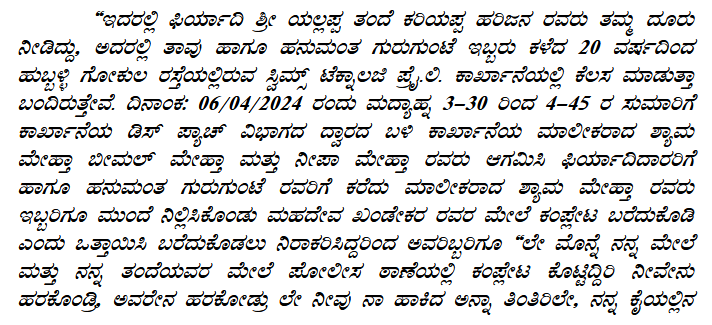
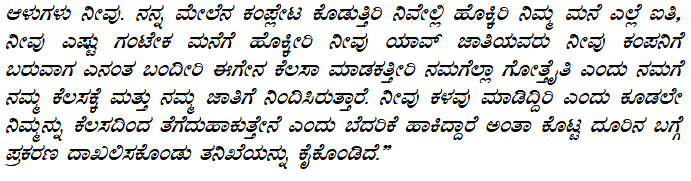
23. Considering this, admittedly the alleged offences occurred at a place inside the factory premises. More particularly, the place is at the door of the dispatch section of the factory. The dispatch section is not a remote place in the factory. The dispatch section and its door are accessible to employees working in the factory and are not isolated places; therefore, the said place is easily accessible and amenable for employees for ingress and egress. Hence, when the alleged incident took place at the said place, it was easily amenable to public view. Public view does not necessity mean public view by any passer by public but if employees are at that place such employees are also to be considered as members of public. Therefore, this prima facie case is made out for prosecution that the alleged incident is amenable to public view; hence, the ingredients of Section 3 of the SC and ST Act, 1989, regarding public view are attracted. Thus, for this reason, when this is a matter for trial at this stage, the proceedings cannot be quashed.
24. Another argument canvassed by the learned counsel for the petitioners/accused Nos.1 to 3 that the present complaint is offshoot of the strike called for by the trade union and the learned counsel for the petitioners/accused Nos.1 to 3 has tried to make a connection between the strike and the complaint with the alleged incident. Learned counsel for the petitioners/accused Nos.1 to 3 has produced a notice issued by the Weir BDK Valves Workers Union addressed to accused No.2, who is the president of the factory, which is dated 16.10.2024 and the complaint is lodged on 29.10.2024.
25. It is argued that the trade union had issued a notice calling for strike if the demands stated therein are not honoured by giving 15 days' notice and after completion of the 15 days of the notice, the complaint is lodged; hence, the learned counsel for the petitioners/accused Nos.1 to 3 tried to make a connection between the complaint and the strike. Calling for strike by the trade union is different aspect. The complainant belongs to a member of the scheduled castes and scheduled tribes.
26. Just because a notice for strike is issued and a complaint is lodged, linking these two events is nothing but appears to be coincidence. Whether trade union has instigated the complainant to lodge complaint against the petitioners is a question of disputed fact is triable issue in the trial, but cannot be decided at this stage. The complaint lodged by the complainant is his private affair with the accused. There is nothing in the notice dated 16.10.2024 that the accused have abused the complainant or any members of the scheduled castes and scheduled tribes with reference to the caste. The notice for strike is given making some demands by the trade union on the dispute between management and union and because the date of notice is issued on 16.10.2024 and the complaint is lodged on 29.10.2024, it cannot be said that the lodging of complaint is linked with the strike. The complaint allegations are to be considered on their prima facie value, apparently on the face of the complaint. The complainant being one of the workmen might have also inevitably joined with the trade union, but the issue of strike cannot be linked with the allegations made in the complaint, which can be tried in the trial. Since the complainant is also an employee of the factory and his grievance cannot be washed away when the notice for strike is issued by the trade union. The issue of strike and the complaint are to be considered independently.
27. It is quite natural that everyone has apprehension if any workman/employee goes against the wish of the owner of the factory, then there is apprehension in the mind of employee/workman that he would be terminated; therefore, this is a question of livelihood. Hence, there might be delay, though it is not explained in the complaint. Therefore, in this context, the delay is a question of fact for trial to verify whether the complaint averments are genuine or not. Under these circumstances, the proceedings cannot be quashed as lodging of the complaint does not amount to abuse of the process of Court as prima facie case is made out to proceed with the trial.
28. The averments in the complaint are to be taken at their face value considering the surrounding circumstances. The abusive words used by the accused are that even though a complaint has been lodged before the Police against the complainant himself and his father "what did you do and what did you achieve" and abused with reference to caste in filthy language and also threatened by lodging a false complaint of theft and terminating him from the employment. These prima facie averments in the complaint constitute offences to be triable during the trial. The genuineness and veracity of the averments of the complaint cannot be decided at this stage.
29. It is argued that the present complaint is lodged in the backdrop of an industrial dispute between the management and the employees. Here, the petitioners are part of the management and have filed a list of cases of industrial dispute, but upon considering this fact of pending industrial disputes, how far it has any connection to the present case, considering the face value of the complaint averments, is to be looked into is not made out. There may be industrial dispute, but upon perusal of the complaint averments extracted above, there is not even a whisper that the complaint has been lodged in the background of pending industrial dispute. Raising an industrial dispute is different; it is done collectively by all the employees in the factory. Therefore, merely because an employee, being a member of trade union, who incidentally happens to belong to the SC/ST community, lodges a complaint as in the present case alleging that an offence has been committed by abusing him with reference to caste, is not a ground to connect this case with industrial dispute cases.
30. The decisions relied on by the learned counsel for the petitioners/accused Nos.1 to 3 are found to be distinguishable on the facts and circumstances involved in the cited cases and in the present case on hand.
31. In the case of B. VENKATESWARAN AND ORS. (supra), the facts are that there was a conspiracy and unlawfully encroached the pathway adjacent to the house of the accused and started to construct temple. It was alleged that the said temple was built on the complainant's water pipeline, sewage pipeline and EB cable thereby causing obstruction to the complainant to enjoy his property. In this background of a civil dispute between the parties, FIR was registered for offences under the provisions of the SC and ST Act, 1989. Hence, there was a property dispute and it was of the opinion that the civil dispute is given the color of criminal proceedings; thus, it was quashed.
32. Considering the difference in facts and circumstances involved in the above cited case, it is not applicable to the present case on hand.
33. Further, in the case of RAJU (supra), the facts are that there was a judgment of conviction and it is upheld by the Division Bench of the High Court of Madhya Pradesh and the accused is sentenced and one of the offences alleged is under Section 376 of the Indian Penal Code (IPC) and Section 3 (2) (V) of the SC and ST Act, 1989. The Hon'ble Apex Court upheld the conviction under Sections 366, 342, 376(2)(g) of IPC and set aside the conviction made under Section 3(2)(V) of the SC and ST Act, 1989, on the reason that offence was made with reference to caste. Therefore, in this background of the factual matrix, the offences under the SC and ST Act, 1989, was set aside. Hence, due to the difference in the factual matrix between the present case and the above cited case, the above cited judgment is not applicable.
34. Further, in the case of SHAJAN SKARIA (supra), the facts are that the accused in his capacity as the Editor of an online news channel named "Marunandan Malayali" published a video on YouTube and an online video sharing platform, leveling certain allegations against the complainant. Therefore, considering the difference between the present case and the above cited case, the said judgment is not applicable to the present case. Moreover, it was considering the scope of ground of the anticipatory bail in the context of Section 18 and 18A of the SC and ST Act, 1989. Hence, the above cited case is not applicable to the present case on hand.
35. Further, in the case of KHUMAN SINGH (supra), the facts are that the complainant-Rajaram along with his brother Raghuveer, the deceased Veer Singh and relative Badam Singh had gone to cultivate the fields and graze their cattle. When the deceased Veer Singh was cultivating the field and the others were grazing the cattle, the deceased objected and drove the buffaloes of the accused out of his field, on which the accused became furious and started abusing and scolding the deceased, saying how the deceased belonging to Khangar caste could drive away the buffaloes of Thakurs out of his field. When the deceased objected to it, it is alleged that the accused with an intention to kill the deceased, attacked him with an axe, due to which the deceased Veer Singh fell down. Thereafter, the accused allegedly gave two-three blows on the head of the deceased with the axe and the deceased died. In this background, the complaint was filed and in criminal proceedings, conviction was recorded and went up to the Hon'ble Supreme Court, which held that the conviction of the accused under Section 3(2)(V) of the SC and ST Act, 1989, is set aside, but the conviction of the accused was modified under Section 302 of IPC as a conviction under Section 304 Part II of IPC and the accused sentenced to undergo. Therefore, due to difference in factual matrix between the above cited case and in the present case, the above cited case is not helpful to the petitioners herein.
36. Further, in the case of VILAS BHORMALJI OSWAL (supra), the facts are that the petitioner, the complainant and two others are partners in the business of real estate and there is an agreement between the partners. It is stated that in the agreement there is a clause that the complainant will be appointed as Managing Director and the petitioner is nominated as Joint Signatory Authority. After passing a decade of the said partnership firm, a dispute arose between the partners, particularly between the petitioner and the complainant on the score that the petitioner did not sign some documents pertaining to the firm, due to which the development of business was stalled. In this background, the matter culminated into the filing of a complaint. Hence, there is a difference in factual matrix between the above said case and the present case on hand, as the facts in the cited case are regarding the business. Therefore, the above cited judgment is not applicable to the present case on hand.
37. Further, the case of CHANCHALPATI DAS (supra) deals with laying down the principle of law regarding use of power under Section 482 of Cr.P.C.
38. Further, in the case of LAKSHMI DEVI AND ORS. (supra), the facts are that the complainant is the owner of the land, who sold the land for a consideration of Rs.50,000/- per acre. Even after the sale of the land, the complainant was still interfering with the said land, which by then had belonged to the petitioners by virtue of the sale deed dated 24.04.2002. This drove the petitioners to institute a suit in O.S.No.105/2011, seeking an injunction against the complainant. The complainant was defendant No.1 in the said suit and the said suit was decreed. In this backdrop of a civil dispute with some allegations, the complainant lodged a complaint under the provisions of SC and ST Act, 1989. Hence, having found a difference in the factual matrix in the above cited case, the said judgment is not applicable to the present case on hand.
39. The observations made by the Hon'ble Supreme Court and High Courts of different States in the cases relied upon by the learned counsel for the petitioners/accused Nos.1 to 3 are on the basis of the facts, circumstances and evidence in each case; therefore, they are found to be distinguishable from the facts and circumstances involved in this case. Hence, they are not applicable in the present case.
40. Upon reading the complaint averments, apparently on the face of the record as discussed above, when it is clearly revealed the offences alleged and considering the surrounding circumstances, the prosecution has made out prima facie case for trial and not found to be abuse of process of Court. Also, the petition fails to demonstrate what is to give effect to code (BNSS) and also fails to what is in the petition to secure ends of justice. Hence, the proceedings cannot be quashed at this stage. Therefore, the criminal petition is liable to be dismissed.
41. Accordingly, the petition is dismissed.

 |
This Product is Licensed to , |