



Judgment (Oral)
1. The challenge in the instant Appeal is to the computation of compensation, arrived at by the Learned Motor Accidents Claims Tribunal, Gangtok, Sikkim (hereinafter, the "MACT"), in MACT Case No.11 of 2024 ( ), vide Judgment dated 26-12-2024.
2. Learned Counsel for the Appellants put forth the contention that the Appellant No.1 had suffered 90% locomotor permanent disability as duly established by Exbt-29 (collectively), Disability Certificate of the Department of Empowerment of Persons with Disabilities, Ministry of Social Justice and Empowerment, Government of India, issued by the Medical Authority, East District, Sikkim. The document specified that the Appellant had been in a road traffic accident and was thereby afflicted with traumatic paraplegia. The Appellant No.1 had also relied on Exbt-8, Wound Certificate which detailed his injuries including fracture of vertebrae. The MACT however failed to access his disability as 100%, which flies in the face of the decision of this Court in The Branch Manager, National Insurance Company Limited vs. Yoel Subba and Others which had relied on the Judgment of the Supreme Court in Raj Kumar vs. Ajay Kumar and Another2 while assessing such disability.
(i) Advancing other grounds for the Appeal and walking this Court through the computation made by the MACT, Learned Counsel for the Appellants contended that, the annual income of the Appellant No.1 prior to the accident was ₹ 3,60,000/- (Rupees three lakhs and sixty thousand) only. However, while calculating the loss of future earnings per annum, the MACT took into consideration only 90% of the income prior to his accident and thereby placed it erroneously at ₹ 3,24,000/- (Rupees three lakhs and twenty four thousand) only, instead of ₹ 3,60,000/- (Rupees three lakhs and sixty thousand) only. It was also urged that for loss of future earnings, 40% ought to have been included in the computation, in view of the fact that, the Appellant No.1 was thirty-three years old at the time of the accident. However, the MACT failed to do so and instead employed the multiplier of ‘16’ to ₹ 3,24,000/- (Rupees three lakhs and twenty four thousand) only, to arrive at an amount of ₹ 51,84,000/- (Rupees fifty one lakhs and eighty four thousand) only. There is no challenge to the 2024 SCC OnLine Sikk 28 (2011) 1 SCC 343 adoption of 16 as multiplier. That, the amount for service of attendant was pegged at ₹ 3,00,000/- (Rupees three lakhs) only, whereas this Court in Yoel Subba (supra), by reference to several Judgments of the Supreme Court had allowed a sum of ₹ 32,40,000/- (Rupees thirty two lakhs and forty thousand) only, to the victim therein. On this facet however, Learned Counsel fairly conceded that the Appellant No.1 is not entitled to a sum of ₹ 32,40,000/- (Rupees thirty two lakhs and forty thousand) only, for services of an attendant as computed in Yoel Subba (supra) but would definitely be entitled to ₹ 28,80,000/- (Rupees twenty eight lakhs and eighty thousand) only. It was next argued that the fact of the Appellant’s disability has not been decimated during his cross-examination. It was also admitted that the Appellants are not entitled to "cost of litigation" granted by the MACT as no compensation under this head has been computed by any of the Judgments of the Supreme Court.
3. Learned Counsel for the Respondent No.1 contended that although a Cross Appeal has not been filed however the amount granted by the MACT for pain and suffering and loss of amenities is exorbitant, having been placed at ₹ 15,00,000/- (Rupees fifteen lakhs) only and ₹ 2,00,000/- (Rupees two lakhs) only, respectively, when in Yoel Subba (supra) the amount under a collective head comprising of pain, suffering and loss of amenities was calculated at ₹ 6,00,000/- (Rupees two lakhs) only. Hence, the amount under the said head should be confined to not more than ₹ 6,00,000/- (Rupees two lakhs) only.
4. Due consideration has been afforded to the submissions of Learned Counsel for the parties. I have also perused the entire records before me, including the evidence and documents on record.
5. Before addressing the arguments, it would be essential to comprehend the facts of the case. The Appellant No.1, aged thirty-three years, at the relevant time, earning about ₹ 3,60,000/- (Rupees three lakhs and sixty thousand) only, per annum, was travelling near Singtam, East Sikkim, in a ‘Ford Figo’ vehicle, bearing registration No.SK-01-P-3752, on 15-02-2021. A Tata Truck bearing registration No.WB-73-F-4905 overtook the Ford Figo vehicle and while doing so hit the car which was then thrust off the road, to about fifty feet below. The Appellant No.1 the sole bread winner of his family was severely injured and diagnosed with 90% permanent disability and traumatic paraplegia. The Appellants were before the MACT with a Petition under Section 166 of the Motor Vehicles Act, 1988, seeking compensation of ₹ 61,88,244/- (Rupees sixty one lakhs, eighty eight thousand, two hundred and forty four) only. The MACT granted compensation of ₹ 74,96,244/- (Rupees seventy four lakhs, ninety six thousand, two hundred and forty four) only.
6. That having been said, in the first instance, it would be relevant to refer to Raj Kumar (supra), where the Supreme Court while dealing with the aspect of disability and loss of earning capacity inter alia expressed its view as hereunder;
"11. What requires to be assessed by the Tribunal is the effect of the permanent disability on the earning capacity of the injured; and after assessing the loss of earning capacity in terms of a percentage of the income, it has to be quantified in terms of money, to arrive at the future loss of earnings (by applying the standard multiplier method used to determine loss of dependency). We may however note that in some cases, on appreciation of evidence and assessment, the Tribunal may find that the percentage of loss of earning capacity as a result of the permanent disability, is approximately the same as the percentage of permanent disability in which case, of course, the Tribunal will adopt the said percentage for determination of compensation. (See for example, the decisions of this Court in Arvind Kumar Mishra v. New India Assurance Co. Ltd. [(2010) 10 SCC 254] and Yadava Kumar v. National Insurance Co. Ltd. [(2010) 10 SCC 341])
12. .......................................................................
13. Ascertainment of the effect of the permanent disability on the actual earning capacity involves three steps. The Tribunal has to first ascertain what activities the claimant could carry on in spite of the permanent disability and what he could not do as a result of the permanent disability (this is also relevant for awarding compensation under the head of loss of amenities of life). The second step is to ascertain his avocation, profession and nature of work before the accident, as also his age. The third step is to find out whether (i) the claimant is totally disabled from earning any kind of livelihood, or (ii) whether in spite of the permanent disability, the claimant could still effectively carry on the activities and functions, which he was earlier carrying on, or (iii) whether he was prevented or restricted from discharging his previous activities and functions, but could carry on some other or lesser scale of activities and functions so that he continues to earn or can continue to earn his livelihood." [emphasis supplied]
(i) Learned Counsel for the Appellants had raised the argument that the Appellant No.1 was completely bedridden post the accident and unable to engage in day to day activities due to his spinal injury which had paralyzed the lower portion of his body. On examination of the documents relied on by the Appellants being Exbt-8 and Exbt-29, it emerges without dispute that he is paralyzed downwards from his waist. Consequent, upon the injury to his spinal cord and limbs it is evident that he is unable to carry out his day to day functions independently which he earlier did, including attending nature’s call. On account of his disability he is also prevented from discharging his duties in his vocation as Manager in a Cafe and other activities. In the obtaining circumstances, being totally disabled he is deprived of his ability to earn his livelihood. His disability can thus be assessed at 100% and not merely 90% as assessed by the MACT.
(ii) I am also of the considered view that the MACT failed to factor in 40% as loss of future earnings to the calculations which is envisaged and allowed in the Judgment of National Insurance Company Limited vs. Pranay Sethi and Others (2017) 16 SCC 680 Loss of future earnings is thereby granted to the Appellants.
(iii) So far as the attendant charges are concerned, the Supreme Court in Kajal vs. Jagdish Chand and Others (2020) 4 SCC 413 was of the view that;
"Attendant charges
22. The attendant charges have been awarded by the High Court @ Rs 2500 per month for 44 years, which works out to Rs 13,20,000. Unfortunately, this system is not a proper system. Multiplier system is used to balance out various factors. When compensation is awarded in lump sum, various factors are taken into consideration. When compensation is paid in lump sum, this Court has always followed the multiplier system. The multiplier system should be followed not only for determining the compensation on account of loss of income but also for determining the attendant charges, etc. This system was recognised by this Court in Gobald Motor Service Ltd. v. R.M.K. Veluswami [AIR 1962 SC 1]. The multiplier system factors in the inflation rate, the rate of interest payable on the lump sum award, the longevity of the claimant, and also other issues such as the uncertainties of life. Out of all the various alternative methods, the multiplier method has been recognised as the most realistic and reasonable method. It ensures better justice between the parties and thus results in award of "just compensation" within the meaning of the Act. .....................................................................................
25. Having held so, we are clearly of the view that the basic amount taken for determining the attendant charges is very much on the lower side. We must remember that this little girl is severely suffering from incontinence, meaning that she does not have control over her bodily functions like passing urine and faeces. As she grows older, she will not be able to handle her periods. She requires an attendant virtually 24 hours a day. She requires an attendant who though may not be medically trained but must be capable of handling a child who is bedridden. She would require an attendant who would ensure that she does not suffer from bedsores. The claimant has placed before us a notification of the State of Haryana of the year 2010, wherein the wages for skilled labourer is Rs 4846 per month. We, therefore, assess the cost of one attendant at Rs 5000 and she will require two attendants which works out to Rs 10,000 per month, which comes to Rs 1,20,000 p.a., and using the multiplier of 18, it works out to Rs 21,60,000 for the attendant charges for her entire life. This takes care of all the pecuniary damages."
[emphasis supplied]
(iv) The MACT while computing medical attendant charges appears not to have followed the principles laid out in Kajal (supra). In the instant matter, the Appellant No.1 is a young man who will have to suffer being bedridden, which would likely give rise to bedsores and other allied medical issues. His wife, the Appellant No.2 would not be competent to assist him on the medical aspect and he would require a medically trained attendant. This Court in Yoel Subba (supra), as per the decision in Kajal (supra) had calculated attendant charges for one attendant for the lifetime of the Appellant therein. The said circumstance would be applicable in the present matter also. The details of calculation are as follows;
| ₹ 500 x 30 days = ₹ 15,000/- per month |
| ₹ 15000/- x 12 months = ₹ 1,80,000/- per annum |
| Multiplier to be adopted is ‘16’ [in terms of Paragraph 42 of Sarla Verma (Smt) and Others vs. Delhi Transport Corporation and Another ((2009) 6 SCC 121) -- ₹ 1,80,000/- x 16] = ₹ 28,80,000/- |
(v) The MACT had granted ₹ 15,00,000/- (Rupees fifteen lakhs) only, for pain and suffering and ₹ 2,00,000/- (Rupees two lakhs) only, for loss of amenities. However, in terms of the decision in Kajal (supra), this Court in Yoel Subba (supra) had granted ₹ 6,00,000/- (Rupees six lakhs) only, clubbing together the heads under for "Pain, Suffering and loss of amenities".
(vi) More recently, in K.S. Muralidhar vs. R. Subbulakshmi and Another2024 INSC 886, the Supreme Court has granted compensation of ₹ 15,00,000/- (Rupees fifteen lakhs) only, for pain and suffering. Having perused the said Judgment it emanates that the Appellant therein was involved in a motor vehicle accident and sustained injuries which resulted in 90% permanent disability on the basis of which the amount (supra) was allowed by the Supreme Court. In the instant matter, applying the same logic, the amount for "Pain, Suffering and loss of amenities" can be computed at ₹ 15,00,000/- (Rupees fifteen lakhs) only and is granted accordingly.
(vii) There is no reason to interfere with the actual medical expenses of ₹ 87,244/- (Rupees eighty seven thousand, two hundred and forty four) only, granted by the MACT as it is indubitable. No prayer has been made for a change in the future medical expenses, which was computed at ₹ 2,00,000/- (Rupees two lakhs) only and is thus not required to be altered. Cost of litigation is however denied as no such head has been enumerated by the Supreme Court.
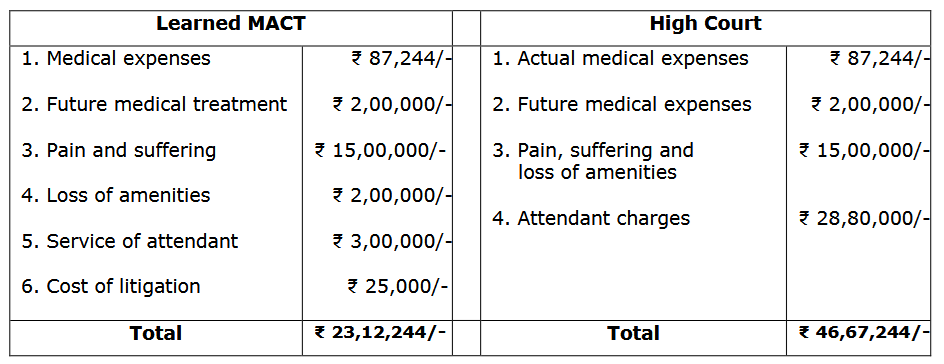
7. The compensation worked out by the MACT and by this Court, under the "other heads", are juxtaposed below for clarity;
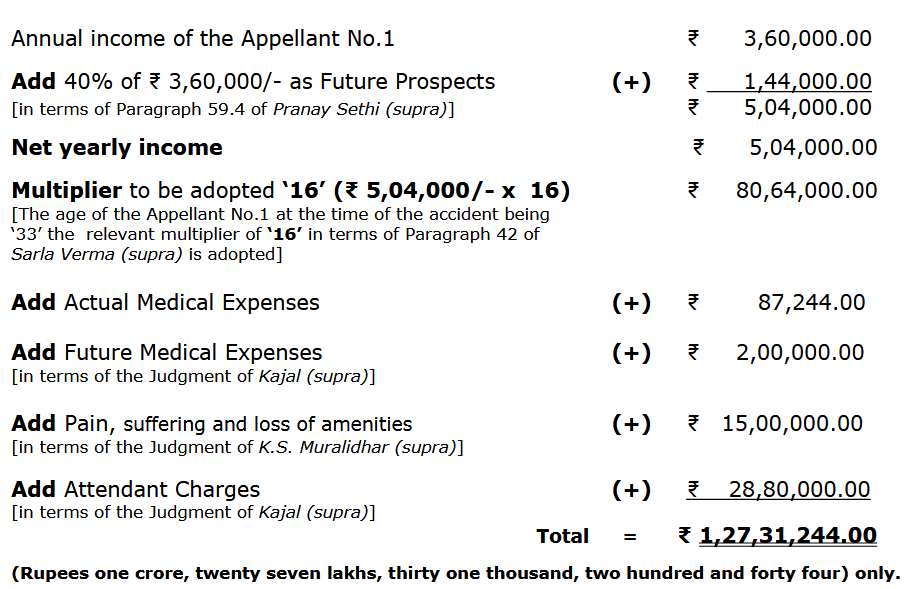
8. Consequently, the total compensation which is found to be "just compensation" is computed as follows;
9. Learned Counsel for the Appellants and Learned Counsel for the Respondent No.1-Insurance Company submits that pursuant to the impugned Judgment of the MACT, the Appellants No.1 and 2 have received a cheque each, bearing No.027762 and 027760, respectively, of the ICICI Bank, dated 24-12-2025, each for a sum of ₹ 29,23,193/- (Rupees twenty nine lakhs, twenty three thousand, one hundred and ninety three) only. The Appellant No.3 has also received a cheque bearing No.027761, of the ICICI Bank, dated 24-12-2025, amounting to ₹ 29,23,192/- (Rupees twenty nine lakhs, twenty three thousand, one hundred and ninety two) only, totaling to a sum of ₹ 87,69,578/- (Rupees eighty seven lakhs, sixty nine thousand, five hundred and seventy eight) only.
10. In such circumstances, the amount received shall be deducted from the compensation calculated today. The remaining amount from the awarded compensation be disbursed by the Respondent No.1-Insurance Company to the Appellant No.1 in view of the fact that he is bedridden and requires medication and an assistant. The Respondent No.1-Insurance Company is directed to pay the remaining compensation with interest @ 9% per annum as ordered, to the Appellants No.1, within one month from today, failing which, it shall pay simple interest @ 12% per annum, from the date of filing of the Claim Petition, i.e.,12-03-2024 till full realisation.
11. Appeal is disposed of accordingly.
12. No order as to costs.
13. Copy of this Judgment be forwarded to the Learned MACT for information along with its original records.