


(Prayer: Criminal Appeal is filed under Section 378(1)(A)(B) of Cr.P.C., to call for the records and set aside the acquittal renderedn in judgment dated 30.10.2019 made in S.C.No.4 of 2019, on the file of the Additional Sessions Judge/Fast Track Mahila Court, Karur by allowing this Criminal Appeal.)
G.K. Ilanthiraiyan, J.
1. This appeal is directed as against the order of acquittal passed in S.C.No.4 of 2019, dated 30.10.2019 by the learned Additional Sessions Judge/Fast Track Mahila Court, Karur.
2. The case of the prosecution is that the deceased Balasubramani was in the habit of stealing small things at small level and as such, he used to be found with small injuries in his body. While his mother questioned about the injuries, he used to say that the injuries were caused due to the attacks of the nearby villagers while being caught red-handed when stealing. While being so, on 22.09.2018 at about 18.00 hours, the deceased allegedly had stolen the mobile phone belonging to the first accused, therefore, the deceased was searched by the first accused and he was enquired about the mobile phone, but he did not give any answer. Thereafter, he was brought to his house and all the accused persons have tied him to the iron pillar erected at his house using a cotton rope and have indiscriminately beaten him. Though the mother of the deceased, the sister of the deceased’s mother and the sister of the deceased were trying to pacify the accused, they lynched him shouting that if he is left, he would do the same act and so he would be finished. All the accused attacked the deceased with iron rods and all the accused lynched the deceased with two sticks. When the mother of the deceased, sister of the deceased’s mother and the sister of the deceased attempted to prevent them from lynching the deceased, the accused persons had threatened them to go away, failing which, they would be beaten up and therefore they went away from that place out of fear of life. Thereafter, the deceased fainted and fell down and all the accused removed the rope from the hands of the deceased and went away from the place of occurrence and the deceased died on the spot. Thereafter, the mother of the deceased i.e., P.W.1 filed a complaint. Based on the complaint, FIR in Cr.No.292 of 2018 has been registered for the offences punishable under Sections 147, 341, 506(ii) and 302 IPC. After completion of investigation, the respondent filed a final report and the same has been taken cognizance by the Trial Court in S.C.No.28 of 2018, on the file of the learned Additional Sessions Judge/Fast Track Mahila Court, Karur.
3. On the side of the prosecution, in order to bring the charges to home, they had examined P.W.1 to P.W.14 and Exs.P1 to P25 were marked and the prosecution had produced Material Objects M.O.1 to M.O.3. On the side of the accused/respondents, no one was examined and no document was produced before the Trial Court.
4. On perusal of the oral and documentary evidence, the Trial Court found the accused not guilty and acquitted them in all the charges. Aggrieved against the said order of acquittal, the State has filed the present appeal.
5. The learned Additional Public Prosecutor appearing for the appellant/State would submit that the mother of the deceased was examined as P.W.1, sister of P.W.1 was examined as P.W.2 and the daughter of P.W.1 was examined as P.W.3. P.W.1 in her evidence has categorically deposed about the specific overt act of the accused persons. Therefore, there is no space for any doubt insofar as the specific overt act of the accused and also identification of the accused. Since all the accused persons belong to same village and same community, they know each other and they are also well acquainted with the deceased’s family. The prosecution had also examined P.W.5, who is an independent eye witness to the occurrence and he is not at all related to the deceased’s family. The evidence of P.W.5 categorically corroborated with the evidence of P.Ws.1 to 3. Without considering the evidence of P.Ws.1 to 3 and P.W.5, the Trial Court mechanically acquitted the accused on the ground that P.Ws.1 to 3 had deposed about the specific overtact of one Kaliammal and Jeeva, but the prosecution has failed to implead them as an accused and it is fatal to the case of the prosecution. Hence, he prays for allowing the appeal by convicting the respondents/accused.
6. The learned counsel for the respondents 1 to 5/accused persons would submit that P.Ws.1 to 3 categorically deposed in their crossexamination about the specific role played by Kaliammal and Jeeva and one Sarasu. Even according to them, they said Kaliammal and Jeeva only tied the hands of the deceased to an iron pillar and they also had beaten the deceased with sticks. P.W.1 also categorically stated in her statement recorded under Section 164 Cr.P.C., about the specific overtact of said Kaliammal and Jeeva. Even then, the prosecution has failed to implead them as an accused. Therefore, the entire case of the prosecution cannot be legitimate.
7. He further submitted that there was no unlawful assembly among the accused persons to attract the offence punishable under Section 147 of IPC. On the date of alleged occurrence, there was a village festival and as such, there were huge crowd. The said assembly cannot be construed as an unlawful assembly. Therefore, the Trial Court rightly acquitted the respondents from the charge under Section 147 IPC. Further, the respondents are not the real accused to attract the charge punishable under Section 302 IPC and the real aggressors were failed to be impleaded as accused. Hence, the Trial Court has rightly acquitted the respondents and it does not warrant any interference of this Court.
8. Heard the learned counsel appearing on either side and perused the materials available on record.
9. It is a very unfortunate case where the minor deceased has had the habit of stealing small things and was used to get beaten up by the fellow villagers. While so, on 22.09.2018 when the mobile phone of the first accused was missing, he suspected that the deceased had stolen it and further, the respondents, Kaliammal and one Jeeva had caught hold of the deceased for inquiring about the stealing of mobile phone that belonged to the first accused. The said Kaliammal and Jeeva had tied the deceased’s hands to an iron pillar at the deceased’s house, that too, in the presence of the mother of the deceased, sister of the deceased’s mother and sister of the deceased. The deceased’s mother was examined as P.W.1 and her sister was examined as P.W.2 and the sister of the deceased was examined as P.W.3. Though P.W.1 categorically stated about the specific overt act of the respondents 1 to 5 herein, she also stated the specific overt act of the said Kaliammal and Jeeva, who tied the hands of the deceased. The relevant portion of P.W.1's cross-examination is reads as follows: -
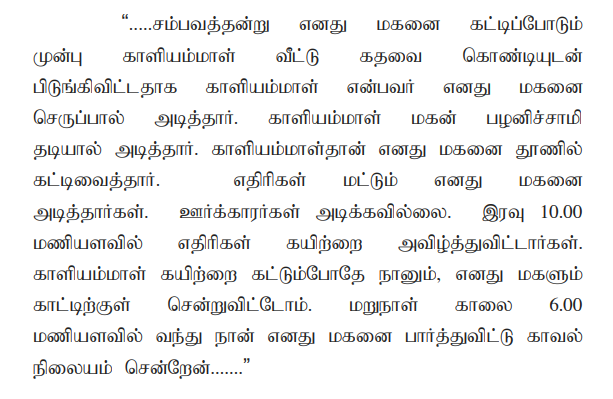
Thus, is it clear that the said Kaliammal and Jeeva also had committed specific overtact in the murder of the deceased.
10. The relevant portion of P.W.2's cross-examination is reads as follows:
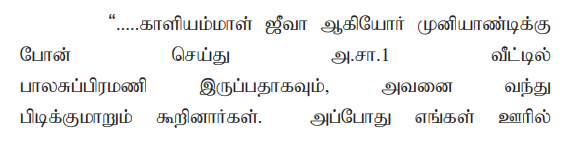
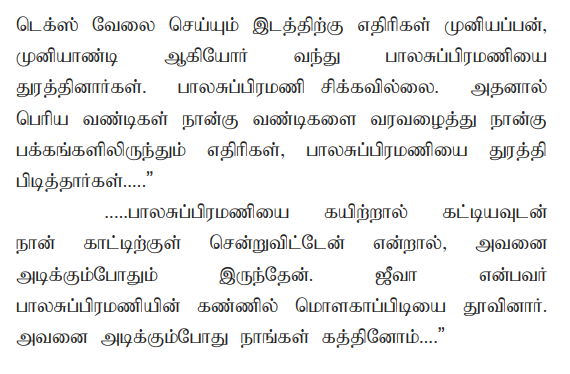
It is seen from the above evidence that the evidence of P.W.2 clearly corroborates the evidence of P.W.1.
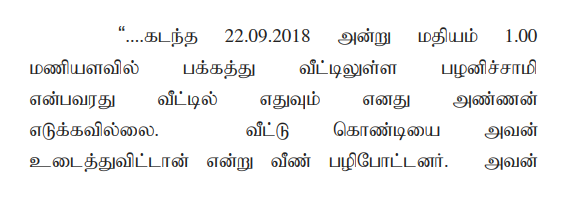
11. The sister of deceased was examined as P.W.3 and she had also clearly spoken about the overt act of the Kaliammal and Jeeva. The relevant portion of her evidence is read as follows:
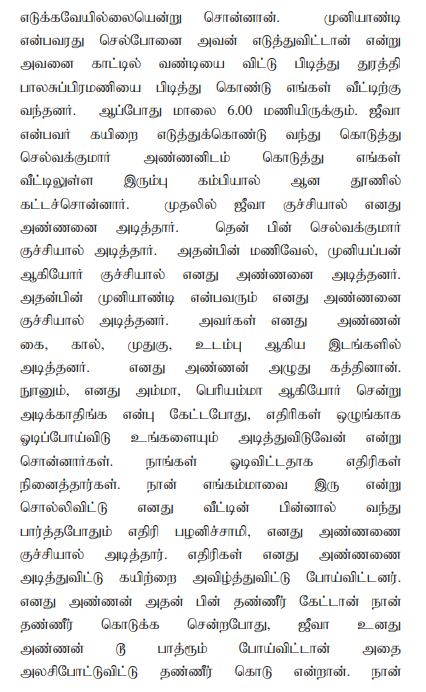
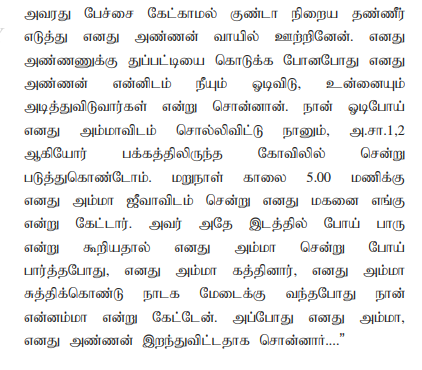
12. In fact, the statement of P.W.3 was also recorded under Section 164 Cr.P.C. Her statement was also marked as Ex.P.2. The relevant portion of P.W.3 is as follows:
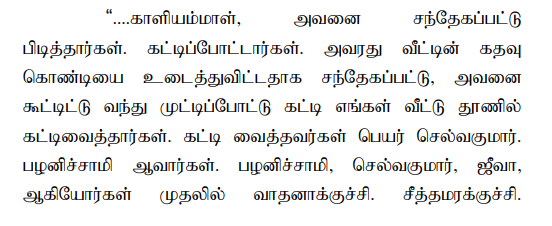
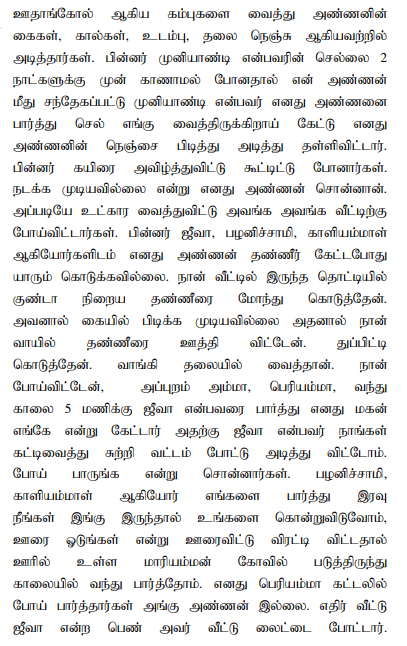
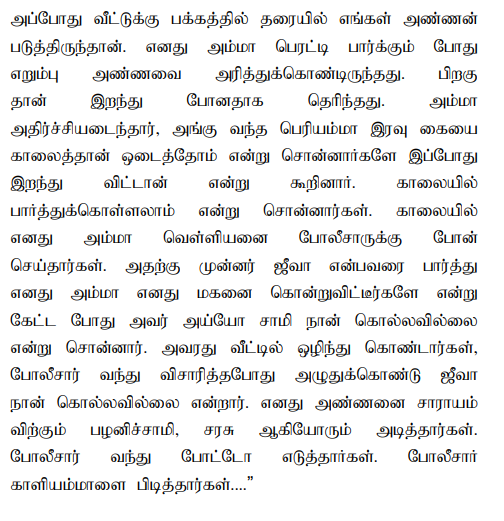
13. Therefore, there is a specific overt act as against the said Kaliammal and Jeeva. In fact, Kaliammal, Jeeva and Sarasu also had beaten the deceased. The appellant also secured the said Kaliammal. Even then, they were not named accused in the FIR, the appellant did not even implead them as an accused while filing the charge-sheet. Further, before the Trial Court, P.Ws.1 to 3 categorically deposed as stated supra about the specific overtact of Kaliammal and Jeeva and another one Sarasu. However, the Trial Court failed to invoke the provision under Section 319 of Cr.P.C., to add them as an accused. It is relevant to extract the provision under Section 319 Cr.P.C:
“319. Power to proceed against other persons appearing to be guilty of offence: -
(1) Where, in the course of any inquiry into, or trial of, an offence, it appears from the evidence that any person not being the accused has committed any offence for which such person could be tried together with the accused, the Court may proceed against such person for the offence which he appears to have committed.
(2) Where such person is not attending the Court, he may be arrested or summoned, as the circumstances of the case may require, for the purpose aforesaid.
(3) Any person attending the Court although not under arrest or upon a summons, may be detained by such Court for the purpose of the inquiry into, or trial of, the offence which he appears to have committed.
(4) Where the Court proceeds against any person under Sub-Section (1) then—
(a) the proceedings in respect of such person shall be commenced afresh, and witnesses re-heard;
(b) subject to the provisions of clause (a), the case may proceed as if such person had been an accused person when the Court took cognizance of the offence upon which the inquiry or trial was commenced.”
14. Therefore, even when a person is not named in the charge sheet as an accused, the Trial Court has power to summon such an unnamed person and add the said person as an accused on the basis of the evidence and available material on record during the course of trial.
15. Unfortunately, the Trial Court failed to implead them as an accused by invoking the provision under Section 319 Cr.P.C. On the other hand, the Trial Court acquitted the respondents mainly on the ground that the prosecution has failed to implead the said Kaliammal and Jeeva, who tied the deceased to a pillar, as accused. Further, the prosecution had shown the said Jeeva as a witness and he was examined as P.W.4 and he turned hostile and he did not support the case of the prosecution. Though there are specific overtact as against the respondents 1 to 5 herein, and even though all the three eye witnesses namely P.Ws.1 to 3 had categorically deposed about the specific overt act of the respondents 1 to 5 herein, they had now escaped the clutches of law for a nonsensical reason that the other offenders have not been impleaded as accused by the appellant and the Trial Court has also miserably failed to exercise its power under Section 319 of Cr.P.C even during the trial.
16. It is relevant to rely upon the case of Shiv Baran v. State of U.P and another reported in 2025 INSC 860, wherein the Hon’ble Supreme Court has held as follows:
“OUR VIEW
14. The foregoing discussion would reveal the following statutory requisites for summoning any person not being the accused: (a) such person has committed an offence; (b) his complicity is revealed from the evidence collected during inquiry or trial; and (c) for such offence, he can be tried together with the accused already facing trial.
15. The principles that the Trial Court ought to follow while exercising power under this Section are:
(a) This provision is a facet of that area of law which gives protection to victims and society at large, ensuring that the perpetrators of crime should not escape the force of law;
(b) It is the duty cast upon the Court not to let the guilty get away unpunished;
(c) The Trial Court has broad but not unbridled power as this power can be exercised only on the basis of evidence adduced before it and not any other material collected during investigation;
(d) The Trial Court is not powerless to summon a person who is not named in the FIR or Chargesheet; they can be impleaded if the evidence adduced inculpates him;
(e) This power is not to be exercised in a regular or cavalier manner, but only when strong or cogent evidence is available than the mere probability of complicity;
(f) The degree of satisfaction required is much stricter than the prima facie case, which is needed at the time of framing of charge(s);
(g) The Court should not conduct a mini-trial at this stage as the expression used is 'such person could be tried’ and not ‘should be tried’.”
17. Therefore, it is clear that the prosecution failing to implead the other offenders in question is not fatal to the case of the prosecution and it for this reason that the Trial Court has been equipped with such powers as stated above. Further, it is not the case that the prosecution had failed to prove the charges against the respondents 1 to 5 rather, the Trial Court had clearly found that there is a specific overt act as against the respondents 1 to 5 and even then, they were acquitted only on the ground that the persons, who tied the deceased to iron pillar, were not arrayed as accused. Further, the Trial Court framed the charges for the offences under Sections 341, 302, 147, 506(ii) IPC. The charges are as follows:
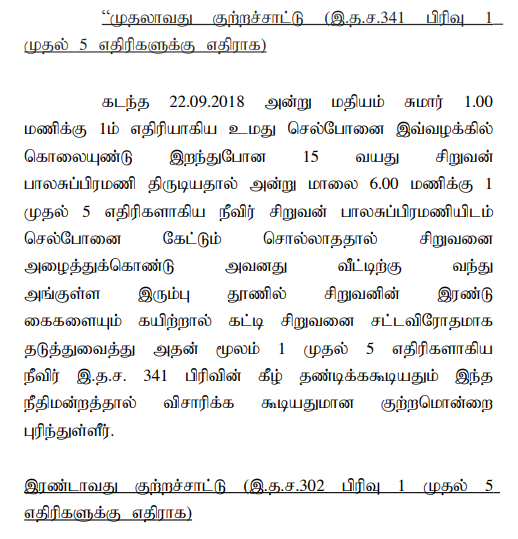
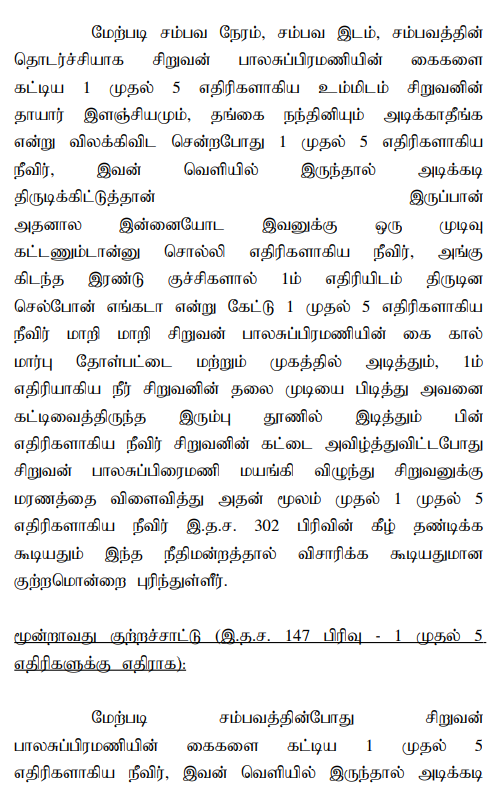
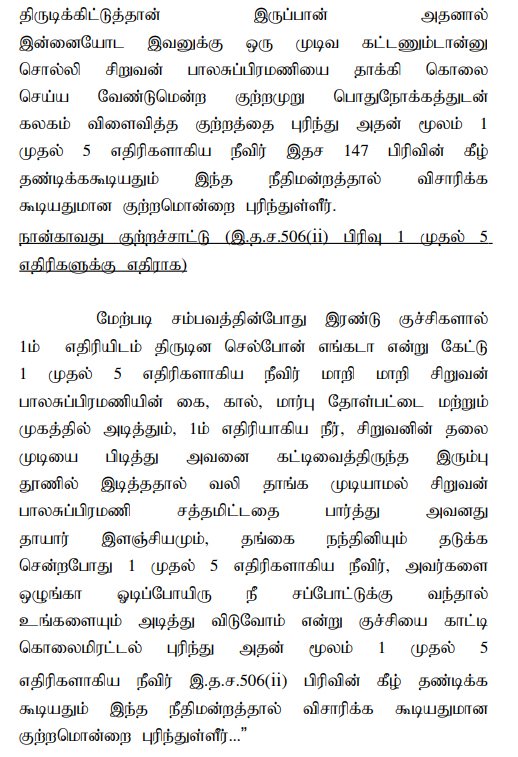
18. Though there is no material to show that the respondents 1 to 5 had tied the deceased to the iron pillar, the Trial Court framed the charges punishable under Sections 341 and 302 IPC. As per the evidence of P.Ws.1 to 3, one Kaliammal, Jeeva along with Sarasu had caught hold of the deceased and had tied his hands to the iron pillar, thereafter, the respondents 1 to 5 had beaten him to death. Therefore, the respondents 1 to 5 cannot be let free on the ground that the prosecution failed to array the other persons as accused.
19. At this juncture, it is relevant to rely upon the Judgment of the Hon’ble Supreme Court in the case of “Ajay Kr. Ghoshal etc. vs State of Bihar”, reported in2017 (12) SCC 699. The necessary paragraphs of the Judgment are extracted hereunder:
“11. Though the word “retrial” is used under Section 386(b)(i) Cr.P.C., the powers conferred by this clause is to be exercised only in exceptional cases, where the appellate court is satisfied that the omission or irregularity has occasioned in failure of justice. The circumstances that should exist for warranting a retrial must be such that where the trial was undertaken by the Court having no jurisdiction, or trial was vitiated by serious illegality or irregularity on account of the misconception of nature of proceedings. An order for retrial may be passed in cases where the original trial has not been satisfactory for some particular reasons such as wrong admission or wrong rejection of evidences or the Court refused to hear certain witnesses who were supposed to be heard.
12. ‘De novo’ trial means a “new trial” ordered by an appellate court in exceptional cases when the original trial failed to make a determination in a manner dictated by law. The trial is conducted afresh by the court as if there had not been a trial in first instance. Undoubtedly, the appellate court has power to direct the lower court to hold ‘de novo’ trial. But the question is when such power should be exercised. As stated in Pandit Ukha Kolhe vs. State of Maharashtra (1964) SCR 926, the Court held that:
“An order for retrial of a criminal case is made in exceptional cases, and not unless the appellate court is satisfied that the Court trying the proceeding had no jurisdiction to try it or that the trial is vitiated by serious illegalities or irregularities or on account of misconception of the nature of the proceedings and on that account in substance there had been no real trial or that the Prosecutor or an accused was, for reasons over which he had no control, prevented from leading or tendering evidence material to the charge, and in the interests of justice the appellate Court deems it appropriate, having regard to the circumstances of the case, that the accused should be put on his trial again. An order of re-trial wipes out from the record the earlier proceeding, and exposes the person accused to another trial which affords the prosecutor an opportunity to rectify the infirmities disclosed in the earlier trial, and will not ordinarily be countenanced when it is made merely to enable the prosecutor to lead evidence which he could but has not cared to lead either on account of insufficient appreciation of the nature of the case or for other reasons.”
20. Therefore, in view of the above, this Court feels that it is a fit case for de novo trial by impleading the other persons, who were involved in the crime, as accused.
21. In view of the above, the judgment of the Trial Court made in S.C.No.4 of 2019 passed by the learned Additional Sessions Judge/Fast Track Mahila Court, Karur cannot be sustained and it is liable to be set aside.
22. Accordingly, this Criminal Appeal is disposed of and the matter is remanded back to the Trial Court for conducting de novo enquiry by impleading the other persons, who were involved in the crime, as accused. It is also made clear that the Trial Court is directed to implead the relevant persons as accused as stated above and issue summons to them and start a trial afresh against the impleaded accused alone by serving the copies to them. Insofar as the respondents 1 to 5 are concerned, no one is permitted to let any further evidence. As against the newly added accused persons, the Trial Court is directed to render justice on the basis of the evidence already on record and the evidence recorded as against the newly added accused. The entire process shall be completed within a period of three months from the date of receipt of a copy of this order.

 |
This Product is Licensed to , |