


A.P. Sahi, President
The appeal has been filed by the Canara Bank assailing the order dated 17.08.2012 in CC No. 27 of 2007 passed by the State Consumer Disputes Redressal Commission, Tamilnadu at Chennai. The respondent complainant company admittedly is engaged in carrying on the business of manufacturing Digital electricity meters for supply to the State Electricity Boards and for this business the appellant Bank had extended various Cash Credit Limits and other banking facilities to the complainant including the furnishing of Bank Guarantees to be accompanied with the tenders applied for by the complainant for award of contracts for supply of such meters. The guarantees were in the shape of Money guarantees and Performance guarantees for a period of five years as per the tender conditions and were ofcourse subject to commission charges payable to the Bank as agreed upon.
2. A total of 28 Bank Guarantees are stated to have been facilitated to accompany tenders of different Electricity Boards which is not in dispute.
3. The complainant subsequently availed of other facilities from the Dena Bank and in the year 2006, the complainant, in all probability due to the expansion of its business and requirement of further financial resources and facilities, approached the IDBI Bank which agreed to provide such facilities to the tune of Rs. 30 crores. Accordingly the complainant availed of the offered facilities by the IDBI Bank and consequently, the entire accounts relating to the complainant were shifted to the IDBI Bank.
4. It may be pointed out that the Bank Guarantees extended by the appellant Canara Bank were for over a period between 2003 to 2006 for a period of 5 years.
5. With the shifting of the banking transactions of the complainant to the IDBI Bank, the conditions on which this transfer was permitted from the Canara Bank are detailed in the letter dated 06.04.2006 that is extracted hereinunder:
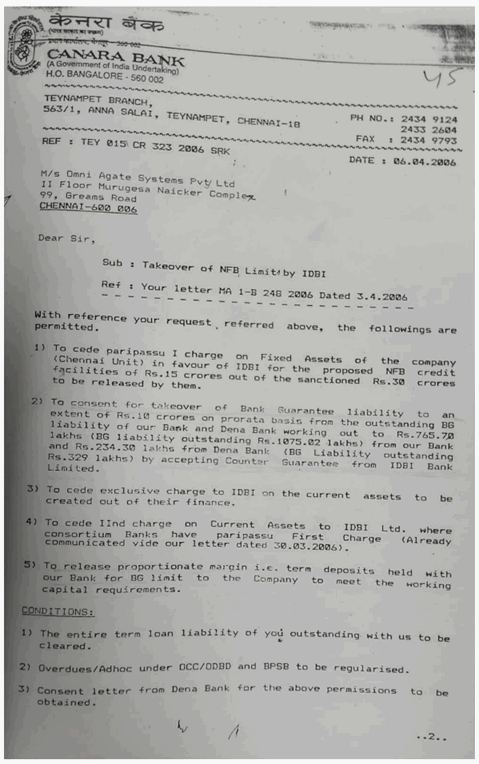
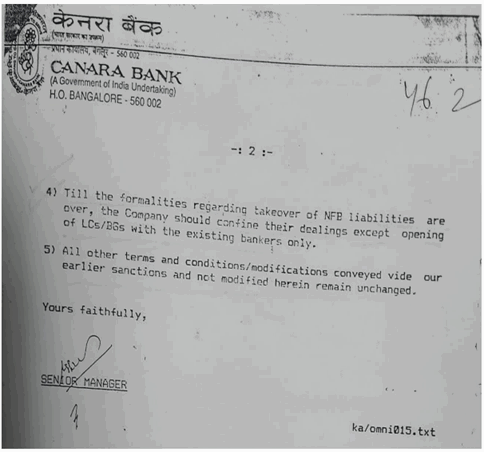
6. In relation to the Bank Guarantees that had already been extended and were subsisting issued by the Canara Bank, the condition imposed relating to Bank Guarantees is at item no. 2 and item no. 5 of the said letter permitting the taking-over of the Bank Guarantee liability to an extent of Rs. 10 Crores by accepting counter guarantees from IDBI Bank Ltd. and for release of the proportionate margin / term deposits for the Bank Guarantee limit to the complainant Company for meeting the working capital requirement. It is also specified in condition no. 4 that the Company should confine its dealings, except opening of BGs with existing Bankers only, and all other terms and conditions as sanctioned earlier were not modified and would remain unchanged.
7. Under the said arrangement, the status of the Bank Guarantees issued by the Canara Bank remained unaltered, subject to counter guarantees from the IDBI Bank Ltd.
8. According to the complainant, once this arrangement had been made and the IDBI Bank had agreed to issue counter Bank Guarantees and take over the liability of the Bank Guarantees, the Canara Bank had to release the respective margin money and also refund the commission on the Bank Guarantees for the remaining period or what is termed as the unutilised period of the Bank Guarantee issued by the Canara Bank.
9. A letter to that effect was sent on 08.04.2006 which admits of the existing Bank Guarantees issued by the Canara Bank. The said letter is extracted hereinunder:
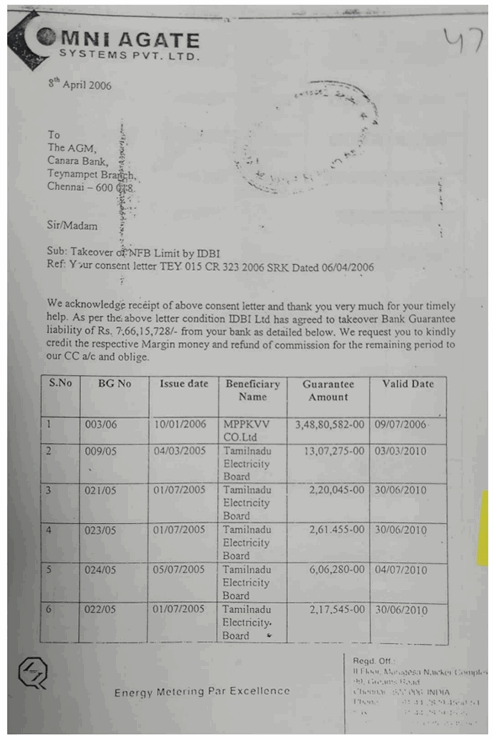
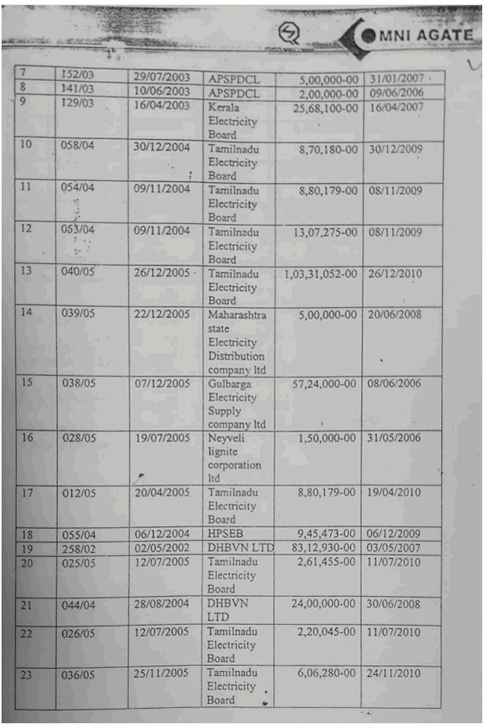
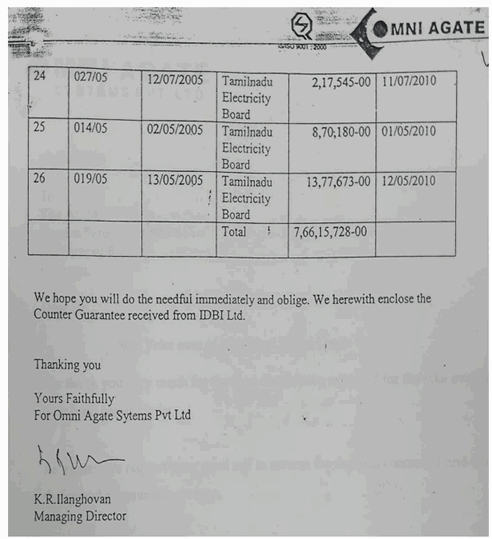
10. In furtherance of its request, the complainant requested the Canara Bank to refund the commission charges of Rs. 32,69,162/- through its letters dated 15.04.2006 and then 20.04.2006.
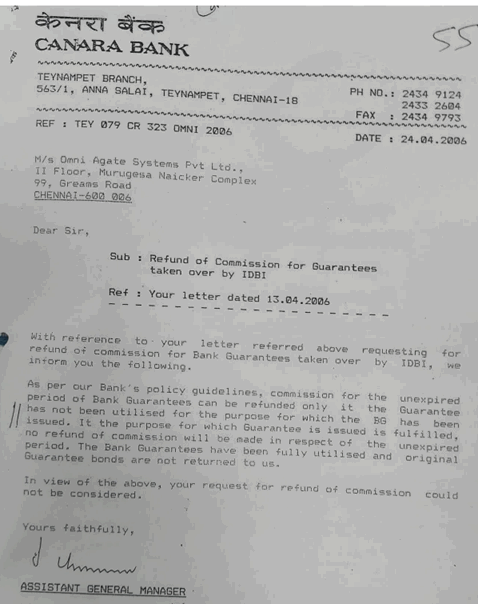
11. The Bank on 24.04.2006 intimated the complainant declining to refund the commission on the Bank Guarantee on the ground that the purpose of the Bank Guarantee being fulfilled, the same has been utilised and therefore according to the policy of the Bank, no refund will be made in respect of the unexpired period. It was further stated categorically that the original Bank Guarantee bonds had not been returned to the Canara Bank. The letter dated 24.04.2006 is extracted hereinunder:
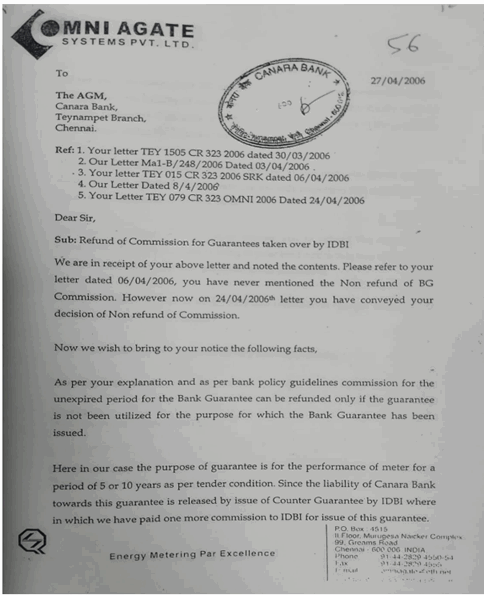
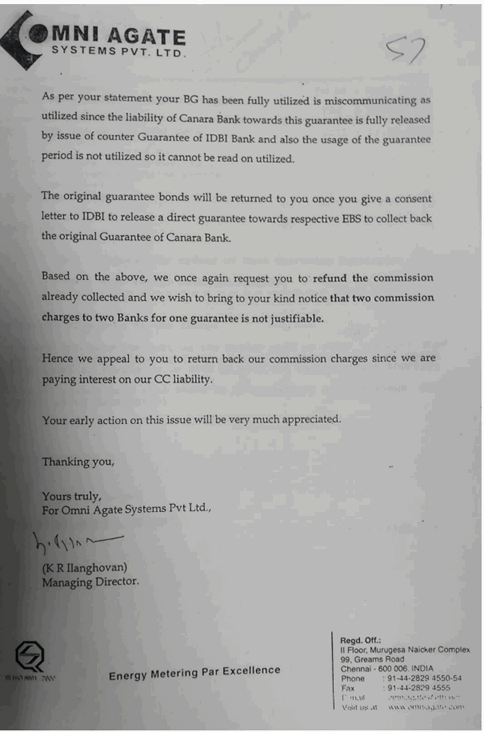
12. The complainant on receiving this letter wrote on 27.04.2006 stating therein that the original Bank Guarantee bonds will be returned upon a consent letter being issued by the Canara Bank to IDBI for releasing a direct guarantee towards respective EBS to collect Bank the original Guarantee of the Canara Bank. The letter dated 27.04.2006 is extracted hereinunder:
13. The Bank again on 19.05.2006 intimated the complainant that this issue would be taken up after receipt of the original Guarantee bonds only followed by reversal of the entries in their books of Accounts as the matter will have to be approved by the sanctioning authority.
14. The complainant on 17.07.2006 once again pressed for refund of the commission on the Bank Guarantees and stated that it was "returning the original guarantees pertaining to Tamilnadu Electricity Board (TNEB)". We have emphasized the aforesaid intimation of the return of the original Bank Guarantees as the arguments advanced on that issue form the core of the dispute between the parties as we shall shortly refer to hereinafter. The Bank has come up clearly contending that only two original Bank Guarantees had been returned, and in turn the Bank had refunded a sum of Rs. 3,69,690/-being the commission of those Bank Guarantees only for their unutilised period as permitted by the respective authorities. The contention of the Bank is that apart from the said two Bank Guarantees, rest of them were not returned and consequently they continued to be utilised and were neither terminated nor released, as such no refund of Commission thereon was made.
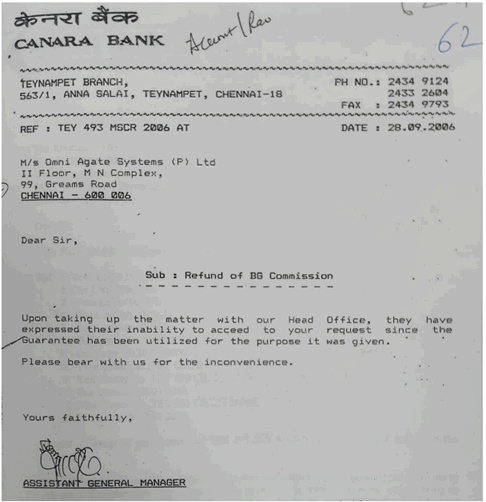
15. After receipt of the said letter and the 2 Bank Guarantees, the Bank declined to make any further refund of the commission charges vide letter dated 28.09.2006, which is extracted hereinunder:
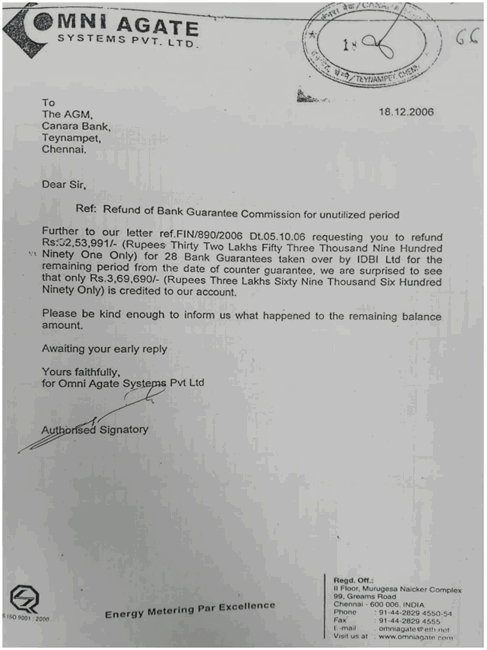
16. The respondent complainant once again pressed their demand and sought refund through letters which are on record including the letter dated 18.12.2006 where they acknowledged the fact that there were 28 Bank Guarantees in total and the commission that was liable to be refunded for the unutilised period was Rs. 32,53,991/-, but the Bank instead had released only Rs. 3,69,690/-. The complainant along with the said letter had also appended a chart of the refundable commission for which the dispute arose between the parties. The letter dated 18.12.2006 and the chart appended thereto are also extracted hereinunder:
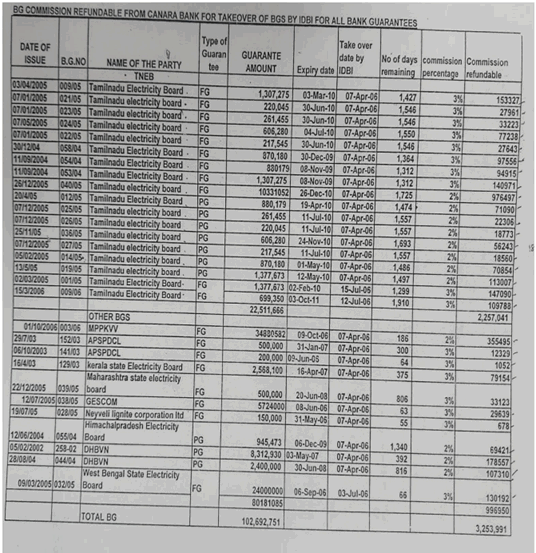
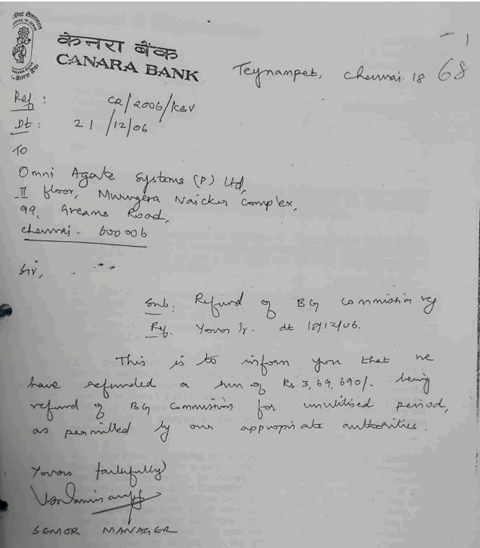
17. The appellant Bank again responded intimating the complainant that the sum of Rs. 3,69,690/- which was refunded was in respect of the commissions relating to Bank Guarantees for the unutilised period and as permitted. The said letter dated 21.12.2006 has a bearing on the dispute, as such is extracted hereinunder:
18. It is thereafter that a legal notice was dispatched whereafter communications went on, but of no avail. Accordingly the complainant filed CC No. 27 of 2007 before the SCDRC Tamilnadu at Chennai. A copy of the complaint is on record raising the question of deficiency on the part of the Bank in refusing to refund the commission charged on the Bank Guarantees extended by the Bank for its unutilised period which according to the complainant ought to have been released and refunded after the arrangement was finalized on 06.04.2006.
19. It was also pleaded that the balance that remains to be refunded is Rs. 28,84,301/- as the Bank had refunded only a minimum partial amount of Rs. 3,69,690/-.
20. On issuance of notice, the appellant Bank filed its written version / statement denying any obligation for refund and raising preliminary objections with regard to the maintainability of the complaint on the ground that on facts, it is neither sustainable and that the complaint should not be entertained relegating the complainant to any remedy that may be available before the Civil Court.
21. The written version of the Bank specifically raises the issue of nonreturn of the original Bank Guarantees that has been categorically stated in paragraph 7 that is extracted hereinunder:
7. At the request of the complaint as many as 26 guarantees were issued by the Opposite Party for various sums in favour various beneficiaries. Most of the guarantees were utilized by the Complainant and they came into effect from 2005 and extended upto 2010, of course with a claim period of three months thereafter. It is admitted by the Complainant that except for two guarantees, all the remaining guarantees were utilized for the purpose for which they were issued and became operative.
22. It was also urged that the complainant had voluntarily chosen to shift their business to IDBI Bank and the issuance of any counter guarantee by the IDBI Bank did not absolve the complainant of its responsibility to return the Bank Guarantees, except two of them, as a result whereof the said Bank Guarantees were continuing to serve the purpose for which they had been issued and as such the commission thereon was not refundable as claimed by the complainant.
23. It was categorically stated that the Bank Guarantee was indivisible and the same has neither been returned and therefore continued to be available to the beneficiary to be invoked as per requirement. In essence the Bank Guarantee was subsisting and did not terminate or became inoperative. It was also pleaded that the complainant ought to have insisted upon the return of the original Bank Guarantees that were given to the various Electricity Boards particularly the Tamilnadu Electricity Board and till the Bank Guarantees are returned, the same continue to be enforceable which the Bank was obliged to encash, in the event it was invoked by the beneficiaries.
24. The period of the Bank Guarantee was still subsisting as it had been issued for 5 years and in such circumstances, there was not even an iota of deficiency of service, hence the complaint was not entertainable and was liable to be dismissed.
25. The same facts were re-asserted by the appellant Bank in its proof affidavit / evidence of affidavit that has also been filed on record.
26. The Bank also relied on another circular issued by it on 04.11.1999 to contend that no such refund was permissible. The circular dated 26.07.1997 was also brought on record indicating payment of commission charges on such Bank Guarantees and the procedure relating thereto that shall be referred to while proceeding to record our findings. Written submissions were also filed before the State Commission denying any liability of refund of the commission charges as claimed.
27. The appeal was admitted on 08.08.2014 and a conditional interim order was also granted. Written arguments have been exchanged before this Commission as well that are on record.
28. Arguments were advanced by the learned counsel for the appellant on 20.11.2025 and then again the matter was directed to come up for hearing on 06.02.2026 when we proceeded to hear the matter finally.
29. Mr. Gautam, learned counsel has advanced his submissions on behalf of the Bank and Advocate Ms. Shrawat has advanced submissions on behalf of the respondent Company.
30. Mr. Gautam urged that the State Commission while proceeding to allow the complaint has erroneously construed facts and pleadings on record including its finding on the maintainability of the complaint. Advancing his submissions, Mr. Gautam urged that the complaint was not maintainable, in as much as, the dominant purpose of availing the Bank Guarantee benefits from the appellant Bank by the respondent complainant was to generate profits for its running business of supply of digital electronic meters to the Electricity Boards throughout the country. It is pointed out that the complaint itself discloses that the complainant was already established in the same business for the past 6 1/2 years and therefore it was not a simple enterprise for selfemployment or livelihood. The whole financial facilities ran into several crores and as is evident from the admitted facts the credit facilities and the Bank Guarantees extended to a sum of Rs. 10 crores. The total Bank Guarantee amount was itself Rs. 10,26,92,751/- as indicated in the chart relied on by the complainant in its own letter dated 18.12.2006. The Bank Guarantees were only for the purpose of negotiating tenders with various Electricity Boards and it was a pure business to business transaction for the pre-dominant purpose for engaging in a business for earning profits. The complaint was filed under the Consumer Protection Act, 1986, where Section 2(d) defines a 'Consumer' to mean any person, who -
(ii) [hires or avails of] any services for a consideration which has been paid or promised or partly paid and partly promised, or under any system of deferred payment and includes any beneficiary of such services other than the person who [hires or avails of] the services for consideration paid or promised, or partly paid and partly promised, or under any system of deferred payment, when such services are availed of with the approval of the first mentioned person [but does not include a person who avails of such services for any commercial purpose].
[Explanation.-For the purposes of this clause, "commercial purpose" does not include use by a person of goods bought and used by him and services availed by him exclusively for the purposes of earning his livelihood by means of self-employment;]
31. Learned counsel urges that the services which were availed of are financial / banking services as defined under Section 2(o) of the 1986 Act, but the banking services that have been availed of by the complainant are purely for a commercial purpose. Learned counsel has emphasized that this issue has been recently dealt with by the Apex Court in two decisions, Chief Manager, Central Bank of India & Ors. vs. AD Bureau Advertising Pvt. Ltd. & Anr., 2025 SCC OnLine SC 460 and another decision of the Apex Court in the case of Poly Medicure Ltd. vs. Brillio Technologies Pvt. Ltd., 2025 SCC OnLine SC 2443, contending that applying the ratio of the aforesaid judgments, the real test is the dominant intention or dominant purpose of the transaction, which in the instant case is clearly to facilitate the profit generation activity of the complainant.
32. Mr. Gautam urges that the decision in the case of Kozyflex Mattresses Pvt. Ltd. vs. SBI General Insurance Co. Ltd. & Anr., (2024) 7 SCC 140 and that in the case of Arun Bhatiya vs. HDFC Bank & Ors., (2022) 17 SCC 229 are decisions in relation to services of indemnity in an insurance matter in the case of Kozyflex Mattresses Pvt. Ltd. (supra) and the second decision in the case of Arun Bhatiya (supra) in relation to a fixed deposit transaction involving a father and a son, and in that context the dispute with the Bank was treated to be within the purview of a banking service where the complainant was held to be a consumer. The submission is that the ratio of those two cases are clearly distinguishable. The contention of Mr. Gautam therefore is that the purpose and the nature of services in the present case was clearly dominated by the sole purpose of the Bank Guarantee to support the award of tenders that were applied for by the complainant.
33. He has therefore urged that the decision of this Commission in the case of Alpha Corp. Development Pvt. Ltd. vs. Canara Bank, 2024 SCC OnLine NCDRC 425 is also distinguishable and not applicable on the facts of the present case.
34. The next contention of Mr. Gautam is that the original Bank Guarantees, except two of them, were never returned and therefore the question of refund of the commission of such of these Bank Guarantees does not arise. He has emphasized that nowhere in the pleadings or the communications of the complainant is there any recital disclosing as to when and how the rest of the original Bank Guarantees were returned to the Bank. He submits that there is an absolute silence and clear avoidance by the complainant to state any such fact, and therefore the stand taken in the reply / written version that except two, none of the Bank Guarantees were returned remained uncontroverted by the complainant. He points out that no rejoinder was filed before the State Commission to meet the specific allegations and recitals contained in the written version and therefore the fact that the original Bank Guarantees were not returned stands established.
35. He further submits that once the Bank Guarantees issued by the appellant Bank continued to be retained by the beneficiary, with no attempt or effort made by the complainant to get them released or hand it over to the Bank, the said Bank Guarantees therefore stood availed and continued to be utilized. They cannot be treated to be unutilized merely because the IDBI had issued a counter guarantee to the appellant Bank. The IDBI had issued no Bank Guarantee to the Electricity Boards and therefore the issuance of a counter guarantee to the appellant Bank in no way can result in an automatic unutilization of the Bank Guarantees given by the appellant Bank that continued to be retained by the beneficiary. It is urged that the Bank Guarantees were for five years and it could be invoked by the beneficiary any time. There is no material on record to demonstrate that the Bank Guarantees issued by the appellant Bank had become defunct or otiose and therefore in the absence of the return of the original Bank Guarantees, they continued to be utilized and therefore the commission charges thereon were not liable to be refunded.
36. Mr. Gautam has invited the attention of the Bench to the Bank circulars that are on record to contend that the said circulars did not permit the refund of the commission at all. He has read out the terms and conditions of the said circular to urge that the same were binding and on the facts of the present case. When the Bank Guarantees had not been returned, they cannot be said to have been lying unutilized. The complainant had been actually utilizing the services of the said Bank Guarantees, and the issuance of any counter Bank Guarantees by the IDBI Bank would not absolve the complainant from the payment of commission charges on the Bank Guarantees issued by the appellant Bank.
37. He has then advanced his submissions contending that the impugned order dated 17.08.2012 erroneously holds the complaint to be maintainable without examining the nature of the transaction which was purely commercial and then went on to hold that there was nothing on record nor any explanation given by the Bank as to how and on what basis had the Bank refunded only Rs. 3,69,690/-. In the absence of any particulars an adverse inference was drawn which the learned counsel contends is without any basis and against the weight of the evidence on record, in as much as, the entire calculation of the commission and the refund sought were already detailed in the chart filed by the complainant itself along with the letter dated 18.12.2006. Learned counsel submits that this evidence has been completely overlooked and ignored and therefore the finding recorded in paragraph 14 is perverse.
38. It is therefore urged that the observations made in paragraph 16 that the complainant had returned back the original Bank Guarantees from the Tamilnadu Electricity Board is yet another perverse recording, in as much as, only two Bank Guarantees had been surrendered by the complainant for which the refund of commission was made to the tune of Rs. 3,69,690/- being the proportionate amount of the commission for the unutilized period of these two Bank Guarantees. It is urged that specific pleadings on behalf of the appellant Bank in respect of the other 26 Bank Guarantees having not been returned, has been completely overlooked and as a matter of fact the said averment in the response of the Bank was nowhere rebutted by the complainant. Thus, the findings proceed on an erroneous impression and assumption, as if all the original Bank Guarantees had been returned, is incorrect.
39. He then submits that the IDBI had taken over the liability of the Bank Guarantees completely ignores the terms and conditions of the transfer and shifting of the business of the complainant to IDBI Bank and therefore the order construing that all the Bank Guarantees remained unutilized and therefore refund of commission was liable to be made is erroneous and against the evidence which is on record as indicated above.
40. He therefore submits that the impugned order is liable to be set aside and the appeal deserves to be allowed.
41. Ms. Shrawat, learned counsel for the respondent complainant, has urged that the submission on behalf of the appellant regarding maintainability of the complaint on the ground that the transaction was a commercial transaction, was not even pleaded and there is no recital to that effect in the written version. The allegation was that the complainant should be relegated to the Civil Court, but there is no averment that the transaction giving rise to the dispute was a commercial transaction. It is therefore submitted that no such plea having been raised, the same cannot be permitted as the same requires pleadings and proofs. She submits that the argument on behalf of the appellant that it is a legal issue is misconceived as the same is a mixed issue of fact and law and in the absence of any fact having been pleaded by the Bank to that effect, this argument in appeal cannot be entertained. She therefore submits that the complaint is very much maintainable.
42. As a corollary to this argument, she also states that the issuance of a Bank Guarantee by the appellant was a service provided on payment of commission charges. The Bank Guarantee by itself was not a profit generating activity and was merely a guarantee of indemnity issued in favour of the beneficiary. It was therefore not a commercial transaction at all and was a service rendered by the Bank for which, it had charged commission and hence, the same cannot be excluded on the ground of being a commercial purpose.
43. She further submits that the Bank itself had refunded the commission for the unutilized period to the tune of Rs. 3,69,690/- which itself indicates that the Bank had accepted this terms of refund. The IDBI Bank had issued counter Bank Guarantees for the same amount to the appellant and therefore their interest was fully protected. It is these counter Bank Guarantees that were utilized whereas the Bank Guarantees issued by the appellant to the Electricity Board consequently remained unutilized after the entire liability of the Bank Guarantee was taken over by the IDBI Bank.
44. She therefore submits the mere subsistence of the Bank Guarantee of the appellant Bank without any utilisation clearly amounts to the Bank Guarantee being unutilized and therefore the commission charged by the Bank for the unutilized period after 06.04.2006 ought to have been refunded. The submission is that there was no utility at all of the Bank Guarantee of the appellant once the counter Bank Guarantee of the IDBI Bank had taken over the entire liability of the Bank Guarantees. She therefore submits that neither the Bank was justified in retaining the balance of the commission amount that was liable to be refunded nor was the Bank justified in withholding the balance of the payments, even though it had made a partial payment on the same terms of the Bank Guarantee. She has invited the attention of the Bench to the circular dated 26.07.1997, the portion whereof has been quoted in paragraph 15 of the impugned order to urge that the purpose for which the Bank Guarantee had been issued stood fulfilled and therefore the commission had to be refunded for the unexpired period in the background above.
45. Having considered the submissions raised, the first contention regarding the maintainability of the complaint deserves to be dealt with. Learned counsel for the respondent complainant has urged that the complaint not being maintainable on account of the transaction being alleged to be for a commercial purpose, was not pleaded in the written version nor argued. This has been countered by Mr. Gautam by contending that the plea of maintainability had been raised and therefore this is a legal issue which is evident from the nature of the transaction itself.
46. The provisions of Section 2(o) of the Consumer Protection Act, 1986 define service to include the provisions of facilities in connection with banking, financing, etc. Thus, banking services are included within the fold of services and can be amenable to legal scrutiny under the Consumer Protection Act. Learned counsel for the appellant has however urged that the observations made by the Apex Court in paragraph 21 of the judgment in the case of Arun Bhatiya (supra) that a person who avails of any service from a Bank will fall under the purview of the definition of the Consumer was made in the context of that case which was a matter relating to the services about a Fixed Deposit in a transaction between a father and son and therefore the observation made in paragraph 21 of the said judgment has to be understood in that context. To that extent, the argument of the learned counsel for the appellant may be correct and therefore we will have to further examine the issue on the anvil of the tests laid down in the decision in the case of Shrikant G. Mantri vs. Punjab National Bank, (2022) 5 SCC 42, Chief Manager, Central Bank of India & Ors. (supra) and the latest decision in the case of Poly Medicure Ltd. (supra). These decisions lay down the dominant purpose test. In the case of Shrikant G. Mantri (supra), the Apex Court held that an overdraft facility availed by a Stock Broker from a Bank was a facility to expand his shareholding business for profits and therefore it was a business to business relationship between the Bank and the complainant, hence the complaint was not maintainable as the transaction reflected a commercial purpose. The decision in the case of Chief Manager, Central Bank of India & Ors. (supra) also indicated that a wide meaning of the word "for any commercial purpose" would include that the services hired should be used in any activity directly intended to generate profits. The decision in the case of Poly Medicure Ltd. (supra) also explained as to when such a transaction would be for a commercial purpose and for that the dominant intention or dominant purpose of the transaction as to whether is to facilitate some kind of profit generation has to be seen. In that case, the complainant had purchased machines facilitating the manufacturing of dyes at cheaper costs, which in turn was to save profits.
47. On the other hand, the case at hand indicates a dispute in relation to the refund of commission charges for Bank Guarantees only for the nonutilised period in respect of Bank Guarantees issued by the appellant Bank. Learned counsel for the complainant respondent while raising her contention has appropriately described that the purpose of the Bank Guarantee was to stand as an indemnity in the event there was any failure on the part of the borrower / tenderer, who had pledged the Bank Guarantee along with the tender. The tender for award of a contract may be a commercial negotiation, but the purpose of the Bank Guarantee was only to get the tender entertained which could be accepted or rejected. The stage of its utilisation would arise only thereafter and accordingly, the commission is chargeable only for the utilized period and refundable for the unutilized period. It is an independent contract.
48. This contention has to be viewed from the point of view that the refund sought is on the ground that the Bank Guarantee remained unutilized after the liability of the Bank Guarantee had been taken over by the issuance of the counter Bank Guarantees by the IDBI Bank. Given the nature of the allegations and the relief prayed for as indicated above, we find it difficult to throw out the complaint on the ground of the transaction being of a commercial purpose. No doubt that the composite transaction of the tender being accompanied by a Bank Guarantee, against which a contract was awarded to the complainant was for profit generating as the complainant had to earn profits while supplying the digital electric meters to the Electricity Boards, but the present dispute is confined between the complainant and the appellant Bank regarding the availing of the services of the Bank Guarantee on commission charges and is limited only to the claim of refund of service charges in the shape of commission. We would therefore carve out this part of the transaction as a banking service, which by itself on its own may not be exactly a commercial purpose. The only service is a Bank Guarantee provided on commission and the limited dispute is refund thereof for the unutilized period of the Guarantee. The contention of the learned counsel for the respondent complainant about the nature and purpose of a Bank Guarantee describing it to secure against any loss or to compensate the beneficiary in the event of any breach of the tender conditions which in a manner is intended to guarantee an indemnification, is a plausible argument and therefore a complaint on such facts would be maintainable.
49. We may point out that the order of this Commission in the case of Alpha Corp. Development Pvt. Ltd. (supra) may not be attracted as urged by the learned counsel for the appellant, in as much as, in that case the issue arose out of an invocation of the Bank Guarantee and was not related to any refund of commission charges. The facts of that case are therefore clearly distinguishable whereas the facts of the present case are clearly peculiar as indicated above. Learned counsel for the appellant is therefore correct in his submission that the ratio of the said decision would not apply on the facts of the present case, but at the same time, as indicated above, we hold that the nature of the transaction in the present case on its peculiar facts in question is not the award of tender or generation of any profit, but is only confined to the claim of refund of the commission charges against the services availed of by the complainant for the issuance of a Bank Guarantee by the appellant Bank. Having said that, we find the complaint to be maintainable and there are no complicated questions of facts requiring any leading of evidence so as to relegate the complainant to a Civil Suit.
50. The dispute is plain and simple and based on the interpretation of the terms of the Bank Guarantee as well as the facts pleaded on record with regard to the return of the original Bank Guarantees and a consequential claim of refund of commission charges. On this count, we find the contention on behalf of the appellant Bank that the original Bank Guarantees were not returned to be tenable. It is established on record that the complainant respondent failed to dislodge the fact of the return of the original Bank Guarantees, except two of them. There is no rebuttal to the stand taken by the Bank in this regard. The State Commission completely overlooked this aspect and without appreciating these relevant facts drew an incorrect inference and recorded a conclusion about the return of all the Bank Guarantees, which is a clear perverse finding. Learned counsel for the respondent complainant urged that the appellants had nowhere indicated as to which of the original Bank Guarantees had not been returned. This argument has to be rejected, in as much as, the complainant itself had admittedly brought on record the details of all the 28 Bank Guarantees through a chart appended to the letter dated 18.12.1996 and therefore an admitted fact by the complainant was not required to be proved otherwise by the Bank. The Bank had categorically denied having received the original Bank Guarantees except two of them. The respondent complainant has nowhere alleged or responded by indicating any fact relating to the return of the original Bank Guarantees except two of them. The fact of the original Bank Guarantees either lying with the Electricity Boards or with the complainant is a fact which was in the special knowledge of the complainant. The complainant did not discharge this burden at all nor has the learned counsel for the complainant been able to show any fact or pleading asserting the return of the original Bank Guarantees to the appellant Bank in any manner whatsoever, except the two of them. This fact remains therefore unsuccessfully rebutted by the respondent complainant and consequently, learned counsel for the Bank is absolutely correct in his submissions that the original Bank Guarantees except the two of them had not been returned, so as to term them to be unutilized for a certain period.
51. There is no need to explain the law of Bank Guarantees, in as much as, the Bank Guarantees are issued in favour of the beneficiary that in the event of any default or any deficit on the part of the tenderer, the same can be unequivocally invoked and encashed. It is an absolute guarantee for payment on the same being invoked and is not hedged by any limitations unless the same is discharged or is released by the beneficiary itself. In the instant case, even though the IDBI Bank had issued the counter Bank Guarantees to the appellant Bank, no such guarantee was issued by the IDBI Bank to the Electricity Boards nor any intimation was given by the Electricity Board releasing the Bank Guarantees issued by the appellant for the unutilized period. Thus, the issuance of the counter Bank Guarantees by the IDBI Bank by itself could not per se amount to an automatic release of the Bank Guarantees issued by the appellant Bank to the Electricity Boards. The documents on record including the letter dated 06.04.2006 nowhere promises any such arrangement of the automatic release of the Bank Guarantees issued by the appellant Bank except two of them to the beneficiary Electricity Boards which continued to remain either in the possession of the Electricity Boards or the complainant himself. The complainant has nowhere disclosed the status of those Bank Guarantees nor did it make any effort to return the same. The State Commission therefore erroneously treated all the Bank Guarantees to have been returned which is factually incorrect. The order therefore is perverse on that count.
52. The argument of the learned counsel for the respondent complainant that a mere subsistence of the Bank Guarantee does not amount to its utilisation, in as much as, the said purpose stood substituted with the counter Bank Guarantee of the IDBI Bank. As noted above, the issuance of the counter Bank Guarantee did not result in the release or termination of the Bank Guarantee issued by the appellant Bank. As a matter of fact, only two of the Bank Guarantees were returned and the commission for the unutilized period was released. To that extent, the appellant Bank has refunded the amount of commission for the unutilized period.
53. In our considered opinion, such of the Bank Guarantees which were not released or returned to the appellant Bank would continue to be falling in the category of a utilized Bank Guarantee and to that effect the argument of the learned counsel for the appellant has to be accepted on the facts of the present case. We therefore find the same to be a good ground to interfere with the impugned order passed by the SCDRC dated 17.08.2012.
54. Consequently, for all the reasons given hereinabove, the order of the SCDRC, Chennai cannot be sustained. Accordingly the order dated 17.08.2012 is set aside. The appeal is allowed.
55. Any amount deposited under the orders of this Commission by the appellant Bank shall be released along with the interest accrued thereon.

 |
This Product is Licensed to , |