



(Prayer: This Writ Petition is filed under Articles 226 and 227 of the Constitution of India praying to issue a writ of certiorari or any other appropriate writ order or direction quashing intimation bearing No. Hce 873/2013 (So & Co) dated: 25.04.2025, issued by the respondent as being arbitrary, illegal, and contrary to the High Court of Karnataka Service (conditions of service and Recruitment Rules 1973 (Annexure-A).)
CAV Order
1. This writ petition is filed under Articles 226 and 227 of the Constitution of India, challenging the intimation dated 25.04.2025 vide Annexure-A issued by the Registrar General, High Court of Karnataka, to the petitioners. By the said intimation it was communicated that, as per the High Court of Karnataka (Conditions of Service and Recruitment) Rules, 1973 (for short, '1973 Rules'), promotion to the cadre of Assistant Registrar shall initially be made only from the feeder cadre of Section Officers until their strength in the cadre of Assistant Registrars reaches 35 posts and that, upon achieving the ratio of 2:1, i.e., 35 posts from the cadre of Section Officers and 18 posts from the cadre of Court Officers, future promotions shall be maintained in the same proportion in the cadre strength. Accordingly, their representations with respect to up-gradation of posts have been rejected.
2. The facts of the case are that the petitioners are working as Court Officers in the respondent establishment. As per the 1973 Rules, the next promotional avenue for Court Officers is to the post of Assistant Registrar. The said post is to be filled by promotion from two feeder cadres, namely, Section Officers and Court Officers, in the ratio of 2:1, respectively.
3. Since the petitioners were not being considered for promotion, they submitted a representation dated 30.10.2014 vide Annexure-D1, seeking up-gradation of their pay scale on par with that of Assistant Registrars by re-designating them as Court Masters. They also sought up-gradation of the pay scale of Assistant Court Officers to the next higher level by re-designating them as Assistant Court Masters. Subsequently, similar representations dated 04.03.2020, 24.01.2022, 20.06.2023 and 06.08.2024 vide Annexures D2, D3, D4 and E were also submitted.
4. By the impugned intimation dated 25.04.2025 vide Annexure-A, their request has been rejected. It was also stated that promotion to the cadre of Assistant Registrar would be governed by cadre strength henceforth. Being aggrieved by the same, the petitioners are before this Court.
5. Sri Prithveesh M.K., the learned counsel appearing for the petitioners has raised the following contentions:
(i) Firstly, the petitioners sought up-gradation and re-designation of the posts of Court Officers and the Assistant Court Officers, and also sought re- fixation of the ratio for promotion to the post of Assistant Registrar through multiple representations. Contrary to their requests, the impugned intimation vide Annexure-A has been issued.
(ii) Secondly, the Section Officers had sought rectification of the alleged anomaly in the ratio for promotion to the post of Assistant Registrars. The operative portion of Annexure-A states that their representations have been rejected. However, the body of the intimation letter suggests that their request was considered favourably. He contends that the impugned order cannot simultaneously grant relief and reject the representation.
(iii) Thirdly, as per Rule 7 of the 1973 Rules, recruitment to a post or class of posts is by promotion on the basis of seniority-cum-merit from the cadres of Section Officers and Court Officers in the ratio of 2:1. The ratio must therefore apply to the vacancies existing at the time of appointment and not to the overall cadre strength. Therefore, there is no ambiguity in the 1973 Rules, warranting issuance of any clarification or correction by way of an intimation. In support of his contention, he relied upon the judgment of the Allahabad High Court in the case of K.K.TIWARI AND OTHERS vs. UNION OF INDIA AND OTHERS reported in 2001 SCC Online All 1024, which has been affirmed by the Apex Court in (2008) 5 SCC 741. Therefore, he contends that the intimation issued by the respondent vide Annexure-A is unsustainable in law.
(iv) Fourthly, until issuance of the impugned intimation vide Annexure-A, promotions to the post of Assistant Registrar were being made in the ratio of 2:1 on the basis of vacancies arising at the time of recruitment or promotion. The 1973 Rules specifically provide that the post of Assistant Registrar shall be filled by promotion from the feeder cadres in the ratio of 2:1 based on the 'vacancies' available at the time of recruitment or promotion. If the respondent intends to change the 1973 Rules, the same must be done by amending the 1973 Rules in accordance with the procedure prescribed by law. The respondent has no authority to alter the method of recruitment by issuing an intimation letter as per Annexure-A. Hence, Annexure-A has been issued without authority of law.
(v) Lastly, by a plain reading of Rule 7 and Schedule III of the 1973 Rules, it is seen that there is no ambiguity in the 1973 Rules. If the quota is prescribed for recruitment to a post or class of posts, the quota rule will have to be observed at the recruitment stage. The quota would be then correlated to the vacancies to be filled in by recruitment. Once the recruitment is made from two different sources, they will have to be integrated into a common cadre. In support of his contention, he has relied on the Judgment of the Apex Court in the case of STATE OF PUNJAB AND OTHERS vs. DR.R.N.BHATNAGAR AND ANOTHER reported in (1999) 2 SCC 330. Hence, he sought for allowing the writ petition.
6. Sri D.R.Ravishankar, the learned Senior Counsel appearing for the respondent raised the following contentions:
(i) Under the Schedule III, Item No.6 of the 1973 Rules, recruitment to the posts of Assistant Registrar and Assistant Registrar (Protocol) is by promotion on the basis of seniority-cum-merit from the cadres of Section Officers and Court Officers in the ratio of 2:1. The Rule does not specify whether such ratio is to be applied on the basis of roster, vacancy, or cadre strength. When there is ambiguity in the Rules, the decision of the Chief Justice is final. Therefore, Annexure-A has been issued in conformity with the 1973 Rules. In support of his contention, he relied on the order passed by this Court in W.P.No.4808/2022 and connected matter disposed of on 26.11.2024, as well as W.A.No.4411/2011 disposed of on 12.10.2011.
(ii) Secondly, under the proviso to Rule 7 of the 1973 Rules, the Chief Justice has the power to amend the Rules. Accordingly, the Committee constituted by the Chief Justice has taken a decision that, for recruitment to the post of Assistant Registrar, the ratio has to be maintained with reference to cadre strength. Further, the Committee's decision has been approved by the Chief Justice. Accordingly, the impugned intimation has been issued and the same is in conformity with the proviso to Rule 7 of the 1973 Rules.
(iii) Thirdly, the judgment cited by the learned counsel for the petitioner, i.e., DR.R.N.BHATNAGAR (supra), relates to an issue concerning roster points. Therefore, the said case is not applicable to the facts of the present case.
(iv) Fourthly, the order passed by the Allahabad High Court in K.K.TIWARI (supra) is distinguishable, as in that case, the Rule itself provided for filling up of the vacancies, and the same was affirmed by the Apex Court in (2008) 5 SCC 741. Therefore, the said judgment is not applicable to the facts of the present case. Hence, he sought for dismissal of the writ petition.
7. By way of rejoinder, learned counsel appearing for the petitioners submitted that even if the Chief Justice intends to amend the 1973 Rules with respect to fixing the ratio based on cadre strength, such amendment has to be notified in the Official Gazette, and only thereafter would it come into force. No such Gazette Notification has been published. In furtherance of the same, he also relied on Section 21 of the General Clauses Act, 1897 to contend that the "power to issue, amend, vary or rescind notifications, orders, rules or bye-laws, includes a power, exercisable in the like manner and subject to the like sanction and conditions if any, to add to, amend, vary or rescind any notifications, orders, rules or bye-laws so issued" and hence the prescribed procedure must be followed. Therefore, he sought allowing of the writ petition.
8. Heard the learned counsel for the parties. Perused the writ petition papers.
9. The main contention of the learned counsel for the petitioners is that there is no ambiguity in the 1973 Rules. He submits that the Rules governing promotion to the post of Assistant Registrar are clear and unambiguous and that as per the 1973 Rules, the 2:1 ratio has to be applied at the time of filling up of vacancies and not for maintaining the cadre strength in the ratio of 2:1.
10. To consider this point, it is necessary to extract certain portions of the 1973 Rules. In exercise of the powers conferred under Article 229(2) of the Constitution of India, the Chief Justice, with the approval of the Governor of Karnataka, except in respect of the Rules related to salaries, allowances, leave, and pension, has framed the 1973 Rules. In 1973 Rules, Rule 2(a) defines, "Chief Justice" as the Chief Justice of the High Court of Karnataka, and Rule 2(d), "Court servant" means a member of the High Court Service. Rule 5 deals with the "Appointing Authority" and provides that all appointments to the service shall be made by the Chief Justice. Rule 7 deals with the "method of recruitment" and states that recruitment to a post or class of posts shall be made by the Chief Justice as enumerated in Schedule III of these Rules. In Schedule III, the relevant provision for consideration in this case pertains to the cadre of Assistant Registrars. The relevant portion of the Rule is extracted below:
| "Assistant Registrar | By promotion on the basis of seniority-cum- efficiency from the cadres of Section Officers, Court Officers and Senior Judgment Writers. (i) The quota of Senior Judgment Writers has been increased from 5 to 6; (ii) The ratio between Court Officers and Sections Officers for promotions to the remaining 18 posts shall be maintained at 2:1 respectively for a period of three years. At the end of three years, the ratio shall stand reverted to 1:1 between Court Offices and Section Officers. (iii) Cadre review shall be done at the end of three years." |
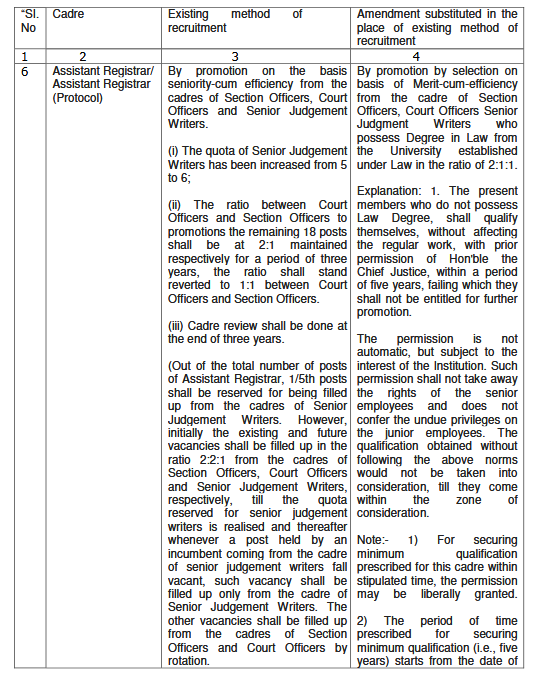

12. Again, the said Rule was amended on 15.02.2013. The relevant amended Rule in respect of Assistant Registrar & Assistant Registrar (Protocol) is extracted below:
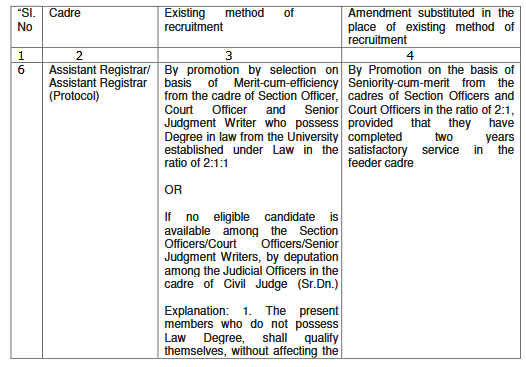
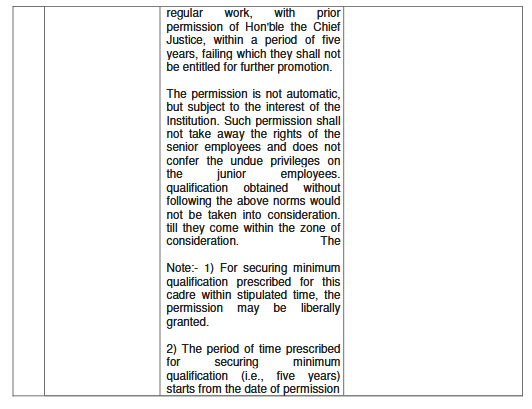
13. Additionally, Rules 23 and 25 are extracted below:
"23. Residuary Powers.-Nothing in these rules shall be deemed to affect the power of the Chief Justice to make such orders, from time to time, as he may deem fit in regard to all matters incidental or ancillary to these rules (not specifically provided for herein or in regard to matters as have not been sufficiently provided for:
Provided that if any such order relates to salaries, allowances, leave or pensions of Court Servants the same shall be made with the approval of the Governor.
...........
25. Interpretation.-All questions relating to the interpretation of these rules shall be referred to the Chief Justice, whose decision thereon shall be final":
14. Rule 23 of the 1973 Rules provides that, in matters not specifically provided for therein or in matters not sufficiently provided for, the Chief Justice may issue orders from time to time as he may deem fit, except in respect of salaries, allowances, leave, or pension of Court servants, for which prior approval of the Governor is required. Further, under Rule 25, where any doubt or ambiguity arises in the interpretation of the 1973 Rules, the Chief Justice is empowered to take a decision, and such decision of the Chief Justice shall be final. Therefore, it is very clear that if there is an ambiguity in the Rules, the decision of the Chief Justice is final.
15. However, in the rule under consideration in the present case, there is no ambiguity. The rule is clear and unambiguous. On a plain reading of Rule 7 along with Schedule III, it is seen that the 'recruitment' to the post of Assistant Registrar/Assistant Registrar (Protocol) is by promotion from the cadre of Section Officers and Court Officers in the ratio of 2:1. Therefore, it is clear that the 1973 Rules governing recruitment to the post of Assistant Registrar states that the ratio has to be maintained in respect of the arising vacancies. The expression "Recruitment" employed in Rule 7 r/w. Schedule III of the 1973 Rules necessarily refers to the act of filling up of vacancies to the concerned post.
16. The vacancies available at the time of promotion have to be considered for the purpose of applying the prescribed ratio of 2:1. The 1973 Rules does not mention that ratio of 2:1 has to be maintained with reference to the overall cadre strength. Therefore, when the rule is clear and unambiguous, the interpretation adopted in the impugned intimation at Annexure-A cannot be sustained. The decision to maintain the 2:1 ratio in the cadre strength is contrary to Rule 7 read with Schedule III of the 1973 Rules and cannot be upheld.
17. In R.K. SABHARWAL AND OTHERS VS. STATE OF PUNJAB AND OTHERS, reported in (1995) 2 SCC 745, the issue arose in the context of Article 16(4) of the Constitution of India. The Apex Court in DR. R.N. BHATNAGAR (supra) has distinguished the judgment in R.K.SABHARWAL (supra), and held that once the recruitment is made from two sources and once the candidate enters into any cadre through an entry point reserved for them, they get fused and blended into a single cadre and their birth marks get obliterated, while further distinguishing the applicability of the quota in terms of Articles 16(1) and 16(4) of the Constitution of India. The relevant portion is extracted below:
"8. In the light of the aforesaid rival contentions, the following points arise for our determination:
(i) whether the interpretation of Rule 9(i)(d), which appealed to the High Court, is a correct one;
(ii) even if the roster operates on vacancies in such a way that from the very inception of the roster, vacancies on the first three roster points will go to promotees and the vacancy on the fourth roster point will go to a direct recruit and similarly, in future for further vacancies, whether the disputed 16th vacancy should go to a direct recruit or a promotee;
(iii) if the answer to the first point is in the negative, whether the ultimate decision of the High Court can be sustained on the conjoint reading of Rule 3 and Rule 9(i)(d) of the statutory rules as submitted by learned counsel for the respondent; and
(iv) what final order?
We shall deal with the aforesaid points in the same sequence in which they are noted hereinabove.
Point 1
9. So far as the first point is concerned, the High Court in the impugned judgment, has heavily relied upon the Constitution Bench decision of this Court in the case of R.K. Sabharwal [(1995) 2 SCC 745 : 1995 SCC (L&S) 548 : (1995) 29 ATC 481] . Now it has to be kept in view that the Constitution Bench of this Court in the aforesaid decision was concerned with entirely a different question, namely, as to how the roster indicating reserved points in connection with reservation of posts in a cadre to be filled in by Scheduled Caste (for short "SC"), Scheduled Tribe (for short "ST") and Backward Class (for short "BC") candidates could be operated. Para 4 of the Report lays down that: (SCC p. 750)
"4. When a percentage of reservation is fixed in respect of a particular cadre and the roster indicates the reserve points, it has to be taken that the posts shown at the reserve points are to be filled from amongst the members of reserve categories and the candidates belonging to the general category are not entitled to be considered for the reserved posts."
In this connection, reliance was placed by the Constitution Bench on Article 16(4) of the Constitution of India which permits the State Government to make any provision for reservation of appointments or posts in favour of any backward class of citizens which, in the opinion of the State, was not adequately represented in the services under the State. In the light of the aforesaid scheme of the Constitution, the Bench had to consider whether reservation of posts for SCs, STs and BCs when sought to be secured by way of operation of the roster could permit the operation of the roster qua the posts or vacancies in the cadre. It was noted in this connection that if the roster operated on vacancies, then it may happen that at a given point of time, the percentage of reservation of posts for SCs, STs and BCs may exceed the permissible percentage of reservation. In para 5 of the Report, it was observed that reservations provided under the impugned government instructions permitted 16% of the posts to be reserved for members of SCs and BCs and it could be achieved by the roster to be maintained in each Department. The roster had to be implemented in the form of running account from year to year. In connection with "16% of the posts..." to be reserved for members of SCs and BCs in promotional posts, it was held as under: (SCC p. 751, para 5)
"When recruitment to a cadre starts then 14 posts earmarked in the (100 points) roster are to be filled from amongst the members of the Scheduled Castes. ... When the total number of posts in a cadre are filled by the operation of the roster then the result envisaged by the impugned instructions is achieved. In other words, in a cadre of 100 posts when the posts earmarked in the roster for Scheduled Castes and the Backward Classes are filled the percentage of reservation provided for the reserved categories is achieved. We see no justification to operate the roster thereafter. The 'running account' is to operate only till the quota provided under the impugned instructions is reached and not thereafter. Once the prescribed percentage of posts is filled the numerical test of adequacy is satisfied and thereafter the roster does not survive."
The aforesaid observations which were heavily relied on by the High Court and are also relied upon by the respondent's (writ petitioner's) counsel before us, cannot be of any assistance to the appellant-State on the facts of the present case. The result is obvious. As per Article 16(4) which carves out a separate field for itself from the general sweep of Article 16(1) which guarantees equality of opportunity in matters of appointments in government services to all citizens of India, the reservation for these categories in employment has to be achieved by earmarking the requisite percentage of posts for the reserved category of candidates and by pitchforking these posts on roster points on requisite points' roster and when such a roster takes a full cycle, posts earmarked on reserved points will enable the requisite reserved category of candidates to fill up these posts. After that is done, the roster would be treated to have achieved its purpose. Whenever a reserved candidate vacated a reserved post, the said post was liable to be filled only by a candidate belonging to the reserved category. If after the roster is first operated and thereafter it is again operated on future vacancies also, a situation may arise wherein a cadre may get reserved category exceeding the permitted quota of reservation. It is to avoid this contingency that the Constitution Bench laid down in the aforesaid decision as indicated therein. So far as Rule 9 of the Rules in the present case is concerned, it has nothing to do with reservation of posts in the cadre of Professors. It is not a rule of reservation envisaged for a specified category of persons as permitted by Article 16(4) of the Constitution. On the contrary, it is a rule of recruitment from two different sources, namely, in case of Professor's cadre, 75% of the posts has to be filled in by promotion while 25% by direct recruitment. These two sources of recruitment permit departmental promotees and direct recruits from the open market to get absorbed in the cadre. They merely serve as two entry points for the cadre. Rule 9 deals with reservation of appointment to the posts of Professor and does not deal with reservation of posts of Professor for any special class or category of candidates. It is well settled that once recruitment is made from two sources, i.e., departmental promotees and direct recruitment from the open market and once the candidates concerned enter into any cadre through entry point reserved for them, they get fused and blended into one single cadre and their birthmarks get obliterated. In this connection, we may usefully refer to a Constitution Bench decision of this Court in State of J&K v. Triloki Nath Khosa [(1974) 1 SCC 19 : 1974 SCC (L&S) 49] . Chandrachud, J. (as he then was), speaking for the Constitution Bench while dealing with recruitment to a cadre from two sources, namely, direct recruits and promotees in the light of an earlier judgment of this Court in Roshan Lal Tandon v. Union of India [AIR 1967 SC 1889 : (1968) 1 SCR 185] made the following pertinent observations: (SCC p. 38, paras 44-45)
"44. The key words of the judgment are: 'The recruits from both the sources to Grade 'D' were integrated into one class and no discrimination could thereafter be made in favour of recruits from one source as against the recruits from the other source in the matter of promotion to Grade 'C'.' (emphasis supplied) By this was meant that in the matter of promotional opportunities to Grade 'C', no discrimination could be made between promotees and direct recruits by reference to the source from which they were drawn. That is to say, if apprentice Train Examiners who were recruited directly to Grade 'D' as Train Examiners formed one common class with skilled artisans who were promoted to Grade 'D' as Train Examiners, no favoured treatment could be given to the former merely because they were directly recruited as Train Examiners and no discrimination could be made as against the latter merely because they were promotees. This is the true meaning of the observation extracted above and no more than this can be read into the sentence next following: 'To put it differently, once the direct recruits and promotees are absorbed into one cadre, they form one class and they cannot be discriminated for the purpose of further promotion to the higher Grade 'C'.' In terms, this was just a different way of putting what had preceded.
45. Thus, all that Roshan Lal case [AIR 1967 SC 1889 : (1968) 1 SCR 185] lays down is that direct recruits and promotees lose their birthmarks on fusion into a common stream of service and they cannot thereafter be treated differently by reference to the consideration that they were recruited from different sources. Their genetic blemishes disappear once they are integrated into a common class and cannot be revived so as to make equals unequals once again."
It has, therefore, to be appreciated that when posts in a cadre are to be filled in from two sources, whether the candidate comes from the source of departmental promotees or by way of direct recruitment, once both of them enter a common cadre, their birthmarks disappear and they get completely integrated in the common cadre. This would be in consonance with the thrust of Article 16(1) of the Constitution of India. No question of exception to the said general thrust of the constitutional provision would survive as Article 16(4) would be out of the picture in such a case. Consequently, the decision rendered by the Constitution Bench in R.K. Sabharwal case [(1995) 2 SCC 745 : 1995 SCC (L&S) 548 : (1995) 29 ATC 481] in connection with Article 16(4) and the operation of roster for achieving the reservation of posts for SCs, STs, and BCs as per the scheme of reservation cannot be pressed into service for the present scheme of Rule 9(1) is not as per Article 16(4) but is governed by the general sweep of Article 16(1). The attempt of learned counsel for the respondent to treat a quota rule as a reservation rule would result in requiring the State authorities to continue the birthmarks of direct recruits and promotees even after they enter the common cadre through two separate entry points regulating their induction to the cadre. Therefore, the roster for 3 promotees and one direct recruit is to be continued every time a vacancy arises and there is no question of filling up a vacancy arising out of a retirement of a direct recruit by a direct recruit or on the retirement vacancy of a promotee by a promotee. Consequently, the question of rotating the vacancies as posts or for treating the posts mentioned in the rules of recruitment as necessarily referable to total posts in the cadre at a given point of time in the light of R.K. Sabharwal [(1995) 2 SCC 745 : 1995 SCC (L&S) 548 : (1995) 29 ATC 481] judgment, therefore, cannot survive for in the case of a quota rule between direct recruits and promotees, the same is to be judged on the touchstone of Article 16(1) and the statutory rules governing the recruitment to the posts of Professor constituting the Punjab Medical Education Service (Class I) and not on the basis of Article 16(4). The Division Bench in the impugned judgment with respect wrongly applied the ratio of R.K. Sabharwal case [(1995) 2 SCC 745 : 1995 SCC (L&S) 548 : (1995) 29 ATC 481] governing Article 16(4) to the facts of the present case which are governed by Article 16(1)."
18. The Rule 7 r/w. Schedule III of the 1973 Rules nowhere provides that the total cadre strength of Assistant Registrars has to be consistently maintained in 2:1 ratio from Section Officers and Court Officers, respectively. On the other hand, the Rules are very clear that the ratio has to be maintained at the time of filling up the vacancies. This view is fortified by the Apex Court in the case of K.K.TIWARI (supra). The relevant paragraphs are extracted below:
"23. Rule 7 on its bare reading does not make reference to Schedule I, which provides that 445 numbers of posts are to be held by civilian officers in the cadre of EEs. The Rules nowhere provide that the total strength of the cadre of EEs has to be consistently maintained in a manner that 2/3rd cadre is manned by those who are promoted from the posts of AEEs and 1/3rd cadre is manned by those who have been promoted from the post of AEs. It appears from the record that the entire basis for issuing the Circular dated 29-7-1997 by Respondent 2 was that in the cadre of EEs the ratio of such officers who had been promoted from the post of AEs had been depleted and after calculation of the posts, the deficiency has been found to the extent of 58 vacancies and, therefore, the vacancies should be filled in from amongst AEs only for a particular year 1997-1998.
24. The High Court, in our opinion, was right in holding that such a direction in terms of the circular of Respondent 2 did not find support from the Rules as Rule 7 neither refers to Schedule I which prescribes the total strength of the cadre nor it provides anywhere further that recruitment shall be made in a manner so as to maintain the ratio of 2/3rd and 1/3rd in the entire cadre for a particular year. The language of Rule 7 is very clear and unambiguous and it emphasises that after the commencement of the Rules which came into force on 9-7-1991, the vacancies shall be filled in a manner provided in Schedule III. Schedule III, as earlier noticed, prescribes that the post of EEs shall be filled in the ratio of 66-2/3 posts to be filled on non-selection basis from the grade of AEEs and 33-1/3 posts have to be filled on selection basis from the post of AEs. The expression "posts to be filled" used in the rule clearly indicates and means that whenever any selection is made to the post of EE, the ratio, the criteria and the essential minimum qualifying service in terms of Schedule III shall have to be strictly followed and adhered to and any promotion in excess of the quota will result in breaking down the prescribed quota. Thus, the language of Rule 7 read with Schedule III governing the service conditions has to be read harmoniously with meaningful construction. It is not possible or advisable to interpret the ratio of 2/3rd and 1/3rd as prescribed in Schedule IV of Rule 7 in the manner that all the 58 posts of EEs for the year 1997-1998 should be filled in by promotion from the cadre of AEs only. If the claim of the appellants that all 58 posts of EEs for the year 1997-1998 are to be filled in by promotion from amongst the AEs cadre only is accepted, then the quota rule as prescribed by Rule 7 read with Schedule IV shall break down with the result that the ratio of 2/3rd and 1/3rd prescribed in the Rules for AEEs and AEs has to be ignored and resultantly a situation may arise when one cadre will get excess quota as compared to other feeder cadre. If we construe the Service Rules in right perspective and read their provisions in a harmonious manner then the desired result can be achieved. If the interpretation which is sought to be given by the learned Senior Counsel for the appellants is to be accepted, then it is likely to disturb the ratio in the cadre strength of sanctioned strength. When the Rules say that posts of EEs shall be filled in from two channels i.e. AEEs and AEs in the proportion of 66-2/3 and 33-1/3 respectively we cannot ignore the intention of the Rules."
19. From the above discussion, it is very clear that Rule 7 r/w. Schedule III of 1973 Rules mandates that a ratio of 2:1 has to be applied to the vacancies that arise at the time of appointment or promotion to the post in the cadre of Assistant Registrars. Once the Section Officers and Court Officers enter the common cadre of Assistant Registrar, they get fused and blended into a single cadre and their source of recruitment loses significance. Unless the rules specifically provide for maintaining the said ratio with reference to the cadre strength, such requirement cannot be read into the Rules. In the absence of any such provision in the Rules, the prescribed ratio is required to be maintained at the time of filling up the vacancy.
20. As per the records made available to the Court, before the amendment of the 2013 Rules, recruitment to the post of Assistant Registrar from the cadres of Section Officers, Court Officers, and Senior Judgment Writers was in the ratio of 2:1:1. As per the said quota, promotions were accorded to the eligible Section Officers, Court Officers, and Senior Judgment Writers in the ratio of 2:1:1 until the year 2013.
21. After the Rule was amended on 15.02.2013, the promotion to the cadre of Assistant Registrar was made from Section Officers and Court Officers in the ratio of 2:1. Since 2013 till today, the same ratio has been maintained and at no point of time has any excess promotion been made either from the cadre of Section Officers or Court Officers.
22. With respect to the judgment relied upon by the respondent in W.P. No. 4808/2022, disposed of on 26.11.2024, the Karnataka Administrative Service (Recruitment) Rules provided that 50% of the vacancies in KAS Group-A (Junior Scale) posts were to be filled by promotion and the remaining 50% by direct recruitment. The said rule was amended in 1995, whereby the expression "arising vacancies" was specifically omitted with the intention of applying the quota against the fixed cadre strength. In compliance with the object of the amendment, the Government issued an Official Memorandum dated 23.03.2016. Therefore, this Court upheld the said Official Memorandum. The said matter has also been challenged before the Apex Court in SLP Nos.8261/2025, 7030/2025, 23831/2025 and 19819/2025, in which leave has been granted and the matters are pending consideration.
23. In view of the above, the impugned intimation is liable to be quashed.
24. Accordingly, the following order:
(i) The writ petition is allowed.
(ii) The impugned intimation dated 25.04.2025 vide Annexure-A is quashed.