


(Prayer: This Criminal Petition is filed under Section 482 of Cr.P.C., praying to set aside the order dated 21.07.2023 in Spl.C.C.No.1673/2023 passed by the Hon'ble XLVII Additional City Civil and Sessions Judge and Special Judge for CBI Cases at Bengaluru (CCH-48) thereby taking cognizance for the offences p/u/S 420 r/w 34 of IPC, Sec. 9 of Karnataka Protection of interest of depositors in Financial Establishments Act, 2004 a/w Section 76 of Chit Funds Act and Sec. 38, 39 and 41 of Karnataka Money Lenders Act and consequently, quash the entire proceedings in Spl.C.C.No.1673/2023, pending against the petitioners in the Court Of XLVII Acc and SJ and Special Judge for CBI Cases (CCH-48), Bengaluru.)
CAV Order
1. The petitioners/accused Nos. 6 and 7 are before this Court calling in question proceedings in Spl.C.C.No.1673 of 2023 pending before XLVII Additional City Civil & Sessions Judge and Special Judge for CBI Cases, Bangalore City arising out of crime in Crime No.347 of 2015 registered for offences punishable under Sections 420 and 34 of the IPC; Section 9 of the Karnataka Protection of Interest of Depositors in Financial Establishments Act, 2004 ('KPID Act' for short); Section 76 of the Chit Funds Act, 1982 ('Chit Funds Act' for short) and Sections 38, 39 and 41 of the Karnataka Money Lenders Act, 1961 ('Money Lenders Act' for short).
2. Heard Sri C.H.Jadhav, learned senior counsel appearing for petitioners, Sri B.N.Jagadeesha, learned Additional State Public Prosecutor appearing for respondent No.1 and Sri C.M. Kempegowda, learned counsel appearing for respondent No.2.
3. Facts, in brief, germane are as follows: -
3.1. In the year 1989 a company called 'Shreyas Finance & Investments' ('the Company' for short) is registered under the Companies Act, a Company established by accused Nos. 1 and 2 who are now accused Nos. 4 and 5 in the additional charge sheet. In the year 2010, the Company was established to run a chit fund business. The petitioners were appointed as Directors of the Company in the year 2011. On 14-07-2015 it appears that the petitioners resigned from the posts of Directors in the said chit fund Company. A complaint comes to be registered by the 2nd respondent, one of the persons who had invested in the chits of the Company that the periodical amounts paid towards chits have vanished, which becomes a crime in Crime No.347 of 2015 for offence punishable under Section 420 r/w 34 of the IPC. The Police after investigation file a charge sheet for the afore-quoted offence. Cognizance is taken by the concerned Court on 26-12-2016 and summons was issued to the accused including the petitioners, not only in this case but in several cases concerning the Company.
3.2. Criminal Petitions had been filed by accused Nos. 1 to 4 in Criminal Petition Nos. 1836 of 2022 and 3561 of 2017. Those criminal cases come to be allowed by quashing the proceedings on the score that the Company was not made a party, following the judgment of the Apex Court in the case of ANEETA HADA v. GODFATHER TRAVELS AND TOURS PRIVATE LIMITED reported in (2012) 5 SCC 661 and liberty was reserved to the State to act in accordance with law. The State then files an additional charge sheet before the concerned Court arraigning the Company as an accused. Therefore, curing the illegality that subsisted at the time of registration of crime, additional charge sheet is filed. The petitioners/accused 6 and 7 are now before this Court calling in question filing of the additional charge sheet, on the score that it did not amount to any offence at all, as the petitioners had resigned as Directors long before.
4. The learned counsel appearing for the petitioners would vehemently contend that the petitioners had resigned in the year 2015 itself long before registration of the complaint and therefore, they cannot be dragged into the web of proceedings. He would further contend that the order of taking cognizance does not bear application of mind and would seek to place reliance upon a judgment rendered by the Apex Court in RAVINDRANATHA BAJPE v. MANGALORE SPECIAL ECONOMIC ZONE LIMITED reported in (2022) 15 SCC 430 to buttress his submission that proceedings must not be permitted to be continued, as there is no principle of vicarious liability for the offences under the IPC.
5. Per contra, the learned Additional State Public Prosecutor would take this Court through the charge sheet by contending that the petitioners may have resigned in the year 2015, but they were admittedly Directors between 2011 and 2015. It is during this period the entire fulcrum of the crime revolves round. The Additional State Public Prosecutor submits that money with regard to chit is taken monthly from 1060 persons and misappropriated to the tune of 115 crores. Therefore, he would submit that this is a classic case in which trial must ensue. The learned counsel appearing for the 2nd respondent/complainant would also submit as to how he lost his amount like several other persons, as submitted by the learned Additional State Public Prosecutor. Therefore, they would seek dismissal of the petition in unison.
6. I have given my anxious consideration to the submissions made by the respective learned counsel and have perused the material on record.
7. The petitioners were the Directors of a newly formed Company viz., Shreyas Finance & Investments (R). They were appointed as Directors in the year 2011. They resigned on 14-07-2015. These are admitted facts. Between 2011 and 2015, the petitioners along with others had indulged in collection of chit amounts as obtaining under the Chit Funds Act from close to 1060 members/clients/customers or investors as the name would be. None of them were returned with the money which they had invested. The total amount of siphoning of funds or misappropriation in the case at hand is ₹115 crores. Based upon these facts one of the investors comes forward to register the complaint against the Company. The complaint is investigated into and the Police file a charge sheet against all the accused. The summary of the charge sheet as obtaining in Column No.7 reads as follows:
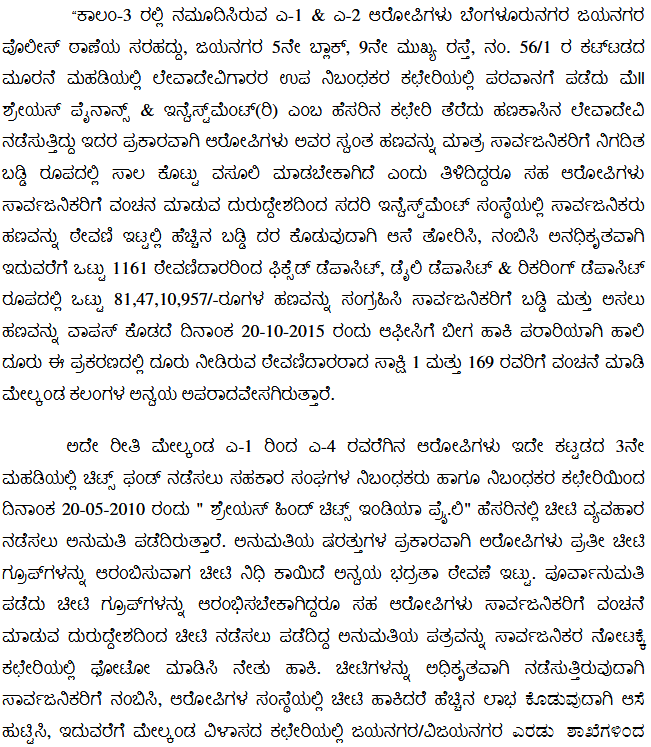
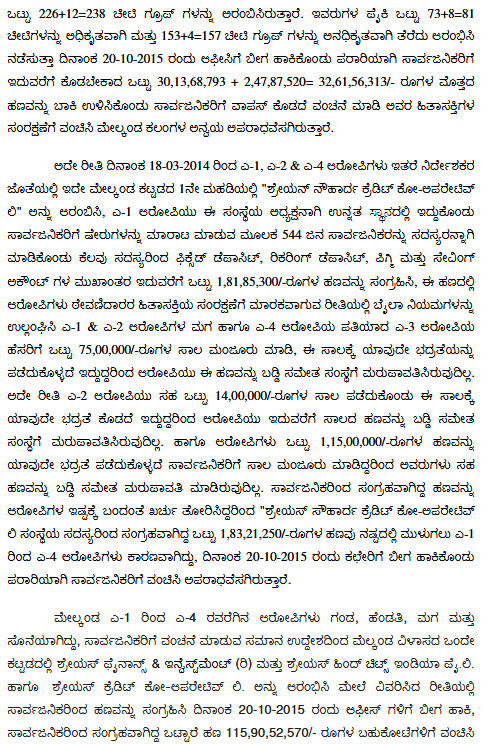
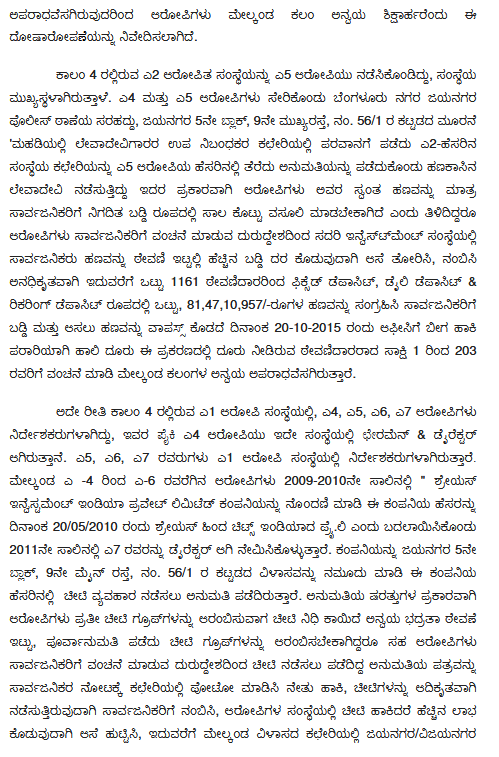
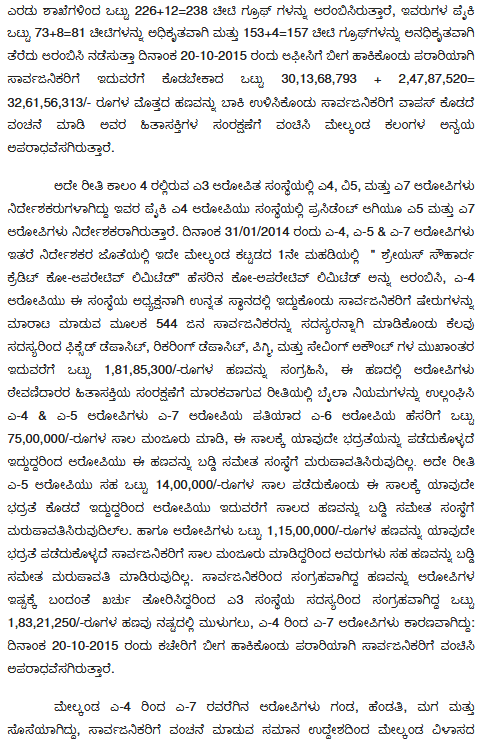
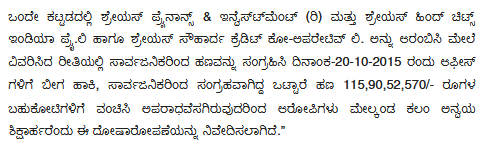
The petitioners, on filing the charge sheet, were before this Court in two of the petitions along with others. Those petitions come to be allowed on a technical ground that the Company was not made a party, while the petitioners who were Directors were made as parties. Following an earlier decision rendered by the coordinate Bench, the filing of charge sheet stood quashed reserving liberty to act in accordance with law. It is then the defect was cured by the State by arraigning the Company as a party, on filing an additional charge sheet. The concerned Court then takes cognizance of the offence and registers a special criminal case against the accused. The order of taking cognizance reads as follows:
".... .... ....
Initially, charge sheet has been filed against the accused persons but, the Company had not been made an accused. Consequently, the Hon'ble High Court of Karnataka, Bengaluru was pleased to quash the case by giving liberty to the State to take appropriate action in accordance with Law.
Now, the IO has filed the present charge sheet against accused No.1 to 5. Perusal of the charge sheet and accompanying material reflects that, the accused had induced the general public to invest their money in accused No.1 Company by offering a higher rate of interest. That, having obtained deposits from 1161 depositors to the tune of Rs.81,47,10,957/-, the accused have absconded and thereby, they have cheated the general public including the depositors.
The prosecution material and statement of witnesses clearly reflect that, there is a prima facie case against the accused No. 1 to 5 for the offences p/u/s 420 r/w 34 IPC and Sec.9 of KPIDFE Act along with Sec.76 of Chit Funds Act and Sec.38, 39 and 41 of Karnataka Money Lenders Act and cognizance has to be taken for that. As such, the accused are required to be summoned before the Court. Accordingly.
ORDER
Acting under Sec. 190(1)(b) of the Code of Criminal Procedure, cognizance is taken for the offences p/u/s 420 r/w 34 IPC and Sec.9 of KPIDFE Act along with Sec.76 of Chit Funds Act and Sec.38, 39 and 41 of Karnataka Money Lenders Act.
Office is directed to register this case as Special CC.
Issue summons to accused No.1 to 5, r/by 08.09.2023."
The order is passed on 21-07-2023 for offences punishable as afore-quoted. The offence under Section 420 of the IPC, is on the face of it met in the case at hand.
8. Section 420 of the IPC has its ingredients in Section 415 of the IPC. Section 415 requires luring of the victim by the accused with a dishonest intention from the inception. Not the de-facto complainant, but 1060 persons are lured into the chit fund transaction and ₹115/- crores is collected and siphoned of. Therefore, the offence under Section 420 of the IPC is prima facie met. It is for the petitioners to come out clean in a full-blown trial.
9. The other offences under the KPID Act or the Chit Funds Act or the Money Lenders Act are the off-shoot of transaction by the Company in which the petitioners were the Directors at the relevant point in time. The petition revolves round seriously disputed questions of fact. In this regard, it is apposite to refer to the judgment of the Apex Court in KAPTAN SINGH v. STATE OF UTTAR PRADESH (2021) 9 SCC 35, wherein it is held as follows:
".... .... ....
"9.1. At the outset, it is required to be noted that in the present case the High Court in exercise of powers under Section 482 CrPC has quashed the criminal proceedings for the offences under Sections 147, 148, 149, 406, 329 and 386 IPC. It is required to be noted that when the High Court in exercise of powers under Section 482 CrPC quashed the criminal proceedings, by the time the investigating officer after recording the statement of the witnesses, statement of the complainant and collecting the evidence from the incident place and after taking statement of the independent witnesses and even statement of the accused persons, has filed the charge-sheet before the learned Magistrate for the offences under Sections 147, 148, 149, 406, 329 and 386 IPC and even the learned Magistrate also took the cognizance. From the impugned judgment and order [Radhey Shyam Gupta v. State of U.P., 2020 SCC OnLine All 914] passed by the High Court, it does not appear that the High Court took into consideration the material collected during the investigation/inquiry and even the statements recorded. If the petition under Section 482 CrPC was at the stage of FIR in that case the allegations in the FIR/complaint only are required to be considered and whether a cognizable offence is disclosed or not is required to be considered. However, thereafter when the statements are recorded, evidence is collected and the charge-sheet is filed after conclusion of the investigation/inquiry the matter stands on different footing and the Court is required to consider the material/evidence collected during the investigation. Even at this stage also, as observed and held by this Court in a catena of decisions, the High Court is not required to go into the merits of the allegations and/or enter into the merits of the case as if the High Court is exercising the appellate jurisdiction and/or conducting the trial. As held by this Court in Dineshbhai Chandubhai Patel [Dineshbhai Chandubhai Patel v. State of Gujarat, (2018) 3 SCC 104 : (2018) 1 SCC (Cri) 683] in order to examine as to whether factual contents of FIR disclose any cognizable offence or not, the High Court cannot act like the investigating agency nor can exercise the powers like an appellate court. It is further observed and held that that question is required to be examined keeping in view, the contents of FIR and prima facie material, if any, requiring no proof. At such stage, the High Court cannot appreciate evidence nor can it draw its own inferences from contents of FIR and material relied on. It is further observed it is more so, when the material relied on is disputed. It is further observed that in such a situation, it becomes the job of the investigating authority at such stage to probe and then of the court to examine questions once the charge-sheet is filed along with such material as to how far and to what extent reliance can be placed on such material.
9.2. In Dhruvaram Murlidhar Sonar [Dhruvaram Murlidhar Sonar v. State of Maharashtra, (2019) 18 SCC 191 : (2020) 3 SCC (Cri) 672] after considering the decisions of this Court in Bhajan Lal [State of Haryana v. Bhajan Lal, 1992 Supp (1) SCC 335 : 1992 SCC (Cri) 426] , it is held by this Court that exercise of powers under Section 482 CrPC to quash the proceedings is an exception and not a rule. It is further observed that inherent jurisdiction under Section 482 CrPC though wide is to be exercised sparingly, carefully and with caution, only when such exercise is justified by tests specifically laid down in the section itself. It is further observed that appreciation of evidence is not permissible at the stage of quashing of proceedings in exercise of powers under Section 482 CrPC. Similar view has been expressed by this Court in Arvind Khanna [CBI v. Arvind Khanna, (2019) 10 SCC 686 : (2020) 1 SCC (Cri) 94] , Managipet [State of Telangana v. Managipet, (2019) 19 SCC 87 : (2020) 3 SCC (Cri) 702] and in XYZ [XYZ v. State of Gujarat, (2019) 10 SCC 337 : (2020) 1 SCC (Cri) 173] , referred to hereinabove.
9.3. Applying the law laid down by this Court in the aforesaid decisions to the facts of the case on hand, we are of the opinion that the High Court has exceeded its jurisdiction in quashing the criminal proceedings in exercise of powers under Section 482 CrPC.
10. The High Court has failed to appreciate and consider the fact that there are very serious triable issues/allegations which are required to be gone into and considered at the time of trial. The High Court has lost sight of crucial aspects which have emerged during the course of the investigation. The High Court has failed to appreciate and consider the fact that the document i.e. a joint notarised affidavit of Mamta Gupta Accused 2 and Munni Devi under which according to Accused 2 Ms Mamta Gupta, Rs 25 lakhs was paid and the possession was transferred to her itself is seriously disputed. It is required to be noted that in the registered agreement to sell dated 27- 10-2010, the sale consideration is stated to be Rs 25 lakhs and with no reference to payment of Rs 25 lakhs to Ms Munni Devi and no reference to handing over the possession. However, in the joint notarised affidavit of the same date i.e. 27-10-2010 sale consideration is stated to be Rs 35 lakhs out of which Rs 25 lakhs is alleged to have been paid and there is a reference to transfer of possession to Accused 2. Whether Rs 25 lakhs has been paid or not the accused have to establish during the trial, because the accused are relying upon the said document and payment of Rs 25 lakhs as mentioned in the joint notarised affidavit dated 27-10-2010. It is also required to be considered that the first agreement to sell in which Rs 25 lakhs is stated to be sale consideration and there is reference to the payment of Rs 10 lakhs by cheques. It is a registered document. The aforesaid are all triable issues/allegations which are required to be considered at the time of trial. The High Court has failed to notice and/or consider the material collected during the investigation.
11. Now so far as the finding recorded by the High Court that no case is made out for the offence under Section 406 IPC is concerned, it is to be noted that the High Court itself has noted that the joint notarised affidavit dated 27-10-2010 is seriously disputed, however as per the High Court the same is required to be considered in the civil proceedings. There the High Court has committed an error. Even the High Court has failed to notice that another FIR has been lodged against the accused for the offences under Sections 467, 468, 471 IPC with respect to the said alleged joint notarised affidavit. Even according to the accused the possession was handed over to them. However, when the payment of Rs 25 lakhs as mentioned in the joint notarised affidavit is seriously disputed and even one of the cheques out of 5 cheques each of Rs 2 lakhs was dishonoured and according to the accused they were handed over the possession (which is seriously disputed) it can be said to be entrustment of property. Therefore, at this stage to opine that no case is made out for the offence under Section 406 IPC is premature and the aforesaid aspect is to be considered during trial. It is also required to be noted that the first suit was filed by Munni Devi and thereafter subsequent suit came to be filed by the accused and that too for permanent injunction only. Nothing is on record that any suit for specific performance has been filed. Be that as it may, all the aforesaid aspects are required to be considered at the time of trial only.
12. Therefore, the High Court has grossly erred in quashing the criminal proceedings by entering into the merits of the allegations as if the High Court was exercising the appellate jurisdiction and/or conducting the trial. The High Court has exceeded its jurisdiction in quashing the criminal proceedings in exercise of powers under Section 482 CrPC.
13. Even the High Court has erred in observing that original complaint has no locus. The aforesaid observation is made on the premise that the complainant has not placed on record the power of attorney along with the counter filed before the High Court. However, when it is specifically stated in the FIR that Munni Devi has executed the power of attorney and thereafter the investigating officer has conducted the investigation and has recorded the statement of the complainant, accused and the independent witnesses, thereafter whether the complainant is having the power of attorney or not is to be considered during trial.
14. In view of the above and for the reasons stated above, the impugned judgment and order [Radhey Shyam Gupta v. State of U.P., 2020 SCC OnLine All 914] passed by the High Court quashing the criminal proceedings in exercise of powers under Section 482 CrPC is unsustainable and the same deserves to be quashed and set aside and is accordingly quashed and set aside. Now, the trial is to be conducted and proceeded further in accordance with law and on its own merits. It is made clear that the observations made by this Court in the present proceedings are to be treated to be confined to the proceedings under Section 482 CrPC only and the trial court to decide the case in accordance with law and on its own merits and on the basis of the evidence to be laid and without being influenced by any of the observations made by us hereinabove. The present appeal is accordingly allowed."
(Emphasis supplied)
10. In the light of the afore-mentioned judgment of the Apex Court, there would be no warrant to entertain the subject petition which is shrouded with seriously disputed questions of fact. Insofar as the submission that the order of taking cognizance does not bear application of mind is also untenable, as cognizance has already been taken. The only defect found was, the Company not being made a party. After the Company is made a party cognizance is taken which is quoted hereinabove. It nowhere depicts non- application of mind. Even otherwise, non-application of mind in taking of cognizance will not take away the effect of crime from the allegations.
11. Finding no merit in the petition, the petition stands dismissed. Interim order if any operating stands dissolved.
Consequently, I.A.No.1 of 2024 also stands disposed.

 |
This Product is Licensed to , |