


1. With the consent of the parties, the matter is finally heard.
2. The instant writ petition filed under Article 226/227 of the Constitution of India seeks s following reliefs:
"a. That, the condition for registration of the decree be modified and the same be delete deleted from the judgment and decree as the same is in violation of the state notification and in alternate the respondent No.1 - 3 may kindly be directed to permit the petitioner for registration of the decree as directed by the trial Court in the notified village as per the condition of judgment decree passed by the learned civil court in the case of 32A/2016.
b. That, the condition on put by the learned court below be set aside.
c. That, any other just and proper relief, warranting under the facts and circumstances of the case be also given to the petitioners, including cost, in the ends of justice.
3. The brief facts leading to filing ling of the present writ petition, petition as discernible from the pleadings and submissions advanced by the leaned counsel appearing for the petitioner petitioners, are as under:
3.1. The grandfather of the petitioners, petitioners Late Shri Dharshan Singh, Singh was permanent resident of Vi Village Mahneked, Tahsil Patti, District Tarn Taran (Punjab), who moved to Village Chitahri, Tehsil Narwar, District Shivpuri (M.P.) in the year 1983. He purchased some lands in the name of his son. After the death of Late Shri Darshan Singh, certain dispute disputes arose between the legal heirs which led to the filing of a civil suit by the petitioners bearing Civil Suit No.32A/2016 No.32A/2016 seeking declaration and permanent injunction in respect of the suit land.
3.2. The said civil suit was disposed of by a compromise judgment and decree dated 08.08.2017 8.08.2017 (Annexure P/1). Learned trial Court, in the compromise decree, enumerated the condition that the decree shall come into force only after its registration under the Registration Act, 1908 and upon payment of adequate stamp duty. Thereafter, the parties to the decree would be entitled to get their names mutated. It appears that the land in question forming the subject matter of the compromise judgment and decree dated 08.08.2017 8.08.2017 was hit by notifications dated 15.02.2000 and 18.02.2000 issued under Section 18 of the Wild Life (Protection) Act, 1972 (hereinafter referred as to "the Act of 1972") 1972"), falling within Village Chitahri forming notified area at Son Chiraiya National Park.. Therefore, in view of the bar contained in Sect Section 20 of the Act of 1972, the petitioners , apprehending denial of registration of the compromise judgment and decree dated 08.08.2017 8.08.2017 challenged the same in a first appeal to the extent that the said decree imposed a condition for coming into effect only on after its registration. The First Appellate Court rejected the first appeal preferred by judgment and decree dated 23.09.2017 on the ground that the challenge is not sought to be made to the compromise judgment and decree dated 08.08.2017 on merits but only a finding is sought to be challenged which may not be permissible. The F First appellate Court also noted that the ground of challenge to the compromise judgment and decree did not fall within the ambit of Order 43 Rule 11-A of CPC and hence, declined interference. Thereafter, hereafter, the instant writ petition has been filed by the petitioners claiming the reliefs as stated hereinabove.
4. Learned counsel appearing for the petitioners submits that in view of the provisions contained in Section 17 (2) (vi) of the Registration Act, 1908,, the compromise decree in question is not required to be registered. Accordingly, the conditions for its registration for the same being given effect as imposed by the learned trial Court is illegal and unenforceable and therefore, deserves to be quashed. Learned counsel appearing for the petitioner, in support of his contentions, contentions places reliance on the judgment of the Apex Court in the case of Mukesh v. State of M.P., reported in 2024 SCC Online SC 3836.
5. Learned counsel el appearing for the petitioners, in the alternative, submits that the bar as contained in Section 20 of the Act of 1972 regarding non-accrual accrual of rights after issuance of notification under Section 18 of the Act 1972 would not come in the way of the petitioners for getting the compromise judgment and decree dated 08.08.2017 8.08.2017 registered as the said compromise judgment and decree does not confer any fresh rights on the petitioners and in fact, the pre pre-existing rights of succession vesting on the petitioners in n respect of the land in question is only recognized by the compromise judgment and decree dated 08.08.2017 8.08.2017 and therefore, even otherwise, the registration of the compromise decree dated 08.08.2017 cannot be denied to the petitioners by the state authorities and accordingly, a mandamus deserves to be issued to the state authority to register the compromise judgment and decree dated 08.08.2017.
6. On the other hand, learned counsel appearing for the State by referring to the return filed, submits that the petitioners were well aware as regards the bar of accrual of rights as provided under Section 20 of the Act of 1972 being in force since the year 2000, i.e., the date of issuance notification ion under Section 18 of the Act of 1972 yet, in order to bypass by the statutory bar, the petit petitioners have devised a mechanism by way of a compromise judgment and decree dated 08.08.2017. He submits that the compromise judgment and decree dated 08.08.2017 does not confer any pre-existing existing rights or the rights flowing from succession qua the lands land in question and therefore, the state authority cannot be compelled to register the judgment and decree dated 08.08.2017.
7. No other point is argued by the learned counsel for the parties.
8. Heard the learned counsel for the parties and perused the record.
9. In view of the rival contentions advanced by the parties, the following issues arise for consideration before this Court are as under:
(i). Whether, in thee given facts and circumstances of the case, the condition imposed by the learned trial Court in the compromise judgment and decree dated 08.08. 8.08.2017 passed in Civil Suit No.32A/2016 No.32A/2016 directing that the said judgment and decree shall be effective only after its registration can be said to be illegal or violative of provisions contained in Section 17 (2) (vi) of the Registration Act, 1908 ?
(ii). Whether, in the given facts and circumstances of the case, in view of the bar on accrual of rights contained in Section 20 of the Act of 1972, a mandamus is required to be issued to the respondents authorities for registration of the compromise judgment and decree dated 08.08.2017 8.08.2017 ?
Answer to issue no. (i):-
10. The question as regards the registration of a compromise judgment and decree came up for consideration before the Apex Court in the case of Bhoop Singh vs. Ram Singh Major and Others, reported in 1995 (5) SCC 709 and the said judgment was later on considered by the Apex Court in the case of Mukesh (supra), (supra), relied upon by the petitioners as well and by considering the earlier judgment and law on the point, the Apex Court in the case of Mukesh (supra) considered and held as under:-
"7. There are two issues involved herein viz., Registration of the document and payment of stamp duty, which are separate and distinct concepts. As regards the issue of registration, we may refer to Section 17 of the Registration Act, 1908, which deals with the t documents of which registration is compulsory and the same reads as follows:
"17. Documents of which registration is compulsory.--(1) compulsory The following documents shall be registered, if the property to which they relate is situate in a district in which, an and d if they have been executed on or after the date on which, Act No. XVI of 1864, or the Indian Registration Act, 1866, or the Indian Registration Act, 1871, or the Indian Registration Act, 1877, or this Act came or comes into force, namely:
(a) instruments of gift of immovable property;
(b) other non non-testamentary testamentary instruments which purport or operate to create, declare, assign, limit or extinguish, whether in present or in future, any right, title or interest, whether vested or contingent, of the value of one hundred rupees and upwards, to or in immovable property;
(c) non non-testamentary testamentary instruments which acknowledge the receipt or payment of any consideration on account of the creation, declaration, assignment, limitation or extinction of any such right, title t or interest; and
(d) leases of immovable property from year to year, or for any term exceeding one year, or reserving a yearly rent;
[(e) non-testamentary non testamentary instruments transferring or assigning any decree or order of a Court or any award when such decree or order or award purports or operates to create, declare, assign, limit or extinguish, whether in present or in future, any right, title or interest, whether vested or contingent, of the value of one hundred rupees and upwards, to or in immovable property: ]
Provided that the [State Government] may, by order published in the [Official Gazette], exempt from the operation of this sub sub-section section any lease executed in any district, or part of a district, the terms granted by which do not exceed five year and the annual rents reserved by which do not exceed fifty rupees.
[(1A) The documents containing contracts to transfer for consideration, any immovable property for the purpose of section 53A of the Transfer of Property Act, 1882 (4 of 1882) shall be registered if they have been executed on or after the commencement of the Registration and Other Related laws (Amendment) Act, 2001 (48 of 2001) and if such documents are not registered on or after such commencement, then, they shall have no effect for the purposes of the said section 53A.]
(2) Nothing in clauses (b) and (c) of sub sub-section section (1) applies to--
(i) any composition deed; or
(ii) any instrument relating to shares in a joint stock Company, notwithstanding that the assets of such Company consist in in whole or in part of immovable property; or
(iii) any debenture issued by any such Company and not creating, declaring, assigning, limiting or extinguishing any right, title or interest, to or in immovable property except in so far as it entitles the holder to the security afforded by a registered instrument whereby the Company has mortgaged, conveyed or otherwise transferred the whole or part of its immovable property or any interest therein to trustees upon trust for the benefit of the holders of such debentures; or
(iv) any endorsement upon or transfer of any debenture issued by any such Company; or
(v) [any document other than the documents specified in sub sub-section section (1A)] not itself creating, declaring, assigning, limiting or extinguishing any right, title or interest of the value of one hundred rupees and upwards to or in immovable property, but merely creating a right to obtain another document which will, when executed, create, declare, assign, limit or extinguish any such right, title or interest; or
(vi) any decree or order of a Court [except a decree or order expressed to be made on a compromise and comprising immovable property other than that which is the subject-matter subject matter of the suit or proceeding]; or
(vii) any grant of immovable property by [Government]; or
(viii) any instrument of partition made by a Revenue- Officer; or
(ix) any order granting a loan or instrument of collateral security granted under the Land Improvement Act, 1871, or the Land Improvement Loans Act, 1883; or
(x) any order granting a loan under the Agriculturists Loans Act, 1884, or instrument for securing the repayment of a loan made under that Act; or
[(xa) any order made under the Charitable Endowments Act, 1890 (6 of 1890), vesting any property in a Treasurer of Charitable Endowments or divesting any such Treasurer of any property; or]
(xi) any endorsement on a mortgage-deed mortgage acknowledging the payment of the whole or any part of the mortgage-money, mortgage money, and any other receipt for payment of money due under a mortgage when the receipt eceipt does not purport to extinguish the mortgage; or
(xii) any certificate of sale granted to the purchaser of any property sold by public auction by a Civil or Revenue Revenue-Officer.
[Explanation.--A A document purporting or operating to effect a contract for the sale of immovable property shall not be deemed to require or ever to have required registration by reason only of the fact that such document contains a recital of the payment of any earnest money or of the whole or any part of the purchase money.]
(3)) Authorities to adopt a son, executed after the 1st day of January, 1872, and not conferred by a will, shall also be registered."
It is thus, clear from the above that Section 17(1) of the Act, 1908 specifies the documents for which Registration is compulsory. Sub-section Sub section (2) of Section 17 carves out the exceptions. The documents/instruments enumerated in sub- sub section (2) of section 17 are not compulsorily registerable. The exemption for decree or order of the Court is covered under section 17 (2) (vi) of the Act, 1908 with a rider. Under the said provision, any decree or order of a Court (except the decree or order expressed to be made on compromise and comprising immovable property other than that which is the subject subject-matter of the suit or proceedings) would not require compulsory registration. Section 17 (2) (vi) carves out the distinction between the property which forms subject-matter matter of the suit and the property that was not the subject subject-matter matter of the suit, but for which a compromise has been arrived at. It would be relevant to point out that the provision permitting the compromise between the parties to include in the compromise decree, the subject matter not forming part of the suit property was introduced with effect from 01.02.1977. Prior to that, the th compromise decree can be passed only with respect to properties or subject matter of suit. If a compromise decree involves immovable property other than the property for which a decree is prayed for, such a property would not be exempted and would require registration. This condition or the exclusion clause was introduced in the Registration Act, 1908 by Act 21 of 1929 by substituting for "and any award". To avail the exemption from the mandate of compulsory registration of documents conveying immovable property of a value of more that Rs. 100/ 100/-,, the compromise decree arrived must be only in respect of the property that is the subject subject-matter matter of the suit. The compromise arrived at before the Lok Adalat and the award passed by the Lok Adalat thereto assume tthe he character of a decree passed under Order XXIII Rule 3 and would also come within the ambit and purview of sub-section sub section (2) of section 17 of the Act, 1908.
8. In the present case, seemingly, the appellant preferred Civil Suit No. 47-A/2013 A/2013 against the respondents for declaration and permanent injunction claiming ownership and continuous possession over the subject land, and the same came to be decreed in favour of him, in view of the compromise arrived at between the appellant and the Respondent No. 2 on on 30.11.2013. For better appreciation, the order passed in the said suit is extracted below:
Order Dt. 30.11.13
Both parties having presented an application have requested to take up the case in National Lok Adalat for disposal.
On the request of both parties this case was taken up today in National Lok Adalat. Sh. M.P. Sharma Advocate is present with the plaintiff.
Defendant is present in person.
Compromise application presented on behalf of both parties was taken into consideration.
Both parties were identified by Sh. M.P. Sharma Advocate.
Case record was perused.
It appears from the perusal of case records that according to compromise application, this suit is admitted by Def. No. 1. Plaintiff is in possession over Land Survey No. 2087/2088/9/1/1/ 2087/2088/9/1/1/measuring measuring 0.076 Ares situated at Village Kheda. Defendant shall not interfere with the possession of plaintiff over aforesaid lands. Plaintiff shall be entitled to get his name recorded in revenue records over aforesaid lands in place of defendant.
Both parties arties have expressed to have voluntarily entered into this compromise.
Therefore, this compromise is hereby allowed as per Ex.P-1. In context of compromise, both parties have got their statements recorded. Decree be prepared in accordance with compromise. Compromise shall be an integral part of this decree...."
In view of the above, the appellant is entitled to possession of the subject land and the Respondent No. 2 shall not interfere with the same; and the appellant is entitled to get his name recorded in the revenue records in respect of the subject land in the place of the Respondent No. 2. Pertinently, it is to be pointed out that the said compromise decree has not been challenged by the Respondent No. 1 before any Court of law and hence, the same attained finality and is binding on the parties.
9. It is further seen that on the strength of the compromise decree passed by the civil court, the appellant approached the Tehsildar for mutation of the subject land in his favour. However, the Tehsildar referred the case to the Collector of Stamps, who after examination, determined the stamp duty under Article 22 of Schedule IA of the Indian Stamp Act, 1899 and directed the appellant to pay a sum of Rs. 6,67,500/- in the Government Treasury. The said order of the Collector of Stamps was affirmed by the Board of Revenue, in the revision filed by the appellant. The High Court has also upheld the orders so passed by the authorities below, by order dated 06.12.2019, which is impugned in this appeal.
10. Evidently,, the High Court passed the impugned order by observing that the compromise decree needs registration and stamp duty is also required to be paid for mutation of the subject land. While so, reliance was made on its earlier order dated 24.07.2019 in M.P. No. 3634 of 2019 (Siddhulal case), in which, two decisions were referred to, viz., (i) the order of this Court in Bhoop Singh (supra) and (ii) the order passed by the High Court dated 13.02.2017 in W.P. No. 2170 of 2015 in Mohd. Yusuf (supra). It is worth men mentioning at this juncture that the said order of the High Court dated 13.02.2017 in W.P. No. 2170 of 2015 was subsequently, challenged by filing Civil Appeal No. 800 of 2020 and this Court vide judgment dated 05.02.2010, after having found that pre-existing existing right through adverse possession existed, has categorically held that a compromise decree does not require registration and accordingly, set aside the said order of the High Court. While so, the decision of this Court in Bhoop Singh (supra) was also elaborately discussed. The relevant portions of the said judgment are reproduced below for ready reference:
"6. Under Section 17(1)(b), non-testamentary testamentary instruments which purport or operate to create, declare, assign, limit or extinguish, whether in present or in future, any right, title or interest, whether vested or contingent, of the value of one hundred rupees and upwards, to or in immovable property requires registration. The word "instrument" is not defined in the Registration Act, but is defined in the Stamp Act, 1899 by Section 2(14).
7. A compromise decree passed by a court would ordinarily be covered by Section 17(1)(b) but sub-section sub section (2) of Section 17 provides for an exception for any decree or order of a court except a decree or order expressed to be made on a compromise and comprising immovable property other than that which is the subject-matter subject matter of the suit or proceeding. Thus, by virtue of sub-section sub section (2)(vi) of Section 17 any decree or order of a court does not require registration. In sub-clausee (vi) of sub sub-section section (2), one category is excepted from sub-clause clause (vi) i.e. a decree or order expressed to be made on a compromise and comprising immovable property other than that which is the subject-matter subject matter of the suit or proceeding. Thus, by conjointlyy reading Section 17(1)(b) and Section 17(2)(vi), it is clear that a compromise decree comprising immovable property other than which is the subject-matter matter of the suit or proceeding requires registration, although any decree or order of a court is exempted from registration by virtue of Section 17(2)(vi). A copy of the decree passed in Suit No. 250-A 250 A of 1984 has been brought on record as Annexure P P-2, 2, which indicates that decree dated 4-10-1985 4 1985 was passed by the Court for the property, which was subject subject-matter ter of the suit. Thus, the exclusionary clause in Section 17 (2) (vi) is not applicable and the compromise decree dated 44-10-1985 1985 was not required to be registered on plain reading of Section 17 (2)
(vi). The High Court referred to judgment of this Court in Bhoop Singh v. Ram Singh Major, (1995) 5 SCC 709, in which case, the provision of Section 17(2)(vi) of Registration Act came for consideration. This Court in the above case while considering clause (vi) laid down following in paragraphs 16, 17 and 18:
"16. We have to view the reach of clause (vi), which is an exception to subsection (1), bearing all the aforesaid in mind. We would think that the exception engrafted is meant to cover that decree or order of a court, including a decree or order expressed to be made on a compromise, which declares the pre- pre existing right and does not by itself create new right, title or interest in praesenti in immovable property of the value of Rs. 100 or upwards. Any other view would find the mischief of avoidance of registration, registration, which requires payment of stamp duty, embedded in the decree or order.
17. It would, therefore, be the duty of the court to examine in each case whether the parties have pre-existing right to the immovable property, or whether under the order or decree of the court one party having right, title or interest therein agreed or suffered to extinguish the same and created right, title or interest in praesenti in immovable property of the value of Rs. 100 or upwards in favour of other party for the first time, either by compromise or pretended consent. If latter be the position, the document is compulsorily registrable.
18. The legal position qua clause (vi) can, on the basis of the aforesaid discussion, be summarised as below:
(1) Compromise decree if bona fide, in the sense that the compromise is not a device to obviate payment of stamp duty and frustrate the law relating to registration, would not require registration. In a converse situation, it would require registration.
(2) If the compromise de decree were to create for the first time right, title or interest in immovable property of the value of Rs. 100 or upwards in favour of any party to the suit the decree or order would require registration.
(3) If the decree were not to attract any of the clauses of sub sub-section section (1) of Section 17, as was the position in the aforesaid Privy Council and this Court's cases, it is apparent that the decree would not require registration.
(4) If the decree were not to embody the terms of compromise, as was the position in Lahore case, benefit from the terms of compromise cannot be derived, even if a suit were to be disposed of because of the compromise in question.
(5) If the property dealt with by the decree be not the "subject "subject-matter of the suit or proceeding", clause (vi) of sub sub-section section (2) would not operate, because of the amendment of this clause by Act 21 of 1929, which has its origin in the aforesaid decision of the Privy Council, according to which the original clause would have been attracted, even if it were re to encompass property not litigated."
8. In the facts of that case, this Court held that the first suit cannot really be said to have been decreed on the basis of compromise, as the suit was decreed "in view of the written statement filed by the defend defendant ant admitting the claim of the plaintiff to be correct". Further, the earlier decree was held to be collusive. Two reasons for holding that the earlier decree in the above said case required registration have been mentioned in paragraph 19 of the judgment, which is to the following effect:--
"19. Now, let us see whether on the strength of the decree passed in Suit No. 215 of 1973, the petitioner could sustain his case as put up in his written statement in the present suit, despite the decree not having been registered. According to us, it cannot for two reasons:
(1) The decree having purported to create right or title in the plaintiff for the first time that is not being a declaration of pre pre-existing existing right, did require registration. It may also be pointed out that the first suit cannot really be said to have been decreed on the basis of compromise, as the suit was decreed "in view of the written statement filed by the defendant admitting the claim of the plaintiff to be correct". Decreeing of suit in such a situation is covered by Order 12 Rule 6, and not by Order 23 Rule 3, which deals with compromise of suit, whereas the former is on the subject of judgment on admissions.
(2) A perusal of the impugned judgment shows that the first appellate court held the decree in question as 'collusive' as it was with a view to defeat the right of others who had bona fide claim over the property of Ganpat. Learned Judge of the High Court also took the same view."
[Emphasis Supplied]
11. A reading of the judgment by the Apex Court in the case of Mukesh (supra) indicates that a co conjoint reading of Section 17 (1) (b) and Section 17 (2) (vi) of the Registration Act, 1908 makes it clear that a compromise decree comprising immovable property other than which is the subject matter of the suit or proceedings requires registration, although any decree or order of a Court is exempted from registration by virtue of Section 17 (2) (vi) of the Registration Act, 1908. When the facts of the instant case are examined in the light of the proposition of the law as laid down by the Apex Court, it is seen that the Civil Suit No.32A/2016 No.32A/2016 was filed by the petitioners in the Court of the Second Civil Judge, Class II, Karera, District Shivpuri, wherein a decree of declaration and permanent injunction in respect of land bearing Survey No.435 admeasuring 2.08 2.0800 hectare and Survey No.436 admeasuring 0.09 0.090 hectare situated at Village Chit Chitahri, Tehsil Narwar, District Shvipuri hereinafter referred to a suit land was prayed for. The plea of inheritance/p inheritance/partition etc. only qua the suit land was prayed for.
12. A perusal of the compromise judgment and decree dated 08.08.2017 passed by the leaned trial Court indicates that the alleged co-owners co namely Gurmeet Singh and Nirmal Singh Singh, were not impleaded as defendants in the said proceedings and the compromise which was recorded between the parties, (i.e, the petitioners and the private respondents herein) not only pertained and 436 but also pertained to land bearing Survey Nos.4 No .438 and 439, 445/Min-2, 2, 434, 451, 447/Min-2 4 and 448/Min-2.
2. It is thus evidently clear that the compromise decree pertain pertained to as many as seven other lands which were not the suit lands and were not forming part of the Civil Suit No.32A/2016 A/2016 filed by the petitioners herein and it is for this reason that the learned trial Court, in the last para paragraph of the compromise judgment and decree dated 08.08.2017 .08.2017, observed as under:
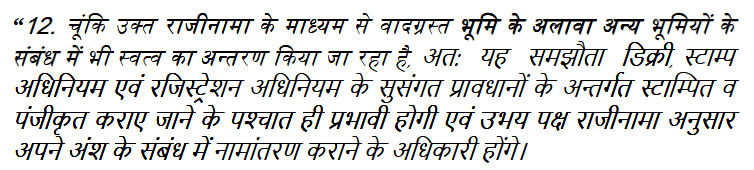
13. It is thus apparent that the compromise judgment and decree dated 08.08.2017 was also in respect of immovable property other than the subject matter of suit or proceedings and therefore, the learned trial Court rightly imposed the condition for its registration in accordance with law for giving effect to the compromise judgment and decree dated 008.08.2017 as the ownership was sought to be transferred in respect of other lands land as well.
14. In the light of the above consideration, consideration, this Court is of the view that the condition of registration of the compromise judgment and decree dated 08.08.2017 as imposed by the learned trial Court is just and proper and is in terms of the provisions contained under Section 17 (2) (vi) of the Registration Act, 1908. This aspect has also been taken into consideration by the first appellate Court while rejecting the first appeal preferred by the petitioners vide order dated 23.09.2017. The issue no. (i) is answered accordingly.
Answer to Issue no. (ii)
15. Though it has been strenuously argued by the learned counsel appearing for the petitioners that the compromise judgment and decree dated 08.08.2017 only recognizes pre pre-existing existing rights of the petitioners qua the lands in question which are flowing from the succession devolved on the petitioners and therefore, the bar contained in Section 20 of the Act, 1972 would not come in their way. The said arguments are taken for consideration. Section 20 of the Wild Life (Protection) Act, 1972 is as under :
"20. Bar of accrual of rights.--After rights After the issue of a notification under section 18, no right shall be acquired in, on or over the land comprised within the limits of the area specified in such notification, except by succession, testamentary or in intestate."
[Emphasis Supplied]
16. It is not in dispute between the parties that all the survey numbers of lands mentioned in the compromise judgment and decree dated 08.08.2017 are affected by the notification date 15.2.2000 and 18.02.2000 issued under Section 18 of the Act of 1972 pertaining to village Chitahri coming under the notified area of Son Chiraiya National Park. The consideration made by this Court hereinabove while answering issue no. (i) reflects that the civil suit was filed by the petitioners ers only seeking declaration and permanent injunction qua the land bearing Survey No.435 admeasuring 2.080 hectare and Survey No.436 admeasuring 0.090 hectare. However, the compromise judgment and decree dated 08.08.2017, as is evident from the consideration ion made hereinabove indicates that the ownership in respect of lands other than suit lands, i.e., Survey Nos. 438, 439, 445/Min-2, 445/Min 434, 451, 448/Min-22 and 447/Min-2 447/Min is also sought to be transferred by the compromise judgment and decree dated 08.08.2017 re regarding which, there was no plea of any accrual of rights through inheritance or succession in the pleadings of the civil suit filed by the petitioners (Annexure P/3).
17. Ass the petitioners claim the exemption under Section 20 of the Act of 1972, it is crucial rucial to highlight the distinction between partition and succession proceedings. In Shub Karan Bubna v. Sita Saran Bubna Bubna, (2009) 9 SCC 689, the Supreme Court held that partition is a redistribution or adjustment of pre pre-existing rights, among co-owners/cop owners/coparceners, resulting in a division of lands or other properties jointly held by them into different lots or portions and delivery thereof to the respective allottees. The relevant paras of Shub Karan Bubna (supra) are reproduced herein as follows:
"The issue
5. "Partition" is a redistribution or adjustment of pre pre-existing existing rights, among co-owners/coparceners, owners/coparceners, resulting in a division of lands or other properties jointly held by them into different lots or portions and delivery thereof to the respective allottees. The effect of such division is that the joint ownership is terminated and the respective shares vest in them in severalty.
6. A partition of a property can be only among those having a share or interest in it. A person who does not have a share in such property cannot obviously be a party to a partition. "Separation of share" is a species of "partition". When all co-owners owners get separated, it is a partition. Separation of share(s) refers to a division where only one or only a few among several co-owners/coparceners co rs/coparceners get separated, and others continue to be joint or continue to hold the remaining property jointly without division by metes and bounds. For example, where four brothers owning a property divide it among themselves by metes and bounds, it is a partition. But if only one brother wants to get his share separated and other three brothers continue to remain joint, there is only a separation of the share of one brother.
7. In a suit for partition or separation of a share, the prayer is not only for declaration of the plaintiff's share in the suit properties, but also division of his share by metes and bounds. This involves three issues:
(i) whether the person seeking division has a share or interest in the suit property/properties;
(ii) whether he is entitled to the relief of division and separate possession; and
(iii) how and in what manner, the property/properties should be divided by metes and bounds?
In a suit for partition or separation of a share, the court at the first stage decides whether the plaintiff has a share in the suit property and whether he is entitled to division and separate possession. The decision on these two issues is exercise of a judicial function and results in first stage decision termed as "decree" under Order 20 Rule 18(1)) and termed as "preliminary decree" under Order 20 Rule 18(2) of the Code. The consequential division by metes and bounds, considered to be a ministerial or administrative act requiring the physical inspection, measurements, calculations and considering various permutations/combinations/alternatives of division is referred to the Collector under Rule 18(1) and is the subject subject-matter matter of the final decree under Rule 18(2).
[Emphasis Supplied]
18. On the other hand, succession involves devolution of title of a deceased person to his heir or heirs. The Apex Court in Sambudamurthi Mudaliar v. State of Madras Madras, (1970) 1 SCC 4 discussed the meaning of succession and held that ...
"4. .... In Black's Law Dictionary the word "succession" is defined as follows:
"The devolution of title to property under the law of descent and distribution.
The right by which one set of men may, by succeeding another set, acquire a property in all the goods, movables, and other chattels of a corporation.
The fact of the transmission of the rights, estate, obligations and charges of a deceased person to his heir or heirs."
[Emphasis Supplied]
19. In the present case, the t relief claimed in civil suit filed by the petitioners was that of declaration and permanent injunction based on an alleged oral partition effected by the grandfather of the petitioners, Late Darshan Singh, during his lifetime that too only in respect of a part of land bearing Survey Nos.435 and 436. In view of the law discussed hereinabove, such a claim based on partition is distinct from succession, as partition involves separation of shares inter se co-parceners during their lifetime,, whereas succession involves devolution of the estate of a deceased person upon his legal heirs in accordance with the applicable laws off intestate succession in the absence of a will or in terms of a valid will made by the deceased. In the present case, there is neither any instrument placed on record nor any other material to prove devolution of title in disputed lands forming subject matter of compromise deed dated 08.08.2017 upon the petitioners in accordance with the laws of succession. Therefore, the plea of oral partition as raised in the compromise suit cannot be equated with acquisition of rights by succession, whether testamentary or intestate, as contemplated under Section 20 of the Act of 1972.
20. Therefore, this Court is of the considered opinion that the bar of accrual of rights as regards the aforesaid lands as provided under Section 20 of the Act of 1972 would come into play and therefore, the alternative relief as prayed for by the petitioners in the instant writ petition, i.e, issuance of mandamus the respondents authorities for registration of the compromise judgment and decree dated 08.08.2017 8.08.2017 being contravention to the mandate as provided under Section 20 of the Act 1972 cannot be issued. The Issue no. (ii) is answered accordingly.
21. In view of the above considerations and answers to the issues framed, no case for interference is made out and the petition, petition being bereft of merits, deserves to be and is hereby dismissed.
22. Interim relief, if any, granted earlier stands vacated and all a pending applications, if any, shall stand disposed of.

 |
This Product is Licensed to , |