


Oral Judgment
A.Y. Kogje, J.
1. The present First Appeal has been filed against the judgment and order dated 15.12.2021 passed by the Judge, City Civil and Sessions Court No.28, Ahmedabad in Civil Suit No.914 of 2020, whereby the applications Exh.35 and Exh.37 filed under Order VII Rule 11 of the Code of Civil Procedure came to be allowed and the plaint was rejected on the grounds of limitation and absence of cause of action.
2. The brief facts of the case relevant for the purpose of the present appeal are that the dispute pertains to Sub-Plot No.8 admeasuring 351 sq. mtrs., bearing City Survey No. 3112, including construction admeasuring approximately 81.67 sq. mtrs., situated in Kalpana Colony on F.P. No. 342 of T.P. Scheme No. 3/3-4, Navrangpura, Ahmedabad. The suit property originally belonged to late Jerom Vendelin Christian, who expired on 24.05.1971. Upon his demise, the property devolved upon his widow and children, including the present plaintiffs-appellants and respondent No.1, and remained undivided.
2.1. The disputes relating to the suit property were the subject matter of L.P.A. Nos. 471 of 1984 and 472 of 1984 before this Court. The said proceedings came to be disposed of by order dated 01.11.1999 on the basis of a compromise directing payment of Rs. 17,00,000/-. It further appears that a modification order came to be passed on 17.10.2000 in M.C.A. No. 1483 of 2000 seeking permission that the applicant Wilson be permitted to act in place of Babubhai Vandalin.
2.2. On 20.05.2013, by Entry No. 3572, the name of late Jerom Vendelin Christian was deleted from the Property Card and names of heirs were entered. On the same date, by Entry No. 3573, the names of the appellants-plaintiffs were deleted from the Property Card. Thereafter, a registered 'release deed' dated 14.03.2014 bearing Registration No. 1673 was executed in favour of respondent No.2. A rectification deed dated 26.03.2014 bearing Registration No. 1987 was executed, and by Entry No. 4183 dated 15.04.2014, the name of respondent No.2 came to be entered in the record of rights. Subsequently, a registered sale deed dated 13.11.2017 was executed in favour of respondent No.3 and by Entry No. 6103 dated 01.05.2018, the name of respondent No.3 came to be entered in the record of rights.
2.3. The suit came to be instituted on 28.10.2020 seeking declaration, cancellation of documents, partition and permanent injunction. During the pendency of the suit, applications Exh.35 and Exh.37 were preferred under Order VII Rule 11 of the Code of Civil Procedure. By the impugned judgment dated 15.12.2021, the Trial Court allowed the said applications and rejected the plaint. Hence, the present Appeal.
3. Learned Senior advocate for the appellants submitted that the trial Court erred in allowing the applications filed under Order VII Rule 11 of the Code of Civil Procedure and in rejecting the plaint. It is submitted that the appellants and respondent No. 1 are legal heirs of deceased Jerom Vendelin Christian, who was the original owner of the suit property and had expired intestate. The appellants, therefore, have right, title and interest in the suit property and that respondent No. 1, without any authority and behind the back of the appellants, got their names deleted from the record and dealt with the suit property in collusion with respondent No. 3, and upon gaining knowledge of such acts, the appellants instituted Civil Suit No. 914 of 2020 seeking declaration, cancellation of documents, partition and permanent injunction.
3.1. It is further submitted that the plaint discloses a cause of action and contains specific averments regarding the fraudulent acts and the date of knowledge thereof. It is contended that for the purpose of deciding an application under Order VII Rule 11 CPC, only the averments made in the plaint are required to be considered.
3.2. It is further submitted that the question of limitation, particularly where fraud and date of knowledge are pleaded, is a mixed question of law and fact which cannot be decided without permitting the parties to lead evidence. Also, as the plaint states the date of knowledge of the fraud committed, the Trial Court has erred by presuming prior knowledge and held the suit to be barred by limitation.
4. As against this, learned Senior advocate appearing for the respondents supported the impugned judgment and submitted that the suit is barred by limitation. According to the respondents, the compromise was recorded by order dated 01.11.1999 in the aforesaid L.P.A. proceedings and subsequent modification orders were passed in the year 2000. The mutation entries were effected in the year 2013, the release and rectification deeds were executed in the year 2014, and the sale deed in favour of defendant No. 3 was executed on 13.11.2017. The suit having been instituted on 28.10.2020 is therefore beyond the prescribed period of limitation.
4.1. It was further submitted that the plaintiffs were parties to the earlier proceedings before this Court and were aware of the compromise and subsequent transactions. It was contended that the plaint does not disclose a cause of action and that the Trial Court has rightly passed an order under Order VII Rule 11 of the Code of Civil Procedure.
5. Having considered the rival submissions of the parties and having perused the documents on record, it appears that before adverting to specific facts of this case, the Court may refer to judgments on the principles governing the operation of Order VII Rule 11 of Code of Civil Procedure. It is trite that while deciding the application under Order VII Rule 11, the averments in the plaint are germane and the stand of the defendants in his pleadings is completely irrelevant. No doubt, the application Order VII Rule-11 can be made at any stage of the civil trial and it can be decided at any stage prior to the judgment, but the relevant factor remains the same i.e. only averments in the plaint are to be seen and if such averments do not disclose any legal cause of action or the cause of action is barred by any law (Law of Limitation in this case), then the plaint can be rejected by applying Order VII Rule 11.
6. The Apex Court in case of Dahiben v/s. Arvindbhai Kalyanji Bhanusali (Gajra) (D) Through Lrs. reported in AIR 2020 SC 3310 has also elaborated on the phrase "cause of action" and went on to hold that such a cause of action has to be made a legal cause of action and that such cause of action should not be an illusory one nor such cause of action be an outcome of clever drafting.
7. One of the latest judgment of the Apex Court, which after referring to various Supreme Court decisions on the point has summarized the principles in two paras of judgment in case of P. Kumarakurubaran v/s. P. Narayanan and ors. reported in 2025 INSC 598, wherein it is held in Para-11 to 13 as under:
"11. It is well-settled that Article 59 of the Limitation Act, 1963, governs suits seeking cancellation of an instrument and prescribes a period of limitation of three years from the date when the plaintiff first had knowledge of the facts entitling him to such relief. The emphasis under Article 59 is not on the date of the transaction per se, but on the accrual of the cause of action, which, in cases involving allegations of fraud or unauthorized execution of documents, hinges upon the date on which the plaintiff acquired knowledge of such facts.
12. In the present case, the appellant has specifically averred in the plaint that upon becoming aware of registration of documents allegedly carried out among the defendants in relation to the suit property, he immediately approached the Additional Commissioner of Police, Chennai and lodged a land grabbing complaint on 09.12.2011 against the family of Defendant No.1. Subsequently, he applied for patta in his favour on 24.02.2012, and raised objections on 05.03.2012 to Defendant No. 4 stating that the suit property belonged to the plaintiff and that noregistration concerning the same should be carried out. He has also submitted an objection petition to Defendant No. 5 requesting that no planning permit be granted to anybody except the appellant in respect of the suit property.
Thereafter, the appellant instituted the suit on 03.12.2014 seeking a declaration and consequential reliefs. On the other hand, the respondents / defendants stated in their application filed under Order VII Rule 11 CPC that the appellant had knowledge of the execution of the sale deed by his father in favour of Defendant No.1 at the earliest point of time and hence, the suit instituted by the appellant was barred by limitation. While the trial Court rejected the said application holding that the issue of limitation involved a mixed question of law and fact, the High Court in revision, took a contrary view and allowed the application filed under Order VII Rule 11 CPC and rejected the plaint solely on the ground that the suit was barred by limitation.
12.1. However, we are of the considered view that the issue as to whether the appellant had prior notice or reason to be aware of the transaction at an earlier point of time, or whether the plea regarding the date of knowledge is credible, are matters that necessarily require appreciation of evidence. At this preliminary stage, the averments made in the plaint must be taken at their face value and assumed to be true. Once the date of knowledge is specifically pleaded and forms the basis of the cause of action, the issue of limitation cannot be decided summarily.
It becomes a mixed question of law and fact, which cannot be adjudicated at the threshold stage under Order VII Rule 11 CPC. Therefore, rejection of the plaint on the ground of limitation without permitting the parties to lead evidence, is legally unsustainable.
12.2. In this regard, we may usefully refer to the following decisions of this Court, which have consistently held that when the question of limitation involves disputed facts or hinges on the date of knowledge, such issues cannot be decided at the stage of Order VII Rule 11 CPC:
(i) Daliben Valjibhai & Others v. Prajapati Kodarbhai Kachrabhai & Another
"10. The First Appellate Court came to the conclusion that the defendants made an application for correcting the revenue records only in the year 2017 and on the said application the Deputy Collector issued notice to the plaintiffs in March 2017 and that was the time when the plaintiffs came to know about the execution of the sale deed. It is under these circumstances that the suit was instituted in the year 2017. While the High Court came to the correct conclusion that under Article 59 of the Limitation Act, a suit can be instituted within 3 years of the knowledge, it proceeded to return a finding that in cases where the document is registered, the knowledge must be presumed from the date of registration.
11. XXXXX
12. Further, in Chhotanben v. Kirtibhai Jalkrushnabhai Thakkar where again a suit for cancellation of sale deed was opposed through an application under Order 7 Rule 11, on ground of limitation, this Court specifically held that limitation in all such cases will arise from date of knowledge. The relevant portion is as follows:
"15. What is relevant for answering the matter in issue in the context of the application under Order 7 Rule 11(d) CPC, is to examine the averments in the plaint. The plaint is required to be read as a whole. The defence available to the defendants or the plea taken by them in the written statement or any application filed by them, cannot be the basis to decide the application under Order 7 Rule 11(d). Only the averments in the plaint are germane. It is common ground that the registered sale deed is dated 18-10-1996. The limitation to challenge the registered sale deed ordinarily would start running from the date on which the sale deed was registered. However, the specific case of the appellant-plaintiffs is that until 2013 they had no knowledge whatsoever regarding execution of such sale deed by their brothers, original Defendants 1 and 2, in favour of Jaikrishnabhai Prabhudas Thakkar or Defendants 3 to 6. They acquired that knowledge on 26-12-2012 and immediately took steps to obtain a certified copy of the registered sale deed and on receipt thereof they realised the fraud played on them by their brothers concerning the ancestral property and two days prior to the filing of the suit, had approached their brothers (original Defendants 1 and 2) calling upon them to stop interfering with their possession and to partition the property and provide exclusive possession of half (½) portion of the land so designated towards their share. However, when they realised that the original Defendants 1 and 2 would not pay any heed to their request, they had no other option but to approach the court of law and filed the subject suit within two days therefrom. According to the appellants, the suit has been filed within time after acquiring the knowledge about the execution of the registered sale deed. In this context, the trial court opined that it was a triable issue and declined to accept the application filed by Respondent 1-Defendant 5 for rejection of the plaint under Order 7 Rule 11(d). That view commends to us. ...
19. XXXXX
13. XXXXX
(ii) Salim D. Agboatwala & Others v. Shamalji Oddhavji Thakkar & Others
"11. XXXXX
12. XXXXX
13. XXXXX
14. XXXXX
(iii) Shakti Bhog Food Industries Ltd. v. Central Bank of India & Another
"6. XXXXX
7. XXXXX
"13. XXXXX
14. XXXXX
'9. XXXXX .
15. XXXXX.
16. XXXXX
17. XXXXX
18. XXXXX
19. In Sopan Sukhdeo Sable v. Charity Commr. [(2004) 3 SCC 137] this Court held thus: (SCC pp. 146-47, para 15) '15. There cannot be any compartmentalisation, dissection, segregation and inversions of the language of various paragraphs in the plaint. If such a course is adopted it would run counter to the cardinal canon of interpretation according to which a pleading has to be read as a whole to ascertain its true import. It is not permissible to cull out a sentence or a passage and to read it out of the context in isolation. Although it is the substance and not merely the form that has to be looked into, the pleading has to be construed as it stands without addition or subtraction or words or change of its apparent grammatical sense. The intention of the party concerned is to be gathered primarily from the tenor and terms of his pleadings taken as a whole. At the same time it should be borne in mind that no pedantic approach should be adopted to defeat justice on hair-splitting technicalities.'
20. XXXXX
8. XXXXX
"10. XXXXX
11. This position was explained by this Court in Saleem Bhai v. State of Maharashtra [(2003) 1 SCC 557], in which, while considering Order 7 Rule 11 of the Code, it was held as under: (SCC p. 560, para 9)
'9. A perusal of Order 7 Rule 11 CPC makes it clear that the relevant facts which need to be looked into for deciding an application thereunder are the averments in the plaint. The trial court can exercise the power under Order 7 Rule 11 CPC at any stage of the suit -- before registering the plaint or after issuing summons to the defendant at any time before the conclusion of the trial. For the purposes of deciding an application under clauses (a) and (d) of Rule 11 Order 7 CPC, the averments in the plaint are germane; the pleas taken by the defendant in the written statement would be wholly irrelevant at that stage, therefore, a direction to file the written statement without deciding the application under Order 7 Rule 11 CPC cannot but be procedural irregularity touching the exercise of jurisdiction by the trial court.' It is clear that in order to consider Order 7 Rule 11, the court has to look into the averments in the plaint and the same can be exercised by the trial court at any stage of the suit. It is also clear that the averments in the written statement are immaterial and it is the duty of the court to scrutinise the averments/pleas in the plaint. In other words, what needs to be looked into in deciding such an application are the averments in the plaint. At that stage, the pleas taken by the defendant in the written statement are wholly irrelevant and the matter is to be decided only on the plaint averments. These principles have been reiterated in Raptakos Brett & Co. Ltd. v. Ganesh Property [(1998) 7 SCC 184] and Mayar (H.K.) Ltd. v. Vessel M.V. Fortune Express [(2006) 3 SCC 100].
12. It is also useful to refer the judgment in T. Arivandandam v. T.V. Satyapal [(1977) 4 SCC 467], wherein while considering the very same provision i.e. Order 7 Rule 11 and the duty of the trial court in considering such application, this Court has reminded the trial Judges with the following observation: (SCC p. 470, para 5)
'5. ... The learned Munsif must remember that if on a meaningful -- not formal -- reading of the plaint it is manifestly vexatious, and meritless, in the sense of not disclosing a clear right to sue, he should exercise his power under Order 7 Rule 11 CPC taking care to see that the ground mentioned therein is fulfilled. And, if clever drafting has created the illusion of a cause of action, nip it in the bud at the first hearing by examining the party searchingly under Order 10 CPC. An activist Judge is the answer to irresponsible law suits. The trial courts would insist imperatively on examining the party at the first hearing so that bogus litigation can be shot down at the earliest stage. The Penal Code is also resourceful enough to meet such men, (Chapter XI) and must be triggered against them.' It is clear that if the allegations are vexatious and meritless and not disclosing a clear right or material(s) to sue, it is the duty of the trial Judge to exercise his power under Order 7 Rule 11. If clever drafting has created the illusion of a cause of action as observed by Krishna Iyer, J. in the abovereferred decision [T.Arivandandam v. T.V. Satyapal, (1977) 4 SCC 467], it should be nipped in the bud at the first hearing by examining the parties under Order 10 of the Code."
14. XXXXX ....
22. XXXXX
13. In this backdrop, the approach of the High Court in reversing the well- reasoned order of the trial Court warrants interference. The trial Court had rightly held that the issue of limitation necessitated adjudication upon evidence, particularly in view of the appellant's assertion that the Power of Attorney executed by him did not confer any authority upon his father to alienate the suit property and that the impugned transaction came to his knowledge only at a much later point in time. In such circumstances, the determination of limitation involved disputed questions of fact that could not be summarily decided without the benefit of trial. The High Court, however, proceeded to reject the plaint solely on a prima facie assumption that the suit was barred by limitation, without undertaking any examination as to whether the plea regarding the date of knowledge was demonstrably false or inherently improbable in light of the record. In the opinion of this Court, such an approach amounts to an error of law and constitutes a misapplication of the well-established principles governing the exercise of power under Order VII Rule 11 CPC. For the same reasons, the decisions relied upon by the learned counsel for the respondents are inapplicable, being factually distinguishable."
8. For the better understanding, the Court may at the outset reproduce the pedigree, which is not in dispute and is as under:
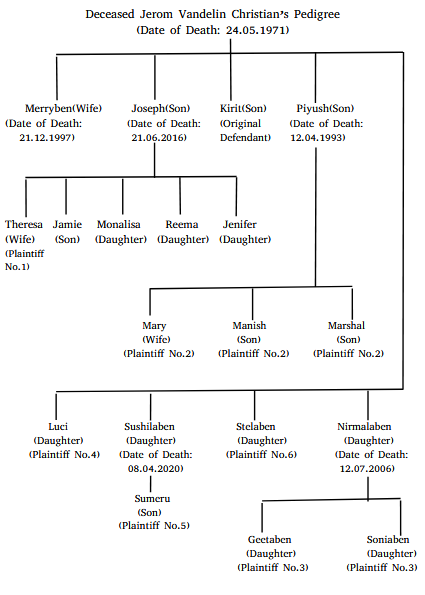
9. The very suit property was a subject matter of litigation between Jerome Vendalin; father of the parties herein and his brothers. This litigation had reached the stage of this Court and was finally settled between the existing parties. Some of whom are also parties herein. The Court finds it necessary to reproduce the order passed in Letters Patent Appeal No.471 of 1984 in First Appeal No.654 of 1980 as the Oral Judgment was passed on the basis of the consent terms, upon such consent terms, the ancestors of both the parties settled the issue amongst the family members, which reads as under:
"Both these Letters Patent Appeals instituted by the original defendants under Clause 15 of the Letters Patent are directed against common judgment and decree dated September 4, 1984 rendered by the learned Single Judge in First Appeals No.654/80 and 655/80.
2. During the course of hearing of these Letters Patent Appeals, the parties to the appeals have arrived at consent terms. They are as under-
"IN THE HIGH COURT OF GUJARAT AT AHMEDABAD
DISTRICT: AHMEDABAD CITY
LETTERS PATENT APPEAL NOS.471 & 472 OF 1984
FROM
FIRST APPEALS NOS. 654 AND 655 OF 1980
SYMON VENDALIN AND OTHERS .... APPELLANTS (ORIG. DEFENDANTS)
VERSUS
MERRYBEN W/O JEROMBHAI VENDALIN AND OTHERS .... RESPONDENTS (ORIG. PLAINTIFFS)
CONSENT TERMS
On the respondent making the payment to the appellant of Rs.17,00,000/- (In words Rupees Seventeen lakhs only) within one year from the date hereof in full and final satisfaction of their claims, rights, title, shares and interest in the suit property being Plot No.8 in Kalpana Colony, Navrangpura and constructions made thereon, the Respondents-Plaintiffs shall be absolute and exclusive owners the suit property. If the respondents fail to pay the same within the stipulated period, the amount/balance remaining unpaid on expiry of the period of one year shall be paid with interest of thereon at 18% per annum till payment.
2. The aforesaid amount shall be paid by A/c. payee cheque in the name of Babubhai V. Christian on behalf of the branches of all the three brothers, Simon Babu and the late Roman. On such payment being made to Babubhai the liability of the respondents hereinbefore provided shall stand discharged.
Babubhai agrees and undertake to this Hon'ble Court that he shall pay to Simon and Roman's branch their respective shares in the amount's to be received by him hereunder. If before the appellants have paid to the respondents the full amount agreed upon hereinbefore, the respondents desire to raise moneys by transfer in any manner of the suit property or any part thereof, the appellants shall give their consent or confirmation of such transfer on condition that the transferee shall pay to Babu the consideration for transfer or such part thereof as is necessary topay to the appellants amount due to them. Simon, Kirpa and her sons Wilson and Linush shall give within 15 days hereof a power of attorney in favour of the appellant. Babu to receive payment on their behalf as aforesaid and to consent to or confirm on their behalf any transfer of the suit property as herein before provided.
3. The appellants agree and undertake to this Hon'ble Court that they or any of them shall not, pending implementation of these terms, and the decree to be passed pursuant thereto transfer, alienate or part with any right, title, share or interest claimed by them in the suit property or part with possession of the suit property any part thereof in favour of any third party. Agreed that within a period of three months from the receipt of the full amount hereinbefore provided the appellants undertake to vacate and hand over vacant and peaceful possession of any part of the suit property occupied by or in possession of them or any of them.
4. Agreed that the decrees dated 4.9.1984 passed by this Hon'ble Court (Coram: G.T.Nanavati, J.) in First Appeals No.654 and 655 of 1980 arising from original suits No. 1759 of 1973 and 1248 of 1975 of the City Civil Court at Ahmedabad be set aside and a decree b ę passed in terms hereof in the said suits.
Agreed that there would be no order as to costs throughout. Ahmedabad.
29th October, 1999 Appellants.
1. SIMON VENDALIN
2. BABUBHAI VENDALIN
3. Heirs and Legal Representative of Roman Vendalin.
3/1. KRIPA ROMAN CHRISTIAN
3/2. WILSON ROMAN CHRISTIAN
3/3. LINUSH ROMAN CHRISTIAN ADVOCATE FOR THE APPELLANTS.
RESPONDENTS
1. KIRITBHAI JEROMBHAI
2. PIYUSHBHAI JEROMBHAI THROUGH HEIRS
2/1. MARRYBEN ALIAS LATABEN, WIFE OF DECEASED PIYUSHBHAI
2/2.MINOR MANISH SON OF PIYUSHBHAI Through their natural guardian Manish Piyush Jerome Marry Piyush Jerome Marshal Piyush Jerome Mary Piyush Jerome
2/3. MINOR MARSHAL SON OF PIYUSHBHAI Through their natural guardian
3. NIRMALABEN JEROMBHAI
4. SUSHILABEN JEROMBHAI
5. STELLABEN JEROMBHAI
6. JOSEPH JEROMBHAI
7. LUSIBEN JEROMBHAI
ADVOCATE FOR THE RESPONDENTS".
10. The Court may therefore refer to the gist of the averments made in the plaint that the Plaintiffs and Defendant No.1 are the legal lineal heirs of deceased Jerom Vendelin Christian and thus, family relationships exist between the Plaintiffs and Defendant Nos.1 and 2. After death of the deceased Jerom Vendelin Christian, the property in suit was jointly acquired by the Plaintiffs and Defendant No.1 by right of inheritance. Defendant Nos.1 and 2, by misusing the family relationships between the Plaintiffs and Defendant Nos.1 and 2 and the faith and trust placed in them by the Plaintiffs, disposed of the property in suit without knowledge and consent of the Plaintiffs and with the malafide intention of divesting the Plaintiffs of their inheritance rights, Defendant Nos.1 and 2, in collusion with Defendant No.3, fraudulently removed the names of the Plaintiffs from the records of the property in suit and created fraudulent sale-deeds.
10.1 In order to bring an end to the disputes over the property in suit, Defendant No.1 decided and agreed to jointly pay an amount of Rs.17,00,000/- to brothers of elder Jerom Vendelin, Babubhai Vendelin, Symond Vendelin and Roman Vendelin. Babubhai Vendelin and others decided to waive all disputes regarding the property in suit upon receipt of the said amount. Accordingly, a settlement was determined amicably and it was produced in the proceedings filed before the High Court of Gujarat, namely L.P.A. No.471/1984 and 472/1984 and pursuant to the said settlement, the High Court of Gujarat took the settlement on record and passed an order on 01/11/1999 regarding payment of Rs.17,00,000/- by the Plaintiffs and Defendant No.1-respondent No.1, to Babubhai Vendelin and others (see Para-9).
10.2 According to the order passed during the year 1999 in L.P.A. No.471/1984 and 472/1984 filed in the High Court of Gujarat regarding the property in suit, the Plaintiffs and Defendant No.1- respondent No.1, were required to pay the amount of Rs.17,00,000/- to the brothers of the original owner and elder Jerom Vendelin, namely Babubhai Vendelin, Symond Vendelin and the heirs of deceased Roman Vendelin. Out of this amount, the plaintiffs paid their share to Defendant No.1-respondent No.1 in cash at the relevant time, as per his demand and instruction. Based on the assurance given by Defendant No.1 to the Plaintiffs-appellants and the settlement decided between them, it was decided that Defendant No.1- respondent No.1 would deposit that amount before the High Court of Gujarat from his own bank account in the name of Babubhai Vendelin as per the order of the High Court. Defendant No.1- respondent No.1 had communicated to the Plaintiffs, that thereafter, proceedings for withdrawing all disputes to clear the title of the property in suit and for entering the names of the plaintiffs- appellants would be carried out by Defendant No.1- respondent No.1.
10.3 According to the information given to the plaintiffs - appellants by Defendant No.1- respondent No.1 during the year 1999, the Court had ordered the payment of Rs.17,00,000/- as a settlement to resolve the disputes by the brothers of the deceased Jerom Vendelin before the High Court of Gujarat, however, thereafter during the year 2000, Babubhai Vendelin Christian passed away, causing a delay in completing those proceedings and as per the information given to us by Defendant No.1- respondent No.1, proceedings to carry out amendments in the matter pending before the High Court of Gujarat were initiated by Defendant No.1- respondent No.1 and Wilson Roman Christian, who is the heir of deceased Roman Vendelin. Such representations were made by Defendant Nos.1 and 2 before Plaintiff No.1, Josef Jerom Vendelin, who was alive until the year 2016.
10.4 As the Defendant No. 1- respondent No.1 is a close relative of the plaintiffs and for the sole reason that he was managing all affairs of the suit property and as per the information and assurances given by him that he would resolve the ongoing disputes regarding the suit property and ensure that the names of the Plaintiffs and Defendant No. 1 shall be entered in the Property Card of the suit property and relying on such representations the Plaintiffs- appellants trusted him.
10.5 It is averred that Defendant No.1- respondent No.1 kept delaying the matter by stating that the amount as per the previous settlement after the death of Babubhai Vendelin, could only be paid after amendments are made as per the judgment of the High Court of Gujarat, and that since some legal heirs reside abroad, the process would take time. As the Defendant No.1 had accepted the responsibility to initiate the process of entering the names of the plaintiff once the titles of the suit property were cleared, the Plaintiffs had placed trust in the assurance of Defendant Nos. 1 and 2 that upon completion of the legal proceedings, the names of the Plaintiffs would be entered in the Record of Rights of the suit property as the legal heirs of the deceased Jerom Vendelin.
10.6 Thus, according to plaintiffs-appellants, Defendant No.1- respondent No.1 continued to pass time under the guise of the assurance given to the Plaintiffs, and keeping the Plaintiffs in confidence and in the dark, without the knowledge and consent of the Plaintiffs, got the name of Jerom Vendelin Christian removed from the Record of Rights of the suit property, i.e., the Property Card, on 20-05-2013; thereafter, vide Entry No. 3572, the names of Defendant No. 1 and Plaintiff Nos. 1 to 6 were entered by the heirship entry of the deceased Jerom Vendelin. On the same date, i.e., on 20-05-2013, by getting another entry No. 3573 entered, he got the names of the Plaintiffs removed. Upon considering the said Entry No. 3573 for the removal of rights, it is evident that the names of the Plaintiffs, namely Joseph Jerom, Maryben wife of Piyushbhai, Marshall Piyushbhai, Manishbhai Piyushbhai, Lucyben Jerombhai, Sushilaben Jerombhai, and Stellaben Jerombhai etc., were wrongly removed from the Property Card of the suit property by misinterpreting the order passed by the High Court of Gujarat in L.P.A. No. 471/1984 and 472/1984.
10.7 The names of the plaintiffs were removed from the Record of Rights of the suit property vide Entry No. 3573 by some way or another in collusion with the concerned officers.
10.8 It is averred that with the malafide intention of defecting the titles of the suit property, Defendant No.1- respondent No.1, on 14-03-2014, executed a false and illegal Release Deed without consideration, regarding the waiving of rights and shares in the suit property vide Serial No. 1673 in favor of his wife, Defendant No.2. On the basis of such a false and illegal Release Deed, another Amendment Deed was executed on 26-03- 2014 vide Serial No. 1987, and consequently, the name of Defendant No. 2 was entered in the Property Card of the suit property vide Entry No. 4183 on 15-04-2014. All these proceedings were carried out without the knowledge of the Plaintiffs.
10.9 Defendant Nos. 1 and 2 maintained cordial relations with the other Plaintiffs as long as Plaintiff No.1, Joseph Jerom, remained alive as the elder of the family of the plaintiff; but thereafter, their behavior changed. Finally, upon the death of Lawrence Samuel Chauhan, the son of Plaintiff No. 6, on 20-12-2019, Defendant Nos.1 and 2, instead of visiting the house of Plaintiff No.6, directly arrived at the cemetery. At that time, Plaintiff Nos. 1/1 and 2/1 had discussion regarding the suit property with Defendant No.1- respondent No.1 and stated that since much time had passed, they should resolve the matter of the suit property together. Upon inquiring about it, Defendant No.1- respondent No.1 got provoked and for the first time asserted that "the suit property belongs to me and no one is going to get anything," and refusing to have any discussion regarding the suit property, he misbehaved with them. Therefore, as the Plaintiffs grew suspicious of the conduct of Defendant No.1- respondent No.1, the Plaintiffs sought legal advice regarding the suit property and initiated the process of obtaining necessary documents. In connection with the same, time was spent in obtaining the Record of Rights and other papers of the suit property. After receiving all the documents, the advocate appointed by the plaintiffs scrutinized the Property Card and other related documents of the suit property. According to the information provided by him, the plaintiffs for the first time at around June 2020 came to know about the fraudulent transactions carried out by the Defendants regarding the suit property, as well as the Sale Deeds Executed by the Defendants in collusion with each other.
11. On the basis of the aforesaid averments, the appellants have pleaded the cause of action as under:
"19. Considering the facts and circumstances of the plaint, the reason for filing the current suit regarding the suit property mentioned in Para No. 3 is such that the suit property was initially owned and possessed by the ancestor of the Plaintiffs and Defendant No.1, namely Jerom Vendelin Christian. From thereon, as per the fact stated in detail in the suit, after the demise of the original owner of the suit property - Jerome Vendelin Christian, the Plaintiff and Defendant No.1 completely held the suit property jointly by way of right of inheritance. From thereon, as per the fact stated in detail in the suit, in respect of the suit property, a settlement order was passed by the Honorable High Court of Gujarat on 01-11-1999 in L.P.A. Nos. 471/1984 and 472/1984, whereby it was decided that the Plaintiffs and Defendant No. 1 should pay Rs. 17,00,000/- to the brother of Jerom Vendelin Christian - Babubhai Vendelin, Symond Vendelin, and the heirs of the late Roman Vendelin. From thereon, around the year 1999, it was decided to pay the said Rs. 17,00,000/- as per the order of the Honorable High Court as per the detailed fact stated in the suit. Since then, after the resolution of the disputes before the Honorable High Court, as Defendant No. 1 had given an assurance that the names of the Plaintiffs would be entered in the Record of Rights of the suit property, and since Defendant No. 1 was managing the entire administration of the suit property, the Plaintiffs placed their trust and confidence in him. Since then, as per the detailed fact mentioned in the suit, Defendant No. 1 committed a breach of trust and fraud with Plaintiffs, and without the knowledge of the Plaintiffs i.e. taking advantage of the Plaintiffs regarding lack of information about the property, Heirship Entry No. 3572 was registered on 20-05-2013 to remove the name of the late Jerom Vendelin from the property card and to extinguish the rights and shares of the plaintiffs, and on the basis of it, after entering the names of the Plaintiffs, a second entry no. 3573 for deletion of rights was registered on 20-05-2013, whereby the names of the Plaintiffs were falsely and illegally deleted under the guise of the orders of the Honorable High Court of Gujarat in L.P.A. Nos. 471/1984 and 472/1984. Since then and as per the facts detailed in the suit, Defendant Nos. 1 and 2 of this case, acting in collusion with each other, executed a Rights Release Deed in favor of Defendant No. 2 on 14-03-2014 vide Serial No. 1673 and subsequently executed a Rectification Deed on 26-03-2014 vide Serial No. 1987. Since then, the name of Defendant No. 2 was falsely and illegally entered in the property card via Entry No. 4183 on 15-04-2014, on the basis of it, acting in collusion with Defendant No. 3, a Sale Deed was executed in their favor on 13-11-2017 vide Serial No. 8170 in a fraudulent manner without any absolute right or authority. Since then and on the basis of the said fraudulent Sale Deed, the name of Defendant No. 3 was entered in the Record of Rights via Entry No. 6103 on 01-05-2018 without the knowledge of us - the Plaintiffs. Since then and by committing the aforementioned wrongful acts, the Defendants have carried out fraudulent transactions without the knowledge of us - the Plaintiffs to extinguish our legal ownership right, interest, and rights. Since then and as per the fact detailed in the suit, the Plaintiffs came to know of the abovementioned facts upon the death of Lawrence Samuel Chauhan - son of Plaintiff No. 6, on 20-12-2019, when a meeting with Defendant Nos. 1 and 2 took place at the cemetery and when Plaintiffs No. 1/1 and 2/1 spoke to Defendant No. 1 regarding the suit property, the Defendant No. 1 became agitated, misbehaved with Plaintiffs no. 1/1 and 2/1, and declared for the first time that the suit property belonged to them and no one else would receive anything. Since then and as per the fact detailed in the suit, following the misconduct of Defendant No. 1 with Plaintiff no. 1/1 and 2/1 on 20-12-2019, as suspicion arose on Defendant no. 1, the Plaintiffs obtained the records of the suit property and sought legal advice to take lawful action, and after receiving the documents, the cause further arose around June 2020. Since then and as per fact detailed in the suit, according to the time and circumstances, the necessity has arisen to file this suit against the Defendants before this Honorable Court for Declaration, Cancellation of Documents, partition as per concerned share, and Permanent Injunction."
12. On basis of above cause of action, the plaintiffs are praying in the plaint for a declaration that no compromise was ever entered into by them with Defendant No.1 in L.P.A. Nos. 471 of 1984 and 472 of 1984 before this Court for receipt of any amount or for relinquishment of their right, title, share or claim in the suit property, and that no such order was passed therein. They had further prayed that the deletion of their names from the Property Card on the basis of the alleged order be declared illegal, unlawful and void ab initio. The plaintiffs had also prayed for a declaration that their names and rights were never deleted or reduced without their knowledge and consent and that they continue to have lawful, undivided ownership right, title, share and interest in the suit property, with a direction to enter their names in the Record of Rights as owners. They had further prayed for a declaration that Defendant No.1 never acquired absolute ownership over the entire suit property and that the Release Deed dated 14.03.2014 (Document No.1973), the Rectification Deed dated 26.04.2014 (Document No.4183), the consequential Entry No.4183 in favour of Defendant No.2 and all actions, proceedings and transactions based thereon are illegal, unlawful and void ab initio. They had also prayed that the Sale Deed dated 13.11.2017 (Document No.8170) executed by Defendant No.2 in favour of Defendant No.3 be declared illegal, unlawful and void ab initio. The plaintiffs had further prayed for a declaration that, being the direct lineal heirs of Jerome Vendeline Christian, they are entitled to an undivided 6/7th share in the suit property, for determination of their share and partition by metes and bounds, and for delivery of peaceful, vacant and actual possession of the portion falling to their share. They had also prayed for a permanent injunction restraining the defendants from executing any deed or document in respect of the suit property, from creating any mortgage, charge, encumbrance, lien or third-party right therein, from making any change in the revenue record or physical status of the suit property, or from carrying out any temporary or permanent construction or alteration therein, and for costs.
13. Accordingly, the Court having considered the relevant averments and the cause of action as well as the relief prayed for may consider the arguments advanced. The main contention of the appellants being that the trial Court ought to have examined the fraud played by the respondents in misinterpreting the order of this Court in Letters Patent Appeal to extinguish the rights of the appellants. To examine this, the Court may refer to the revenue entries made in the City Survey Record, particularly Entry No.3572 dated 20-05-2013, which is made on account of the death of the parent of the present party, where in names of all the decedents of Jerome was entered i.e. both the plaintiffs' side and defendants' side.
14. On the very same day, another Entry No.3573 dated 20-05-2013 is also made purportedly on the basis of Orders in Letters Patent Appeal as if as per the directions in Letters Patent Appeal, the names of the appellants side of decedent as Jerome are ordered to be removed. However, the party in the LPA whose rights in the property were to be extinguished were of the brothers' of Jerome, who had filed the proceedings and did not refer to the legal heirs of Jerome himself. Moreover, it is the claim of the appellants that necessary procedure of notice and hearing to the other legal heirs of Jerome was not followed thereby averring that entire process was behind the back of the appellants.
15. The Court finds substance in the contention and this would be a triable issue. Over and above, this also is the contention that the amount of Rs.17,00,000/-, which was to be paid as per LPA Orders to the brothers of Jerome, were contributed by the family of the appellants also and not simply by the respondent alone or his wife. On this issue, the trial Court in impugned order has given a conclusion on fact by taking into consideration the evidence of payment made by the respondents in form of Bank Statement and Bank Letter. In Para-6 of the impugned judgment, the trial Court has considered the receipt dated 28-11-2000, the cheque dated 20-11-2000 and Certificate dated 12-09-2012 of Central Bank of India, which is the part of the challenged registered Sale-deed.
16. In the opinion of the Court, even while appreciating such document, the trial Court ought to have provided the opportunity to the appellants to establish their contention that though the amount was transferred from one account only, but the other family members had also contributed to it. This also is a triable issue.
17. On the other hand, the respondents while justifying the impugned order, had argued that entry made on the strength of the registered Sale- deed and the registration of the Release Deed by respondent No.1 in favour of his wife is a constructive notice and that was in the year 2014 and therefore, the suit is beyond the limitation. In this connection, the Court may refer to the judgment of the Apex Court in case of Salim D. Agboatwala and Ors. v/s. Shamalji Oddhavji Thakkar and Ors. reported in AIR 2021 SC 5212, wherein in Para-17 to 19 the Court has held as under:
"17. The decision in Ram Niwas (supra) which revolved around Explanation II under Section 3 of the Transfer of Property Act, 1882, cannot go to the rescue of the respondents. Section 3 of the Transfer of Property Act, 1882, provides that a person is said to have notice of a fact, (i) either when he actually knows that fact; or (ii) when, but for willful abstention from an enquiry or search which he ought to have made, or gross negligence, he would have known it. The relevant part of Section 3 together with Explanation II thereunder reads as follows:
"a person is said to have notice" of a fact when he actually knows that fact, or when, but for willful abstention from an enquiry or search which he ought to have made, or gross negligence, he would have known it
Explanation II.--Any person acquiring any immovable property or any share or interest in any such property shall be deemed to have notice of the title, if any, of any person who is for the time being in actual possession thereof."
18. The 2 ingredients of the relevant part of Section 3 providing as to when "a person is said to have notice", are matters of fact to be established through evidence. The respondents in this case cannot even fall back upon Explanation II which holds that a person acquiring an immovable property will be deemed to have notice of the title of a person in actual possession thereof. In this case, it was the Court Receiver who was in possession and management of the entire Estate at the time of the impugned proceedings and hence Explanation II cannot be used by the defendants.
19. The decision in Rajasthan Housing Board (supra) also reiterates the two ingredients of Section 3 of the Transfer of Property Act, 1882, and hence the same cannot be raised in an application under Order VII Rule 11. It should be pointed out at this stage that Section 32 (G) (1) of the Act contemplates a public notice in the prescribed form to be published in each village. It is not the case of respondents that the plaintiffs had real or constructive notice of the proceedings by virtue of such a public notice. It is not even known whether a public notice was ever published. Therefore, the plea of constructive notice raised with a view to sustain the plea of limitation cannot be accepted at the stage of dealing with an application for rejection of plaint."
18. In view of the aforesaid, particularly what is laid down in Para-19, this Court is of the view that registration of the Release Deed in 2014 is not constructive notice to trigger the limitation and it therefore, will have to be treated as a mixed question of law and fact, which will have to be decided on the basis of the evidence on record.
19. It is also contended on behalf of the respondents that the cause of action is a clever drafting and has relied on judgment of this Court in case of Whiteswan Buildcon Llp v/s. Thakor Praveenji Mangaji reported in AIR 2023 CC 128. The decision cited is that of learned Single Judge in the facts of the case recorded in Para-14 of the order.
20. Another decision of this Court in case of Mansingbhai Laxmanbhai Halpati v/s. Shantaben Laxmanbhai Halpati reported in AIR 2018 CC 2666, again decision of learned Singe Judge, which records that the plaintiffs on facts have taken a chance to litigate after 30 years and when the partition has taken place 30 years back. Both these judgments, in the opinion of the Court are not helpful to the case of the respondents.
21. One of the arguments advanced by learned Senior Advocate for the respondents to support plea of "no cause of action" is by contending that the appellants have deliberately not prayed for cancellation of the 'Release Deed' of the year 2014. This is a part of clever drafting to bring to suit within limitation. Reliance is placed on the decision of the Apex Court in case of Hussain Ahmed Choudhury v/s. Habibur Rahman (Dead) Through Lrs. reported in 2025 (3) GLH 457 , particularly on Para-40 and 42. In Hussain Ahmed Choudhury (supra), the questions framed by the Apex Court to answer is in Para-18, which reads as under:
"D. ANALYSIS
18. Having heard the learned counsel appearing for the parties and having gone through the materials on record, the following question of law falls for our consideration:
"Whether the High Court was right in taking the view that the suit of the plaintiff for declaration of his title based on a valid Gift Deed should fail as the plaintiff omitted to pray for the consequential relief of cancellation of the sale deed or a declaration that the same is not binding on him?"
21.1 These questions are answered in Para-29, which reads as under:
"29. Where the executant of a deed wants it to be annulled, he has to seek cancellation of the deed under Section 31 of the Act, 1963. But if a non-executant seeks annulment of a deed, he has to only seek a declaration that the deed is invalid, or non est, or illegal or that it is not binding on him. The difference between a prayer for cancellation and declaration in regard to a deed of transfer/conveyance, can be brought out by the following illustration relating to 'A' and 'B' ─ two brothers. 'A' executes a sale deed in favour of 'C'. Subsequently 'A' wants to avoid the sale. 'A' has to sue for cancellation of the deed. On the other hand, if 'B', who is not the executant of the deed, wants to avoid it, he has to sue for a declaration that the deed executed by 'A' is invalid/void and non est/ illegal and he is not bound by it. In essence, both may be suing to have the deed set aside or declared as non-binding. [See : Suhrid Singh alias Sardool Singh v. Randhir Singh & Ors., reported in (2010) 12 SCC 112]"
22. Applying the ratio to the prayer clause of the plaint in our case, the Court is of the view that the stakes of the parties vis.-a-vis. the Release Deed relief prayed for being declaratory in nature is justified, therefore, the argument of learned Senior Advocate for the respondents in this regard is not accepted.
23. It is also argued by learned Senior Advocate for the respondents that the limitation should begin from the day when the right to sue accrued. It is argued that right to sue has to be considered from the day when for the first time right to sue accrued and in this case, it accrued for the first time in 2014 when due to 'Release Deed' by respondent No.1 in favour of his wife was registered and appellants had constructive notice about this right in property being adversely affected. In this connection, reliance is placed on the decision of the Apex Court in case of Shri Mukund Bhavan Trust and Others v/s. Shrimant Chhatrapati Udayan Raje Pratapsinh Maharaj Bhonsle and Another reported in 2024 SCC Online SC 3844. The Court observes that in the aforesaid judgment, the Apex Court had on facts observed that the averments made in the plaint regarding the fraud (see Para-25), were found to be very vague and baseless and this allegation of fraud was in relation to a compromise decree, proceeding before the Court. In the facts of the present case, the Court finds that allegation of fraud by misinterpreting the order of this Court in Letters Patent Appeal is specifically made. Moreover, the fact that two Revenue Entries back to back on the same day, where by the names of the appellants were entered in City Survey Record and on the very day, the same was deleted by a separate entry clearly raised grave suspicion regarding the extinguishing of the rights of the appellants qua the suit property.
24. Moreover, it is trite that the entry made in the City Survey Records is mainly for the fiscal purpose, but cannot create or extinguish any Civil right in the property. Therefore, in Para-26 of the aforesaid judgment, the Apex Court has specifically adverted to the facts even after considering the underlying principle that the 'limitation' is a mixed question of fact and law required to be examined after weighing of the evidence.
25. The reliance placed by learned Senior Advocate for the respondents in the decision of the Apex Court in case of RBANMS Educational Institution v/s. Gunashekar and Another reported in 2025 SCC Online SC 793, is for the purpose of highlighting the reason behind Order VII, Rule 11 to serve as a crucial filter to civil litigation, is an accepted principle, but it is equally true that the exercise of Order VII, Rule 11 at the threshold is a rare exercise, as the civil right is to be brought to an end once and for all.
26. In the facts of this case, the Court finds this not being one such case where civil rights of the appellants be scuttled at the threshold. The cause of action mentioned in the plaint to this Court, does not appear to be bereft of accurate date of incident, but is specifically averred and therefore, an opportunity need to be given to the appellants to make good his case on the strength of whatever evidence that he may produce in support.
27. With regard to finding of the trial Court given about the cause of action being illusory and outcome of clever drafting, the Court may refer to preceding paras referring to the cause of action in the plaint and then the judgment of the Apex Court in case of Mayar (H.K.) Ltd. and others v/s. Owners and Parties Vessel M.V. Fortune Express and others reported in (2006) 3 SCC 100, wherein in Para-12, it is held as under:
"12. From the aforesaid, it is apparent that the plaint cannot be rejected on the basis of the allegations made by the defendant in his written statement or in an application for rejection of the plaint. The Court has to read the entire plaint as a whole to find out whether it discloses a cause of action and if it does, then the plaint cannot be rejected by the Court exercising the powers under Order VII Rule 11 of the Code. Essentially, whether the plaint discloses a cause of action, is a question of fact which has to be gathered on the basis of the averments made in the plaint in its entirety taking those averments to be correct. A cause of action is a bundle of facts which are required to be proved for obtaining relief and for the said purpose, the material facts are required to be stated but not the evidence except in certain cases where the pleadings relied on are in regard to misrepresentation, fraud, willful default, undue influence or of the same nature. So long as the plaint discloses some cause of action which requires determination by the court, mere fact that in the opinion of the Judge the plaintiff may not succeed cannot be a ground for rejection of the plaint. In the present case, the averments made in the plaint, as has been noticed by us, do disclose the cause of action and, therefore, the High Court has rightly said that the powers under Order VII Rule 11 of the Code cannot be exercised for rejection of the suit filed by the plaintiff-appellants."
28. The Court having perused the cause of action, the relief clause and adverting to the facts from the plaint, is of the opinion that the cause of action is not illusory. It is the relationship between the parties that naturally had element of trust and confidence, which was shaken when said incident of a demise in the family took place and when some discussion about property ensued. These set of facts is completely natural within the family situation and certainly not illusory. Therefore, keeping in mind the observation of the Apex Court above, the submission of defendants-respondents are not accepted.
29. An attempt was also made by the respondents on the point of multiple cause of action as a part of clever drafting by relying on a decision of the Apex Court in case of Khatri Hotels Private Limited and another v/s. Union of India and another reported in (2011) 9 SCC 126 and submitted that use of word 'first' in Article 58 of the Limitation Act assumes significance as it will also be a part of consideration to examine the starting point of limitation. Therefore, successive violation of right will not renew the limitation. This submission is made with specific fact here that post the entry in City Survey Record, there was a 'Release Deed' inter-se and later on the registered Sale-deed. Therefore, registered Sale-deed will not give new lease of limitation to the cause of action, which accrued in the year 2014.
30. In the facts of the present case, the reliefs are enumerated in the preceding paras, which according to this Court are distinct and stand alone. The Apex Court in case of Karam Singh v/s. Amarjit Singh and others reported in 2025 INSC 1238 , has held in Para-19, which is as under:
"19. That apart, where several reliefs are sought in suit, if any one of the reliefs is within the period of limitation, the plaint cannot be rejected as barred by law by taking recourse to Order 7 Rule 11 (d) of CPC."
31. In view of foregoing discussions, the Court finds it difficult to sustain the impugned judgment and order thereby non-suiting the appellants at the threshold on the ground of limitation and lack of cause of action. Though an attempt is made by the respondents by placing before the Court the latest photographs to show the prevailing situation on the suit land, this Court is of the view that the plaintiffs had all the rights to be permitted to proceed with the suit and lead the necessary evidence in support of its contention. Therefore, impugned judgment and order dated 15-12-2021 passed by learned Judge, City Civil and Sessions Court No.28, Ahmedabad in Civil Suit No.914 of 2020 is hereby quashed and set aside. The matter is remanded back to the concerned trial Court, to be decided on merits and in accordance with law. The appeal accordingly stands allowed.
32. In view of the order passed in the main appeal, the Civil Application does not survive and disposed of accordingly.
33. At this stage, learned Advocate appearing for the respondents has prayed for staying the implementation of the present judgment and order for sometime. Considering the nature of dispute between the parties and the present status of the property, the Court deems it fit that present judgment and order will be operational after four weeks from today and in the meantime, the parties are directed not to change the status of the suit property.

 |
This Product is Licensed to , |