| |
CDJ 2026 SC 227


|
| Court : Supreme Court of India |
| Case No : Criminal Appeal No. 457 of 2012 with Criminal Appeal Nos. 894-895 of 2012 |
| Judges: THE HONOURABLE MR. JUSTICE RAJESH BINDAL & THE HONOURABLE MR. JUSTICE MANMOHAN |
| Parties : Gudipalli Siddhartha Reddy Versus State C.B.I. |
| Appearing Advocates : For the Petitioner: ----- For the Respondent: ------ |
| Date of Judgment : 17-02-2026 |
| Head Note :- |
Indian Penal Code - Section 306 -
Comparative Citation:
2026 INSC 160,
|
| Judgment :- |
|
Manmohan, J.
The present appeals have been filed challenging the common judgment and order dated 28th December 2011 passed by the High Court of Andhra Pradesh in Criminal Appeal No. 405 of 2004 and Criminal Revision Case No. 2055 of 2004, whereby the criminal appeal filed by the Appellant-Accused and the criminal revision filed by the mother of the deceased were dismissed. By way of the Impugned Judgment, the High Court reduced the sentence for offence punishable under Section 306 IPC to two years but increased the fine to Rs. 50,000/.
2. It is pertinent to mention that the Criminal Appeal and Criminal Revision were filed against the judgment dated 23rd February 2004 in Sessions Case No.88 of 2003, whereby the Appellant-Accused was convicted for offences punishable under Sections 306 and 309 of Indian Penal Code, 1860 ("IPC") and sentenced to rigorous imprisonment for five years and fined Rs. 5,000/- under Section 306 IPC and one year simple imprisonment and fined Rs. 1,000/- under Section 309 IPC.
FACTS
3. The deceased Ms. Pratyusha was an actress, who had acted as a heroine in a number of feature films in South India. The Appellant-Accused was an engineering student. They had known each other close to a decade and wanted to marry each other. Smt. Sarojini Devi (PW-1), mother of the deceased and Appellant in Criminal Appeal Nos.894-895 of 2012 was initially opposed to the marriage but had subsequently agreed to it. However, the parents of the Appellant-Accused were opposed to the marriage and the mother of the Appellant-Accused had even threatened to commit suicide in the event the Appellant-Accused married the deceased.
4. In the morning of 23rd February 2002, the Appellant-Accused informed the deceased of the threat of suicide extended by his mother. At around 5:00 PM, the deceased along with her cousin Ms. Prafulla Sri (PW-2) went to a beauty parlour as the deceased had been engaged for a Kannada feature film and had planned to leave for Bangalore on the morning of 24th February 2002.
5. At the parlour, the deceased asked Ms. Prafulla Sri (PW-2) to call the Appellant-Accused to the parlour. Upon his arrival, PW-2 talked to the Appellant-Accused for a while and when the deceased came out of the parlour, the Appellant-Accused and the deceased started crying and left together in the car of the former.
6. Both the deceased and the Appellant-Accused were thereafter seen together at CARE Hospital, Banjara Hills, Hyderabad ('CARE Hospital) at around 7:30 or 8:00 PM. Both of them had consumed poison and were admitted in the said hospital. The deceased could not survive and passed away the next day, i.e., 24th February 2002. The Appellant-Accused, however, survived and was discharged from the hospital on 09th March 2002.
7. Upon a complaint made by Sarojini Devi (PW-1), FIR No. 144 of 2002 dated 24th February 2002 was registered under Section 174 of the Code of Criminal Procedure ("CrPC") at Panjagutta Police Station, Hyderabad.
8. On 25th February 2002 one Dr. B. Muni Swamy conducted the postmortem examination of the deceased. Even though one Dr. Krupal Singh was the doctor on duty at the mortuary, Dr. B. Muni Swamy, Professor, came to the mortuary on his own and conducted postmortem of the deceased. This is surprising as Dr.B.Muni Swamy was neither on duty at the mortuary nor on call duty as Professor. Further, Dr. Rajgopal Reddy, HOD, Department of Forensic Medicine informed the investigative agency subsequently that Dr. B. Muni Swamy did not intimate or seek permission for conducting the postmortem. The postmortem report dated 25th February 2002 is reproduced hereinbelow:-
"CR No. 144/2002
PME No. 435/2002
25.02.2002 at 12:10 pm
25.02.2002 at 12:15 pm
4347 of Punjagutta P.S.
SCHEDULE OF OBSERVATIONS
A-GENERAL
1
| Name
| Samala Prathuysha
| 2
| Sex
| Female
| 3
| Approximate age (Assessedfrom the appearance of the body)
| 20 years
| 4
| Height (Measure length of body)
| 176 cms
| 5
| Weight
| -
| 6
| Physique (state in appropriate terms e.g. well built, normal, weak etc.)
| Normal
| 7
| Nutrition (state in appropriate terms e.g. .. normal weak etc)
| Normal
| 8
| Special identifying features (if body is unidentified, describe all identifying laboures eg color of hair & eyes, scars tattoo marks and their patterns, ...condition caste marks etc.
| Identified body
| 9
| Extent of... postmortem ..illegible
| Rigor mortis present all over the body Post-mortem staining present over back of trunk
| 10
| | Body supine ..Eyes closed Mouth partly open Blood stain discharge from both nostrils.
Body dressed in green printed Punjabi shirt and printed white shalwar. Hair tight with hair band Metal eye rings. Black waist thread with white cloth tawiz.
|
Injection mark over dorsum of right hand, near base of right thumb with surrounding contusion of 20 ms. Old healed scars over front of both knees. Finger tips and nails - cyanosed.
Injection mark over back of left hand, near base of left thumb.
Neck: Congestion present over the front of neck.
INJURIES: The following ante mortem injuries found on the body:
1. Abrasion over tip of nose 1.5 x 0.25 cms
2. Abrasion, 4 cms below right ear lobule, linear, with interruptions over right side of neck, horizontally placed measuring 4 cm x 0.5 cms.
3. Abrasion, over right side of neck, 5 cms from angle of right mandiable and 5 cm below injury No.2, measuring 1 x 0.25 cms.
4. Abrasion, 1 x 0.5 cm, 2 cms outer to injury No. 3.
5. abrasion 2.5 x 0.25 cms over front of neck 2 cm from mid- line and 8 cms below middle of ramus of mandiable on right side.
6. Abrasion, 0.5 x 0.5 cms, out to injury No. 5
7. abrasion, l x 0.5 cms, over front of neck, 3.5 cm above suprasternal notch and inner end of left clavicle.
8. 3 pin head size, puncture wounds over outer part of front of right fore arm, 2cms above right wrist.
9. Multiple pin head size puncture wounds with surrounding contusion of 2cms over outer part of front of left fore arm, 5cm above left wrist over an area of 3 X 2 cms.
10. Abrasion, 8x4cms over inner end of left breast, 3cms from mid-line, vertical, irregular (multidirections).
11. Abrasion, C-Shaped, extending from middle of outer part of left breast downwards, below left nipple, 14cms (Multiple linear).
12. Injection marks, over both groins with blood stains around external genitilia.
13. On reflection of skin flap over neck, there is contusion over interns smace of right side of neck, lower purt, with contusion of plastysma, corresponding to injury No.5 & 6 and contusion of lower end of sterno-mustoid, right side.
B-Head & Neck
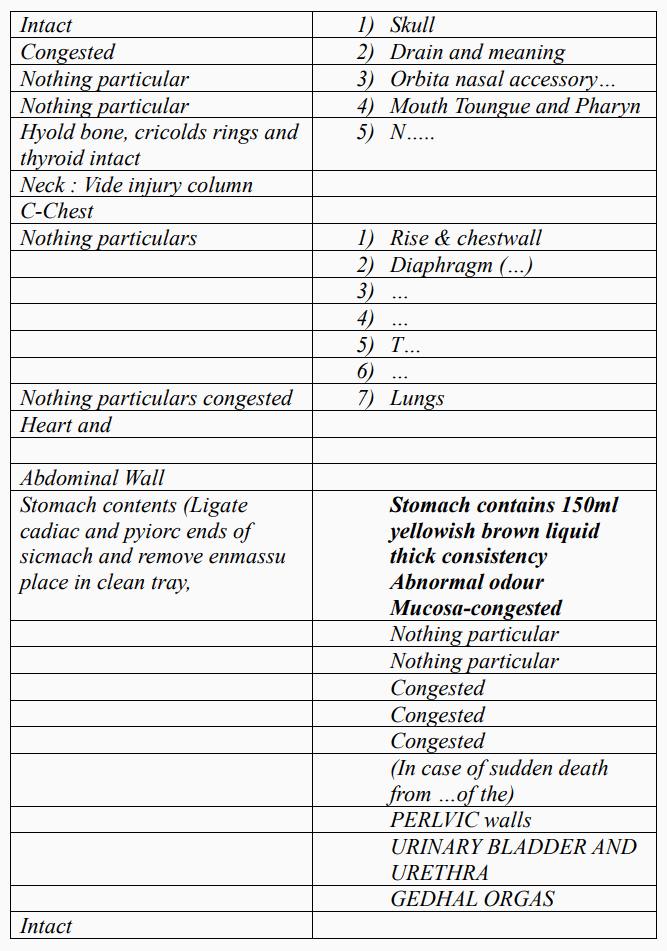
E Specimen Removal or Chemical...
S.No.
| Name of the Specimen
| Name & Contain
| | Small instine and contents
| -do-
| | | do-
| | | do-
| | Blood
| do-
| | | do-
| | | |
... concluded at 1-45pm on 25.02.2002
Opinion as to the cause of death
Approximate time of death : Hospital death
DFSL Hyderabad
PRESSURE OVER THE NECK, ASPHYXIA DUE TO MANUAL STRANGULATION, HOWEVER VISCERA PRESERVED FOR CHEMICAL ANALYSIS TO DETECT POISON IF ANY, SEMEN COLLECTED FROM VAGINA FOR GROUPING AND DNA FINGER PRINTING TEST.
Gandhi Hospital
25.02.2002
Sd/-
Dr. B. Muni Swamy
Dept. of Forensic Medicine
Gadhi Medical College,
Hyderabad"
(emphasis supplied)
9. It is to be noted here that Dr. B. Muni Swamy made his opinion public by giving an interview on Teja TV on 25th February 2002, even before giving the postmortem report to the SHO on 26th February 2002 and before receiving the AP FSL report on 27th February 2002. In the interview Dr. B. Muni Swamy stated that the deceased died of manual strangulation and that she was gang raped.
10. However, the Andhra Pradesh Forensic Science Laboratory ("AP FSL") report dated 27th February 2002 revealed that organophosphate an insecticide poison was found in the internal organs of the deceased and the stomach wash of both the accused and the deceased. The AP FSL report dated 27th February 2002 is reproduced hereinunder:
"DETAILS OF CASE PROPERTY RECEIVED
Received three sealed bottles and two sealed paper parcels, Paper parcel no. l containing two unsealed plastic containers and paper parcel no. 2 containing one unsealed plastic container.
A bottle labelled as "S. Pratyusha'' containing,
l. Piece of stomach and intestine in brownish turbid liquid marked as item no. l.
A bottle labelled as: "S. Pratyusha" containing,
2. Piece of liver and kidney in brownish turbid liquid marked as item no. 2,
A bottle labelled as "S. Pratyusha" containing,
3. Reddish turbid liquid marked as item no. 3
A paper parcel no. l containing,
A plastic container labelled as ''Pratyusha" containing
4. Brownish turbid liquid marked as item no. 4.
A plastic container labelled as "G. Siddarth Reddy" containing,
5. Whitish turbid liquid marked as item no. 5.
A paper parcel no. 2 containing,
6. An empty plastic container labelled as "Nuvacron" marked as item no. 6.
Nature of Examination/Tests conducted:
1. Physical Examination
2. Chemical Tests
REPORT
The above items 1 to 6 are analysed and Organophosphate an insecticide poison is found in all of them.
xxxx xxxx xxxx
Examination of case property in Cr No. 144/2022 of Panjagutta PS-Report furnished-Reg.
Your Lr Cr No 144/ACP-PG/2022, Dt-27.02.2022
OF CASE PROPERTY RECEIVED
Received four sealed paper parcels and two sealed bottles.
A bottle labelled as "Kumari S. Prathyusha" marked as Item no.1 contained,
1. Cotton swab.
A bottle labelled as "G. Siddarth Reddy" marked as item no.2 contained,
2. Reddish turbid liquid.
A paper parcel contained, a card board box contained,
3. A white colour mill made underwear labeled as Jockey marked as item no.3.
A paper parcel contained, a card board box contained,
4. A black colour cotton full sleeved shirt without collar and labeled as "Colour Plus two ply fabric" Men's' Wear "S" marked as item no.4
5. A blue jeans pant labelled as "Levi Strauss & Co." marked as item no.5.
A paper parcel contained, a card board box contained,
6. A pair of black colour socks marked as item no.6.
A paper parcel contained, a card board box contained,
7. A light green, white and grey colour design cotton kurta with dark brown stains marked as item no.7.
8. A white colour cotton pyjama with light green colour dots marked as item no.8.
Nature of examination:
- Biochemical, Immunological tests and
- Microscopic Examination
REPORT
The above items nos. 1, 3 to 8 are examined.
Human blood is detected on item no.7.
Blood group of blood stains on item nos. 7 is 'B' group.
Blood is not detected on item nos. 3, 4, 5, 6 and 8.
Semen and spermatozoa are not detected on item nos., 1, 3 to 8." (emphasis supplied)
11. Even after the receipt of the AP FSL report dated 27th February 2002, Dr. B. Muni Swamy stuck to his opinion that the death was due to manual strangulation and that sexual assault could not be ruled out.
12. In view of the difference of opinion regarding the cause of death and the public outcry caused due to the sensation created by the interview given by Dr. B. Muni Swamy, the Government of Andhra Pradesh vide G.O.Rt. No. 174 dated 05th March 2002, constituted a three-member Expert Committee comprising Dr. M. Narayana Reddy (PW-31), Dr. P. Vijaya Kumar and Dr. K. Sathyavathi to conduct an enquiry and submit a report.
13. The three-member Expert Committee gave its findings vide report dated 09th March 2002 stating the following:
"EXPERT COMMITTEE REPORT
Sub: Expert Committee Report regarding the cause of death of Late Miss. Prathyusha- Regarding.
Ref: G.O. Rt. No.174, HM & FW (NI) Dept. Dated. 05-03-2002 to conduct enquiry into the cause of death of Late Miss. Prathyusha.
The members of the' Expert Committee met on 09-03-2002 in the Department of Forensic Medicine, Osmania General Hospital, Hyderabad, and examined in detail the following documents:
----- ----- ------
1. Copy or the Inquest Report in Cr.No.144/2002, Dated 25-02-2002 of PS. Pujjagutta.
2. Copy of the P.M.E. Report No.435/2002 Dated 25-02-2022 on the body of the deceased Samala Prathyusha, Aged about 20 Years issued by Dr. B Muniswamy, Professor of Forensic Medicine, Gandhi Medical College, Hyderabad.
3. Copies of the Reports of the A.P. Forensic Science Laboratories, bearing File Nos.TOX/929/2002 Dated 27-02-2002 and SER/202/2002, Dated. 27-02-2002.
4. Photos of the deceased taken at the time of: Postmortem Examination.
5. Copy of the in-patient case sheet of Care Hospital, Hyderabad, in relation to Samala Prathyusha.
After careful. examination of the documents, cited, the following facts have been obtained:
1. INQUEST REPORT:
The Inquest Report was conducted in the presence of Smt. S. Sarojini Devi, the mother of the deceased, and others. According to the Inquest Report it is a case of death due to consumption of Organophosphorus Poison.
2. POSTMORTEM REPORT, PHOTOS AND CASE SHEET:
The 13 injuries mentioned in the P.M.E. Report were analysed in comparison with the Photos and the Case Sheet .
INJURY NO.1; On the left side of the tip of the nose - noted in the P.M.E. Report as abrasion of 1.5 x 0.25 cms.
These could be due to the pressure by the Ryles Tube or the pressure caused due to the application of Plaster to keep the tube in position.
INJURY No:2: Over the lower border of the lower jaw on right side - described in the P.M.E. Report as horizontally placed interrupted abrasion of 4 x 0.05 cms.
It could be due to the pressure mark by the application of Plaster to fix the Endotracheal tube in position.
INJURY Nos. 3 & 4: On the right side of the neck - described in the P.M.E. Report as abrasions of 1x0.25 cm and 1x 0.5 cm. respectively.
These could be the suture marks made to keep the central venous catheter in position.
INJURY NO: 5: On the front of the lower part of right side of the neck-mentioned in the P.M.E. report as abrasion of 2.5x0.25 cm.
This could be the pressure mark caused either due to the finger pressure while introducing the catheter into the internal jugular vein, to keep the caroted artery away or the pressure mark caused while applying the Plaster to keep the catheter in position.
INJUR YNO. 6: By the right side of the injury No.5 - described in the P.M.E. Report as abrasion of 0.5 x 0.5 cm.
It could be the entry site of central venous catheter.
INJURY NO. 7: Over the inner end of left collar bone - described in the P.M.E. Report as abrasion of 1 x 0.5 cm.
These could be the pressure mark due to the application of the Plaster to maintained the central venous catheter in position.
INJURY NO.8: On the front of right wrist - mentioned in the P.M.E. Report as three pin head sized puncture wounds.
These could be the puncture marks caused to obtain arterial blood for analysis.
INJURY NO:9: On the front of lower part of left forearm - mentioned in the P.M.E. Report as multiple pin head size puncture wounds.
These could be the puncture marks caused to obtained arterial blood for analysis.
INJURY NOs.10 & 11: On the front of left side of the chest - mentioned in the P.ME. Report as abrasions.
These could be the superficial burns marks caused by the heated edges of the paddles while giving the D.C. Shocks.
INJURY NO:12: Over the groins - Described in the P.M.E. Report as Injection marks.
These could be the marks caused due to introduction of catheters into the femoral arteries.
INJURY NO:13: Internal injury - Described as contusion of the lower end of sterno-mastoid muscle, corresponding to injury Nos. 5 & 6 in the P.M.E. Report.
As per the P.M.E. Report the Stomach contained 150 ml of yellowish brown liquid of thick consistency. Mucosa of the Stomach was congested and abnormal odour was present.
Brain, Lungs, Liver, Pancreas, Spleen, Kidneys and Addrenals were congested.
Hyoid bone, Cricoid cartilage, and thyroid cartilage were intact.
Nothing abnormal was noted in the Genital Organs.
3. REPORTS OF THE FORENSIC SCIENCE LABORATORIES:
On Chemical Analysis Organophosphate Poison was found in the Internal Organs.
Semen and Spermatozoa were not detected from the Cotton Swabs.
OPINION REGARDING THE CAUSE OF DEATH EXPRESSED IN THE P.M.E. REPORT BY THE DOCTOR WHO CONDUCTED THE P.M. EXAMIATION.
1. Pressure over the Neck, Asphyxia due to manual strangulation.
2. Viscera preserved for Chemical Analysis to detect poison, if any.
3. Semen collected from Vagina for grouping and D.N.A. Finger Printing Test.
VIEW OF THE COMMITTEE ON THE ABOVE OPINION
1. No signs of death due to manual strangulation were noted in the Postmortem Report. On the contrary there is evidence that she was under treatment from 8-00 p.m. of 23-02-2002 to 11-45 P.M. of 24-02-2002, for Organophospate Poisoning.
2. The Postmortem signs such as the congestion of the mucus membrane of the Stomach and the presence of abnormal odour in the contents of the Stomach are consistent with that of death due to "POISONING".
3. In the opinion column it has been stated that the Semen was collected from the Vagina. It is not possible to identify from the naked eye examination whether the fluid collected from the Vagina is Semen or Vaginal secretion. It can be known as the Semen only on the Laboratory Examination.
OPINION OF THE EXPERT COMMITTEE:
1. The cause of death is due to Organophospate Poisoning.
2. There is no evidence of death due to manual Strangulation.
3. There is no evidence of sexual assault prior to her death.
NOTE:
It appears that the Doctor, who conducted the P.M. Examination misinterpreted the therapeutic injuries as the injuries caused by violence. The Doctor should have exercised restraint before expressing the opinion, contrary to the Inquest Report. He should have asked the Police to produce the copy of the hospital treatment case sheet and should have perused it before expressing his opinion.
Medical technology is advancing every day. There should be inter-disciplinary interaction programme to update the knowledge to prevent the difficulties caused by the gap in the knowledge.
Sd/-
(Dr. K. SATHYAVATHI)
MEMBER
| Sd/-
(DR. P. VIJAYA KUMAR)
MEMBER
| Sd/-
(DR. M. NARAYAN REDDY)
MEMBER/CONVENOR
|
xxxx xxxxx xxxx xxxx
(emphasis supplied)
Sir,
Sub: Opinion of the Expert Committee regarding the death of Late Miss. Prathyusha in Cr. No.144/2002 of PS. Punjagutta-Submitted - Regarding.
Ref: G.O. Rt. No.174, Health, Medical and Family Welfare (N1) Department, Dated. 05-03-2002.
--- --- ---
With reference to the subject cited above the Members of the Expert Committee constituted by the Government through the reference cited above met in the Department of Forensic Medicine, Osmania General Hospital, on 09-03-2002 and examined the relevant documents. The report of the Expert Committee, prepared after perusing the documents including the Photographs of the deceased, taken at the time of Postmortem Examination at the Mortuary of Gandhi General Hospital, Secunderabad, is herewith submitted.
In this case the deceased was admitted with the complaint of consumption of Poison and was treated for Organophosphorus Poisoning in the hospital from 8-00 PM on 23-02-2002 to 11-45 a.m. on 24-02-02, i.e. for 15 hours 45 minutes. At the time of admission she was conscious and coherent. This itself rules out the cause of death as that of "PRESSURE OVER THE NECK, ASPHYXIA DUE TO MANUAL STRANGULATION".
At the time of Postmortem Examination, the Doctor who conduct the P.M. Examination, did not find any bite marks on the lips, cheeks, neck or breast that are expected to be found in case of sexual assault. He also did not find any scratches caused by the finger nails.
He did not notice any injuries on the genital organs around the genital organs, to indicate that it was a cause of Rape. He did not note any finding in his report proper (except) in the opinion column) that indicates that she had sexual intercourse prior to her death.
He also did not note any signs of Asphyxia in the face, to indicate that it was a case of death due to Manual Strangulation.
Either at the time of admission on 23-02-2002 or at the time of declaring the death on 24-02-2002 or at the time of conduction of the Inquest on 25-02-2002, there was no reason to suspect that it was a case of Rape. When she was under treatment in the hospital, her clothes were removed to facilitate the treatment. The clothes are generally removed in the critical care units by cutting them, as the patient cannot be turned around to remove the clothes when the treatment is on. As there was no indication of Rape, the police did not feel it necessary to collect the clothes for any examination that is helpful in the investigation of the case. There is nothing unusual in the disposal of these torn clothes.
As per the Inquest Report at the time of the conduction of inquest the mother of the deceased and four other persons were present as eye witnesses. The inquest conducted in their presence clearly states that it was a case of death due to Organophosphorus Poisoning.
This is for your information.
Yours sincerely,
Sd/-
(DR. M.N. NARAYANA REDDY)
Professor & Head
Dept. of Forensic Medicine,
Osmania Medical College."
14. Due to the interview given by Dr. B. Muni Swamy in a matter pending investigation regarding the cause of death of an actress and finding of sexual assault and the controversy arising therefrom, public interest litigations being Writ Petitions Nos. 4054 and 4329 of 2002 were filed before the High Court of Andhra Pradesh seeking an investigation by the Central Bureau of Investigation ("CBI").
15. Pertinently, Dr. B. Muni Swamy in his affidavit dated 20th March 2002 filed before the High Court wrongly represented that there was swelling of the neck of the deceased and that there were injuries on the back of the thighs even though he had not mentioned these injuries in his postmortem report dated 25th February 2002.
16. The investigation was entrusted by the High Court of Andhra Pradesh to the CBI vide order dated 21st March 2002 passed in Writ Petitions Nos. 4054 and 4329 of 2002.
17. Accordingly, CBI registered an FIR dated 28th March 2002 in Crime No.RC-1/S/2002/CBI/SCB/Chennai for offences punishable under Section 302 IPC.
18. On 26th March 2002, the High Court of Andhra Pradesh directed the Director, Centre for DNA Fingerprinting and Diagnostics ("CDFD") to conduct a DNA test on the basis of swabs collected from APFSL and submit a report to the Court.
19. Accordingly, DNA tests were conducted on the basis of cotton swab collected from AP FSL and the samples submitted by the mother of the deceased and Appellant in Criminal Appeal Nos.894-895 of 2012. Pertinently, the report dated 24th April 2002 revealed that cotton swab contained two fractions of DNA i.e. female fraction and male fraction. The female fraction matched with the DNA of the mother of the deceased and Appellant in Criminal Appeal Nos.894-895 of 2012. However, to ascertain the source of the male fraction, samples were taken from the Appellant-Accused herein and five other individuals known to the Appellant-Accused. Upon examination, none of the samples which were taken from the Appellant-Accused and five other individuals matched with the male fraction of the DNA found on the cotton swab. The relevant portions of the CDFD reports dated 5th April 2002, 24th April 2002 and 13th May 2002 are reproduced hereinbelow: -
A. Report dated 5th April 2002
"The Hon'ble Registrar
(Judicial),
High Court of Judicature of Andhra Pradesh
At Hyderabad
Sub: Submission of DNA typing report in Cr. No.144/2002 of Panjagutta PS-Regarding.
CDFD File No.1119
DNA typing report No.LS/DNA-FP/2002-1079
DESCRIPTION OF SOURCE RECEIVED/COLLECTED
Name of the material object/Source/sample
| Received on
| Exhibit
| CPFD No.
| Part of cotton swab
| 26.03.2002
| A
| 4613
| Part of pieces presumed to be stomach and intestine
| 26.03.2002
| B
| 4614
| Part of pieces of liver and kidney
| 26.03.2002
| C
| 4615
| Part of reddish turbid liquid (blood)
| 26.03.2002
| D
| 4616
| Blood of Mrs. P. Sarojini Devi Identification card No.1
| Collected on 27.03.2002
| E
| 4617
|
xxxx xxxx xxxx xxxx
RESULT OF EXAMINATION & CONCLUSION
On comparison of the DNA fingerprints of the source of exhibit B (part of pieces of presumed stomach and intestine), exhibit C (part of pieces of liver and kidney) and exhibit D {part of reddish turbid liquid (blood)} with the DNA fingerprint of the source of exhibit E (blood sample of Smt P Sarojini Devi), it is concluded beyond any reasonable doubt that:-
1) the source of exhibit B (part of pieces presumed to be stomach and intestine), is that of biological child of the source of exhibit E (Smt P Sarojini Devi);
2) The sources of exhibit C (part of pieces of liver and kidney) is not that of the of the biological child of the source of exhibit E (Smt P Sarojini Devi);
3) The sources of exhibit D (part of reddish turbid liquid (blood)) is not that of the biological child of the source of exhibit E (Smt P Sarojini Devi);
4) The sources of exhibits C and D i.e. parts of liver, kidney and reddish turbid liquid (blood) is that of one single human individual who is not biologically related to the source of exhibit E i.e., Smt P Sarojini Devi;
The photograph of the results will be submitted along with the report of the source of exhibit A i.e., part of the cotton swab on or before 26.04.2002. The absence of the photograph in this report does not affect the conclusions in any manner.
sd/-
Dr. G.V. Rao,
Examining Scientist"
xxxx xxxx xxxx xxxx
B. Report dated 24th April 2002
The Hon'ble Registrar (Judicial),
High Court of Judicature of Andhra Pradesh
at Hyderabad
Hyderabad
Sub: Submission of further DNA typing report in Cr. No.144/2002 of Panjagutta PS- Regarding.
CDFD File No.1119
DNA typing report No.LS/DNA-FP/2002-1079/1
DESCRIPTION OF SOURCE
Name of the source/sample
| Received/collected on
| Exhibit
| CPFD No.
| Part of cotton swab
| 26.03.2002
| A
| 4613
| Blood sample of Mrs. P. Sarojini Devi Identification card No.1
| 27.03.2002
| E
| 4617
|
xxxx xxxx xxxx xxxx
RESULT OF EXAMINATION & CONCLUSION
On comparison of the DNA fingerprints of the source of exhibit A (part of cotton swab) which contained two fractions i.e. female fraction and male fraction, with the DNA fingerprint of the source of exhibit E (blood sample of Mrs P Sarojini Devi), it is concluded beyond reasonable doubt that:-
1) the source of exhibit A (part of cotton swab) contains DNA of a female human individual who is the biological child of the source of exhibit E (Mrs P Sarojini Devi);
2) the male fraction of the source of exhibit A (part of cotton swab) contained DNA of a human male individual;
3) the male fraction of the source of exhibit A (part of cotton swab) is not biologically related to the sources of exhibits B, C and D as mentioned in our earlier report bearing No. LS/DNA-FP/2002-1079 dated 05.04.2002.
sd/-
Dr. G.V. Rao,
Examining Scientist
xxxx xxxx xxxx xxxx
C. Report dated 13th May 2002
The Deputy Superintendent of Police,
CBI/SCB/Chennai
Camp: At Hyderabad
Room No.17 Police Officers' Mess
Hyderabad
Sub: Submission of 2nd further DNA typing report in Cr. No.144/2002 of Panjagutta PS- Regarding.
CDFD File No.1119
DNA typing report No.LS/DNA-FP/2002-1079/2
Name of the source/sample
| Received/ Collected on
| Exhibit
| CDFD No.
| Part of cotton swab
| 26.03.2002
| A
| 4613
| Mr Gudipally Siddhartha Reddy Identification form No.2
| 29.04.2002
| G
| 4683
| Mr Mulamalla Suraj Reddy Identification form No.3
| 29.04.2002
| H
| 4684
| Mr Komirishetty Bhaskar Identifiction form No.4
| 29.04.2002
| I
| 4685
| Mr Vishwanatham Nishanth Identification form No.5
| 29.04.2002
| J
| 4686
| Mr Grandhi Raghav Identification form No.6
| 29.4.2002
| K
| 4687
| Mr Kalakuntla Ranga Rao Identification _ form No.7
| 29.4.2002
| L
| 4688
|
Sources of exhibits G to L were subjected to DNA isolation and DNA profiles have been prepared to compare with the DNA profile of the source of exhibit A which were prepared earlier.
RESULT OF EXAMINATION
On comparison, the DNA fingerprint for the male fraction of the source of exhibit A (part of cotton swab) does not match with the DNA fingerprints of the sources of exhibits G to L (blood samples of the suspects). Therefore, sources of exhibits G to L (suspects) can be excluded from being responsible for the biological fluid, present on the source of exhibit A (part of cotton swab).
The photograph of the results will be submitted later. The absence of the photograph does not affect the results in any manner.
CONCLUSION
The above test (STR analysis) is sufficient to conclude that the sources of exhibits G to L (Mr Gudipally Siddhartha Reddy, Mr Mulamalla Suraj Reddy, Mr Komirishetty Bhaskar, Mr Vishwanatham Nishanth, Mr Grandhi Raghav and Mr Kalakuntla Ranga Rao) are not the sources of the biological fluid present on the source of exhibit A (part of cotton swab).
Sd/-
Dr. G.V. Rao
Examining Scientist"
(emphasis supplied)
20. The CBI vide its letter dated 19th April 2002 (Ex. P-55) sought expert opinion from the Department of Forensic Medicine, All India Institute of Medical Sciences ("AIIMS") New Delhi, inter alia, as to the exact cause of death and the finding of manual strangulation in the postmortem report dated 25th February 2002.
21. Accordingly, a Committee of doctors was constituted by AIIMS which gave its report dated 02nd May 2002. The Committee, inter alia, opined that the cause of death of deceased was Organophosphate poisoning and the external injuries were caused due to therapeutic procedures which were misinterpreted as injuries due to manual strangulation in the postmortem report dated 25th February 2002 prepared by Dr. B. Muni Swamy. The AIIMS Committee of doctors further opined that the substance mentioned in the postmortem report as semen could have been a natural secretion. The relevant portion of the report dated 02nd May 2002 is reproduced hereinbelow:-
"Q1. Exact cause of Death
Ans. After perusal of all the documents and photographs forwarded to us, we are of the considered opinion that the cause of death of the deceased Miss S. Pratyusha was Organophosphorus poisoning.
Q 2. Whether all the injuries seen in the photographs relate to the treatment and can be explained by the case records. Whether the type and nature of injuries are recorded correctly in the column of injuries in the PM report.
Ans. On examination of all documents numbered Annexure A - K a co-relation between the clinical notes, record of therapeutic procedures carried out, injuries observed on PM Examination and photographs (numbered 1/23 to 23/23) was prepared to clarify the origin of the injuries, which is as under :-
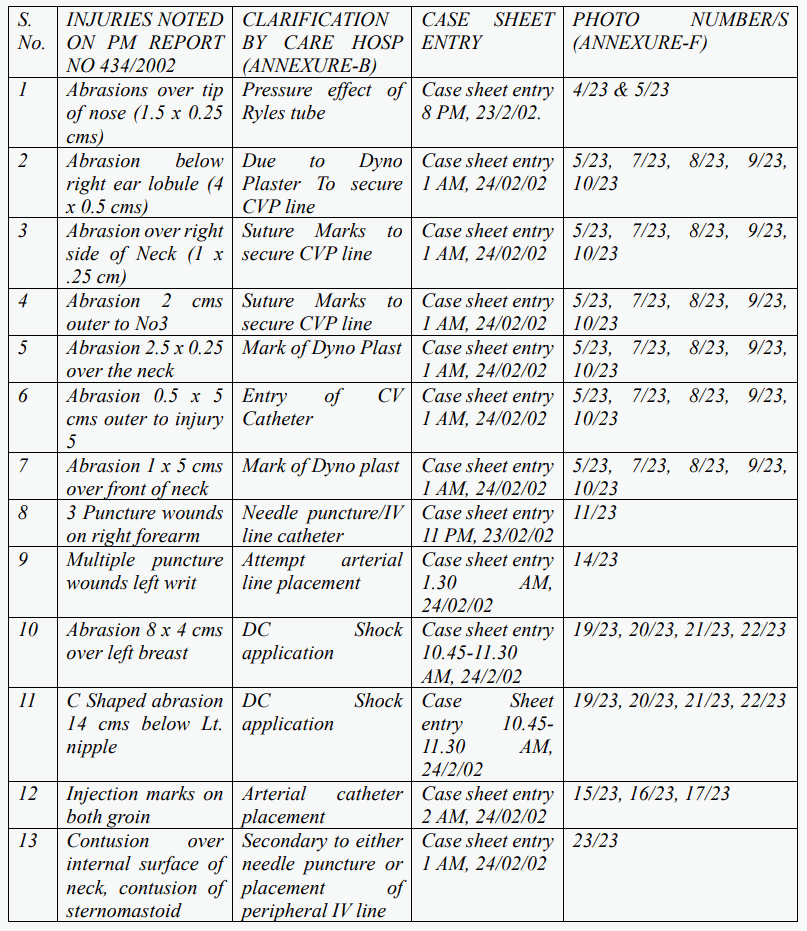
It is observed from the above analysis that the external injuries No 1-13 were the result of therapeutic procedures adopted during management of the deceased and these artefacts were misinterpreted on postmortem examination as injuries due to manual strangulation. The substance mentioned in PM Report in the opinion as semen could have been a natural secretion.
Q 3. Whether the treatment given by the hospital was proper.
Ans. According to the Case record No 2207 of Care Hospital the deceased Miss S Pratyusha was diagnosed and managed as a case of Organo-phosphorus poisoning. The management of the patient as evident from the Medical Records made available (Annexure B) was appropriate and along conventional lines and hence may be regarded as proper.
Q 4. Whether the observations noted in the PME report are indicative of manual strangulation and whether opinion given in the PME report is based on proper analysis..
Ans. Considering all the documents provided the Observations recorded in PM report no 434/2002 dated 25.2.2002 do not appear to be indicative of manual strangulation. The congestion in the Brain and abdominal organs is also observed in cases of Organophosphorus poisoning. The Opinion given in the PME Report appears to be based on a misinterpretation of injuries produced by therapeutic procedures.
Q.5 Whether there was any sexual assault in this case.
Ans. The PM Report no.434/2022 (Annexure E), APFSL report no. SER/202/2002 dated 27.2.20202 (Annexure-I) and photographs (Annexure-F) do not indicate any evidence of sexual assault in this case.
Q6, As the opinions given in this case by the hospital authorities and the expert committee are in contradiction with the opinion of the doctor who conducted the PM, whose opinion is wrong and whether such a wrong opinion was given by the concerned doctor/doctors by deliberately twisting the facts or was it due to professional negligence or was it a genuine bonafide mistake, which can occur m such a case?
Ans. Usually opinion given by the treating physician is based on the clinical examination, observations and diagnostic tests etc. The Expert committee has formulated its opinion based on the medical records, PM Report, photographs, and AFSL report. The above are consistent with the opinion that the cause of death in this case was Organophosphorus poisoning. The Doctor who has conducted the Post Mortem examination seems to have misinterpreted the findings to conclude that the cause of death was Manual Strangulation. It appears to have been an error of judgement on the part of the Autopsy Surgeon.
Q 7. The Doctor who conducted the PM has filed an affidavit in the High Court regarding the injuries. In your opinion, whether the observations by the said Doctor about the injuries are correct?
Ans. The Observations made by the Autopsy Surgeon do not appear to be correct.
Q 8. What is the minimum quantity of Organo-phosphorus poison that can cause death?
Ans. The minimum fatal dose of Organo-phosphorus compounds varies depending on the chemical nature of the exact compound. It varies from 25 mg orally for TEPP to :75 mg for Parathion. Refer Modi's Medical Jurisprudence & Toxicology, twenty second edition page 87(copy enclosed). Monocrotophos in listed among the Highly toxic Organophosphorus compounds. Refer Medical Toxicology-Diagnosis & Treatment of Human Poisoning 1988 Edn, page 1072 (copy enclosed). The fatal dose of Monocrotophos is 120 mg. Refer Pesticide News of Pan -UK page 2 (copy enclosed).
Q9. Time required for reaction to occur after consumption
Ans. In cases of Organophosphorus poisoning the symptoms begin in half an hour. Refer Modi's Medical Jurisprudence & Toxicology, twenty second edition page 87 (copy enclosed).
Sd/-
| Sd/-
| Sd/-
| Maj. Abhijit Rudra
| Lt. Col. Ravi Rautji
| Dr. D N Bhardwaj
| Junior Resident
| Junior Resident
| Associate Professor"
|
(emphasis supplied)
22. Meanwhile, the internal organs of the deceased, the stomach wash of both the deceased and the Appellant-Accused and a bottle labeled 'Nuvacron' were sent for forensic examination to Central Forensic Science Laboratory ("CFSL"), which gave two reports dated 16th May, 2002 and 20th May, 2002.
23. A perusal of the report dated 16th May 2002 reveals that Monocrotophos, an organo-phosphorous insecticide was detected in the internal organs of the deceased and in the bottle labeled as 'Nuvacron'. However, Monocrotophos an organo-phosphorous insecticide was not found in the stomach wash of the Appellant-Accused and the deceased. In another report dated 20th May 2002 submitted by CFSL, it was stated that no semen could be detected on the portion of cotton swab or the cloth belonging to the deceased. The relevant portion of the reports dated 16th May 2002 and 20th May 2002 are reproduced hereinbelow:-
A. Report dated 16th May 2002
Parcel No.
| No. of Seals & Impression
| Description
| 1
| 3, FSL,, HYD WITH EMBLEM GOVT.OF ANDHRA PRADESH
| one sealed card board box wrapped with adhesive tape and labelled containing six items.
| | 1, -do-
| Item No.1: One sealed glass bottle marked as Item 1 containing
Exhibit-1a. Exhibit-1a: Greenish brown colour liquid (Approx.8 ml) having sediments and small piece of tissue (Approx. 2 gms) stated to be "piece of stomach & intestine "
| | 1, -do-
| Item No.2: One sealed glass bottle marked as Item 2 containing Exhibit-1b.
Exhibit-1b : Reddish brown colour liquid (Approx.15 ml) and small piece of tissue (Approx.3 gms) stated to be piece of liver and kidney.
| | 1, -do-
| Item No.3 : One sealed glass bottle marked as item 3 containing
Exhibit-le. Exhibit-le: Dark reddish colour liquid (Approx.18 ml) stated to be reddish turbid liquid{blood).
| | 1, -do-
| Item No.4: One sealed small plastic container marked as item 4 containing Exhibit-Id.
|
9. Condition of seal(s)/Parcel(s): Intact and tallied with the specimen seal impression
10. Purpose of reference: For Chemical Examination & Report
11. Dates of Examination: 29.4.2002 to 16.5.2002
RESULT OF EXAMINATION / REPORT
With reference of sampling procedure etc. Use separate sheets if necessary.
The exhibits were analysed by Physico-chemical and chromatographic techniques. Based on the observation the results thus obtained are given below.
1. Monocrotophos an organo-phosphorous insecticide has been detected in Exhibit-2.
2. Monocotophos an organo-phosphorous insecticide has been detected in Exhibit 1a, 1b, 1c and 1f.
3. Monocrotophos an organo-phosphorous insecticide could not be detected in Exhibit-1d and 1e.
B. Report dated 20th May 2002
DESCRIPTION OF ARTICLES CONTAINED IN PARCEL (S)
Parcel-I: One sealed cloth parcel marked 'Item No. 1: SER/202/2002' containing exhibit l, kept in an injection vial.
Exhibit-I: One pale yellowish cotton wool described as, "A portion of cotton swab".
Parcel-2: One sealed paper parcel marked 'hem No.: SER/202/2002 (B) ' containing exhibit 2, kept in a cardboard box.
Exhibit-2: One black colour polyester self design cloth piece attached to a white cloth and cotton piece.
RESULTS OF ANALYSIS
On the basis of biological examination carried out in the laboratory, following results have been obtained:
1. Semen could not be detected on exhibits 1 and 2 .
Note: Remnants of the exhibits have been sealed with the seals of GDG PSO (Bio) CFSL, CBI, NEW DELHI.
Sd/-
20.5.2022
(DR. G.D. GUPTA)
Principal Scientific Officer (Biology)-cum-
Assistant Chemical Examiner to the Govt. of India
CFSL, CBI, New Delhi."
(emphasis supplied)
24. During the time the High Court was monitoring the investigation, CBI submitted three status reports. The relevant portion of one of the status reports dated 25th July 2002 filed by CBI is reproduced hereinbelow:-
"...During her treatment, she passed urine and motion on the bed and various tubes were placed on her body and so the clothes had to be removed by cutting them. The dirty clothes were later put in the dust bin which was in the room next to the ICCU (Next day the dust bin was cleared into the municipal bin). This has been confirmed by nurses Tushara Jose, Sashi Kumari and Anitha, ayah of Care Hospital. The whole body of Prathyusha including private parts was cleaned by the Ayah. The above cited witnesses clearly indicated that there were no injuries on her body. This was also confirmed by Doctors Kalyanasundaram and Sarat Chandra Thalluri. During the treatment a urinary catheter smeared with jelly "Xylocaine" was inserted into the urinary tract for passing the urine. The said jelly is colourless and on drying it becomes white in colour and acts as lubricant and anaesthesia During the treatment, attempts were made to place the catheter and I.V. line on both the wrists (radial artery) and on both sides of the groin (femeral artery) for treatment. Documents further revealed that around 1.00 a.m. on 24.02.2002 the Central Venous Catheter was inserted on the right side of Prathyusha's neck to measure her BP since the peripheral veins had collapsed. To secure this catheter, an incision was made to insert the same and two sutures for holding the catheter in place. This was done by Dr. Sarat Chandra Thalluri and confirmed by doctors Kalyanasundaram and Lakshmi Kanthaiah. In the early morning of 24.02.02 Prathyusha's condition improved, but suddenly deteriorated at around 10.30 a.m. The Cardio Pulmonary Resuscitation was carried out since a cardiac arrest was suspected. Around 10.45 a.m. three cycles of DC shock was given for reviving her for which two electric pads were placed around the left breast of the patient. This was revealed by Dr. Muralidhar, anaesthetist of Care Hospital but all efforts to revive her failed and at 11.45 a.m. Prathyusha was declared dead.
The condition of Siddharth Reddy also deteriorated around 11.00 p.m. on 23.02.02 and he was shifted to the ICCU and put on ventilator. His condition stabilised only on 03.03.02 and only thereafter his statement was recorded by a Magistrate as stated earlier. On 09.03.02 he was discharged from the hospital and arrested by the CID of AP police. He was released from judicial custody on 28.06.02 on the orders of the Hon'ble High Court of Andhra Pradesh.
Investigation revealed that Sarojini Devi, mother of Prathyusha filed a complaint in Panjagutta PS at 3.00 p.m. on 24.02.02. In her complaint she stated that Siddartha Reddy and Prathyusha were in love and the parents of the boy were not agreeable for their marriage. Further she stated that her daughter received a phone call on the previous day from Siddartha Reddy and was informed that his mother threatened to kill herself if he married Prathyusha. In the evening she went to a Beauty Parlour where she might have met Siddartha Reddy. Around 7'0 clock she was informed by Prathyusha that Siddarth was with her and that she was coming back home. Later at 8.30 p.m she received the call from Care Hospital stating that her daughter had consumed poison and she was admitted there. Based on this complaint Cr. No: 144/02 was registered u/s. 174 Cr.PC by the said PS.
....Even though Dr. Krupal Singh was the duty doctor at the mortuary, Dr. B. Muniswamy, Professor came to the mortuary on his own and conducted postmortem. The duty roster revealed that Dr. Muniswamy was neither on duty at the mortuary nor on call duty as Professor. This was revealed by Dr. Rajgopal Reddy, HOD, Department of Forensic Medicine, who stated that Dr. Muniswamy did not intimate or sought permission for conducting the postmortem.
SI Chungi, had explained to the two doctors that it was a case of poisoning and suicide. He also summoned a photographer and twenty one photographs were taken as per the directions of Dr. Muniswamy. This is corroborated by Sheikh Aziz Hussain, who further stated that on 26.02.02 he gave one set of photographs to Dr. Muniswamy and another set alongwith negatives to Panjagutta PS. The postmortem report No. 434/2002 dated 26/2/2002 revealed that there were 13 injuries and death, was caused due to pressure over the neck, asphyxia due to manual strangulation. Viscera was preserved for chemical analysis to detect poison, if any, and 'semen collected from vagina for grouping and DNA finger printing test'. The report was signed by Dr. B. Muniswamy and Dr. Krupal Singh.
Dr. Krupal Singh a Post Graduate student during his examination stated that he did not agree with the findings of Dr. Muniswamy even though he signed the postmortem report. The viscera and the vaginal cotton swabs of Prathyusha were sent to Andhra Pradesh Forensic Science Laboratory on 27.02.2002 and their reports revealed that the viscera contained organophosphate, an insecticide poison. They also stated that the said poison was found in the stomach wash of Prathyusha and Siddharth Reddy and in the empty container recovered from the Pick n Move' lane (these were obtained from Care Hospital). The APFSL also opined that no semen and spermatozoa were detected in the cotton swab, in the clothes of Siddharth Reddy and in the clothes of Prathyusha worn by her at the time of postmortem.
On 25.02.02 after the postmortem examination, Dr. Muniswamy gave an interview on Teja T.V. stating that Prathyusha died of manual strangulation and that she was gang raped, even though he gave the PME report to SHO Panjagutta only on 26/02/2002. This was followed by a press statement issued by the Commissioner of Police, Hyderabad wherein the finding of the PME report was revealed. On 27.02.02 the Director of APFSL Dr. KPC Gandhi told the media that Prathyusha died of poisoning and that it could be a suicide. This was followed by a press statement by the DGP confirming the same.
After receipt of the APFSL reports and a copy of the case sheet relating to Prathyusha, Dr. Muniswamy's final opinion dated 13.03.02 revealed 'Pressure over the neck, asphyxia due to manual strangulation. The chemical analysis report of FSL revealed presence of organo phosphate insecticide poison present. Death uncertain. Presence of semen and photographic evidence (rape) sexual assault cannot be ruled out'. It can be seen that Dr. Muniswamy in his T.V. interview stated that it was a gang rape and in his final opinion stated that rape / sexual assault cannot be ruled out.
In view of the contradictory opinions, a committee was formed by the Government of Andhra Pradesh who opined that Prathyusha died of poisoning and that there was no evidence of manual strangulation or sexual assault. They also opined that the injuries found on the body of Prathyusha were caused during treatment at the Care Hospital.
During CBI investigation, opinion was also sought from a committee of doctors at All India Institute of Medical Sciences, (AIIMS) New Delhi who also confirmed the findings of the earlier committee...
The CBI also sent the viscera and the cotton swabs (already used by APFSL) of Prathyusha to Central Forensic Science Laboratories and they confirmed the presence of monochrotophos (one of the substances in the chemical family of organophosphate) in the viscera. The CFSL however, did not detect poison in the stomach wash of the above two persons. It was ascertained later that only traces were available which were insufficient, for carrying out the tests. The CFSL also opined that no semen was present in the cotton swabs of Prathyusha.
In view of some doubts about the genuineness of the vaginal swabs and viscera of the deceased which were reported to be in the custody of APFSL the Hon'ble High Court felt it appropriate to get a DNA test done. The APFSL accordingly sent the samples for the said tests to the Centre for DNA Finger Printing and Diagnostics (CDFD) Hyderabad. The CDFD opined that the stomach and intestine were that of Prathyusha while the kidney / liver and blood did not belong to her and it was that of a male individual. CBI investigation was then directed, to check the source of the said blood and kidney/liver. Enquiries were conducted at APFSL and Gandhi Medical College mortuary to ascertain the source of mix-up. However this could not be identified. The viscera of one Devji (male) whose postmortem was conducted just prior to that of Prathyusha was also sent to CDFD to ascertain whether it was biologically related to the viscera of the male identified by CDFD. The report is awaited.
The CDFD further opined that the cotton swabs belonged to Prathyusha but detected a male DNA in it which according to them is that of a sperm cell. It would be pertinent to mention here that five vaginal cotton swabs were received from the mortuary for test by the APFSL. It needs to be emphasised that the APFSL had used all the five swabs for tests and no semen or sperms were detected. It needs to be further emphasised that for microscopic examination the APFSL had extracted the material found in the cotton swabs and it was on this examination that the APFSL had determined it's results. The CDFD did not conduct any microscopic examination to ascertain the presence of sperms. A part of the swabs were sent by CBI to the CFSL. However, the findings of the CFSL corroborates the findings of the APFSL that no semen or sperms were present in the cotton swabs.
Nevertheless, in view of the findings of CDFD that a male DNA was present in the cotton swabs, CBI obtained blood samples of Siddharth Reddy and his five friends and sent them to CDFD for analysis. The result indicated that the male DNA did not match with any of them.........
....Enqunries with expert however revealed that contamination could have caused the presence of male DNA in Prathyusha's cotton swab either through the analyst or the environment. The CDFD ruled out the contamination on account of the analyst since it was a female who had done the analysis It is therefore possible that contamination from environment could have caused the presence of the male DNA.
It has however to be noted that the mix-up of the viscera of Prathyusha and the presence of a male DNA in her vaginal swab does not have a bearing on the case for the following reasons :-
1. During the time Prathyusha was with Siddharth Reddy (i.e. from 6-00 p.m. to 7-30 p.m. on 23.3.2002), she talked three times to her cousin Siri, once to her mother, twice to film co- director Shri Anand and other friends and she did not disclose that she was raped.
2. Prathyusha came to the hospital alive with signs of poisoning and admitted to the doctor that she consumed a pesticide. She further made no mention about any rape/sexual assault to any of hospital staff or her mother who met her there.
3. State and Central FSL Reports have opined that stomach/ intestine of Prathyusha contained the pesticide poison. It was further confirmed by APFSL that the stomach wash of Prathyusha also contained the pesticide poison.
4. The CARE hospital doctors and staff who had examined Prathyusha's body after removing the clothes by cutting the same for the purpose of treatment found no injuries on the body to indicate any physical violence leading to a sexual assault.
The investigation by the CBI has disclosed that Prathyusha and Siddharth Reddy were in love and they decided to commit suicide since there was strong objection to their marriage from the family of Siddharth. No evidence has come on record to suggest that suicide was pre-planned either jointly or by any of them individually. So, in all probability the decision to commit suicide together was an impulsive one and so also the decision to live again thereafter, which brought them to the hospital. The fact that Prathyusha committed suicide by consuming Nuvocron, a pesticide poison is proved by the following facts : -
(1) Prathyusha came to the hospital alive and admitted to the doctor that she consumed a pesticide.
(2) State and Central FSL Reports have opined that the viscera of Prathyusha contained the said pesticide poison. The stomach wash of both Prathyusha and Siddharth Reddy also contained the said pesticide poison as revealed by the State FSL. The report of the FSL has precedence over the postmortem report since the opinion corroborates with the direct evidence of the case.
The following facts revealed that Prathyusha was not manually strangulated or sexually assaulted.:
(1) Prathyusha came to the hospital alive and made no mention about any strangulation or rape/sexual assault to any of hospital staff or her mother who met her there. During the time she was with Siddharth (i.e. from 6-00 p.m. to 730 p.m. on 23.3.2002), she talked thrice to her cousin Siri, once to her mother, twice to Anand, co-director and other friends and she did not disclose that she is being raped or strangulated.
(2) There were no injuries on the body of Prathyusha at the time of admission in the hospital to indicate any physical violence leading to a manual strangulation or sexual assault.
(3) Even though a male DNA was detected by CDFD in the cotton swab, notwithstanding the fact that it could be a case of contamination, the fact that during the crucial time (6.00 p.m. to 7.30 p.m.) on 23.02.2002 the deceased was with Siddharth alone and that the male DNA did not match with Siddharth or his friends coupled with other evidences clearly show that there was no sexual assault/rape.
(4) Even at the time of postmortem there were no indications of manual strangulation such as wide open eyes, finger nail marks on her neck etc.,
(5) Sexual assault / rape was not suspected by the doctor is proved by the fact that he did not collect (i) loose pubic hair and sample pubic hair to identify the accused from the foreign hair (ii) matted pubic hair to identify the material responsible for the matting of the hair and to identify the accused
The fact that Siddharth Reddy survived could be for the following plausible reasons:
(1) Prathyusha was on diet and had lost 12 kgs. prior to her death. On that day she had only two chapatis while Siddharth Reddy had attended a lunch party that afternoon. Their physical conditions were poles apart.
(2) In females collinestrous enzyme is 50% less than in males, so the effect of poison is much stronger on the females.
(3) Siddharth Reddy could not have known the fatal dose of the pesticide.
The offence of attempt to commit suicide (309 IPC) against Siddarth Reddy is clearly brought out. He has aided the act of suicide by purchasing the pesticide, coca-cola etc. on 23.02.2002. Therefore the offence of abetment of suicide (306 IPC) is attracted against him.
It was observed during investigation that Dr. B. Muniswamy who conducted the postmortem examination had committed the following omissions and commissions which culminated in an opinion regarding the cause of death of Prathyusha which was erroneous and unprofessional.
1. Dr. B. Muniswamy disclosed his opinion to the media on 25.2.2002 even before the receipt of reports from APFSL and even before he sent the PME report dated 26.2.2002 to the IO.
2. In his interview to the TV he stated that it was a gang rape and in his final opinion he revealed that rape/ sexual assault cannot be ruled out.
3. Even after receipt of the APFSL reports and a copy of the case sheet relating to Prathyusha he opined that death was due to manual strangulation and sexual assault/ rape cannot be ruled out.
4. Dr. B. Muniswamy had falsely represented to the Hon'ble High Court regarding the following two injuries found on the body of Prathyusha (i) Swelling of the neck (ii) Injuries on the back of the thighs in his affidavit dated 20.3.2002 filed before the Hon'ble court. It should be noted that he has not mentioned these injuries in his postmortem report dated 26.2.2002.
5. The original final opinion of Dr. B. Muniswamy is not available on record. The carbon copy of his opinion dated 13.3.2002 could not have been prepared on that date since in his another letter dated 13.3.2002 sent to Panjagutta P.S he declined to give a final opinion till he received the original case sheets and the negatives of the photographs taken during postmortem examination.
In view of these commissions & omissions on the part of Dr. Muniswamy, disciplinary action is called for. A report is being sent to Govt. of Andhra Pradesh in this regard.
xxxx xxxx xxxx xxxx
CONCLUSION:
(1). Prathyusha committed suicide by consuming a pesticide poison, Nuvocron.
(2) Siddharth Reddy abetted the suicide of Prathyusha and also attempted to commit suicide whereby he is liable for prosecution u/s. 306 and 309 IPC.
(3) Dr. B. Muniswamy, Professor, Department of Forensic Medicine, Gandhi Medical College who conducted the postmortem examination gave an opinion regarding the cause of death of Prathyusha which was erroneous and unprofessional.
(4) There was negligent response on the part of police officials attached to Panjagutta PS and the Police Control Room when Prathyusha and Siddharth Reddy were under treatment at the Care Hospital.
The report is placed before this Hon'ble Court.
(Prem Kumar)
Dy. Supdt. of Police
CBI/SCB/Chennai"
(emphasis supplied)
25. The High Court after examining the entire record including the affidavit filed by Dr. B. Muni Swamy closed the public interest litigations vide its order dated 6th September 2002 and permitted the CBI to file its charge-sheet. Accordingly, CBI filed a chargesheet for offences punishable under Sections 306 and 309 IPC.
26. To prove the fact of past relationship between the deceased and the accused, the prosecution examined Sarojini Devi (PW-1), who produced Ex. P2 autograph book, Ex. P3, P5 and P6 love letters, and Ex. P4 a chit, all in the handwriting of the deceased and addressed to the Appellant-Accused. The relevant part of the testimony of PW-1 is reproduced hereinbelow:
"About 9 months prior to her death, my daughter informed me that she was in love with the accused and that she intended to marry him... As a mother, I initially objected for the love affair between the accused and my daughter for a period of one month, during which I advised her to concentrate on building up the career of herself first. My daughter was stubborn and asserted that she was love with the accused and that she would marry him. Then I relented and agreed for their marriage in principle, but I advised both of them to first pursue and build up their careers, and then only their marriage can be performed...She spoke on the phone for about 10 to 15 minutes. I heard her shout loudly into the phone "don't irritate me". I then rushed to her bed room and asked her to whom she was speaking to. She told me that she was talking to the accused. I asked her why they were speaking so loudly, she told me that the accused conveyed to her that his parents were not willing for his marriage with my daughter and that they even threatened to commit suicide enmasse if the accused marries my daughter and that the accused was worried about the prospects of the marriage. There was a call from Buddha films, Bangalore confirming her booking in a Kanada film. My daughter talked to them on phone enthusiastically over all aspects pertaining to her role and remuneration. I found my daughter lying on the bed with an Oxygen mask and other gadgeteries with several doctors and nurses around her. One of the doctors asked my daughter how she was feeling, my daughter replied in feeble voice that she was O.K. and her legs were shivering. After 2 or 3 minutes, I was asked to go out, so as not to cause any disturbance to the patient, I then came out. It was the last time I have seen my daughter alive. The hospital staff informed that my daughter is condition became serious because of consumption of poison. On the previous evening itself, we found some pressing marks of fingers on the throat of my daughter. On the next morning we again saw the dead body and found those press marks on throat."
27. Ms. Prafulla Sri, cousin of the deceased (PW-2) was examined to prove the relationship between the deceased and the accused and the fact that they were last seen together outside the parlour. The relevant portion of her evidence is reproduced hereinbelow:
"The deceased Prathyusha was in love with the accused. The deceased and the accused were close to each other since the time of Intermediate. The same closeness was maintained till the death of the deceased. As we were to go to Bangalore on the next morning, we went to Ferry's Beauty Parlour in Panjagutta on that evening. Myself and the deceased left home at about 4 p.m. on my Kinetic Honda and reached Beauty Parlour about an hour later. We were waiting there for our turn as there were some more customers. During that wait the deceased telephoned to the accused. Then she sat down on a chair and was getting her done and told me that she wanted to call the accused there for one last time before she went to Bangalore. Then I telephoned to the accused and told him what exactly the deceased wanted me to tell him. The accused agreed to come. After some time the deceased asked me to go outside and check around whether he came. I came out looked around and found the accused there. I told him to wait a minute and that I would go inside and informed, the deceased. I told the deceased that accused has come, she asked me to give him some company till she came out. I came out and spoke to the accused. He told me the same thing which the deceased told us in the morning after the telephone talk to the accused. The accused told me that his mother was not agreeing for the marriage and told him that she would take poison if he goes through the marriage with the deceased and that his other family members also told him the same thing... When myself and accused were discussing about it, the deceased came out of the Beauty parlour. All of a sudden the accused and the deceased were in tears. As people were looking at us. I suggested that we may sit down and talk. The accused suggested that we may sit in his car and talk. The deceased told me to wait there or go to my friends as she wanted to discuss with the accused something in private and she told me that she would be back in five or ten minutes. I told the deceased to come back soon so that we can go and book the Air tickets for our trip to Bangalore. The deceased then left with the accused in his car. It was a white Maruti Zen.." (emphasis supplied)
28. Similarly, G. Raghava (PW-6) and K. Bhasker (PW-7) were examined to prove the past relationship between the deceased and the accused, and the fact that they had met outside the beauty parlour and were thereafter admitted in hospital together. Relevant portion of the evidence of G. Raghava (PW-6) and K. Bhasker (PW-7) is reproduced hereinbelow:
G. Raghava (PW-6):
"... The accused again telephoned to me, when I was still in Ranga's house and told me that he was going to Somajiguda Ferry's Beauty Palour to meet the deceased there. The accused told me that as he was going to meet the deceased, if his parents telephoned to us and enquired about him, we may tell them that he is with us only... After sometime he -called me back. I asked him where he was. He told me that he was at Tank Bund. Then I passed on the cell phone to Ranga and Suraj, they talked to the accused. Suraj told me that accused wanted me to telephone after sometime. From Baker's Inn, myself, Suraj, Bhasker and others went to Necklace road. After reaching there Suraj telephoned the accused. The accused told that he was in Himayathnagar. After sometime the accused telephoned to the mobile of Bhasker and asked him to give the phone to Ranga. We were in the necklace road at that time. Ranga informed us that the accused and the deceased were in the Care Hospital and that we should go there."
K. Bhasker (PW-7):
"I am aware that the deceased and the accused were in love with each other. Myself, PW.6, Ranga and Suraj went to Necklace road. Before we left for Necklace road, Siddharth contacted us and asked to contact him half an hour later. After reaching the necklace road Suraj among us called the accused on Phone, and asked him where he was and the accused informed us that he was in Himayathnagar. After sometime the accused called me again on my cell, and asked me to hand over the cell phone to Ranga. Then Ranga talked to accused. During that call the deceased also talked to me and told me Hai Bhasker and Bai Bhasker. The accused told Ranga to come to Care hospital. After putting down the phone we were in doubt as to which Care hospital we have to go. I again telephone to the accused and he told us that he was in Care Banjara Hospital and asked me to come there. All of us went to Care hospital, Banjara Hills. We saw the car of the accused parked outside the hospital. We did not open the car. We entered the hospital, we could not find the accused. Ranga again called the accused on the cell phone and accused told Ranga that he was in I.C.C.U."
29. The presence of the deceased along with PW-2 was also spoken of by K. Lavanya (PW-11), an employee of the beauty parlour. The relevant portion of her testimony is reproduced hereinbelow:
"I am working in Ferry's beauty parlour in Amruthamall, Somajiguda since seven years. The deceased Prathysha was a regular customer of our beauty parlour. On 23-2-2002 the deceased came to our beauty parlor at 4:30 p.m. She was accompanied by her cousin whose name I do not know. The deceased was given Hair doing and hair setting in our beauty parlour at that time. The deceased and her cousin left our beauty parlour at 6 p.m, before leaving the deceased telephoned from our beauty parlour. The deceased was in good mood at that time. The cousin of the deceased was waiting outside while the deceased was getting her hair done."
30. The deceased and the accused were admitted to Care Hospital, Banjara Hills and were attended to by Dr. Saraschandra (PW-10), Dr. Laxmi Kantaiah (PW-13) and Dr. Kalyanasundaram (PW-32). The relevant portion of the evidence of PW-10, PW-13 and PW-32 is reproduced hereinbelow:
Dr. Saraschandra (PW-10):
"Ex.P.17 is the Case sheet pertaining to the deceased Prathyusha maintained in Care Hospital, Banjara Hills. On 23-2-2002 I went to Care Hospitals; Banjara Hills. The deceased was admitted in the Hospital at 8 p.m. on 23-22002, I saw the deceased in ICCU at about 10.30p.m. while she was undergoing treatment, I have gone through the case sheet of the deceased. The deceased and accused were both admitted in the hospital as per the initial evaluation as disclosed by the accused, the deceased and the accused consumed poison. It was organophosphorus poison. After initial evaluation we found the deceased quite sick and she was unable to breathe on her own. She was put on life supporting measures. As the deceased was seriously ill, we have put her on Central Veinus, Arterial blood lines and she was put on a mechanical ventilation... On 23.2.2002 I have seen the accused also, we was admitted in the acute medical care unit which is situate adjacent to ICCU. Ex. P.18 is the case sheet in respect of the accused maintained by the hospital. The condition of the accused is also critical but his vitals were found to the stable. We started the standard treatment for poisoning for him also. The deceased was directly admitted into ICCU because her condition was more critical and she needed more life supporting measures which are available in ICCU.
The seriousness due to poisoning depends on the sex and also whether the stomach is empty or otherwise. In case of females the poisoning will have more serious effect and also if the poison is consumed on empty stomach, it will have more impact. In females the body surface is less and the levels of enzymes were also less and therefore the poison will have more effect." (emphasis supplied)
Dr. Laxmi Kantaiah (PW-13):
"On 23.2.2002 at 5 p.m. I went to CARE Hospital, Banjara Hills, on duty, While I was in the hospital I received a phone from the ICCU at 8 p.m. saying that there was a poison case and I should attend. I immediately went to ICCU, I have seen a woman aged about 20 to 22 years. The woman was conscious. I asked her what has happened. She told me that she consumed poison. She is the deceased Prathyusha, I asked her what poison she has consumed. She replied that it, was some pesticide. Immediately she vomited. I immediately put ryles tube through her nose into stomach and I did stomach wash. At about. 8.30 p.m. her condition was deteriorating and she was sinking. She was nearing arrest. So immediately I put endotracheal tube through mouth into the wind pipe to give artificial respiration. I connected her to the ventilator. Till about 1.30 a.m. fluid was coming out from her lungs through the tube. Then I called for help. At about 11 p.m. Dr. Sharath Chandra PW-10 came. He has put an external jugular vein, small plastic canula into the jugular vein by the side of the neck and into the heart which helped assess the pressure in the heart. She was improving till the morning of next day. Whenever I was calling her by name she was responding by opening her eyes and nodding her head. I was in the ICCU throughout night and till 6 a.m. I obtained consent from the mother of the deceased for doing above procedure. The brother of PW.1 was also present outside the ICCU. At about 6:30 a.m. Dr.Soma Raju came to see the patient. As the patient was moving with pain, he suggested to me to give some sedation to her. I did not give the sedation to the patient as we wanted to observe the brain function and I told Dr.Soma Raju about it. At 9:00 a.m. my reliver came and I handed over the patient case sheet to Dr.Murli who was my reliver. At that time the deceased was conscious and is opening her eyes and nodding her head and her B.P. was stable. On the night of 23-2-2002 I had another call from A.M.C. which is adjacent to ICCU to attend on another patient Siddartha Reddy the same person the accused now before the Court. I went there and saw the accused, I asked him what has happened. He told me that he has consumed two gulps of pesticide. He was struggling to breathe... I have not seen any Injuries on the person of the deceased." (emphasis supplied)
Dr. Kalyanasundaram (PW -32)
"At about 8 p.m. on 23-2-2002 Dr. Prakash, Junior Resident doctor who was my colleague informed that there is a patient of consumption of Poison. I advised him to admit in the Acute Medical Care Unit. At that time, I was attending on another patient at Acute Medical Care Unit. The AMCU and ICCU are adjacent to each other. The patient was brought from ICCU to AMCU in a wheel chair. I attended on the patient immediately. The said patient is Siddartha Reddy, accused herein. I asked him whether the can get the poison container. He did not say anything. I was called to see another patient admitted in ICCU. I went there and saw the said patient who is the deceased Pratyusha. She was already on treatment. We did stomach wash. All the treatment given to deceased Pratyusha is noted in the case sheet Ex:P.70 under my signatures....
I did not notice any injuries on the person of the deceased at the time of admission in the hospital. I told Junior Residents Dr.Prakash and Dr.Chima to secure the container of the poison through the relatives of the patient. About 2 hours later, the friends of the accused showed me the poison container. M0.1 is the said poison container and it is Nuvokran, inspite of the treatment, the deceased could not survive. She died about 11.45 a.m. In the case sheet Ex. P. 70 the cause of death is noted as consumption of Organo Phosperous Poisoning." (emphasis supplied)
31. The deceased was also attended to by A. Anitha (PW-16), who was working as Ayaha in CARE Hospital. The relevant part of the deposition of A. Anitha (PW-16) is reproduced hereinbelow:
A. Anitha (PW-16)
"On 23-2-2002 I was on duty in the second shift at ICCU. On that night I continued on duty in the night shift also as my reliever who was a muslim could not attend duty because it was Bakrid Festival day. When my second shift was about to come to an end, a boy and a girl came to ICCU. The sister on duty asked me to bring two basins as those two patients were vomiting. At that time, I did not know the names of those two patients. Both the patients. Both the patients vomited. The girl vomited slightly and the boy vomited severely. I took that boy to AMC in a wheel chair and I came back. By that time the girl was lying on the bed and some pipes were put in her nose and mouth. After some time the girl passed urine and motioned. The sister instructed me to wine clean up and I cleaned the patient. The dress the girl was wearing was so tight that it could not be easily removed. Then the sister on duty by name Tushara instructed me to cut the dress and remove it. I cut the dress of the girl and removed it and put it in the dust bin. I cleaned the whole bed and also the patient. The removed clothes were kept in another dust bin outside the ICCU in the dust bin room. I continued on duty on the next morning first shift also as that reliever also a muslim did not turn up. I was on duty till 1 p.m, on 24.2.2002. After the girl died. Myself and another sister on duty at that time packed the body of the deceased in another dress brought by the patient's people. After that I left duty. The deceased was admitted to Bed No.8 and then shifted to Bed No.5. The accused now before the court was the" boy who came to the hospital that night and whom I have taken to AMC in the wheel chair from the ICCU. I came to know subsequently that the name of the deceased is Prathyusha and the name of the accused is Siddhartha Reddy. I have not observed any injuries on the person of the deceased, when I cleaned her. I was examined by the CBI and my statement was recorded." (emphasis supplied)
32. The Investigating Officer, Mr. M. Narendra Chungi (S.I. Panjagutta PS) was examined as PW-24. SI M. Narendra Chungi had issued the requisition for conducting postmortem on 25th February 2002. The relevant portion of his deposition is reproduced hereinbelow:
M. Narendra Chungi (PW-24)
"PW-1 the mother of the deceased and uncle of the deceased came to me and informed me that the deceased had consumed poison....When I saw the dead body Ifound injuries on the neck and also on the wrist. I asked Dr. Kalyana Sundaram of CARE Hospital about those injuries. He told me that the said injuries were caused during the course of the treatment."
33. Dr. M. Narayana Reddy, who was part of the three-member Expert Committee constituted by the Government of Andhra Pradesh vide order dated 05th March 2002 and which gave its report dated 09th March 2002, was examined as PW-31. The relevant portion of his evidence is reproduced hereinbelow:
Dr. M. Narayana Reddy (PW-31)
"As per the PME report stomach contained 150 ml ofyellowish brown liquid of thick consistency, abnormal odour was present Mucosa was congested, brain, lungs, liver, pancreas, spleen, kidneys and adrenals were congested. These signs are consistant with that of poisoning. The Hyoid bone, Crycoid cartilage and Thyroid cartilage were intact. Nothing abnormal was noted in the genital organs. The reports of FSL shows on Chemical analysis organo phosphate poison was found in the internal organs. Semon and spermatozoa were not detected from the cotton swabs. After going through all the above documents we expressed the following opinion:-
1) No signs of death due to manual strangulation were noted in the post mortem report on the contrary there was evidence she was under treatment from 8 p.m. on 23.2.2002 to 11.45 a.m. (not 11.45 p.m. as mistakenly typed in the report of 24.2.2002, for organo phosphate poisoning.
2)The post mortem signes such as the congestion of them mucus membrane of the stomach and the presence of abnormal odour in the contest of the stomach were consistent with that of death due to poisoning.
3) In the opinion column it has been stated that the semen was collected from the vagina. It is not possible to identify from the naked eye examination whether the fluid collected from the vagina was semen or vaginal secretions. It could be known as semen only on the Laboratory examination.
The opinion of the expert committee is as follows:-
1) The cause of death was due to Organo Phosphate poisoning.
2) There was no evidence of death due to manual strangulation.
3) There was no evidence of sexual assault prior to her death."
34. The case of the prosecution was that due to opposition to the marriage proposal between the deceased and the Appellant-Accused by the family of the latter, both of them decided to commit suicide by consuming 'Nuvacron' pesticide mixed with coca-cola. According to the prosecution, it was the Appellant-Accused who purchased the poison, i.e., 'Nuvacron' on the evening of 23rd February 2002 from G. Anil Kumar (PW-34) who was at that time a salesman in a shop called Revathi Agencies at Hyderguda, Hyderabad. Further, the Appellant-Accused also procured chocolate and knife from Anand Rao (PW-35) who at the time was working in Food-world Shop at Himayatnagar. Relevant portion of the testimonies of G. Anil Kumar (PW-34) and Anand Rao (PW-35) are reproduced hereinbelow:
G. Anil Kumar (PW-34)
"I am studying intermediate 1st year, Vivekavardhini College, Hyderabad. In the year 2002, I was studying 9th class in PR Vidyalaya High school. The school timings were from 12-30 p.m to 5 p.m. I was working as Sales Boy in Revathi Agencies in the year 2002. The owner of the said shop is my uncle by name B.Ravi Kumar. The shop timings are from 9.30 a.m to 9 p.m. The shop is situate in Hyderguda. After the school timings are over, I will be working in the shop from 5 p.m to 9 p.m. We sell seeds and pesticides in that shop. On the orders placed by the owner of the shop, the stocks are received and I enter them in the stock register. Bills are issued (for the purchases made if they are asked for by the purchasers. If bills are not asked for by the purchasers, we prepare a comprehensive bill of all such sales at the end of the day for our record purpose and we enter the same in the stock register.
On 23-2-2002 between 5 p.m and7 p.m, one person came to the shop and asked for Novokran bottle. The cost of the said Novokran bottle is Rs. 100/-. I prepared the bill Ex.P.42 regarding the sale of the said Novokran bottle. In Ex.P.42 bill, there are two other entries one in respect of Dalraet 250 ml for Rs.60/- and Ara 250 ml for Rs.60/-. Ex.P.42 bill was prepared in the evening regarding the total sales. The person who purchased the Novokran bottle is now present before the court as accused. I entered the bill Ex.P.42 in the stock register under Ex.P.44 entry.
We purchased 80 tills of Novokran from Rekha corporation on 21-6-2001 and the same is entered in the stock register at page 75. MO.1 is Novokran bottle sold by me to the accused. Subsequently, local police came to our shop and took me to the Care hospital and asked me to identify the person to whom I sold the bottle and I identified him. Local police took the bill book and also the stock register. Subsequently, the CBI police came to our shop and seized one bottle of Novokran from our shop .
I appeared for the Test Identification Parade in the Jail conducted by Magistrate and in that parade also I identified the accused. I signed the statement before the Magistrate at the time of Test Identification Parade. Ex.P.58 is my statement before the Magistrate on the eve of T.I.Parade. I was examined by CBI and my statement was recorded. I was examined by CBI on 9-4-2002.
....As per Ex. P.42, all the three items are not purchased by the same person. There was a bill prepared by us for purpose of stock register entry. Ex.P.42 does not show that the three items mentioned there were purchased by different persons.
The bill book containing Ex.P.42 and also the stock register contained Ex.P.44 were taken by local police." (emphasis supplied)
Anand Rao (PW-35)
"I am a resident of Sirpur Kagaznagar, RR District. I am now doing contract work along with my father in Sirpur Kagaznagar. I worked in Food world shop at Himayatnagar from January, 2000 to December, 2002.
ACP Mohd. Ismail came and met me on 23-2-2002. I do not remember the exact date. He showed me Ex.P.40. Ex.P.40 bills pertains to fisker knife and two cadburry chocolates. I was cashier in food world shop at the time of the said purchase. I gave the bill Ex.P.40 for the said purchase. After issuing the bill, I verified with the stock monitoring machine and assured that the bill was issued by me. M.O. 4 is the fisker knife covered by Ex.P.40. Accused now before the court was the person who purchased M0.4 knife and the chocolates under Ex.P.40. I was examined by CBI and my statement was recorded.
CROSS EXAMINATION FOR THE ACCUSED:-
I was examined by CBI on 9.4.2002. I had no prior acquaintance with the accused prior to date of purchase. Subsequently. I have seen the accused in the media. There is no other record to show that the accused was the person who purchased the knife MO.4 under Ex. P.40 bill. I was taken to the jail to identify the accused in Test Identifiation Parade. I did not identify the accused in T.I. parade. It is not true that the accused did not purchase MO.4 knife at our shop. Police did not ask me for any document to show that I was the employee of food world and that is why I have not produced any such document before them."
35. The Sessions Court vide judgment dated 23rd February 2004 convicted the Appellant-Accused of offences punishable under Sections 306, and 309 IPC and sentenced him to rigorous imprisonment for five years and fined Rs. 5,000/- under Section 306 IPC and one year simple imprisonment and fined Rs. 1,000/- under Section 309 IPC. The relevant portion of the judgment dated 23rd February 2004 is reproduced hereinbelow:-
"31..From the evidence, of PW26 coupled with Ex, P39 report the learned counsel for the accused contended that the stomach wash of the deceased and accused were not containing the pesticide and so the case of the prosecution that the death was due to poisoning cannot be accepted. It is to be noted that PW18 examined the stomach wash within three days of its collection and gave the report Ex, P26 stating that the stomach was as also the other items of viscera contained the pesticide poison. The examination of the remnants of the same sample of stomach was by PW26 was much later ie., between 29-4-2002 and 16-5-2002 as can be seen from Ex.P.39 report which is more than two months after the incident. The possibility of the traces of the poison in the remnants of the sample after such long lapse of time disappearing cannot be ruled out. Further apart from the stomach wash the other Items of Viscera examined by PW26 were found to contain the poison, the sample of MQ.1. The same Monocrotophos which is an Organo Phosphate insecticide was found in the control item of Nuvocron also; The testimony of PW26 coupled with Ex, P39 report also supports the prosecution case except that the poison was not found in the sample of stomach wash at that length of time. The above evidence of the Forensic Experts establishes that it was a case of poisoning and the poison consumed is monocrotophos an organo phosperous insecticide.
xxxx xxxx xxxx
36. The learned counsel for the accused contended that the prosecution has not placed before the court the reports of the D.N.A. finger printing. The learned Special Public Prosecutor contended that as there was nothing incriminating in the said reports, they are not placed before the court. He ...filed a memo on 16-12-2002 to the effect that the C.D.F.D. has submitted one the report to the Honourable High Court and one copy to the 'C.B.I. and the C.D.F.D. reports are not found relevant to the present case and they are no more required to the C.B.I, When the prosecution found it not relevant, or required for the purpose of their case, there is no call upon them to file such documents. In the present case, the evidence of various experts discussed supra, clearly shows that the death was only due to poisoning and not manual strangulation with or without sexual assault."
36. Vide the impugned judgment, the criminal appeal filed by the Appellant-Accused and the criminal revision filed by the Appellant-Complainant, were dismissed. The relevant portion of the said judgment is reproduced hereinbelow:-
"25. It should be noted that in both the above cases the accused and the deceased entered into a suicide pact and executed it, but one of them died and the other survived. The survivor was put on trial for murder or manslaughter. At that time in England when the above cases were decided there was no provision akin Section 306 IPC though it is not known what the position now is. However the principle is important. The principle and the reasons in the above two cases would, in my opinion, show that in such cases which are akin to the present case, each of them i.e. the two partners must be held responsible for the abetment of the suicide by the other in keeping silent i.e. by an illegal omission and encouraging the other to go for suicide while the abettor himself/herself also making an attempt to commit suicide. At the end of the second case the authors of the commentary gave an opinion that in India in such cases the survivor can be held guilty of abetment.
xxxx xxxx xxxx
35. It may be noted that after the CBI has filed the charge sheet alleging the offences under Section 306 and 309 IPC against the accused, the de facto complainant did not take any steps either by filing a protest petition or a private compliant or otherwise to plead before the committal court that the investigation done by the CBI was faulty and the accused should have been prosecuted for the offences of murder and rape. The de facto complainant also gave evidence as P.W.1 and her evidence does not show that she alleged that the accused has committed the murder of her daughter. P.W.2 Prafulla Sri is a cousin of the deceased. She also did not complain against the CBI. What should be noted is that the de facto complainant allowed the committal proceedings and the trial to go on, for the offences alleged by the CBI and they did not pursue any steps which were available to them before the committal court for prosecution of the accused for more serious offences. From the evidence on record also nothing has been brought to the notice of this court to set aside the convictions and for directing a committal and a re-trial for severe offences though this court has got that power under Section 386(b) of Cr.P.C. even in an appeal from conviction."
ARGUMENTS ON BEHALF OF THE APPELLANT-ACCUSED
37. Mr. S. Nagamuthu and Mr. L. Narasimha Reddy, learned senior counsel for the Appellant-Accused stated that the present case was based on circumstantial evidence. They submitted that each circumstance projected by the prosecution was required to be proved beyond reasonable doubt and such proved circumstance would have to form a complete chain without any missing link and unerringly pointing to the guilt of the accused, without any alternative hypothesis which would have to be inconsistent with the guilt of the accused. According to them, the circumstances projected by the prosecution to prove the guilt of the Appellant-Accused in the present appeals were the following:-
A. Appellant-Accused and deceased were in tears because their marriage proposal had become impossible on account of the suicide threat given by the parents of the accused in the event they went ahead with their marriage proposal.
B. The Appellant-Accused and deceased were last seen together in the car of the Appellant-Accused.
C. The Appellant-Accused and the deceased reached the hospital together for their treatment.
D. The deceased told the Dr. Laxmi Kanthaiah (PW-13) that she had consumed pesticide.
E. The deceased died of organophosphate poisoning.
F. The Appellant-Accused had purchased the pesticide from the shop of Mr. G. Anil Kumar (PW-34).
G. The Appellant-Accused had purchased a knife as well as coca-cola and chocolates from PW-35.
38. According to them, the circumstances 'A' and 'B' stood proved from the testimony of PW-2. They stated that circumstance 'C' was proved by PW-13, who stated that both the accused and the deceased appeared together in the hospital for treatment. Apropos circumstances 'D' and 'E', they stated that the same were proved by Dr. Laxmi Kanthaiah (PW-13) and the medical opinion given by Dr. M. Narayana Reddy (PW-31).
39. They, however, stated that circumstances 'F' and 'G', that the Appellant-Accused had purchased pesticide as well as Coca-Cola, chocolates and knife, were not proved by the prosecution beyond reasonable doubt.
40. They pointed out that to prove the purchase of the poison, i.e., Nuvacron, the prosecution had examined PW-34 from whose shop the Appellant-Accused allegedly purchased the poison on 23rd February 2002 between 5:00 PM and 7:00 PM. The bill for the alleged purchase was marked as Ex. P-42. They pointed out that Ex. P-42 showed sale of three items viz. Dalraet and Ara for Rs. 60 (Rupees Sixty) each and Nuvacron for Rs. 100 (Rupees One Hundred). They stated that it was not the prosecution's case that the Appellant-Accused had purchased all three items and therefore, by relying upon Ex. P-42, it was doubtful that the Appellant-Accused had purchased any item. They further pointed out that the bill Ex. P-42 did not bear the name of the purchaser and therefore, the Appellant-Accused could not be linked with the purchase of the pesticide.
41. They further stated that G. Anil Kumar (PW-34) was examined by the CBI on 09th March 2002. They emphasised that before the Magistrate, Mr. G. Anil Kumar (PW-34) had stated that Nuvacron was purchased one month prior to examination by the CBI. They, therefore, contended that Appellant-Accused did not purchase the pesticide on 23rd February 2002.
42. They contended that the prosecution had failed to establish that the Test Identification Parade (TIP) was properly conducted. They stated that though PW-34 identified the Appellant-Accused during the TIP; however, the learned Magistrate who conducted the TIP was not examined.
43. They stated that even before the TIP, the Appellant-Accused was shown to PW-34 in hospital. They contended that there was no special reason for PW-34 to have an imprint of the identifying features of the person who purchased the items, so as to correctly identify him during TIP. They contended that the dock identification two years after the incident was of no value. In support of their submission, they relied upon the judgments of this Court in Umesh Chandra vs. State of Uttarakhand (2021) 17 SCC 616; Ganpat Singh vs. State of Rajasthan (1997) 11 SCC 565; Girja Shankar Misra vs. State of U.P. 1994 Supp (1) SCC 26; Amrik Singh vs. State of Punjab (2022) 9 SCC 402.
44. They emphasised that there was no evidence to prove either the recovery of the bottle of Nuvacron or the place of its recovery. They pointed out that Mr.K. Bhasker (PW-7), the recovery witness had turned hostile. Therefore, according to them, the purchase of the pesticide/poison had not been proved by the prosecution beyond reasonable doubt.
45. Similarly, they contended that the prosecution had failed to prove that the Appellant-Accused purchased the fiskar knife, coca-cola and chocolate from the shop of PW-35 vide Bill Ex. P-40. They pointed out that PW-35 during cross examination had stated that in the TIP, he did not identify the Appellant-Accused. They stated that the Appellant-Accused was identified for the first time in court, two years after the incident. They stated that Ex. P-40 did not bear the name of the purchaser.
46. They submitted that offence under Section 306 IPC is no exception to the requirement of mens rea. They contended that the conduct of the deceased and the Appellant-Accused in going to the hospital after consuming poison was a relevant fact under Sections 8 and 9 of the Evidence Act, 1872. According to them, if the intent of the accused and deceased was to end their lives, they would not have gone to the hospital at all. They contended that the conduct of both the deceased and the Appellant-Accused gave rise to a presumption under Section 114 of Evidence Act, 1872 that they had either accidentally consumed the pesticide, or had done so with intent to threaten their family members that if their marriage proposal was not accepted, they may end their lives.
47. They also contended that the statement of the deceased before Dr. Laxmi Kantaiah (PW-13) amounted to a dying declaration under Section 32(1) of the Evidence Act, 1872. They contended that the dying declaration did not remotely indicate that the deceased had consumed poison upon any instigation or aid of the Appellant-Accused. They pointed out that the deceased had merely stated that she had consumed pesticide, thereby ruling out any instigation or aid of the Appellant-Accused.
48. They contended that the dying declaration as well as the subsequent conduct of the appellant and deceased gave rise to an alternative hypothesis which is inconsistent with the guilt of the accused.
49. They submitted that in similar circumstances where the deceased had died due to poisoning, this Court in Velladurai vs. State (2022) 17 SCC 523, had acquitted the accused therein. The relevant portion of the judgment in Velladurai vs. State (supra) is reproduced hereinbelow:
"12. Now so far as the offence under Section 306 IPC is concerned, in a case where if any person instigates other person to commit suicide and as a result of such instigation the other person commits suicide, the person causing the instigation is liable to be punished for the offence under Section 306 IPC for abetting the commission of suicide. Therefore, in order to bring a case within the provision of Section 306 IPC, there must be a case of suicide and in the commission of the said offence, the person who is said to have abetted the commission of suicide must have played an active role by an act of instigating or by doing a certain act to facilitate the commission of suicide. As observed and held by this Court in Amalendu Pal [Amalendu Pal v. State of W.B., (2010) 1 SCC 707 : (2010) 1 SCC (Cri) 896] , mere harassment without any positive action on the part of the accused proximate to the time of occurrence which led to the suicide would not amount to an offence under Section 306 IPC.
13. Abetment by a person is when a person instigates another to do something. Instigation can be inferred where the accused had, by his acts or omission created such circumstances that the deceased was left with no other option except to commit suicide. In the instant case, the allegation against the appellant is that there was a quarrel on the day of occurrence. There is no other material on record which indicates abetment. There is no material on record that the appellant-accused played an active role by an act of instigating the deceased to facilitate the commission of suicide. On the contrary, in the present case, even the appellant-accused also tried to commit suicide and consumed pesticide. Under the circumstances and in the facts and circumstances of the case and there is no other material on record which indicates abetment, both the High Court as well as the learned trial court have committed an error in convicting the accused for the offence under Section 306 IPC."
50. However, learned senior counsel for the Appellant-Accused admitted that since the deceased was no more, the appellant was bound to explain the events between the time period when the appellant and deceased were last seen outside the beauty parlour and when they arrived at the hospital for treatment. They submitted that the explanation can either be expressly made by way of defence or gathered from the evidence on record. They submitted that this burden under Section 106 of Evidence Act is required to be discharged by preponderance of probabilities and not beyond reasonable doubt. They contended that the dying declaration as well as the subsequent conduct of the appellant and deceased duly explained as to what had happened in between. They, therefore, contended that the Appellant-Accused had discharged the burden under Section 106 of Evidence Act, 1872.
51. Even otherwise, they stated that assuming that the Appellant-Accused had failed to discharge the burden under Section 106 of the Evidence Act, 1872, that by itself would not go to prove the guilt of the Appellant-Accused beyond reasonable doubt. They emphasised that failure to discharge such burden at most can only be an additional link in the chain of circumstance.
52. They conceded that insofar as the offence under Section 309 IPC was concerned, since the accused had offered no explanation as to how he came to consume the poison, there was no valid defence. They, however, submitted that this Court in Gian Kaur vs. State of Punjab (1996) 2 SCC 648 has held that an accused held guilty under Section 309 IPC was entitled to be released under Section 4 of Probation of Offenders Act, 1958.
ARGUMENTS ON BEHALF OF MOTHER OF THE DECEASED AND APPELLANT IN CRIMINAL APPEAL NOS.894-985 OF 2012
53. Mr. Gireesh Kumar, learned counsel appearing for the mother of the deceased and Appellant in Criminal Appeal Nos.894-895 of 2012 contended that the present case is of rape and murder by manual strangulation and not poisoning as alleged by the prosecution and as held by the Courts below. He contended that the FIR was registered for an offence punishable under Section 302 of the Indian Penal Code ('IPC'), but no investigation was conducted to prove the case of murder. He stated that the respondent-CBI filed a chargesheet for offences under Sections 306 and 309 IPC alone. He pointed out that the postmortem of the deceased was conducted by Dr. B. Muni Swamy, who in his report dated 25th February 2002 opined the cause of death as under:
"Pressure over the neck, Asphyxia due to manual strangulation. However, viscera is preserved for chemical analysis to detect poison if any. Semen collected from vagina for grouping and DNA fingerprinting test."
54. He stated that even though the said Dr. B. Muni Swamy died in 2009, yet he was never produced as a witness before the Court. He stated that the semen which was collected by Dr. B. Muni Swamy was sent to CDFD. However, the report stating that semen was detected and the male fraction of the semen of Exhibit A (Part of cotton swab) contained DNA of a human male individual was not produced before the Courts below.
55. He further alleged that there had been tampering with the evidence in the present case as the CDFD report stated that source of Exhibits C & D, i.e., part of kidney and liver and reddish turbid liquid (blood) were not that of the victim.
56. He also stated that the CFSL report dated 16th May 2002 proved that the death of the deceased was not due to poisoning as no poison was detected in the stomach wash of the deceased, meaning thereby, the consumption of poison by the accused was doubtful.
57. He stated that PW-1 to PW-3 had categorically stated that they had found pressing marks/injuries on the throat of the deceased. He further stated that Investigating Officer (PW-24) had deposed that he had found injuries/pressing marks on the throat of the deceased.
58. According to Mr. Gireesh Kumar, learned counsel, the aforesaid circumstances proved beyond doubt that the deceased was raped and thereafter murdered by strangulation. He contended that the investigating agency failed to properly investigate the death of the deceased and erroneously filed the chargesheet for offences under Sections 306 and 309 IPC.
59. He pointed out that according to Mr. G. Raghava (PW-6), the accused had contacted Ranga and Suraj and asked them to get the container containing the pesticide. He stated that the accused had falsely denied any relationship with the deceased in his Section 313 Cr.P.C. statement. According to him, the said conduct of the accused was unnatural.
ARGUMENTS ON BEHALF OF RESPONDENT-CBI
60. Per contra, Mr. Nachiketa Joshi, learned senior counsel for the CBI submitted that the impugned judgment is in consonance with the facts and legally tenable.
61. He pointed out that admittedly, on 23rd February 2002, the Appellant-Accused had conveyed to the deceased his parents' opposition to the marriage between the Appellant-Accused and the deceased and that the deceased was very upset. He pointed out that PW-2 had deposed that the Appellant-Accused had arrived at Ferry's beauty parlour at around 5:45 PM on the date of the incident and thereafter both the deceased and the Appellant-Accused had left in the Maruti Zen car of the Appellant-Accused.
62. He stated that G. Raghava (PW-6) had deposed that the Appellant-Accused had informed him that he was going to Ferry's beauty parlour to meet the deceased. G. Raghava (PW-6) had further deposed that after some time, the Appellant-Accused had informed Ranga (a friend) that both the deceased and the Appellant-Accused were in CARE Hospital. He stated that presence of deceased at Ferry's beauty parlour had also been corroborated by K. Lavanya (PW-11), who at the time was an employee of the beauty parlour. He, therefore, contended that the abovementioned evidence proved beyond doubt that the Appellant-Accused was last seen together with the deceased at Ferry's beauty parlour and thereafter they arrived together at the hospital for their treatment.
63. He contended that in a mutual bid to end their lives, the Appellant-Accused had purchased 250 ml of 'Nuvacron', a pesticide, from Revathi Agencies in Hyderguda and also purchased a fiskar knife from Foodworld Store, Himayatnagar for opening the 'Nuvacron' tin can and 2 bottles of 1.5 liters of coca-cola from King's Bakery. He stated that the 'Nuvacron' pesticide was mixed with coca-cola and both the deceased and the Appellant-Accused had consumed the same around 7 PM on the same day.
64. He stated that G. Anil Kumar (PW-34), who at the time was a salesman at Revathi Agencies had deposed that the Appellant-Accused had purchased the pesticide 'Nuvacron' on the date of the incident. He pointed out that the bill for the purchase was Ex. P-42 and sale & stock registers had also been exhibited as Ex. P-43 and Ex. P-44. He stated that G. Anil Kumar (PW-34) had identified the Appellant-Accused in the hospital and in the Test Identification Parade in the presence of a Magistrate. He emphasised that G. Anil Kumar (PW-34) again identified the Appellant-Accused in Court. He thus contended that the purchase of 'Nuvacron' pesticide by the Appellant-Accused had been proved beyond doubt.
65. He stated that similarly, Anand Rao (PW-35), an employee of the Food World Shop had testified that the Appellant-Accused was the person who purchased fiskar knife and two chocolates under a receipt Ex. P-40.
66. He contended that the evidence of G. Anil Kumar (PW-34) could not be brushed aside only on the ground that the learned Magistrate was not examined. He emphasized that identification in Court is admissible in law, especially when the presence of the Appellant-Accused at the time of consumption of poison is proved beyond doubt. He pointed out that this Court in Dana Yadav alias Dahu and Ors. vs. State of Bihar (2002) 7 SCC 295 has held that failure to hold TIP does not make the evidence of identification inadmissible, rather the same is very much admissible in law. He submitted that it is settled position of law that the identification parade of the accused before the court of law is not the main and substantive piece of evidence but is only a corroborative piece of evidence.
67. He pointed out that the fact that they both consumed poison is proved from the AP FSL report dated 27th February 2002, which records that organophosphate poison was found in all the items sent for testing. He pointed out that as per the AP FSL report dated 27th February 2002, the deceased had consumed 150 milli liters of poison. He stated that the three-member Committee vide its report dated 09th March 2002 has recorded that the deceased was under treatment for organophosphate poisoning and that the external injuries were a result of the treatment given to the deceased.
68. He pointed out that Dr. Laxmi Kantaiah (PW-13) at CARE Hospital had deposed that the deceased had informed her that she had consumed poison. He stated that Dr. Saraschandra (PW-10) had deposed that the deceased and the accused had consumed organophosphate poison. According to him, from the above evidence it is proved that the Appellant-Accused had purchased pesticide and thus aided in the consumption of the said pesticide by the deceased. He contended that the act of the accused in procuring the poison and not preventing the deceased from consuming the same makes him culpable for offences punishable under Section 306 read with 107 IPC. He further contended that the above evidence makes it apparent that the accused did not dissuade the deceased and, in fact, joined the deceased in consuming poison.
69. He submitted that the ingredients essential to establish a case of abetment of suicide have been reiterated in a recent judgment passed by this Court in Abhinav Mohan Delkar vs. State of Maharashtra and Others 2025 SCC Online SC 1725, wherein this Court has held as under:
"21. It was held that abetment involves the mental process of instigating a person or intentionally aiding a person in doing of a thing and without a positive act on the part of the accused, in aiding or instigating or abetting the deceased to commit suicide, a conviction cannot be sustained.
22. What comes out essentially from the various decisions herein before cited is that, even if there is allegation of constant harassment, continued over a long period; to bring in the ingredients of Section 306 read with Section 107, still there has to be a proximate prior act to clearly find that the suicide was the direct consequence of such continuous harassment, the last proximate incident having finally driven the subject to the extreme act of taking one's life. Figuratively, 'the straw that broke the camel's back'; that final event, in a series, that occasioned a larger, sudden impact resulting in the unpredictable act of suicide. What drove the victim to that extreme act, often depends on individual predilections; but whether it is goaded, definitively and demonstrably, by a particular act of another, is the test to find mens rea. Merely because the victim was continuously harassed and at one point, he or she succumbed to the extreme act of taking his life cannot by itself result in finding a positive instigation constituting abetment. Mens rea cannot be gleaned merely by what goes on in the mind of the victim."
70. He contended that the Appellant-Accused had not given any explanation in his statement recorded under Section 313 CrPC thereby pointing to the guilt of the Appellant-Accused. He stated that the Appellant-Accused had denied having any relationship with the deceased and had even denied being admitted to the hospital. He pointed out that the Appellant-Accused had stated that he did not consume any poison and that he did not know how the deceased died. He contended that these facts were within the exclusive knowledge of the deceased/the appellant/accused. According to him, since the deceased had passed away, it was for the Appellant-Accused to explain the circumstances under Section 313 CrPC, but he had failed to do so.
71. According to him, the fact that the deceased was alive when admitted in hospital and was receiving treatment for organophosphate poisoning rules out death by strangulation. He stated that the entire forensic and medical evidence rules out death by strangulation and points conclusively to a case of death of organophosphate poisoning.
72. He submitted that as per Section 114 IPC, where the person was present when the act or offence was committed, he shall be deemed to have committed such an act or offence and would be liable to be punished as an abettor. In support of his submission, he relied upon a judgment of this Court in Patel Babubhai Manohardas and Ors. vs. State of Gujarat 2025 SCC Online SC 503.
73. He further submitted that Appellant-Accused is not entitled to benefit under Section 3 of Probation of Offenders Act, 1958 as the case of the Appellant-Accused did not fall in any of the categories mentioned therein, as the punishment for offence under Section 306 IPC could extend to ten (10) years.
74. He pointed out that both the AP FSL report dated 27th February 2002 and CFSL report dated 20th May 2002 recorded that semen and spermatozoa were not detected on the cotton swab. He stated that the three-member committee in its report dated 09th March 2002 also recorded that there was no evidence of sexual assault prior to death. He, therefore, contended that the present case was not that of rape and death by manual strangulation, as alleged by the mother of the deceased and Appellant in Criminal Appeal Nos. 894-895 of 2012.
75. The learned senior counsel stated that the postmortem report dated 25th February 2002 was not only erroneous but the same was prepared by Dr. B. Muni Swamy in a wholly unprofessional manner as he had given an opinion of presence of sperm on a naked eye examination and without waiting for the AP FSL report dated 27th February 2002. The learned senior counsel further stated that Dr. B. Muni Swamy had misinterpreted the injuries received during the treatment as external injuries. He pointed out that the three-member Expert Committee vide its report dated 09th March 2002 had clearly opined that cause of death of deceased was Organophosphate poisoning. He emphasised that the three-member Expert Committee was of the opinion that Dr. B. Muni Swamy ought to have exercised restraint before expressing an opinion contrary to the Inquest Report.
76. He stated that a recommendation for initiation of RDA for imposition of a major penalty was made against Dr. B. Muni Swamy for contravention of Rules 3(1) to 3(4) of the Andhra Pradesh Civil Services (Conduct) Rules, 1964, on account of furnishing an erroneous and unprofessional opinion regarding the cause of death.
REJOINDER
77. In rejoinder, Mr. Nagamuthu and Mr. L. Narasimha Reddy, learned senior counsel for the Appellant-Accused stated that the AP FSL report dated 27th February 2002 and CFSL report dated 20th May 2002 had confirmed that no semen had been detected on the cotton swabs forwarded to them. They stated that even the CDFD report dated 24th May 2002 only mentioned that DNA was found but it did not mention the presence of semen. They contended that the complainant's assumption that the said DNA necessarily represented semen was unfounded and scientifically untenable. They stated that there was no conclusive proof of the presence of semen and in any event, the deceased's declaration that she consumed poison ruled out any interference of sexual assault or homicidal violence.
78. Further, the complainant-deceased mother's reliance on CDFC report dated 05th April 2002 was misconceived as according to the said report, Exhibit A (Cotton Swab) and Exhibit B (stomach and intestine) belonged to the deceased but Exhibit C (liver and kidney) and Exhibit D (blood) did not. They stated that nothing turned on the alleged "mix-up", since Exhibit B (stomach and intestine) - in which poison was found by AP FSL and CFSL - admittedly belonged to the deceased. They contended that this fact confirmed consumption of poison by the deceased.
REASONING
MURDER BY STRANGULATION IS RULED OUT
79. This Court is of the view that the allegation of homicidal death by manual strangulation is wholly unsustainable. The testimony of PW-1, the mother of the deceased and appellant in Criminal Appeal Nos. 894-895 of 2012, is particularly telling. She admitted that when she saw her daughter in the ICU of CARE Hospital, the latter was not only alive but also conscious, able to respond in a feeble voice to the doctor's questions and her legs were trembling. Such a condition is medically inconsistent with strangulation. The fact that the deceased was able to speak and exhibit motor activity demonstrates beyond doubt that strangulation was not the cause of death.
80. This conclusion is further reinforced by the testimony of Dr. Laxmi Kanthaiah (PW-13), who stated that at the time of admission, the deceased was conscious and herself disclosed that she had consumed poison. Dr. Saraschandra (PW-10) corroborated this account, testifying that both the deceased and the accused informed him that they had consumed organophosphate poison. These statements, made contemporaneously by the deceased herself, carry great evidentiary weight and cannot be brushed aside.
81. Moreover, three witnesses namely, Dr. Kalyansundaram (PW-32), Dr. Saraschandra (PW-10) and A. Anitha (PW-16), all confirmed that they observed no external injuries on the deceased's body. The absence of injuries is significant because strangulation ordinarily leaves tell-tale signs such as abrasions, bruises or hemorrhages.
82. Taken together, these facts conclusively establish that the deceased was conscious at the time of admission, bore no injuries consistent with strangulation and herself disclosed poisoning. The argument of death by strangulation is therefore ruled out.
OVERWHELMING OCULAR AND MEDICAL EVIDENCE PROVES DEATH DUE TO POISONING
83. Having ruled out strangulation, the Court turns to the actual cause of death. A wealth of ocular and medical evidence points to poisoning. The materials on record, when examined holistically, leave no room for doubt that the deceased died due to consumption of organophosphate poison, specifically Nuvacron.
84. Dr. Laxmi Kanthaiah (PW-13) of CARE Hospital has deposed that the deceased had informed her in the ICU that she had consumed poison which was some sort of pesticide. Dr. Kalyanasundram (PW-32) of CARE Hospital has deposed that when he was informed that the deceased and the Appellant-Accused had consumed poison he had asked his junior resident doctors to secure the container of the poison through the relative of the persons. Dr. Kalyanasundram (PW-32) has further deposed that after about two hours the friends of the Appellant-Accused had shown him the poison container which was marked as M.O.1 which contained Nuvacron poison. Dr. Saraschandra (PW-10) of CARE Hospital has deposed that Ex. P-17 & P-18 prepared at the time of admission mentioned that the deceased and the Appellant-Accused had consumed Organophosphate poison and the entire line of treatment in the hospital was on that basis. Even, Investigating Officer (PW-24) has deposed that the mother of the deceased and appellant in Criminal Appeal Nos.894-895 of 2012 and the uncle of the deceased had informed him that the deceased had consumed poison.
85. Also, the death summary prepared by CARE Hospital mentions the cause of death as Organophosphate poison. Even, the postmortem report dated 25th February 2002 prepared by Dr. B. Muni Swamy records that the stomach of the deceased contained 150 ml. yellowish brown liquid with thick consistency and an abnormal odor with the congested mucosa.
86. Additionally, the AP FSL upon a chemical analysis of viscera and stomach wash of the deceased had stated in its report dated 27th February 2002 that it had found Organophosphate, an insecticide poison, in all the body pieces and liquids forwarded to it for examination.
87. Further, Mr. R.K. Sarine (PW-26), CFSL Hyd., confirmed the presence of Monocrotophos in the items sent to FSL. Dr. M. Narayana Reddy (PW-31) reiterated his opinion given in three-member Expert Committee report dated 09th March 2002 that death was caused by poison. Dr. D.N. Baradwaj (PW-33), Additional Professor Forensic Medicine and Toxicology, AIIMS stated that considering all the documents provided, the observations recorded in PME report dated 25th February 2002 prepared by Dr. B. Muni Swamy did not appear to be indictive of manual strangulation as the congestion in the brain and abdominal organs, as found in the present case, is found in cases of Organophosphate poisoning.
88. Consequently, the convergence of multiple independent expert opinions lends overwhelming credibility to the conclusion that the deceased died of poisoning.
OFFENCE OF RAPE AGAINST APPELLANT-ACCUSED IS NOT MADE OUT
89. Two separate and independent laboratory reports, namely, report by AP FSL dated 27th February 2002 and report by CFSL, New Delhi dated 20th May 2002 on analysis of cotton swabs forwarded in sealed bottles concluded that Semen and Spermatozoa were not detected thereon.
90. Though the CDFD report dated 24th April 2002 stated that cotton swab contained two fractions i.e. female fraction and male fraction and the male fraction of Exhibit A (Part of Cotton Swab) contained DNA of a human male individual, yet CDFD in its subsequent report dated 13th May, 2002 concluded upon STR analysis that the biological fluid present on the cotton swab of the deceased did not match with the DNA profiles of the person whom the mother of the deceased (i.e. Appellant herein in Criminal Appeal Nos.894-895 of 2012) suspected to be involved in alleged rape of the deceased, which included the DNA profile of the Appellant-Accused.
91. This Court is of the view that non-production of CDFD report before the Courts below is immaterial, insofar as, it does not reveal the commission of rape and murder as alleged by mother of the deceased and Appellant in Criminal Appeal Nos.894-895 of 2012. The CDFD report is in fact exculpatory qua the Appellant-Accused insofar as it concludes that male DNA strand in the cotton swab did not match with the samples taken from the accused or any of the persons suspected by the mother of the deceased and Appellant in Criminal Appeal Nos.894-895 of 2012.
92. Additionally, the three-member Expert Committee Report dated 09th March 2002 recorded that it was not possible to identify from a naked eye examination whether the fluid collected from the vagina was semen or vaginal secretion and that clothes had been removed to facilitate the treatment. The three-member Expert Committee also pointed out that postmortem report dated 25th February 2002 itself did not find any evidence of sexual assault prior to death, inasmuch as, it did not find any bite marks on the lip, cheeks, neck or breast or injury marks or scratch marks that are normally found in cases of sexual assault.
93. The AIIMS Committee of doctors has concluded in its report dated 16th July 2002 that, "Semen cannot be identified solely by naked eye examination. Semen has a distinct smell when fresh, but smell is not a basis for its identification. An Autopsy Surgeon is not competent to comment on the presence of semen before subjecting the specimen to microscopic and histo-chemical tests." Further, the AIIMS report dated 02nd May 2002 records that FSL report dated 27th February 2002 does not indicate any evidence of sexual assault in the case.
94. Also, Dr. Kalyanasundram (PW-32) of CARE Hospital has clarified to the Investigating Officer (PW-24) that injuries found on the neck and the wrist of the deceased had been caused during the course of treatment.
95. Consequently, in light of the deceased's own statement, hospital records, forensic reports and expert opinions, allegations of rape or murder are devoid of legal or factual foundation.
AT THIS BELATED STAGE, IT IS DIFFICULT TO ALLEGE THAT THE CAUSE OF DEATH WAS RAPE AND STRANGULATION
96. It is also pertinent to mention that the High Court of Andhra Pradesh had monitored the investigation in Public Interest Litigations being W.P. Nos.4054 and 4329 of 2002 to which Dr. B. Muni Swamy, was a party. The High Court after considering all facts, including, the affidavit filed by Dr. B. Muni Swamy as well as CDFD report and status reports filed by CBI, was satisfied with the investigation conducted by CBI and it was only thereafter that it closed the writ petitions.
97. The mother of the deceased and Appellant in Criminal Appeal Nos.894-895 of 2012 never filed any protest petition or sought further investigation. Even in the present appeals, no pleading is forthcoming as to why the said steps were not taken. Consequently, at this belated stage, allegations of rape and strangulation cannot be revived.
DR. B. MUNI SWAMY HAD FURNISHED AN UNPROFESSIONAL POSTMORTEM REPORT
98. This Court is of the opinion that non-examination of Dr. B. Muni Swamy is immaterial as the subsequent three-member Expert Committee report and the AIIMS Committee report, completely belies the postmortem report prepared by him. The three-member Expert Committee and AIIMS committee after careful examination of all relevant facts have concluded that it was a case of poisoning and not strangulation and that Dr. B. Muni Swamy had prematurely given the findings of presence of semen on naked eye examination without waiting for the FSL report.
99. In fact, the three-members Expert Committee of doctors appointed by the State of Andhra Pradesh has commented adversely on the opinion given by Dr. B. Muni Swamy. The three-members Expert Committee was of the view that Dr. B. Muni Swamy had not only misinterpreted the therapeutic injuries as the injuries caused by violence but had not exercised restraint before expressing his opinion. This conduct of Dr. B. Muni Swamy demonstrates lack of professional restraint and objectivity.
100. Even the AIIMS Committee of doctors was unanimous in its opinion that Dr. B. Muni Swamy had misinterpreted the findings to conclude that the cause of death was manual strangulation. The AIIMS Committee of doctors was of the view that the opinion given by Dr. B. Muni Swamy suffered from an error of judgment and the observations made by the Autopsy Surgeon did not appear to be correct.
101. Pertinently, even though Dr. Krupal Singh was the duty doctor at the mortuary, Dr. B. Muniswamy, Professor came to the mortuary on his own and conducted postmortem. The duty roster revealed that Dr. Muniswamy was neither on duty at the mortuary nor on call duty as Professor. This was revealed by Dr. Rajgopal Reddy, HOD, Department of Forensic Medicine, who stated that Dr. Muniswamy did not intimate or seek permission for conducting the postmortem.
102. Consequently, this Court concurs with the finding of the CBI that Dr. B. Muni Swamy had furnished an erroneous and unprofessional postmortem report in the present case and had gone to the press with premature sensational claims. His actions were not only medically unsound but also irresponsible, as they created unnecessary public controversy.
CONSEQUENCES OF PREMATURE AND DELIBERATE PUBLICATION
103. The premature and erroneous opinion of Dr. Muni Swamy unleashed a wave of public controversy. Media reports amplified his conclusions, leading to widespread suspicion of investigators and calls for immediate action against alleged perpetrators. This demonstrates how a single erroneous report, when publicised prematurely, can distort public perception and derail the course of justice.
104. This Court is of the view that the impact of a doctor issuing an erroneous postmortem report and publicising it through the media goes far beyond individual misconduct. It spreads misinformation, erodes trust in investigative agencies and institutions such as the police and judiciary, prejudices public opinion, traumatises the victim's family, and undermines the rule of law. Such misconduct does not merely harm one case; it corrodes public trust in medicine, law, and governance, destabilising peace and harmony in society. It also violates the sub judice rule, which restricts commentary on matters under judicial consideration to preserve fairness and integrity.
105. The Court emphasises that justice is not served by following majority sentiment or public pressure. Justice is served by truth, established through evidence and impartial investigation. While public outrage is understandable in high-profile cases, it should never dictate the course of inquiry. Investigations require careful collection of evidence, impartial analysis, and conclusions grounded in fact. Allowing public sentiment to shape outcomes risks miscarriages of justice. A society committed to fairness must recognise that investigators and courts serve the truth, not popularity. Their independence is not a luxury but the foundation of justice itself.
106. Consequently, this Court holds that the conduct of Dr. Muni Swamy in furnishing an erroneous report, publicising it prematurely and thereby violating professional ethics and the sub judice rule constitutes contempt of Court. It also breaches medical ethics, which demand competence, honesty and diligence. However, in view of his demise, this Court refrains from imposing any further consequences.
EVIDENCE OF PW-34 INSPIRES CONFIDENCE AND IS TRUSTWORTHY
107. The submission that Appellant-Accused is entitled to benefit of doubt merely because of a purportedly faulty TIP is untenable. In the present case, G. Anil Kumar (PW-34) and Anand Rao (PW-35) identified the accused in Court as the person who purchased Nuvacron as well as knife and chocolates. It is pertinent to mention that TIPs are primarily meant to give an assurance to the investigating agency that their progress with the investigation into the offence is proceeding in the right direction. TIP or identification in Court is not sine qua non in every case if from circumstances the guilt is otherwise established. The fact that a particular witness has been able to identify the accused at an identification parade is only a circumstance corroborative of the identification in Court.
108. This Court is of the view that the evidence of PW-34 with respect to identification of the Appellant-Accused as the person who bought 'Nuvacron' on 23rd February 2002 inspires confidence. There is nothing on record to doubt his deposition.
109. The contention of the learned senior counsel for the Appellant-Accused that Ex. P-42 is not a reliable document as the said bill shows sale of three items when allegedly the accused had purchased only a single item, is misconceived on facts. A perusal of the deposition of G. Anil Kumar (PW-34) shows that he has explained that all the three items mentioned in Ex. P-42 were not purchased by the same person and that Ex.P-42 bill reflected consolidated daily sales for accounting purposes, not a single transaction. His explanation is logical and consistent with business practice and therefore the objection is rejected.
ADVERSE INFERENCE AGAINST APPELLANT-ACCUSED
110. Additionally, it is an admitted fact that both the deceased and the Appellant-Accused consumed poison. It is also an admitted fact that both the deceased and Appellant-Accused were seen outside the beauty parlor and thereafter seen together in the hospital for their treatment. Since the deceased is no more, it was for the Appellant-Accused to explain the circumstances in which the poison was purchased and consumed. In his Section 313 CrPC statement, the response of the accused was that of complete denial. In fact, not only did the Appellant-Accused denied being in a relationship with the deceased, but he also denied being admitted in CARE Hospital, despite overwhelming evidence to the contrary. No explanation regarding the manner of purchase or consumption of pesticide was forthcoming from the Appellant-Accused. It was not his case that the deceased or some other person had purchased the poison for them or that either of them were in possession of the poison prior to the date of the incident. Consequently, in the circumstances, an adverse inference has to be drawn against the Appellant-Accused. [See: Munna Kumar Upadhyay Alias Munna Upadhyaya vs. State of Andhra Pradesh Through Public Prosecutor, Hyderabad, Andhra Pradesh, (2012) 6 SCC 174["76. If the accused gave incorrect or false answers during the course of his statement under Section 313 CrPC, the court can draw an adverse inference against him. In the present case, we are of the considered opinion that the accused has not only failed to explain his conduct, in the manner in which every person of normal prudence would be expected to explain but had even given incorrect and false answers. In the present case, the Court not only draws an adverse inference, but such conduct of the accused would also tilt the case in favour of the prosecution."]; State of W.B. vs. Mir Mohammad Omar & Ors., (2000) 8 SCC 382["36. In this context we may profitably utilise the legal principle embodied in Section 106 of the Evidence Act which reads as follows: "When any fact is especially within the knowledge of any person, the burden of proving that fact is upon him."
37. The section is not intended to relieve the prosecution of its burden to prove the guilt of the accused beyond reasonable doubt. But the section would apply to cases where the prosecution has succeeded in proving facts from which a reasonable inference can be drawn regarding the existence of certain other facts, unless the accused by virtue of his special knowledge regarding such facts, failed to offer any explanation which might drive the court to draw a different inference."]; RajKumar vs. State of Madhya Pradesh, (2014) 5 SCC 353["22. The accused has a duty to furnish an explanation in his statement under Section 313 CrPC regarding any incriminating material that has been produced against him. If the accused has been given the freedom to remain silent during the investigation as well as before the court, then the accused may choose to maintain silence or even remain in complete denial when his statement under Section 313 CrPC is being recorded. However, in such an event, the court would be entitled to draw an inference, including such adverse inference against the accused as may be permissible in accordance with law. (Vide Ramnaresh v. State of Chhattisgarh , Munish Mubar v. State of Haryana and Raj Kumar Singh v. State of Rajasthan."]; Munish Mubar vs, State of Haryana, (2012) 10 SCC 464[31......It is obligatory on the part of the accused, while being examined under Section 313 CrPC to furnish some explanation with respect to the incriminating circumstances associated with him, and the court must take note of such explanation, even in a case of circumstantial evidence, so as to decide, whether or not, the chain of circumstances is complete."]]
DEFENCE OF ACCIDENTAL CONSUMPTION REJECTED
111. The accused's contention that he consumed pesticide either accidentally or with intent to threaten family members is implausible. As an engineering student, he was expected to understand the lethal nature of pesticide. There is no evidence to suggest that he mistook pesticide for a harmless substance. His defence is therefore rejected as unbelievable.
112. Pertinently, the pesticide Nuvacron is one of the highly toxic pesticides available for purchase. It is the evidence of PW-34 that the accused came to the shop and asked for Nuvacron, meaning thereby that the accused was likely aware of the toxicity of the said pesticide and had purchased it with the knowledge that ingesting the same will likely result in death.
ABETMENT BY PURCHASE OF NUVACRON
113. The offence of abetment is defined under Section 107 of the IPC, the same is reproduced hereinbelow:-
"107. Abetment of a thing.-A person abets the doing of a thing, who-
First.-Instigates any person to do that thing; or
Secondly.-Engages with one or more other person or persons in any conspiracy for the doing of that thing, if an act or illegal omission takes place in pursuance of that conspiracy, and in order to the doing of that thing; or
Thirdly.-Intentionally aids, by any act or illegal omission, the doing of that thing.
Explanation 1.-A person who, by wilful misrepresentation, or by wilful concealment of a material fact which he is bound to disclose, voluntarily causes or procures, or attempts to cause or procure, a thing to be done, is said to instigate the doing of that thing."
114. Also, in order to constitute abetment, the abettors must have intentionally aided the commission of offence. Aiding can be construed as an act of intentionally facilitating the commission of an offence.
115. In the present case, the Appellant-Accused has abetted the offence under Section 306 of the IPC by purchasing the pesticide with the knowledge of its lethal nature. Furthermore, in absence of any explanation by the accused as to why the deceased and the accused consumed poison would lead to an adverse inference that it was consumed with intent to commit suicide. Driving to the hospital is a natural human conduct in face of death.
INAPPLICABILITY OF VELLADURAI (SUPRA) TO THE PRESENT CASE
116. The judgment in Velladurai (supra) is not applicable to the present matter as in the said case, the accused-husband had harassed the deceased-wife to the extent that she was left with no option but to commit suicide. In the said case, there were no allegations of aiding the deceased wife in commission of suicide.
SURVIVING PARTNER IN A MUTUAL SUICIDE PACT IS LEGALLY CULPABLE
117. Notwithstanding the culpability of the act of purchasing pesticide, the Accused's participation in a suicide pact renders him culpable under Section 107 IPC. A suicide pact involves mutual encouragement and reciprocal commitment to die together. The survivor's presence and participation acts as a direct catalyst for the deceased's actions. It is pertinent to mention that abetting as defined under Section 107 IPC is not limited to physical act of supplying means to commit suicide. Accordingly, any psychological assurance or instigation, as long as the same is intentional and directly related to the commission of offence, also constitutes abetment.
118. This Court is of the view that it is the reciprocal commitment of each party to commit suicide which provides necessary impetus/support to the other to go through with the act. In a suicide pact, it is implicit that each participant knows the intent of the other to commit the act knowing that their withdrawal from the pact will likely deter the other. Each party's resolve to commit the act is, therefore, reinforced and strengthened due to the participation of the other party. Suicide in a suicide pact is conditional upon mutual participation of the other. In other words, if not for the active participation of both the parties, the act would not occur. The law treats such conduct as abetment because the State has a fundamental interest in preserving life. Any assistance in ending life is treated as a crime against the State.
119. Consequently, this Court holds that the accused's conduct in entering into and acting upon the suicide pact falls squarely within all the three situations envisaged in Section 107 of the IPC. His participation directly facilitated the deceased's suicide. Notably, it is not his defence that the deceased was the dominant personality who pressured him into the pact. His culpability therefore stands established.
CONCLUSION
120. Keeping in view the aforesaid reasons, the present Appeals being bereft of merits are dismissed, but with no order as to costs. The Appellant is directed to surrender within four weeks.
|
| |

