| |
CDJ 2026 Kar HC 174


|
| Court : High Court of Karnataka |
| Case No : Original Side Appeal No. 19 Of 2015 |
| Judges: THE HONOURABLE MR. JUSTICE D.K. SINGH & THE HONOURABLE MR. JUSTICE T. VENKATESH NAIK |
| Parties : Official Liquidator Of The Mysore Kirloskar Ltd., (In Liqn.), Bangalore Versus M/s. Kirloskar Institute Of Advanced Management Studies, Harihar |
| Appearing Advocates : For the Appellant: Krutika Raghavan, K.S. Mahadevan, Advocates. For the Respondent: K.G. Raghavan, Senior Counsel, Raghuram Cadambi, Advocate. |
| Date of Judgment : 17-02-2026 |
| Head Note :- |
Companies Act, 1956 - Section 483 -
|
| Judgment :- |
|
(Prayer: This OSA is filed under Section 483 of Companies Act, 1956, praying this Hon'ble Court to call for records and set aside the order passed on 21.07.2015 in Co.A. No. 826/2011 in Co.P. No. 166/2001 and be pleased to pass an order allowing C.A. 826/11 in COP 166/01, and etc.)
CAV Judgment
D.K. Singh, J.
1. The present appeal has been filed by the appellant- the Official Liquidator of the Mysore Kirloskar Ltd., (the Company in liquidation) being aggrieved by the impugned order dated 21.07.2015 passed by the learned Company Court in Company Application No.826/2011 in Company Petition No.166/2001.
2. The Company Application No.826/2011 was filed by the appellant herein seeking a declaration from the Company Court to declare the Lease Agreement dated 22.01.2000 executed between the Mysore Kirloskar Limited., and the respondent as void against the Official Liquidator and for consequential cancellation of the lease agreement. The learned Company Court vide impugned order dated 21.07.2015 has dismissed the application in CA No.826/ 2011.
3. The relevant facts for the purposes of decision in the present appeal are stated as under:
i. The respondent is a Society registered under the Karnataka Registration of Societies Act, 1960 under the name "Kirloskar Institute of Advanced Management Studies" now named as "Kirloskar Institute of Management Studies" ;
ii. The respondent entered into a registered lease agreement dated 22.01.2000 with M/s. Mysore Kirloskar Ltd., (the Company in liquidation). Pursuant to the aforesaid lease deed, respondent was put in possession of the land bearing Survey No.22, a part of Survey No.23 and a part of Survey No.27 in Harihara Village and Taluka, Karnataka.
iii. Since its execution, respondent has been paying the paltry rent of Rs.1,250/- per month. The Company Court vide order dated 01.04.2004 ordered for winding up of Mysore Kirloskar Limited, pursuant to the petitioner in Company Petition No.166/2001. On 29.07.2011, the Official Liquidator filed an application in Company Application No.826/2011, seeking to declare the lease deed as void against the Official Liquidator as it was executed a few days prior to the presentation of the Company Petition before the Company Court, which was on 14.03.2000.
iv. The Company Court after hearing the parties in Company Application No.826/2011 has dismissed the application vide impugned judgment and order dated 21.07.2015, on the ground that the Company Application was barred by Limitation.
BACKGROUND OF THE CASE:
4. The Mysore Kirloskar Limited was ordered to be wound up by the Company Court vide order dated 01.04.2004 in Company Petition No.166/2001 and the Official Liquidator attached to this Court was appointed as Liquidator of the Company (in liquidation) by virtue of provisions of Section 449 of the Companies Act, 1956.
5. Consequences of the winding up in respect of the assets and properties of the Company in Liquidation are provided in Section 456 of the Companies Act. Section 456(1) of the Companies Act provides as under:-
"'Where a winding up order has been made or where a provisional liquidator has been appointed, the liquidator or the provisional liquidator as the case may be, shall take into his custody or under his control, all the properties, effects and the actionable claims to which the Company is or appears to be entitled."
6. Further Section 456(2) provides "All the properties and effects of the Company shall be deemed to be in the custody of the Tribunal as from the date of the order for the winding up of the company". Accordingly, the official liquidator had taken possession of the company's land ad measuring 176 acres, buildings, plants and machineries, fixtures and movable assets, residential quarters and sites etc., situated at Yantrapura, Harihara, Davangere District. Subsequently with the permission of this Court the Official Liquidator had sold the undisputed properties.
7. With the permission of this Court, the Official Liquidator invited claims from the creditors of the Company (Company in liquidation) and distributed dividend to an amount of Rs.89,70,74,758/- as first dividend and Rs.17,67,59,066/- as the second dividend to the secured creditors and workmen of the Company in liquidation. Put together 95% of their admitted amounts were paid by the Official Liquidator by disposing of the properties of the Company in liquidation. Apart from that, under the order of High Court dated 16.08.2019 passed in OLR No.5/2019, the Official Liquidator had paid a sum of Rs.50,52,521/- to M/s.Kotak Mahindra Bank towards an interim dividend (at the rate of 50 paisa in a Rupee) Now the Company in liquidation is having Rs.14,01,923/- only available to the credit of the Company in liquidation.
8. The Company in liquidation is also having land of 6.29 acres in Survey Nos.22, 23 part, 27 part in Harihar Village and Taluk, measuring to an extent of 1.430 acres and 4.869 acres together with assets thereon which was leased to M/s. Kirloskar Institute of Advanced Management Studies (KIAMS), the respondent herein by the Ex- management of the Company in liquidation vide the lease agreement dated 22.01.2000 for a period of 28 years.
9. The valuable land ad measuring 6.29 acres was given on lease basis by the former Management in favour of M/S. Kiloskar Institute of Advanced Management Studies, Harihara, a related entity vide lease agreement dated 22.01.2000, just a few days prior to the filing of the petition for winding up on monthly rental of Rs.1,250/- for a period of 28 years.
10. The Official Liquidator therefore, filed an application in CA No.826/2011 before the Company Court against M/s.KIAMS informing the facts of the case and prayed to declare the lease agreement dated 22.01.2000, entered between the Ex-Management of Mysore Kirloskar Limited, company in liquidation in favour of KIAMS Institute of Advanced Management Studies for 28 years as void against the Official Liquidator and to cancel the lease agreement. However, the said application has been dismissed vide impugned order dated 21.07.2015 passed by the learned Company Judge on the ground that the application was barred by Limitation.
11. The leased property is pending for realisation, therefore, the Official Liquidator is unable to settle the balance payable amount to the secured creditors, workmen and other creditors of the Company in liquidation, who are eagerly waiting and knocking the doors of the Official Liquidator often and the Official Liquidator is unable to complete the liquidation proceedings to dissolve the Company in liquidation.
Relevant Clauses of the Lease Agreement dated 22.01.2000:-
12. Before proceeding further, it would be apt to take note of the relevant clauses of the lease agreement dated 22.01.2000, whereby the Ex-Management of the Company in liquidation had allegedly leased the valuable land and buildings, structures and facilities, plants and machinery thereon measuring 6.29 acres in favour of a related party, KIAMS, for a paltry sum of Rs.1,250/- per month for a period of 28 years. The lease deed is not only in respect of the land, but also land together with buildings, structures, facilities, plant and machinery and other capital assets as described in the schedule of the lease deed. The land together with buildings, structures, facilities, plants, machinery and other capital assets are described in the schedule as demised premises in the lease deed. The Ex- Management also agreed to make available its facilities like cricket ground, tennis court, squash court, golf course for the use of the lessee KIAMS. The lessee has been given a right, free of any hindrance, to plan and construct its own further buildings, structures including residential buildings required for its purposes at its own costs with prior intimation to the lesser.
13. Under the lease deed, it is also provided in Clause 15 that the lessor, the Company in liquidation would not have any objection to lease out the demised premises by the lessee to any third party. The lessee, may offer the same as security to any person, firm or Company or Financial Institution to secure any borrowing arrangement. The lessee would also be entitled to enter into with such lenders and create charge in their favour for such borrowing of the demised premises.
14. In Clause 19 it is further provided that on the expiry of the term of the lease agreement, the demised premises shall be conveyed by the lessor to the lessee without any further financial or other compensation whatsoever, and the parties shall execute such documents or conveyance as would be required to transfer the absolute title over the demised premises to the lessee. Clause 19 of the lease deed is extracted hereunder:
" (19) On the expiry of the term of this LEASE AGREEMENT, the subject Demised Premises shall be conveyed by the LESSOR to the LESSEE without any further financial or other compensation whatsoever and the parties herein shall execute such documents of conveyance as may be required to transfer the absolute title over the Demised Premises to the LESSEE. Upon such conveyance conferring absolute title to the LESSEE, the LESSOR shall permit the right of passage to the staff members of the LESSEE, who may reside in the staff quarters of the LESSEE located within the residential colony premises of the LESSOR. The stamp duty, registration charges and other expenses for the conveyance of the title to the LESSEE as aforesaid shall be borne by the parties herein equally."
15. The Questions for consideration:-
a. Whether the lease deed executed by the Ex-Management of the Company in liquidation is a fraud played by the Ex-Management on shareholders, creditors (secured and unsecured) and against the public interests?
b. Whether the lease deed was void abinitio, entered by the Ex-Management of the Company in liquidation to a related party as it was not a transaction at arm's length?
c. Whether the valuable properties of 6.29 acres along with all the assets, the buildings, structures, facilities, plant and machinery and other capital assets as described in the schedule of the lease deed, could have been leased out to a related party just before filing of the winding-up petition by the Ex- Management for a paltry sum of Rs.1,250/- per month for a period of 28 years which stipulated that and the property would get conveyed without any further consideration in favour of the KIAMS on completion of 28 years i.e., in the year 2028, was a bona fide transaction in the interest of the Company or it was a fraud played by the Ex-Management, conveying the valuable assets of the Company to a related party and therefore, same was void ab initio as it was not a transaction at arm's length?
The Previous Proceedings:-
16. Company Application No.413 /2005 in Company Petition No. 166/2001:
The KIAMS filed the aforesaid application on 05.05.2005 under Section 446 and 531(A) of the Companies Act r/w Rule 9 of the Companies (Court) Rules, 1959, seeking for stay of the sale proceedings of the property in question. It was further prayed that applicants be permitted to bid the leased properties in the interests of justice. The prayer of the said application reads as under:
"It is therefore prayed that this Hon'ble High Court be pleased to stay the Sale Proceedings to be held on 10.05.2005 by the Respondent insofar as this Applicant's Institution is situated in portion of Sy,No.22,23 and 27 is concerned as per Schedule mentioned in Annexure A including lands of Sy.No.21, 22, 23 and 27 of Harihar Village and Taluk and further permit this Applicant to bid and buy these lands, in the interest of justice."
17. The learned Company Court vide ordered dated 26.07.2005 rejected the application on the statement made by the learned counsel for the Official Liquidator that the property in occupation of the applicant was not the subject matter of auction sale and therefore, the Company Court held that the relief sought for in the application would not survive for consideration and therefore, the application came to be rejected.
18. The Company Application No.188/2005 in Company Petition No.166/2001:
The aforesaid application was filed by KIAMS on 04.03.2008 under Section 457 of the Companies Act r/w Rule 9 of the Companies (Court) Rules. In Paragraph 11 of the said application, KIAMS submitted that the it would be constrained to get the property transferred into their name immediately, failing which, the Institution would not be recognized. It was also said that they were willing to pay the present market price of the said land and buy the scheduled property situated in 6.3 acres, immediately.
19. Prayer was sought for a direction to the Official Liquidator to sell the said 6.3 acres of schedule property wherein the Institution of the KIAMS is situated by accepting the amount stated therein.
20. Company Court vide order dated 30.09.2008 took note of the earlier application filed by the KIAMS being Application No.413/2005 and the order was passed on the basis of the stand taken by the learned counsel appearing for the Official Liquidator. The Company Court rejected the application giving liberty to the KIAMS to buy the property as and when the property in question would be sold in public auction. It would always be open to the petitioner to participate in such auction.
21. Company Application No.237/2011 in Company Petition No.166/2001:
The said application was filed seeking permission of the Company Court by KIAMS to create a charge over the leasehold rights on the property in question in favour of the ICICI Bank. The Company Court vide detailed judgment and order dated 14.07.2011 noted the relevant provisions of the lease deed and also took note of the fact that the Company had closed its activities w.e.f. 31.12.2000 itself. The lease deed was entered in respect of the land admeasuring 6.29 acres and the buildings, structures, fixtures, machinery etc., on the said land for a period of 28 years on a monthly rent of Rs.1,250/-. The lease agreement came to be executed one and a half months prior to the commencement of the liquidation proceedings before the Company Court.
22. The Company Court also took note of the relevant Clause 5 of the lease deed, which would provide for delivery of the demised premises to the lessor on expiry of the lease or its earlier determination thereof in good condition. However, Clause 19 would provide for conveying the demised premises by the lessor to the lessee on expiry of the terms of the lease agreement without any further financial or other compensation whatsoever. The learned Single Judge held that under Section 531 of the Companies Act, certain transaction are treated as invalid and Section 532 treats another category of transfer as void, Section 531A stands in between, treating the transfers covered thereunder as void against the Liquidator. The Section 531A of the Companies Act provides for avoidance of the voluntary transfer made by the Company within a period of 1 year before presentation of the petition for winding up.
23. The learned Company Judge held that for meagre amount of Rs.2,84,000/- would be paid over a period of 28 years for the land of 6 acres 29 guntas and buildings, structures, facilities, amenities, plants and machinery on the land. A very valuable property had been transferred in favour of the applicant- Society and the such a transfer was not for valuable consideration. The learned Company Judge also took note of the fact that the official liquidator after taking control over the company in liquidation, issued notification on 28.10.2008 for sale of the assets of the Company in liquidation and sold the properties of the Company except the property held by the KIAMS and the housing quarters for a sum of Rs.65 crores.
24. It was further held that the transaction entered into between the ex-management of the Company in liquidation and the KIAMS was not in the ordinary course of business and the encumbrance was not on good faith. Before initiating winding up proceedings, the statutory notice would have been issued to the Companies, then only winding up proceedings could have been initiated. After the receipt of the statutory notice, the lease agreement was entered into between the KIAMS and the Company in liquidation. Some clauses in the lease agreement were prejudicial to the interest of the creditors, workers and contributors of the Company in liquidation.
25. Paragraphs 11 and 12 of the said order are extracted hereunder.
"11. Admittedly, 6 acres 29 guntas of land has been leased/transferred in favour of the applicant-Society for a period of 28 years. After completion of 28 years, the applicant became the absolute owner of the said property as per clause 19 of the lease agreement. The rent is fixed as Rs.1,250/- p.m. The value of the property at Davanagere is more than Rupees one Crore. For the use of 6 acres 29 guntas of land for 28 years, the rent being paid is only about Rs.2,84,000/-. For the said meager amount very valuable property has been transferred in favour of the applicant- Society and it is not a valuable consideration. In fact, after the Official Liquidator taking control over the Company in liquidation issued notification on 28-10-2008 for the sale of the assets of the company in liquidation and sold the properties of the Company except the property held by the applicant and the housing quarters for Rs.65,00,00,000/- Crores (Rupees sixty five crores only). The transaction entered into between the company in liquidation and the applicant-Society was not in ordinary course of business, the encumbrance is not on good faith. Before initiating winding up proceedings, the statutory notice would have been issued to the Companies, then only winding up proceedings would be initiated. It appears to me that after issuing statutory notice the lease agreement was entered into between the applicant-Society and the Company in liquidation. Some clauses in the lease agreement are also prejudicial to the interest of creditors, workers and contributors of the company in liquidation. 6 acres 29 guntas of land is being leased to the applicant- Society for a period of 28 years and the rent for the entire 28 years is only Rs.2,84,000/-. After expiry of lease period, the applicant becomes the absolute owner of the said property. Apart from that, on an earlier occasion, the applicant-Society approached this Court in C.A.No.413/2005 challenging the auctioning of the property of the Company in liquidation on the apprehension that the Leasehold properties, which are in occupation of the applicant, were also auctioned. A prayer was also made to sell 6 acres 29 guntas of land in favour of them. The said company application was dismissed by this Court. Thereafter, the applicant-Society once again approached this Court in C.A.No188/2008 seeking direction to the Official Liquidator to sell 6 acres 29 guntas of land held by the applicant-Society and applicant to purchase the same. The said application has been dismissed by this Court on 30th September 2008. Being aggrieved by the same, OSA 27/2008 was filed by the applicant-society and the same was also dismissed by the Division Bench of this Court on 28th January 2009 observing as under:
"Therefore, we do not find any reason to interfere in the impugned order passed by Learned Company Judge. More so, when Learned Company Judge has made it categorically clear that as and when land, under occupation of appellant, is put to an auction sale, it would also be at liberty to participate in the auction proceedings. This according to us serves the purpose of the appellant. There cannot be any other better method for sale of the properties belonging to company in liquidation so as to have complete transparency in the transaction. As and when land in occupation of the appellant as lessee is put to auction sale, appellant would be at liberty to participate in the said auction and in case its offer happens to be maximum, then the same can be considered by Official Liquidator."
12. Hence, it is clear that efforts made by the applicant-society to grab 6 acres 29 guntas of land ended in failure. One more attempt is being made to garb the land creating charge on the Leasehold right by mortgaging the property to ICICI bank for Rs.8.00 crores. The present market value of the land is valued at Rs.1.00 crore per acre. The applicant-Society by virtue of clause 19 of the lease agreement wanted to take control over the said land. The intention of Society is not genuine. Further, without the permission of the Official Liquidator or the Lessor, the building is being constructed in violation of clause 14 of the lease agreement. The building can be constructed only with the prior intimation to the Official Liquidator or the Lessor. Further, clause 11 of the lease agreement provides for using of sports facilities like cricket ground, tennis court, squash court, golf course was permitted to use by the Lessee. Further, Lessee may also reside in the staff quarters within the residential colony. The intention of the applicant-Society is to grab to maximum extent of the land. I find that there is no bonafide in the claim made by the society and the applicant is not entitled for any reliefs in this application. Lease deed also appears to be contrary to Section 531-A of the Act. The transaction between the Lessor and Lessee is tainted with element of dishonesty. Hence, I pass the following:
ORDER
The Company Application is dismissed."
26. Thus, the Company Court held that there was no bona fide in the claim made by the KIAMS, and the applicant was not entitled for any relief in the application. The lease deed was contrary to Section 531A of the Companies Act. The transaction between the lessor and lessee was tainted with element of dishonesty.
OSA No.27/2008:-
27. The OSA No.27/2008 was filed by KIAMS against the order dated 30.09.2008 passed by the Company Court in Company Application No.188/2005 in Company Petition No.166/2001. The said OSA came to be dismissed by the Division Bench of this Court vide judgment and order dated 28.01.2009 observing as under:
"Therefore, we do not find any reason to interfere in the impugned order passed by Learned Company Judge. More so, when Learned Company Judge has made it categorically clear that as and when land, under occupation of appellant, is put to an auction sale, it would also be at liberty to participate in the auction proceedings. This according to us serves the purpose of the appellant. There cannot be any other better method for sale of the properties belonging to company in liquidation so as to have complete transparency in the transaction. As and when land in occupation of the appellant as lessee is put to auction sale, appellant would be at liberty to participate in the said auction and in case its offer happens to be maximum, then the same can be considered by Official Liquidator."
28. COMPANY APPLICATION No.826/2011 in COMPANY PETITION NO.166/2001:
The Company Application No.826/2011 in Company Petition No.166/2001 was filed by the official liquidator under Section 446 read with 456(1) (2) and Section 531-A of the Companies Act, 1956. The learned Company Judge has dismissed the said application as mentioned above.
Submissions on behalf of the Appellant/Official Liquidator:
29. The Official Liquidator has enlisted the amount dues and payable to the secured creditors, workmen and other creditors of the Company till 19.04.2024 in its written synopsis which is extracted in tabular form hereunder:
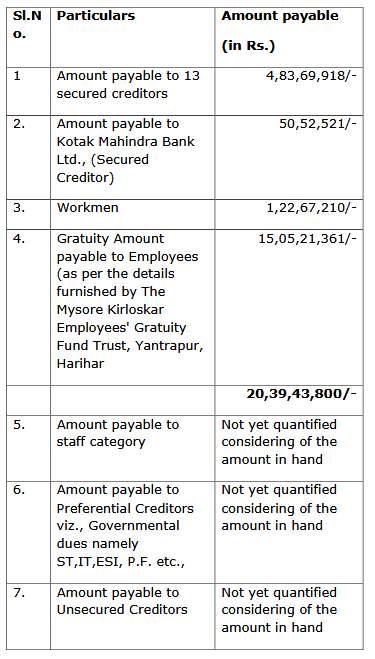
30. It has been submitted that the lease deed was entered on 22.01.2000 when the Company in liquidation was facing all financial issues and just before winding-up petition was filed by the creditors on 14.03.2000. It is evident that after the statutory notice of winding-up was issued by the creditors to the Company, the said lease deed was entered into on 22.01.2000. The KIAMS has been paying partly sum of Rs.1,250 per month as rental for last 24 years for use of the vast extent of valuable land and the properties situated thereon. It is further submitted that there is an inconsistency in clause 5 and 19 of the lease agreement. Whereas the clause 5 of the lease deed provides that the lessee shall deliver the scheduled premises to the lessor on expiry of the lease or on its earlier determination thereof in good condition, clause 19 of the lease deed provides for conveying of the scheduled premises to the KIAMS on expiry of the term of lease (28 years).
31. It is submitted that the said property is custodia legis and the Official Liquidator has stepped into the shoes of the management of the Company, therefore, the Official Liquidator has become the lessor of the property. Once the official liquidator has terminated the lease, the clause 19 would not be operational. Learned counsel for the official liquidator has placed reliance on the judgment of Delhi High Court in SUNIL KUMAR CHANDRA VS. SPIRE TECHPARK PRIVATE LIMITED (2023) SCC OnLine del 286 to say that where there is inconsistency between two clauses in an agreement, the former clause would have precedence over the latter clause. The Delhi High Court has placed reliance on the judgment of the Supreme Court in the case of RAMKISHORE LAL VS. KAMALNARAYAN (1962) SCC OnLine SC 113 wherein it has observed as follows:
"12. The golden Rule of construction, it has been said, is to ascertain the intention of the parties to the instrument after considering all the words, in their ordinary, natural sense. To ascertain this intention the Court had to consider the relevant portion of the document as a whole and also to take into account the circumstances under which the particular words were used. Very often the status and the training of the parties using the words have to be taken into consideration. It has to be borne in mind that very many words are used in more than one sense and that sense differs in different circumstances. Again, even where a particular word has to a trained conveyancer a clear and definite significance and one can be sure about the sense in which such conveyancer would use it, it may not be reasonable and proper to give the same strict interpretation of the word when used by one who is not so equally skilled in the art of convincing. Sometimes it happens in the case of documents as regards disposition of properties, whether they are testamentary or non- testamentary instruments, that there is a clear conflict between what is said in one part of the document and in another. A familiar instance of this is where in an earlier part of the document some property is given absolutely to one person but later on, other directions about the same property are given which conflict with and take away from the absolute title given in the earlier portion. What is to be done where this happens? It is well settled that in case of such a conflict the earlier disposition of absolute title should prevail and the later directions of disposition should be disregarded as unsuccessful attempts to restrict the title already given. (See Sahebzada Mohd. Kamgar Shah v. Jagdish Chandra Deo Dhabal Deo) [(1960)(3) SCR 604 at p. 611] . It is clear, however, that an attempt should always be made to read the two parts of the document harmoniously, if possible; it is only when this is not possible, e.g., where an absolute title is given is in clear and unambiguous terms and the later provisions trench on the same, that the later provisions have to be held to be void."
32. It is further submitted that dismissal of the Company Application No.188/2005, vide impugned order dated 30.09.2008 on the ground of limitation is incorrect and against the provisions of the law. The Learned Company Judge has not considered the fact that the lease deed was nothing but a bogus, sham and fraudulent act of the ex- management in conveying the valuable properties of several crores to the related party for pittiance and therefore, the lease deed was nothing but a fraudulent act against the interests of the shareholders, creditors, members, workers and the public interest, the said lease deed was void for all purposes and not only against the official liquidator. By mentioning a wrong provision in the application i.e., Section 531A, the void transaction would not become voidable. It is therefore, submitted that the said lease deed was neither in any commercial prudence or at arm's length not in the ordinary course of the business of the company, and therefore, the learned Company Court ought not to have dismissed the petition on the ground of delay.
Submissions on behalf of the Respondent:
33. On the other hand, Mr. K.G. Raghavan, learned Senior Counsel for KIAMS has submitted that under Section 531, the transfer of movable or immovable property of the Company within one year before the presentation of the petition is void against liquidator, if the transfer of the property by a Company was not made in ordinary course of its business, and if the transfer was not made in good faith for valuable consideration. He has placed reliance on judgment in VIRENDRA SINGH BHANDARI VERSUS NANDLAL BHANDARI AND SONS P. LTD. (2019) SCC OnLine MP 6437 and K.N. NARAYANA IYER VERSUS COMMISSIONER OF INCOME TAX (1992) SCC OnLine Ker 436.
34. As the transaction of lease could be said to be voidable, the limitation for seeking the relief of declaration under Article 58 of the Limitation Act, 1963, is three years from the date of the cause of action which would be execution of the document in respect of which declaration is sought. In addition, under Section 458A of the Companies Act, the benefit extended to the Companies in liquidation while computing the period of limitation in respect of any suit or application in the name and on behalf of the Company which is being wound up by the Company Court is the period from the date of commencement of the winding up of the Company to the date on which the winding up order is made (both inclusive) and a period of one year immediately thereafter stands excluded. Thus, the period between 14.03.2000 which is the commencement of the winding-up proceedings and 01.04.2004 the date on which the winding-up order came to be passed and a further period of one year thereon is excluded. Thus, the exclusion period would be 5 years and 15 days. The application was filed on 27.07.2011 by the official liquidator whereas the limitation as provided under Section 58 of the Limitation Act read with Section 458A of the Companies Act got expired on 04.04.2008. Therefore, the Company Court was right in holding that the application was barred by limitation.
35. Learned Senior Counsel has further submitted that the transfer of the assets by the lease deed was not per se void but void against the liquidator as mentioned in Section 531A of the Companies Act. In support of his submission the learned counsel for the respondent has placed reliance on the following judgments
i. RM. NL. Ramaswami Chettiar & Ors. Vs. Official Receiver, Ramanathapuram at Madurai & Ors. 1959 SCC Online SC 166.
ii. Johri Lal Soni Vs. Smt. Bhanwari Bai (1977) 4 SCC 59.
iii. Pankaj Mehra & Anr. Vs. State of Maharashtra & Ors. (2000) 2 SCC 756.
Analysis and Conclusion:
36. Section 531 provides that any transfer of property whether movable or immovable etc., by the Company within 6 months before the commencement of its winding- up which, had it been made, shall be in the event of Company being wound up, be deemed a fraudulent preference of its creditors and be invalid accordingly.
37. Section 531 of the Companies Act reads as under:
"531. FRAUDULENT PREFERENCE (1) Any transfer of property, movable or immovable, delivery of goods, payment, execution or other act relating to property made, taken or done by or against a company within six months before the commencement of its winding up which, had it been made, taken or done by or against an individual within three months before the presentation of an insolvency petition on which he is adjudged insolvent, would be deemed in his insolvency a fraudulent preference, shall in the event of the company being wound up, be deemed a fraudulent preference of its creditors and be invalid accordingly:
Provided that, in relation to things made, taken or done before the commencement of this Act, this sub- section shall have effect with the substitution, for the reference to six months, of a reference to three months.
(2) For the purposes of sub-section (1), the presentation of a petition for winding up in the case of a winding up by [the Tribunal], and the passing of a resolution for winding up in the case of a voluntary winding up, shall be deemed to correspond to the act of insolvency in the case of an individual.
38. Section 532 provides that any transfer by a Company of all its property to trustees or to the benefit of all its creditors shall be void.
39. Section 531A comes in between Section 531 and 532 which provides that any transfer of property, movable or immovable, or any delivery of goods, made by a company, not being a transfer or delivery made in the ordinary course of its business or in favour of a purchaser or encumbrancer in good faith and for valuable consideration, if made within a period of one year before the presentation of a petition for winding up shall be void against the liquidator.
40. Section 531 is not in the respect of void transactions which are mentioned in Section 531A. The transactions in Section 531 are a distinct category other than the transactions made in Section 531A. The void transactions under Section 531 are void from the very inception that is void ab initio. Whereas under Section 531A, the transactions are to be made in good faith for valuable consideration but if they are not in the ordinary course of its business and made within a period of one year before the presentation of the petition for winding up would be void against the liquidator.
41. Therefore, we are of the opinion that by merely mentioning Section 531A in the application filed by the official liquidator i.e., CA No. 826/2011, it would not change the nature of the transaction which was void ab initio. Under Section 531 of the Companies Act, as the transfer of the valuable assets of the company was effected within less than two months before the filing of the winding up petition and it was a fraud on its creditors, therefore, void ab initio.
42. Section 533 provides for liability and rights of certain fraudulently preferred persons. Section 533 of the Companies Act, 1956 reads as under:
"533. Liabilities And Rights Of Certain Fraudulently Preferred Persons
(1) Where, in the case of a company which is being wound up, anything made, taken or done after the commencement of this Act is invalid under section 531 as a fraudulent preference of a person interested in property mortgaged or charged to secure the company's debt, then (without prejudice to any rights or liabilities arising apart from this provision), the person preferred shall be subject to the same liabilities, and shall have the same rights, as if he had undertaken to be personally liable as surety for the debt, to the extent of the mortgage or charge on the property or the value of his interest, whichever is less.
(2) The value of the said person's interest shall be determined as at the date of the transaction constituting the fraudulent preference, and shall be determined as if the interest were free of all encumbrances other than those to which the mortgage or charge for the company's debt was then subject.
(3) On any application made to the[Tribunal] with respect to any payment on the ground that the payment was a fraudulent preference of a surety or guarantor, the 1[Tribunal] shall have jurisdiction to determine any questions with respect to the payment arising between the person to whom the payment was made and the surety or guarantor and to grant relief in respect thereof, notwithstanding that it is not necessary so to do for the purposes of the winding up, and for that purpose may give leave to bring in the surety or guarantor as a third party as in the case of a suit for the recovery of the sum paid."
43. Section 533 does not speak about the transaction under Section 531A.
44. As noted above, the learned Company Judge vide a detailed order dated 14.07.2011 in Company Application No.237/2011 in Company Petition No.166/2001 observed that if the transaction is tainted with an element of dishonesty, the question of fraud would arise. The KIAMS is to grab 6 acres 39 guntas of land and the properties thereon. It was also held that on the date of the order, the market value of the land itself was valued at Rs.1 Crore per acre. The lease deed was not a genuine transfer. The lease deed also appears to be contrary to Section 531 of the Act and the transaction between the lessor and lessee was tainted with element of dishonesty and fraud on its creditors.
45. Considering the aforesaid facts, we are of the considered view that the lease deed was nothing but fraudulent and dishonest act on behalf of the ex- management of the Company in liquidation to transfer the valuable property of several crores against the interest of the company, its shareholders, creditors, workmen and members and therefore, it is a void transaction from the very inception. The application filed by the official liquidator was to take possession of the property and put the same for auction for making payment of the creditors. The said application has been rejected only on the ground of limitation as the transaction was said to be covered under Section 531A.
46. We, therefore, hold that the view taken by the learned Single Judge is erroneous one and cannot be sustained. The transaction between the Company in liquidation and the KIAMS is not at arm's length but to a related party and that too against the interest of the Company, its creditors, shareholders etc., valuable properties of several crores has been sought to be given for pittance to the related party just before presentation of the winding up petition. The lease deed is nothing but sham, bogus and fraudulent transaction in transferring the valuable assets in favour of the KIAMS, a related party.
47. Accordingly, we proceed to pass the following:
ORDER
i. The appeal is allowed.
ii. The impugned judgment and order dated 21.07.2015 in C.A.No.826/2011 in COP No.166/2001 is set aside.
iii. The Official Liquidator is directed to take possession of the property in question and put the same for public auction to realize the fair market value in a transparent manner for making payment to the creditors as mentioned above.
iv. The respondent may also participate in public auction proceedings, if they so desire.
v. The respondent is liable to pay the market rent of the assets in its possession from the date of the lease deed till the possession is taken over by the official liquidator for which the approved valuer to assess the market rent of the assets in question.
|
| |

