



Om Prakash Shukla, J.
Facilitative Index to the Judgment
| S. No. | Particulars | Page Nos. |
| 1. | Introduction | 2 |
| 2. | Prelude to the Dispute | 5 |
| 3. | Proceedings Before the Learned Single Judge | 9 |
| 4. | Reply to Interim Application | 11 |
| 5. | Impugned Order | 14 |
| 6. | Proceedings Before This Court | 20 |
| 7. | Submission of Appellant | 20 |
| 8. | Submission of Respondent | 25 |
| 9. | Analysis | 33 |
| 10. | Conclusion | 68 |
1. The present appeal is preferred under Section 13(1) of the Commercial Courts Act, 2015, read with Order XLIII Rule 1(r) and Section 151 of the Code of Civil Procedure, 1908 ("CPC" hereinafter), assailing the judgment dated 18.07.2023 passed by the learned Single Judge in I.A. No. 14842/2021 in CS (COMM) 573 of 2021, whereby the application filed by the Respondent/Plaintiff under Order XXXIX Rule 1 & 2 CPC seeking an interim injunction on the ground of alleged infringement of Indian Patent No. 360726 ("Suit Patent") was allowed.
2. For the sake of convenience and consistency, the parties to the present appeal shall be referred to by the same nomenclature as adopted before the learned Single Judge. Accordingly, the Appellant shall be referred to as "Defendant", and the Respondent No.1 as "Plaintiff" and so on and so forth unless the context otherwise requires.
3. The plaintiff, RxPrism Health Systems Private Limited, claims to be a startup company registered under Companies Act, 1956 engaged in providing technology products for social selling and social commerce to business organization for digital customer engagement. Plaintiff asserts ownership of Indian Patent No. 'IN360726' titled "A system and a method for creating and sharing interactive content rapidly anywhere and anytime" ("Suit Patent" hereinafter).
4. Defendant No. 1, Canva Pvt Ltd., is an Australian technology company operating a globally used online design and content-creation platform under the brand name "Canva". The dispute in the present proceedings arises from the Plaintiff's allegation that Canva's feature titled "Present and Record" infringes the Suit Patent by enabling users to create presentations containing a video overlay, along with certain interactive elements.
5. By the impugned judgment, the learned Single Judge has recorded a prima facie finding that Defendant's "Present and Record" feature infringes the Suit Patent and consequently granted an interim injunction restraining the Defendant from using the impugned feature in India and inter alia directed :
"92. In view of the above discussion, the Defendant shall stand restrained from making available their Canva product with the 'Present and Record' feature, which infringes the Plaintiff's Suit Patent being IN360726 or use any other feature that would result in infringement of the Plaintiff's patent IN360726.
93. This Court also notices that the Defendant No. I is an Australian company and the Defendant Nos.2 & 3 are the senior officials in the said company. The Defendant has no assets in India and also do not have physical business in India. Accordingly, considering the revenue and sales figures of the users who have used the 'Present and Record' feature in India at least once as per the Defendant themselves, till 30th June, 2022 the Defendant No.I- Canva Pvt. Ltd is directed to deposit a sum of Rs. 50 lakhs with the Registrar General of this Court, which shall be kept in the form of a FDR, as a security for the Plaintiff's claims for past use of the infringing feature in India.
94. In the facts and circumstances of this case and bearing in mind the language used in the written statement against the Plaintiff, costs of Rs. 5 lakh is awarded in favour of the Plaintiff- Rxprism Health Systems Pvt. Ltd "
6. Aggrieved by the said impugned judgment and order, the Defendant has preferred the present appeal seeking the following reliefs:
"a) Set aside the Impugned Judgement dated 18 July 2023 passed by the Hon'ble Single Judge in I.A. No. 14842 of 2021 in C. S. (Comm) No.573 of 2021;
b) Award costs in favour of the Appellants / Defendants; and
c) Grant any other reliefs which this Hon'ble Court may deem fit in the light of facts and circumstances of the instant case and in the interest of justice and equity."
7. The Defendant submits that the learned Single Judge has erred in law and on facts by misconstruing the essential claims of the Suit Patent, misapplying settled principles of claim construction under Indian patent jurisprudence, ignoring material prior art, and failing to appreciate that the Defendant's feature does not embody the essential three-layer architecture claimed by the Plaintiff.
PRELUDE TO THE DISPUTE
8. The dispute traces its origin to the Plaintiffs' development of a digital content-creation technology titled "A system and a method for creating and sharing Interactive Content Rapidly Anywhere and Anytime." The Plaintiff filed the corresponding patent application on 19.12.2018, and Indian Patent No. IN 360726 ("IN'726") was granted on 10.03.2021.
9. The Plaintiff asserts that even prior to the grant of the patent, it had commercially deployed the claimed invention through their product "My Show & Tell," which was launched in May 2020. According to the Plaintiff, this product embodies the patented system and method for creating and sharing interactive content rapidly, anywhere and anytime.
10. In essence, the Plaintiffs' claimed invention pertains to a system that enables users to quickly create and share interactive multimedia presentations comprising synchronized layers of media. The system allegedly operates as follows: (i) A first user, using a computing device equipped with a processor, memory, display, camera, microphone, and media library, presents first media such as images, slides, videos, text, animations, graphics, or polls as background content; (ii) Simultaneously, the user records second media i.e., their own audio and/or video explanation, which appears as a smaller, movable overlay window in the foreground; (iii) An authoring module provides tools to record, arrange, and configure the presentation, while a player module allows viewers to watch and interact with the content; (iv) The created content is stored as a network resource and published via a shareable URL, making it accessible on any device through a communication network; (v) During playback, viewers can pause the content, navigate through background slides, and jump to corresponding points in the audio/video timeline, thereby creating a more interactive than a conventional linear video.
11. The Defendant, which operates the globally popular Canva platform, introduced a feature titled "Present and Record" on 27.08.2020. This feature enables users to record themselves while presenting visual slides and to generate a synchronised composite presentation. The feature gained significant traction during the COVID- 19 pandemic owing to the increased reliance on digital communication tools for professional, educational, and commercial purposes.
12. For ease of reference and comparison, the interfaces of the Plaintiff's and the Defendant's "Present and Record" feature is presented below:
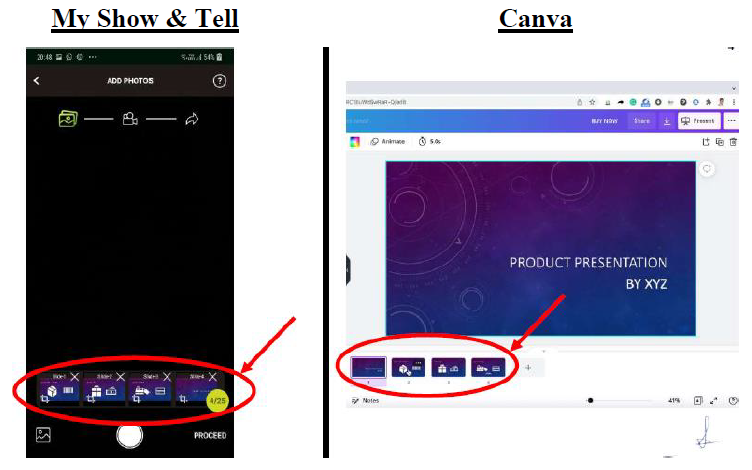
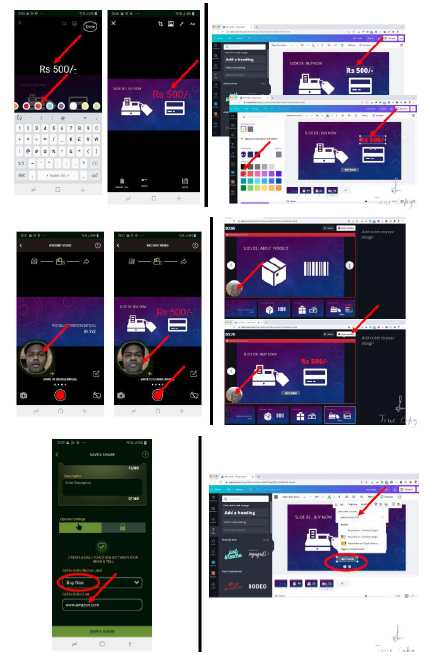

13. According to the Plaintiff, it first became aware of the Defendants' "Present and Record" feature in June 2021. Upon discovery, the Plaintiff conducted a technical analysis of the feature which, in its assessment, revealed that the feature allegedly embodied the essential elements of the Suit Patent.
14. The Plaintiff thereafter initiated communications with the Defendant, over a period of approximately two and a half months. During these communications, the Plaintiff claims to have: (i) Shared details of its patent; (ii) Furnished claim-mapping charts; (iii) Explained the alleged technical overlap; and (iv) Offered the Defendant a commercial licence for use of the patented technology. The Plaintiff further asserts that it responded to all information requests made by the Defendant in good faith, with the expectation of resolving the matter amicably through commercial negotiations.
15. However, the Plaintiff alleges that despite these efforts, Defendant continued to commercially exploit the impugned "Present and Record" feature in India without obtaining a license under the Suit Patent. The Plaintiff formed the view that an amicable commercial resolution was no longer possible.
16. In these circumstances following the grant of the patent, the launch of the competing feature, the discovery of the alleged infringement, and the failure of licensing discussions, the Plaintiff instituted the present suit before the learned Single Judge, seeking injunctive relief and other remedies under the Patents Act, 1970 ("Patents Act" hereinafter) and the CPC.
PROCEEDINGS BEFORE THE LEARNED SINGLE JUDGE
17. The Plaintiff instituted a commercial civil suit bearing CS(COMM) No. 573/2021, along with an application under Order XXXIX Rule 1 & 2 of the CPC, seeking urgent interim relief in the nature of a decree of permanent and mandatory injunction. The Plaintiff prayed, inter alia, for restraining the Defendant, their directors, officers, agents, affiliates, and all persons acting on their behalf from infringing Indian Patent No. IN 360726 ("IN'726"). It was specifically pleaded that the Defendant's software feature titled "Present and Record", available on the Canva platform, amounting to making, using, offering for sale, selling, and advertising the patented invention within the territory of India, in contravention of the exclusive rights conferred upon the Plaintiff under Section 48 of the Patents Act.
18. The Plaintiff asserted that they had successfully commercialized the patented invention through their proprietary product "My Show & Tell" in May 2020. The product was stated to be fully based on the claims of IN'726 and designed to enable users, particularly in the domain of sales, education, and corporate communication, to create rapid, interactive, and multimedia-rich presentations. The Plaintiff contended that the Defendant's "Present and Record" feature mirrored their patented architecture in all material aspects and performed each step, employed each module, and implemented each functional element claimed in the Suit Patent. It was alleged that the impugned feature reproduced the essential technical components of the invention, thereby constituting a direct and literal infringement under Indian Patent Law.
19. The Plaintiff sought to distinguish their invention from existing prior art systems such as Microsoft PowerPoint 2016, Loom, Auto Auditorium, and various asynchronous lecture tools. It was pleaded that while such platforms/ prior art offered conventional presentation or recording functionalities, none of them disclosed or taught: A layered, interactive presentation structure; an integrated authoring workflow, or the use of configurable Call-to-Action ("CTA" hereinafter) elements embedded within a multi-layered presentation environment, as specifically claimed in IN'726. The Plaintiff further contended that the Defendant's reliance on combinations of multiple prior art references amounted to impermissible "mosaicing", which is prohibited under Indian patent law.
20. Hence, the Plaintiff sought a decree of permanent injunction restraining the Defendant their associates, and all persons acting under their authority from making, using, manufacturing, offering for sale, selling, importing, or advertising the impugned technology known as the "Present and Record" feature of Canva, along with ancillary reliefs.
REPLY TO INTERIM APPLICATION
21. The Defendant in their reply to the interim application, strongly opposed the grant of any ad interim or interim injunction. They raised both preliminary objections to the maintainability of the suit and substantive objections to the allegation of patent infringement.
22. At the threshold, the Defendant contended that the present suit was premature and not maintainable, since the Suit Patent bearing No. IN 360726 had been granted only on 10 March 2021, and the statutory period for filing post-grant opposition under Section 25(2) of the Patents Act had not expired when the suit was instituted.
23. It was submitted that patent rights do not crystallise conclusively until the expiry of the post-grant opposition period or the adjudication of any opposition proceedings. Therefore, according to the Defendant, no infringement action, and certainly no interlocutory relief, could be entertained during this interregnum. The Defendant further argued that there is no presumption of validity attached to a patent merely upon grant under the Patents Act, and registration alone does not entitle the patentee to injunctive relief.
24. The Defendant emphasized that Courts in India have consistently exercised caution in granting interim injunctions in respect of recently granted and untested patents, particularly when the patent is less than one year old and its validity is under serious challenge. They submitted that such patents have not yet stood the test of time through opposition proceedings.
25. It was also contended that the Suit Patent had not been commercially worked in India. According to the Defendant, the Plaintiff, had failed to place any cogent evidence of sales, licensing, or commercial working of the patented invention. The reliance on the "My Show & Tell" application was disputed on the ground that the said application was allegedly non-functional during the relevant period, thereby undermining the Plaintiff's claim of working of the patent.
26. On merits, the Defendant submitted that the Plaintiff failed to establish a prima facie case of infringement. It was argued that infringement under Patent law requires strict satisfaction of the "all- elements" or "all-limitations" test, and the absence of even a single essential claim element is fatal to an infringement claim. Several essential limitations of Claim 1 (and consequently Claim 39) of the Suit Patent were alleged to be missing in Canva's "Present and Record" feature, particularly the "communication module" and the "CTA user interface".
27. A specific objection was taken to the Plaintiff' interpretation of the "CTA user interface". According to the Defendant, the patent contemplated a distinct, system-configured interface, whereas in Canva, any CTA element was merely user-generated content embedded within the presentation itself. Such hyperlinks or text, they argued, could not be equated with the claimed interface, and therefore no infringement arises.
28. Without prejudice, the Defendant raised a credible challenge to the validity of the Suit Patent under Section 64 of the Patents Act. It was argued that the alleged invention lacked inventive step and technical advancement, being obvious in light of prior art such as US 2008/0126943 (Parasnis), US 2014/0123014, and US 2011/0161834. According to the Defendant, features like synchronised slide playback, audio-video integration, layered presentations, and bandwidth optimisation were already known.
29. On these grounds, the Defendant contended that the Plaintiff failed to satisfy the triple test of prima facie case, balance of convenience, and irreparable injury, and that granting an interim injunction would cause grave prejudice to the Defendant by conferring an unwarranted monopoly over a vulnerable patent. Accordingly, the defendants pray for dismissal of the application for interim injunction.
IMPUGNED ORDER
30. The learned Single Judge commenced by outlining the statutory framework governing interim injunctions in patent matters. It was emphasized that once a patent has been examined and granted, the patentee enjoys statutory exclusivity under Section 48 of the Patents Act, unless the Defendant demonstrates a credible and compelling challenge to validity or a fundamental defect in the infringement case.
31. The Court reiterated that at the interim stage, the inquiry is not into final validity or infringement, but whether the Plaintiff has made out a prima facie case, and whether the balance of convenience and irreparable harm favours protection. The Court noted that software and technology patents require careful claim construction informed by the specification, expert testimony, and functional mapping.
32. The learned Single Judge, thereafter, proceeded to examine the construction of the Suit Claim (IN 360726). Adopting a purposive and holistic approach to claim interpretation, as mandated under Indian Patent law, the Court analysed the complete specification and held that the invention did not merely relate to a "computer program per se" but instead disclosed a comprehensive technical system architecture comprising three distinct functional layers, namely: (i) a first media layer consisting of presentation slides or static visual content, (ii) a second media layer comprising audio and/or video recording, and (iii) a third 'sandwiched' or CTA layer enabling interactive features such as sharing, navigation, and editing flexibility.
33. Accepting the Plaintiff's submissions, the Court held that the aforesaid three layers constituted the "essential and inventive features" of Claim 1. The dependent claims further specified technical functionalities such as server-side processing, client-side rendering, movable picture-in-picture ("PiP" hereinafter) video, and inclusion of CTA elements. Relying on the principles laid down in F. Hoffmann -La Roche v. Cipla ([2016 (65) PTC 1 (Del))) , the learned Single Judge reiterated that for a prima facie finding of infringement, it is not necessary that every minor or peripheral element of the patented invention be identically reproduced. What is determinative is whether the substance of the essential features of the patented invention has been appropriated by the Defendant as laid down in F. Hoffmann Hoffmann -La Roche (supra) and Raj Parkash v. Mangat Ram Chowdhury (AIR 1978 Delhi 1).
34. The learned Single Judge undertook a detailed comparison of the Suit Patent claims and the Defendant's "Present & Record" feature on Canva. On the basis of the Plaintiff's claim charts, functional screen- recordings, and demonstrative presentations, the Court noted that Defendant's Canva feature allowed users to upload slides, record a PiP video overlay, integrate interactive CTA elements such as share buttons, navigation tools, and generate a cloud hosted link enabling subsequent review and editing. These features, the Court found, reproduced the layered multimedia architecture claimed in the Suit Patent in functional and operational terms.
35. The Defendant contended that Canva did not use three independent layers as contemplated by the patent. It was argued that CTA elements were embedded within the slide environment (Media 1) itself rather than a separate sandwiched layer, that PiP movement was browser dependent, and that Canva did not allow the same degree of decoupled editing described in the patent. The learned Single Judge, however, rejected these submissions as being mere tactical distinctions. The Court reiterated the settled principle that "slight variations in implementation do not absolve infringement" where the core inventive concept has been adopted in substance.
36. The Court placed particular reliance on the Plaintiff's evidence demonstrating that Canva permitted independent modification of slides after recording and that its server-side storage of audio-video and slide content facilitated layered editing. The demonstrative evidence was found persuasive in establishing that Canva's system "superimposes interactive elements over the dual-media composite," which the Court considered a defining hallmark of the patented invention.
37. A substantial portion of the impugned judgment dealt with the expert evidence adduced by both sides. The Defendant relied upon two reports of Dr. Benjamin Bederson, a human-computer interaction specialist, who opined that Canva did not practice "several essential elements" of the Suit Patent. However, the Court highlighted that even Dr. Bederson, acknowledged the presence of several overlapping elements such as the PiP overlays, user-interface integration, and composite rendering architecture.
38. In contrast, the Plaintiff's expert, Dr. Vivek Kapoor, provided a comprehensive claim-by-claim mapping of Canva's functionalities to the patented features. He explained that the layered architecture existed in Canva's system even if implemented through a different code structure. The learned Single Judge found this explanation consistent with the Plaintiff's demonstrative evidence.
39. The Court clarified that at the interim stage, it is not required to conduct a full-scale claim construction or resolve expert disputes conclusively. The relevant inquiry is whether the Plaintiff's expert evidence is sufficiently credible and coherent to establish a prima facie case. The Court held that the Plaintiff met this burden, while the Defendant reports failed to effectively neutralise the apparent overlap between the two systems.
40. The learned Single Judge also took note of the Defendant's earlier PCT application (PCT/AU2021/050502), which disclosed a system closely resembling Canva's "Present & Record" feature. The application contained diagrams and descriptions reflecting a layered interaction architecture similar to that of the Plaintiff's patent.
41. Although the Defendant subsequently abandoned the PCT application, the Court observed that such abandonment, while not conclusive of infringement, raised serious doubts about the Defendant's claim that their system is fundamentally different. The Court described this inconsistency as a "complete somersault" over the Defendant's stance, thereby strengthening the Plaintiff's prima facie case.
42. The Defendant relied on prior art such as Microsoft PowerPoint 2016, Loom, Auto Auditorium, and academic works, and also challenged the patent on grounds of Section 3(k) of the Patents Act, insufficiency, lack of clarity, and obviousness.
43. The learned Single Judge reiterated that for invalidity to defeat interim relief, it must be clear, immediate, and compelling. The Court held that while the cited prior art disclosed individual elements like slide presentations, screen/wall recording, or PiP features, none showed the integrated sandwiched architecture with CTA layer enabling server- side compositing and independent editing. Hence, the validity challenge was found to be arguable but not "so strong as to defeat interim protection" or the statutory presumption of validity.
44. The Court further noted that the Defendant's post-grant opposition to the Plaintiff's patent in which recommendations of the Opposition Board have been published and the same was stated to be in favour of the Plaintiff but since the proceedings in the Opposition was pending before the Patent Office, the learned Single Judge refrained to pre-empt the administrative process or from commenting on the conclusions of the Opposition Board.
45. While Canva submitted an affidavit detailing relatively low usage of the "Present & Record" feature in India, the Court held that infringement is not a matter of volume. Even limited unauthorized use can distort market expectations, erode licensing potential, and impair the patentee's competitive advantage.
46. To balance equities, the Court directed the Defendant to deposit Rs.50 lakhs as security for past acts and imposed costs of Rs. 5 lakhs on account of the language used by the Defendant in their pleadings.
47. Relying on Merck Sharp and Dohme Corporation v. Glenmark Pharmaceuticals (2015 SCC OnLine Del 8227), the learned Single Judge emphasized that interim injunctions serve to preserve the patentee's monopoly and prevent irreversible market distortion. Allowing the Defendant continued use of the infringing feature would risk entrenching market expectations, depressing licensing prospects, and conferring an unfair price advantage, a harm not easily compensable by damages.
48. Consequently, the Court held that:
(i) there exists a strong prima facie case of infringement;
(ii) the balance of convenience lies in restraining Canva and in favour of the Plaintiff; and
(iii) denial of injunction would cause irreparable harm to the plaintiff.
The Court therefore restrained Defendant Canva from making the "Present & Record" feature available in India pending trial.
PROCEEDINGS BEFORE THIS COURT
APPELLANT/ DEFENDANT'S SUBMISSIONS
49. Mr. Saikrishna Rajagopal, learned Counsel for the Defendant submitted that the impugned interim injunction was granted in patent disregard of settled principles governing interlocutory relief. The learned Single Judge failed to apply the correct tests for infringement, misconstrued essential claim features, and inadequately assessed serious validity challenges. In such circumstances, appellate interference is clearly warranted in terms of Wander Ltd. v. Antox India P. Ltd. (1990 Supp SCC 727.), which permits intervention where discretion is exercised on erroneous legal principles, irrelevant considerations, or non- application of mind.
50. Learned Counsel in his usual erudite manner, has submitted that the linchpin and core inventive concept of the Suit Patent IN'726 is a three-layered architecture, enabling modification of slides without affecting the underlying video or the CTA. The Plaintiff themselves consistently asserted this three-layer structure as the basis of novelty, inventive step, and infringement, including in their Replication. The learned Single Judge also acknowledged this structure as the foundation of the invention.
51. The learned Counsel further submitted that the Canva's "Present and Record" feature does not contain any independent third or sandwiched CTA layer. The alleged CTA in Canva is merely formatted or hyperlinked text embedded directly within the slide content itself. When slide is deleted, the CTA is also deleted, conclusively demonstrating that no independent CTA layer exists. This is fatal to infringement.
52. Despite expressly recording the absence of the sandwiched layer, the learned Single Judge held in paragraph 68 of the impugned judgment that "mere non-existence of a sandwich layer would not obviate infringement" on the ground that the functionality of both products is "almost identical". The learned Counsel contended that this approach is legally impermissible. Patent infringement is determined by element-by-element comparison, not by overall functional resemblance. The absence of even one essential claim feature is fatal to infringement.
53. The Learned Counsel has strenuously sought to highlight that the Plaintiff themselves identified seven essential inventive features of the Suit Patent in their Replication. These were adopted by the learned Single Judge as the benchmark for infringement analysis. Of these seven features, four are admittedly absent in the impugned Canva's product. Despite this, infringement was still found, contrary to settled law.
54. It was submitted that the Suit Patent expressly defines the PiP insert window as "movable" through haptic interaction. Canva's PiP is not movable within the system; any perceived movement relied upon by the Plaintiff arose solely from browser-level functionality, not from Canva's architecture. Nevertheless, the learned Single Judge held in paragraph 66 that movability is irrelevant and not an essential feature. The Defendant contended that this finding violates the doctrine of patent lexicography, under which express definitions in the specification govern claim interpretation.
55. Reliance was placed on Phillips v. AWH Corp (415 F.3d 1303 (Fed. Cir. 2005))., CCS Fitness Inc. v. Brunswick Corp. (288 F.3d 1359 (Fed. Cir. 2002)), and Thorner v. Sony Computer Entertainment America LLC (669 F.3d 1362 (Fed. Cir. 2012)), which establish that courts cannot ignore express definitional limitations provided by the patentee in the patent specification.
56. With regard to Feature C7- CTA Display, it was contended that Feature C7 requires that the CTA is enabled and displayed only during rendering and playback, not during the authoring stage. In Canva, however, the hyperlink or CTA is fully enabled and visible to the author during creation itself. This is a direct deviation from the claim requirement.
57. The learned Counsel also submitted that the learned Single Judge failed to undertake the mandatory first step of claim construction, as held by the Division Bench of this Court in F. Hoffmann-La Roche Ltd.(supra). Merely referring to the principle in paragraph 59 without actually construing to the claim renders the infringement analysis legally unsustainable.
58. Although acknowledging that infringement must be determined by a claim-to-product comparison, the learned Single Judge repeatedly compared Canva's feature with the Plaintiff's product "My Show & Tell", This constitutes a foundational legal error, as infringement can only be assessed by mapping the claims to the accused product.
59. This error extended to the validity assessment. Prior art such as Microsoft PowerPoint 2016 was compared to the Plaintiff's product rather than to the claims. Paragraph 76 wrongly concludes that MS PowerPoint cannot be equated with the Plaintiff's product.
60. The learned Counsel for defendant has emphatically tried to drive home the point that the learned Single Judge reduced the Doctrine of Equivalents to a test of "same effect", ignoring the mandatory function- way-result analysis. Although Sotefin SA v. Indraprashtha Cancer Society (2022:DHC:595) was cited, the "way" prong was omitted. FMC Corporation v. Natco Pharma Ltd (2022/DHC/005311) makes it clear that similarity of result alone is insufficient.
61. Learned Counsel further placed reliance on Rodi and Wienenberger A.G. v. Henry Showell Ltd. 1966 RPC 441 which holds that similarity in idea or functionality does not justify infringement. The learned Single Judge's reliance on "almost identical effect" impermissibly expands the doctrine to cover overall functional similarity.
62. Further the learned Counsel invoked the settled principle that patentees cannot adopt narrow claim construction for validity and broad construction for infringement. This violates the quid pro quo of patent law. Claims must be interpreted consistently.
63. Reliance was placed on Vifor (International) Ltd. v. MSN Laboratories Pvt. Ltd. 2024:DHC:878-DB, Novartis AG v. Union of India (2013) 6 SCC 1,, and Raj Parkash v. M.R. Chowdhry AIR 1978 Delhi 1, to show that the impugned judgment adopted inconsistent claim constructions for validity and infringement.
64. It was contended that the learned Single Judge erroneously applied a novelty test instead of the correct inventive step analysis by requiring all features to be disclosed in a single prior art reference and refusing to mosaic multiple prior arts such as Auto Auditorium, Loom, and MS PowerPoint 2016.
65. The Defendant's entire non-infringement case rested on the settled principle that absence of even one essential element negates infringement.
66. Learned Counsel further laid emphasis on the alleged fundamental contradiction that if the claimed "modules" are interpreted as hardware devices (as asserted by the Plaintiff before the Patent Office in response to the FER), then Canva's software feature cannot infringe. If construed as software, the Suit Patent is invalid under Section 3(k) of the Patents Act. The Plaintiff cannot approbate and reprobate.
67. It was also contended that the inference in paragraph 87 of the impugned judgment by the learned Single Judge regarding alleged abandonment of the PCT application is erroneous and irrelevant. The PCT was not abandoned, and in any event, PCT status has no bearing on infringement analysis.
68. The learned Counsel also submitted that the direction to deposit Rs. 50 lakhs is disproportionate, unsupported by pleadings, and lacks empirical basis, especially when the learned Single Judge recorded that usage of the impugned feature was substantially low.
69. Finally, it was submitted that the learned Single Judge mechanically recorded findings on the triple test in paragraph 91 without any substantive analysis of irreparable harm, balance of convenience, or inadequacy of damages contrary to the principles in Wander Ltd.(supra).
RESPONDENTS/ PLAINTIFF'S SUBMISSION
70. Per Contra, Ms. Swathi Sukumar, learned Senior Counsel for the Plaintiff submitted that the appeal is founded on a selective, distorted, and internally inconsistent reading of the record. It was contended that the Defendant have failed to demonstrate any perversity, manifest illegality, or jurisdictional error in the impugned judgment that would justify appellate interference.
71. The learned Senior Counsel submitted that the impugned judgment was passed in the exercise of discretionary jurisdiction under Order XXXIX Rules 1 and 2 of the CPC. Consequently, the scope of appellate review is extremely limited. Reliance was placed on the settled principle laid down in Wander Ltd. (supra), that interference is permissible only where discretion has been exercised arbitrarily, capriciously, perversely, or in disregard of settled principles of law.
72. Further reliance was placed on Ramakant Ambalal Choksi v. Harish Ambalal Choksi (2024 SCC OnLine SC 3538), wherein perversity was defined as a conclusion which is either against the weight of evidence or altogether unsupported by the record. It was contended that no such infirmity arises in the present case, as the learned Single Judge undertook a detailed and reasoned evaluation of prima facie infringement, balance of convenience and irreparable harm.
73. On the issue of infringement, it was argued that the Defendant's allegation that the learned Single Judge engaged in an impermissible product-to-product comparison is factually incorrect and misleading. Reliance was placed on paragraph 59 of the impugned judgment, where the Court clarified that it was "focusing on the Defendant's product feature in comparison with the claims of the patent specification", and not comparing the rival products directly.
74. It was further submitted that the Court thereafter undertook a detailed claim mapping exercise, particularly recorded in paragraphs 68 to 70 of the impugned judgment, leading to a prima facie finding that all the essential elements of the asserted claims were present in the Defendants' product.
75. It was emphasised that infringement was found in respect of 40 claims (two independent and thirty-eight dependent claims), and that the Defendant were unable to raise any credible challenge to this claim- based mapping, as recorded in paragraph 90 of the impugned judgment.
76. The Learned Senior Counsel further argued that the learned Single Judge had correctly adopted a purposive construction of the claims, consistent with Indian patent jurisprudence. Reliance was placed on paragraphs 62 and 63(a) of the impugned judgment, wherein the Court applied the principles laid down by the Division Bench in F. Hoffmann-La Roche Ltd(supra).
77. It was contended that the Defendant's criticism regarding the alleged absence of claim construction is unfounded, as the Court construed the claims in light of the specification, figures, and technical effect, rather than importing artificial limitations not present in the claims.
78. The learned Counsel further refuted the defendants' assertion that the "way" prong of the Doctrine of Equivalents was ignored. Reliance was placed on paragraph 62 of the impugned judgment, where the learned Single Judge expressly cited Sotefin S.A (supra), recording the correct legal test that the substituted element must perform the same work, in substantially the same way, to achieve substantially the same result.
79. It was submitted that the learned Single Judge thereafter correctly held that trivial or minor differences cannot enable an infringer to escape liability, relying on Raj Parkash v. Mangat Ram Chowdhury AIR 1978 Delhi 1, and Sotefin S.A. (supra). The Defendant's attempt to characterise the finding as one based merely on "functional similarity" was therefore described as misleading and legally untenable.
80. Addressing the Defendant's principal non-infringement contention regarding the alleged absence of a "third layer" or "sandwiched layer", the learned Counsel argued that such a contention is legally untenable and factually incorrect. It was pointed out that these expressions do not appear in either the claims or the specification. The patent consistently refers only to background and foreground layers, and that even the Defendant's own expert admitted that the Plaintiff's patent "does not have/require a third layer".
81. A specific procedural contention was raised that the Defendant's entire appeal revolves around the expressions "sandwiched layer" / "third layer", which were never pleaded as a ground of non- infringement in the Written Statement. It was submitted that although the Plaintiff used the phrase "sandwiched / in-between" in their Rejoinder dated 31.01.2022 and in replication to the invalidity response, the Defendant, despite having noticed, failed to plead absence of a third layer as a defence when filing their Written Statement or Reply. The "third layer" argument was therefore characterised as a clear afterthought, raised only at the appellate stage, and impermissible in law.
82. Reliance was placed on screenshots and video evidence demonstrating that the CTA button in the Defendant's product exists in a separate selectable layer, is independently configurable, and is rendered during playback, thereby satisfying Feature C6.
83. It was emphasised that the configuration interface is functional in nature, and neither the claims nor the specification imposes any location-based restriction on how or where it must be displayed.
84. With respect to the dispute about PiP, the learned Senior Counsel submitted that movability is not the essence of PiP. The reference to "movable" in the specification merely demonstrates that the PiP video is placed in a separate foreground overlay, which the Defendant admit exists in their product.
85. It was highlighted that the Defendant's own expert stated that PiP is optional in Claim 01, directly contradicting the Defendant's argument that absence of movability defeats infringement. In any event, video evidence cited in the plaint demonstrated repositioning of the PiP in the Defendant's product.
86. A procedural objection was raised to the PiP movability argument on the ground that it was never pleaded in the Written Statement or in the reply to the injunction application. During oral arguments before the learned Single Judge, movement in the PiP was admitted, albeit attributed to browser behaviour. Such an argument, raised for the first time in appeal, was therefore impermissible and, in any event, a matter for trial.
87. On the issue of CTA visibility, it was submitted that the Defendant's claim that the CTA must not be visible during authoring is unsupported by the claims or specification. Reliance was placed on the Defendant's own expert's supplemental report, which admits that no claim or specification mandates invisibility of the CTA during authoring.
88. The Plaintiff's clarified that their reference to a CTA being "sandwiched" was never intended to assert a separate physical or isolated third layer. The expression was used only to explain the CTA as a distinct interactive element from the end-user's perspective, positioned between background (first media) and foreground (second media). Since the claims refer only to background and foreground, the Defendant's attempt to convert descriptive language into a mandatory structural limitation was characterised as legally untenable.
89. It was also contended that the Defendant's own expert, Dr. Benjamin Bederson, expressly contradicts the Defendant's case. Reliance was placed on Dr. Bederson's report (pdf p. 1786), where he states in paragraph 28 that "the implementation of three layers is not part of the claim or even the specification" and in paragraph 29 that "the word 'layer' does not appear in any of the 54 claims of the '726 patent". Once the Defendant's own expert admits that the patent does not require a third or sandwiched layer, the entire appellate challenge collapses on its own footing.
90. The learned Counsel also submitted that the Defendant's attempt to describe their configuration interface as a mere "formatting option" is misleading. The patent specification defines a configuration interface as any interface enabling a user to add one or more CTA buttons at a specific position in the interactive content.
91. It was submitted that the Defendant's product clearly uses a separate interface (left-side User Interface) to add a CTA, adding the CTA does not alter the first media image, and the CTA sits on top of the background media as a separate selectable element. This squarely satisfies the claim language, regardless of how the Defendant choose to label the interface.
92. It was further submitted that Feature C7 concerns rendering and playback for the viewer, which the Defendant's product admittedly performs in the same manner.
93. Contention was also raised regarding the Defendant's post-grant opposition, which was rejected on all pursued grounds and the patent was found to be credibly valid. Reliance was placed on Dr. Aloys Wobben v. Yogesh Mehra (Civil Appeal No. 6718 of 2013) to submit that once a party invokes Section 25(2) of the Patents Act, it is eclipsed from subsequently pursuing revocation under Section 64(1).
94. It was further contended that the learned Single Judge duly considered the principal prior arts, including Microsoft PowerPoint 2016, Auto-Auditorium, and Loom, and correctly distinguished them, particularly noting in paragraph 76 that MS PowerPoint's audio overlay mechanism is fundamentally different from the Suit Patent.
95. Defending the reliefs granted, the learned Counsel argued that the learned Single Judge correctly applied the triple test for interim injunction. On irreparable harm, reliance was placed on paragraph 88 where the Court relied on Merck Sharp & Dohme Corporation (supra) and recorded the market-distorting effect of continued infringement.
96. It was also contended that the deposit of Rs.50 lakhs was justified, as the Defendant have no physical presence or assets in India, and the direction was passed after considering the Defendant's own sales affidavit. The award of costs of Rs. 5 lakhs was also justified due to the language used in the Written Statement and the making of wild and unfounded allegations, as recorded in paragraph 80 of the impugned judgment.
97. Finally, the learned Senior Counsel argued that the Defendant repeatedly attempted to mislead the Court by citing isolated portions of judgment, advancing half-truths, making sweeping and factually incorrect assertions, and contradicting their own expert's reports. The learned Single Judge expressly deprecated such conduct and imposed costs, which further militates against the grant of equitable relief in appeal.
98. In conclusion it was submitted that the learned Single Judge applied the correct legal principles, infringement was established through detailed claim mapping, validity challenges were rightly rejected, and that the impugned judgment reflects a sound exercise of judicial discretion. The present appeal therefore deserves to be dismissed in limine, with the impugned judgment being upheld in toto.
ANALYSIS AND FINDINGS
99. At the outset, this Court is conscious that the present appeal arises from an interlocutory order passed under Order XXXIX Rules 1 and 2 of the CPC, whereby the learned Single Judge exercised discretionary jurisdiction in granting/refusing interim relief. It is trite law that appellate interference with such discretionary orders is limited and circumscribed. An appeal against an order granting or refusing an injunction is not an appeal on facts, but an appeal on principle.
100. The legal position governing such appellate interference stands firmly settled by the Supreme Court in Wander Ltd (supra), wherein it was held that an appellate Court may interfere only where the discretion exercised by the Court of first instance is shown to be arbitrary, capricious, perverse, or contrary to settled legal principles, and not merely because another view is possible on the same material. This principle was also reiterated in Ramakant Ambalal (Supra), and consistently followed thereafter.
101. Therefore, the threshold question before this Court is not whether a different conclusion could have been arrived at on the same set of facts but whether the methodology adopted by the learned Single Judge conforms to settled principles of patent jurisprudence, and whether the findings suffer from legal infirmity, perversity, or misapplication of law.
102. However, before examining whether the established principles governing patent infringement have been correctly applied, it is necessary to first recapitulate the legal framework relating to the test of infringement in patent disputes.
103. The decision of Division Bench of this Court in F. Hoffmann- La Roche Ltd. (supra), comprehensively discussed the law relating to test of infringement in patent matters. Relying on the seminal judgment of the United States Supreme Court in Herbert Markman and Positek, Inc vs. Westview Instruments Inc. and Althon Enterprises, Inc., (517 U.S 370 (1996)), this Court recognized that the determination of infringement proceeds in two distinct stages: (i) to determine the meaning and scope of the patent claims asserted to be infringed (ii) Comparison of the properly construed claims with the allegedly infringing product or process.
104. The first stage, namely claim construction, is a matter of law. The second stage, i.e., comparison with the impugned product/process, is a mixed question of law and fact.
105. With regards to the examination under first stage, the Supreme Court in Bishwanath Prasad Radhey Shyam v. Hindustan Metal Industries (1979) 2 SCC 511 in the context of claim construction held:
"43. As pointed out in Arnold v. Bradbury (1871) 6 Ch A 706, the proper way to construe a specification is not to read the claims first and then see what the full description of the invention is, but first to read the description of the invention, in order that the mind may- be prepared for what it is, that the invention is to be claimed, for the patentee cannot claim more than he desires to patent. In Parkinson v. Simon, Lord Esher, M. R. enumerated that as far as possible the claims must be so construed as to give an effective meaning to each of them, but the specification and the claims must be looked at and construed together."
106. Further, this court in the decision of Merck Sharp & Dohme Corporation (supra) on claim construction held as follows:
"38. Construction of the patent by this court, to verify its coverage is fundamental. This coverage depends on the nature of the claims made (and enabling disclosures specified) by MSD in its 'Complete Specification' under Form 2 of the Act. The words used to describe the claims - as read by a person of ordinary skill in the art-determine the breadth of the monopoly granted by the patent, for which the substantive (and indeed, substantial) rights under Section 48 of the Act are triggered. The 'Field of the Invention' described by MSD in Form 2 states that the patent is "directed to pharmaceutical compositions comprising these compounds and the use of these compounds and compositions." The issue is how far these compositions can be......."
48. At this juncture, the Court notes that :
- "the construction of claims is not something that can be considered in isolation from the rest of the specification, Claims are intended to be pithy delineations of the scope of monopoly, and they are drafted in light of the much more detailed text of the description. A specification must be read as a whole, just as any document is. It must moreover be read as having been addressed to a person acquainted with the technology in question. So it must take account of that person's state of knowledge at the time."
(see, Cornish, Llewelyn and Aplin, Intellectual Property, Seventh Ed, Sweet and Maxwell, pages 182-3, "Cornish"). Those to whom the above claims, examples and schemes are directed are not judges, ably assisted by lawyers; they are "persons of ordinary skill in the art". This was stated long ago in Hinks & Son v. Safety Lighting Co. (1876) 4 Ch.D 607 when it was held that patent claims are "addressed not to the public generally, but to persons skilled in the particular art." Likewise, this was stated again in Tubes Ltd. v. Perfecta Seamless Steel, 1902 (20) RPC:
"... to enable not anybody but a reasonably well informed artisan dealing with a subject matter with which he is familiar to make the thing, so as to make it available to the public at the end of the protected period."
While reading a patent claim, therefore, the Court must not reinvent the wheel and mandate disclosures of techniques and product rehearsed in the industry already, but only examine what is new in the invention and how to arrive there from the state of the art.
56. Section 3(d) does not work backwards, such that two independent patent claims are to be construed in reference to each other. Each claim is regulated by its own terms, subject to the statutory prescriptions of inventive step and industrial applicability. Moreover, such an argument also introduces an undeserved subjectivity in the patent construction process. A patent is construed by reference to the words used by the inventor, and not her subjective intent as to what was meant to be covered (as was noted in Kirin-Amgen Inc v. Hoechst Marion Roussel Limited, [2004] UKHL 46, "[t]here is no window into the mind of the patentee or the author of any other document. Construction is objective in the sense that it is concerned with what a reasonable person to whom the utterance was addressed would have understood the author to be using the words to mean."]. Merely because an inventor applies for a later patent - that is already objectively included in a prior patent, but which the inventor subjectively feels needs a separate patent application - does not mean that it is taken to be at face value. The intent of the inventor, through the use of the words that have been employed, must be judged, but the subjective intent cannot replace a detailed analysis of the text of the patent. This Court has already noted - on a different basis - that the coverage of SPM in the suit patent is questionable on account of Section 10(4)(b), although the issue is ultimately tied to important factual disputes. The same decision significantly provided the following rationale for patent construction in terms of the words and expressions used:
"The courts of the United Kingdom, the Netherlands and Germany certainly discourage, if they do not actually prohibit, use of the patent office file in aid of construction. There are good reasons : the meaning of the patent should not change according to whether or not the person skilled in the art has access to the file and in any case life is too short for the limited assistance which it can provide. It is however frequently impossible to know without access, not merely to the file but to the private thoughts of the patentee and his advisors as well, what the reason was for some apparently inexplicable limitation in the extent of the monopoly claimed. One possible explanation is that it does not represent what the patentee really meant to say. But another is that he did mean it, for reasons of his own; such as wanting to avoid arguments with the examiners over enablement or prior art and have his patent granted as soon as possible. This feature of the practical life of a patent agent reduces the scope for a conclusion that the patentee could not have meant what the words appear to be saying."
This Court is furthermore also cautious of using either Section 3(d) or the abandonment of a subsequent patent application to read into the terms of a prior application which has to be construed on its own terms. Accordingly, while the coverage of SPM is shrouded in some uncertainty that requires detailed examination of facts and evidence, the Court notes that the Sitagliptin free base is prima facie disclosed, claimed and thus covered by the suit patent.
107. Further, the Division Bench of this Court in F. Hoffmann-La Roche Ltd. (supra), laid down the following observation with regards to claim construction which makes an interesting read:
33. Before we apply the aforenoted legal position to the facts of the instant case we need to discuss the legal position concerning construction of claims. In the decision reported as AIR 1969 BOMBAY 255 FH & B v. Unichem Laboratories it was held that specifications end with claims, delimiting the monopoly granted by the patent and that the main function of a Court is to construe the claims without reference to the specification; a reference to the specification being as an exception if there was an ambiguity in the claim. Claims must be read as ordinary English sentences without incorporating into them extracts from body of specification or changing their meaning by reference to the language used in the body of the specification. In a recent decision in FAO (OS) No. 190/2013 Merck v. Glenmark the Division Bench held that claim construction to determine the coverage in the suit patent has to be determined objectively on its own terms with regard to the words used by the inventor and the context of the invention in terms of the knowledge existing in the industry. Abandonment of an application cannot remove what is patented earlier nor can it include something that was excluded earlier and that a patent is construed by the terms used by the inventor and not the inventors subjective intent as to what was meant to be covered. Merely because an inventor applies for a latter patent that is already objectively included in a prior patent, but which inventor subjectively feels needs a separate patent application, doesn't mean it is to be taken at face value and therefore neither Section 3(d) or abandonment of subsequent patent application can be used to read into terms of prior application, which has to be construed on its own terms. In the decision reported as 415 F. 3d 1303 Edward H. Phillips v. AWH Corporation it was held that claims have to be given their ordinary and general meaning and it would be unjust to the public, as well as would be an evasion of the law, to construe a claim in a manner different from plain import of the terms and thus ordinary and customary meaning of the claim term is the meaning of the term to a Person of Ordinary Skill in the Art as of effective date of filing of the patent application. In case of any doubt as to what a claim means, resort can be had to the specification which will aid in solving or ascertaining the true intent and meaning of the language employed in the claims and for which the court can consider patent prosecution history in order to understand as to how the inventor or the patent examiner understood the invention. The Court recognized that since prosecution is an ongoing process, it often lacks clarity of the specification and thus is less useful for claim construction. The Court also recognizes that having regard to extrinsic evidence such as inventor testimony, dictionaries and treaties would be permissible but has to be resorted to with caution because essentially extrinsic evidence is always treated as of lesser significance in comparison with intrinsic evidence. In the decision reported as 457 F.3. 1284 (United States) Pfizer v. Ranbaxy the Court held that the statements made during prosecution of foreign applications are irrelevant as they are in response to unique patentability requirements overseas. The Court also held that the statement made in later unrelated applications cannot be used to interpret claims of prior patent. In the decision reported as 1995 RPC 255 (UK) Glaverbel SA v. British Coal Corp the Court held that a patent is construed objectively, through the eyes of a skilled addressee. The Court also held that the whole document must be read together, the body of specification with the claims. But if claim is clear then monopoly sought by patentee cannot be extended or cut down by reference to the rest of the specification and the subsequent conduct is not available to aid the interpretation of a written document.
63. Cipla relied very heavily on what was stated to be admissions made in the polymorphic patent US'221. It is a cardinal principle of claim construction that the claim must be interpreted on its own language and if it is clear then resort cannot be had to subsequent statements or documents either to enlarge its scope or to narrow the same.
81. It is therefore left to the Court to study the specification and claims of the suit patent and note that as they are in relation to Erlotinib Hydrochloride and are not restricted to any specific Polymorph, they would be infringed by any manufacture of Polymorph B by a third party as the same would use the subject matter of IN '774 as its basic starting point. The Learned Single Judge has correctly applied the principle in the decision reported as AIR 1969 Bom 255 F.H & B v. Unichem, in stating that in case of any ambiguity of the Claim of the suit patent then resort can be taken to the specification of the said suit patent and nothing else. He correctly recognized that a Purposive Construction of the claims is necessary in order to not construe claims too narrowly. Yet we find that neither of these tests have been applied in the present case to construct the claims themselves and hence a conclusion that the IN '774 patent covers Polymorphs A+B itself is erroneous.
108. The legal position emerging from the above reading makes the path of claim construction clear. The claims of a patent define the scope of the monopoly granted to patentee, and the patentees' rights are confined strictly to what is claimed. What is not claimed is deemed to be disclaimed. Claim construction must be done objectively by focusing on the plain language of the claims.
109. However, the claims can be construed purposively, keeping in mind the technical context of the invention, so as not to unduly narrow the scope of protection. While the complete specification serves as a guide to understand the technical meaning and context of the claims, it cannot be used to enlarge, rewrite, or substitute the language of the claims. Claims cannot be construed in isolation as they are intended to be concise delimitations of the monopoly and must therefore be read in light of, and together with, the entirety of the specification.
110. Importantly, the scope of the claims must remain consistent for both validity and infringement. A patentee cannot adopt a narrow construction to avoid prior art challenges and simultaneously seek a broad construction to allege infringement. Such an inconsistent approach is impermissible in law.
111. The purpose of claim construction is thus to identify the essential features, elements, and limitations of the invention as claimed, without importing extraneous material from the specification or unduly restricting the scope of protection.
112. The Defendant's contention that the Suit Patent has been construed narrowly for validity and broadly for infringement is misconceived. A careful reading of the impugned judgment shows that the essential features have been consistently identified in both contexts as: (i) layered media architecture involving background first media and foreground second media; and (ii) post-creation configurability of interactive elements, including CTAs, without re-recording. The alleged requirements of a third layer, invisibility of CTAs during authoring, and movability of PiP are thus not essential claim limitations. There is therefore no impermissible oscillation in claim scope.
113. Once the claims are properly construed under first stage, the second stage requires a comparison between the essential elements of the patented claims and the elements of the allegedly infringing product or process.
114. In cases where every element of the claim is found in the impugned product or process, infringement is established on a literal basis. However, it is well recognized that in many cases, the infringing product or process may not reproduce every claimed element verbatim. In such circumstances, the Doctrine of Equivalents becomes relevant.
115. The Doctrine of Equivalents applies where the differences between the impugned product or process is so minor and insignificant that they would effectively deprive the patentee the benefits of his invention.
116. Thus, this doctrine prevents an infringer from escaping liability by making only minor, insubstantial, or cosmetic changes to a patented invention while appropriating its core inventive concept.
117. The Division Bench of this court, in FMC Corporation (supra), clarified the law regarding "non-literal" patent infringement and the application of the Doctrine of Equivalents, particularly in the context of process patents. The FMC Corporation (supra) is reproduced for the sake of ease of analysis -
24. The doctrine of equivalents is applicable where a product or process is not identical to the claim granted in a patent but its essential elements are sufficiently similar to the patented claim, so as to construe the product or process as infringing the patent.
*****
31. The doctrine of equivalents has been accepted in the jurisprudence to protect patent rights from being infringed by infringers using colourable method of making some minor, insubstantial variations to escape the reach of the patent. The doctrine of equivalents, in essence, seeks to address infringers who introduce minor variations as subterfuge to defeat patent rights. The doctrine is applied to ascertain whether there is an infringement by excluding any insubstantial, minor or trivial changes that are designed to deprive the patentee of the benefits of his invention.
32. The doctrine of equivalents is applicable only in cases where the variation or difference between the product or process and the patented claim is insignificant, insubstantial and not essential to the patented claim. In order to determine whether, on the basis of doctrine of equivalents, a product or process infringes the patent, it is essential to determine the essence and scope of the patent. It is important to understand as to what is the invention that is patented. If the invention is infringed by a product or process, the minor differences in the non-essential trappings of the product or process would be irrelevant
33.This Court is unable to accept the contention that the doctrine of equivalents is only relevant in case of a product patent and not a process patent. If an innovation - whether it is a product or a process - is pirated, an action to prevent such infringement cannot fail solely for the reason that the offending product or the process has certain minor and insubstantial variations or differences as compared to the patent.
34. The triple test - substantially the same function, in substantially the same way and to yield the same result - is applied primarily to products or devices. A device which substantially performs the same function, in substantially the same way, and accomplishes the same result, may infringe the patent rights. However, when it comes to a process or a method, this test may require to be suitably adapted. In a case where a method of achieving a result is the essence of the patent, achieving substantially the same result would clearly not be relevant. The method with which the result is obtained would be material to determining whether the patent has been infringed. The test of substantial identity of the competing methods must necessarily be viewed by identifying the essential elements and steps of the said process and then examining the manner in which the key elements interact in each essential step that the process/method entails to yield the given result. The essential elements of the given process; the necessary steps of that process; and the manner in which the essential elements interact at each step must be substantially similar to the patented process or method to sustain a claim of infringement. The variations in the competing methods require to be compared to ascertain whether they are minor/trifling and inessential and have been introduced only to camouflage piracy.
118. Thus, it is clear from the above discussion that an infringer cannot escape liability by making minor or insubstantial changes to a patented invention. Variations in the non-essential features or trappings of a product or process are irrelevant where the essential elements of the invention have been appropriated. The Doctrine of Equivalents therefore prevents colourable or cosmetic modifications from defeating patent rights and applies equally to both product patents and process patents.
119. However, in paragraph 34, the decision in FMC Corporation (supra) draws a clear distinction in the applicability of the doctrine of equivalents to process patents on the one hand and product or device patents on the other. This court upheld the "triple test" or the "function- way-result" test for assessing infringement in product or device patent but held that it cannot be applied mechanically to process patent because, where the patented invention lies in the method itself, merely achieving the same result is not determinative. Therefore, instead of the "triple test', this court adapted "Essential Element Test" for process patent, holding that infringement must be examined by identifying the essential elements and steps of the patented process and then comparing how those elements interact at each essential stage in the competing method. If the competing process is substantially similar in its essential elements, steps, and interactions, infringement may be made out; and any variations will not avoid liability if they are minor, inessential, or introduced only to shield itself from infringement. The aforesaid relevant finding read as under:
"The test of substantial identity of the competing methods must necessarily be viewed by identifying the essential elements and steps of the said process and then examining the manner in which the key elements interact in each essential step that the process/method entails to yield the given result. The essential elements of the given process; the necessary steps of that process; and the manner in which the essential elements interact at each step must be substantially similar to the patented process or method to sustain a claim of infringement. The variations in the competing methods require to be compared to ascertain whether they are minor/trifling and inessential and have been introduced only to camouflage piracy".
120. Thus, the settled legal framework for determining infringement of a patent process may thus be summarized to: (a) First, the claims of the patent asserted to be infringed must be construed to ascertain their scope, meaning, essential elements and limitations, (b) Second, the properly construed claims must be compared with the allegedly infringing process or product, (c) If every essential element is found, literal infringement is established, (d) Even if literal infringement is absent, the Doctrine of Equivalents may apply, (e) In the case of a product or device patent, infringement by equivalence is assessed by applying the "function-way-result" triple test; whereas in the case of a process or method patent, infringement by equivalence depends on whether there is substantial identity of the method itself, assessed by comparing the essential elements of the process, the necessary steps involved, and the manner in which those essential elements interact at each step.
121. It is against this settled legal framework that the impugned judgment must now be examined and analysed.
122. Before proceeding to examine the merits of the case, this Court reiterates that an appeal against an order of the Commercial Court, on an application for interim injunction in an intellectual property dispute is an appeal on principle.
123. This Court does not sit in appeal over the factual appreciation of evidence as would be done under Section 96 of the CPC. The task of this Court is confined to examining whether the learned Single Judge applied the correct legal principles, adopted a legally sound methodology, considered the relevant material, and arrived at a conclusion that is not arbitrary, perverse, or contrary to settled law. Only if these parameters are found to have been violated would appellate interference be warranted.
124. With the aforesaid legal principles in mind, we now proceed to examine the present case on merits.
125. The first step in determining infringement, as noted above, is the construction of the claims of the Suit Patent.
126. Claim 1, the principal system claim, sets out this architecture by requiring the presence of a first media presented as background content, a second media presented as a foreground PiP overlay, and interactive elements configured in a manner that permits user engagement. Claim 39, the principal method claim, complements this architecture by prescribing method steps for creating and rendering such interactive content, including steps for capturing user interaction and enabling post-creation modification.
127. The learned Single Judge in the impugned judgment effectively construed and ascertained the admitted essential elements/inventive steps of claim 1 and claim 39. Learned Single Judge has noted in the impugned judgment that the Plaintiff has identified seven inventive steps in its replication, namely A1, A2, A3, A4, B5, C6, and C7. Out of these, the Defendant has admitted the presence of three features, namely A2, A3, and B5, in its product. The dispute, therefore, is confined to the remaining four features, namely A1, A4, C6, and C7. The description of these disputed features, as extracted from the replication, is reproduced for ready reference:
A. Content presented in Layers while both Authoring (creation) & Playing (Viewing) retains INTERACTIVE experience even after creation (but looks like single video), the first media visual content retains interactive experience for viewers to interact.
1. None of the provided prior arts "present the interactive content" in "Layered presentation" to retain interactive user experience while authoring and playing. '726 invention never combines layers (background & foreground) as a single video [Refer section II in below table in right column] The invention brings maximum internet bandwidth optimisation by keeping second media video/audio content component smaller and separated from background first media content and retains best interactive user experience by using layered presentation approach both while authoring and playing the content....... The invention never combines background and foreground content as a single video...
If layers are merged/combined, the content in layers cannot retain interactive experience - it becomes noninteractive. First media content cannot be changed without re-recording entire video as no layers exists. So, the '726 invention produces "single video kind" output but in layers to maintain interactive experience of visual content.
2. None of the provided prior arts disclose "First media content" as interactive content and its respective "First Media Holder" & "First media container" as interactive user interface. [Refer section III in below table in right column]
3. None of the provided prior arts disclose "First media" visual content can be interacted by second user while playing interactive content [Refer section III in below table in right column]
4. None of the provided prior arts disclose picture-in-picture "second media" as layered presentation [Refer section II in below table in right column] B. Content changes in a Particular layer (background first media content changes) allows modification without affecting other layers(Foreground second media video content).
5. None of the provided prior arts disclose characteristic of "First media holder", where First media can be changed for already recorded & stored interactive content from interactive content module. [Refer section IV in below table in right column] C. Content (set button with links, text info like product pricing details etc) configured through "configuration interface" and stored as data (interactive content settings) is changeable/configurable even for already created & stored interactive content without need of rerecording the video:
6. None of the provided prior arts disclose characteristic of "Configuration interface" which loads already configured interactive content settings of stored interactive content(from interactive content module), further it allows to configure interactive content settings for already created interactive content. Hence, First user can change the information (text information like product price, stock details etc or CTA button with links) displayed (configured through configuration interface) in interactive content even after creating interactive content [Refer section V in below table in right column]
7. None of the provided prior arts disclose characteristic of "interactive content settings", where call-to-action buttons are configured "in" interactive content (to look like a part of in the video, Fig. 7B). Further call-to-action user interface button are enabled (as per interactive content settings data) and displayed only while Rendering and playing as a part of interactive content. [Refer section VI & VII in below table in right column]
Eg: First user can configure Product Price information (text) in the already created and stored interactive content without need of re-recording video. Like running Flash offer on price mentioned in the interactive content. Further, First user can configure call-to-action button URL to another ecommerce website if existing linked ecommerce website is running out-of- stock, without need of re-recording.
128. Thus, applying the legal tests ascertained above, it must be determined whether the four disputed inventive steps are present in the Defendant's product. Additionally, it has to be examined, that even if there are differences between the essential features/ inventive steps of the Suit Patent and the Defendant's product. If these differences are so minor or insignificant then they do not enable the Defendant to avoid infringement.
129. The learned Single Judge correctly applied the settled principles for infringement, compared the essential features/ inventive steps of the Suit Patent with the Defendant's product and returned the following findings on each of the four disputed inventive steps:
66. After perusing the manner in which the Defendant's product functions, insofar as A1 and A4 are concerned, it would be incorrect for the Defendant's to argue that their product does not have a layered presentation or a PIP second media. A bare perusal of the Defendant's product would show that the feature of PIP exists. However, the absence of this feature is argued on the basis that it is not in the form of a moveable window. The question whether the window is moveable or not, is irrelevant insofar as the Plaintiff's product is concerned. The product is focused on the existence of two media i.e. the first, and the second media in the form of a PIP. The movement is not an essential feature of the Plaintiff's product, but the fact that the first and second media is integrated in a manner as to sync the audio with the video and the image is essential. The syncing of the audio, video and the image clearly exists in the Defendant's product. Thus, the distinction that the Defendant seeks to draw is of no consequence when judging the core of the Plaintiff's product.
67. Insofar as C6 ["Content... Configured through "Configuration Interface" which loads already configured interactive content settings of stored interactive content..."] and C7 ["...call-to-action user interface button are enabled (as per interactive content settings data) and displayed only while Rendering and playing as a part of the interactive content"] are concerned, the Defendant's argument is that there is no separate configuration interface for the Call-to-Action button in the sandwiched layer.
68. A perusal of the video showing the functioning of the Defendant's product would reveal that the Call-to-Action element can be superimposed on any of the two layers, or even a new layer can be created. The mere fact that the said feature is importable as an element in the Defendant's product, onto the first layer or the second layer, or even in between would mean that the same would read onto the claims of the suit patent. The Defendant cannot escape infringement on the basis of the location of the Call- to-Action button. The effect of the Defendant's product is the same as contemplated in the patent. After the merging of the first and the second media, some action can be taken by the viewer or the consumer, which is enabled both in the Plaintiff's and in the Defendant's product. The Defendant's characterisation of the configuration interface into a mere Call-to-Action button is itself misplaced. The action that can be taken by the consumer or viewer could be in any form, either for buying a product or for adding a comment or for sending a query. Depending upon the application and implementation, the said element can be added both in the Plaintiff's and Defendant's product. Thus, the mere non-existence of a sandwich layer would not obviate the infringement, inasmuch as by applying the doctrine of equivalence, the functionality of both the Plaintiff's and the Defendant's product is almost identical. Insofar as C7 is concerned, the same is almost identical to C6 and has been dealt with above.
130. This Court, at the outset, finds no error of principle in the application of the above-mentioned infringement test and the Doctrine of Equivalents by the learned Single Judge. The learned Single Judge has compared all four disputed inventive steps with the Defendant's product and, only after undertaking such an assessment, returned a prima facie finding of infringement.
131. Be that as it may, we now proceed to address the submissions made by the learned Counsel for the Defendant who has challenged the findings in respect of each of the four disputed inventive steps, by and large two principal grounds have been urged, which, according to him, permeate the entirety of the impugned judgment: (i) First, it was submitted that, despite relying on F. Hoffmann-La Roche Ltd. (supra) and recognising the correct test of infringement, the learned Single Judge has, in substance, granted interim relief on the basis of an impermissible product-to-product comparison instead of undertaking the legally mandated claim-to-product mapping. It is further contended that (i) instead of comparing the prior art references with the claims of the Suit Patent, the impugned judgment wrongly compares the prior art with the Plaintiff's commercial product. (ii) Second, it was contended that the doctrine of equivalents has been wrongly applied in the present case. According to the learned Counsel for the Defendant, the impugned judgment posed the wrong legal question by merely examining whether the Canva feature produces the same effect or functionality as the Suit Patent, while ignoring the other mandatory components of the equivalence inquiry namely, whether the substituted elements perform substantially the same work, interact and operate in substantially the same way, and achieve substantially the same result as each of the essential features of the Suit Patent.
132. Keeping in view the conclusions recorded in the impugned judgment, we shall now briefly examine each of these disputed inventive steps and the challenges raised by the defendant thereto.
133. On the first ground, we are unable to agree with the contention of the learned Counsel for the Defendant. It is settled law that a judgment of a court must not be read selectively and must be read as a whole. The reliance placed by the learned Counsel for the Defendant on paragraph 68 of the impugned judgment particularly the observations that the 'mere non-existence of sandwiched layer would not obviate infringement' as the 'effect of the Defendant's product is the same' and 'the functionality of both the Plaintiff 's and Defendant's product is almost identical' to contend that the learned Single Judge undertook an impermissible product-to-product comparison is unsustainable.
134. This Court is of the view that, upon a cumulative and holistic reading of the impugned judgment, there is no doubt that the conclusion reached by the learned Single Judge was arrived at after comparing the features of the Defendant's product with the claims of the Suit Patent. The relevant findings of the learned Single Judge, evidencing application of the correct test of claim-to-product comparison, are reproduced below for ease of reference:
"59. The Plaintiff has also attempted to demonstrate not just the manner in which the Defendant's 'Present and Record' feature functions, but also tried to establish identity by showing the manner in which the Plaintiffs product 'My Show and Tell' compares with the Defendant's 'Present and Record' feature. For the present, however, the Court is merely focusing on the Defendant's product feature in comparison with the claims of the patent specification, rather than comparing the two products directly.
90. In terms of the above order, the deponent filed an affidavit dated 15th July 2022. According to the affidavit, Defendant's Canva product is available in three forms: 'Canva Free', 'Canva Pro' and 'Canva for Enterprise'. The latter two are subscription-based models, whereas the first one provides unpaid/free access to certain features on the Canva platform. Data has been filed in respect of all three forms indicating the number of users and net revenue from sales. The said data in the affidavit, which has been perused by this Court is not being reproduced in order to maintain Defendant's commercial confidentiality. The affidavit reveals that the use of the 'Present and Record' feature by users of the Defendant's Canva product is substantially low when compared to the total number of users and subscribers of the Defendant's Canva product. Considering the fact that the Plaintiff has made out a case of infringement, especially by a mapping of claim charts, and that the Defendant has been unable to make a credible challenge to the Plaintiff's patent, the balance of convenience also lies in favour of the Plaintiff whose market opportunities for licensing and revenue generation can be completely eroded, if in case an interim injunction is not granted at this stage.
76. A perusal of the presentation submitted by the Defendant would show that the manner in which the audio overlay has been made on each of the slides, is completely different from the Plaintiff's suit patent. In the PPT 2016 version demonstration provided by the Defendant, the audio is recorded separately on each of the slides, and not while the slides presentation is running continuously with a separate overlaying of a video. This slide-by- slide content plus audio recording cannot be equated with the Plaintiff's product, which contemplates a separate first media and separate second media for running in a coordinated and synchronised manner. The working of the 2016 PPT, as shown to the Court, is different from the subject product as shown by the Defendant.
70. From the decisions extracted above, and after analysing the claimed features and the Defendant's product it is clear that the highlighting of differences between the patented claims and the Defendant's product is an attempt to distract the Court from the overall identity. A comparison of the claims and the Defendant's product would establish the opposite......."
135. Upon a reading of the above paragraphs, it is abundantly clear that the learned Single Judge granted interim relief on the basis of a structured comparison between the patented claims and the Defendant's product. The mapping table in paragraph 70 of the impugned judgment clearly demonstrates a claim-centric analysis. Further, in paragraph 59, the learned Single Judge expressly clarified that the Court was focusing on the Defendant's product in comparison with the claims of the patent specification, and not on a direct product-to-product comparison. The learned Single Judge also analysed the prior art with the Suit Patent and then returned the findings. We therefore find no error of principle in the approach adopted by the learned Single Judge either in claim mapping or in comparing the prior art with the claims of the Suit Patent.
136. The second principal contention of the learned Counsel for the Defendant is that the doctrine of equivalents has been wrongly applied in the present case. Upon a perusal of the impugned judgment, we are of the view that the learned Single Judge, while exercising prima facie discretionary jurisdiction, did not commit any error of principle in applying the Doctrine of Equivalents. The learned Single Judge expressly recorded the correct legal test governing equivalence as laid down in Sotefin S.A. (supra) and Raj Parkash (supra).
137. Further, in paragraph 86 of the impugned judgment, the learned Single Judge returned a categorical prima facie finding that all the essential elements of the Suit Patent exist in the Defendant's product. The relevant portion is reproduced below:
"86. Insofar as non-infringement is concerned, the Defendant's Expert states that all the elements of the Plaintiff's patent do not exist in the Defendant's product. The chart extracted in paragraph 70 above clearly demonstrates that the so-called differences, which the Defendant seeks to rely upon are, in fact, non-existent. The functionality of the Defendant's product, which has been demonstrated to the Court, clearly falls within the claims of the suit patent and all the essential elements of the suit patent exist in the Defendant's product. In any event, the settled law on the test for infringement, as set out in Raj Parkash (supra) and Sotefin SA (supra) is that the trivial or minor differences between the patented invention and the Defendant's product would not permit the Defendant to escape the infringement."
138. The learned Single Judge, before arriving at the conclusion recorded in paragraph 86, effectively applied the Doctrine of Equivalents by undertaking a structured comparison of each essential inventive feature of the Suit Patent with the Defendant's product. The learned Single Judge examined whether any of the four disputed essential features were altogether absent, or whether they had merely been substituted by insubstantial variations introduced to camouflage infringement.
139. In applying the doctrine to inventive steps A1 and A4 and comparing them with the corresponding elements of the Defendant's product, the learned Single Judge held that the "movability" of the PiP window is not an essential feature of the claimed invention, and that what is essential is the integrated and synchronised layered media effect produced by the interaction of the first and second media. The contention that the learned Single Judge engaged in an impermissible product-to-product comparison cannot be accepted, as it proceeds on a selective reading of the impugned judgment. In paragraph 66, the learned Single Judge expressly held:
"After perusing the manner in which the Defendant's product functions, insofar as A1 and A4 are concerned, it would be incorrect for the Defendant to argue that their product does not have a layered presentation or a PiP second media."
This finding clearly demonstrates that the learned Single Judge compared the essential features of the patented claims with the Defendant's product and only thereafter returned a prima facie conclusion. The learned Single Judge correctly examined whether the absence of "movability" constituted a material departure from the claimed invention or merely an insignificant variation incapable of avoiding infringement, and rightly held it to be inessential.
140. Having thus analysed two principal grounds of interference urged by the learned Counsel for the Defendant, we now proceed to examine the specific submissions advanced in respect of each of the four disputed inventive steps.
141. As discussed above, there are seven essential inventive steps identified in Claims 1 and 39 of the Suit Patent, out of which the Defendant admits the presence of three in its product. Therefore, in order to establish infringement, the remaining four essential inventive steps must also be found to be present in the Defendant's product.
142. With respect to inventive steps A1 and A4, the learned Single Judge held that the Defendant's product contains a layered presentation system and also incorporates a PiP feature.
143. The Defendant has assailed these findings in the present appeal, particularly disputing the existence of inventive step A1 in its product.
144. According to Mr. Saikrishna Rajagopal, learned Counsel for the Defendant, submitted that the learned Single Judge erred in holding that 'mere non-existence of sandwiched layer would not obviate infringement' as the 'effect of the Defendant's product is the same' and 'the functionality of both the Plaintiff 's and Defendant's product is almost identical'.
145. According to the learned Counsel, the learned Single Judge granted an injunction despite noting layered presentation (feature A1) as an essential element of Suit Patent, and having accepted the absence of a sandwiched / in-between layer in the Defendant's product.
146. The case of Defendants' is that the foundational premise of the Suit Patent lies in the provision of a system that enables modification of slides, CTA elements, or interactive components without affecting the underlying video content or the CTA. This feature makes the Plaintiffs product unique, as the entire video or the slide will not need to be re-recorded in order to effect a small change. This is stated to be achieved through a three-layered architecture consisting of: (i) slides (first media), (ii) video (second media), and (iii) a separate sandwiched layer housing CTA elements.
147. According to the Defendant, this distinct third layer and the configuration interface enabling creation and modification of CTA elements constitute the core of the Suit Patent. It is asserted that the Defendant's Canva product operates only through two layers, namely slides and audio/ video, and does not employ any separate sandwiched layer. Consequently, the Defendant submits that an essential feature of the Suit Patent is absent from its product.
148. The Plaintiff has refuted these submissions by contending that the Defendant has artificially introduced expressions such as "third layer" and "sandwich layer" which find no mention in the claims or specifications of the Suit Patent. It is submitted that such limiting language has been raised belatedly at the stage of rejoinder and cannot be used to narrow the scope of the patent claims.
149. In our view, the conclusion of the learned Single Judge regarding the existence of a layered presentation in the Defendant's product is neither perverse nor contrary to the record. The learned Single Judge undertook a comparison of the Suit Patent claims with the features of the Defendant's product and concluded that the Defendant's product adopts a layered presentation system.
150. To substantiate, the impugned judgment, in paragraph 65, delineates the scope of claim A1, and in paragraph 66, applies the same to the Defendant's product. This Court find that the same is in consonance with the established principles of claim construction and infringement test.
151. The Defendant's primary contention is that the absence of a distinct third or sandwiched layer is fatal to the Plaintiff's case, since even the absence of a single essential feature is sufficient to negate infringement.
152. However, upon a careful perusal of the Suit Patent claims and specifications, we do not find any reference to a "third layer" or a "sandwiched layer" as an essential requirement of the invention. Reading such a limitation into the patent would amount to impermissible reappreciation of the evidence and re-writing of the claims, which is not warranted at the appellate stage.
153. Prima facie, the Defendant's product also adopts a layered presentation, wherein interactive elements are integrated into the media content. It is undisputed that changes can be made to one layer without affecting the others, and the Defendant's product includes PiP foreground media component. The attempt to distinguish the Defendant's product solely on the basis of the absence of a so-called third layer is, therefore, unsustainable at this appellate stage.
154. With respect to inventive A4, the learned Single Judge has found that the Defendant's product incorporates a PiP feature. The learned Counsel for the Defendant has not denied the existence of such a feature but has sought to distinguish it on the ground that, unlike Plaintiff's product, the PiP window in the Defendant's product is not movable through haptic interaction.
155. It is the Defendant's case that the Suit Patent defines PiP as requiring movement via haptic interaction, whereas the PiP feature in the Defendant's product lacks any such movable functionality.
156. The learned Single Judge, while adopting a similar analytical framework as applied to Claim A1, first undertook an exercise of ascertaining the scope and purpose of Claim A4, and thereafter proceeded to compare the same with the Defendant's impugned product. In doing so, the learned Single Judge correctly applied the well settled infringement test of claim construction followed by comparison with the allegedly infringing product.
157. Additionally, upon perusal of the Patent Specifications, it is evident that the term "PiP" has been defined as:
10 "Picture-in-picture means one or more foreground content placed within a smaller insert window which is movable through haptic interaction as foreground overlay on top of one or more background content.
Insert window are round or polygonal or oval or non-polygonal in shape."
158. We find that the phrase "movable through haptic interaction" has been employed in the specification primarily to describe the nature of the PiP window as a distinct foreground overlay that is layered above the background content. While it cannot be conclusively ruled out that "movability" may constitute a functional attribute, the learned Single Judge, exercising prima facie discretion, has not committed any error of principle in treating such movability as a non-essential feature at the interlocutory stage.
159. Further, as settled in patent jurisdiction, including F.Hoffmann - La Roche Ltd.(supra) and Merck Sharp and Dohme Corporation (supra), the infringement enquiry must remain tethered to the claims as purposively construed, and not to an isolated descriptive term in the specification being elevated into essential claim limitations. Whether or not the PiP window is movable, the second media continues to operate as an independent foreground layer superimposed over the background content and achieves the same technical result of layered visual presentation. The absence of movement does not alter the functional architecture, operational mechanism, or the technical effect produced by the Defendant's implementation.
160. The Defendant has further admitted that the movability feature is enabled only when the product is accessed through the Firefox browser, owing to the specific enabling mechanisms provided by that browser, whereas such movement is not observed when accessed through Google Chrome. However, this Court is of the view that at the prima facie stage, the Defendant cannot seek to appropriate browser-dependent behaviour as a product-level defence to infringement. The relevant inquiry remains whether the impugned system, as deployed, embodies the essential elements of the claimed invention.
161. It has also been alleged that the movability of the PiP has been altered during the pendency of the suit. Needless to state, the authenticity and implications of such altercation can only be established through leading evidence at trial.
162. Accordingly, whether movability constitutes an essential feature of the claimed invention is a matter that can be conclusively determined only after full evidence is led. At the prima facie stage, however, it is reasonable to conclude that movability is inessential, and therefore, no interference with the learned Single Judge's finding is warranted.
163. Insofar as Claim C6 relates to a "configuration interface" that allows the user to open and modify the configuration of already stored media, thereby enabling the editing of pre-created interactive content.
164. Learned Counsel for the Defendant has challenged the finding on the ground that the Suit Patent envisages a configuration interface to configure the CTA feature in the form of a separate "third" / "sandwiched" layer, which is allegedly absent in the Defendant's product.
165. In this we regard, we are in agreement with the submission of Ms. Swathi Sukumar, learned Senior Counsel for the Plaintiff that while the first media (image) resides in the background layer and the second media (video) in the foreground layer, such an architectural arrangement does not, either expressly or by necessary implication, require the CTA button to exist in a distinct "third" or "sandwiched" layer to satisfy the claimed invention.
166. Further, even the Defendants' own expert, Dr. Benjamin Bederson, supports this position. In paragraphs 28-30 of his report, Dr. Bederson, expressly states that "the implementation of three layers is not part of the claim or even the specification."
167. He further clarifies in paragraph 29 that the word "layer" does not appear in any of the 54 claims of the '726' Patent. The claims merely refer to the implementation of first media in the background and second media in the foreground, with no reference to any "sandwiched" or intermediate layer for CTA elements.
168. Therefore, the core issue for consideration is whether the Defendant's system provides a "configuration interface" that enables the placement of a CTA button at a specific position within the interactive content, and whether such CTA is instantiated as part of the final output. This Court is of the view that the demonstration of the Defendant's clearly establishes the existence of such a configuration interface. The CTA button is not embedded within or created by modifying the underlying first media image; rather, it is added through a separate interface and then superimposed at a chosen position. The patent specification defines a "configuration interface" as any interface configuring a wide array of "interactive content settings," including security, metadata, commercial data, and visual branding, in addition to the functional configuration of CTA buttons.
169. The Defendant's interface performs precisely this function. Merely labelling it as a "formatting option" is a semantic manoeuvre that does not alter its substantive function. The Defendant's product, therefore, performs the same function in substantially the same way to achieve the same result.
170. Claim C7 pertains to the feature whereby CTA appears as part of the interactive content during rendering or playback. Learned Counsel for the Defendant has argued that this claim requires the CTA to be enabled and displayed only when viewers see the final presentation, and not during the authoring stage. According to the Defendant, in the Suit Patent, the CTA is not enabled for the author, whereas in the Defendant's product, the CTA is visible and functional even during content creation.
171. The impugned judgment has treated Claim C7 as substantially overlapping with Claim C6. However, upon a purposive construction of the claims, it is evident that C6 relates to the ability to reopen and edit configuration settings of interactive content, where C7 concerns the rendering behaviours of those configurations during playback, ensuring that CTAs appear embedded and functional at the appropriate time.
172. While Claim C7 refers to the CTA being displayed when the viewers see the final presentation, it is an admitted position that in the Defendant's product, the CTA is visible both during authoring and playback. However, the Defendant's own expert, in the supplemental report, acknowledges that neither the claims nor the specification of the Suit Patent expressly states that CTAs must not be displayed during the authoring stage.
173. Consequently, it would not be unreasonable or perverse to conclude, at the prima facie stage, that the visibility of CTAs to authors does not take the Defendant's product outside the scope of Claim C7. This view is fortified by the Defendant's own expert opinion.
174. Also, even assuming arguendo that the Suit Patent contemplates CTAs being hidden during authoring, it remains to be examined whether such non-visibility is merely a cosmetic or protective feature to camouflage infringement, or whether it results in a materially distinct technical operation.
175. These issues necessarily require detailed evidentiary examination at trial. At the prima facie stage, the learned Single Judge was justified in noting the presence of Claim C7 in the Defendant's product.
INVALIDITY
176. A foundational requirement of patent adjudication is that the assessment of validity in light of prior art must proceed through a structured and element-wise comparison between the asserted claims, as properly construed, and the disclosures contained in the prior art. Patent protection attaches to the claims, and not to the manner in which the invention is commercially embodied. This claim-centric discipline that governs infringement analysis under the Patents Act.
177. While analysing prior art references such as Microsoft PowerPoint 2016, Auto-Auditorium and Loom, the learned Single Judge rejected the plea of anticipation on the express footing that these systems lacked key architectural features of the Suit Patent, including, a layered media structure, configuration-based post-creation modifiability, and non-merging of media streams. These features were thus implicitly treated as essential elements of the claimed invention for the purpose of sustaining novelty and inventive step under Sections 2(1)(j) and 2(1)(ja) of the Patents Act.
178. The learned Counsel for the Defendant assailed the validity of the Suit Patent primarily by relying on Microsoft Power Point 2016. It was contended that instead of comparing the prior art with the claims of the Suit Patent, the impugned judgment erroneously compared the prior art with the Plaintiff's commercial product. In particular, reliance was placed on the finding that Microsoft Power Point 2016 "cannot be equated with the Plaintiff 's product" and that its working, demonstrated before the Court, was different from the subject product.
179. It was further submitted that the impugned judgement proceeded without proper claim construction and without identifying the inventive features of the Suit Patent, yet paradoxically concluding that the Suit Patent was inventive over the prior art.
180. At first blush, these submissions appear persuasive. However, upon a careful and holistic perusal of the impugned judgment, we are unable to agree with the learned Counsel for the Defendant. The learned Single Judge did consider the scope of the Suit Patent and compared it with the prior art reference. In para 84, the learned Single Judge observed: "A perusal of the presentation submitted by the Defendant would show that the manner in which the audio overlay has been made on each of the slides, is completely different from the Plaintiff's suit patent.". This observation, though couched in reference to the Plaintiff's product, is clearly rooted in the technical architecture claimed in the Suit Patent.
181. Further, a reading of Paragraph 70 of the impugned judgment makes it evident that the learned Single Judge, prior to returning a finding on invalidity, analysed the claimed features of the Suit Patent vis-a-vis the Defendant's product and the prior art. The paragraph reflects a consideration of the essential elements such as media layering, post-creation configuration, and non-merging of streams, features that form the crux of the patented invention.
182. In view of the above, we find no perversity or material error in the approach adopted by the learned Single Judge, the impugned judgment consistently emphasizes on claim to product mappings. After discussing the prior art in sufficient detail, the learned Single Judge rightly concluded that the Plaintiff had, at the prima facie stage, established the presence of inventive essential elements in the Suit Patent. Consequently, the challenge to validity was correctly held to be unstainable.
RELIANCE ON DEFENDANT'S PCT APPLICATION
183. The next contention relates to the reliance placed by the learned Single Judge on the Defendant's PCT application. The Plaintiff relied upon this document to contend that Defendant's own disclosures mirrored the essential features of the Suit Patent, thereby evidencing both infringement and imitation.
184. In paragraph 87 of the impugned judgment, the learned Single Judge went further and drew adverse inference against the Defendant, observing that they had "abandoned" their PCT application after the Plaintiff relied upon it in the proceedings. This was characterized as a "complete somersault" and an attempt to camouflage their stand.
185. At the threshold, the Defendant disputed the factual basis of this finding. They clarified that the PCT application had not been abandoned, but had, in fact, entered the national phase in the United States and other jurisdictions. What had lapsed, according to the Defendant, was only the original Australian provisional application, a routine procedural event that does not affect the subsistence of the PCT application.
186. It is trite law that a PCT application, at best, reflects the applicant's research trajectory and technical disclosures. It does not constitute an admission of infringement, nor does similarity in disclosures establish that a commercial product necessarily embodies the claimed invention. Infringement must always be tested by comparing the claims of the patent with the allegedly infringing product.
187. We, therefore, agree with the submission of learned Counsel for the Defendant that the status or prosecution decisions concerning the Defendant's PCT application cannot substitute for, or colour, the technical and legal comparison that the Court is required to undertake under Indian patent law.
188. However, it is equally well-settled that documents emanating from a Defendant including its own patent filings, specifications, and prosecution history, are relevant pieces of evidence. Such documents may shed light on the Defendant's understanding of the technology, the features they themselves consider novel or essential, and any inconsistency between what they seek to protect through patents and what they deny before the court.
189. Viewed thus, the PCT record is not being used as a substitute for the infringement analysis. Rather, it has been relied upon as corroborative material, demonstrating the Defendant's shifting stand and justifying a heightened scrutiny of their denials in the infringement proceedings.
190. Accordingly, while the observation regarding "abandonment" may not be factually precise, the reliance placed on the PCT application as a relevant evidentiary circumstance does not warrant interference with the impugned judgment.
CONCLUSION
191. In view of the foregoing discussion, we are unable to accept the contention advanced by the learned Counsel for the Defendant that the impugned judgment suffers from absence of proper claim construction in terms of the principles laid down in F. Hoffmann-La Roche Ltd. (supra), or that the injunction was granted merely on the basis of claim- to-claim mapping or overall identity.
192. A careful reading of the impugned judgment reveals that the learned Single Judge has effectively construed the four disputed claims of the Suit Patent and has undertaken a detailed claim mapping exercise. The learned Single Judge has explicitly observed that claims of the patent specification are required to be compared with the features of the Defendant's product. Additionally, while concluding on the issue of infringement, the learned Single Judge has again referred to the mapping of the Suit Patent claims.
193. We are therefore satisfied that the process of claim construction and comparison was undertaken in accordance with settled principles of patent law, and the impugned judgment cannot be faulted on this ground.
194. We also find no merit in the primary contention of the Defendant that its product lacks the "third layer" or a "sandwiched layer" unlike the Suit Patent. These expressions do not find place in the Suit Patent specification or in the claim construction adopted by the learned Single Judge. This position is further reinforced by the Defendant's own expert report, which categorically refers to the alleged absence of a "sandwiched layer". Moreover, from the demonstration of the Defendant's product, it is evident that the CTA button is added through a separate interface. As per the patent claims and specifications, any interface that enables a user to add one or more CTA buttons at a specific place or position within interactive content qualifies as a "configuration interface". Thus, the presence of such a feature in the Defendant's product prima facie satisfies the requirements of the Suit Patent.
195. With regard to the issue of movability, as an essential feature of the claim, and whether such movement is attributable to the Defendant's product or to the browser interface, are matters which can be best adjudicated upon at the stage of trial, after evidence is led. We therefore find no error in principle in the learned Single Judge's rejection of the Defendant's contention at the interlocutory stage.
196. With respect to the challenge to the direction requiring the Defendant to deposit a sum of Rs. 50 lakhs, we find no infirmity in the exercise of discretion by the learned Single Judge. The record discloses that the learned Single Judge's findings was based on an affidavit dated 15.07.2022, and number of users and net revenue. The direction to deposit Rs. 50 lakhs was thus founded on relevant considerations, including the extent of usage of the infringing feature in India, the revenue generated therefrom, the absence of attachable assets within the jurisdiction, and the need to secure the Plaintiff's claims in the event the suit ultimately succeeds. The amount directed to be deposited has been expressly made subject to the final outcome of the suit and is in the nature of a protective and provisional measure, intended to safeguard the Plaintiff against the risk of irrecoverable loss. The said direction on a prima facie stage therefore reflects a reasoned exercise of discretion. In appellate proceedings arising from an interlocutory order, this Court is guided by the well-settled principles laid down in Wander Ltd.(supra), which restrict interference to cases of perversity, arbitrariness. The learned Single Judge has exercised discretion judiciously, upon a consideration of relevant material and applicable legal principles. We are, therefore, not persuaded to re-appreciate the evidence or re-examine the issues as if sitting in appeal on facts.
197. In the circumstances, we are of the considered view that no compelling case has been made out to warrant interference with the impugned judgment.
198. Accordingly, after having carefully examined the reasoning adopted by the learned Single Judge, we find no merit in the present appeal.
199. The appeal is, therefore, dismissed.
200. It is clarified that the observations made herein are confined to the prima facie stage and shall not be construed as an expression of opinion on the merits of the case, which shall be decided independently at the stage of trial.
201. All pending applications, if any, stand disposed of in the above terms. There shall be no order as to costs.