


(Prayer: This CP is filed under Order XXVI Rules 19 to 22 read with Section 78 of the CPC, 1908 praying to pass an order appointing a Ld. Local Commissioner, preferably a Senior Person having good knowledge in the Fields of Technology and circuitry such as a retired professional or a District Judge for collection of Evidence, Documents (as mentioned in Clause 11 of the Letters Rogatory) as well as for obtaining and recording the Testimony (as mentioned in Clause 10 of the Letters Rogatory) from the respondent and its Authorized Representatives whose details are given in Clause 9 of the Letters Rogatory and etc.)
CAV Order
1. This petition is filed by Wacom Company Limited, Japan, Represented by power of attorney holder Mr. Nripendra Kashyap against Cirel Systems Private Limited situated at Kundalahalli, Bengaluru, Karnataka, India under Order XXVI Rules 19 to 22 R/w Section 78 of CPC, 1908, seeking relief as directed in Civil Action No.2:24-CV-00702-JRG (between Wacom Co. Ltd. Vs. Shenzhen Qianfenyi Intelligent Technology Co. Ltd.) by the Hon'ble United States District Court for the Eastern District of Texas.
2. It is stated that the Petitioner is a corporation incorporated under the laws of Tokyo, Japan, having its registered in Japan. It is a global technology firm specializing in interactive pen tablets, pen displays, digital styli, and signature solutions. Mr. Nripendra Kashyap is the authorised signatory of the Petitioner vide a Power of Attorney dated 24.09.2025 issued by the Petitioner.
3. That the Respondent-Cirel Systems Private Limited (hereinafter referred to as "Maxeye"). The Plaintiff alleged before the Hon'ble US District Court that Maxeye makes, offers to sell and sells branded and non-branded infringing stylus products, including at least under the names Maxeye, Penoval, and Metapen, for use, sale, distribution, and exportation to and importation into the United States. The Plaintiff's claim is that the production, sale, and distribution of these impugned products infringe on their rights in the Patents-in-Suit. The Plaintiff asserts the details under para 4(i) to 4(vi) in the petition.
4. Maxeye asserted before the Hon'ble US District Court that they are not liable due to non-infringement, invalidity of the Patents-in-suit, that the Plaintiff's damages are statutorily limited, that such claims are barred by prosecution history estoppel, disclaimer, ensnarement, principles of equity, license, exhaustion, lack of damages, or the stature of limitations. There is no basis for injunctive relief.
5. The Plaintiff represents that the US case include components comprising hardware and software that are provided by the Respondent in the present petition to Maxeye. It is submitted that Maxeye has purchased Active Stylus Integrated Circuits including Cirel CSAA2001 and CSAA2002 from the Respondent Cirel for use in the impugned stylus products. The Petitioners believe that the Respondent Company and its employees possess information and documents relating to Maxeye's impugned product that are relevant to proving infringement of the Patents-in-suit before the Hon'ble US District Court. The Petitioners filed a request for International Judicial Assistance (Letters Rogatory) as per the Hague Convention of 18.3.1970 on the Taking of Evidence Abroad in Civil or Commercial Matters (hereinafter referred to as "Hague Evidence Convention, 1970").
6. For the purpose of obtaining documents or evidence from entities or individuals situated beyond the territorial jurisdiction of a particular Court, litigants customarily seek the issuance of Letters Rogatory, also referred to as Letters of Request for Judicial Assistance. These instruments constitute formal judicial communications transmitted from a court within one nation to a court of another nation, the taking of evidence, production of documents, or the service of judicial process upon persons or entities located abroad.
7. Both India and the United States of America are signatories Hague to Evidence Convention, 1970. In the present matter, the Petitioner seeks to obtain evidence from the Respondent, who is situated within the territorial jurisdiction of this Hon'ble Court, for the purpose of its use in civil proceedings presently pending before the Hon'ble U.S. District Court.
8. The Hon'ble U.S. District Court approved the Letters Rogatory vide order dated 10.06.2025 after hearing both parties, and issued the Letters Rogatory dated 12.08.2025 requesting this Court for obtaining the deposition of and documents from the Respondent under Annexure-B.
9. As per the Article 3 of the Hague Evidence Convention, 1970, the questions that are sought to be put before the Respondent are mentioned in Clause 10 of the Letters Rogatory dated 12.08.2025 and the documents and other property to be inspected/produced by the Respondent are detailed in Clause 11 of the said document. The Letters Rogatory dated 12.08.2025 accompanied by the 'Protective Order' appended as Attachment A to the Letters Rogatory is as stipulated in Clause 7(d) of the Letters Rogatory. It was issued to protect the proprietary or confidential trade secrets or technical, business, financial, source code or personal information disclosed by the Petitioners or Respondent or any third party. Thus, no prejudice will be caused to them.
10. Article 9 of the Hague Evidence Convention, 1970 empowers the judicial authority executing a Letter of Request to do so in accordance with its own procedural and municipal laws. In India, it is conferred under Order XXVI, Rules 19 to 22, read with Section 78 of CPC. It is also requested this Court to set up a 'Confidentiality Club' with the persons mentioned in paragraph 17 of the petition on the following lines mention in paragraph 18 of the petition.
11. The Letters Rogatory requests the appointment of a commissioner, preferably a senior person having good knowledge in the field of technology and circuitry, such as a retired professional or a retired District Judge. The Petitioners are willing to reimburse and meet all costs for conducting the commission proceedings. The Petitioner's main case is of infringement, pending before the US Court, in which the Respondent is not impleaded as a Defendant. The purpose of the Petitioners, is only to discover certain, documents through the Respondent.
12. The only relief that the Petitioner is claiming against the Respondent is to produce the evidence as mentioned in the Letters Rogatory, that are critical for the US District Court matter to reach its logical conclusion, and the Petitioner is not seeking any other relief (injunctive or damages or costs) against the Respondent. The evidence sought from the Respondent is subject to a confidentiality club arrangement. The Respondent is carrying on business and/or working for gain within the ordinary jurisdiction of this Court.
13. The Petitioner is engaged in patent infringement proceedings before the Hon'ble US District Court, wherein certain entities located in India, with whom the Respondent maintains an ongoing contractual and commercial relationship, are directly. connected to the subject matter of the dispute. The documents and information sought from the Respondent are material and necessary for the just and effective adjudication of the said proceedings. Despite the Petitioner's bona fide efforts, the relevant documents are not accessible within the jurisdiction of the United States of America, as they are in the possession, custody, and control of the Respondent situated within the territorial jurisdiction of this Court.
14. The cause of action for the present petition first arose when the Hon'ble US District Court for East Texas issued the said Letters Rogatory on 12.08.2025, and thus, he requested for :
(i) appointing preferably learned Local Commissioner as detailed in the above paragraphs for collection of evidence, documents and obtaining and recording the testimony as mentioned in clause 10 of the Letters Rogatory from the Respondent and its authorized representatives whose details are given in Clause 9 of the Letters Rogatory;
(ii) Conferring special powers on the local commissioner including power to summon the person or persons including corporations and their representations to produce documents and for other aspects which are detailed in clause 2 of the prayer portion;
(iii) Setting up Confidentiality Club as stated in paragraph 14 and on the lines as stated in paragraph 15 of the petition;
(iv) Conducting further proceedings before this Court as well as by the local commissioner in camera with only members of confidentiality club being present;
(v) Directing the officials of the registry and also local commissioner to keep all the documents collected in a sealed cover and allow access to the documents only to the members of the club;
(vi) Directing the local commissioner to send evidence and documents collected and testimony recorded to the United States District Court in a sealed cover.
15. In the statement of objections filed by the Respondent, it is stated that nothing in the petition shall be deemed to be admitted for want of specific traverse. It is also stated that the Respondent is a semiconductor company that develops a wide range of integrated circuits, predominantly for active capacitive styli and he/it is a licensee of the Universal Stylus Initiative ("USI") and the Microsoft Pen Protocol ("MPP"), and has by virtue of several years of effort and significant time and cost developed several integrated circuits, including the Cirel CSAA2001 and the Cirel CSAA2002, in compliance with USI and MPP standards. His/Its products are well regarded in the stylus market and the Respondents have been included in Google's approved vendor list.
16. In the preliminary submissions, the Respondent stated that he is neither aware of, nor a party to the Texas Proceedings, and is no way involved in the Texas Proceedings. He is not a Defendant in the Texas Proceedings and that no claim of infringement or costs is being made against him. He is non-party to the Texas Proceedings and completely unaware of the dispute between the parties to the Texas Proceedings and he cannot be compelled to part with sensitive and confidential documents of the nature sought in proceedings. Order dated 12.08.2025 passed by the Texas Court approving the Letter of Request does not examine whether such a letter can be issued, or provide the reasons for issuing it, but merely notes that it unopposed by Shenzhen.
17. The Letter of Request does not merit any consideration by this Court:
(a) it admittedly seeks to conduct a pre-trial discovery despite the fact that the Government of India has, by notification, expressly refused to execute such Letters of Request under Article 23 of the Hague Convention;
(b) the requests made are in violation of Article 3 of the Hague Convention, being vague, omnibus, and in the nature of a fishing and roving enquiry;
(c) the Respondent, as a non-party to the dispute, is legally entitled to protect as privileged and confidential, its valuable trade secrets in terms of Article 11 of the Hague Convention;
(d) Article 9 of the Hague Convention provides that a Letter of Request will be executed in accordance with Indian Law. Indian law does not provide for pre-trial discovery in the nature sought for.
(e) the requests made, if allowed, would severely prejudice the Respondent by giving access to the Respondent's confidential and sensitive information to the Petitioner, who is in a competing supply chain; and
(f) enforcing the same would prejudice the sovereignty of India.
18. It is submitted that the Letter of Request is admittedly in the nature of pre-trial discovery of documents, which is in violation of Article 23 of the Hague Convention as it was issued for the purpose of obtaining pre-trial discovery of documents. As per paragraphs 8(b) and 11 of Petition, that trial is yet to commence in the Texas Proceedings, and the documents sought are to be used during trial or prior to trial for the purpose of obtaining a summary Judgment. The purpose of the instant Petition as per para 22 is to "discover certain documents through the Respondent". The Letter of Request being in the nature of pre-trial discovery ought not to be executed in India. Hence, the Petition is to be dismissed.
19. The Letter of Request was issued in a complete abuse of process of law. It is trite law that such a declaration by the Government of India mandates Courts to exercise careful scrutiny of Letters Rogatory received for execution, and orders cannot be passed as a matter of routine. Respondent has the right to refuse to give evidence as enshrined in Articles 11 and 12 of the Hague Convention. The Petitioner seeks to conduct a fishing and roving enquiry, as it is bereft of specific details regarding what documents are sought, and their relevance to the Texas Proceedings. The documentary requests made in clause 11 of the Letter of Request are omnibus, vague and do not contain specific details. Petitioner is not aware of what documents are in the Respondents possession, and he is not aware of their relevance to the Texas Proceedings.
20. The Letter of Request fails to meet the requirements under Article 3 of the Hague Convention, which mandates that it has to specify which documents / property are sought to be inspected or received. The Letter of Request contains a list of documentary requests not limited to the alleged infringing products that form subject matter of the Texas Proceedings, but in relation to "all/any USI Protocol based Active Stylus Integrated Circuits" provided by the Respondent to Shenzhen, not just those used in the two products. This broad and open- ended request includes internal documents in the nature of functional specifications, register-level specifications, data sheets, roadmap presentations, compliance and certification documents, developer manuals etc., for products provided by the Respondent to Shenzhen. The Letter of Request seeks to cast a wide net for production of a vast, all-encompassing range of documents with no explanation for their relevance or necessity.
21. The Petitioner is seeking to obtain information from a non-party to the proceedings as a pre-trail discovery. Indian Law does not provide for such pre-trial discovery from a non- party to the proceedings, and hence, under Article 9 of the Hague Convention, a Letter of Request cannot be executed. The Letter of Request also covers confidential and sensitive documents such as the Chip Schematics, Printed Circuit Board Layouts, VHSIC Hardware Description Language descriptions and source codes for software and hardware in the products supplied by the Respondent and it includes the Respondent's proprietary intellectual property, which is a product of several years of dedicated research and development. Respondent would be severely prejudiced if the Petitioner is permitted to access such documents, as the Petitioner is in a competing supply chain of the Respondent. This intellectual property does not belong to either party to the Texas Proceedings, but solely to the Respondent. The Respondent a licensee of USI and MPP, invested over 100 man-months towards developing high performance integrated circuits to which he has a propriety right. If the Petitioner is permitted to access a wide array of documents as sought in the Letters Rogatory, the Respondent's right to protect its intellectual property, stands to be jeopardized.
22. It is submitted that the Petitioner has not claimed violation by the Respondent of any of the Petitioner's patents. The Petitioner does not claim to have patents over the alleged infringed products in India. In the absence of any patent rights that are enforceable against the Respondent or even allegations as to violation of the Petitioner's intellectual property rights, he is not entitled to the Respondent's documents or information. As such, the Respondent has refused to provide its sensitive and confidential intellectual property and trade secrets for pre- trial discovery in proceedings that it is a complete stranger to by availing the protection available to it under Article 11 of the Hague Convention. It is submitted that the Respondent is a renowned manufacturer of integrated circuits, operating for over a decade in the industry, whose products are utilized across the world by several companies. The Respondent's products are in terms with the Universal Stylus Initiative, Inc.'s policies. The Respondent cannot be compelled to part with confidential and sensitive documents at the instance of the Texas Court, before whom the Respondent is not a party, the proceedings are at a nascent stage, trial is yet to commence and where the Respondent has been conducting its operations in compliance with all applicable laws.
23. The Petitioner's request for international judicial assistance should have emanated out of legal necessity, only after exhausting the available remedies before the Texas Court for seeking production of documents from Shenzhen. The Petitioner does not possess valid patents in India, for all the items protected by its purported United States patents. Patents being inherently jurisdictional and territorial, and he cannot seek to enforce any related rights in India.
24. It is further stated that the decision of the Single Judge of the Hon'ble Madras High Court in Pfizer Inc. and Ors. v. Softgel Healthcare Private Limited has been set aside by a Division Bench of the Hon'ble Madras High Court as it does not consider the India's declaration under Article 23 of the Hague Convention. The enforcement of the Letter of Request ex-facie be prejudicial to Indian Sovereignty. Confidentiality club partially mitigates the prejudice that is caused by the disclosure of confidential information and does not eliminate such prejudice. The Power of Attorney issued by the Petitioner is neither validly executed nor stamped. The Power of Attorney is dated 24.08.2025, and the Notarial Certificate is date 10.10.2025. As such, this petition is not filed with valid authority.
25. The Petitioner has also failed to indicate the relevance of the all-encompassing array of documents sought from the Respondent. As such, a blanket protective order would not sufficiently prevent the Respondent's rights being prejudiced. The Petitioner lacks any cause of action to enforce the Letter of Request as against the Respondent, and the same is barred by law and in the teeth of the declaration of the Government of India under Article 23 of the Hague Convention and other legal protection available to trade secrets.
26. Learned Counsel for the Respondent has relied upon Article 23 of the Hague Convention, which reads as follows:
"A. contracting State may at the time of signature, ratification or accession, declare that it will not execute letters of Request issued for the purpose of obtaining pre-trial discovery of documents as known in common Law countries."
27. The Respondent has mainly contended that Letter of Request issued in Texas proceedings is against the said Article and cannot be executed. He further stated that Petitioner has not made any best efforts to get the relevant documents and information from the defendant before Texas Court and simply obtained Letters Rogatory against him, though he is no way related to the defendant before the U.S. Court. Petitioner does not possess valid patents in India and there is no infringement of his patents. Under the guise of Letters Rogatory, he cannot get all the sensitive and confidential information from them. Even the Confidentiality Club cannot protect the prejudice caused to it and he has a right to refuse to give evidence as per Articles 11 and 12 of the Hague Convention.
28. Admittedly, Petitioner herein filed a case against Shenzhen QIANFENY Intelligence Technology Company Ltd. before the District Court of Texas, And Respondent herein is not at all party to the proceedings. Even the said fact was already mentioned by the Petitioner in this petition. The Petitioner is represented by Mr. Nripendra Kashyap, as per the power of attorney dated 24.09.2025 issued in this regard. The learned counsel for the Respondent objected the authenticity of the same on the ground that date of power of attorney and the notary attestation is not one and the same date. Letters Rogatory was granted on 12.08.2025 after hearing both sides.
29. The Petitioner requested the U.S. Court for issuance of assistance from the authorities in India to obtain documents and testimony from Respondent herein as it is relevant to the plaintiff's claim of patent infringement in the litigation.
30. Perusal of letter of request issued on 18.03.1970 clearly shows the purpose of evidence of judicial act sought under clause 8B, and in clause 11, it was mentioned that requesting authority is aware of declaration of the Republic of India made under Article 23 of the Hague Convention and they stated that documents requested by them in the Letter of Request are likely to be in the possession and custody and power of Respondent herein for the reasons stated in the clause 11. They also mentioned the details of the documents in the same clause under 1 to 9 and thus, Petitioner sought for the specific documents from the Respondent as detailed in clause 11 from 1 to 9. It was also specifically mentioned in the said document.
31. In clause 8, it was mentioned as follows:
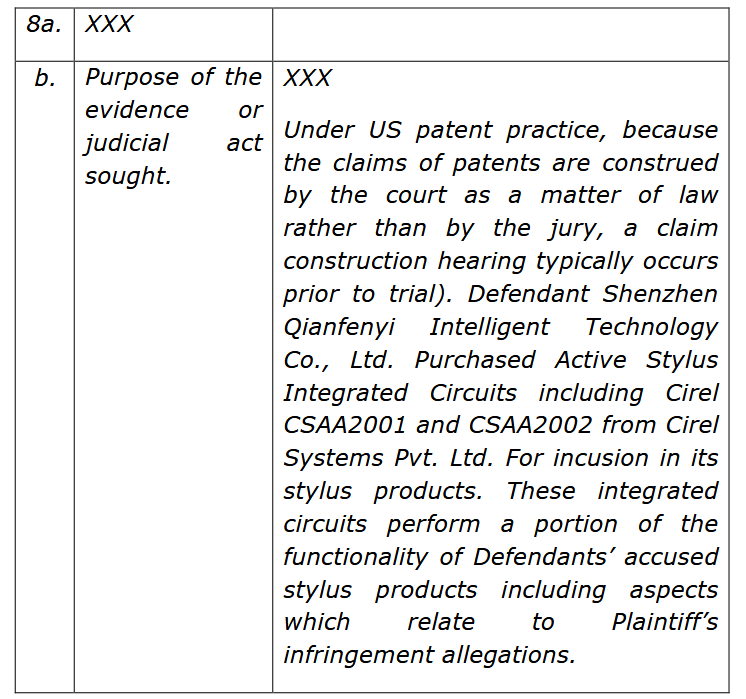
32. In clause 9, they sought for information of the documents and evidence from any other office or location where Respondent has stored the details of the questions to be put to the Respondent are also mentioned. The main objection of the Respondent is that Petitioner has not made any efforts to get information from the defendant before Texas court and he simply sought for information from the Respondent, and the said Letters Rogatory was issued in favour of Petitioner merely because the Shenzon company has not opposed the same. But, the perusal of the same clearly reveals that it was issued after hearing both the sides and also considering Article 23 of the Hague convention and it was specifically mentioned in clause 8B that the said information is sought for pre-trial Purpose. Therefore, the objections raised by the Respondent cannot be considered.
33. The learned counsel of the Petitioner also relied upon the judgments of the Madras High Court, Bombay High Court, Andhra Pradesh High Court and also of this Court and perused the same.
34. This Court in the case of United States Federal Trade Commission Vs. Nil (in W.P. No.13264/2020 dated 23.11.2020)) has held as follows :
"19. Cases in which High Court may issue commission to examine Witness.-(1) If a High Court is satisfied.-
(a) that a foreign Court situated in a foreign country wishes to obtain the evidence of a witness in any proceeding before it;
(b) that the proceeding is of a civil nature; and
(c) that the witness is residing within the limits of the High Court's appellate jurisdiction, it may, subject to the provisions of Rule 20, issue a commission for the examination of such witness.
(2) Evidence may be given of the matters specified in clauses (a), (b) and (c) of sub- rule (1).-
(a) by a certificate signed by the consular officer of the foreign country of the highest rank in India and transmitted to the High Court through the Central Government; or
(b) by a letter of request issued by the foreign Court and transmitted to the High Court through the Central Government; or
(c) by a letter of request issued by the foreign Court and produced before the High Court by a party to the proceeding."
There is no need for any interpretation of these provisions which are as clear as Gangetic waters.
(C) The aforementioned provisions of the Code which were originally enacted by Act 10 of 1932 have been re-framed in the 1976 amendment, for giving effect to the Directive Principles of State Policy enshrined in Article 51 of the Constitution of India; the said Article is phrased as under:
"Article 51. The State shall endeavour to.-
(a) promote International peace and security;
(b) maintain just and honourable relations between nations;
(c) foster respect for international law and treaty obligations in the dealings of organised peoples with one another; and
(d) encourage settlement of international disputes by arbitration."
The text of the aforesaid provisions of the Code are presumably enacted for giving effect inter alia to the intent of The Hague Convention to which both India and United States of America are parties; the Apex Court in Safal Karamchari Andolan v. Union of India MANU/SC/0233/2014: III (2014) SLT 695 : 2014(4) Scale 165 has ruled that the International Covenants which have been ratified by India are binding to the extent they are not inconsistent with the provisions of the domestic law."
35. The Respondent has not submitted any iota papers to show that production of documents by the Respondent will be detrimental to the national security interest of India.
36. In a judgment of the Hon'ble High Court of Judicature at Madras in the case of Pfizer Inc and others Vs. Softgel Healthcare Private Limited (in O.P. (PT). Nos.5 and 6 of 2024 decided on 28.01.2025), it was held as follows:
"The only objection raised by India as a signatory to the Hague Evidence Convention under Article 23 of the said convention is that they will not execute Letter or Request issued in pursuance of Article 23 of the Convention for the purpose of obtaining pre-trial discovery of documents, only in cases where the documents are not specified. In the case on hand, documents have been specified in the Letters Rogatory issued by the United State District Court at Delaware"
37. Even in this case, the documents required by Petitioner from the Respondent are mentioned in detail in clause 11 from 1 to 9. Therefore, the objection of the Respondent that the purpose of obtaining them for pre-trial of documents with the Respondents cannot be accepted. Therefore, this Court finds it just and reasonable to allow this petition and appoint Mr. Vikram Unni Rajagopal, Advocate.
38. In the result, the following order is passed:
(a) The petition is allowed.
(b) Mr. Vikram Unni Rajagopal, Advocate, is appointed as a Local Commissioner for collecting evidence, including documentary evidence as mentioned in Schedule A to the Letters Rogatory, and also for obtaining and recording the testimony and depositions from the person(s) designated by the Respondent as mentioned in Schedule B to the Letters Rogatory. Mr. Vikram Unni Rajagopal required to adhere to the terms of the protective order dated 15.12.2023:
c) Mr. Vikram Unni Rajagopal, the appointed Commissioner is conferred with "Special Powers' including the power to -
i. Summon a person to produce documents and things as per Schedule A to the Letters Rogatory, which shall be done as per the schedule set by the appointed Commissioner and should be at least three weeks prior to the commencement of the testimony;
ii. Accept copies of the said documents and things, and provide the same to the members of the confidentiality club from the Petitioner's side;
iii. Set the schedule for the collection of the testimony of the Respondent's witness on a day-to- day basis;
iv. Decide to collect evidence based on the digitized files of the court record and as collected from the Court;
v. Summon a person, to administer oath to her/him and to record his her evidence;
vi. Allow the Petitioners' and Respondent's respective Indian counsel the opportunity to examine or cross- examine the aforesaid person;
vii. To record the objections, if any, of the parties and conclude, without delay, the testimony of the witness nominated by the Respondent. To not stall the testimony of the witness, once started, for technical grounds and reasons. It is clarified, that the questions, as asked should be recorded along with the answers given;
viii. Permit the Petitioners' and Respondent's respective foreign representatives to attend and observe the examination of the said person;
ix. Video record the testimony of the said person;
x. Have the said recording transcribed verbatim;
xi. Provide both the documents and recording and the transcript to the Petitioners and Respondents respective representatives and their Indian Counsels;
d) A 'Confidentiality Club' is set-up by this Court consisting of the persons stated in Paragraph 60 above and on the terms set out in paragraph 13 of the petition; and
e) All proceedings before Mr. Vikram Unni Rajagopal will be in camera with only the members of the 'Confidentiality Club' being present; and
f) The Registrar General of this Court is directed to keep all documents and records pertaining to these petitions or the matters arising therefrom, including the evidence collected by Mr. Vikram Unni Rajagopal under seal. They shall allow access to those documents only to the members of the Confidentiality Club;
g) The venue of collecting evidence and recording testimony of the Respondent shall be at the Karnataka Mediation Centre, Bengaluru, and the Cost of the Karnataka Mediation Centre, Bengaluru as well as the secretarial expenses shall be borne by the Petitioners;
h) Mr. Vikram Unni Rajagopal to conduct proceedings as per the above terms and send the evidence/ documents collected and the testimony recorded to the Registrar General of this Court who would then forward to the Hon'ble United States District Court for the Eastern District of Texas in a sealed cover.
i) Mr. Vikram Unni Rajagopal, Advocate, shall be paid remuneration of Rs.3,00,000/- by the Petitioner from the date of receipt of a copy of this order. The Commissioner is also permitted to seek additional remuneration once the work is completed.

 |
This Product is Licensed to , |