


(Prayer: This COMAP is filed under Section 13(1-A) of Commercial Courts Act 2015, Commercial Division and Commercial appellate division of High Courts Act, 2015 r/w Section 37 of the Arbitration and Conciliation Act praying to allow the present appeal in Favour of the appellants by setting aside the impugned order dated 29.03.2025 in COM.AP No.24/2025, passed by the Hon’ble Court of the LXXXV Additional City Civil and Sessions Judge, Commercail Division, Bengaluru (CCH-86) (Annexure A).)
CAV Judgment
C.M. Poonacha, J.
1. The present appeal is filed under Section 13(1) of the Commercial Courts Act, 2015 [CC Act] r/w Section 37 of the Arbitration and Conciliation Act, 1996 [A&C Act] impugning the judgment dated 29.03.2025 passed by the LXXXV Addl. City Civil & Sessions Judge, Bengaluru (CCH-86) (Commercial Court) in Com.A.P.No.24/2025 [old A.S. No.191/2017) [impugned judgment], whereunder the petition filed by the appellant under Section 34 of the A&C Act impugning an arbitral award dated 15.09.2017 [arbitral award] passed by the sole arbitrator [Arbitral Tribunal] in A.C. No.3/2015, was rejected. Vide the arbitral award, the claim made by the respondent / claimant was partly allowed and the appellant was directed to pay a total sum of Rs.8,65,99,649/- as also a sum of Rs.1,09,17,991/- for purchase of software, storage and UPS, as well as a sum of Rs.25,12,378/- with service tax for rental Laptops. The said amounts were directed to be paid along with the interest @ 18% per annum to the respondent. The counter claims made by the appellants were rejected.
2. The relevant facts in a nutshell leading to the present appeal are that the claimant was in the business of providing consultancy services pertaining to recruitment, strategy, consultancy and implementation, business planning, business development, marketing, sales, placement, accounts, HR advisory services and other related services within India and abroad. The parties entered into a business plan dated 28.07.2014 [business plan] and a Consultancy Agreement dated 01.08.2014 [Agreement] whereunder, the claimant was required to deliver certain services to the appellant.
3. The Agreement was for a period of 18 months from 01.08.2014 to 31.01.2016. Alleging that the appellant unlawfully terminated the Agreement, the respondent initiated arbitral proceedings and made various claims before the Tribunal. The appellant had also made various counter claims. The Tribunal framed following issues:
(1) Whether the Claimant proves that the termination of the Consultancy Agreement dated 1-8-2014 is illegal and without any basis or valid reasons?
(2) Whether the Claimant proves that the Respondent is liable to pay them Rs. 12,03,07,649/- towards outstanding professional fees and interest there on?
(3) Whether the Claimant proves that the Respondent is liable to pay them Rs.25,12,378/- that is paid by them to Prosol Itand interest there on?
(4) Whether the Claimant proves that the Respondent is liable to pay them Rs. 1,09,17,991/- that is paid to purchase Software, storage and UPS and interest there on?
(5) Whether the Claimant proves that the Respondent has to be directed to stop using the software provided by them to the Respondent under the agreement?
(6) Whether the Respondent proves that the Claimant is liable to refund all the payments made for Software, storage and UPS to the Respondent?
(7) Whether the Respondent proves that the Claimants have to be directed to hand over to the Respondent all the files including the Software licences and Software?
(8) What Award or Order?
4. The proceedings before the Tribunal were contested by the parties. The Tribunal vide the impugned award passed the following Order:
The claim of the Claimant is allowed in part with proportionate costs of the arbitral proceedings. The Respondent is directed to pay to the Claimanta total of Rs.86,599,649/- (Rupees Eight Crores Sixty Five Lakhs Five Hundred Ninety Nine Thousand Six Hundred Forty Nine only) and also interest at the rate of 18% per annum on the same amount from the date of termination of the contract that is 28-02-2015 till realisation of the entire amount. The Respondent is directed also to pay to the Claimant Rs. 1,09,17,991/- paid for purchase of Software, Storage and UPS with service tax at applicable rate and also interest at the rate of 18% per annum on the same amount 28-02-2015 till realisation of the entire amount. The Respondent is directed also to pay to the Claimant Rs. 25,12,378/- with service tax at applicable rate to the Claimant towards rental paid for laptops and also interest at the rate of 18% per annum on the same amount 28-02-2015 till realisation of the entire amount.
Rest of the claims of the Claimant are rejected. The Counter Claim of the Respondent is also rejected.
5. Being aggrieved, the appellant preferred the petition under Section 34 (Com.A.P. No.24/2025) before the Commercial Court. The Commercial Court by the impugned judgment, dismissed the said petition with costs. Being aggrieved, the present appeal is filed.
6. Heard submissions of leaned Senior Counsel Sri Naveen Pahwa appearing along with Sri Prajith Chakkingal for the appellant and learned Senior Counsel Sri.Dhananjaya Joshi, appearing along with Sri Kashyap N.Naik for the respondent.
7. The Arbitral Tribunal while considering issue No.1 as to whether the claimant had proved that the termination of the Agreement was illegal and without any basis noticed that periodic assessments as contemplated in clause 9 of the Agreement for progress review "should have been a joint effort and therefore, the periodical reports were not expected to be done unilaterally by the claimant alone". Further, the Tribunal noticed the email sent by the appellant to the claimant on 28.02.2015 (Ex.R7), whereunder the Agreement was terminated and held that although few reasons have been stated in the said email, no attempts have been made by the appellants even thereafter to make clear to the claimant the reasons for termination of the Agreement. The relevant finding of the Tribunal is as under:
17. ..... It is clear from this email Ex.R-7 that they having chosen to state that few of the main reasons therein but, there has been no attempt to make it clear even later to the Claimant for what other reasons the Respondent chose to terminate the contract under the agreement. Clause 16 of the Agreement requires that Service Provider shall replace any non-productive engineers within 7 days of request by AIS, with another engineer who is better qualified or at least more competent. From the statement made in Ex.R.7 that they were constrained to terminate the contract with immediate effect it is clear that they did not want to give any time to the Claimant for any kind of redressal of their grievances contrary to the terms of the contract out of those quoted above and therefore the termination was abrupt. It is the evident from the testimony of the witness of the Respondent as well as the testimony of the witness of the Claimant that there was no written complaint or suggestion for redressal of any grievances at any earlier point of time than issuing the notice for termination of the contract at Ex.R-7. No doubt, Clause 27 of the contract at Ex.P-2 does not specifically state that the termination notice should be followed by any request for redressal or to state that how many days after the issuance of notice of termination it should take effect. In my considered opinion it does not mean that the Respondent could have terminated the contract in such a way to take aggressive step with immediate effect that too without any warning or request for redressal asa prelude for termination of the contract. The RW-1 has admitted during cross-examination that they have not sent any email to the Claimant before terminating the contract by them stating that their performance of the obligations was not satisfactory. Her statement that they had communicated orally to the Claimant is denied by the Claimant by way of suggestion during cross-examination and there is no statement on oath or otherwise by the PW1 that they had received any such observation even orally. It is the specific case of the Claimant that the Respondent had never communicated to them that their performance of the obligations was not satisfactory. There is no evidence on record of any such communication by Respondent to the Claimant. RW-1 has admitted that they have not sent any notice or email to the Claimant earlier to the termination of the contract stating that the services of the Claimant were not up to the mark. She has admitted that few of the employees of the Claimant were working with them as on 28.02.2015 and they have absorbed all those employees with them on the ground that they were forced to do so on humanitarian grounds though they had no contractual obligation to absorb those employees with them. This was an act beneficial to the Respondent in the bargain, especially when they terminated the contract much before the contract period came to an end. RW-1 has admitted during cross-examination that they did not send any letter or email to the Claimant that they did not provide proper services with regard to facilitating staff to the Respondent and that there was no proper planning in bringing inflow to the Respondent Company to achieve the requirements as agreed in the agreement. Her evasive answer that they had been following this aspect over phone has no corroboration. The learned Counsel for the Claimant has, rightly it appears, argued that as suggested by him to the witness since there was no deficiency on the part of the Claimant the Respondent had no occasion to send any notice or email on this aspect to the Claimant. Clause 22 which we have seen above provides that the Respondent was entitled to get any resources not meeting their expectation either in quality or in competence or in performance or efficiency or any other contractual agreement removed immediately and however they were entitled also to request the Claimant to replace the same within two working weeks with the commensurate resources. This Clause impliesthe obligations, responsibility and duty on both the parties but it is not a one sided Programme. Though removal of a lot of engineers by the Respondent was done on 5-2-2015, less than a month earlier to the termination of the contract, the Respondent did not choose to request the claimant to replace the same within two working weeks with the commensurate resources under clause 22. RW.1 has clearly admitted during cross-examination that she is not aware of any letter, email or notice to have been sent by the Respondent to the Claimant stating that they were causing delays in work. RW-1 has further admitted during cross- examination that they have no written notes issued to the Claimant stating that they had lacked in reporting, in meeting the obligations and in giving explanations for delaying the work of the Respondent. It is suggested to her that there was absolutely no delay on the part of the Claimant in performing their work under the contract. If, really, there was such delay there would have been at least a letter or email or notice sent by the Respondent to the Claimant asserting the same. But, no such documents have either been claimed to be in existence or produced by the Respondent before this Tribunal.
(emphasis supplied)
8. The Tribunal, noticing the correspondences between the parties held that the termination as per the terms of clause 27 would arise only when there was non-performance in any of the Key Performance Indexes (KPIs) for a continued period of two quarters but not otherwise, which was not alleged by the appellant. It is also found that the consultancy charges were paid to the claimant without any protest. The relevant finding of the Tribunal in this regard is as under:
20. It is to be further seen that Clause 27 attracts termination only when there was non-performance in any of the KPls for a continued two quarters but not otherwise. The learned Counsel for the Claimant argued that when the notice for termination of contract dated 28.02.2015 was issued, admittedly non-performance for continued two quarters was neither alleged by the Respondent nor has been shown by means of acceptable evidence before this Tribunal. On the other hand, the learned Counsel for the Respondent argued that two quarters period of non- performance had completed by 28.02.2015 when the notice was issued when calculated from 01.08.2014 the date of commencement of the period of agreement. It is to be appreciated that Clause 27 does not state that termination of the contract could have been done by the end of two quarters of the commencement of the agreement. But, it is the specific stipulation unambiguously that in order to attract termination of the contract there should have been non- performance in any of the KPls for a continued two quarters (Emphasis supplied). It should mean that there should have been continuous non-performance of any of the KPIs by the Claimant for not less than two quarters, that is, six months. It cannot be disputed that there should have been non- performance of any of the KPls by the Claimant commencing from the very beginning of the period of contract on 01.08.2014 so that the continued period of two quarterscould have been over by 28.02.2015 as far as non- performance by the Claimant is concerned. Admittedly, the Respondent never complained about the non-performance at any time in writing to the Claimant as to whether there was at all non-performance by the Claimant or on what grounds the Respondent could have aired their grievances regarding performance by those recruited by the Claimant and placed at the services of the Respondent. It is not the specific case of the Respondent at all that the Claimant failed to perform their obligations at least in August and September 2014. On the other hand the fees payable for those two months to the Claimant at the rate of Rs.1.8 Crores per month under the contract was paid to them without demur of any protest. Therefore it was never the case of the Respondent that there was non-performance of any of the KPIs by the Claimant for the first two months at least. Thus it is clear that by the time the termination notice was issued on 28-02-2015 two quarters' non-performance did not occur at all.
(emphasis supplied)
9. The Tribunal considered the various materials on record with regard to the ground for termination as was urged by the appellant and held that the appellant had also participated in the recruitment process of the employees who were hired by the claimant. It had further held that the appellant could not have complained of the claimant not having met the requirements as early as February 2015 i.e., within six months of the Agreement when the tenure of the Agreement was for a period of 18 months. Hence, the Tribunal held issue No.1 in the affirmative. The Tribunal also held issue No.2 partly in the affirmative and held that the appellant was liable to pay a sum of Rs.36,76,649/- as part fee for October 2014 and Rs.1,55,07,000/- for December 2014; and Rs.3,37,08,000/- each for January and February 2015. Hence, it was held that the appellant was liable to pay the claimant a total sum of Rs.8,65,99,649/- together with interest at 18% per annum from the date of termination till realisation.
10. With regard to Issue Nos. 3 and 4, the Tribunal held the same in the affirmative that the appellant was liable to pay the claimant a sum of Rs.25,12,378/- with service tax as the rental for laptops and Rs.1,09,17,991/- for purchase of software, storage and UPS together with applicable service tax.
11. In this context, it is pertinent to note that the parties had entered into a business plan and proposal dated 28.07.2014, consequent to which, the Agreement was entered into on 01.08.2014. Some of the relevant clauses of the said Agreement are as under:
5. Towards rendering of the services to AIS the service provider shall:
a) Provide 4 smart & aggressive HR recruiters and reorganize the HR Process to the benchmark it with the best in the industry.
b) Provide 2 to 5 domain experts for DRDO/HAL/BEL/CSIR-Design, HAL/BEL-mfg., Military-market-Researcher/Strategist and manufacturing expert.
c) Provide around 250 engineers in the field of Aeronautical embedded software, embedded systems and avionics - R & D.
d) Provide 40 experienced (2-20 yrs) engineers depending on the project requirements.
e) provide 5 experienced BD experts.
The above manpower estimation may be increased by the service provider to meet its deliverable area and KPIs. AIS is not responsible for any extra cost incurred by the service provider for any reason. -
xxxxx
6. Service provider assures the following KPIs:
a) Recover lost key accounts with ELBIT SYSTMS LTD. Israel and its subsidiary group companies to build US$ 5Mn order in-take during the contract period of 18months
b) Recover lost key accounts with SOGECLAIR AEROSPACE SAS, France/Germany, SII, France, AUSY, France to build US$ 1Mn order in-take during the contract period of 18 months
c) Recover lost key accounts with AIRBUS and its subsidiaries like EUROCOPTER, AIRBUSMILITARY, AEROLIA and MBDA to build US$ 10Mn order in-take during the contract period of 18 months.
d) Recover lost key accounts with RAFAEL SYSTEMS, Israel to build US$ IMn order in-take during the period of 18months
e) Enhance business with key accounts like THALES, France and its subsidiaries and European Suppliers, in new areas such as mechanical systems-design & manufacture and software development to build US$ 40Mn order in-take during the contract period of 18 months.
f) Enhance chances of business with prime prospects like DASSAULT, BOEING, LOCKHEED MARTIN, BAE- SYSTEMS, SHINMAYWA, SIKORSKY, and BELL for a possible business opportunity worth US$ 20Mn.
7. The strategic plan given above will address the mid and long term goals of AIS to Achieve an annual turnover of US$ 15Mn by 2016-17, US$ 25Mn by 2017-18, US$ 35Mn by 2018-19 and US$ 45Mn by 2019-20 - thereby ensuring the returns on investment in 4-5 yrs, as a result of the contractual BOT (Build operate Transfer) agreement.
8. The Service provider will assure the following turnover for the period from August 2014 to January 2016 based on the Actual turnover for the Period from February 2013 to July 2014:
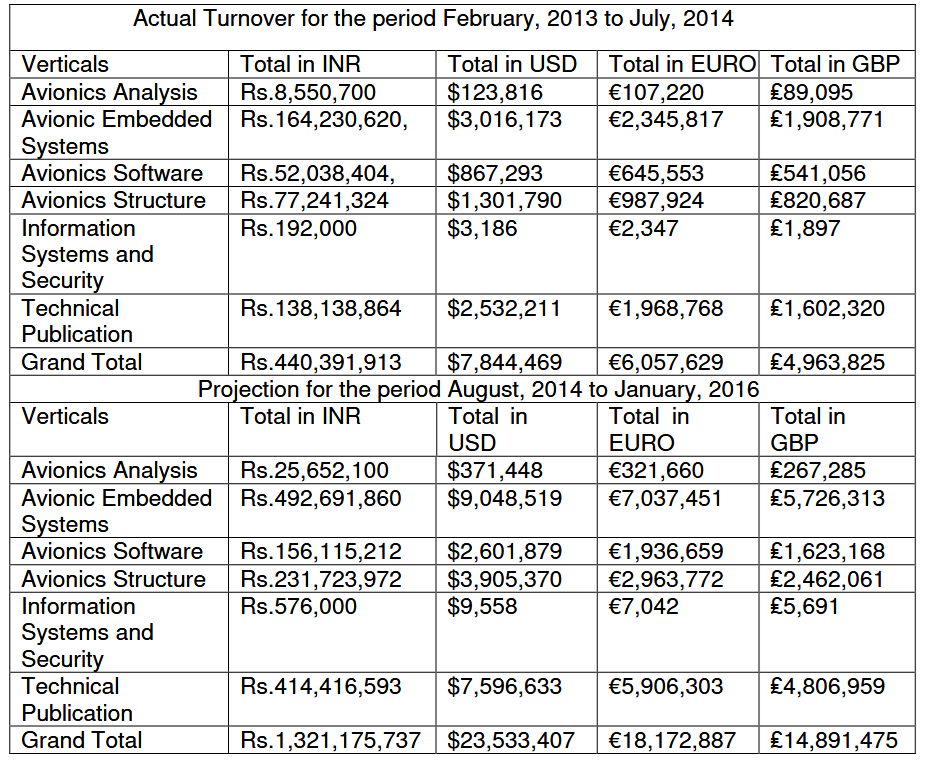
9. Periodic assessment of the activities at AIS shall be conducted by the service provider at frequency of 3 months and a report along with actions proposed shall be submitted to AIS.
10. The Service Provider will provide All necessary and new computers/PC's/Laptops/ /Server etc., for the engineers would have to be procured and installed and managed (with 90% uptime + System Administrator onsite placement) by Service Provider at the premises of AIS. xxxx
15. The Parties agree that this Agreement is based on a Build-Operate-Transfer model, wherein Service Provider will be required to recruit engineers, Recruiters, Onsite-Placement-Consultants, BD personnel and place them as required by AIS to ensure building a profitable business model. AIS shall issue Specific Purchase Orders for its requirements arising from time to time. All the infrastructure, processes, Tools (including the softwares) thus created/procured shall be transferred to AIS after the end of the project. Such transfers, if required by AIS shall be done at the written down value or market value, whichever is less.
xxxx
19. As consideration for the Services provided herein, AIS shall pay to the Service provider a sum not exceeding Rs.1,80,00,000/- (Rs. One Crores Eighty Lakhs Only) per month in the month of August & September 2014 in order to build confidence and ease the engagement process. The Consultancy fees for remaining 16 months shall be Rs.3,60,00,000/- (Rupees Three Crores Sixty Lakhs Only) per month.
20. The Service provider shall raise an invoice for the aforesaid amount in advance at the beginning of each month and send the same to AIS. A consideration should be remitted within 10 days on submission of bill.
xxxx
27. Non-performance in any of the KPIs for a continued 2 quarters will attract termination of the contract. The consultant will not hold the client commercially liable or responsible for early foreclosure of the contract due to non- performance of the consultant. The consultant will reimburse the client for 50% of the entire consultancy fees for the period of non-performance and will forego the fee for the remaining period of the contract.
28. Progress review will be jointly held every month between CFO or consultant and CEO/Dy.CEO of client organization or persons designated by them, if mutually acceptable. The commitments within this Business plan & Proposal, monthly plan, any other requirements shall from the KPls for the progress review.
xxxx
30. If within a period of sixty (60) days, the event continues and the parties are unable to identify a workable alternative, either party may terminate this Agreement and/or the relevant SOW by invoking the Termination clause of this Agreement.
xxxx
32. xxxx
(d) if the either party violates or breaches any terms and conditions as above, both party may, without prejudice to its right to terminate this agreement as provided for in Clause 27 hereinabove, proceed and recover any loss and / or damage caused to them due to the violation and to further proceed under the relevant laws and claim penalty damages, from the Company.
e) All disputes which cannot be resolved amicably shall be subject to arbitration at Bangalore in accordance with the Arbitration and Conciliation Act, 1996.
12. The consultancy Agreement commenced on 01.08.2014 and was for a period of 18 months. The monthly consultancy fee was Rs.360 lakhs + 12.36% service tax payable in advance on or before 10th of the month. However, for the months August and September 2014, it was agreed that only 50% of the consultancy fee would be paid [Rs.1.80 lakhs + 12.36% service Tax].
13. The said Agreement was terminated by the appellant vide e- mail dated 28.02.2015. The said e-mail is as under:
"Dear Sirs,
Kindly be informed, that we are constrained to terminate the above contract with immediate effect, as it is not meeting our defined contractual SLA (Service Level Agreements). Few of the main reasons, but not limited to, which have compelled us to take this decisions are as follows:
1) Inadequacy of services as defined in clause 4 of the contact - leading to increased outflow and no visible forecast for inflow in the near-term
2) No progress demonstrated towards the proposed KPIs mentioned in clause No.6
3) No reports received since Oct 2014 as required under clause no. 9.
Kindly take necessary action to stop further expenditures and/or commitments towards the said contract - as they will not be considered during settlements per Clause 14 & 27"
14. The Tribunal had framed issue No.1 as to whether the termination was illegal and without any basis or reason. As noticed above, while considering the said issue, the Tribunal held that there was no basis for the appellant to terminate the Agreement since there was no deficiency on the part of the claimant. It was noticed by the Tribunal that the appellant did not send any communication calling upon the claimant to redress any grievances nor was any time given to the claimant to rectify or improve its performance. It was the specific case of the claimant that the appellant never communicated to them that its performance of the obligations was not satisfactory. The Tribunal, by construing the fact that the appellant had paid the monthly remuneration amount to the claimant for the months of August 2014 and September 2014, has construed the same as an indication that the appellant was satisfied with the services rendered by the claimant.
15. In this context, it is pertinent to note that clause 6 of the Agreement specifically noted that the claimant had assured the KPIs as mentioned therein, to be achieved. Clause 8 of the Agreement also specified the assurance by the claimant of the turnover from August 2014 to January 2016, which was based on the actual turnover of the appellant from February 2013 to July 2014. The claimant has not placed any material on record to indicate that the assured KPIs or the turnover as assured by it in the Agreement were achieved. The Tribunal has not specifically dealt with the assurances as agreed between the parties in clauses 6 and 8 of the Agreement. In fact, the appellant in the termination email dated 28.02.2015, had specifically mentioned that there was no progress demonstrated towards the KPIs mentioned in clause 6 of the Agreement.
16. At this juncture, it is pertinent to note the background of the scope of services as stated in the business plan, which is an indication as to the intent with which the parties entered into the Agreement. The background, as mentioned in the business plan is extracted hereunder:
BACKGROUND
AvioHeliTronics InfoSystems Pvt. Ltd. (AIS) is a wholly Indian MSME Engineering Services & Manufacturing company with Defence Industrial License and CEMILAC (MoD Laboratory for Military Aircraft Airworthiness Certification) approval. AIS is also registered as 100% EOU unit under Cochin Special Economic Zone. AIS quality processes are certified CMMI-Level3, AS9100RevC, and ISO27001:2005 and ISO9001:2008. AIS is also MSME (Micro Small Medium Enterprise) certified by Government of India, hence providing an offset multiplier in defence. The company has broad-based its risks by including variety of Aerospace Services in the portfolio: Embedded-Software, AeroStructure Design/ Analysis/ Prototyping, Embedded- Systems Design & Manufacture, Technical-Documentation and AeroStructure-Manufacturing. AIS has however, since inception in early 2006, struggled to meet cash-flow vis-à- vis business intake and growth targets. AIS is desirous of circumventing all internal process & strategy related bottlenecks to make a quantum leap in the Aerospace & Defence Engineering industry - Civil & Military- internationally & nationally. AIS wishes to gear up and project the image of a strategic supply chain & defence offset partner to the likes of Dassault, Airbus, Eurocopter, Safran, Turbomeca, Sagem, Boeing, Lockheed Martin, BAE, Sikorsky, Bombardier, Rockwell-Collins, Honeywell, GE, Rolls-Royce as well as DRDO, HAL, BEL, NAL, etc. (emphasis supplied)
17. It is also pertinent to notice the opportunities as visualized by the appellant which was mentioned in the business plan. The relevant portion of the same is as under:
* If substantial capital is invested to build teams, R&D and Infrastructure, above OEMs will be convinced in perceiving AIS as a serious contender and strategic supply chain partner
* Employing strong lobby through reputed ex-DRDO and/or ex-HAL/ex-CSIR/ex-MoD/ex-OFB/ex-Military personnel with their past contacts in the major foreign OEMs' offices, is another important strategy to succeed at creating greater visibility, access & success
* Strong PR with French, German, UK & USA at their embassies to create visibility in Civil as well as Military engineering outsourcing opportunities is very do-able but will require considerable investment to ensure the same.
18. The business plan and proposal which also contained the strategic plan is as under:
BUSINESS PLAN & PROPOSAL
1. STRATEGIC PLAN
Assessment of the Activities Periodic assessment of the activities at AIS shall be conducted by the service provider at a frequency of 3 months and a report along with actions proposed shall be submitted to AIS.
As per the initial assessment done in the month of July 2014, the following broad actions are identified;
* Provide high level domain experts from retired DRDO, HAL, CSIR & Military to lobby and provide PR with high level management of foreign OEMs - to create a perception of higher capability at delivery in niche technology areas
* Provide culturally savvy BD experts to liaise with mid-level management of foreign OEMs in India and abroad - to improve chances of visibility to receive RFPs & RFIs as and when globally released
* Provide large teams of engineering staff in low, mid & high levels of experience to showcase delivery capability
* Employ aggressive HR recruiters to attract the best talent from the Indian job market
* Broad-base the risk and improve corporate visibility & image, by avoiding over-focus in Aerospace & defence business and include strategy of scoping other markets like Railways, Naval-Ship-Building, local DRDO/HAL/BEL/CSIR, IT, ITeS, etc.
19. It is clear from the aforementioned that the appellant was a Micro Small and Medium Enterprise (MSME) Engineering and service manufacturing company with a defence industrial license which was already carrying on the business of providing a variety of aerospace services. The intent and purport of the appellant entering into an Agreement with the claimant has been adequately captured in the business plan as noticed above, which is indicative of the fact that the appellant intended to increase its business by attempting to secure new clients and businesses and also expand the volume of business from its existing clientele. Hence, the KPI and the turnover mentioned in clauses 5, 6 and 8 of the Agreement have been clearly stipulated. The Arbitral Tribunal has not, in any manner, dealt with the said aspect of the matter while adjudicating upon the reasons for the termination by the appellant i.e., non- performance of the KPIs by the claimant.
20. Although, it is sought to be contended on behalf of the appellant that the consultancy agreement is the binding contract between the parties and the Arbitral Tribunal ought not to have considered the business plan, the business plan has been considered in these proceedings so as to deduce the purport and intent with which the consultancy agreement was entered into between the parties and not for the purpose of interpreting the business plan so as to override the terms of the agreement.
21. It is forthcoming from clause 5 of the agreement that the claimant was required to provide 4 HR recruiters, 2 to 5 domain experts, 250 engineers in the field of aeronautical embedded software, embedded systems and avionics R&D, 40 experienced (2 to 20 years) engineers depending on project requirements and 5 experienced BD experts. Vide email dated 05.02.2015, the appellant had informed the claimant that it had decided to eliminate 124 probationary engineers due to non-performance. By another email dated 05.02.2015, the appellant intimated the claimant that it had short-listed 52 probationary engineers. It is forthcoming from the record that pursuant to the Agreement, the claimant had recruited various personnel as per the requirement of the appellant. However, it is the consistent case of the appellant that the employees hired by the claimant were not qualified and did not meet the criteria/requirements of the appellant, due to which a large number (142) were asked to leave due to non-performance.
22. A perusal of clause 6 of the agreement indicates that the claimant was required to recover lost key accounts of various companies and its subsidiaries, and build the order intake upto an amount specified in the said clause. It is pertinent to note here that there was no material placed by the claimant to demonstrate that it had secured new businesses/clients for the appellant or in any manner expanded the volume of business from the existing clientele of the appellant. The only reference to the same is a statement in the cross examination of PW-1, whereunder PW1 has admitted that it did not meet any customers of the appellant. There was no independent material placed on record by the claimant to, in any manner demonstrate, that it had complied with the stipulations as stated in clauses 5, 6 and 8 of the Agreement. In fact, the Tribunal had also recorded a finding that the six months period was "too short a time" to require the claimant to achieve the KPIs. The said finding of the Tribunal is contrary to the purport and intent of the parties in entering into the Agreement and tantamounts to re-writing the contract between the parties.
23. The Tribunal had noticed that non-performance of KPIs ought to have continued for two quarters. The Agreement commenced on 01.08.2014 and was terminated on 28.02.2015 i.e., after six months (two quarters). The finding of the Tribunal that when the termination notice was issued on 28.02.2015, two quarters non-performance did not occur at all, is ex-facie untenable. The said finding is premised on the fact that the appellant paid the claimant the monthly remuneration charges for August and September 2014 at the rate of Rs.1.8 crores per month without any demur or protest and hence the said months of August and September 2014 cannot be taken into account for calculating the six month period i.e., two consecutive quarters.
24. As noticed above, the termination was made after six months of the parties having entered into the Agreement. Merely since the appellant had paid two months remuneration in its entirety to the claimant (i.e., for the months of August 2014 and September 2014), the finding of the Arbitral Tribunal that the same having been made without any demur or protest, the said two months cannot be considered while determining the period of two quarters, is ex-facie, without any basis.
25. As noticed above, clause 8 had also specified the assurances of the claimant with regard to the turnover projection for the period August 2014 to January 2016.
26. Although, there is no periodic specifications provided in clauses 5, 6 and 8 of the agreement, which mandated the claimant to adhere to, it is pertinent to note here that it is not even the case of the claimant that in 2 quarters (6 months) it had achieved a fraction of the assurances as stipulated in clauses 5, 6 and 8 of the agreement. It is also pertinent to note that the claimant did not immediately reply to the termination made by the appellant vide its email dated 28.02.2015. It is a matter of record that the appellant wrote another email dated 26.03.2015 once again intimating the claimant that it had terminated the agreement. It is only thereafter that the claimant got issued a legal notice dated 21.05.2015 (Ex P27).
27. Neither in the response of the claimant to the termination made by the appellant, nor has it been placed on record in the arbitration proceedings that the claimant has achieved a portion of the assurances as made in clauses 5, 6 and 8 of the agreement. Further, apart from the email dated 05.02.2015 wherein the appellant had intimated the claimant its decision to retain 52 probationary engineers and remove 124 probationary engineers, no other material is placed on record by the claimant to indicate that it had provided the other personnel as stipulated in clause 5 of the agreement.
28. In view of the foregoing, the finding of the Tribunal on Issue No.1 is without any basis and is patently illegal.
29. The vehement contention of the counsel for the respondent that the finding of fact made by the Arbitral Tribunal regarding issue No.1 ought not to be interfered by this Court in the present appeal, is not liable to be accepted since the said finding is patently illegal, having been made without any basis and contrary to the material on record.
30. Further, the finding of the Arbitral Tribunal that the periodic assessments as contemplated in clause 9 of the Agreement "should have been a joint effort" is also contrary to the said clause 9 as stipulated in the Agreement.
31. The Commercial Court has also not considered the aspect of termination of the agreement in the proper perspective and without noticing the fact that the finding of the Arbitral Tribunal was without adequately noticing clauses 5,6 and 8 of the agreement in the proper perspective.
32. It is forthcoming from the record that for the months of August 2014 and September 2014, the agreed amounts have been paid by the appellant to the claimant, whereas for the month of October 2014, a sum of Rs.2,97,46,351/- was paid along with a debit note of Rs.1,03,61,249/- and for the month of November 2014, a sum of Rs.3,34,23,000/- was paid. For the month of December 2014, a sum of Rs.1,79,16,000/- was paid. Admittedly, for the months of January and February 2015, no payments have been made. The Arbitral Tribunal has held that the appellant is liable to pay professional fee to the claimant for the months of December 2014, January 2015 and February 2015. Issue no. 2 was answered partly in the affirmative as under:
...... Therefore, I answer issue No.2 partly in the AFFIRMATIVE that the Respondent is liable to pay Rs.36,76,649/- for part of the fee for October 2014, Rs.1,55,07,000/- for December 2014 and Rs.3,37,08,000/- each for January and February 2015, thus a total of Rs.86,599,649/- (Rupees Eight crores Sixty Five Lakhs Five Hundred Ninety Nine Thousand Seven Hundred Forty Nine only) and also interest at the rate of 18% per annum on the same amounts from the date of termination of the contact till realization of the entire amount.
33. Even if the finding of the Arbitral Tribunal on issue No.1 is interfered with, having regard to the fact that the Agreement was terminated on 28.02.2015, the appellant was liable to pay the claimant the agreed monthly charges during the period when the Agreement was in force i.e., from August 2014 to February 2015. However, clause 27 of the Agreement which is extracted in para No.11 hereinabove stipulates that non performance of any of the KPIs for a continued two quarters will attract termination of the contract, in which event, the claimant was required to reimburse 50% of the entire consultancy fees for the period of non- performance. Hence, the claimant is entitled to only 50% of the consultancy fee for the said period of six months. However, the arbitral Tribunal has recorded a finding on issue No.2 by taking the entire agreed consultancy fee payable.
34. Having regard to a plain reading of clause 27 of the Agreement and since the finding of the Arbitral Tribunal on issue No.1 has been set aside, the finding of the arbitral Tribunal on issue No.2 and the award of Rs.8,65,99,649/- together with interest at 18% is also without any basis and liable to be set aside. However, the parties are at liberty to initiate fresh arbitration proceedings in respect of the claim towards consultancy fees payable by the claimant to the appellant for the period of six months between 01.08.2014 to 28.02.2015, in terms of the Agreement (particularly clause 27).
35. Claim Nos.3 and 4 pertains to reimbursement of a sum of Rs.25,12,378/- paid by the claimant to Prosol IT towards the rental charges for laptops and claim No.4 is of a sum of Rs.1,09,17,991/- paid towards purchase of software. In this context, it is pertinent to note that in the Agreement, there is no clause which specifies that the amounts incurred by the claimant for providing the laptops and the software are to be reimbursed by the appellant. All the e-mails produced by the claimant are exchanged between the claimant and the supplier of the laptops i.e., Prosol IT. The claimant has also produced the invoices to show the rental charges paid by it. However, the appellant has taken a specific contention in its statement of objections filed before the Arbitral Tribunal that it has paid the amounts to the claimant. The relevant portion of the statement of objections reads as under:
12. Reg Para 9 & 10: The contents of this paragraph are denied as false and your client is put to strict proof of the same. The respondentinforms that they have paid in full for the purchase of various software and other tools undertaken by the Claimant. The Claimantmisled the Respondent that the aforesaid purchases were basic requirements and should be purchased. Further, the Claimant stated that the ownership of the aforesaid purchases would be transferred to the Respondent the Claimant though installed the software on the Respondent system, has with ulterior motive and subterfuge, purchased all licenses in itsname. While the Respondent has paid for the said software, the Claimant is now claiming the same. From the correspondence filed it is clear that the Claimant has enjoyed themoney paid by the Respondent has taken the licenses towards the software in its name. This is a criminal breach of trust by the Claimant, against which the Respondent reserves its right to initiate separate proceedings against the Claimant. The Claimant is now attempting to terminate the usage. Withoutprejudice the Respondent submits, after having spent heavily on the said software, on the representations of the Claimant, the Respondent has not profited or even broken even on the said licenses. It has been another useless investment made. based on the representations made by the claimant. It is false to state that the Claimant has paid advance rent for supplying HP Laptops on rental basis to the Respondent's office, as the Respondent states that they have made the payments towards all the purchase orders submitted and the Claimant only facilitated the purchase. The Respondent submits that the qualities of the laptops procured wee pathetic. The fact of the matter is that all laptops were rented from one Prosol IT was returned to PROSOL after 12 months. With the said losses incurred by the Respondent due to thecallous attitude of the Claimant, it is this Respondent that is due money from the Claimant, a right which it will invoke in due course as it reserves the same presently. Respondentreiterates that all these have caused it tremendous loss, ad it reserves the right to claim the loss from the Claimant.
(emphasis supplied)
36. The said aspect was noticed by the Arbitral Tribunal and hence the Arbitral Tribunal held that the appellant was liable to pay the claimant a sum of Rs.25,12,378/- towards the rental charges towards laptops, which finding is based on the material on record.
37. With regard to claim No.4 i.e., the purchase of software, although the claimant has produced invoices to indicate that it has incurred various expenses for the purchase of software and on the said basis the Arbitral Tribunal has awarded a sum of Rs.1,09,17,991/-, however, the purchases made by the claimant are in the name of the claimant itself. There is no material on the record to indicate that the said software was utilised on the laptops that were supplied by the claimant to the appellant. In fact, the appellant has specifically contended that the claimant has continued to use the software even after termination of the Agreement. The finding of the Arbitral Tribunal holding the appellant liable to pay a sum of Rs.1,09,17,991/- towards charges for laptops is without any basis and liable to be interfered with on the ground of patent illegality.
38. In view of the foregoing, the award of the Arbitral Tribunal for payment of Rs.8,65,99,649/- together with interest at 18% as well as for payment of Rs.1,09,17,991/- for purchase of software, storage of UPs with service tax and interest are set aside. The remaining portion of the award is not interfered with.
39. The parties are at liberty to initiate fresh arbitration proceedings with regard to the consultancy fee payable between 01.08.2014 and 28.02.2015.
40. The appeal is disposed of in the aforesaid terms.
41. Pending IAs., if any, stand disposed of.

 |
This Product is Licensed to , |