


Oral Order
1. Rule, returnable forthwith. Learned Additional Public Prosecutor waives service for the respondent - State.
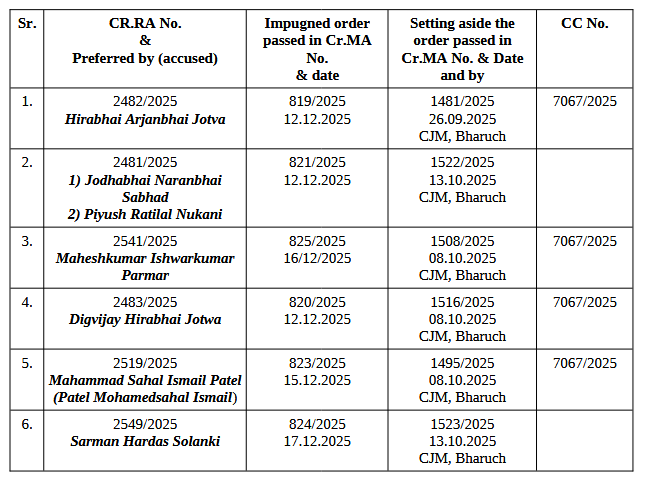
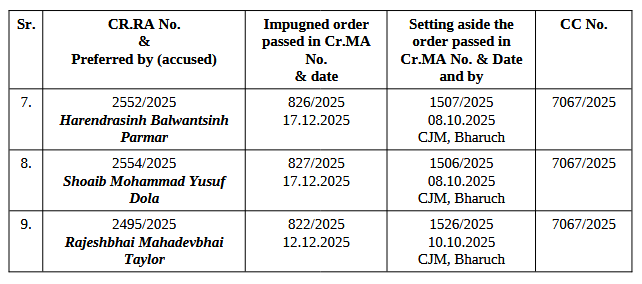
2. By these revision applications, filed under Section 438 r/w. Section 442 of the Bharatiya Nagarik Suraksha Sanhita, 2023 (BNSS), the applicants have challenged the orders, as detailed below, passed by the learned 5th Additional Sessions Judge, Bharuch, whereby, bail granted to the present applicants came to be cancelled:
3. Outlined facts of the prosecution case are that Murlidhar Enterprise and Jalaram Enterprise were allotted work relating the construction of road in different 11 villages, which was to be carried out as per the SOP provided and specifications therefor by using stipulated material, under MGNREGA Scheme of the Government. However, allegedly with mala fide intention, the same was not complied and the work done was against the said SOP as well as other Government stipulations, generating false bills for the work so allotted and done, although knowing the said fact, by using the same as legitimate bills and thereby, Murlidhar Enterprise got Rs.13,05,676.51/- whereas, Jalaram Enterprise got Rs.6,58,898.89/-, totalling to Rs.19,64,575.40/- in excess from the State Government. Thereby, in connivance with each other, by hatching conspiracy, in defiance of the objects and provisions of the MGNREGA Scheme of the Government, thereby, snatching employment of poor village people, for the works relating to approx 56 villages of Jambusar, Amod, and Hasot Talukas of Bharuch District, the applicant - accused caused monetary loss to the Government approximately Rs.7,30,00,000/- and committed criminal breach of trust and forgery, for which offence came to be registered vide FIR No. 11199010250535 of 2025 with City A-Division Police Station, Bharuch, District: Bharuch for the offence punishable under Sections 409, 406, 465, 467, 468, 471, 120B and 114 of the Indian Penal Code, 1860 (IPC).
4. Pursuant to the FIR filed, the applicants herein filed bail applications before the learned Chief Judicial Magistrate, Bharuch, which came to be allowed, as per details given in the above table. Grieved State, applied for cancellation of bail thus granted to the applicants herein before the learned Sessions Court at Bharuch. The said applications, as aforesaid, came to be allowed and bail granted to the applicants herein came to be cancelled. Against such cancellation of bail granted to the applicants herein, they have moved this Court by these revision applications.
5. Heard, the learned counsel appearing for the applicants and the learned Public Prosecutor, assisted by learned Additional Public Prosecutor for the respondent - State.
6. At the outset, the learned advocates for the respective applicants have submitted that the offences for which, the applicants have been charged are the ones for which the punishment prescribed is either less than seven years or the one where there is no minimum punishment is prescribed for. Accordingly, it is submitted that the learned Sessions Judge has committed a grave error cancelling the bail already granted to the applicants herein.
6.1 It is also submitted by the learned counsel for the applicants herein that investigation qua applicants is over and Charge-sheet is the case has already been filed and hence, custodial interrogation is not required. Further, there is no possibility of tampering and/or hampering with the evidence.
6.2 It is further submitted that there is a difference between setting aside the bail order and cancellation of bail. It is submitted that the learned Sessions Judge has no power to set aside the order passed by the learned Magistrate and that, prosecution ought to have filed appeal against the order granting bail, which is not the case here.
6.3 Relying on a decision of the Apex Court in Neeru Yadav v. State of U.P., reported in (2014) 16 SCC 508, it is submitted by the learned advocate for the applicants as observed therein, that, "if in a case, the relevant factors which should have been taken into consideration while dealing with the application for bail and have not been taken note of bail or it is founded on irrelevant considerations, indisputably the superior court can set aside the order of such a grant of bail. Such a case belongs to a different category and is in a separate realm. While dealing with a case of second nature, the Court does not dwell upon the violation of conditions by the accused or the supervening circumstances that have happened subsequently. It, on the contrary, delves into the justifiability and the soundness of the order passed by the Court".
6.4 Relying on a decision in Ashok Dhankad v. State of NCT of Delhi and Anr., reported in 2025 INSC 974, it is submitted that as observed by the Apex Court therein, there are several principles to be followed while entertaining an appeal against an order granting bail and an application for cancellation of bail.
6.5 The learned counsel for the applicants have submitted that bail once granted can be cancelled only considering whether any supervening circumstances have rendered it no longer conducive to the accused to retain his freedom by enjoying concession of bail and/or, there is apprehension of misuse of liberty and/or tampering or hampering with evidence and/or threat/danger to the victim of crime. It is submitted that the in the case on hand nothing such sort has been pointed out by the prosecution.
6.6 Moreover, it is submitted that looking to the Charge-sheet papers, no ingredients of the offences alleged against the present applicants have been satisfied.
6.7 It is vehemently submitted that the officer who filed the complaint is the same officer responsible for monitoring the 60:40 ratio (Material : Labour) and in case of any violation, the office was having powers to withheld or cancel the allocation of grant. However, at relevant point of time, no question was raised.
6.8 Moreover, it is submitted that in such a Government Scheme, there are multiple layers of scrutiny at different administrative levels and hence, it is highly improbable and practical too, to conspire with each and every official involved in execution of public work. It is submitted that the prosecution case rests on presumption and assumption, which is against the criminal justice system, where standard of proof is beyond reasonable doubt.
6.9 It is submitted that so far as applicants in Criminal Revision Application Nos. 2495, 2554 and 2552 of 2025 are concerned, they were merely performing their duties as Assistant in Hasot Taluka and was making entries only as instructed and that they are the victims with co-accused Hirabhai Jotva and Digvijay Jotva, who are victims of political vendetta being of opposite faction. So far as the applicants in Criminal Revision Application Nos. 2541 and 2519 of 2025 are concerned, they were the Taluka Development Officers (TDO). It is submitted that no overt act has been committed by them in commission of crime.
6.10 Further, it is submitted that so far as the applicants in Criminal Revision Application Nos. 2482 and 2483 of 2025 are concerned, it is stated that merely on the basis of bank transactions between the applicants and the contractors, it is alleged that the applicants are the main conspirators who had been managing the firms and all contract works by registering the firms in the names of the different persons. It is submitted that the applicants therein and the applicants of Criminal Revision Application No. 2481 of 2025, who are the Proprietors of the Murlidhar Enterprise and the Jalaram Enterprise, respectively, are residents of nearby village and have cordial business relations since long and due to the relations and the same line of work, they extend financial support in business of each other, which is routine and the transactions are also recorded in their books of account and accordingly, they have no role to play in the alleged offence.
6.11 It is submitted that the offence alleged against the present applicants is Magistrate triable only. The applicants have roots in the family and they are not likely to flee from justice and accordingly, it is urged that these revision applications may be allowed by setting aside the orders impugned herein and confirming the orders of the learned Chief Judicial Magistrate, Bharuch, granting bail to the applicants.
6.12 In support of their submissions, the learned advocates appearing for the applicants herein, have further relied on the following decisions:
i) Satender Kumar Antil v. Central Bureau of Investigation & Anr., reported in (2022) 10 SCC 51
ii) P. Chidambaram v. Directorate of Enforcement, reported in (2020) 13 SCC 791;
iii) Virupakshappa Gouda v. State of Karnataka and Anr., reported in (2017) 5 SCC 406;
iv) State (Delhi Administration) v. Sanjay Gandhi, reported in (1978) 2 SCC 411;
v) Dolat Ram and Others v. State of Haryana, reported in (1995) 1 SCC 349;
vi) Puran v. Rambilas and Anr., with Shekhar and Anr., v. State of Maharashtra and Anr., reported in (2001) 6 SCC 338;
vii) Abhimanue Etc. Etc. v. State of Kerala with Vishnu Etc. v. State of Keral and Anr., reported in 2025 SCC OnLine SC 2037;
viii) Deepak Yadav v. State of Uttar Pradesh and Anr., reported in (2022) 8 SCC 559;
ix) Sanjay Chandra and Ors. v. Central Bureau of Investigation, reported in (2012) 1 SCC 40;
x) Bhagirathsinh S/o. Mahipat Singh Judeja v. State of Gujarat, reported in (1984) 1 SCC 284;
xi) Shahnavaz Rafikbhai Katariya v. Tejmal @ Raghu Hitendrasinh Desai, reported in 2025 (0) AIJEL-HC 252100;
xii) Vineet Jain v. Union of India, reported in 2025 SCC OnLine SC 2331;
xiii) Victim 'X' v. State of Bihar and Anr., rendered by the Apex Court in Criminal appeal of 2025, arising out of SLP (Crl.) No (s). 4335 of 2024;
xiv) Narender Kumar v. Directorate General of GST Intelligence, rendered by the Delhi High Court in Bail Application No. 3065/2025 on 08.10.2025;
7. Countering the arguments made on behalf of the applicants - original accused, the learned Public Prosecutor, assisted by the learned Additional Public Prosecutor, while, supporting the impugned judgment and orders passed by the learned Sessions Judge, submitted that no perversity and/or palpable error or illegality has been committed by the learned Sessions Judge while passing the impugned judgment and orders cancelling the bail granted to the present applicants.
7.1 At the outset, the learned Public Prosecutor, inviting attention of the Court to the decision of the Apex Court in the case of Amit Kapoor v. Ramesh Chander and Anr., reported in (2012) 9 SCC 460, submitted that scope in revisional jurisdiction is very limited one and cannot be exercised in a routine manner and it is only with a view to correct the manifest error, such jurisdiction should be invoked. Revisional Jurisdiction can be invoked where the decisions under challenge are grossly erroneous, there is no compliance with the provisions of law, the finding recorded is based on no evidence, material evidence is ignored or judicial discretion is exercised arbitrarily or perversely.
7.2 Taking this Court through the FIR, the learned Public Prosecutor for the State submitted it is a case of huge loss and misappropriation of Government money running into crores of rupees, and likely to spread over to many Districts. It is submitted that in the instant case, out of 430 parts of 56 villages of Amod, Hasot, and Jambusar Talukas, report qua only 98 parts has been availed so far wherein, misappropriation of Rs.2,30,22,744.01/- is found, whereas, report qua the rest 332 parts (works) still awaited wherein, there is a possibility of high stake. It is submitted that investigation is still going on and there are chances of further revelation. He further submits that the involvement of the applicant in that also, cannot be ruled out. In the circumstances, it is submitted that if the applicants are set at large, there are high chances of tampering and hampering with the evidence and the witnesses.
7.3 The learned Public Prosecutor further submitted that if the order passed by the learned Magistrate is perused, the same is much less a non-speaking and routinely passed order. Further, the offences for which the applicants includes the offence for which, even life imprisonment is prescribed for. In the circumstances, there is jurisdictional error also committed by the learned Magistrate and thus, it is submitted that the learned Sessions Judge has rightly cancelled the bail granted to the present applicants.
7.4 The learned Public Prosecutor, drawing attention of the Court to the Charge-sheet papers submitted that statements of several witnesses have been recorded. He submitted that Technical Analysis of the work done (construction of roads) is undertaken, report of which is a part of the Charge-sheet papers, wherein, there found to be huge anomaly in the specifications and thus, clear overt act on the part of the applicants in the crime in question has been establishment and accordingly, it is submitted that the learned Sessions Judge has rightly come to such a conclusion.
7.5 The learned Public Prosecutor submitted that the applicants are influential persons and when the investigation is still going on and it is at a crucial stage, consideration of these applications may highly jeopardize the case of the prosecution.
7.6 Making above submissions, it is submitted that this Court may not entertain these applications and it is urged to be rejected.
8. Heard, the learned counsel for the respective parties and gone through the material placed on record including the Charge-sheet papers and the decisions relied on by both the sides.
8.1 At the outset, it is apt to be noted here that law with regard to scope of revision is no more res integra. In catena of decisions the same is reiterated and the core principles, which are to be kept in mind in dealing with a revision application, are observed in celebrated decision of the Apex Court in the case of Amit Kapoor (supra), in which it is held as under:
"The object of the provisions of revision is to set right a patent defect or an error of jurisdiction or law. There has to be a well-founded error and it may not be appropriate for the Court to scrutinize the orders which upon the face of them bear a token of careful consideration and appear to be in accordance with law. Revisional Jurisdiction can be invoked where the decisions under challenge are grossly erroneous, there is no compliance with the provisions of law, the finding recorded is based on no evidence, material evidence is ignored or judicial discretion is exercised arbitrarily or perversely."
9. Be that as it may. It is no more res integra that the order granting bail is an interlocutory order against which, revision under Section 438 BNSS (analogues to Section 397 CrPC) cannot lie. The Apex Court, in the case of Amar Nath and Others v. State of Haryana and Another, (1977) 4 SCC 137, has clearly held in para 6 as under:
"6. Let us now proceed to interpret the provisions of s. 397 against the historical background of these facts. Sub- section (2) of s. 397 of the 1973 Code may be extracted thus:
"The powers of revision conferred by Sub- section (1) shall not be exercised in relation to any interlocutory order passed; in any appeal, inquiry, trial or other proceeding."
The main question which falls for determination in this appeal is as to, the what is the connotation of the term "interlocutory order" as appearing in sub-s. (2) of s. 397 which bars any revision of such an order by the High Court. The term "interlocutory order" is a term of well-known legal significance and does not present any serious diffident. It has been used in various statutes including the Code of Civil Procedure, Letters Patent of the High Courts and other like statutes. In Webster's New World Dictionary "interlocutory" has been defined as an order other than final decision. Decided cases have laid down that interlocutory orders to be appealable must be those which decide 'the rights and liabilities of the parties concerning a particular aspect. It seems to, us that the term "interlocutory order" in s. 397(2) of the 1973 Code has beenused in a restricted sense and not in any broad or artistic sense. It merely denotes orders of a purely interim or temporary nature which do not decide or touch the important rights, or the liabilities of the parties. Any order which substantially affects the, right of the accused, or decides certain rights of the parties cannot be said to be an interlocutory order so as to bar a revision to the High Court against that order, because that would be against the very object which formed the basis for insertion of this particular provision in s. 397 of the, 1973 Code. Thus, for instance, orders summoning witnesses, adjourning cases, passing orders for bail, calling for reports and such other steps in aid of the pending proceeding, may no doubt amount to interlocutory orders against which no revision would lie under s. 397 (2) of the 1973 Code. But orders which are matters of moment and which affect or adjudicate the rights of the accused or a particular aspect of the trial cannot be said to be interlocutory order so as to be. outside the purview of the revisional jurisdiction of the High Court."
(emphasis supplied)
9.1 Further, the Apex Court in the case of Madhu Limaye v. State of Maharashtra, AIR 1978 SC 47, has held that revision against an interlocutory order cannot lie.
9.2 In the case of Usmanbhai Dawoodbhai Memon and Ors. Vs. State of Gujarat, reported in 1988 (2) SCC 271, the Apex Court has observed (in para 24) that, ".....it cannot be doubted that the grant or refusal of a bail application is essentially an interlocutory order . There is no finality to such an order for an application for bail can always be renewed from time to time.....".
(emphasis supplied)
9.3 The coordinate Bench of this Court also, in a reportable decision in the case of Aarif Mohammadsharif Pipadwala v. State of Gujarat and Anr., rendered in Special Criminal Application No. 2624 of 2018 dated 21.06.2018, while referring to the observations made in the decision in Ambarish Rangshahi Patnigere v. State of Maharashtra, reported in 2011 Cri.L.J. 515, rendered by the Bombay High Court, in para 36 thereof, wherein there is reference of decision in the case of Prahlad Singh Bhati v. NCT, Delhi & Anr. JT, 2001 (4) SCC 116, has referred observations thereof, relevant of which, is extracted hereunder:
"...He relied upon certain authorities in this respect including Prahlad Singh Bhati vs. NCT, Delhi & Anr. JT 2001 (4) SCC 116. In that case, offence was under Section 302 which is punishable with death sentence or life imprisonment and is exclusively triable by Court of Sessions. The offence under Section 409 is punishable with imprisonment for life or imprisonment for 10 years and fine. Similarly, the office under Section 467 is also punishable with imprisonment for life or imprisonment for 10 years and fine. Even though the maximum sentence which may be awarded is life imprisonment, as per Part I of Schedule annexed to Cr.P.C., both these offences are triable by a Magistrate of First Class. It appears that there are several offences including under sec.326 in the Indian Penal Code wherein sentence, which may be awarded, is imprisonment for life or imprisonment for lesser terms and such offences are triable by Magistrate of the First Class. If the Magistrate is empowered to try the case and pass judgment and order of conviction or acquittal, it is difficult to understand why he cannot pass order granting bail, which is interlocutory in nature, in such cases. In fact, the restriction under Sec. 437(1) Cr. P.C. is in respect of those offences which are punishable with alternative sentence of death or life imprisonment....".
(emphasis supplied)
9.4 Another coordinate Bench of this Court, in the decision in Vithalbhai Talsibhai Parmar v. State of Gujarat and Anr., reported in 2000 SCC OnLine Guj. 302, in para 7 thereof, referred the decision of this Court in the case of Makwana Sambhubhai Chethabhai v. State of Gujarat, reported in 1992 (2) GLR 1291, wherein, this Court has held that, "granting or refusing bail being an interlocutory order, revision would not lie".
9.5 Further, in the decision rendered by the Bombay High Court in the case of Mohan @ Mannu Basantani v. State of Maharashtra, reported in 1989 MAH.L.R. 1556, it is observed that, "the order granting or refusing bail is an interlocutory order and in view of Sub-section 2 of Section 397, the revisional powers could not be exercised in respect of such interlocutory order".
9.6 Thus, from the above, it is manifestly clear that the orders granting, rejecting and cancelling the bail are interlocutory orders against which, revision cannot lie as there is no finality to such orders for an application for bail can always be renewed from time to time.
10. In the aforesaid view of the matter, without going into the merits of the case, only on the ground of maintainability, these applications are rejected. Rule is discharged.
11. It goes without saying that the applicants may resort to the remedy available to them under the law.
12. By an order dated 08.01.2026 passed by this Court, time to surrender by the applicants - accused was extended upto 29.01.2026. Accordingly, the applicants - accused are directed to surrender to custody on 29.01.2026, failing which, the trial Court concerned is at liberty to take appropriate steps in accordance with law.
12.1 Registry to communicate this order to the trial Court concerned, forthwith.
Further Order:
After this order is passed, Mr. S. I. Nanavati, learned senior counsel for the respective applicants, requested that time to surrender may be extended suitably so as to enable the applicants to resort to the appropriate legal remedies available to them under the law as the matters are rejected only on the count of maintainability and not on merits.
The request is found to be genuine and hence, acceded to.
Accordingly, time to surrender by the applicants - accused (as detailed in para 2 of this order) in these revision applications, is extended till 16.02.2026.
Direct service is permitted.
Registry to place a copy of this order in each petition.

 |
This Product is Licensed to , |