| |
CDJ 2026 Kar HC 094


|
| Court : High Court of Karnataka |
| Case No : Criminal Petition No. 3258 Of 2024 |
| Judges: THE HONOURABLE MR. JUSTICE M. NAGAPRASANNA |
| Parties : Sirajuddin Versus The State Of Karnataka, Represented by SPP, Bengaluru & Another |
| Appearing Advocates : For the Petitioner: T. Ramesh, Advocate. For the Respondents: R1, B.N. Jagadeesha, Addl.SPP, R2, Rakshith Kumar, Advocate. |
| Date of Judgment : 30-01-2026 |
| Head Note :- |
Information Technology Act, 2008 - Section 67 -
|
| Judgment :- |
|
(Prayer: This Criminal Petition is filed under Section 482 of Cr.P.C., praying to quash the fir in Cr.No.4/2021 dated 25.01.2021 (Annexure-B) registered for the offence p/u/S 295(A) of IPC and Sec.67 of I.T Act 2000 by the Sho Cen (Cyber, Economics, Narcotics Crime) P.S. Mangaluru D.K., Taluk, pending on the file of the Prl.Civil Judge and J.M.F.C at Belthangady D.K. (Annexure-G).)
CAV Order
1. The petitioner/accused No.1 is at the doors of this Court calling in question registration of a crime in Crime No.4 of 2021 registered for offences punishable under Section 295A of the IPC and Section 67 of the Information Technology Act, 2008 (hereinafter referred to as 'the Act' for short).
2. FACTUAL BACKGROUND:
The factual narrative, shorn of embellishment, is this. The 2nd respondent claims that on 23-01-2021 he received a whatsapp link from an unknown source under the name "Bajarangi Go Kallaru". Upon accessing the link, he was added to a whatsapp group consisting of 6 administrators and nearly 250 participants. According to the complainant, obscene and deeply offensive images, depicting deities of the Hindu pantheon and certain political figures have been repeatedly circulated in the group. Alleging that the content was deliberately intended to outrage religious feelings and insult religious beliefs, a complaint was lodged, culminating in registration of crime No.4 of 2021. Investigation ensued. Electronic devices were seized, screenshots were collected, and group details were obtained. One of the administrators of the group was apprehended, who surrendered his mobile device. The petitioner was later arrested, his device is seized and was produced before the Jurisdictional Magistrate. He was enlarged on bail on 16-02-2021. It is the registration of the crime and continuation of investigation, that is questioned before this Court.
3. Heard Sri T.Ramesh, learned counsel appearing for the petitioner, Sri B.N.Jagadeesha, learned Additional State Public Prosecutor appearing for respondent No.1 and Sri Rakshith Kumar, learned counsel appearing for respondent No.2.
SUBMISSIONS:
4. The learned counsel appearing for the petitioner would vehemently contend that the learned Magistrate cannot take cognizance of the offence under Section 295A of the IPC, as no previous sanction as necessary under Section 196(1) of the Cr.P.C., was obtained from any of the Competent Authorities. The Investigating Officer has been negligent and has failed to make necessary application under Section 67C of the Act directing the intermediaries, specifically Airtel and Jio, to preserve the contents in the electronic form, as it has been more than 4 years and 2 months and the electronic evidence would be destroyed by default by the intermediaries. He would project bias and partisan attitude of the Investigating Officer, as the creator of the group is not taken into custody nor investigation is conducted against him. The petitioner is singled out for penal action. He would submit that there is no role of the petitioner neither directly nor indirectly in the complaint, except mention of the telephone number of the petitioner. It is his submission that every act would not become an offence under Section 295A of the IPC, as the acts have no effect of bringing out breach of peace or destruction of public order.
5. Per contra, the learned Additional State Public Prosecutor appearing for the 1st respondent would vehemently refute the submissions in contending that sanction under Section 196 of the Cr.P.C., is not required for registration of a FIR or conduct of an investigation for offence under Section 295A of the IPC. It is only when the charge sheet is filed and upon which cognizance is taken, it is at that point in time sanction would require. That stage is yet to arrive. The offence under Section 295A has been clearly made out in the case at hand. Explicit photographs of Hindu Gods and Goddesses are posted in the group, thereby maliciously insulting the religious feelings of the de-facto complainant. He would seek dismissal of the petition and permitting further investigation to be conducted in the case at hand.
6. I have given my anxious consideration to the submissions made by the respective learned counsel and have perused the material on record. In furtherance whereof, the issues that call for consideration are:
ISSUES FOR CONSIDERATION:
(i) Whether sanction under Section 196 of the Cr.P.C. is necessary for registration of a crime and investigation thereon under Section 295A of the IPC?
(ii) Whether ingredients of Section 295A of the IPC are prima facie made out in the case at hand?
Issue No.1:
Whether sanction under Section 196 of the Cr.P.C. is necessary for registration of a crime and investigation thereon under Section 295A of the IPC?
7. The offence alleged is the one punishable under Section 295A of the IPC. Section 295A reads as follows:
"295A. Deliberate and malicious acts, intended to outrage religious feelings of any class by insulting its religion or religious beliefs.--Whoever, with deliberate and malicious intention of outraging the religious feelings of any class of citizens of India, by words, either spoken or written, or by signs or by visible representations or otherwise, insults or attempts to insult the religion or the religious beliefs of that class, shall be punished with imprisonment of either description for a term which may extend to three years, or with fine, or with both."
Section 295A punishes those persons who with malicious intention of outraging the religious feelings of any class of citizens of India, by words either spoken or written or by signs or by visible representations or otherwise, insults or attempts to insult the religion or the religious beliefs of that class and would incur punishment of 3 years imprisonment or fine or both. The contention is that without there being a sanction under Section 196 of the Cr.P.C., an offence under Section 295A of the IPC cannot be investigated into. Therefore, I deem it appropriate to notice Section 196 of the Cr.P.C. It reads as follows:
"196. Prosecution for offences against the State and for criminal conspiracy to commit such offence. - (1) No Court shall take cognizance of –
(a) Any offence punishable under Chapter Vi or under Section 153-A, Section 295A or sub- section (1) of Section 505 of the Indian Penal Code (45 of 1860), or
(b) A criminal conspiracy to commit such offence, or
(c) Any such abetment, as is described in Section 108-A of the Indian Penal Code (45 of 1860),
Except with the previous sanction of the Central Government or of the State Government.
(1-A) No Court shall take cognizance of –
(a) Any offence punishable under Section 153-B or sub- section (2) or sub-section (3) of Section 505 of the Indian Penal Code (45 of 1860), or
(b) A criminal conspiracy to commit such offence,
Except with the previous sanction of the Central Government or of the State Government or of the District Magistrate.
(2) No Court shall take cognizance of the offence of any criminal conspiracy punishable under section 120-B of the Indian Penal Code (45 of 1860), other than a criminal conspiracy to commit an offence punishable with death, imprisonment for life or rigorous imprisonment for a term of two years or upwards, unless the State Government or the District Magistrate has consented in writing to the initiation of the proceedings:
Provided that where the criminal conspiracy is one to which the provisions of section 195 apply, no such consent shall be necessary.
(3)The Central Government or the State Government may, before according sanction under sub-section (1) or sub- section (1-A) and the District Magistrate may, before according sanction under sub-section (1-A) and the State Government or the District Magistrate may, before giving consent under sub- section (2), order a preliminary investigation by a police officer not being below the rank of Inspector, in which case such police officer shall have the powers referred to in sub-section (3) of section 155."
Section 196 Cr.P.C. employs the expression "No Court shall take cognizance" of certain offences including those punishable under Section 295A of IPC without previous sanction of the appropriate Government. The statutory embargo is explicit and unambiguous. The bar under Section 196 Cr.P.C. operates only at the stage when the Court proposes to take cognizance of the offence and does not fetter the police to register a FIR or conduct investigation. Therefore, there is no warrant in law to obtain sanction even for registration of crime and investigation of the offence.
7.1. The law, in this regard, is too well settled. The Apex Court in PARVEZ PARWAZ v. STATE OF UTTAR PRADESH (2022 SCC OnLine SC 1103), has held as follows:
".... .... ....
"10. The words "No Court shall take cognizance" employed in Section 196 of the Code of Criminal Procedure (for short 'CrPC') and the consequential bar created under the said provision would undoubtedly show that the bar is against 'taking of cognizance by the Court'. In other words, it creates no bar against registration of a crime or investigation by the police agency or submission of a report by the police on completion of investigation as contemplated under Section 173, CrPC [Refer:-- State of Karnataka v. Pastor P. Raju, (2006) 6 SCC 728)]."
7.2. A little earlier to the judgment of the Apex Court, a coordinate Bench of this Court in VISHWANATH v. STATE OF KARNATAKA (2020 SCC OnLine Kar 501) has held as follows:
".... .... ....
15. The questions that would arise for consideration in this petition are as under:
i. Whether prior sanction is required under Section 196 of Cr.P.C. for carrying out an investigation of an offence against the State and/or for criminal conspiracy to commit such offence?
ii. Whether prior sanction is required before filing of charge sheet before the Magistrate as regards an offence against the State and/or for criminal conspiracy to commit such offence?
iii. Whether once charge sheet has been filed, can the sanction granted be withdrawn by the State Government?
iv. Whether once the charge sheet has been filed after sanction, the State Government can direct the public prosecutor to withdraw the complaint?
v. If there is a valid sanction issued can the petitioners try to take advantage of the so- called direction by the State Government to the Public Prosecutor to withdraw the complaint vide government order dated 04.11.2015 to seek for discharge from the proceedings?
vi. Whether a complaint for defamation can only be filed by a person defamed or can it also be filed by an institution or a representative of the institution so alleged to be defamed?
vii Whether Section 153-A of IPC can be invoked only if it resulted in promoting enmity between two separate religions or could it be invoked if it promotes enmity within the same religious group or sect or in general disturb public tranquility?
viii. Whether dissemination of material which is "lascivious or appeals to the prurient interest" by way of Compact Disks would attract Section 67 of Information Technology Act?
ix. What Order
Point No. (i) : Whether prior sanction is required under Section 196 of Cr.P.C. for carrying out an investigation of an offence against the State and/or for criminal conspiracy to commit such offence?
16. Sri. A.P. Hegde, Learned Counsel appearing for the petitioner has contended that even before the investigation is carried out, sanction under Section 196 of Cr.P.C. is required. He contends that the State has to give sanction for the investigation and no investigation can be carried out without sanction. He contends that, in the present case, since the investigation is carried out without a sanction, the investigation can not be looked into and no further proceedings be initiated thereon.
17. Per contra, Smt.Vidyavathi, Learned AAG, and Sri. S.M. Chandrashekar, Learned Senior Counsel have contended that at the stage of the investigation, there is no requirement for any sanction and therefore, the investigation can not be faulted with on account of not obtaining of sanction.
18. Section 196 of the Cr. P.C. reads as under:
Section 196: Prosecution for offences against the State and for criminal conspiracy to commit such offence.
(1) No Court shall take cognizance of—
(a) any offence punishable under Chapter VI or under section 153A, [ Subs, by Act 63 of 1980, s. 3, for "section 153B, section 295A or section 505" (w.e.f. 23-9-1980).] [section 295A or sub-section (1) of section 505] of the Penal Code (45 of 1860), or
(b) a criminal conspiracy to commit such offence, or
(c) any such abetment, as is described in section 108A of the Penal Code (45 of 1860), except with the previous sanction of the Central Government or of the State Government.
[ Ins. by s. 3, ibid. (w.e.f. 23-9-1980).] [(1 A) No Court shall take cognizance of
(a) any offence punishable under section 153B or sub-section (2) or sub-section (3) of section 505 of the Penal Code (45 of 1860), or
(b) a criminal conspiracy to commit such offence, except with the previous sanction of the Central Government or of the State Government or of the District Magistrate.]
(2) No Court shall take cognizance of the offence of any criminal conspiracy punishable under section 120B of the Penal Code (45 of 1860), other than a criminal conspiracy to commit [ Subs, by Act 45 of 1978, s. 16, for "a cognizable offence" (w.e.f. 18-12-1978).] [an offence] punishable with death, imprisonment for life or rigorous imprisonment for a term of two years or upwards, unless the State Government or the District Magistrate has consented in writing to the initiation of the proceedings:
Provided that where the criminal conspiracy is one to which the provisions of section 195 apply, no such consent shall be necessary.
(3) The Central Government or the State Government may, before according sanction [ Subs, by Act 63 of 1980, s. 3, for "under sub- section" (1) (w.e.f. 23-9-1980).] [under sub- section (1) or sub-section (1 A)] and the District Magistrate may, before according sanction under sub-section (1A) and the State Government or the District Magistrate may, before giving consent under sub-section (2), order a preliminary investigation by a police officer not being below the rank of Inspector, in which case such police officer shall have the powers referred to in sub-section (3) of section 155.
19. Section 196, therefore imposes an embargo which is mandatory in nature, the conditions for taking cognizance of an offence have to be necessarily followed before taking such cognizance. Counsel for the petitioner has relied upon the decision in VALISIDDAPPA's case, stated supra to contend that even for preliminary investigation sanction is required. That was a case where the order indicated both a direction for preliminary investigation as also sanction for prosecution. Hence, this Court has held that there cannot be simultaneous direction according sanction for prosecution as also for investigation since the question of sanction would arise only on completion of the investigation by the Investigating Officer and on availability of relevant material collected during the investigation. This decision relied upon by Mr Hegde, in fact, is contrary to his submissions.
20. This Court in VALISIDDAPPA's case, has categorically held that the question of sanction would arise only after all the materials are placed before the Sanctioning Authority. As a corollary, it is clear that at the investigation stage, there is no sanction which is required and the question of according of sanction would arise only after the investigation is completed.
21. This Court in the case of State of Karnataka v. K. Rajashekar, supra has held that the prior sanction of the Government is required before cognizance is taken of any such offence. Section 196 would apply only to a Court and not to the police or any investigating agency. Thus, it is clear from the above discussion that no sanction is required for the purpose of carrying out investigation. This is also logically correct in the sense that the sanction contemplated under Section 196 Cr.P.C. is for "prosecution for offences against the State and for criminal conspiracy to commit such offence".
22. Prosecution for an offence does not commence at the stage of investigation. At the investigation stage, the Investigating Officer is only to ascertain the facts of the matter and to prepare investigation report. Thereafter, the Investigating Officer has an option either to file a 'B' summary report to state that no offence is committed or to file a charge sheet. If the Investigating Officer is to file a 'B' summary, there would be no prosecution. It is only if a charge sheet is to be filed, then, after filing of the charge sheet, the prosecution would commence. Therefore, at the stage of investigation, it would not be clear as to whether the complaint received would require prosecution or not. It is only if the matter were to proceed towards prosecution, Section 196 of Cr.P.C. would get attracted which contemplates prior sanction by the State for such prosecution.
23. Infact, Section 196(1A) speaks of 'no Court could take cognizance of certain offences except with the previous sanction of the Central Government or of the State Government or of the District Magistrate as the case may. That is to say that prior to cognizance being taken, there is no sanction which is required, more so since Section 196 (1 A) applies only to Courts and Courts taking cognizance. An Investigating Officer conducting an investigation on a complaint being received will not come within the purview of Section 196 (1A). Accordingly, I answer Point No. 1 by holding that no prior sanction is required under Section 196 of Cr.P.C. for carrying out the investigation of an offence by the Investigating Officer, without the intervention of the Court.
Point No. (ii): Whether prior sanction is required before filing of charge sheet before the Magistrate as regards an offence against the State and/or for criminal conspiracy to commit such offence?
24. The word 'cognizance' is derived from Middle English word 'conisance', which in turn is derived from Old French 'conoisance' which in turn is based on Latin word cognoscere which essentially means 'get to know'. The common understanding of the word is "taking notice", legally it can be said to be "takingjudicial notice by a competent jurisdictional Court of law".
25. The Hon'ble Apex Court in R.R. Chari v. State of U.P. [AIR 1951 SC 207.], observed that "taking cognizance does not involve any formal action or indeed action of any kind but occurs as soon as a Magistrate as such applies his mind to the suspected commission of offence".
26. Though the word cognizance assumes a very important position in the discharge of functions of the Court the same is not statutorily defined.
27. As discussed above no sanction is required prior to or during the course of the investigation, in terms of Section 196(1A) and (2) prior sanction is required at the time of taking cognizance, i.e., at the time when the Court takes notice of the alleged offence committed. This gives rise to the interesting question as to whether sanction is required for purposes of filing a charge sheet of which the Court takes cognizance of subsequently. Cognizance of an offence can only happen after the filing of a charge sheet, needless to say without the filing of a charge sheet; there can be no cognizance taken by the Court. Such a cognizance could be taken immediately after the charge sheet is filed or on a subsequent date, when the charge sheet filed in the office of the Court is placed before the Court. Thus, this would mean that sanction has to be obtained prior to the cognizance being taken.
28. Section 196 however, speaks of prosecution for offences against the State and for criminal conspiracy to commit such offence. Neither Cr.P.C. nor the IPC defines the word "prosecution" so is "commencement of prosecution" not defined. I'm of the considered view that a prosecution commences with the filing of the charge sheet in so far as the State is concerned. It is therefore required that before a charge sheet is filed and prosecution commences, prior sanction of the concerned authority being State Government, Central Government or the District Magistrate be obtained. Trial Court can only take cognizance of an offence if the charge sheet is accompanied by the sanction. Thus, without the sanction order being available before the Court, no cognizance could be taken.
29. However, Section 196 speaks of sanction for prosecution and imposes an embargo on the Court taking cognizance. Prior sanction is required for the purpose of prosecution, the sanction of the prosecution being in the discretion of the concerned authority, even if the investigation report makes out an offence, the concerned authority may decide not to prosecute the matter. Thus, the decision in regard to prosecuting or not is at the sole discretion of the concerned authority. Since the offences are against the State, Investigating Officer has to submit the investigation report to the concerned authority to enable the concerned authority to take a decision on whether to prosecute the matter or not. While doing so, the concerned authority would decide whether to sanction such prosecution or not.
30. If such a sanction is granted, only then, a formal charge sheet would have to be prepared and filed before the jurisdictional Magistrate. The Hon'ble Apex Court has held that prior sanction of the Government is required before taking cognizance of an offence. The cognizance being taken subsequent to the charge sheet being filed, the charge sheet being the basis for such cognizance, the charge sheet has to be accompanied by such sanction. Thus, I answer Point No. (ii) by holding that at the time of filing of the charge sheet, it is required that the sanction order be filed with the same."
7.3. The High Court of Bombay in KHYYUM v. THE STATE OF MAHARASHTRA (Crl. Application No.1028 of 2024 decided on 12-09-2025) has held as follows:
".... .... ....
14. We would also like to deal with the arguments of the learned Advocate for the applicant in respect of Section 196 of Cr.P.C. The argument deserves to be rejected outrightly for the simple reason that sanction required under Section 196 of Cr.P.C is a condition precedent to the Court for taking cognizance. It is the Court who takes cognizance of an offence after a report under Section 173 of Cr.P.C is filed by the Investigating Officer. It does not fetter police powers to register an F.I.R and investigate. Therefore, the arguments of the learned Advocate for the applicant for applicability of Section 196 of Cr.P.C is misconceived and untenable in law. Though we must clarify that this argument about absence of sanction does not rendered the F.I.R epso facto illegal. In the present case, this question is merely academic as in our considered view the F.I.R itself fails on its own merits.
Both, the coordinate Bench of this Court and the High Court of Bombay have clearly held that there can be no fetters put on the Police to register a FIR and investigate. Sanction is a condition precedent only when a Court takes cognizance on the final report placed by the investigating agency before the Court. Absence of sanction cannot mean that registration of crime is illegal. The provision is unequivocal.
8. The learned counsel for the petitioner has placed reliance upon several judgments rendered by the coordinate Benches bringing in issue of sanction even at the stage of a crime. All those would become inapplicable, as the provision itself does not indicate that prior sanction is required at the stage of registration of a crime. The Apex Court in PARVEZ PARWAZ supra has clearly delineated the said issue in a judgment rendered in the year 2022. Therefore, it is no law that for registration of a crime sanction is required. In the light of the statute and the judicial landscape as considered by the Apex Court, coordinate Bench of this Court and the Bombay High Court, I deem it appropriate to hold that sanction would be required for an offence under Section 295A of the IPC, only at the stage of cognizance and not for registration of a crime or conduct of investigation. Investigation precedes prosecution. At the investigating stage, it is not known whether the material collected would ultimately warrant filing of a charge sheet or closure of proceedings. To insist upon sanction even before investigation, would be to place a cart before the horse and defeat the very object of investigation. I, therefore, hold that prior sanction under Section 196 Cr.P.C. is not required for registration of FIR or for conduct of investigation and becomes mandatory only when the Court takes cognizance upon presentation of the final report. In the case at hand, the matter is still at the stage of investigation. The stage of taking of cognizance is yet to arrive. The issue is answered accordingly.
Issue No.2:
Whether ingredients of Section 295A of the IPC are prima facie made out in the case at hand?
9. Section 295A of the IPC criminalizes such acts as are committed with deliberate and malicious intention to outrage religious feelings. The provision has borne consideration/interpretation by the Apex Court in plethora of cases, striking a balance between freedom of expression under Article 19(1)(a) and maintenance of public order.
9.1. The Apex Court in RAMJI LAL MODI v. STATE OF UTTAR PRADESH (1957 SCC OnLine SC 77) has held as follows:
".... .... ....
8. It is pointed out that Section 295-A has been included in Chapter XV of the Indian Penal Code which deals with offences relating to religion and not in Chapter VIII which deals with offences against the public tranquillity and from this circumstance it is faintly sought to be urged, therefore, that offences relating to religion have no bearing on the maintenance of public order or tranquillity and consequently a law creating an offence relating to religion and imposing restrictions on the right to freedom of speech and expression cannot claim the protection of clause (2) of Article 19. A reference to Articles 25 and 26 of the Constitution, which guarantee the right to freedom of religion, will show that the argument is utterly untenable. The right to freedom of religion assured by those Articles is expressly made subject to public order, morality and health. Therefore, it cannot be predicated that freedom of religion can have no bearing whatever on the maintenance of public order or that a law creating an offence relating to religion cannot under any circumstances be said to have been enacted in the interests of public order. Those two Articles in terms contemplate that restrictions may be imposed on the rights guaranteed by them in the interests of public order.
9. Learned counsel then shifted his ground and formulated his objection in a slightly different way. Insults to the religion or the religious beliefs of a class of citizens of India, may, says learned counsel, lead to public disorders in some cases, but in many cases they may not do so and, therefore, a law which imposes restrictions on the citizens' freedom of speech and expression by simply making insult to religion an offence will cover both varieties of insults i.e. those which may lead to public disorders as well as those which may not. The law insofar as it covers the first variety may be said to have been enacted in the interests of public order within the meaning of clause (2) of Article 19, but insofar as it covers the remaining variety will not fall within that clause. The argument then concludes that so long as the possibility of the law being applied for purposes not sanctioned by the Constitution cannot be ruled out, the entire law should be held to be unconstitutional and void. We are unable, in view of the language used in the impugned section, to accede to this argument. In the first place clause (2) of Article 19 protects a law imposing reasonable restrictions on the exercise of the right to freedom of speech and expression "in the interests of public order", which is much wider than "for maintenance of" public order. If, therefore, certain activities have a tendency to cause public disorder, a law penalising such activities as an offence cannot but be held to be a law imposing reasonable restriction "in the interests of public order" although in some cases those activities may not actually lead to a breach of public order. In the next place Section 295-A does not penalise any and every act of insult to or attempt to insult the religion or the religious beliefs of a class of citizens but it penalises only those acts of insults to or those varieties of attempts to insult the religion or the religious beliefs of a class of citizens, which are perpetrated with the deliberate and malicious intention of outraging the religious feelings of that class. Insults to religion offered unwittingly or carelessly or without any deliberate or malicious intention to outrage the religious feelings of that class do not come within the section. It only punishes the aggravated form of insult to religion when it is perpetrated with the deliberate and malicious intention of outraging the religious feelings of that class. The calculated tendency of this aggravated form of insult is clearly to disrupt the public order and the section, which penalises such activities, is well within the protection of clause (2) of Article 19 as being a law imposing reasonable restrictions on the exercise of the right to freedom of speech and expression guaranteed by Article 19(1)(a). Having regard to the ingredients of the offence created by the impugned section, there cannot, in our opinion, be any possibility of this law being applied for purposes not sanctioned by the Constitution. In other words, the language employed in the section is not wide enough to cover restrictions both within and without the limits of constitutionally permissible legislative action affecting the fundamental right guaranteed by Article 19(1)(a) and consequently the question of severability does not arise and the decisions relied upon by learned counsel for the petitioner have no application to this case.
10. For the reasons stated above, the impugned section falls well within the protection of clause (2) Article 19 and this application must, therefore, be dismissed."
9.2. The Apex Court, later, in SHATRUGHNA PRASAD SINHA v. RAJBHAU SURAJMAL RATHI ((1996) 6 SCC 263) has held as follows:
".... .... ....
5. Section 295-A of the IPC envisages the essential ingredients of the punishment and provides that whoever, with deliberate and malicious intention of outraging the religious feelings of any class of citizens of India, by words, either spoken or written, or by signs or by visible representations or otherwise, insults or attempts to insult the religion or the religious beliefs of that class, shall be punished with imprisonment of either description for a term which may extend to three years, or with fine, or with both. The quoted para does not contain essential facts constituting the offence."
9.3. The Apex Court in AMISH DEVGAN v. UNION OF INDIA ((2021) 1 SCC 1) has held as follows:
".... .... ....
99. Section 295-A and sub-section (2) of Section 505 of the Penal Code read as under:
"295-A. Deliberate and malicious acts intended to outrage religious feelings of any class by insulting its religion or religious beliefs.-- Whoever, with deliberate and malicious intention of outraging the religious feelings of any class of citizens of India, by words, either spoken or written, or by signs or by visible representations or otherwise, insults or attempts to insult the religion or the religious beliefs of that class, shall be punished with imprisonment of either description for a term which may extend to three years, or with fine, or with both.
***
505. Statements conducing to public mischief.--(1) * * *
(2) Statements creating or promoting enmity, hatred or ill-will between classes.-- Whoever makes, publishes or circulates any statement or report containing rumour or alarming news with intent to create or promote, or which is likely to create or promote, on grounds of religion, race, place of birth, residence, language, caste or community or any other ground whatsoever, feelings of enmity, hatred or ill-will between different religious, racial, language or regional groups or castes or communities, shall be punished with imprisonment which may extend to three years, or with fine, or with both."
100. The two provisions have been interpreted earlier in a number of cases including Ramji Lal Modi [Ramji Lal Modi v. State of U.P., AIR 1957 SC 620 : 1957 Cri LJ 1006] , Kedar Nath [Kedar Nath Singh v. State of Bihar, AIR 1962 SC 955 : (1962) 2 Cri LJ 103] , Bilal Ahmed Kaloo [Bilal Ahmed Kaloo v. State of A.P., (1997) 7 SCC 431 : 1997 SCC (Cri) 1094]. It could be correct to say that Section 295-A of the Penal Code encapsulates of all three elements, namely, it refers to the content-based element when it refers to words either spoken or written, or by signs or visible representation or otherwise. However, it does not on the basis of content alone makes a person guilty of the offence. The first portion refers to deliberate and malicious intent on the part of the maker to outrage religious feeling of any class of citizens of India. The last portion of Section 295-A refers to the harm-based element, that is, insult or attempt to insult religions or religious belief of that class. Similarly, sub-section (2) to Section 505 refers to a person making publishing or circulating any statement or report containing rumour or alarming news. Thereafter, it refers to the intent of the person which should be to create or promote and then refers to the harm-based element, that is, likely to create or promote on the ground of religion, race, place of birth, residence, language, caste, etc. feeling of enmity, hatred or ill-will between different religions, racial language, religious groups or castes or communities, etc."
9.4. The Apex Court in VINOD DUA v. UNION OF INDIA ((2023) 14 SCC 286) has held as follows:-
".... .... ....
27. In Priya Prakash Varrier [Priya Prakash Varrier v. State of Telangana, (2019) 12 SCC 432 : (2019) 4 SCC (Cri) 397] , the nature of relief claimed was set out in para 1 of the decision whereafter this Court relied upon the dictum of the Constitution Bench in Ramji Lal Modi v. State of U.P. [Ramji Lal Modi v. State of U.P., 1957 SCC OnLine SC 77: AIR 1957 SC 620] that for an offence to come within the parameters of Section 295-AIPC, the crime ought to have been committed with deliberate and malicious intention of outraging the religious feelings of a class. Finding such element to be completely absent, the relief prayed for was granted by this Court. The relevant observations of this Court were: (Priya Prakash Varrier case [Priya Prakash Varrier v. State of Telangana, (2019) 12 SCC 432: (2019) 4 SCC (Cri) 397], SCC pp. 433-37, paras 1, 7, 12-13 and 15)
"1. In the instant writ petition preferred under Article 32 of the Constitution of India, the petitioners, namely, the actor, producer and director of the movie, have prayed for quashing of FIR No. 34 of 2018, dated 14-2-2018, registered at Falaknama Police Station, Hyderabad, Telangana. That apart, a prayer has also been made that no FIR should be entertained or no complaint under Section 200 of the Code of Criminal Procedure, 1973 should be dealt with because of the picturisation of the song "ManikyaMalarayaPoovi" by Petitioner 1 in the film, namely, "OruAdaar Love".
***
7. It is worthy to note here that the constitutional validity of the said provision was assailed before this Court and a Constitution Bench in Ramji Lal Modi v. State of U.P. [Ramji Lal Modi v. State of U.P., 1957 SCC OnLine SC 77: AIR 1957 SC 620], spoke thus: (SCC OnLine SC paras 8-9)
'8. It is pointed out that Section 295-A has been included in Chapter XV, Penal Code which deals with offence relating to religion and not in Chapter VIII which deals with offences against the public tranquillity and from this circumstance it is faintly sought to be urged, therefore, that offences relating to religion have no bearing on the maintenance of public order or tranquillity and consequently a law creating an offence relating to religion and imposing restrictions on the right to freedom of speech and expression cannot claim the protection of clause (2) of Article 19. A reference to Articles 25 and 26 of the Constitution, which guarantee the right to freedom of religion, will show that the argument is utterly untenable. The right to freedom of religion assured by those articles is expressly made subject to public order, morality and health. Therefore, it cannot be predicated that freedom of religion can have no bearing whatever on the maintenance of public order or that a law creating an offence relating to religion cannot under any circumstances be said to have been enacted in the interests of public order. Those two articles in terms contemplate that restrictions may be imposed on the rights guaranteed by them in the interests of public order.
9. The learned counsel then shifted his ground and formulated his objection in a slightly different way. Insults to the religion or the religious beliefs of a class of citizens of India, may, says the learned counsel, lead to public disorders in some cases, but in many cases they may not do so and, therefore, a law which imposes restrictions on the citizens' freedom of speech and expression by simply making insult to religion an offence will cover both varieties of insults i.e. those which may lead to public disorders as well as those which may not. The law insofar as it covers the first variety may be said to have been enacted in the interests of public order within the meaning of clause (2) of Article 19, but insofar as it covers the remaining variety will not fall within that clause. The argument then concludes that so long as the possibility of the law being applied for purposes not sanctioned by the Constitution cannot be ruled out, the entire law should be held to be unconstitutional and void. We are unable, in view of the language used in the impugned section, to accede to this argument. In the first place clause (2) of Article 19 protects a law imposing reasonable restrictions on the exercise of the right to freedom of speech and expression "in the interests of public order", which is much wider than "for maintenance of" public order. If, therefore, certain activities have a tendency to cause public disorder, a law penalising such activities as an offence cannot but be held to be a law imposing reasonable restriction "in the interests of public order" although in some cases those activities may not actually lead to a breach of public order. In the next place Section 295-A does not penalise any and every act of insult to or attempt to insult the religion or the religious beliefs of a class of citizens but it penalises only those acts of insults to or those varieties of attempts to insult the religion or the religious beliefs of a class of citizens, which are perpetrated with the deliberate and malicious intention of outraging the religious feelings of that class. Insults to religion offered unwittingly or carelessly or without any deliberate or malicious intention to outrage the religious feelings of that class do not come within the section. It only punishes the aggravated form of insult to religion when it is perpetrated with the deliberate and malicious intention of outraging the religious feelings of that class. The calculated tendency of this aggravated form of insult is clearly to disrupt the public order and the section, which penalises such activities, is well within the protection of clause (2) of Article 19 as being a law imposing reasonable restrictions on the exercise of the right to freedom of speech and expression guaranteed by Article 19(1)(a). Having regard to the ingredients of the offence created by the impugned section, there cannot, in our opinion, be any possibility of this law being applied for purposes not sanctioned by the Constitution. In other words, the language employed in the section is not wide enough to cover restrictions both within and without the limits of constitutionally permissible legislative action affecting the fundamental right guaranteed by Article 19(1)(a) and consequently the question of severability does not arise and the decisions relied upon by the learned counsel for the petitioner have no application to this case.'
***
12. In Mahendra Singh Dhoni v. Yerraguntla Shyamsundar [Mahendra Singh Dhoni v. Yerraguntla Shyamsundar, (2017) 7 SCC 760 : (2017) 4 SCC (Cri) 153] , the justification for the registration of an FIR under Section 295-A had come up for consideration before this Court. Appreciating the act done by the petitioner therein, the Court quashed the FIR for an offence under Section 295-AIPC.
13. If the ratio of the Constitution Bench [Ramji Lal Modi v. State of U.P., 1957 SCC OnLine SC 77 : AIR 1957 SC 620] is appropriately appreciated, the said provision was saved with certain riders, inasmuch as the larger Bench had observed that the language employed in the section is not wide enough to cover restrictions, both within and without the limits of constitutionally permissible legislative action affecting the fundamental right guaranteed by Article 19(1)(a) of the Constitution. The emphasis was laid on the aggravated form of insult to religion when it is perpetrated with the deliberate and malicious intention of outraging the religious feelings of that class.
***
15. In view of the aforesaid, we allow the writ petition and quash FIR No. 34 of 2018. We also direct that no FIR under Section 154 or any complaint under Section 200 of the Code of Criminal Procedure should be entertained against the petitioners because of the picturisation of the song. However, there shall be no order as to costs."
Notably, this decision rendered by a three-Judge Bench of this Court was in the context of right claimed under Article 19(1)(a) of the Constitution, where the offence alleged was one under Section 295-A IPC. Apart from quashing the FIR, this Court also directed that no FIR or complaint should be entertained against the petitioners because of the picturisation of the song concerned."
9.5. A Division Bench of this Court in an earlier judgment in the case of THE STATE OF MYSORE v. HENRY RODRIGUES (1961 SCC OnLine Kar.138) holds as follows:
".... .... ....
2. It is not denied that quite a considerable number of Indians are followers of the Roman Catholic Religion; it is not disputed that for the purposes of Section 295-A of the Penal Code, 1860, they are a class of citizens of India. The contention advanced on behalf of the appellant is, that the offending articles (all of which have been specified in the charges) have been written and published by the first accused with the deliberate and malicious intention of outraging the religious feelings of the Indian Roman Catholics and that these are articles which are insulting to the religious beliefs of the Indian Roman Catholics. The contention advanced by Sri Rai on behalf of the first respondent is, that all these articles have been written by the first respondent in a spirit to bring about reformation and out of a sincere conviction that certain practices followed by the Roman Catholics and certain superstitious beliefs entertained by them, are all wholly opposed to what is stated in the Holy Bible. It is contended by him that as long as the first respondent is sincere in his conviction that the said practices and beliefs are against the teachings in the Bible, he would be justified in attacking the same and that any excesses in the language used while making such attacks, need not necessarily be attributable to a malicious intention. But, the answer of the learned Advocate-General to this stand taken on behalf of the first respondent is, that the intention of the writer must be judged primarily by the language of the articles and if that language is abusive and calculated to unnecessarily hurt the feelings of the class against which it is directed or is insulting to the religious beliefs of that class, then malicious intention on the part of the writer ought to be inferred.
Before proceeding to consider the respective contentions above referred to, it would be desirable to refer briefly to the matters to which these articles generally relate. Sri Rai has taken us through all the articles, which have been specified in the charges framed by the trail Court. The subject of the attack in these articles are certain practices and beliefs of the followers of the Roman Catholic Religion; the main targets of the attack are, the worship of Virgin Mary, the observance of the Mass, the distribution of wafers and obedience to the Pope, the Roman Church and the priests of that Church. The first respondent claims to have made a deep study of the Holy Bible and become convinced that the Bible does not sanction the worship of Virgin Mary. He admits that Mary is blessed and therefore entitled to be honoured; but, it is only God that is entitled to worship and not Mary who was only a human being. His stand is that Jesus Christ made the supreme sacrifice for all humanity and for all time to come and that the Bible does not sanction the offer of any other sacrifice to God. The Mass, transubstantiation and the distribution of the wafers amongst the devotees which are practised by the followers of the Roman Church, are all, according to him, the relics of paganism. The worship and prayers offered to the images of Mary which have been set up in ever so many places all over the world, amount, according to him, to idolatry which has been forbidden by the Bible. The Institution of Papacy, is not one sanctioned by the Bible. According to him, the Pope and the Roman Church, have been encouraging superstitious beliefs, in order to profit themselves; much of their preachings is opposed to what is stated in the Holy Bible. The priests of the Roman Church have prevented the followers of Christianity from correctly understanding the teachings of Christ. The claim of the first respondent is, that it is in a sincere attempt to remove these evils and in order to make the people understand the real teachings of Christ, that he had made the attacks against the worship of Virgin Mary, and the superstitious beliefs fostered by the Roman Church and its priests.
3. These articles which have been specified in the charge, have all been read out to us by Sri Rai and have been commented upon by him and by the learned Advocate-General. There cannot be any doubt that the language used by the first respondent in most of these articles is abusive, often times insulting and that it must have caused very great pain to the followers of the Roman Catholic Church. The learned Assistant Sessions Judge also, has made it quite clear in a number of places, in his judgment, that the language used by the first respondent in many of these articles is vile and insulting. At para 13 of his judgment, this is what he states:--
"When these fourteen passages are read over, severally or collectively, either one after the other, or in a sequence, we get an impression that the accused has indulged in vile and vitriolic abuses. His expressions are unbridled. It is natural that the series of invectives which he has used would pain any orthodox Roman Catholic."
At para 100 of his judgment, he states as follows:--
"It cannot be denied by the first accused that Babylon stands for a 'City of idolatrous cults, dissolute vices, and political oppression'.....................To call the Roman Church, Babylon is most offensive."
It is in evidence, that the first respondent had been carrying on his campaign against the Roman Church and its priests and certain religious beliefs of the Roman Catholics, since a number of years prior to the complaint which led to this prosecution of the first respondent for an offence under Section 295-A of the I.P.C. These articles are not due to any sudden impulse of the moment; they are part of a continuous and calculated campaign against the Roman Catholic Church and the followers of that Church; they are the result of deliberate intention on the part of the first respondent. From what is stated at para 123 of his judgment, it is quite clear that the learned trial Judge also was satisfied that these articles have been written by the first respondent, with a deliberate intention.
4. What has been strenuously urged by the learned Advocate General is, that the language in some of these articles is so vile and abusive as to manifest the malicious intention of the writer to outrage the religious feelings of the followers of the Roman Catholic Church and to insult their religious beliefs. His grievance is, that this aspect of the matter has not been satisfactorily dealt with by the learned Assistant Sessions Judge. While not disputing the proposition that the entire article should be read to gather the intention of the writer, he has specially brought to our notice certain passages in these articles, which are referred to below.
In the 1958 August issue of the 'Crusader', which is in Konkani there is an article which has been marked as Ex. P-2 and the English translation of which has been marked as Ex. P- 3. That article is under the title "Honour to Mary or Dishonour?" That appears to be an article intended to ridicule the worship of Virgin Mary and it also purports to severely criticize the Roman Catholic priests for exploiting the ignorant people by falsely attributing miracles to Mary. The following passages are found in this article:--
"Taken up with this infidel devotion to Mary, what a large number of people call upon a dead creature (for help). The poor dead Mary neither hears nor sees them. If a thousand people, in a thousand cities use a thousand rosaries at the same time to say "Hail Mary, Hail Mary........................" to honour and worship a corpse, will a single dead creature be able to hear the prayers and honour uttered by the thousand people in the thousand cities in a thousand languages (which include the language of the dumb too)?"
"On the whole, these are means to loot money by practising meaningless superstitions in the name of devotion and honour to Mary, a creature............ If she protects (us), then in a special manner she protects our priests, nuns, Bishops, Cardinals (and) the Pope because they are her dallali (paid agents)."
In the same article, later on, after referring to certain alleged miracles which, according to certain publications in Roman Catholic papers, had been wrought by Mary, the following passage is found:--
"These are the wonderful miracles of the Roman Catholic Lootmar Company for thieving money by swindling people."
In the 1958 October issue of the "20th Century", which is marked as Ex. P-4, the first respondent has written an article under the heading "The Truth Shall Make you Free." The following passage occurs in that article:--
"Satan through his Roman Church, has corrupted not only the religious Truth that Lord Jesus Christ and the Apostles gave the early Church, but also secular truth--political, sociological, economic, historical, scientific philosphical, moral, etc. In every domain of religious and secular truth he has wrought this corruption through his agents, the priests."
In the same issue, there is another article under the heading "Mother of Harlots and Her Daughters." The following passages appear in the said article:--
"Babylon, the Roman Church, must fall and before Babylon falls, somebody must shoot at her. So the call to God's people today is to shoot at her, and spare no arrows."......
"Every man-made Church that organised, after the Roman Catholic Church. (The mother of harlots) the six hundred or more other man-made church organisations that have made their own names, all of them must come out of Babylon, lest they be partakers of Babylon's plagues (read Apoc. Rev. 18:4. Jer 51:6, 2 Cro. 6:17 and Zech. 2:7). This is the reason why the Pope in a recent Broadcast was calling all her daughters to come to their mother. And the organisations will be forced to go back to their mother, because the Anti- christ will give this Harlot church power over the Church world, to rule the same.".........
"Is it now clear to see every time we assemble ourselves in an organised Church we are assembling ourselves in an Harlot Church, or have been born in one of these churches, we are children of a harlot, born out of Wedlock, illegitimate, and without even the promise of God being our father, unless we come out from out of that organized church and be a separate people."
In the January 1959 issue of the "20th Century" which has been marked as Ex. P-5, there is an article under the heading "Was the late Pope Plus XII a man of Peace?" Towards the end of that article, there occurs the following passage:--
"The Scriptures are very clear. The Roman Church is clearly described arrayed in purple and scarlet colour, and decked with gold and precious stones and pearls, having a golden cup in her hand full of abominations and filthiness of her fornication......Babylon the Great. The Mother of Harlots and abominations of the earth" (Rev. Apoc. 17:4-5)."
5. Even if it were to be accepted that the first respondent is looking at the above said practices and beliefs of the followers of the Roman Church, with the eyes of a reformer and his attacks on the same are due to his sincere conviction that the said practices and beliefs are wholly opposed to the teachings of Jesus Christ, there cannot be any excuse for the vile and highly insulting language used by him. It may be open to him to put forward his own views: it may also be open to him while persuading others to accept his views, to criticize those practices and beliefs which according to him, do not find the sanction of the Bible. As observed by the Allahabad High Court in Kali Charan Sharma v. Emperor [A.I.R. 1927 All. 649.] .
"It must of course be recognized that in countries where there is religious freedom a certain latitude must of necessity be conceded in respect of the free expression of religious opinions together with, a certain measure of liberty to criticise the religious beliefs of others."
But, that does not mean that he should indulge in writing articles in a highly objectionable language intended to outrage the religious feelings of the followers of the Roman Catholic Church. As pointed out later in the abovesaid case, it is contrary to all reason to imagine that liberty to criticize includes a license to resort to vile and abusive language. In a subsequent decision of the Allahabad High Court, Baba Khalil Ahamad v. State [A.I.R. 1960 All. 715.] , their Lordships had occasion to consider the meaning of the word "malicious" in Section 295-A of the I.P.C. The view of their Lordships, was expressed as follows:--
"It, therefore, appears that, in Sec. 295-A, I.P.C. the word "malicious" has not been used in the popular sense. In order to establish malice as contemplated by this section, it not necessary for the prosecution to prove that, the applicant bore ill will or enmity against specific persons. If the injurious act was done voluntarily without a lawful excuse, malice may be presumed."
It was argued by Sri Rai that in the present case, there was material to show that there was truth in the first respondent's allegation that the followers of the Roman Catholic Church indulged in superstitious beliefs and practices contrary to the Holy Bible. According to him, the truth of the allegations, could be an effective defence to a charge under Section 295-A of the I.P.C. We are unable to agree with this argument. Such a contention was considered and rejected by the Allahabad High Court in the case of Baba Khalil Ahamad v. State [A.I.R. 1960 All. 715.] . Their Lordships observed as follows:--
"The present enquiry has to be confined to the question whether there was malicious intention of outraging the religious feelings of a class of citizens of India. Even a true statement may outrage religious feelings."
Having regard to the purpose for which Section 295-A of the I.P.C. has been enacted, we find ourselves unable to accept the view that a statement which would otherwise fall within that mischief of Section 295-A, can be taken out of it merely because is happens to be a true statement. As contended by the learned Advocate- General, if the language used transgresses the limits of decency and is designed to vex, annoy and outrage the religions feelings of others, then, the malicious intention of the writer can be inferred from the language employed by him.
In the present case, the contention advanced on behalf of the first respondent to the effect that the statements made by him in these articles were all true, is found on an examination, to be not a very correct contention. In the article under the heading "Honour to Mary or Dishonour?," it is alleged that the followers of the Roman Catholic Church offer worship and prayer to a corpse (that is, to the corpse of Mary). This is an allegation made, without any just or lawful excuse. Because, by no stretch of imagination can it be said that in worshipping and offering prayers to Mary, the followers of the Roman Church actually worshipped a corpse or a dead body. When the first respondent concedes that Mary is entitled to honour he cannot be understood to say that it is the corpse of Mary that is entitled to honour. There cannot be any doubt that the statement of the first respondent that the followers of the Roman Church worship and offer prayers to the corpse of Mary, is one made without any lawful or just excuse and intended only to outrage the religious feelings of the followers of the Roman Catholic Church. Again, the statement of the first respondent that in the Scriptures the Roman Church is clearly described as arrayed in purple and scarlet color, etc., and having a golden cup in her hand full of abominations, etc., is not true. By giving reference to Verses 4 and 5 of Chapter 17 of Apocalypse, the first respondent has attempted to create an impression that in those Verses the Roman Church has been described in this manner. The said Verses which have been pointed out to us (in Douay Version of the Holy Bible), by the earned Advocate-General are as follows:--
"4 And the woman was clothed round about with purple and scarlet, and gilt with gold and precious stones and pearls, having a golden cup in her hand, lull of the abomination and filthiness of her fornication."
"5. And on her forehead a name was written: A mystery: Babylon the great, the mother of the fornications and the abominations of the earth."
It is seen that there is absolutely no reference in these verses, to the Roman Church. Sri Rai was not able to point out any portion in the Bible where the Roman Church has been described in such terms. It is quite clear that the words in these verses in the Bible, have been taken out of their context and made use of by the first respondent to describe the Roman Church in such a way as to insult the Roman Catholic Religion and outrage the religious feelings of the followers of that Religion. For so doing, the first respondent had no just or lawful excuse.
In Veerabrahmam v. State of Andhra Pradesh [A.I.R. 1959 A.P. 572.] the Andhra Pradesh High Court had occasion to consider whether the writings in a book called "Bible Bandaram" came within the mischief of Section 295-A of the Penal Code, 1860. In that case also, the Court accepted the proposition that the intention of the author has to be gathered primarily from the language used. Bhimasankaram J., who dissented from the other two Judges in that case, took the view that the material placed in that case was not sufficient to draw the conclusion that the author was guilty of deliberate and malicious intention to outrage the religious feelings of the Christian Community. But, he did not disagree from the view of the other two learned Judges (Chandra Reddy C.J. and Srinivasachari J.) on the point, that the intention is to be gathered mainly from the words used by the author (See para 58 at page 583 of A.I.R. 1959 Andhra Pradesh 572).
The learned Counsel for the first respondent sought to make use of the following observations made by the Supreme Court in Ramji Lal Modi v. State of U.P. [A.I.R. 1957 S.C. 620.] at page 623:--
"In the next place S. 295-A does not penalise any and every act of insul to or attempt to insult the religion or the religions beliefs of a class of citizens but it penalises only those acts of insults to or those varieties of attempts to insult the religion or the religious beliefs of a class of citizens, which are perpetrated with the deliberate and malicious intention of outraging the religious feelings of that class. Insults to religion offered unwittingly or carelessly or without any deliberate or malicious intention to outrage the religious feelings of that class, do not coma within the section."
Having regard to the fact that repeated attacks couched in foul language have been made by the first respondent, we are satisfied that these observations cannot be of any use to the first respondent.
The worship of Mary by the followers of the Roman Catholic Church has been characterised by the first respondent, as the worship of a corpse. The priests of the Roman Church have been described as her "Dallalies". He has equated the Roman Church, which is held in great respect by its followers, to Babylon which was a place of dissolute vices. Passages taken out of their context from the Bible, have been used to depict the Roman Church as holding in its hand a cup full of abomination and filthiness. It has been described as the Harlot Church. The Pope who is the head of the Roman Church and is held in great veneration by the Roman Catholics, has been called the Satan and the Anti-Christ. The Roman catholic priests have been referred to as "a Lootmar Company" (that is, a company engaged in looting).
The fact that the first respondent was sincerely opposed to certain practices and beliefs of the Roman Catholics (on the ground that the same did not have the sanction of the Bible), was not a just or lawful excuse for using such a foul and abusive language. On a carefull consideration of the entire articles in which the passages above referred to appear, we are satisfied that it is with the malicious intention of outraging the religious feelings of the Roman Catholics and to insult their religion and religious beliefs that the first respondent has indulged in these writings.
Courts would do well to take serious note of the observations made by the Supreme Court in VeerabadranChettiar v. E.V. RamaswamiNaickery [A.I.R. 1958 S.C. 1032.] Though their Lordships were dealing with a case under section 295 of the I.P.C., the following observations made by them at page 1035 are equally applicable to a case under Section 295-A of the I.P.C.:--
"The section has been intended to respect the religious susceptibilities of persons of different religious persuasions or creeds. Courts have got to be very circumspect in such matters, and to pay due regard to the feelings and religious emotions of different classes of persons with different beliefs, irrespective of the consideration whether or not they share those beliefs, or whether they are rational or otherwise, in the opinion of the court."
6. A faint attempt was made by Sri Rai to suggest two other contentions. He hinted in the course of his arguments that the Court may consider as to whether Section 295-A of the I.P.C. was consistent with the right guaranteed under Article 25(1) of the Constitution to propagate religion. We do not think that there is any necessity to consider this question as the matter has been set at rest by the Supreme Court. In Ramji Lal Modi v. State of U.P. [A.I.R. 1967 S.C. 620.] while repelling a similar contention, the Supreme Court has pointed out that the right to freedom of religion assured by Arts. 25 and 26 of the Constitution has been expressly made subject to public order, morality and health. The view taken by the Supreme Court was to the effect that though Section 295-A was a law creating an offence relating to religion, it had been enacted in the interests of Public Order.
The next contention suggested by Sri Rai was that the publication of each article had to be viewed as a separate offence and that if so viewed, the charge framed by the trail Court was not in accordance with Section 234(1) of the Cr. P.C.: in other words, it was stated that the charge related to more than three offences. Sri Rai, frankly conceded before us that there is absolutely no material to indicate that any such objection had been raised, before the trail Court. He did not also make any attempt to show that any prejudice had been, thereby caused to the accused. The first accused knew for what he was being tried and he had every opportunity to meet the charges. As a matter of fact, he has defended himself against all the articles specified in the charge. His defence was of a type that was, in a way, common to all the offending articles mentioned in the charge. Under these circumstances we do not find any force in the said contention.
7. For the reasons above stated, we are satisfied that the acquittal of the first respondent is wrong and that it should be set aside.
So far as the second respondent is concerned, it is seen that he was merely the printer of the offending articles. There is no charge against him except under Section 295-A read with Section 109 of the I.P.O. He has stated that he does not understand Konkani language and that he does not very well understand English language. It is possible that he was unaware of the malicious intention of the first accused; it is doubtfull whether it can be said, in the circumstances of the case, that the second accused had intentionally abetted the first accused to commit any offence punishable under Section 295-A of the I.P.C. The learned Advocate-General also conceded the possibility of some doubt existing in regard to the position of the second accused. In these circumstances, we do not think that we ought to interfere with the acquittal of the second respondent.
The writing and the publication of any of the articles above referred to, containing any of the passages extracted above, is sufficient to render the first respondent liable to punishment under Section 295-A of the I.P.C. Though these articles have been written under different headings, the main subject-matter of their attack is, in reality, only one; that is, the Roman Church and certain beliefs and practices of the followers of that Church. Having regard to this aspect of the matter, it does not appear to be necessary to convict the first accused separately for each of these articles and to award separate sentences; it appears to be sufficient, in the interests of justice, if there is a single conviction and sentence. This appeal, in so far as it relates to the first accused, is allowed and his acquittal is set aside and he is found guilty under Section 295-A of the I.P.C. for his having written and published the articles above referred to, containing the passages extracted above. Having regard to the fact that he had the good fortune of obtaining an acquittal at the hands of the trial Court, we think that it is sufficient to impose merely a sentence of fine on him. He is sentenced to pay a fine of Rs. 200 and in default of payment of fine, to undergo simple imprisonment for one month. He is given fifteen days' time to pay the fine amount.
The appeal, in so far as it relates to the second respondent, is dismissed."
(Emphasis supplied at each instance)
The law as laid down by the Apex Court and that of this Court would clearly indicates that in cases where insult does not lead to disorder, if the act has the propensity to disrupt public order, it squarely falls within the scope of reasonable restriction of free speech. Therefore, in the garb of free speech anything and everything cannot be countenanced.
10. Diving back to the facts obtaining in the case at hand, the complaint so registered reads as follows:
"From,
Station House officer
C.E.N Police station
Mangaluru
From,
K.Jayaraj Salian
S/o Sesappa Poojari
Kanarpa House,
Kadirudyavara Village,
Belthangady Taluk
(m) 9900799789
Sir,
Subject: In a whatsapp group created obscene photos of Hindu gods and Political persons and hurted religious feeling.
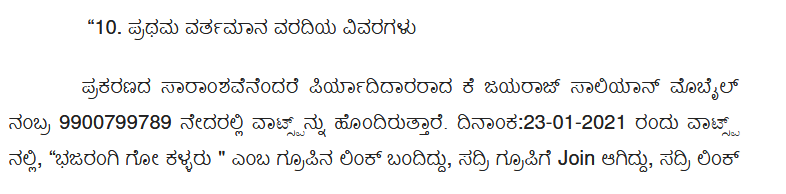
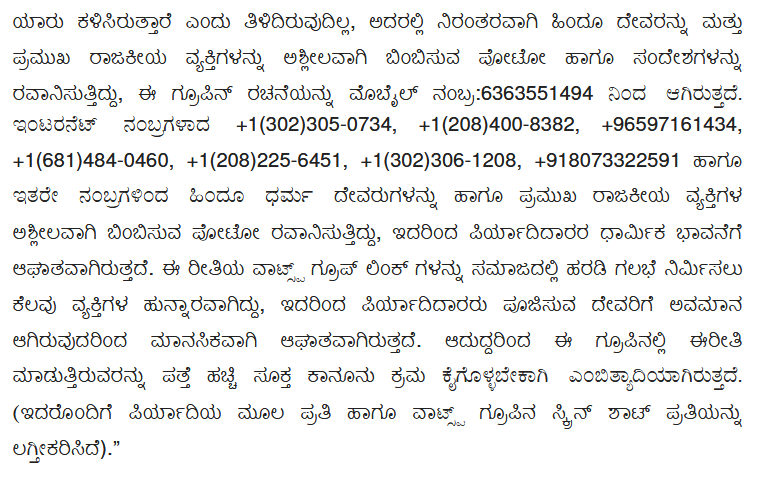
I in the above said subject matter is true on date 23.01.2021 in whatsapp an link is sent in the name of "Bajarangi Go Kallaru",. I don't know who sent the Link, on pressed the link it joined the above mentioned group. further in the group continuously the created obscene photos of Hindu God and Political persons are sent, this group is created by number 6363551494. Several internet numbers +1(302)305-0734, +1(208)400-8382, +96597161434, +1(681)484- 0460, +1(208)6451, +1(302) 306-1208, +918073322591 also from other numbers Hindu god and political persons photos and messages are been sent. By spreading this group link few person are conspiring to create communal violence in the society also because of this for me the insult to the god I pray made me cause mental trauma, hence I request to investigate and take action against those persons.
Yours Faithfully
K.J Salian
Enclosed: copies of whatsapp group screen shots.
This Complainant came to station on date 25/01/2020 at 16.30 hours and gave this written complaint, its received and registered as Crime No 4/2021 under section 67 IT Act, 295(A) IPC Act. An FIR Registered."
This is carried out in the gist of the crime. It reads as follows:
Investigation was in progress prior to interdiction by this Court. The State has produced entire investigation material before this Court, a perusal of which contains depictions of Hindu deities in an extraordinarily obscene, demeaning and profane manner. The content is such that reproduction thereof, in a judicial order, would itself be inappropriate. Suffice it to observe that the material on its face has the tendency to outrage religious feelings and disturb communal harmony. Whether the petitioner had requisite mens rea, the extent of his role and the liability of other administrators are all matters that falls squarely within the domain of investigation. Premature interdiction by this Court would amount to stifling a lawful enquiry into allegations of serious import. I am of the considered view that the offence under Section 295A of the IPC is met to every word of its ingredient albeit, prima facie. The matter is still at the stage of investigation. What could be the outcome of the investigation is yet to be known. Therefore, this Court cannot now interdict the investigation of an offence of such nature. While this Court notes with some concern that the Investigating Officer appears to have blissfully ignored to proceed uniformly against all administrators of the group. However, if the investigation leads to any member being actively involved in permitting circulation of such pictures, they must be brought to book. At this investigative stage, any further observation at the hands of this Court would be unnecessary.
11. Therefore, finding the petition meritless, as none of the contentions advanced would hold water and finding prima facie ingredients being met of the offence under Section 295A of the IPC or even under the Act, the petition lacking in merit stands rejected. Since the crime is of the year 2021, the Investigating Officer shall now conclude the investigation as expeditiously as possible, without brooking any delay, bearing in mind the observations made in the course of the order. Ordered accordingly.
Interim order of any kind operating shall stand dissolved. Consequently, I.A.No.2 of 2024 also stand disposed.
|
| |

