


1. Pursuant to the letter addressed to the Registrar General dated 21.01.2026 as per directions issued by the Division Bench of this Court in the case of In reference (suo moto) vs State of M.P. : Writ Petition No. 5184 of 2025 decided on 20.02.2025, cognizance was taken and the letter was treated as suo moto petition. Accordingly, this writ petition came up for consideration before this Court.
2. Today when the matter is taken up, State counsel has brought to the notice of this Court the documents placed on record which indicate that the mother and the prosecutrix/victim were provided counselling by the authorities and they have stated before the Medical Board that the victim will not undergo abortion. In this regard, their statements have been recorded on 20.01.2026 and the same reads as under :

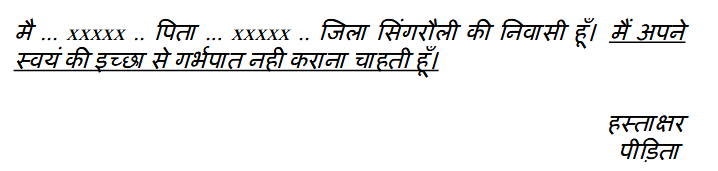
3. From the perusal of the Final Medical Opinion, the victim has categorically denied for termination of pregnancy and she wants to continue with the pregnancy. The extracts of the Final Medical Opinion dated 20.01.2026 read as under :
Upon examination and review of the records, it is stated that the pregnant woman is above eighteen (18) years of age and is therefore a major, legally competent to take decisions regarding her body and pregnancy.
The woman has been appropriately counselled regarding her condition and available options. She has clearly and voluntarily expressed her decision not to undergo medical termination of pregnancy (MTP). As she is a major and mentally competent, her decision is valid in law and is hereby respected.
Further, as per the provisions of the Medical Termination of Pregnancy (Amendment) Act, 2021 and the applicable MTP Rules, termination of pregnancy beyond twenty-four (24) weeks of gestation is not permissible, except under conditions explicitly allowed by law and on the recommendation of a duly constituted Medical Board. In the present case, the gestational age is approximately thirty-three (33) weeks, which is beyond the legally permissible limit for medical termination of pregnancy. Therefore, medical termination of pregnancy cannot be performed at this stage as per existing statutory guidelines.
4. I n the case of A vs State of Maharashtra , reported in (2024) 6 SCC 327 , the Hon'ble Supreme Court has held as under :
"25. From a perusal of the MTP Act, its Statement of Objects and Reasons as well as the recommendation of the Shah Committee which examined the issue of liberalising abortion laws in India, [Report of the Committee to Study the Question of Legalisation of Abortion, Ministry of Health and Family Planning, Government of India, dated December 1966.] two clear postulates emerge as to the legislative intent of the MTP Act. Firstly, the health of the woman is paramount. This includes the risk avoided from the woman not availing unsafe and illegal methods of abortion. Secondly, disallowing termination does not stop abortions, it only stops safe and accessible abortions. The opinion of the RMP and the Medical Board must balance the legislative mandate of the MTP Act and the fundamental right of the pregnant person seeking a termination of the pregnancy. However, as noticed above and by this Court in X v. State (NCT of Delhi) [X v. State (NCT of Delhi), (2023) 9 SCC 433] the fear of prosecution among RMPs acts as a barrier for pregnant people in accessing safe abortion. Further, since the MTP Act only allows abortion beyond twenty-four weeks if the foetus is diagnosed with substantial abnormalities, the Medical Board opines against termination of pregnancy merely by stating that the threshold under Section 3(2-B) of the MTP Act is not satisfied. The clarificatory report dated 3-4-2024 fell into this error by denying termination on the ground that the gestational age of the foetus is above twenty-four weeks and there are no congenital abnormalities in the foetus....
35. In Suchita Srivastava v. Chandigarh Admn. [Suchita Srivastava v. Chandigarh Admn., (2009) 9 SCC 1 : (2009) 3 SCC (Civ) 570] , a three-Judge Bench of this Court has held that the right to make reproductive choices is a facet of Article 21 of the Constitution. Further, the consent of the pregnant person in matters of reproductive choices and abortion is paramount. The purport of this Court's decision in Suchita Srivastava [Suchita Srivastava v. Chandigarh Admn., (2009) 9 SCC 1 : (2009) 3 SCC (Civ) 570] was to protect the right to abortion on a firm footing as an intrinsic element of the fundamental rights to privacy, dignity and bodily integrity as well as to reaffirm that matters of sexual and reproductive choices belong to the individual alone. In rejecting the State's jurisdiction as the parens patriae of the pregnant person, this Court held that no entity, even if it is the State, can speak on behalf of a pregnant person and usurp her consent. The choice to continue pregnancy to term, regardless of the court having allowed termination of the pregnancy, belongs to the individual alone."
5. In the instant case, the victim aged about 18 years is a rape victim as the case being Crime No. 06 of 2026 has been registered at Police Station Vindhyanagar District Singrauli for the offence under Sections 69, 296A, 115(2), 351(3), 3(5) of Bharatiya Nyaya Sanhita and Section 4(1) and 5l/6 of the POCSO Act. The victim is carrying pregnancy of more than 33 weeks and she has voluntarily expressed her consent not to undergo medical termination of pregnancy which is reflected from her statement as well as from final medical opinion which are placed on record. In other words, she wants to continue with the pregnancy. It is well settled that the consent of pregnant woman in such matters is paramount.
6. Therefore, in view of the final medical opinion as well as the statement of victim pointing out that she does not want to terminate the pregnancy, this Court cannot direct the Medical Board to terminate the pregnancy of the victim. Accordingly, the procedure for full-term delivery will be carried out in the presence of the expert team of doctors.
7. It is made clear that in case the victim and her parents are not ready to keep the child if born alive, then they may hand over the child to the State authorities/CWC after a period of 15 days from the date of his/her birth. The child if born alive will remain with the mother/victim for 15 days from date of birth for the purpose of breast feeding. The CWC will be at liberty to give the child on adoption to any willing family in accordance with law. The State authorities are directed to ensure the privacy of the victim and any information including family details should not be published in any form of media which could lead to the identification of the victim. The said directions are being issued looking to the welfare of the child so that his/her upbringing can be taken care of.
8. In above terms, the petition stands disposed of finally.

 |
This Product is Licensed to , |