Judges: THE HONOURABLE MR. JUSTICE NARESH KUMAR CHANDRAVANSHI
Parties : Rameshwar Pathak Versus State Of Chhattisgarh Through District Magistrate, Raigarh, (C.G.)
Appearing Advocates : For the Appellant: Sudeep Verma, Advocate on behalf of Akansha Singh, Advocate. For the Respondent: Sachchidanand Yadav, Panel Lawyer.
Date of Judgment : 23-11-2026
Head Note :-
Protection of Children from Sexual Offences Act, 2012 - Section 8 -
Comparative Citation:
2026 CGHC 48045,
Judgment :-
CAV Judgment
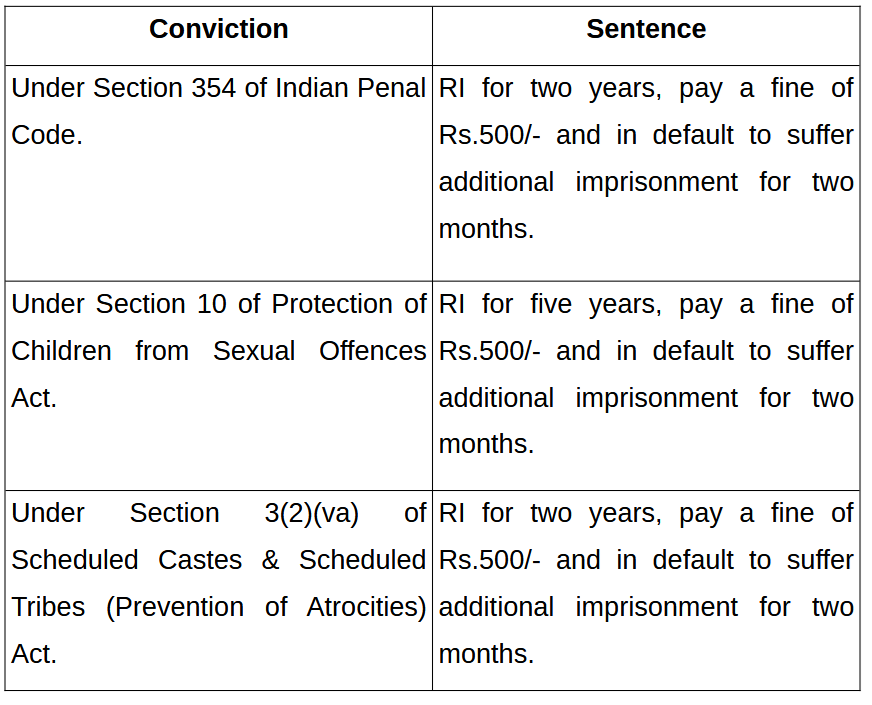
1. The appellant in this appeal calls in question the legality and validity of the judgment of conviction and order of sentence dated 16.5.2024 passed by Additional Sessions Judge, FTSC (POCSO), Distt. Raigarh in Special POCSO Case No.36/2023 whereby the appellant stands convicted and sentenced as under:
All the substantive jail sentences were directed to run concurrently.
2. Case of the prosecution, in brief, is that father of the victim lodged a written complaint (Ex.P/4) at Police Station Chakradharnagar, alleging that his daughter (the victim), whose date of birth is 21.07.2017, had gone to the house of their neighbour, Rameshwar Pathak, on 07.05.2023 at around 6:30 p.m. to play with his grandchildren, who had come to visit him. At around 7:30 p.m., Rameshwar Pathak shouted at the guard in an unusual and improper manner. Hearing his voice, the complainant sent his wife to bring the victim back. The victim returned home in a frightened and distressed condition and informed her mother that Rameshwar Pathak had put his hand inside her pants and touched her, due to which she had become frightened. On the basis of the aforesaid written complaint (Ex.P/4) lodged by the victim's father, FIR bearing Crime No. 266/2023 was registered at Police Station Chakradharnagar for the offences punishable under Section 354 of IPC, Section 8 of the Protection of Children from Sexual Offences Act, 2012 (POCSO Act) and Section 3(2) of the Scheduled Castes and Scheduled Tribes (Prevention of Atrocities) Act, and investigation was taken up.
2.1 During investigation, the statement of the victim was recorded by a woman police officer, and the statements of her mother and other witnesses were also recorded. The spot was inspected and a spot map was prepared vide Ex.P/7. Upon finding prima facie evidence against the accused, he was arrested and the arrest memo was prepared. The birth certificate of the victim (Article A-3), and the caste certificate of the victim's father (Article A-1) were seized, and a seizure memo (Ex. P-6) was prepared. Upon completion of the investigation, the charge-sheet was filed before the competent Court for the offences punishable under Section 354 of IPC, Section 10 read with Section 9(d) of the POCSO Act, and Section 3(2)(va) of the Scheduled Castes and Scheduled Tribes (Prevention of Atrocities) Act (in short "SC/ST Act"), for trial.
3. Learned trial Court framed charges under Sections 354, 9(d)/10 of POCSO Act and Sections 3(2)(va) of the SC/ST Act, which were abjured by the appellant and he prayed for trial. In order to substantiate its case the prosecution examined 09 witnesses in all and exhibited 19 documents. Statement of the accused was recorded u/s 351 of BNSS wherein he denied all the incriminating circumstances appearing against him in the prosecution evidence, pleaded innocence and false implication. However, no witness was examined by him in defence.
4. After hearing counsel for the respective parties and appreciation of oral and documentary evidence on record, the learned trial Court convicted and sentenced him as mentioned in the opening paragraph of this judgment. Hence this appeal.
5. Learned counsel for the appellant would submit that the impugned judgment is per se illegal and contrary to the material available on record. He submits that in fact, the appellant had a dispute with the complainant as the complainant's dogs had bitten the family members of the appellant twice and whenever the appellant or his family members asked the complainant to tie the dogs, he would quarrel with them. This fact has come in the evidence of the complainant and his wife. Learned counsel would next submit that had there been any such molestation of the victim, then she being under fear and trauma would not have attended birthday party of her friend on the same day. The medical evidence also does not support the prosecution case. He further submits that the FIR was lodged after an inordinate delay of 22 days, which remains unexplained and creates serious doubt regarding the allegations levelled against the appellant. Thus, looking to the nature and quality of evidence adduced, the whole prosecution case appears to be concocted one but the learned trial Court without properly appreciating the evidence, has recorded a finding of guilt against the appellant. Hence the present appeal deserves to be allowed and the impugned judgment is liable to be set aside.
6. Per contra, learned State counsel submits that the victim was aged about 6 years and 1 month at the time of the incident. She has remained consistent with regard to the allegation of bad touch committed by the appellant, right from the complaint lodged by her parents and recording of her statement (Ex.P/3) under Section 164 of the Cr.P.C., as well as in her police statement and statement before the Court. He further submits that although the parents of the minor victim had taken her to the birthday party of her friend, the same was only with the intention of helping her return to normalcy and overcome her fear and trauma. He also submits that the parents of the victim have duly supported her deposition. It has been specifically mentioned in the written complaint that since the minor victim was under fear and trauma, the FIR was lodged after due deliberation among the family members, which resulted in the delay. Hence, the impugned judgment is well-merited and does not call for any interference. The instant appeal being without any substance is liable to be dismissed.
7. Heard learned counsel for the parties and perused the material available on record.
8. First of all, this Court has to see whether on the date of incident, the victim was below 12 years of age. The trial Court, upon appreciation of the oral and documentary evidence available on record, has recorded a finding that the date of birth of the victim was 21.03.2017. In arriving at the said conclusion, the trial Court took into consideration her original birth certificate (Article A-3), which was seized during investigation vide seizure memo (Ex.P-6), as well as the testimonies of her mother (P.W.-1) and father (P.W.-3), who duly corroborated the date of birth mentioned therein. The prosecution has further established that the birth certificate was issued by the Directorate of Economics and Statistics, Department of Finance, Planning, Economics and Statistics, Government of Chhattisgarh, on 08.01.2018. The said document was produced by the victim's father, who was her natural guardian, and was duly proved during trial. The testimonies of her parents regarding her date of birth remained unchallenged in their cross-examination. Although the written complaint (Ex. P-4) mentions the date of birth of the victim as 21.07.2017, such discrepancy does not materially affect the prosecution case regarding her age, as even reckoning her age from the said date, she was below 12 years on the date of incident. Moreover, the date of birth recorded in the original birth certificate (Article A-3) stands duly corroborated by the testimonies of her parents. The victim, while appearing before the trial Court, also stated her age to be seven years and disclosed that she was studying in Class-I. Her age was also recorded as seven years in the deposition sheet. Further, in her statement recorded under Section 164 of the CrPC (Ex.P/3), she had stated her age to be seven years.
9. In view of the aforesaid oral and documentary evidence, this Court finds no reason to take a different view from that taken by the trial Court. The prosecution has successfully established that the date of birth of the victim was 21.03.2017 and, consequently, on the date of incident, i.e., 07.05.2023, she was aged about 6 years, 1 month and 16 days, and was thus below 12 years of age. Accordingly, the prosecution has duly proved that the victim was a child within the meaning of Section 2(1)(d) of the POCSO Act on the date of the incident.
10. As regards the caste of the victim, the trial Court, upon appreciation of the oral and documentary evidence available on record, has recorded a finding that she belongs to the Scheduled Tribe community. The mother of the victim (P.W.-1), in her deposition, categorically stated that her caste is 'Oraon', which is recognised as a Scheduled Tribe. Similarly, the father of the victm (P.W.-3), in paragraph 2 of his examination-in-chief, also deposed that his caste is 'Oraon' and that the same falls within the Scheduled Tribe category. During investigation, Sub-Inspector Santra Chauhan (P.W.-9), in paragraph 4 of her examination-in-chief, stated that the father of the victim had produced his own caste certificate as well as that of his wife, which were seized by her vide seizure memo (Ex. P-6). The said caste certificates were marked as Articles A-1 and A-2, respectively. Her testimony regarding the seizure of the caste certificates remained unchallenged.
11. A perusal of the aforesaid caste certificates (Articles A-1 and A-2) reveals that the caste of both the parents of the victim has been recorded as 'Oraon', and they have been certified to be members of the Scheduled Tribe community. The oral testimony of both parents duly corroborates the documentary evidence brought on record by the prosecution. In view of the aforesaid oral and documentary evidence, this Court finds that the prosecution has successfully established that the parents of the victim belong to the 'Oraon' community, which is recognised as a Scheduled Tribe. Consequently, the victim, being their daughter, has also been established to be belonging to the Scheduled Tribe community. Further, PW-1 and PW-3 mother and father of the victim respectively have deposed that the appellant belongs to "Pathak" community which falls in the unreserved category. The appellant in his accused statement has also admitted the fact that he is of "Pathak" community. Accordingly, this Court finds no reason to interfere with the finding recorded by the trial Court on the said issue, and the same is hereby affirmed.
12. Now, this Court proceeds to examine whether the prosecution has successfully established the charge against the appellant under Sections 354 of the IPC and 9(d)/10 of the POCSO Act. The victim, who was aged about seven years at the time of her deposition, has categorically stated that while she had gone to the house of the appellant to play, he inserted his hand inside her underwear and touched her private parts. She has further stated that the appellant asked her to touch his private parts and made indecent gestures. The victim also disclosed that the appellant asked her not to reveal the incident to her parents and offered to take her out. Her testimony is natural, consistent and inspires confidence. Nothing material could be elicited in her cross-examination to discredit her testimony.
13. The testimony of the victim finds substantial corroboration from the evidence of her mother (P.W.-1), to whom the victim disclosed the incident immediately after returning home. P.W.-1 has categorically stated that the victim was frightened and distressed when she returned from the appellant's house and narrated the incident to her. The father of the victim (P.W.-3) has also corroborated the version of P.W.-1 regarding the disclosure made by the victim. Their evidence, in material particulars, supports the prosecution case.
14. The defence has sought to discredit the prosecution case on the ground that the victim attended the birthday party of her friend on the same evening. However, this circumstance, by itself, cannot be considered sufficient to discard the otherwise trustworthy testimony of a child victim. The mere fact that the victim participated in a social gathering after the incident does not necessarily negate the occurrence. Rather, father of the victim (PW-3) has given a genuine and plausible explanation in this regard in para 15 of his cross- examination that he had sent the victim to the birthday party because he did not want the incident to have any adverse impact on her mind. Similarly, the absence of external injuries on the person of the victim or her private parts, as stated by the medical officer (P.W.-7), does not disprove the allegation of touching her private parts. The medical evidence is not inconsistent with the nature of the act alleged.
15. The delay in lodging the FIR has also been explained by the father of the victim (P.W.-3), who stated that after discussing the matter with his family, he lodged the written complaint on 29.05.2023. Having regard to the tender age of the victim and the nature of the allegations, the said delay, in the facts of the present case, does not appear to be fatal to the prosecution. The evidence of P.W.-1 and P.W.-3 regarding the disclosure made by the victim further lends assurance to the prosecution version.
16. The defence has also suggested that the appellant was falsely implicated on account of a dispute relating to the alleged dog-bite incidents involving the family members of the appellant. However, the said suggestion has been denied by P.W.-1 and P.W.-3. No cogent material has been brought on record to establish that the alleged dispute was the reason for falsely implicating the appellant. Mere suggestions put to the witnesses, without any supporting material evidence, cannot displace the otherwise reliable testimony of the victim.
17. So far as the offence under Section 3(2)(va) of the SC/ST Act is concerned, the prosecution has established through the testimony of P.W.-1 and P.W.-3, as well as the caste certificates (Articles A-1 and A- 2), duly seized vide seizure memo (Ex. P-6) and proved by the investigating officer (P.W.-9), that the parents of the victim belong to the 'Oraon' community, which is recognised as a Scheduled Tribe. Consequently, the victim has also been established to be a member of the Scheduled Tribe community. Further, P.W.-1 and P.W.-3 have specifically deposed that the appellant, who belongs to unreserved category, was aware of their tribal identity. Their testimony on this aspect has not been materially shaken in cross-examination. In the facts and circumstances of the case, the prosecution has established the necessary ingredients of the offence punishable under Section 3(2) (va) of the SC/ST Act.
18. It is well settled that the conviction can be based upon the sole testimony of the victim, provided it is found to be reliable and inspires confidence. In the present case, the victim's testimony is cogent and trustworthy and receives assurance from the surrounding circumstances and the evidence of her parents. Minor discrepancies and omissions in the statements of the witnesses, particularly having regard to the tender age of the victim, do not affect the credibility of the prosecution case.
19. In view of the foregoing discussion, this Court finds that the prosecution has successfully established all the charges leveled against the appellant beyond reasonable doubt. The learned trial Court has properly appreciated the oral and documentary evidence available on record and has rightly recorded the finding of guilt as also sentence against the appellant. This Court, therefore, finds no illegality or perversity in the impugned judgment warranting interference.
20. In the result, the appeal fails and is, accordingly, dismissed. The appellant is reported to be in jail, therefore, no further order regarding his arrest, surrender etc. is required to be passed.
21. Record of the concerned trial Court along with a copy of this judgment be sent back forthwith for information and necessary compliance.
22. Pending application(s), if any, shall also stand disposed of.