Mool Chand Tyagi, J.
1. The present Appeal is filed by the Appellant - State of Gujarat under the provisions of Section 378 of the Code of Criminal Procedure, 1973 ( hereinafter be referred to as Cr.P.C. ) challenging the Judgment dated 26.06.1997 passed by the learned Additional Sessions Judge, Jamnagar ( hereinafter be referred to as the Ld. Trial Court / Ld.ASJ) in Sessions Case No.8 of 1996, whereby the Respondents herein were ordered to be acquitted of the charges for the offences punishable under Section 302 r/w 114 of the Indian Penal Code,1860 (hereinafter be referred to as "IPC") .
2. The facts and circumstances giving rise to the filing of the present appeal are as follows: The deceased - Harish Ramniklal Tanna was residing at Jamnagar. Accused No.1-Sonal Harish Tanna is the wife of the deceased, whereas Accused No.2- Jayaben Natvarlal Radia is the mother-in-law of the deceased. It is alleged that on 25.10.1995, at about 11:00 a.m., on the occasion of the Gujarati New Year, the deceased along with accused No.1 had gone to the residence of his maternal uncle- Prafulbhai for paying respects and seeking blessings. Thereafter, as the deceased intended to visit Virpur for darshan, he left accused No.1 at the residence of his maternal uncle and proceeded to Virpur alone. At about 11:00 p.m., he returned to Jamnagar from Virpur and at about 1:00 a.m., he and accused No.1 returned to their residence. According to the prosecution, upon their return, accused no.2 reprimanded the deceased for having gone to Virpur alone after leaving accused no.1 at the residence of his maternal uncle. As the deceased was tired, he retired to bed at about 1:30 a.m. It is further the case of the prosecution that during the late hours of the night, the deceased woke up due to coughing and noticed that kerosene had been sprinkled over his body. Immediately thereafter, accused No.2 allegedly ignited a matchstick and threw the same upon the deceased, as a result of which he sustained extensive burn injuries. The deceased raised shouts for help, whereupon Rajesh Kanaji, son of the landlord, rushed to the spot with a pillow and attempted to extinguish the fire by pressing the pillow against the back of the deceased. Thereafter, the deceased ran into the falia and succeeded in extinguishing the flames by rolling on the ground.
3. Accordingly, FIR being I.C.R.No. 429 of 1995 was lodged at Jamnagar City 'A' Division Police Station, Jamnagar and investigation was carried out and ultimately, charge-sheet came to be filed against the accused under Sections 302 r/w 114 of the IPC before the Judicial Magistrate. As the case was exclusively triable by the Court of Sessions, learned Chief Judicial Magistrate under Section 209 of the Cr.P.C. committed the said case to the Court of Sessions Court, Jamnagar , which came to be numbered as Sessions Case No.8/1996.
4. On 23.04.1997, the learned Trial Court framed the charges at Exh. 5 under Sections 302 r/w 114 of the IPC. Since, the accused did not plead guilty and claimed to be tried, they were tried for the said offences.
5. In order to bring the home the guilty of the accused, the prosecution has led following oral and documentary evidences:-
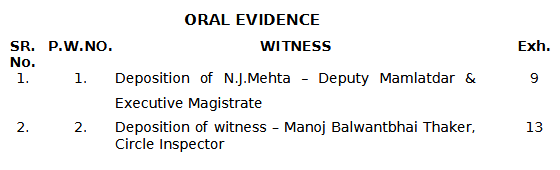
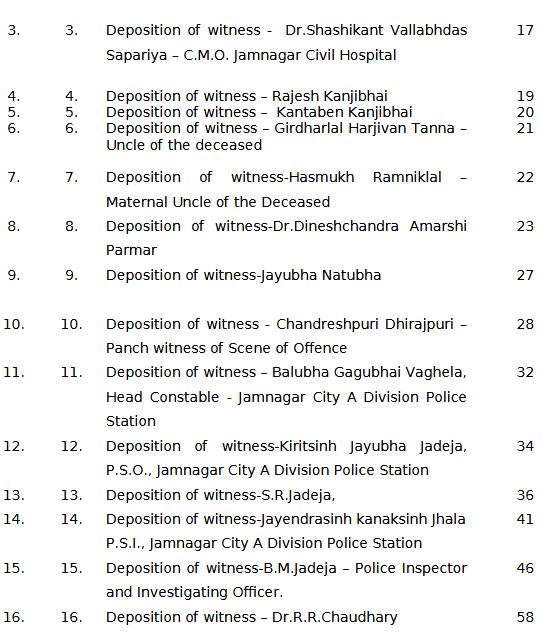
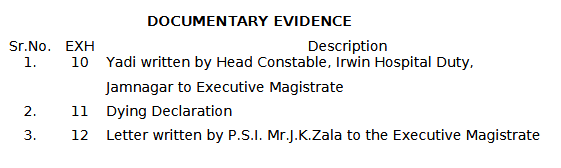
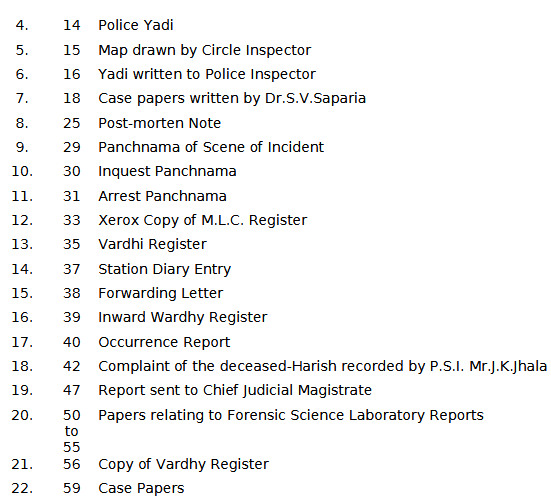
6. After recording all the evidence, statements of the accused under Section 313 of Cr.P.C. were recorded and all the incriminatory evidence were put to them. They denied all the incriminatory evidences and took the plea that they have been falsely implicated in the crime. Thereafter, the case was fixed for the evidence of accused, but they had not led any oral and/ or documentary evidence. Thereafter, hearing the arguments on behalf of the prosecution and the defence and having considered the arguments and evaluating the oral as well as documentary evidences, the Ld. ASJ acquitted the accused of all the charges levelled against them by the Judgment dated 26.06.1997.
7. Being aggrieved by and dissatisfied with the judgment dated 26.06.1997 passed by the learned ASJ, Jamnagar, the appellant-State has preferred the present Criminal Appeal.
8. We have heard learned Additional Public Prosecutor for the appellant-State.
9. Mr. Yuvraj Brahmbhatt, learned Additional Public Prosecutor for the appellant-State, vehemently submitted that the case of prosecution rests on dying declaration, which was recorded by P.W.1 and he also made the oral dying declarations before the P.W.4, P.W.5, P.W.6 and P.W.9. It is submitted that P.W.14 took the complaint made by the deceased himself at Exh.42. Not only this, P.W.1 recorded the dying declaration, which had been proved at Exh.11. It is submitted that the version of the witnesses in respect of dying declaration is in consonance with the dying declaration recorded by P.W.1. It is submitted that there are ample evidence on record to convict the respondents, however, the learned ASJ committed a grave illegality in acquitting the accused. It is submitted that the learned Trial Court ought to have believed the dying declaration and ought to have convicted the accused for the charges levelled against them. He, therefore, submitted that the order of acquittal recorded by the learned ASJ is not sustainable, hence contended that the impugned judgment is liable to be set aside and accused persons shall be held guilty and be convicted accordingly.
10. Though Rule has been duly served upon the respondents, they have chosen not to appear before the Court, and thereafter, bailable and non-bailable warrants were issued. It also emerges from the record that as per the directions of the Court, the proclamation was to be issued. It also emerges from the record that vide order dated 02.09.2023, learned advocate Mr.Ekant Ahuja was appointed by the Court to represent the respondents in accordance with Rule 360 of the Gujarat High Court Rules, 1993, but when the matter was heard, none appeared on behalf of respondents, therefore, appeal has been heard in absence of respondents.
11. We have heard the learned APP appearing for the appellant - State and perused the material available on record. Before proceeding further, it would be apposite to scrutinize the oral as well as documentary evidence tendered by the material prosecution witnesses before the learned ASJ, so as to decided as to whether the order of acquittal is sustainable or liable to be set aside.
12. In order to bring home the guilt of the accused, the prosecution has examined as many as 16 witnesses and has also led 22 documentary evidences on record.
13. From perusal of the ocular as well as documentary evidence available on record, it emerges that the case of the prosecution rests primarily upon the dying declaration of the deceased recorded by P.W.1 and the complaint made by the deceased himself to P.W.14. Before appreciating the ocular evidence, it would be apposite to narrate the law regarding the appreciation of ocular evidence. In the case of Balu Sudam Khalde v. State of Maharashtra reported in 2023 SCC OnLine SC 355, wherein the principles of appreciating the ocular evidence have been summarized. The same is reproduced hereinunder for ready reference:-
APPRECIATION OF ORAL EVIDENCE
25. The appreciation of ocular evidence is a hard task. There is no fixed or straight-jacket formula for appreciation of the ocular evidence. The judicially evolved principles for appreciation of ocular evidence in a criminal case can be enumerated as under:
"I. While appreciating the evidence of a witness, the approach must be whether the evidence of the witness read as a whole appears to have a ring of truth. Once that impression is formed, it is undoubtedly necessary for the Court to scrutinize the evidence more particularly keeping in view the deficiencies, drawbacks and infirmities pointed out in the evidence as a whole and evaluate them to find out whether it is against the general tenor of the evidence given by the witness and whether the earlier evaluation of the evidence is shaken as to render it unworthy of belief.
II. If the Court before whom the witness gives evidence had the opportunity to form the opinion about the general tenor of evidence given by the witness, the appellate court which had not this benefit will have to attach due weight to the appreciation of evidence by the trial court and unless there are reasons weighty and formidable it would not be proper to reject the evidence on the ground of minor variations or infirmities in the matter of trivial details.
III. When eye-witness is examined at length it is quite possible for him to make some discrepancies. But courts should bear in mind that it is only when discrepancies in the evidence of a witness are so incompatible with the credibility of his version that the court is justified in jettisoning his evidence.
IV. Minor discrepancies on trivial matters not touching the core of the case, hyper technical approach by taking sentences torn out of context here or there from the evidence, attaching importance to some technical error committed by the investigating officer not going to the root of the matter would not ordinarily permit rejection of the evidence as a whole.
V. Too serious a view to be adopted on mere variations falling in the narration of an incident (either as between the evidence of two witnesses or as between two statements of the same witness) is an unrealistic approach for judicial scrutiny.
VI. By and large a witness cannot be expected to possess a photographic memory and to recall the details of an incident. It is not as if a video tape is replayed on the mental screen.
VII. Ordinarily it so happens that a witness is overtaken by events. The witness could not have anticipated the occurrence which so often has an element of surprise. The mental faculties therefore cannot be expected to be attuned to absorb the details.
VIII. The powers of observation differ from person to person. What one may notice, another may not. An object or movement might emboss its image on one person's mind whereas it might go unnoticed on the part of another.
IX. By and large people cannot accurately recall a conversation and reproduce the very words used by them or heard by them. They can only recall the main purport of the conversation. It is unrealistic to expect a witness to be a human tape recorder.
X. In regard to exact time of an incident, or the time duration of an occurrence, usually, people make their estimates by guess work on the spur of the moment at the time of interrogation. And one cannot expect people to make very precise or reliable estimates in such matters. Again, it depends on the time- sense of individuals which varies from person to person.
XI. Ordinarily a witness cannot be expected to recall accurately the sequence of events which take place in rapid succession or in a short time span. A witness is liable to get confused, or mixed up when interrogated later on.
XII. A witness, though wholly truthful, is liable to be overawed by the court atmosphere and the piercing cross examination by counsel and out of nervousness mix up facts, get confused regarding sequence of events, or fill up details from imagination on the spur of the moment. The sub- conscious mind of the witness sometimes so operates on account of the fear of looking foolish or being disbelieved though the witness is giving a truthful and honest account of the occurrence witnessed by him.
XIII. A former statement though seemingly inconsistent with the evidence need not necessarily be sufficient to amount to contradiction. Unless the former statement has the potency to discredit the later statement, even if the later statement is at variance with the former to some extent it would not be helpful to contradict that witness."
[See Bharwada Bhoginbhai Hirjibhai v. State of Gujarat 1983 Cri LJ 1096 : (AIR 1983 SC 753) Leela Ram v. State of Haryana AIR 1995 SC 3717 and Tahsildar Singh v. State of UP (AIR 1959 SC 1012)]"
14. Now, in the light of the aforesaid principles, the ocular evidence on record deserves to be scrutinized. P.W.1 - Deputy Mamlatdar and Executive Magistrate, recorded the dying declaration of the deceased. A careful reading of his entire deposition, however, reveals that he has substantially deposed about the procedure adopted and the manner in which the dying declaration came to be recorded. He has not specifically and independently deposed as to the contents of the dying declaration. Though the dying declaration has been exhibited at Exh.11, the contents thereof attribute specific acts to both the accused, namely, that both of them sprinkled kerosene over the deceased and that accused No.2 ignited a matchstick and set him on fire. In cross-examination, he denied the suggestion that at the time of recording the dying declaration, the relatives and the neighbors of the deceased were not present. He denied the suggestion that the deceased was not conscious and was in a condition to made the dying declaration.
15. P.W.14, Jayendrasinh Kanaksinh Jhala, P.S.I. at Jamanagar City 'A' Division Police Station, in his deposition at Exh.41 deposed that on 26.01.1995, he was serving as Investigating P.S.I. at Jamnagar City 'A' Division Police Station. He received the Yadi of Station Diary Entry No.5/95 at 3:10 hours in the early morning from Head Constable Manubha Naranji, who was on duty at Irwin Hospital. On receiving the Yadi, he immediately rushed to the hospital where deceased was taking the treatment for burn injuries in Ward M. S.3 of Irwin Hospital under Dr.Dodia. He also deposed that he personally recorded the complaint as dictated by the deceased. He could not obtain the signature of the deceased, as the Doctor applied the bandages on his hands. Therefore, he obtained his toe impression on the complaint. He also proved the complaint at Exh.42. He deposed that the deceased disclosed that his wife and his mother-in-law had set him on fire. In cross- examination, he admitted that before recording the complaint, he had not obtained the certificate from the doctor regarding the fitness of the deceased. He also admitted that the deceased was severely burnt. He also admitted that, at that time, 2 to 3 relatives of the injured were present.
16. The prosecution has also examined Dr.Shashikant Vallabhdas Sapariya as P.W.3 at Exh.17. He deposed that when the deceased was admitted, he was conscious and he gave the history before him that his wife and mother-in-law have set him on fire. The history was noted in the case papers. He proved the case papers at Exh.18. He also deposed that that the deceased had sustained the burn on his face, head, chest, abdomen part, back part and both the hands. He also deposed that burn injures were serious and was such that to cause the death. In the cross-examination, he admitted that when he saw the patient, it did not appear he would die immediately.
17. The prosecution has also examined Rajesh Kanjibhai as P.W.4 at Exh.19. He deposed that the deceased and accused are residing in their house. The incident occurred on the New Year eve between 12:00 to 1:00 hour at night. He was sleeping in his house and his mother was sleeping in Veranda. At that time, on hearing the shouts of the deceased, his mother woke him up and stated that someone is burning at the outside. Therefore, he took the pillow and went to douse the fire and with the help of the pillow, he doused the fire of deceased. The deceased shouted for help. At that time, the accused persons were standing in the street near the tin-sheet gate. Accused- Jayaben threw water from an iron hod on deceased. Thereafter, he caught hold of hand of deceased and made him sit near the gate and then he ran to call father of the deceased. The house of father of deceased was locked because he had gone for pilgrimage. Therefore, he went to call the uncle of deceased viz. Girdharilal. When he returned back with Girdharilal, an ambulance had arrived and deceased was shifted to Irvin Hospital in ambulance. They were 7 to 9 persons accompanying with the deceased, which included him, Kantibhai, Jayubhai, Pravinbhai, Somabhai, Kasambhai and Girdharilal. Deceased-Harish died in this hospital on the next day. In the cross-examination, he admitted that he did not know that his mother-in-law and wife of the deceased used to behave well with the deceased. He did not know as to whether deceased had fallen into a ditch or not.
18. The prosecution has also examined Kantaben Kanjibhai as P.W.5 at Exh.20. She deposed that they had given small room to Ramnikbhai for use. Ramnikbhai's son/daughter's mother-in-law Jayaben came to live in that room. She also deposed that hearing a commotion in her courtyard, she looked through the crack from her house door and saw a flame and heard shouts of "Save me, Save me" so she called out and woke up her son Raju, who went to extinguish the fire with pillow. Thereafter, she felt dizzy and fell unconscious. She further deposed that she had seen both accused persons standing in the courtyard at that time. She regained consciousness after 40-45 minutes. She also deposed that she heard the shout of deceased shouting "My mother-in-law has set on fire, save me, save me.". In cross-examination, she admitted that she told the police that "Jayaben filed a hod (tagaru) with water from the water tank in the courtyard and poured it on Harish and Harish rolled on the grond and extinguished his body".
19. The prosecution has also examined Girdharlal Harjivan Tanna as P.W.6 at Exh.21. He deposed that the incident had occurred on the night of New Year eve on 26.10.1995. It happened in night around at 1:00 a.m. to 1:30 a.m. Rajesh came to him to inform about the incident. He came and told him "Come, Your Nephew is burnt." Therefore, he immediately rushed to the house of deceased-Harish, but deceased-Harish had gone to his father Ramnik's house, therefore, he went to the house of Ramnikbhai. At that time, I asked the deceased- Harish "What did you do? and Harish stated, "The mother and daughter together have set me ablaze." Meanwhile, the ambulance arrived, so putting deceased-Harish in the ambulance, he, Rajesh and other people went to Irwin Hospital and admitted him. He was accompanied with Jayubha, Kanjibhai, Pravinbhai, Vala etc. The police recorded his statement. In his cross-examination, he admitted that Rajesh told him that accused-Jayaben poured poured a hod (tagaru) of water over deceased-Harish. He denied the suggestion that deceased-Harish did not tell the names of accused persons at all, but all of them gathered together and gave the names of the accused persons on behalf of Harish. He also denied that suggestion that the deceased-Harish did not tell him that his mother-in-law and his wife have burnt him.
20. The prosecution has has also examined Hasmukh Ramniklal as P.W.7 at Exh.22. He deposed that deceased- Harish was his sister's son and his sister has passed away. He came to know about the incident when Shailesh informed him that deceased-Harish had been burnt and taken to the Hospital. Therefore, he and his nephew-Umesh and Shailesh went to Irwin Hospital. In the hospital, he asked the deceased- Harish as to what had happened and how this happened? deceased-Harish told him that he had gone to Virpur with his employer, so his mother-in-law asked him why I did not take her daughter along with him and over this issue, his wife and his mother-in-law poured kerosene on him and set him on fire. In cross-examination, he admitted that when deceased-Harish and his son came to his house to seek blessings there were glad. They took some refreshment at his house. From his house, they went to the house of his elder uncle - Prafulbhai for seeking blessings. There was no dispute between the deceased-Harish and his wife.
21. The prosecution has also examined Dr.Dineshchandra Amarsinh Parmar as P.W.8 at Exh.23. He deposed that he conducted the post-mortem of deceased-Harish Ramniklal on 27.10.1995. He proved that the deceased sustained burn injuries of first to second decree on the face, neck, chest, upper part of the abdomen, back portion and on both the hands. Which means the upper layer of the skin on these parts of the body was completely burnt. He proved that the cause of death of the deceased was trauma caused due to burn injuries. He proved the post-mortem report at Exh.25. In his cross- examination, he admitted that the brain of the deceased was swollen. De to swelling in the brain, it can generally be said that in such circumstances, a person might not be in his complete senses. He also admitted that the person, who sustained such injuries can speak in a very low voice, and therefore, his statement can be recorded only if a person familiar with his voice and language explains it to another unknown person.
22. The prosecution has examined Jayubha Natubha as P.W.9 at Exh.27. He deposed that on the day of incident, while he was sleeping at his home, Somabhai came and informed him that deceased-Harish had been burnt and he had been taken to the Hospital. Therefore, he went to Ramnikbhai's house where deceased-Harish was standing in a burnt condition. He asked deceased-Harish what had happened to which he replied that "Get me to the hospital, I am feeling severe burning sensation." He also told me that "My mother-in-law and my wife sprinkled kerosene and set me on fire with a matchstick.". Thereafter, they have taken him to the hospital. In cross- examination, he denied the suggestion that deceased-Harish did not tell me that his wife and mother-in-law set him on fire.
23. The prosecution has also examined Chandreshpuri Dhirajpuri as P.W.10 at Exh.28. He is the panch-witnesses of the place of accident. He proved the panchnama. He deposed that the a mattress, two pillows, a kerosene an, two matchsticks and one shirt were lying in the room and these all articles were seized by drawin a panchanama. In his cross- examination, he admitted that the seized shirt was wet with water. There was also a hod in which water can be stored. He further stated that seized mattress was slightly burnt. The pillows or the bed-sheet were not burnt. The muddmala mattress is shown to him. He stated that there were no visible signs on the mattress that indicate it was burnt.
24. The prosecution has also examined Balubha Gangubha Vaghela as P.W.11 at Exh.32. He proved that on 26.10.1995, he was serving as a Head-Constable at Jamnagar City B Division Police Station. At that time, he was posted as Irwin Hospital as Duty Head Constable. Head Constable Manubha Naranji was on duty as Duty Constable from 00:00 hours to 08:00 hours on 26.10.1995. He has passed away. He proved the original M.L.C. Register and Entry No.2457/95.
25. The prosecution has also examined Dr. Rajesh Raghuvir Chaudhari as as P.W.16 at Exh.58. He proved that on 26.10.1995, he was on duty as First Year Resident Doctor in the ward of Dr.Dodiya at Irwin Hospital, Jamnagar. At that time, injured/deceased-Harish was admitted for treatment in Dr.Dodiya's ward. He deposed that after 15-20 minutes of admitting the inured/deceased, the Executive Magistrate had arrived to record the dying declaration. At that time, the injured/deceased was fully conscious and could have made the statement. He opined that the injured/deceased had 60 to 65% burn injuries. The injured/deceased had suffered burn injuries on vital part of body. He also admitted in the cross- examination that when the police recorded the complaint, he was present in the ward. He also admitted that the uncle of the injured/deceased viz. Girdharilal and the brother of the injured/deceased viz. Umesh were with the injured/deceased. He also admitted that when the statement of the injured/deceased was recorded, the relatives of the injured/deceased were present in the room, however, he denied the suggestion that the injured person was not in a physical and mental condition to give a dying declaration.
26. The prosecution has also examined Manoj Balwantbhai Thaker as as P.W.2 at Exh.13. He has prepared the map of place of accident. He proved the map on record.
27. P.W.14 has recorded the complaint of the deceased, wherein the deceased narrated the same version of the incident as reflected in the dying declaration. The said complaint, which has been proved at Exh.42 and formed the basis for registration of the F.I.R., can also be treated as a dying declaration in view of the decision of the Hon'ble Apex Court rendered in the case of Niraj Kumar @ Neeraj Yadav v. State of U.P. & Ors., reported in 2025 LiveLaw (SC) 1171. It is a well-settled proposition of law that a conviction can be founded solely on a truthful and reliable dying declaration. However, before placing reliance upon such evidence, the Court is required to satisfy itself that the dying declaration inspires confidence and has been proved beyond all reasonable doubt. Therefore, the question that falls for consideration is whether the dying declaration recorded by P.W.1 and the complaint of the victim/deceased recorded by P.W.14, which is also in the nature of a dying declaration, have been proved to be genuine, voluntary and trustworthy, free from any suspicion or doubt.
28. The case of the prosecution rests substantially upon the dying declaration of the deceased. P.W.1 recorded the said dying declaration, which has been brought on record and proved at Exh.11. As per the contents of Exh.11, the deceased stated that his mother-in-law and wife had set him on fire. The reason stated by the deceased for the alleged incident was that, in the morning, a quarrel had taken place between him, his mother-in-law and his wife. P.W.1 has deposed that, at the relevant time, the deceased was undergoing treatment at Irwin Hospital in the ward of Dr. Dodiya. According to P.W.1, he obtained the signature of the concerned doctor and the dying declaration was recorded in the presence of the doctor. Thus, the prosecution seeks to place considerable reliance upon Exh.11 as the principal incriminating circumstance against the accused. However, merely because a statement is recorded in the form of a dying declaration and bears the certification or signature of a medical officer, its contents do not become immune from scrutiny. The Court is required to examine the dying declaration as a whole and assess its intrinsic reliability in the light of the manner in which it came to be recorded, the surrounding circumstances, the conduct of the witnesses and its consistency with the other evidence on record. Where the dying declaration constitutes the principal foundation of the prosecution case, the Court is required to examine with greater care whether the statement inspires confidence and whether the same finds assurance from the surrounding circumstances. In the present case, therefore, Exh.11 cannot be considered in isolation. Its contents, particularly the allegation that the wife and mother-in-law had set the deceased on fire and the alleged quarrel in the morning stated to be the genesis of the incident, are required to be tested against the contemporaneous medical record as well as the depositions of the witnesses who were the first persons to reach the scene and the other surrounding circumstances brought on record by the prosecution. If material aspects narrated in the dying declaration are not supported by such evidence, or if the same are contradicted by the contemporaneous record or the testimony of material witnesses, the evidentiary value of the dying declaration would necessarily require careful reconsideration. It is in this background that the contents of Exh.11, the circumstances in which it was recorded and the subsequent evidence on record are required to be examined conjointly rather than in isolation.
29. P.W.16 - Dr. Rajesh Raghuvir Chaudhari deposed that, in his opinion, the patient was fully conscious and in a fit condition to give a dying declaration. He further deposed that the dying declaration at Exh.11 bears his signature certifying the mental and physical condition of the deceased. However, in his cross-examination, P.W.16 admitted that, at the time when the statement was being recorded, the relatives of the deceased were present in the room. Thus, in light of the deposition of P.W.16, it emerges that the dying declaration was recorded in the presence of the relatives of the deceased. This circumstance assumes significance while assessing the evidentiary value and reliability of the dying declaration recorded by P.W.1. The dying declaration is, therefore, required to be tested in the light of the surrounding circumstances and other evidence on record. P.W.14 recorded the complaint, which came to be proved at Exh.42 and which, according to the prosecution was made by the deceased- Harish himself. If the contents of the dying declaration recorded at Exh.11 by P.W.1 are compared with the contents of the complaint recorded by P.W.14 at Exh.42, material contradictions and omissions emerge. In the dying declaration, the reason stated for the incident was the quarrel which had taken place between the deceased-Harish, his wife and his mother-in-law in the morning. However, no such fact has been narrated in the complaint at Exh.42. Further, neither in the FIR nor in the dying declaration has the deceased stated that he had informed any of the other witnesses that his wife and mother-in-law had set him on fire. Moreover, in the dying declaration, the deceased stated that immediately after coming out of the room, he fell into a ditch situated outside the room. However, this material fact does not find any mention in the complaint at Exh.42.
30. P.W.4 was the first person, who came to the rescue of the deceased and attempted to rescue the deceased by dousing the fire with the help of a pillow. However, he has also nowhere stated that, at the relevant time, the deceased was shouting that his wife and mother-in-law had set him on fire. The absence of any such material assertion in the deposition of P.W.4, being the first person who came to the rescue of the deceased, assumes significance and creates a material doubt on the version of the prosecution.
31. P.W.5, who is the mother of P.W.4 deposed that the deceased-Harish was shouting that his mother-in-law had set him on fire. However, she has nowhere stated that the deceased was also shouting that his wife had set him on fire. Significantly, in her cross-examination, P.W.5 admitted that she had stated before the police that Jayaben (mother-in-law of the deceased) had filled a hod (tagaru) with water from the water tank situated in the courtyard and had poured the same over Harish in an attempt to douse the fire. The factum of dousing the fire by pouring water also finds corroboration from the deposition of the panch witness viz. Chandreshpuri Dhirajpuri examined as P.W.10 at Exh.28. He was a panch witness to the scene of offence and deposed that the shirt of the deceased was wet with water. He further deposed that a hod (tagaru) was found at the scene of offence. The aforesaid circumstance is further corroborated by the deposition of P.W.2, Circle Inspector, who had prepared the map of the scene of offence. Thus, the prosecution itself has brought on record evidence, which does not support and in material respects contradicts, the version of the prosecution. Furthermore, on a close scrutiny of the deposition of P.W.5, it emerges that when she saw the deceased in flames, she became dizzy and fell unconscious and regained consciousness only after about 40 to 45 minutes. In such circumstances, her subsequent assertion that she had heard the deceased shouting that he had been set on fire by his wife and mother- in-law requires careful scrutiny. More particularly, this assertion does not appear to be free from doubt when considered in the light of her own admission that the mother- in-law was attempting to douse the fire by pouring water over the deceased with the help of a hod (tagaru). The aforesaid circumstances, therefore, materially affect the reliability of the version of P.W.5 regarding the alleged oral dying declaration.
32. Further, P.W.7 - Hasmukh Ramniklal, who is the maternal uncle of the deceased has deposed that on the day of the incident, the deceased had visited his house along with his wife to seek his blessings on the occasion of the New Year. As per his deposition, the deceased and his wife appeared to be happy and there was no indication of any discord between them. Thus, the deposition of P.W.7 does not support the prosecution version regarding the alleged altercation between the deceased and his wife in the morning, as stated in the alleged dying declaration. On the contrary, the evidence of P.W.7 creates a doubt regarding the occurrence of any such altercation and consequently, does not lend support to the prosecution case.
33. Firstly, it has come on record that the mother-in-law was alleged to have set the deceased on fire. She does not implicate the wife. Further, the medical case papers at Exh.18 do not implicate the accused-wife and, in fact, keep her completely out of the picture. P.W.6, P.W.9 and P.W.12 have deposed that the deceased had made an oral dying declaration. However, from the deposition of P.W.4, it emerges that he had accompanied the aforesaid witnesses and had informed P.W.6 about the incident. He had also accompanied the deceased to the hospital. Despite the same, P.W.4 has nowhere stated in his deposition that the deceased had made any such oral dying declaration. Further, the medical history proved on record at Exh.59 also casts a serious doubt on the prosecution case, particularly in view of the apparent alteration and manipulation therein as regards the person by whom the history was given and the nature of the burn injuries viz. whether the same were suicidal or homicidal. The said alteration and manipulation in the medical history have not been satisfactorily explained by the prosecution. Such unexplained discrepancy necessarily operates against the prosecution and creates a material doubt regarding the alleged oral dying declaration. In view of the aforesaid material contradictions and discrepancies in the prosecution evidence, the learned ASJ was justified in disbelieving the prosecution version and extending the benefit of doubt to the accused.
34. The learned ASJ has recorded six reasons for disbelieving the case of the prosecution. The learned ASJ has committed no error in appreciating the evidence on record and in disbelieving the prosecution case. Thus, in view of the settled position of law, no infirmity can be found in the judgment of acquittal rendered by the learned ASJ, whereby both the respondents have been acquitted of all the charges levelled against them. While arriving at the aforesaid conclusion, the learned ASJ has assigned as many as six cogent and convincing reasons. In my considered view, the reasons recorded by the learned ASJ are sound, cogent and consistent with the well-settled principles of law. Hence, no interference is warranted with the impugned judgment and order of acquittal.
35. In light of the aforesaid evidence on record, it is difficult to rely the version of the prosecution that the both the accused persons poured the kerosene on deceased and set him on fire. The evidence placed on record had not inspire the confidence of the Court when more particularly, the version of the victim before the witness is different. In case of Paniben (Smt.) versus State of Gujarat reported in (1992) 2 SCC 474, the Hon'ble Apex Court laid down the following principles governing the dying declaration:-
"18. ........ (i) There is neither rule of law nor of prudence that dying declaration cannot be acted upon without corroboration. (Munnu Raja v. State of M.P.17 )
(ii) If the Court is satisfied that the dying declaration is true and voluntary it can base conviction on it, without corroboration. (State of U.P. v. Ram Sagar Yadav18 ; Ramawati Devi v. State of Bihar19 ).
(iii) This Court has to scrutinise the dying declaration carefully and must ensure that the declaration is not the result of tutoring, prompting or imagination. The deceased had opportunity to observe and identify the assailants and was in a fit state to make the declaration. (K. Ramachandra Reddy v. Public Prosecutor20) .
(iv) Where dying declaration is suspicious it should not be acted upon without corroborative evidence. (Rasheed Beg v. State of M.P.21)
(v) Where the deceased was unconscious and could never make any dying declaration the evidence with regard to it is to be rejected. (Kake Singh v. State of M. P.22)
(vi) A dying declaration which suffers from infirmity cannot form the basis of conviction. (Ram Manorath v. State of U.P.23) 16 (1992) 2 SCC 474 17 (1976) 3 SCC 104 18 (1985) 1 SCC 552 19 (1983) 1 SCC 211 20 (1976) 3 SCC 618 21 (1974) 4 SCC 264 22 1981 Suppl. SCC 25 23 (1981) 2 SCC 654 Criminal Appeal No.485 of 2012
(vii) Merely because a dying declaration does not contain the details as to the occurrence, it is not to be rejected. (State of Maharashtra v. Krishnamurti Laxmipati Naidu24)
(viii) Equally, merely because it is a brief statement, it is not be discarded. On the contrary, the shortness of the statement itself guarantees truth. (Surajdeo Oza v. State of Bihar25).
(ix) Normally the court in order to satisfy whether deceased was in a fit mental condition to make the dying declaration look up to the medical opinion. But where the eye witness has said that the deceased was in a fit and conscious state to make this dying declaration, the medical opinion cannot prevail. (Nanahau Ram v. State of M.P.26).
(x) Where the prosecution version differs from the version as given in the dying declaration, the said declaration cannot be acted upon. (State of U.P. v. Madan Mohan27)."
36. Further, in case of Irfan @ Naka versus The State o Uttar Pradesh reported in 2023 LiveLaw (SC) 698, in Paragraph No.62, the Hon'ble Apex Court has observed as under:-
"62. There is no hard and fast rule for determining when a dying declaration should be accepted; the duty of the Court is to decide this question in the facts and surrounding circumstances of the case and be fully convinced of the truthfulness of the same. Certain factors below reproduced can be considered to determine the same, however, they will only affect the weight of the dying declaration and not its admissibility: -
(i) Whether the person making the statement was in expectation of death?
(ii) Whether the dying declaration was made at the earliest opportunity? "Rule of First Opportunity"
(iii) Whether there is any reasonable suspicion to believe the dying declaration was put in the mouth of the dying person?
(iv) Whether the dying declaration was a product of prompting, tutoring or leading at the instance of police or any interested party?
(v) Whether the statement was not recorded properly?
(vi) Whether, the dying declarant had opportunity to clearly observe the incident?
(vii) Whether, the dying declaration has been consistent throughout?
(viii) Whether, the dying declaration in itself is a manifestation / fiction of the dying person's imagination of what he thinks transpired?
(ix) Whether, the dying declaration was itself voluntary?
(x) In case of multiple dying declarations, whether, the first one inspires truth and consistent with the other dying declaration?
(xi) Whether, as per the injuries, it would have been impossible for the deceased to make a dying declaration?"
37. It is well settled by catena of decisions that the an Appellate Court has full power to review, re-appreciate and reconsider the evidence upon which the order of acquittal is founded. However, Appellate Court must bear in mind that in case of acquittal there is double presumption in favour of the accused. Firstly, the presumption of innocence is available to him under the fundamental principle of criminal jurisprudence that every person shall be presumed to be innocent unless he is proved guilty by a competent Court of law. Secondly, the accused having secured his acquittal, the presumption of his innocence is further reinforced, reaffirmed and strengthened by the trial Court.
38. Further, if two reasonable conclusions are possible on the basis of the evidence on record, the Appellate Court should not disturb the finding of acquittal recorded by the trial Court. Further, while exercising the powers in appeal against the order of acquittal, the Court of appeal would not ordinarily interfere with the order of acquittal unless the approach of the lower Court is vitiated by some manifest illegality and the conclusion arrived at would not be arrived at by any reasonable person and, therefore, the decision is to be characterized as perverse. Merely because two views are possible, the Court of appeal would not take the view which would upset the judgment delivered by the Court below. However, the Appellate Court has a power to review the evidence if it is of the view that the conclusion arrived at by the Court below is perverse and the Court has committed a manifest error of law and ignored the material evidence on record. A duty is cast upon the Appellate Court, in such circumstances, to re-appreciate the evidence to arrive to a just decision on the basis of material placed on record to find out whether the accused are connected with the commission of the crime with which he is charged.
39. In the instance case, learned APP failed to point out any cogent and incriminating evidence against the accused persons, which may connect the accused persons with the commission of the offence beyond reasonable doubt. At this stage, it would be profitable to refer to the judgment of Apex Court in the case of Chandrappa & Ors. Vs. State of Karnataka reported in 2007 (4) SCC 415. The relevant observations made in the said judgment are as under:-
"..... (1) An appellate Court has full power to review, reappreciate and reconsider the evidence upon which the order of acquittal is founded;
(2) The Code of Criminal Procedure, 1973 puts no limitation, restriction or condition on exercise of such power and an appellate Court on the evidence before it may reach its own conclusion, both on questions of fact and of law;
(3) Various expressions, such as, 'substantial and compelling reasons', 'good and sufficient grounds', 'very strong circumstances', 'distorted conclusions', 'glaring mistakes', etc. are not intended to curtail extensive powers of an appellate Court in an appeal against acquittal. Such phraseologies are more in the nature of 'flourishes of language' to emphasize the reluctance of an appellate Court to interfere with acquittal than to curtail the power of the Court to review the evidence and to come to its own conclusion.
(4) An appellate Court, however, must bear in mind that in case of acquittal, there is double presumption in favour of the accused. Firstly, the presumption of innocence available to him under the fundamental principle of criminal jurisprudence that every person shall be presumed to be innocent unless he is proved guilty by a competent court of law. Secondly, the accused having secured his acquittal, the presumption of his innocence is further reinforced, reaffirmed and strengthened by the trial court.
(5) If two reasonable conclusions are possible on the basis of the evidence on record, the appellate court should not disturb the finding of acquittal recorded by the trial court."
40. Applying the aforesaid principle as laid down by the Apex Court in the case of Chandrappa (supra), it is apparent on record that no credible evidence had been produced by the prosecution, which may connect the accused persons in the alleged crime. The prosecution has miserably failed to prove the guilt of the accused persons beyond reasonable doubt. Thus, the Trial Court has not committed any error in appreciating the evidence on record and in acquitting the accused persons from the challenges levelled against them.
41. In these facts and circumstances, we are of the considered opinion that the learned Trial Judge committed no error in passing the impugned judgment and order. Hence, the present appeal deserves to be dismissed.
42. In the result, the appeal fails and is dismissed. The judgment and order of the Trial Court dated 26.06.1997 stands confirmed. Bail and bail bonds of the accused, if any, stands discharged. R & P be sent back to the concerned Trial Court, forthwith. No order as to costs.



