Judges: THE HONOURABLE CHIEF JUSTICE MR. VIBHU BAKHRU & THE HONOURABLE MRS. JUSTICE K.S. HEMALEKHA
Parties : State Project Director Rashtriya Madhyamika Shiksha Abhiyan, Bangaluru Versus M/s. KMV Projects, Rep. by Its Vice President & Authorised Signatory, D. Taranath Dasari, Bengaluru & Another
Appearing Advocates : For the Appellant: Kiran Vasanth Ron, Additional Advocate General, K.S. Harish, Government Advocate. For the Respondents: R1, Zufikir Shafi, Advocate.
Date of Judgment : 18-08-2026
Head Note :-
Commercial Courts Act, 2015 - Section 13(1a) -
Judgment :-
(Prayer: This Commercial Appeal is filed under Section 13(1a) of the Commercial Courts Act, 2015 read with Section 37(1)(C) of the Arbitration and Conciliation Act, 1996 praying to set aside the judgment dated 30.11.2024, passed in Com.Ap.No.40/2024 on the file of the Hon'ble LXXXVI Additional City Civil and Sessions Judge at Bangalore and consequently.)
C.A.V. Judgment
Vibhu Bakhru, CJ.
1. The appellant, the State Project Director, Rashtriya Madhyamika Shikshana Abhiyana, has filed the present appeal under Section 13(1A) of the Commercial Courts Act, 2015 [CC Act] read with Section 37(1)(c) of the Arbitration and Conciliation Act, 1996 [A&C Act], impugning a judgment dated 30.11.2024 [impugned order] passed by the learned LXXXVI Additional City Civil and Sessions Judge, Commercial Court, Bengaluru (CCH-87) [Commercial Court] in Com.A.P.No.40/2024. The appellant had filed the said petition under Section 34 of the A&C Act seeking setting aside of an arbitral award dated 10.11.2023 [impugned award] rendered by the learned Sole Arbitrator [Arbitral Tribunal]. The learned Commercial Court found no ground to interfere with the impugned award and accordingly passed the impugned order dismissing the petition.
2. Respondent No.1, M/s KMV Projects [KMV], was the claimant before the Arbitral Tribunal and the appellant was the respondent. In terms of the impugned award, the Arbitral Tribunal partly allowed KMV's claims and directed the appellant to pay a total sum of Rs.3,80,58,227/- (Rupees three crores eighty lakhs fifty-eight thousand two hundred and twenty-seven only), comprising Rs.1,94,43,288/- towards price adjustment (Claim No.1) together with past and current interest of Rs.1,04,99,375/-; Rs.51,80,150/- towards unproductive overhead charges, Claim No.6(a); and Rs.29,35,414/- towards loss of expected profit (Claim No.7); with future interest at 9% per annum on Rs.2,75,58,852/- from the date of the award till payment; and Rs.3,00,000/- towards costs (Claim No.11).
3. The present appeal is one of a batch of nine appeals, (COMAP Nos.53/2025 to 61/2025), filed by the appellant against orders passed by the learned Commercial Court dismissing the appellant's petitions under Section 34 of the A&C Act, (Com.A.P.Nos.39/2024 to 47/2024) assailing separate Arbitral Awards rendered by the Arbitral Tribunal constituted of Sole Arbitrator in respect of the contract of nine packages awarded to M/s. KMV. The arbitral awards rendered are substantially in similar terms and the issues involved in the said nine appeals are also materially similar.
PREFATORY FACTS
4. Rashtriya Madhyamika Shikshana Abhiyana [RMSA] is a centrally sponsored scheme launched in the year 2009-10 by the Ministry of Human Resource Development, Government of India, for enhancing access to, and the quality of, secondary education. The Government of Karnataka [GoK] implemented the scheme through the appellant and took up 2,024 civil works under 77 packages between 2009-10 and 2013-14. The said civil works involved construction of new school buildings, Adarsha Vidyalayas [model schools] and girls' hostels, and strengthening and upgradation of existing schools at an aggregate cost of Rs.1,645.70 crores. The scheme has since been integrated with Samagra Shikshana Karnataka (2018-19).
5. On 24.09.2012, tenders were invited on a package basis through the e-procurement portal in respect of works spread over thirty districts of the State. KMV emerged the successful bidder in respect of nine packages comprising 406 scattered work sites. The present dispute pertains to Package A-4 -- Construction of Adarsha Vidyalayas at Bidar and Aurad Blocks and Girls' Hostels at Bidar, Aurad, Basavakalyan and Humnabad Blocks of Bidar District [the subject package] - comprising six works. After KMV was declared as the lowest bidder (L1), the parties entered into negotiations, and pursuant to said negotiations, KMV reduced its quoted rates.
6. By its letter dated 13.02.2013 (Ex.C2), which bears an acknowledgement of service at the appellant's office, KMV offered a revised price of Rs.17,61,88,838/-, being 19.55% above the updated estimate. It is material to note that KMV concluded the said letter by stating that it was "ready to execute the above project considering the inclusion of 'Price Adjustment Clause' at the said price. Thereafter, by Letter of Acceptance dated 18.03.2013 (Ex.C3), the appellant accepted the revised offer for a contract price of Rs.1,761.89 lakhs.
7. The parties executed a Construction Agreement [the Agreement] dated 15.05.2013 (Ex.C4). Clause 4 of the Agreement stipulates that the Letter of Acceptance, the Contract Data, the Conditions of Contract, and the Special Conditions of Contract, among other documents, formed an integral part of the Agreement.
8. Notice to proceed with the work was issued on 17.05.2013 (Ex.C5) and the stipulated period of completion was twenty months therefrom, which expired on 16.02.2015. During execution, additional quantities and EIRL (Extra Items Rate List: unbudgeted items) items were required to be executed. Upon approval of the competent authority, the parties entered into a Supplementary Agreement dated 17.03.2017, which forms part of Ex.C4, for Rs.374.89 lakhs taking the revised contract value to Rs.2,136.78 lakhs.
9. Clause 4(i) of the Supplementary Agreement stipulates that all conditions of the original agreement (the Agreement) are applicable "except for the price adjustment clause, for which a decision will be taken after the completion of enquiry ordered by the Government".
10. There was delay in execution of the works it was not completed within the stipulated period. During the period between 2013 and 2019, KMV addressed several letters to the appellant, inter alia, alleging (i) delay in handing over sites; (ii) delay in supply of drawings; (iii) delay in approval of work slips and EIRL items; (iv) delay in release of payments; (v) non availability of water and power; and (vi) scarcity of sand. KMV invoked Clause 39 of the Conditions of Agreement and raised the price adjustment. None of the said bills were paid.
11. In the meantime, under Government Order No. ED 49 MCD 2016 dated 16.11.2016, the GoK, while granting administrative approval to a revised project cost of Rs.1,717.24 crores excluding price adjustment, the GoK directed (i) an audit by the Karnataka Institute of Public Auditors [KIPA] into the causes of and responsibility for the delay; and (ii) an enquiry into the issue of price adjustment by a committee headed by an officer of the rank of Additional Chief Secretary. The committee reported that the price adjustment clause incorporated in the tender documents for the RMSA civil works of 2009-10 and 2010-11 was not duly approved and was not binding on the GoK. By a communication dated 17.07.2018, the State Project Director informed the contractors that price adjustment would not be paid and that extension of time would be considered only upon giving up their contractual claims in that behalf.
12. The said Government Order and communication were impugned by three other contractors namely, M/s Jampana Constructions Pvt. Ltd., M/s NCC Ltd., and M/s KBR Infratech Pvt. Ltd. in W.P. Nos.38613/2018, 35594/2018 and 34990/2018 respectively. By orders dated 25.02.2019 (Ex.R2), a learned Single Judge of this Court quashed the Government Order dated 16.11.2016 and restrained the State from acting upon KIPA's reports and suggestions. The court observed that whether Clause 39 was incorporated with approval or inserted unauthorisedly is a disputed question of fact, and relegated the petitioners to arbitration. The intra-court appeals - W.A. Nos.958/2019, 996/2019 and 1031/2019 by the contractors, and W.A. No.2791/2019 by the State - were disposed of by a Division Bench of this Court on 20.10.2020, observing that "the parties would be governed by the terms of the contract entered into by them in respect of various packages awarded by the State".
13. By its letter dated 12.03.2019 (Ex.C68), KMV set out the causes of delay and its claims; and by legal notice dated 08.05.2019 (Ex.C69), it invoked the arbitration agreement under Clause 24 of the Conditions of Contract read with Clause 4 of the Special Conditions of Contract.
14. The appellant responded by letter dated 11.06.2019 (Ex.C70), stating that the claims were rejected in its office letter No.146 dated 06.05.2019 and that the reference was premature in view of the pendency of the writ appeals.
15. KMV filed an application under Section 11 of the A&C Act (C.M.P.No.251/2019) seeking appointment of an Arbitrator. This Court allowed the same by an order dated 05.11.2020 and appointed a Sole Arbitrator to adjudicate the disputes between the parties.
16. In the meanwhile, by Government Order No.EP 89 YYK 2020 dated 30.09.2020 (Ex.R1), the GoK, adopted the recommendations of the Technical Advisory Committee in supersession of the KIPA report, ordered that (i) for computing extension of time and penalty, each work site in a package be treated as a separate unit; (ii) the administration be held responsible for delays occasioned by causes beyond the contractor's control; and (iii) price adjustment be allowed in respect of the 25 packages whose tender conditions contained the price adjustment clause. Admittedly, the sums due to KMV were released only thereafter and were received in full before 29.03.2021. By an order dated 13.01.2021, extension of time was
ARBITRAL PROCEEDINGS
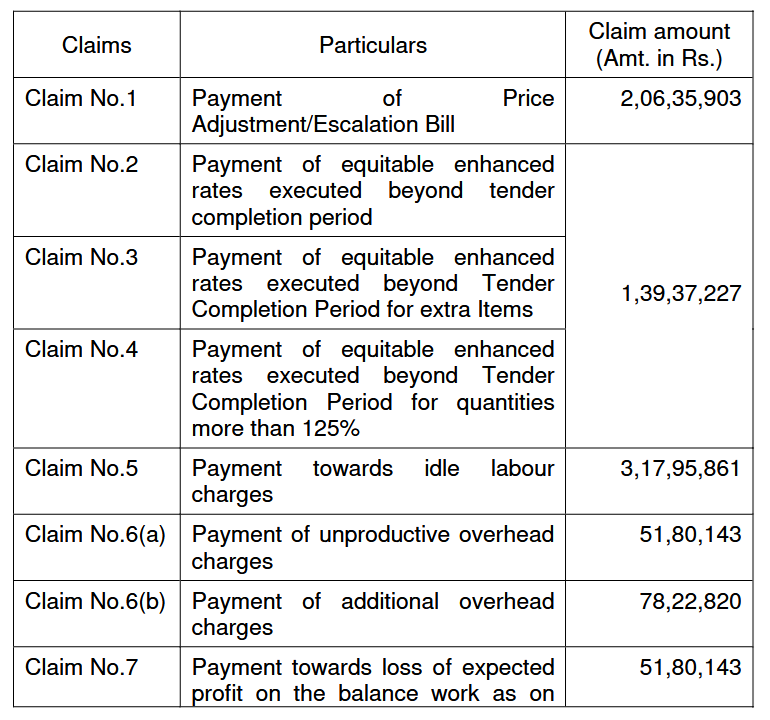
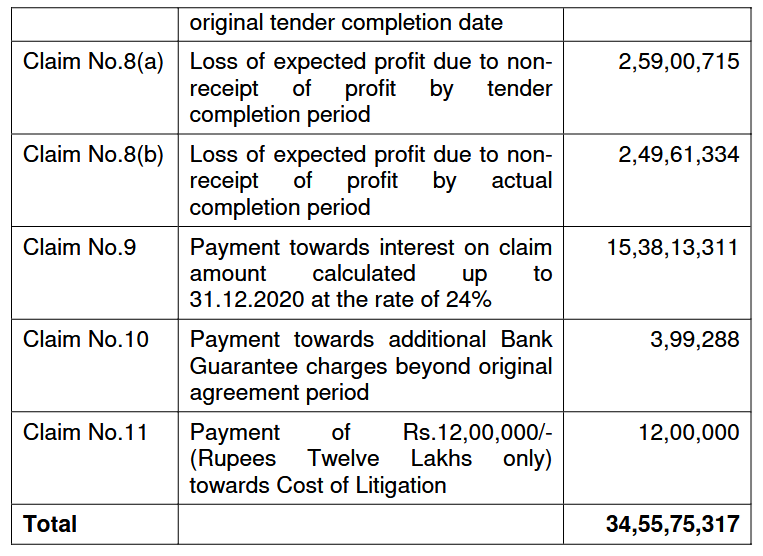
17. KMV filed its statement of claims before the Arbitral Tribunal claiming an amount of Rs.34,55,75,317/- (Rupees Thirty-four crores Fifty-five lakhs Seventy-five thousand Three hundred and Seventeen) under eleven heads. The summary of claims as set out in the statement of claims is reproduced below.
18. It was the KMV's case that after it was declared a successful bidder, it had reduced its rates by factoring in the price escalation clause and the economies of scale. KMV claimed that the appellant did not hand over the sites within the stipulated period despite various requests. Thus, KMV was effectively prevented from completing the contract within time, and the execution of the works was prolonged. KMV alleged that the appellant also withheld amounts due to KMV, which compelled KMV to seek reference of disputes to arbitration.
19. The respondent contended that the price variation clause (clause 39) of the conditions of contract was not applicable as the notice inviting tenders uploaded expressly provided that the said clause be read as deleted. It is contended that this clause was unauthorisedly included in the Agreement. Thus, the appellant was not bound by the said price variation clause.
20. On the basis of the pleadings between the parties, the Arbitral Tribunal framed the following issues.
"1. Whether Claimant proves that non completion of the works under the contract within the stipulated period was for the reasons solely attributable to Respondent, resulting in breach of contract by Respondent, as such, the delay in completion of the works was solely attributable to Respondent?
2. Whether for the reasons set out in SOC which were beyond the control of Claimant, he was prevented from completing the entire scope of work within the scheduled contract period?
3. Whether Respondent proves that the delay in completion of the works under the contract within the original period stipulated under the contract was solely attributable to Claimant?
4. Whether Respondent proves that as the requirements of Clause 37.3 of Conditions of Contract have not been complied with by Claimant, none of the claims put-forth in SOC is tenable?
5. Whether the Claimant is entitled for payment of amounts claimed under various heads as put-forth under claim Nos.1 to 8 of SOC?
6. Whether the Claimant is entitled for payment towards past interest on the amounts claimed up to 31-12-2021 at 24% PA as claimed under claim No.9 of SOC?
7. Whether Claimant is entitled for current and future interest at 24%PA on the amount claimed?
8. Whether Claimant is entitled for cost of this arbitral proceeding?
9. To what order and award the parties are entitled to?"
21. The Arbitral Tribunal, after examining the evidence and materials placed on record, found that non-completion of the contract within the stipulated period was for the reasons attributable to the appellant. The Arbitral Tribunal also partly found that some of the actions had prevented KMV from completing the contract.
22. The Arbitral Tribunal partly allowed claims No. 1, 6(a), and 7. The Arbitral Tribunal also awarded future interest and costs but rejected the remaining claims.
23. The dispositive part of the impugned award is set out below:
"The claims of Claimant as put forth in Statement of Claim are allowed in part as under:
(1) Claim No.1 is allowed in part in a sum of Rs.1,94,43,288/- only as against the claim of Rs.2,06,35,903/- together with Rs.1,04,99,375/- towards past and current interest calculated up to 10.11.2023, totalling to Rs.2,99,42,663/;
(2) Claim No.6(a) is allowed in a sum of Rs.51,80,150/-;
(3) Claim No.7 is allowed in part in a sum of Rs.29,35,414/- only, as against the claim of Rs.51,80,143/-;
(4) Respondent is directed to pay to Claimant a total sum of Rs.3,80,58,227/-as per Sl.No.(1) to (3) above together with future interest at the rate of 9% per annum from the date of this Award till the date of payment on- Rs.02,75,58,852/-;
(5) Claim No.11 is allowed in part in a sum of Rs.3,00,000/- only as against claim of Rs.12,00,000/-. Respondent is directed to pay to Claimant, this amount within a period of 3 months from the date of this award failing which the said amount shall carry interest at the rate of 9% per annum from the date of award till the date of payment;
(6) Claim Nos.2 to 5, 6(b); 8(a); 8(b), 9 and 10 are rejected in their entirety;
(7) Claimant shall pay requisite stamp duty on this award payable as per Karnataka Stamp Act,
With the pronouncement and publication of Award, this Arbitral Proceeding stand terminated as per Section 32(1) of the Act.
REASONS AND CONCLUSION
24. The appellant has assailed the impugned award on several grounds. First, the appellant submitted that the price adjustment clause was not part of the contract between the parties. It was contended that the tender documents state that clause 39 of the conditions of contract was deleted. Thus, the Arbitral Tribunal has erred in ordering an award on the basis of the said clause. Second, it is submitted that the Arbitral Tribunal awarded claims without any evidence or material to substantiate them.
25. The Arbitral Tribunal rejected the contention that clause 39 of the conditions of contract is not a part of the Agreement. The Arbitral Tribunal set out elaborate reasons in support of the conclusion that the said clause forms part of the Agreement. First, the Agreement expressly included the Conditions of Contract as part of the contract, and the signed Agreement did not contain any notation excluding Clause 39. The Contract Data - which also forms a part of the Agreement - sets out the formulae for computing the price variation. It also includes a notation N/A for some clauses, but the same is not applicable for the formulae set out for computing price variation under clause 39 of the Conditions of Contract
26. The Arbitral Tribunal examined the nature of the Agreement and found that the Agreement specifically sets out the documents, which would form and be read as part of the Agreement. The Arbitral Tribunal also noted that the contract between the parties was an item rate contract and not a lump sum contract. The term "initial contract price" was defined as the contract price listed in the letter of acceptance. The Arbitral Tribunal reasoned that the said contract price (critical contract price) was subject to adjustment on account of variations in quantities, as well as increase or decrease in the prices of various components.
27. The Arbitral Tribunal accepted KMV's contention that it had negotiated the reduced price on the basis that the contract would include a price variation clause, which would cover it for any escalation. Additionally, the Arbitral Tribunal noted that KMV had raised several bills and various communications referring to the price variation clause, which were not refuted at the material time.
28. Admittedly, the price variation clause formed part of the Agreement that was finally executed between the parties. In view of the above, the Arbitral Tribunal's conclusion to the effect that the price variation clause formed part of the Agreement is a matter that relates to interpretation of the Agreement between the parties and is well within its jurisdiction. The conclusion is also informed by reasons. In this view, the said conclusion would warrant no interference under Sections 34 or 37 of the A&C Act.
29. Mr. Ron, the learned AAG fairly did not press the aforesaid challenge. He focused his submissions primarily on the ground that the amounts awarded against claim Nos.1, 6(a) and 7 were without any material evidence and were inconsistent with the findings of the learned Arbitral Tribunal to the aforesaid effect.
30. At this stage, it would be relevant to refer to the Claim Statement, which sets out the basis for the said claims (Claim Nos.1, 6(a) and 7). KMV had set out various issues that had plagued the execution of the works. It claimed that there was, (i) delay in supply of agreement copies and signing of the condition of contract; (ii) delay in handing over site; (iii) delay in performance of pooja; iv) delay in supply of drawings; (v) non-availability of water and power source; (vi) scarcity of sand; (vii) increase in quantities to be executed; (viii) delay in payments; (ix) delay in approval of work slips/EIRL; (x) increase in cost of material due to shortage; (xi) posting of technical staff; xii) loss of working season; and xiii) extension of bank guarantees.
31. KMV claimed that the delay was beyond its control and the reasons for the delay were attributable to the appellant. It claimed that the appellant had committed a breach of the contract resulting in the execution period being prolonged. On the basis of the aforesaid narration, KMV claimed: "payment of price adjustment/escalation bill as claim No.1 and quantify the said amount as Rs.2,06,35,903/-".
32. It is material to note that the Claim Statement did not provide any calculation or the break-up of the said amount. The legal notice (Exhibit-C69) also did not set out the details of claim No.1. Similarly, the Claim Statement did not set out any break up or provide any details as to the other claims including claim Nos.6(a) and 7 (payment of additional overhead charges and payment towards loss of expected profits on the balanced work order as on the original tender completion date).
33. In the context of claim no.1, the Arbitral Tribunal observed as under:
"233. However, Claimant has not produced either a calculation sheet indicating all the relevant factors for deriving the amounts payable for each of the permitted components supported by required documents or produced any documentary evidence to substantiate the total claim of Rs.2,06,35,903/- towards price adjustment. Claimant has also not placed any evidence to show as to how he has arrived at the figure of Rs.2,06,35,903/-towards price adjustment claim."
34. Notwithstanding the finding that the KMV has neither produced any calculation sheet nor any documentary evidence to substantiate its claim, the Arbitral Tribunal proceeded to award an amount of Rs.1,94,43,288/- towards price adjustment under claim No.1. The only reason for awarding the said amount was that a letter dated 20.09.2017 (Exhibit-C63) set by KMV mentioned that it had submitted a bill for Rs.1,94,43,288/- and the appellant had not responded to the said letter. The Arbitral Tribunal reasoned that it was obligatory on the appellant to respond to the same. Since the appellant had not done so; it presumed that the said bill was not disputed. Plainly, the said reasoning is unsustainable. There is no dispute that the onus to establish the claim for variation in price rested on the KMV. The appellant's Statement of Objections indicates that the appellant has denied the claim in its entirety. Thus, KMV had to not only establish that it was entitled to price as adjusted but also prove the quantum of such variation.
35. Merely producing a letter which mentions a bill is clearly no evidence to establish a claim of escalation. According to KMV, escalation was payable in terms of the price adjustment clause 39 of the Conditions of Contract. Clause 39 is set out below:
"39. Price Adjustment :
39.1 Contract Price shall be adjusted for increase or decrease in rates and Prices of Labour, Materials, Fuels and Lubricants in accordance with the following Principles and Procedures and as per the Formulae given in the Contract Data.
a) The Price Adjustment shall apply for the Work done from the Date of Commencement upto the End of Original Period of Completion or Extensions granted by the Employer and shall not apply to Work carried out beyond the Stipulated Period of Completion for Reasons attributable to the Contractor.
b) Price Adjustment shall be admissible from the Date of Opening of Tenders (Original or Extended).
c) The Price Adjustment shall be determined during each quarter from the Formulae given in Contract Data.
d) Following Expressions and Meanings are assigned to the Work done during the quarter:
R= Total Value of Work done during the quarter. It will exclude Value for Works executed under Variations for which Price Adjustment (if any) will be worked out separately based on the Terms mutually agreed.
39.2 To the extent that full compensation for any rise or fall in costs to the contractor is not covered by the Provisions of this or other Clauses in the Contract, the Unit Rates included in the Contract shall be deemed to include Amounts to cover the Contingency of such other rise or fall in costs."
36. As apparent from the above, clause 39 of Conditions of Contract refers to the formulae in the Contract Data. The Contract Data sets out formulae on the basis of which the contract price was to be adjusted for labour component, cement component, steel component, fuel and lubricant component, plant and machinery spares component, and for other materials. The variables as set out in the formulae required to be establish for the quantum of price variation to be computed according to the formulae. However, as stated above, KMV had not produced any material to show as to how the amount as claimed by it was computed.
37. There is no evidence or material to establish the quantum of compensation/escalation as claimed. Therefore, an arbitral award for the said sum is unsustainable. An arbitral award, which is not based on any relevant material, is vitiated by patent illegality.
38. The claimant had claimed a sum of Rs.51,80,143/- towards unproductive overhead charges under claim No.6(a) and Rs.78,22,820/- towards additional overhead charges under claim No.6(b). In regard to the said claim, the Arbitral Tribunal noted as under:
"257. In SOC, there is no averments made in support of these claims to indicate the basis and the methodology under which the amounts have been arrived at. Even PW1 in his affidavit evidence has not stated anything in this regard."
39. Although, the Arbitral Tribunal found that there was neither any evidence nor any averments to support the claims, it awarded the claim of additional overhead charges on the basis of the Hudson formula as referred to by the Supreme Court in a decision in McDermott International Inc. v. Burn Standard Ltd. and Ors (2006) 11 SCC 181.
40. KMV had submitted a spreadsheet (Exhibit-C71) claiming 10% of the contract price as overhead charges. Apparently, it had computed the amount of extra overhead charges by multiplying the value of work less the value of the amount paid after the tender completion date by 10%. This is noted by the Arbitral Tribunal in the impugned award as under:
"265. As indicated in the spreadsheet submitted as per Ex.C71 and the spreadsheet submitted along with the written arguments, Claimant has claimed overhead and establishment charges at 10% of the contract price. In these spreadsheets, the methodology for working out the quantum has been shown as UPOH Value = 70% of BOQ value X percentage of overhead and establishment charges. With regard to unproductive overhead and establishment charges, the methodology indicated in the spreadsheets is: Value of Extra and Additional Overhead = (Value of revised estimate minus amount paid up to tender completion) X 10%. On this basis, the Claimant has worked out actual figures towards each of the two heads in respect of five working locations."
41. There is no evidence or material to suggest that the overhead charges are of 10% value of work done. Nonetheless, the Arbitral Tribunal had accepted the same on the ground that a suggestion had been put to KMV's witness, PW1, that the item rates mentioned covered 10% overhead charges and 10% as contractor's profit. It is relevant to extract the relevant extract of PW1's statement which is set out below:
"17. It is true that the tender price awarded to the claimant was over and above the PWD SR prevailing at the relevant point of time. However, it is not correct to suggest that it was 20% above the PWD SR. According to me, it was 19% above the PWD SR. I do not know if it is suggested that the percentage over and above the PWD SR covers 10% towards the overhead charges and 10% towards contractors' profit. It is not correct to suggest that since the tender price includes 10% of contractors' profit, claimant has not suffered any loss."
42. It was necessary for the KMV to produce some material or evidence to establish its overhead charges. The denial by a witness to a suggestion to the effect that the overhead charges were included in the contract price cannot be construed as an admission on the part of the appellant that the KMV's overhead charges are 10% of the total contract value.
43. In our view, the amount awarded against claim No.6(a) is unsupported by any evidence or material.
44. Insofar as the loss of profits (claim No.7) is concerned, the Arbitral Tribunal expressly noted that there were no averments to support the claim.The relevant extract of impugned award is set out below:
"274. Under this claim, Claimant has sought payment of Rs.51,80,143/- towards loss of expected profit on the balance work as on the original tender completion date.
275. In SOC, there is no averments made in support of this claim to indicate the basis and the methodology under which the amount has been arrived at. Even PWI in his affidavit evidence has not stated anything in this regard."
45. Notwithstanding the aforesaid finding, the Arbitral Tribunal found that it was just and proper to grant compensation at the rate of 10% of the expected profit of 10% of the balance work that was executed after the contract completion date. The Arbitral Tribunal held that the work of a value of Rs.5,18,01,427/- was executed after the contract completion date. Notwithstanding, that there was material to establish the expected profit, the Arbitral Tribunal assumed that the expected profit on the said amount of Rs.51,80,143/- would be 10% of that amount (computed at Rs.51,80,143/-) and the Arbitral Tribunal awarded 10% of that amount per annum from the date of expiry of the completion period up to the date of actual payment. Since the execution of the contract was delayed by 68 months (5 years and 8 months), the Arbitral Tribunal computed the amount payable against claim No.7 as Rs.29,35,414/- along with interest. We also note that there is an inconsistency in the impugned award to the extent that the Arbitral Tribunal has awarded future interest at the rate of 6% per annum on the said claim in paragraph 292 of the impugned award. But in paragraph 293 of the impugned award, the Arbitral Tribunal has awarded a future interest at the rate of 9% per annum against the said amount.
46. The Arbitral Tribunal referred to the decision in case of A.T. Brij Paul Singh and others v. State of Gujarat (1984) 4 SCC 59 and MSK Projects India (JV) Limited v. State of Rajasthan (2011) 10 SCC 573. And, on the strength of the said decisions held that the claim for loss of profits by a contractor would be maintainable if the employer had breached the terms.
47. There is no cavil that if the employer breaches the terms of the contract, then the contractor would be entitled to loss of profits for the unexecuted works. However, in the present case, KMV had completed the works. Thus, it had received the element of profit, which was included in the contract price. Although KMV had not articulated in so many words, it is obvious that its claim for loss of profits could only be on account of prolongation of works. This is on the assumption that if the work had been completed within the stipulated period, KMV could be free to take up other works which would yield profit. However, there was neither any pleadings nor any evidence to establish this claim.
48. In Bharat Coking Coal Ltd. v L.K. Ahuja (2004) 5 SCC 109, the Supreme Court had, in the context of claim for loss of profit and prolongation of works, observed as under:
"24. Here when claim for escalation of wage bills and price for materials compensation has been paid and compensation for delay in the payment of the amount payable under the contract or for other extra works is to be paid with interest thereon, it is rather difficult for us to accept the proposition that in addition 15% of the total profit should be computed under the heading "Loss or Profit". It is not unusual for the contractors to claim loss of profit arising out of diminution in turnover on account of delay in the matter of completion of the work. What he should establish in such a situation is that had he received the amount due under the contract, he could have utilised the same for some other business in which he could have earned profit. Unless such a plea is raised and established, claim for loss of profits could not have been granted. In this case, no such material is available on record. In the absence of any evidence, the arbitrator could not have awarded the same. This aspect was very well settled in Sunley (B) & Co. Ltd. v. Cunard White Star Ltd. [(1940) 1 KB 740 : (1940) 2 All ER 97 (CA)] by the Court of Appeal in England. Therefore, we have no hesitation in deleting a sum of Rs 6,00,000 awarded to the claimant."
49. We also consider it apposite to refer to the following observations made by the Supreme Court in UNIBROS v All India Radio 2023 SCC OnLine SC 1366:
"16. To support a claim for loss of profit arising from a delayed contract or missed opportunities from other available contracts that the appellant could have earned elsewhere by taking up any, it becomes imperative for the claimant to substantiate the presence of a viable opportunity through compelling evidence. This evidence should convincingly demonstrate that had the contract been executed promptly, the contractor could have secured supplementary profits utilizing its existing resources elsewhere.
17. One might ask, what would be the nature and quality of such evidence? In our opinion, it will be contingent upon the facts and circumstances of each case. However, it may generally include independent contemporaneous evidence such as other potential projects that the contractor had in the pipeline that could have been undertaken if not for the delays, the total number of tendering opportunities that the contractor received and declined owing to the prolongation of the contract, financial statements, or any clauses in the contract related to delays, extensions of time, and compensation for loss of profit. While this list is not exhaustive and may include any other piece of evidence that the court may find relevant, what is cut and dried is that in adjudging a claim towards loss of profits, the court may not make a guess in the dark; the credibility of the evidence, therefore, is the evidence of the credibility of such claim.
18. Hudson's formula, while attained acceptability and is well understood in trade, does not, however, apply in a vacuum. Hudson's formula, as well as other methods used to calculate claims for loss of off-site overheads and profit, do not directly measure the contractor's exact costs. Instead, they provide an estimate of the losses the contractor may have suffered. While these formulae are helpful when needed, they alone cannot prove the contractor's loss of profit. They are useful in assessing losses, but only if the contractor has shown with evidence the loss of profits and opportunities it suffered owing to the prolongation.
19. The law, as it should stand thus, is that for claims related to loss of profit, profitability or opportunities to succeed, one would be required to establish the following conditions : first, there was a delay in the completion of the contract; second, such delay is not attributable to the claimant; third, the claimant's status as an established contractor, handling substantial projects; and fourth, credible evidence to substantiate the claim of loss of profitability. On perusal of the records, we are satisfied that the fourth condition, namely, the evidence to substantiate the claim of loss of profitability remains unfulfilled in the present case.
20. The First Award was interfered with by the High Court for the reasons noted above. The Arbitrator, in view of such previous determination made by the High Court, could have granted damages to the appellant based on the evidence on record. There was, so to say, none which on proof could have translated into an award for damages towards loss of profit. A claim for damages, whether general or special, cannot as a matter of course result in an award without proof of the claimant having suffered injury. The arbitral award in question, in our opinion, is patently illegal in that it is based on no evidence and is, thus, outrightly perverse; therefore, again, it is in conflict with the "public policy of India" as contemplated by section 34(2)(b) of the Act."
50. In the present case, there are no averments that would support the award of the claim as computed by the Arbitral Tribunal. There is no basis for awarding 10% of the assumed profits, calculated as 10% of the contract value executed after the stipulated completion date. In view of the above, to that extent, the impugned award is vitiated by patent illegality.
51. It is also relevant to note that the Arbitral Tribunal had rejected certain claims on the ground that the claims were not supported by any averments or any evidence. Having recorded similar findings in respect to claim Nos.1, 6(a) and 7, the said claims were required to suffer the same fate.
52. The impugned award to the extent that it awards claim Nos.1, 6(a) and 7 in favour of the KMV is unsustainable and is accordingly set aside. Consequently, the interest awarded on the said sums would not survive. The costs (claim No.11) have been awarded on the basis of the KMV's success in the aforementioned claims. Thus, the same is also liable to be set aside.
53. Accordingly, the impugned award to the extent of sums awarded against claim Nos.1, 6(a), 7 and 11 is set aside. The appeal is allowed in the aforesaid terms.