Judges: THE HONOURABLE MR. JUSTICE M. NAGAPRASANNA
Parties : State Of Karnataka By Station House Officer, Represented By Its Spl.Public Prosecutor, Bengaluru Versus Pavitra Gowda & Others
Appearing Advocates : For the Petitioner: P. Prasanna Kumar, SPL.PP. For the Respondents: R2, R11 & R12, Hashmath Pasha, Sr. Advocate, N.A. Kariappa, R3, D.S. Sudhanva, R4, R6 to R10, Ranganath Reddy, Advocates.
Date of Judgment : 18-08-2026
Head Note :-
Criminal Procedure Code - Section 482 -
Judgment :-
(Prayer: This Criminal Petition is filed under Section 482 of Cr.P.C., praying to set aside the order dated 17.01.2026 passed by the Learned LVI Addl.City Civil and Sessions Judge (CCH-57) at Bengaluru in S.C.No.1319/2024 thereby rejecting the permission sought by the petitioner to conduct cross examination of Pw1 (produced vide Annexure-A) and consequently permit the petitioner to conduct Cross Examination of PW1.)
CAV ORDER
1. The State through its Special Public Prosecutor is before the Court calling in question an order dated 17-01-2026 passed by the LVI Additional City Civil and Sessions Judge, Bengaluru, by which the concerned Court rejects the permission sought by the State to conduct cross-examination of PW-1 in S.C.No.1319 of 2024.
2. Facts, in brief, germane are as follows; -
A crime comes to be registered on a first information by one Keval Ram Dorji before the Kamakshipalya Police Station, which becomes a crime in Crime No.250 of 2024 for offences punishable under Sections 302 and 201 of the IPC. It is the case of the first informant that he was working as Security Officer at Sattva Anugraha Apartment and on 09-06-2024, at about 8.00 a.m., the first informant/CW-1 reported to duty at the apartment and while he was patrolling in front of the apartment, which adjoins a stream of water drain, notices a body of a male person aged about 32 to 35 years and informs the Police. The Police officials of Kamakshipalya Police Station visited the spot, notices several injuries over the face, head, ears and on several parts of the body indicating grave assault. On the fulcrum of the said complaint becomes the aforesaid crime. An inquest mahazar is conducted and during the course of investigation several accused are drawn into the dragnet of crime. Initially accused Nos.4, 15 to 17 were held to be allegedly guilty of the murder of the deceased Renukaswamy. The investigation continued and accused Nos.1 to 7 then crop up in a larger conspiracy to do away with the life of the deceased. On interrogation of accused Nos.4, 15 to 17, other accused i.e., accused Nos.1 to 3 and 5 to 14 come into the web of crime. The matter is pending trial before the concerned Court in S.C.No.1319 of 2024 after its committal and framing of charges by the concerned Court.
3. The issue is not with regard to merit of the matter before the concerned Court. Subsequent to the framing of charges, it appears, that the prosecution examines CW-8 as PW-1 and marked documents Exhibits P1 to P13 and material objects 1 to 8. PW-1 was thereafter, subjected to cross-examination by the counsel of the accused, wherein the said witness is said to have deposed contrary to the material available on record and to the aspects deposed in the examination-in-chief, which were marked as Exs.D1 to D22. At that juncture, the prosecution/State makes an oral request to the concerned Court to permit the prosecution to cross- examine PW-1 under Section 154 of the Indian Evidence Act, 1872 ('the Evidence Act' for short). The concerned Court rejects the oral request on the score that the prosecution without turning the prosecution witness hostile cannot be permitted to be cross- examined. The rejection of the prayer of the petitioner is what is called in question in the subject petition.
4. Heard Sri P.Prasanna Kumar, learned Special Public Prosecutor appearing for the petitioner; Sri Hasmath Pasha, learned senior counsel appearing for respondent Nos. 2, 11 and 12; Sri Sudhanva D.S., learned counsel appearing for respondent No.3 and Sri Ranganath Reddy, learned counsel appearing for respondent Nos. 4, 6 to 10, 13 and 15 to 17.
5. The learned Special Public Prosecutor Sri P.Prasanna Kumar would vehemently contend that CW-1, the mother of the deceased Renukaswamy, during the cross-examination has deposed that the Police have identified the body of the deceased based upon his ID card. It is his submission that there was no ID card in the case at hand. The tower location or the CDR details of PW-1 indicated that she contacted the deceased with mobile on a particular number, which she denies. The third instance is with regard to statements made during the cross-examination about the weapon and wound on the deceased body. When these factors were deposed, it is then the oral submissions were under Section 154 of the Evidence Act. The learned Special Public Prosecutor submits that Section 154 of the Evidence Act permits a party to question his own witness and the Court in its discretion would permit such cross-examination. The learned Special Public Prosecutor seeks to place reliance upon several judgments of the Apex Court interpreting Section 154 of the Evidence Act to buttress his submissions.
6. Per contra, the learned senior counsel Sri Hasmath Pasha appearing for accused Nos.2, 11 and 12 and the learned counsel Sri Ranganath Reddy appearing for respondent Nos.4, 6 to 10, 13 and 15 to 17 would in unison contend that PW-1 is the witness of the prosecution. The mother has completely supported the case of the prosecution and certain vague statements here and there, which will not prejudice the case of the prosecution, are now projected to be a ground for cross-examination of the witness by the prosecution. They would submit that law does not permit cross-examination of a witness without turning the witness hostile, except in exceptional circumstances as obtaining under Section 154 of the Evidence Act. Section 154 Evidence Act is not a mandatory right of any person to pose questions to his own witness. But, if permission of such kind is sought, it is a discretion of the Court to permit or otherwise. They would also seek to place reliance on the judgments of the Apex Court on the said issue.
7. The decisions relied on by both the petitioner and the respondents overlap. Therefore, they would all bear consideration qua their relevance in the course of the order.
8. I have given my anxious consideration to the submissions made by the respective learned counsel and have perused the material on record.
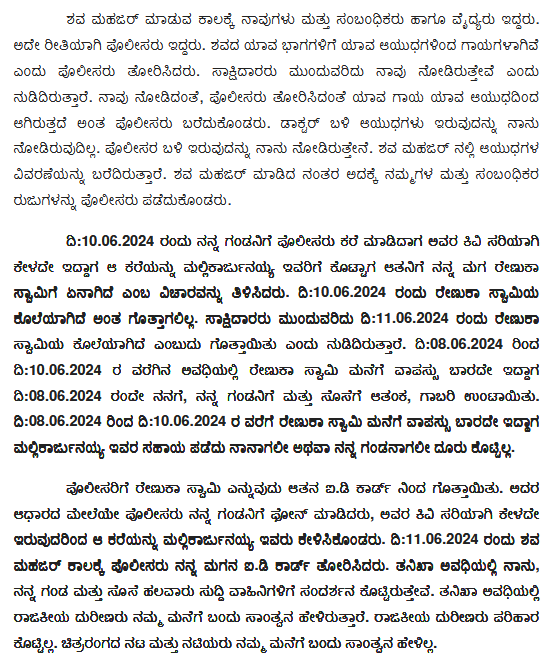
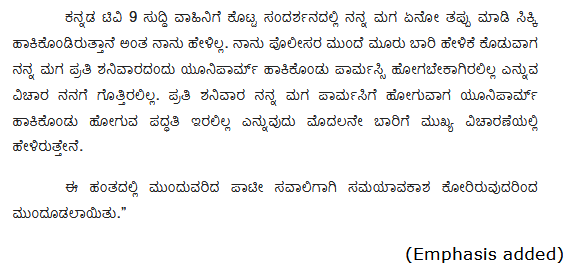
9. The afore-narrated facts that led to registration of the crime and the order of committal or pendency of proceedings are all a matter of record. They would not require any iteration. What brings the prosecution to this Court is an order dated 17-01-2026. What led the concerned Court to pass the order dated 17-01-2026 is the deposition of PW-1. PW-1 is the mother of the deceased Renukaswamy. According to the prosecution, particular questions that are answered in the cross-examination by PW-1 would require cross-examination of the PW.1, is the submission. Therefore, those parts of deposition are required to be noticed. They read as follows:
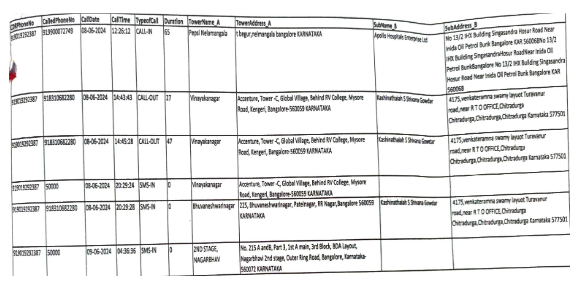
This is one instance. The other is, with regard to the call record details. The learned Special Public Prosecutor takes this Court through particular call record details to demonstrate that there has been conversation between the mother/PW-1 and the son/ Renukaswamy at a particular hour on 08-06-2024. The call record details are as follows:
9.1. Based upon these two circumstances, an oral request is made by the prosecution to cross-examine the mother of the deceased, PW-1/ CW-8. This comes to be rejected by the concerned Court by a detailed order passed on the following reasons:
".... .... ....
-:REASONS:-
Arguments of prosecution:-
6. The learned SPP urged that, as per prosecution case IO has recorded statement of PW.1 on 14.06.2024. In cross examination PW.1 deposed that she has given statement before IO in three time. A portion of inquest mahazar Ex.P.9 is not previous statement and IO has not recorded to statement of PW.1 while conducting inquest mahazar of statement, As per last sentence of statement of PW.1 recorded by IO on 14.06.2024 a word in Kannada “" (submitted requisition) mentioned therein, it is statement. she has submitted requisition before commissioner of police, not statement. It is not statement. which is contrary to prosecution case. Further, argued that PW.1 deposed that, she is not aver about mobile No 9019292387 and another mobile No.9035888476. On 08.06.2024 PW.1 herself and her husband have contented with mobile No 9019292387 and another mobile No.9035888476. As per tower location report and CDR collected by IO, mobile No. 9035888476 is belonged to deceased. An oral evidence of PW.1 is also contrary to prosecution version.
7. The learned SPP submission that, IO was not recovered the weapon while conducting inquest mahazar and they not in custody of investigation agency. PW.1 deposed that, at the time of identifying the dead body, police have shown weapon, which wound was sustained from which weapon. As per statement of CW.68 recorded by learned jurisdictional magistrate U/Sec 164 of Cr.P.C. As per this statement, IO has seized the shed on Thursday i.e., 11.06.2024. In such circumstances, it is not possible to show the weapons to PW 1 While identifying the dead body. Therefore, aforesaid portion of evidence of PW.1 is also to contrary to prosecution case. Further, in her cross examination PW.1 deposed police have identified the dead body of deceased based on his ID card. An investigating officer has not seized ID card. It is not contrary to prosecution version. Therefore, the prosecution is required elicit truth, cross examination from prosecution is necessary as contemplated under Sec.137 and Sec 154 of Evidence Act."
".... .... ....
Arguments of defence/accused No.2:-
9. As against this, learned counsel for accused No.2 urged that PW.1 being mother of deceased. She has no intention to deposed false evidence. The PW.1 deposed that her son was used wear golden chain, golden ring, watch, linga () at his neck and also his ID card on very day, while he was going his works at Apollo pharmacy. Therefore, version of PW.1 regarding police have identified the dead body based on his ID card is true. PW.1 deposed that, she has given statement in three time. During investigation, an investigating officer can record the statement of witnesses who are acquainted facts with crime or offence while conducting inquest mahazar U/Sec 174 of Cr.P.C, while interrogation of the witnesses and recording their statement U/Sec 161 of Cr.P.C and while drawing mahzar. As per Sec 36 of Cr.P.C the police commissioner of Bengaluru city is superior officer over all police stations situated within Bengaluru. As per statement of PW.1 recorded by IO on 14.06.2024, PW.1 submitted statement in writing to police commissioner of Bengaluru. On 14.06.2024, IO has recorded statement of PW.1. and Questionnaires while conducting inquest mahazar. Therefore, evidence of PW.1 regarding giving statement in three time is true. IO can be taken statement of witnesses in oral (afterwards he reduced in writing) and written.
10. As per prosecution records and oral evidence of PW.1 herself and deceased her sons having two mobiles, PW.1 having two mobile bearing No 743747374 and 8310682280 and deceased had two mobile bearing No 901929387 and 9035888476. At the time giving statement before IO PW.1 has furnished one mobile No.9743747374 and in her cross examination she has stated her another mobile No.8310682280, this mobile was not given to IO for investigation. So IO has to collect CDR of these four mobile, but he has collected CDR of two mobiles. Therefore, evidence of PW.1 respect of mobile number is true and correct.
11. Further, the learned counsel for accused No.2 has drawn attention of this Court on statement of CW.69 given before learned Judicial Magistrate, as his statement, godown (alleged place of incident) was seized by the investigating officer since 09.06.2024. As per prosecution case, IO has recovered the material objects from said godown. It is very clear that on 11.06.2024 the police having custody of material objects prior to conducting inquest mahazar, for that reason PW.1 deposed that police have shown the weapon to her at the time of identification of dead body. This evidence also true and correct. The PW.1 is not having hostile animus to prosecution case. She has deposed unguarded moment speaking truth before Court. It is not ground for grant to permission to cross examination by the prosecution. Hence, prays for reject the oral submission of the prosecution......"
.......
".... .... ....
Arguments of defence/accused No. 4, 6, 7, 8, 9, 15 to 17:-
12. The learned counsel for accused No 4, 6, 7, 8, 9, 15 to 17 urged that a word "hostile witness" is not defined in Cr.P.C as well as Evidence Act. In this regard, the learned counsel for these accused persons has relied on Judgment of Hon'ble supreme Court rendered in Sat Paul Vs Delhi Adm (AIR 1976 SC 294). Wherein, their lordship have clarified the meaning of "hostile witness". On considering portion of evidence relied by prosecution will not exhibited manifest antipathy by demeanour, answers and attitude towards prosecution's case. In this prosecution has cited 273 witnesses. In orders to disposal of this case, it may takes two decades. The PW.1 has not shown her manifest antipathy to prosecution case to prosecution case. Accordingly, prays for reject permission of prosecution as sought for."
17.1. Firstly, identification of dead body.
During cross-examination of PW.1 by accused No.2, The PW.1 deposed that, the police have identified dead body of deceased based on his ID card. The learned SPP contented that, ID card is not seized by IO and it is not case of the prosecution. I have carefully perused the statement of PW.1(Ex.D.3, portion of statement of PW.1) recorded by IO on 14.06.2024. She stated that her son went to his work on 08.06.2024 by wearing uniform with ID card as usual manner.
17.2. Secondly, mobiles of PW.1 and deceased.
Mobile No 8310682280 is belongs to PW.1. While given statement before IO she has furnished her mobile No 9743747374. Further, she deposed that she has not given Mobile No. 8310682280 to IO and she given her mobile No 9743747374 to IO. Further, she is not averred about mobile No 9019292387, another mobile No 9035888476. Both mobiles belonged to deceased. The PW.10 voluntarily deposed that she was contacted with last Mobile is "----387".
17.3. Thirdly three statement of PW.1.
During cross-examination PW.1 deposed that she has given statement three times. Firstly, while drawing inquest mahazar, secondly, IO has recorded her statement on 14.06.2024 and thirdly PW.1 submitted written statement to police commissioner of Bengaluru. The prosecution contented that statement of PW.1 recorded by IO on 14.06.2024 only. It is not dispute between parties. Further, as per statement recorded by IO, PW.1 was submitted written requisition to police commissioner of Bengaluru. As per sec 36 of Cr.P.C this officer may be take part in investigation of the case. While drawing inquest mahazar IO has collected certain information (Ex.D.9, which is part of inquest mahazar) from PW.1 regarding who was lastly contacted with deceased. Further, I have care perused the Ex.D.9 information (as per prosecution's case) (page No275 of
even though PW.1 furnished information as per Ex.D.9 to IO on 11.06.2024 in part of inquest mahazar, as per recitals of statement of PW.1 dates more particularly in line No.4 to 6 of 2nd para (page No. 1320 of charge sheet) in my opinion it is also previous statement of PW.1. During investigation any information or materials collected by IO is part of his investigation. Therefore, written requisition submitted PW.1 before Commissioner of police, Bengaluru and statement of PW.1 while conducting inquest mahazar, it part of said mahazar, but it is previous statement of PW.1 are falls U/Sec 161 of Cr.P.C. Therefore, oral evidence of PW.1 regarding giving statement before IO in three times it also true and correct.
17.4. Fourthly weapon and wound on deceased body"-
The learned SPP contented that IO has not recovered the club, tree branch, rope. In this regarded, both prosecution and defence questionnaire i.e., Q.10 and Q.12. As per Q.No. 10 and Q.No.12. As per Q.10 IO has not recorded statement of PW.1 while conducting inquest mahazar. Accordingly, Q.12 IO has repeatedly mentioned in inquest mahazar/Ex.D.9 that injuries sustained on dead body of deceased with club (), branch of tree () rope (), hands and legs. CW.69 specifically stated that police have seized the shed on next day i.e., Tuesday. I have carefully perused that statement of CW.69 as recorded by Judicature Magistrate, as per version of CW.69 said Tuesday was fallen on 11.06.2024. IO was conducted inquest mahazar on 11.06.2024 from 11:30am to 02:00pm. According to statement of CW.69 police have seized share between 10:00am to 11:00am. On considering these timings of 11.06.2024, prior to conducting inquest mahazar shed was under custody of police. At this stage, this can not discussed with facts in detailed which is in dispute otherwise it amounts to mini trial. Which is not permissible under law.
18. On examination and scanning of materials of prosecution and ocular evidence of PW.1 exhibits that PW.1 is being mother of deceased, not having hostility animus or her answers are not manifest antipathy towards to prosecution case. Therefore, I am of the Opinion that question of granting permission to cross-examination prosecution's own witness not necessary. According, point No.1 is answered in the negative.
POINT No.2:-
19. In view of finding on point No.1, proceed to pass the following;
ORDERS
The permission of prosecution regarding cross-examination of it's own witness i.e., PW.1 is hereby rejected."
This order is what has driven the prosecution to this Court.
The issue would now hinge upon interpretation of Section 154 of the Evidence Act upon which the oral request is said to have been made by the prosecution before the concerned Court.
THE STATUTE:
10. Section 154 of the Evidence Act reads as follows:
"154. Question by party to his own witness.--(1) The Court may, in its discretion, permit the person who calls a witness to put any questions to him which might be put in cross-examination by the adverse party.
(2) Nothing in this section shall disentitle the person so permitted under sub-section (1), to rely on any part of the evidence of such witness."
Section 154 of the Evidence Act vests a discretion in the Court to permit the person who calls a witness to put to such witness questions, which could ordinarily be put in cross-examination by the adverse party. The provision is thus, an exception to the normal rule governing examination of one's own witness. What merits consideration is, the judicial interpretation placed upon the contours of this discretion. For that purpose, this Court need not travel far, much less delve deep into the precedential thicket, as the law on the point stands lucidly declared by the Apex Court.
10.1. The Apex Court in the case of SAT PAUL v. DELHI ADMINISTRATION ((1976) 1 SCC 727) has held as follows:
".... .... ....
38. To steer clear of the controversy over the meaning of the terms "hostile" witness, "adverse" witness, "unfavourable" witness which had given rise to considerable difficulty and conflict of opinion in England, the authors of the Indian Evidence Act, 1872 seem to have advisedly avoided the use of any of those terms so that, in India, the grant of permission to cross-examine his own witness by a party is not conditional on the witness being declared "adverse" or "hostile". Whether it be the grant of permission under Section 142 to put leading questions, or the leave under Section 154 to ask questions which might be put in cross-examination by the adverse party, the Indian Evidence Act leaves the matter entirely to the discretion of the court (see the observations of Sir Lawrence Jenkins in Baikuntha Nath v. Prasannamoyi [AIR 1922 PC 409 : 72 IC 286] ). The discretion conferred by Section 154 on the court is unqualified and untrammelled, and is apart from any question of "hostility". It is to be liberally exercised whenever the court from the witnesses' demeanour, temper, attitude, bearing, or the tenor and tendency of his answers, or from a perusal of his previous inconsistent statement, or otherwise, thinks that the grant of such permission is expedient to extract the truth and to do justice. The grant of such permission does not amount to an adjudication by the court as to the veracity of the witness. Therefore, in the order granting such permission it is preferable to avoid the use of such expressions, such as "declared hostile", "declared unfavourable", the significance of which is still not free from the historical cobwebs which, in their wake bring a misleading legacy of confusion, and conflict that had so long vexed the English courts.
39. It is important to note that the English statute differs materially from the law contained in the Indian Evidence Act in regard to cross-examination and contradiction of his own witness by a party. Under the English law a party is not permitted to impeach the credit of his own witness by general evidence of his bad character, shady antecedents or previous conviction. In India, this can be done with the consent of the court under Section 155. Under the English Act of 1865, a party calling the witness can "cross-examine" and contradict a witness in respect of his previous inconsistent statements with the leave of the court, only when the court considers the witness to be "adverse". As already noticed, no such condition has been laid down in Sections 154 and 155 of the Indian Act and the grant of such leave has been left completely to the discretion of the Court, the exercise of which is not fettered by or dependent upon the "hostility" or "adverseness" of the witness. In this respect, the Indian Evidence Act is in advance of the English law. The Criminal Law Revision Committee of England in its Eleventh Report, made recently has recommended the adoption of a modernised version of Section 3 of the Criminal Procedure Act, 1865, allowing contradiction of both unfavourable and hostile witnesses by other evidence without leave of the court. The report is, however, still in favour of retention of the prohibition on a party's impeaching his own witness by evidence of bad character.
... ... ...
52. From the above conspectus, it emerges clear that even in a criminal prosecution when a witness is cross- examined and contradicted with the leave of the court, by the party calling him, his evidence cannot, as a matter of law, be treated as washed off the record altogether. It is for the Judge of fact to consider in each case whether as a result of such cross-examination and contradiction, the witness stands thoroughly discredited or can still be believed in regard to a part of his testimony. If the Judge finds that in the process, the credit of the witness has not been completely shaken, he may, after reading and considering the evidence of the witness, as a whole, with due caution and care, accept, in the light of the other evidence on the record, that part of his testimony which he finds to be creditworthy and act upon it. If in a given case, the whole of the testimony of the witness is impugned, and in the process, the witness stands squarely and totally discredited, the Judge should, as a matter of prudence, discard his evidence in toto."
10.2. The Apex Court in the case of RABINDRA KUMAR DEY v. STATE OF ORISSA (1976) 4 SCC 233 considers the issue elaborately and holds as follows:
".... .... ....
10. Before proceeding further we might like to state the law on the subject at this stage. Section 154 of the Evidence Act is the only provision under which a party calling its own witnesses may claim permission of the court to cross-examine them. The section runs thus:
"The Court may, in its discretion permit the person who calls a witness to put any question to him which might be put in cross-examination by the adverse party."
The section confers a judicial discretion on the court to permit cross-examination and does not contain any conditions or principles which may govern the exercise of such discretion. It is, however, well-settled that the discretion must be judiciously and properly exercised in the interests of justice. The law on the subject is well- settled that a party will not normally be allowed to cross- examine its own witness and declare the same hostile, unless the court is satisfied that the statement of the witness exhibits an element of hostility or that he has resiled from a material statement which he made before an earlier authority or where the court is satisfied that the witness is not speaking the truth and it may be necessary to cross-examine him to get out the truth. One of the glaring instances, in which this Court sustained the order of the court in allowing cross-examination was where the witness resiles from a very material statement regarding the manner in which the accused committed the offence. In DahyabhaiChhaganbhai Thakker v. State of Gujarat [AIR 1964 SC 1563: (1964) 7 SCR 361, 368, 369, 370: (1964) 2 Cri LJ 472] this Court made the following observations:
"Section 154 does not in terms, or by necessary implication confine the exercise of the power by the court before the examination-in-chief is concluded or to any particular stage of the examination of the witness. It is wide in scope and the discretion is entirely left to the court to exercise the power when the circumstances demand. To confine this power to the stage of examination-in-chief is to make it ineffective in practice. A clever witness in his examination-in- chief faithfully conforms to what he stated earlier to the police or in the committing Court, but in the cross-examination introduces statements in a subtle way contradicting in effect what he stated in the examination-in-chief. If his design is obvious, we do not see why the court cannot, during the course of his cross-examination, permit the person calling him as a witness to put questions to him which might be put in cross-examination by the adverse party.
Broadly stated, the position in the present case is that the witnesses in their statements before the police attributed a clear intention to the accused to commit murder, but before the court they stated that the accused was insane and, therefore, he committed the murder."
A perusal of the above observations will clearly indicate that the permission to cross-examine was upheld by this Court because the witnesses had categorically stated before the police that the accused had committed the murder but resiled from that statement and made out a new case in evidence before the court that the accused was insane. Thus it is clear that before a witness can be declared hostile and the party examining the witness is allowed to cross-examine him, there must be some material to show that the witness is not speaking the truth or has exhibited an element of hostility to the party for whom he is deposing. Merely because a witness in an unguarded moment speaks the truth which may not suit the prosecution or which may be favourable to the accused, the discretion to allow the party concerned to cross-examine its own witnesses cannot be allowed. In other words a witness should be regarded as adverse and liable to be cross-examined by the party calling him only when the court is satisfied that the witness bears hostile animus against the party for whom he is deposing or that he does not appear to be willing to tell the truth. In order to ascertain the intention of the witness or his conduct, the Judge concerned may look into the statements made by the witness before the Investigating Officer or the previous authorities to find out as to whether or not there is any indication of the witness making a statement inconsistent on a most material point with the one which he gave before the previous authorities. The court must, however, distinguish between a statement made by the witness by way of an unfriendly act and one which lets out the truth without any hostile intention.
11. It may be rather difficult to lay down a rule of universal application as to when and in what circumstances the court will be entitled to exercise its discretion under Section 154 of the Evidence Act and the matter will largely depend on the facts and circumstances of each case and on the satisfaction of the court on the basis of those circumstances. Broadly, however, this much is clear that the contingency of cross-examining the witness by the party calling him is an extraordinary phenomenon and permission should be given only in special cases. It seems to us that before a court exercises discretion in declaring a witness hostile, there must be some material to show that the witness has gone back on his earlier statement or is not speaking the truth or has exhibited an element of hostility or has changed sides and transferred his loyalty to the adversary. Furthermore, it is not merely on the basis of a small or insignificant omission that the witness may have made before the earlier authorities that the party calling the witness can ask the court to exercise its discretion. The court, before permitting the party calling the witness to cross-examine him, must scan and weigh the circumstances properly and should not exercise its discretion in a casual or routine manner."
10.3. Later, the Apex Court in the case of GURA SINGH v. STATE OF RAJASTHAN (2001) 2 SCC 205 holds as follows:
".... .... ....
11. There appears to be a misconception regarding the effect on the testimony of a witness declared hostile. It is a misconceived notion that merely because a witness is declared hostile his entire evidence should be excluded or rendered unworthy of consideration. This Court in Bhagwan Singh v. State of Haryana [(1976) 1 SCC 389: 1976 SCC (Cri) 7: AIR 1976 SC 202] held that merely because the Court gave permission to the Public Prosecutor to cross-examine his own witness describing him as hostile witness does not completely efface his evidence. The evidence remains admissible in the trial and there is no legal bar to base the conviction upon the testimony of such witness. In Rabindra Kumar Dey v. State of Orissa [(1976) 4 SCC 233: 1976 SCC (Cri) 566: AIR 1977 SC 170] it was observed that by giving permission to cross-examine nothing adverse to the credit of the witness is decided and the witness does not become unreliable only by his declaration as hostile. Merely on this ground his whole testimony cannot be excluded from consideration. In a criminal trial where a prosecution witness is cross-examined and contradicted with the leave of the court by the party calling him for evidence cannot, as a matter of general rule, be treated as washed off the record altogether. It is for the court of fact to consider in each case whether as a result of such cross-examination and contradiction the witness stands discredited or can still be believed in regard to any part of his testimony. In appropriate cases the court can rely upon the part of testimony of such witness if that part of the deposition is found to be creditworthy.
12. The terms "hostile", "adverse" or "unfavourable" witnesses are alien to the Indian Evidence Act. The terms "hostile witness", "adverse witness", "unfavourable witness", "unwilling witness" are all terms of English law. The rule of not permitting a party calling the witness to cross-examine are relaxed under the common law by evolving the terms "hostile witness and unfavourable witness". Under the common law a hostile witness is described as one who is not desirous of telling the truth at the instance of the party calling him and an unfavourable witness is one called by a party to prove a particular fact in issue or relevant to the issue who fails to prove such fact, or proves the opposite test. In India the right to cross-examine the witnesses by the party calling him is governed by the provisions of the Indian Evidence Act, 1872. Section 142 requires that leading question cannot be put to the witness in examination-in-chief or in re-examination except with the permission of the court. The court can, however, permit leading question as to the matters which are introductory or undisputed or which have, in its opinion, already been sufficiently proved. Section 154 authorises the court in its discretion to permit the person who calls a witness to put any question to him which might be put in cross- examination by the adverse party. The courts are, therefore, under a legal obligation to exercise the discretion vesting in them in a judicious manner by proper application of mind and keeping in view the attending circumstances. Permission for cross- examination in terms of Section 154 of the Evidence Act cannot and should not be granted at the mere asking of the party calling the witness. Extensively dealing with the terms "hostile, adverse and unfavourable witnesses" and the object of the provisions of the Evidence Act this Court in Sat Paul v. Delhi Admn. [(1976) 1 SCC 727: 1976 SCC (Cri) 160: AIR 1976 SC 294] held: (SCC pp. 741-43 & 745-46, paras 38-40 & 52)
"38. To steer clear of the controversy over the meaning of the terms 'hostile' witness, 'adverse' witness, 'unfavourable' witness which had given rise to considerable difficulty and conflict of opinion in England, the authors of the Indian Evidence Act, 1872 seem to have advisedly avoided the use of any of those terms so that, in India, the grant of permission to cross-examine his own witness by a party is not conditional on the witness being declared 'adverse' or 'hostile'. Whether it be the grant of permission under Section 142 to put leading questions, or the leave under Section 154 to ask questions which might be put in cross-examination by the adverse party, the Indian Evidence Act leaves the matter entirely to the discretion of the court (see the observations of Sir Lawrence Jenkins in Baikuntha Nath Chattorji v. PrasannamoyiDebya [AIR 1922 PC 409 : 27 CWN 797]. The discretion conferred by Section 154 on the court is unqualified and untrammelled, and is apart from any question of 'hostility'. It is to be liberally exercised whenever the court from the witnesses' demeanour, temper, attitude, bearing, or the tenor and tendency of his answers, or from a perusal of his previous inconsistent statement, or otherwise, thinks that the grant of such permission is expedient to extract the truth and to do justice. The grant of such permission does not amount to an adjudication by the court as to the veracity of the witness. Therefore, in the order granting such permission, it is preferable to avoid the use of such expressions, such as 'declared hostile', 'declared unfavourable', the significance of which is still not free from the historical cobwebs which, in their wake bring a misleading legacy of confusion, and conflict that had so long vexed the English courts.
39. It is important to note that the English statute differs materially from the law contained in the Indian Evidence Act in regard to cross-examination and contradiction of his own witness by a party. Under the English law, a party is not permitted to impeach the credit of his own witness by general evidence of his bad character, shady antecedents or previous conviction. In India, this can be done with the consent of the court under Section 155. Under the English Act of 1865, a party calling the witness can 'cross-examine' and contradict a witness in respect of his previous inconsistent statements with the leave of the court, only when the court considers the witness to be 'adverse'. As already noticed, no such condition has been laid down in Sections 154 or 155 of the Indian Act and the grant of such leave has been left completely to the discretion of the court, the exercise of which is not fettered by or dependent upon the 'hostility' or 'adverseness' of the witness. In this respect, the Indian Evidence Act is in advance of the English law. The Criminal Law Revision Committee of England in its Eleventh Report, made recently, has recommended the adoption of a modernised version of Section 3 of the Criminal Procedure Act, 1865, allowing contradiction of both unfavourable and hostile witnesses by other evidence without leave of the court. The Report is, however, still in favour of retention of the prohibition on a party's impeaching his own witness by evidence of bad character.
40. The danger of importing, without due discernment, the principles enunciated in ancient English decisions, for interpreting and applying the Indian Evidence Act, has been pointed out in several authoritative pronouncements. In Praphullakumar Sarkar v. Emperor [ILR (1931) 58 Cal 1404 : AIR 1931 Cal 401 (FB)] an eminent Chief Justice, Sir George Rankin cautioned, that
'when we are invited to hark back to dicta delivered by English Judges, however eminent, in the first half of the nineteenth century, it is necessary to be careful lest principles be introduced which the Indian Legislature did not see fit to enact'.
It was emphasised that these departures from English law 'were taken either to be improvements in themselves or calculated to work better under Indian conditions'.
***
52. From the above conspectus, it emerges clear that even in a criminal prosecution when a witness is cross-examined and contradicted with the leave of the court, by the party calling him, his evidence cannot, as a matter of law, be treated as washed off the record altogether. It is for the Judge of fact to consider in each case whether as a result of such cross-examination and contradiction, the witness stand thoroughly discredited or can still be believed in regard to a part of his testimony. If the Judge finds that in the process, the credit of the witness has not been completely shaken, he may, after reading and considering the evidence of the witness, as a whole, with due caution and care, accept, in the light of the other evidence on the record, that part of his testimony which he finds to be creditworthy and act upon it. If in a given case, the whole of the testimony of the witness is impugned, and in the process, the witness stands squarely and totally discredited, the Judge should, as a matter of prudence, discard his evidence in toto."
10.4. The Apex Court in the case of K.P. TAMILMARAN v. STATE BY DEPUTY SUPERINTENDENT OF POLICE 2025 SCC OnLine SC 958 holds as follows:
".... .... ....
30. The word 'hostile' or 'hostile witness' has not been used anywhere in the Evidence Act. The logic behind this exclusion seems to be that the declaration of witness as 'hostile witness' carries a specific significance under the English law, from where this term has been derived, where liberty is only granted to a side to cross- examine its own witness when such declaration of 'hostility' is made. The position in India is different and here it is left to the discretion of the Court to allow a party to cross-examine its own witness, regardless of a declaration of 'hostility'. This has been explained by this Court in Sat Paul:
"38. To steer clear of the controversy over the meaning of the terms "hostile" witness, "adverse" witness, "unfavourable" witness which had given rise to considerable difficulty and conflict of opinion in England, the authors of the Indian Evidence Act, 1872 seem to have advisedly avoided the use of any of those terms so that, in India, the grant of permission to cross-examine his own witness by a party is not conditional on the witness being declared "adverse" or "hostile". Whether it be the grant of permission under Section 142 to put leading questions, or the leave under Section 154 to ask questions which might be put in cross-examination by the adverse party, the Indian Evidence Act leaves the matter entirely to the discretion of the court (see the observations of Sir Lawrence Jenkins in Baikuntha Nath v. Prasannamoyi, [AIR 1922 PC 409 : 72 IC 286]). The discretion conferred by Section 154 on the court is unqualified and untrammelled and is apart from any question of "hostility". It is to be liberally exercised whenever the court from the witnesses demeanour, temper, attitude, bearing, or the tenor and tendency of his answers, or from a perusal of his previous inconsistent statement, or otherwise, thinks that the grant of such permission is expedient to extract the truth and to do justice. The grant of such permission does not amount to an adjudication by the court as to the veracity of the witness. Therefore, in the order granting such permission, it is preferable to avoid the use of such expressions, such as "declared hostile", "declared unfavourable", the significance of which is still not free from the historical cobwebs which, in their wake bring a misleading legacy of confusion, and conflict that had so long vexed the English Courts."
(Emphasis Provided)
31. The phrase 'hostile witness' is commonly used in criminal jurisprudence and court proceedings. We too cannot escape the blame of using the term 'hostile witness' in our judgment. We do it for pragmatic reasons. Some words like 'hostile witness' in this case are now a part of our legal vocabulary. There is no point in inventing or substituting new words or phrases, at least in the present case, and we leave that for the future. But what is necessary, however, is to explain the meaning of the term as it is now to be understood. The phrase 'hostile witness' has come to be used for a witness who gives a statement contrary to the story of the side for which he/she is a witness. All the same, because a witness has supported some, though not all, aspects of a case, it would not automatically mean that this witness has to be declared 'hostile'. A party can cross-examine its own witness under Section 154 Evidence Act, even without getting a declaration of 'hostility'. The only restriction to cross-examination under Section 154 Evidence Act is that the party, who seeks to cross-examine its own witness, must obtain the leave of the Court. Whether there is a declaration of 'hostility' or not, one thing is clear that evidence of witness, who has been cross-examined under Section 154 Evidence Act by the party who called such witness, cannot be washed off entirely and it is for the Court to see what can be retrieved from such evidence.
32. This can be understood from another aspect. We shall now refer to the definition of the term 'evidence' given under Section 3 of the Evidence Act. It reads as follows:
"Evidence" - "Evidence" means and includes-
(1) all statements which the Court permits or requires to be made before it by witnesses, in relation to matters of fact under inquiry; such statements are called oral evidence;
(2) all documents including electronic records produced for the inspection of the Court; such document are called documentary evidence."
(Emphasis Provided)
33. The statements made by a witness in Court, including in cross-examination, either conducted by the opposite party or by the party who produced the witness, would come under the definition of 'evidence' under Section 3 of the Evidence Act, since this evidence has come before the Court with its permission. Moreover, there is no specific bar under the Evidence Act which mandates that such evidence has to be discarded. Thus, it would form part of the entire evidence which the Court can examine while arriving at its decision, and it is for the Court to determine what value has to be given to that piece of evidence or how such evidence has to be used in a given case.
34. Viewed from a different perspective, the rejection of the entire testimony of a prosecution witness, who has been cross-examined by the prosecution, would not only harm the case of the prosecution but perhaps also of the defence in a given case. This is because as the law stands today, the benefit of the testimony of such witness can be taken by both the prosecution and the defence, allowing them to use it to build their case [See: Paulmeli v. State of T.N., (2014) 13 SCC 90, Ramesh Harijan v. State of U.P., (2012) 5 SCC 777]. In any case, ultimately, it will be the cause of justice that will suffer if the testimony of such witness is totally discarded. It is, therefore, rightly left to the discretion of the Court to test the evidentiary value of such a testimony."
10.5. The Apex Court again in the case of SHIVKUMAR ALIAS BALESHWAR YADAV v. STATE OF CHHATTISGARH 2025 SCC OnLine SC 2223 holds as follows:
".... .... ....
9. We are at a loss to understand as to why the witness was treated as hostile in the first place? We are frequently coming across cases where the prosecutor, for no ostensible reason, wants to treat the witnesses hostile and the Court indiscriminately grants permission. It is well settled, by judgments of this Court, that before a witness can be declared hostile and the party examining the witnesses is allowed to cross-examine, there must be some material to show that the witnesses are not speaking the truth or has exhibited an element of hostility to the party for whom he is deposing. No doubt, the circumstances under which the Court will exercise the discretion under Section 154 of the Evidence Act, 1872 (Section 157 of the Bharatiya SakshyaAdhiniyam (BSA), 2023) and permit the party calling the witness to put any question which might be put in cross-examination by the adverse party will depend on the facts and circumstances of each case. However, this Court has held that the contingency of cross-examining the witness by the party calling, is an extraordinary phenomenon and permission should be given only in special cases. Small or insignificant omissions cannot be the basis for treating the witnesses hostile and the Court before exercising its discretion must scan and weigh the circumstances properly and ought not to exercise its discretion in a casual or routine manner.
10. In Sri Rabindra Kumar Dey v. State of Orissa1, this Court held as under:--
"10. Before proceeding further we might like to state the law on the subject at this stage. Section 154 of the Evidence Act is the only provision under which a party calling its own witnesses may claim permission of the court to cross-examine them. The section runs thus:
"The Court may, in its discretion permit the person who calls a witness to put any question to him which might be put in cross-examination by the adverse party."
The section confers a judicial discretion on the court to permit cross-examination and does not contain any conditions or principles which may govern the exercise of such discretion. It is, however, well-settled that the discretion must be judiciously and properly exercised in the interests of justice. The law on the subject is well-settled that a party will not normally be allowed to cross- examine its own witness and declare the same hostile, unless the court is satisfied that the statement of the witness exhibits an element of hostility or that he has resiled from a material statement which he made before an earlier authority or where the court is satisfied that the witness is not speaking the truth and it may be necessary to cross-examine him to get out the truth. One of the glaring instances, in which this Court sustained the order of the court in allowing cross-examination was where the witness resiles from a very material statement regarding the manner in which the accused committed the offence. In DahyabhaiChhaganbhai Thakker v. State of Gujarat [AIR 1964 SC 1563 : (1964) 7 SCR 361, 368, 369, 370 : (1964) 2 Cri LJ 472] this Court made the following observations:
"Section 154 does not in terms, or by necessary implication confine the exercise of the power by the court before the examination-in-chief is concluded or to any particular stage of the examination of the witness. It is wide in scope and the discretion is entirely left to the court to exercise the power when the circumstances demand. To confine this power to the stage of examination-in-chief is to make it ineffective in practice. A clever witness in his examination-in-chief faithfully conforms to what he stated earlier to the police or in the committing Court, but in the cross-examination introduces statements in a subtle way contradicting in effect what he stated in the examination-in-chief. If his design is obvious, we do not see why the court cannot, during the course of his cross-examination, permit the person calling him as a witness to put questions to him which might be put in cross-examination by the adverse party.
Broadly stated, the position in the present case is that the witnesses in their statements before the police attributed a clear intention to the accused to commit murder, but before the court they stated that the accused was insane and, therefore, he committed the murder."
A perusal of the above observations will clearly indicate that the permission to cross-examine was upheld by this Court because the witnesses had categorically stated before the police that the accused had committed the murder but resiled from that statement and made out a new case in evidence before the court that the accused was insane. Thus it is clear that before a witness can be declared hostile and the party examining the witness is allowed to cross-examine him, there must be some material to show that the witness is not speaking the truth or has exhibited an element of hostility to the party for whom he is deposing. Merely because a witness in an unguarded moment speaks the truth which may not suit the prosecution or which may be favourable to the accused, the discretion to allow the party concerned to cross-examine its own witnesses cannot be allowed. In other words a witness should be regarded as adverse and liable to be cross-examined by the party calling him only when the court is satisfied that the witness bears hostile animus against the party for whom he is deposing or that he does not appear to be willing to tell the truth. In order to ascertain the intention of the witness or his conduct, the Judge concerned may look into the statements made by the witness before the Investigating Officer or the previous authorities to find out as to whether or not there is any indication of the witness making a statement inconsistent on a most material point with the one which he gave before the previous authorities. The court must, however, distinguish between a statement made by the witness by way of an unfriendly act and one which lets out the truth without any hostile intention.
11. It may be rather difficult to lay down a rule of universal application as to when and in what circumstances the court will be entitled to exercise its discretion under Section 154 of the Evidence Act and the matter will largely depend on the facts and circumstances of each case and on the satisfaction of the court on the basis of those circumstances. Broadly, however, this much is clear that the contingency of cross-examining the witness by the party calling him is an extraordinary phenomenon and permission should be given only in special cases. It seems to us that before a court exercises discretion in declaring a witness hostile, there must be some material to show that the witness has gone back on his earlier statement or is not speaking the truth or has exhibited an element of hostility or has changed sides and transferred his loyalty to the adversary. Furthermore, it is not merely on the basis of a small or insignificant omission that the witness may have made before the earlier authorities that the party calling the witness can ask the court to exercise its discretion. The court, before permitting the party calling the witness to cross- examine him, must scan and weigh the circumstances properly and should not exercise its discretion in a casual or routine manner."
11. Similarly, in Gura Singh v. State of Rajasthan2, this Court held as under:--
"13. We deprecate the manner in which the prayer was made by the Public Prosecutor and permission granted by the trial court to cross-examine Jarnail Singh (PW 2) allegedly on the ground of his being hostile. On facts we find that the said witness was wrongly permitted to be cross-examined. It was only on a post-event detail that he did not concur with the suggestion made by the Public Prosecutor. That single point, in our opinion, was too insufficient for the Public Prosecutor to proclaim that the witness made a volte- face and became totally hostile to the prosecution. Otherwise also, the permission granted and utilised for cross-examination was limited to the extent of the time of lodging the first information report (Exhibit P-2). There is no reason to disbelieve PW 2 who is closely related to the appellant and has no reason to falsely implicate, particularly when no inducement, threat or promise is allegedly given or assured."
12. It is also clear from the above judgments that merely because a witness is declared hostile does not make him unreliable. As held in Bhagwan Singh v. State of Haryana.
"8. We have carefully perused the evidence of Jagat Singh, who was examined in the trial after more than a year of detection of the case. The prosecution could have even avoided requesting for permission to cross-examine the witness under Section 154 of the Evidence Act. But the fact that the court gave permission to the prosecutor to cross-examine his own witness, thus characterising him as, what is described as a hostile witness, does not completely efface his evidence. The evidence remains admissible in the trial and there is no legal bar to base a conviction upon his testimony if corroborated by other reliable evidence. We are satisfied in this case that the evidence of Jagat Singh, but for whose prompt assistance the case would not have seen the light of day and whose statement had immediately been recorded by the D.S.P., is amply corroborated by other evidence mentioned above to inspire confidence in his testimony. Apart from that the fact of recovery of the gold coins in the pocket of the appellant gave a seal of finality to the truth of the charge against the appellant. If Jagat Singh had accepted the bribe he would have been guilty under Section 161 IPC. There is, therefore, clear abetment by the appellant of the offence under Section 161 IPC and the ingredients of Section 165-A IPC are established against him.""
(Emphasis supplied at each instance)
A blend of the judgments interpreting Section 154 of the Evidence Act would unmistakably demonstrate that no straight-jacket formula can be evolved, much less universally applied, as to the circumstances in which a Court should exercise the discretion conferred upon it by the provision. The discretion is undoubtedly wide; but width of discretion is not licence for its mechanical exercise. It is a judicial discretion, to be exercised upon discernible material and in furtherance of the cause of justice. The provision is an exception to the ordinary rule that a party cannot cross- examine its own witness and, therefore, the exception cannot be permitted to casually swallow the rule.
11. In the case of SAT PAUL supra, the Apex Court holds that grant of permission under Section 154 of the Evidence Act does not, by itself, amount to an adjudication upon the truthfulness or otherwise of the witness. What is necessary is, material demonstrating such contradiction, departure or adverse disposition as would justify allowing the party calling the witness to test his testimony by questions in the nature of cross-examination.
12. The principle receives further exposition in RABINDRA KUMAR DEY supra, wherein the Apex Court holds that permitting a party to cross-examine the very witness whom it has called to depose is an extraordinary phenomenon, resort to which must remain confined to special cases. There must be material before the Court indicating that the witness has resiled from an earlier statement, is suppressing the truth, has exhibited hostility, has changed sides, or has, in substance, transferred his allegiance to the adversary. A small discrepancy, an insignificant omission, or an answer escaping from a witness in an unguarded moment cannot furnish the foundation for invoking Section 154 of the Evidence Act. The discretion, being judicial in character, cannot be exercised casually, routinely or merely because, a particular answer does not fit neatly into the narrative of the party calling the witness.
13. In GURA SINGH supra, the Apex Court further clarifies that even the declaration of a witness as hostile does not result in his entire testimony being effaced from the record. The evidence does not evaporate merely because the witness has been labelled hostile; that part of the testimony which inspires confidence can nevertheless be acted upon. What assumes significance, therefore, is that, the threshold for exercise of discretion under Section 154 of the Evidence Act must itself be crossed on cogent material.
14. The same thread runs through the judgment in the case of SHIVKUMAR supra. The Apex Court reiterates that, before a witness can be treated as hostile and the party calling him permitted to cross-examine, there must be sufficient material demonstrating that the witness is not speaking the truth or has exhibited an element of hostility towards the party at whose instance he has entered the witness box. The contingency is extraordinary; the permission cannot become commonplace. Trivial inconsistencies, stray answers or insignificant omissions cannot be magnified into hostility. The Court must scan the deposition as a whole, weigh the surrounding circumstances and then exercise the discretion with circumspection. The Apex Court in the case of TAMILMARAN supra, reiterates the same principle.
15. If the evidence of PW-1, the mother of the deceased, and the order impugned are placed on the anvil of the aforesaid principles, the answer is not far to seek. PW-1 has neither turned her back upon the prosecution nor crossed over to the adversary. She has not completely departed from what she stated in her examination-in-chief; nor has she disowned the substratum of the prosecution case. There is no demonstrable transfer of loyalty from the prosecution to the defence. What is sought to be projected as hostility is, at best, a stray statement made in the course of deposition--an answer at an unguarded moment. A stray answer cannot be elevated into a wholesale abandonment of the prosecution case.
16. A witness does not become hostile merely because every syllable uttered by the said witness does not march to the drumbeat of the party who summoned him. Nor does Section 154 of the Evidence Act confer upon a party an automatic right to cross-examine its own witness whenever an answer turns inconvenient. Inconvenience is not hostility; discrepancy is not disloyalty; and an isolated departure is not necessarily an abandonment of the case. Something more must be demonstrated before the extraordinary jurisdiction under Section 154 of the Evidence Act can be invoked.
17. To hold otherwise would produce consequences plainly destructive of the statutory scheme. If every inconvenient answer, minor deviation or stray omission were sufficient to open the doors of Section 154 of the Evidence Act, examination-in-chief would cease to retain its character. A party could summon its witness, wait for an answer not entirely to its liking and then seek permission to put leading questions under the guise of cross-examination. Section 154 of the Evidence Act would then cease to be an exceptional procedural safeguard and become a convenient device to repair perceived deficiencies in examination-in-chief. The exception would devour the rule.
18. It is equally true that the law does not insist upon the ritualistic declaration of a witness as "hostile" before permission under Section 154 of the Evidence Act can be granted. The nomenclature is not decisive; the circumstances are. But the absence of any statutory requirement of a formal declaration cannot be converted into an unrestricted licence to cross-examine one's own witness. The discretion remains hedged by judicial discipline. The Court must find circumstances warranting such departure from the ordinary mode of examination, and those circumstances must emerge from the conduct and testimony of the witness viewed as a whole.
19. There is yet another facet, which cannot be brushed aside. If, after cross-examination by the defence, an ambiguity, omission or apparent inconsistency had surfaced in the testimony of PW-1, the prosecution had the remedy of re-examination to explain matters arising out of such cross-examination. The record indicates that the prosecution chose not to re-examine PW-1. Having allowed that statutory opportunity to pass, the prosecution cannot seek to achieve, through the extraordinary route of Section 154 of the Evidence Act, what could appropriately have been clarified in re- examination. Section 154 of the Evidence Act cannot become a procedural second innings merely because the first was not played to the satisfaction of the party calling the witness.
20. The concerned Court has borne these principles in mind while declining the request of the prosecution. The order impugned is neither perfunctory nor bereft of reasons. It recognizes the distinction between a witness who has truly turned adverse and one whose testimony merely contains an answer inconvenient to the party calling him. That distinction is the very heart of Section 154 of the Evidence Act.
21. Therefore, on a cumulative consideration of the deposition of PW-1, her examination-in-chief and cross-examination, and the law declared by the Apex Court in the afore-quoted judgments, no circumstance emerges which could compel, or even warrant, exercise of discretion under Section 154 of the Evidence Act. A stray statement cannot be metamorphosed into hostility, nor can an unguarded answer become a passport for the prosecution to cross-examine its own witness.
22. The impugned order declining such permission is founded upon cogent reasons and is in complete consonance with the principles declared by the Apex Court. It warrants no interference. The challenge, therefore, must necessarily fail.
23. The petition lacking in merit, stands rejected.


 " (submitted requisition) mentioned therein, it is statement. she has submitted requisition before commissioner of police, not statement. It is not statement. which is contrary to prosecution case. Further, argued that PW.1 deposed that, she is not aver about mobile No 9019292387 and another mobile No.9035888476. On 08.06.2024 PW.1 herself and her husband have contented with mobile No 9019292387 and another mobile No.9035888476. As per tower location report and CDR collected by IO, mobile No. 9035888476 is belonged to deceased. An oral evidence of PW.1 is also contrary to prosecution version.
 ) at his neck and also his ID card on very day, while he was going his works at Apollo pharmacy. Therefore, version of PW.1 regarding police have identified the dead body based on his ID card is true. PW.1 deposed that, she has given statement in three time. During investigation, an investigating officer can record the statement of witnesses who are acquainted facts with crime or offence while conducting inquest mahazar U/Sec 174 of Cr.P.C, while interrogation of the witnesses and recording their statement U/Sec 161 of Cr.P.C and while drawing mahzar. As per Sec 36 of Cr.P.C the police commissioner of Bengaluru city is superior officer over all police stations situated within Bengaluru. As per statement of PW.1 recorded by IO on 14.06.2024, PW.1 submitted statement in writing to police commissioner of Bengaluru. On 14.06.2024, IO has recorded statement of PW.1. and Questionnaires while conducting inquest mahazar. Therefore, evidence of PW.1 regarding giving statement in three time is true. IO can be taken statement of witnesses in oral (afterwards he reduced in writing) and written.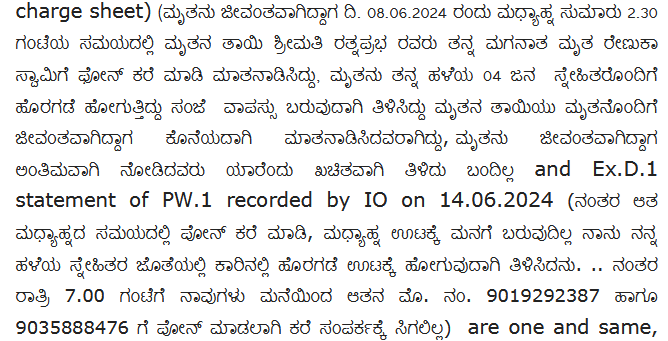
 ), branch of tree (
