Oral Judgment
P.M. Raval, J.
1. By way of the present Criminal Appeal, the State has challenged the judgment and order of acquittal passed by the Court of learned Additional Sessions Judge, Mehsana in Sessions Case No. 217/1995 on 13.08.1999, whereby, the accused persons were came to be acquitted for the offences punishable under Section 147,148,149 and 302 of the Indian Penal Code, 1860 (hereinafter referred to as the 'IPC').
2. The case of the prosecution as per the FIR is that:-
2.1 On 01.08.1995, in the morning at Karannagar, the victim and deceased Jagdish Ramabhai Patel had inflicted blows using a sharp and edged weapon like a knife as a deadly weaponwith the intention of launching a fatal attack on his stomach upon injured Amratbhai Juhabhai Raval. Regarding that incident, keeping a feeling of grievance, difference of opinion, and animosity towards deceased Jagdish Ramabhai Patel, on 01.08.1995 at around 11:00 to 11:15 hours in the night, or thereabout, with the object of fulfilling their common intention, having formed an unlawful assembly and as members thereof, possessing deadly weapons like Dharias and sticks with them, and to use them as deadly weapons, and with the intention of launching a fatal attack on deceased Jagdish and causing his death, were seated in a DCM Matador bearing number 3016.
2.2 Thereafter, the said accused, as stated above, travelled in a vehicle from Karannagar towards Karannagar Railway Station. The accused, in furtherance of their said common intention, and as members of the unlawful assembly so formed, used force and violence and created a riotous situation. Further, they were armed with deadly weapons such as dhariyas and sticks, and as members of the unlawful assembly, they remained present at the aforesaid place carrying such deadly weapons. By use of force and violence, they created a situation amounting to rioting. Therefore, they have committed offences punishable under Sections 147 and 148 of the Indian Penal Code.
2.3 Subsequently, it is alleged in the FIR that while the complainant Vijaybhai Ramabhai Patel and victim/deceased, Jagdish, were traveling in an auto-rickshaw from Karannagar towards the Karannagar Railway Station, the accused persons spotted them. Consequently, due to fear, they suddenly got down from the auto-rickshaw and attempted to flee. At that moment, with the intention of launching a fatal attack upon him as members of an unlawful assembly, the accused persons assaulted him with Dharias and sticks. They committed this act with the intention of voluntarily causing hurt or grievous hurt and thereby causing his death. Furthermore, the said accused persons succeeded in achieving the common object of the unlawful assembly formed with the common intention of causing the death of deceased, Jagdish Ramabhai Patel. Thereby they have committed a punishable offense under Section 302, read with Section 149 of the Indian Penal Code.
2.4 After completion of investigation, chargesheet came to be filed before the concerned jurisdictional Court. Since the case was sessions triable, the same is committed to the Sessions Court, wherein, it came to be registered as Sessions Case No. 217/1995. The learned Sessions Judge thereafter framed charges at Exhibit 41 and recorded the pleas of the Accused at Exhibits 42 to 52, to which they denied the charges and prayed for trial.
2.4 To bring home the charges, the prosecution relied upon the following documentary as well as oral evidence:

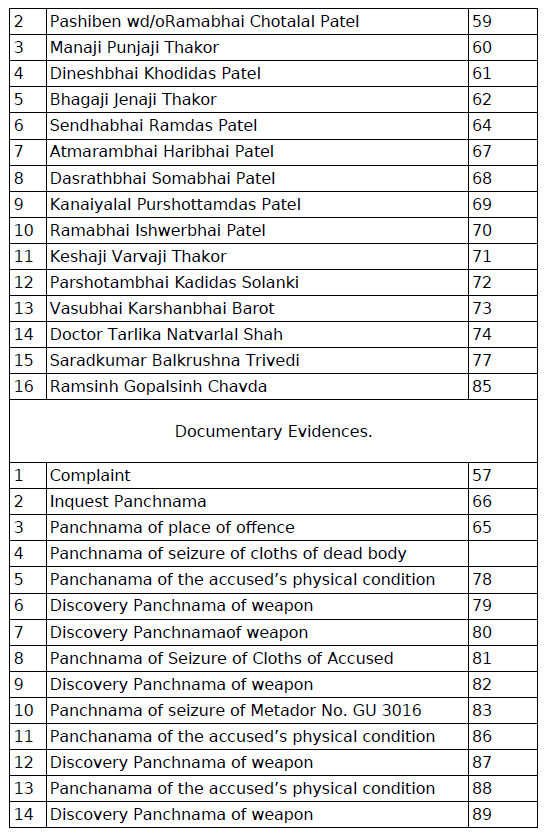
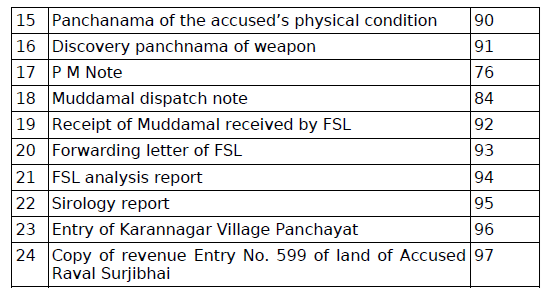
2.5 After completion of the trial and after recording the further statements of the accused under Section 313 of the CrPC, and upon hearing the respective advocates for the parties, the learned Sessions Judge passed the impugned judgment, which is now under challenge before this Court.
3. Learned APP, Ms. Chetna M. Shah, submitted that:-
3.1 That there are eyewitnesses; however, the entire prosecution case is based on circumstantial evidence. On 01.08.1995, deceased, Jagdish, who was the brother of the complainant, allegedly caused injuries to Amratbhai Raval. Thereafter, he went to his house and informed his mother, Pashiben, about the injuries caused to Amratbhai and stated that the accused persons were chasing him. He further informed her that he was proceeding immediately to Kadi Police Station. Subsequently, the respondent-accused came to his house in search of deceased Jagdish and also inquired with Pashiben who is prosecution witness regarding his whereabouts. They stated that Jagdish had assaulted Amratbhai and threatened that they would kill him. Thereafter, all the accused persons, armed with deadly weapons, went to Karannagar, where they waited for the arrival of Jagdish. They also inquired about him from prosecution witnesses Jayantibhai and Dineshbhai, who were present there. Thus, all the accused persons were actively searching for deceased Jagdish with a clear intention to take revenge. Therefore, it is evident that the respondent-accused committed the murder of Jagdish, and the learned Sessions Judge ought to have convicted them for the charges levelled against them.
3.2 That the learned Sessions Judge has not properly appreciated the evidence of witnesses Manaji Punjaji and Bhagaji Jenaji, who have stated that while coming from Kadi to Karannagar, deceased Jagdish was travelling with them in a rickshaw. As soon as he saw the Matador, he immediately jumped out of the rickshaw. At that time also, the accused persons were inquiring about deceased Jagdish. The incident took place at the very place where Jagdish had jumped out of the rickshaw. Therefore, it is evident that the accused persons were pursuing Jagdish with the intention to kill him. Therefore also, the learned Sessions Judge ought to have convicted the respondent-accused for the charges levelled against them.
3.3 That the learned Sessions Judge has further failed to appreciate that the circumstantial evidence on record, as well as the deposition of the Investigating Officer, the Discovery Panchnama, and the evidence of the panch witnesses, have fully supported the prosecution case. The evidence clearly establishes that all the respondent-accused had formed an unlawful assembly with a clear intention to cause the death of deceased. Therefore, each member of the unlawful assembly is equally responsible for the act committed by the members of the unlawful assembly and is equally liable for any act committed in furtherance of the common object of the unlawful assembly. Therefore also, the respondent-accused are guilty of the offence punishable under Section 302 read with Section 149 of the Indian Penal Code.
3.4 That the learned Sessions Judge ought to have seen that deceased Jagdish had caused injuries to Amratbhai, who is the brother of accused No. 11, and therefore, with a clear intention to take revenge, the respondent-accused had formed an unlawful assembly with the common object of causing the murder of deceased Jagdish and had assaulted deceased with their respective weapons.
3.5 That the learned Sessions Judge has not properly appreciated the evidence of the Investigating Officer, Shri S.B. Trivedi, who is an independent witness and has fully supported the prosecution case. He has deposed with regard to the recovery of weapons such as dharias and sticks from the respondent-accused on different dates and at different times, and necessary panchnamas under Section 27 of the Evidence Act were drawn by him which would prove the complicity of the present accused persons being involved in the commission of the offence.
3.6 That the learned Trial Judge has taken into consideration irrelevant facts while appreciating the evidence and thus wrongly acquitted the Applicant. Thus, argued to allow the present appeal.
3.7 Learned APP would lastly submit that the chain of circumstances is so complete that the point of guilt is clearly facing towards the accused persons and there is no brake in the chain of circumstances to give any benefit of doubt and thus, learned Trial Court has committed serious error in appreciating oral as well as documentary evidence and thus, prayed to allow the present appeal.
4. At the outset, it is required to be noted that vide order dated 13.03.2026 passed in this appeal, the appeal qua Respondent Nos. 1 to 4 and 10 has been abated by the Coordinate Bench of this Court. Further, the order dated 17.04.2026 reflects that Respondent Nos. 5 to 9 and 11 were personally present in the Court and requested time to engage an Advocate, However, the order dated 01.05.2026 reflects that learned Advocate Mr. Rafik Lokhandwala states that he has instructions to appear for Respondent Nos. 5, 9 and 11. However, he has not filed any Vakalatnama till today. Thus, there is no representation on behalf of the Respondents.
5. Heard learned APP for the Respondent - State.
6 At the outset, it would be profitable to refer the judgment of the Hon'ble Supreme Court in the case of Constable 907 Surendra Singh vs State Of Uttarakhand reported in (2025) 2 SCR 239 wherein it is held that:-
"11. Recently, in the case of Babu Sahebagouda Rudragoudar and others v. State of Karnataka, a Bench of this Court to which one of us was a Member (B.R. Gavai, J.) had an occasion to consider the legal position with regard to the scope of interference in an appeal against acquittal. It was observed thus:
38. First of all, we would like to reiterate the principles laid down by this Court governing the scope of interference by the High Court in an appeal filed by the State for challenging acquittal of the accused recorded by the trial court.
39. This Court in Rajesh Prasad v. State of Bihar [Rajesh Prasad v. State of Bihar, (2022) 3 SCC 471 : (2022) 2 SCC (Cri) 31] encapsulated the legal position covering the field after considering various earlier judgments and held as below : (SCC pp.482-83, para 29) 6 (2024) 8 SCC
29. After referring to a catena of judgments, this Court culled out the following general principles regarding the powers of the appellate court while dealing with an appeal against an order of acquittal in the following words :(Chandrappa case [Chandrappa v. State of Karnataka, (2007) 4 SCC 415 :(2007) 2 SCC (Cri) 325] , SCC p.432, para 42)
42. From the above decisions, in our considered view, the following general principles regarding powers of the appellate court while dealing with an appeal against an order of acquittal emerge:
(1) An appellate court has full power to review, re appreciate and reconsider the evidence upon which the order of acquittal is founded.
(2) The Criminal Procedure Code, 1973 puts no limitation, restriction or condition on exercise of such power and an appellate court on the evidence before it may reach its own conclusion, both on questions of fact and of law.
(3) Various expressions, such as, "substantial and compelling reasons", "good and sufficient grounds", "very strong circumstances", "distorted conclusions", "glaring mistakes", etc. are not intended to curtail extensive powers of an appellate court in an appeal against acquittal. Such phraseologies are more in the nature of "flourishes of language" to emphasise the reluctance of an appellate court to interfere with acquittal than to curtail the power of the court to review the evidence and to come to its own conclusion.
(4) An appellate court, however, must bear in mind that in case of acquittal, there is double presumption in favour of the accused. Firstly, the presumption of innocence is available to him under the fundamental principle of criminal jurisprudence that every person shall be presumed to be innocent unless he is proved guilty by a competent court of law. Secondly, the accused having secured his acquittal, the presumption of his innocence is further reinforced, reaffirmed and strengthened by the trial court.
(5) If two reasonable conclusions are possible on the basis of the evidence on record, the appellate court should not disturb the finding of acquittal recorded by the trial court.
"40. Further, in H.D. Sundara v. State of Karnataka [H.D. Sundara v. State of Karnataka, (2023) 9 SCC 581: (2023) 3 SCC (Cri) 748] this Court summarised the principles governing the exercise of appellate jurisdiction while dealing with an appeal against acquittal under Section 378CrPC as follows : (SCC p. 584, para 8) "8. ... 8.1. The acquittal of the accused further strengthens the presumption of innocence;
8.2. The appellate court, while hearing an appeal against acquittal, is entitled to reappreciate the oral and documentary evidence;
8.3. The appellate court, while deciding an appeal against acquittal, after reappreciating the evidence, is required to consider whether the view taken by the trial court is a possible view which could have been taken on the basis of the evidence on record;
8.4. If the view taken is a possible view, the appellate court cannot overturn the order of acquittal on the ground that another view was also possible; and 8.5. The appellate court can interfere with the order of acquittal only if it comes to a finding that the only conclusion which can be recorded on the basis of the evidence on record was that the guilt of the accused was proved beyond a reasonable doubt and no other conclusion was possible."
41. Thus, it is beyond the pale of doubt that the scope of interference by an appellate court for reversing the judgment of acquittal recorded by the trial court in favour of the accused has to be exercised within the four corners of the following principles:
41.1. That the judgment of acquittal suffers from patent perversity;
41.2. That the same is based on a misreading/omission to consider material evidence on record; and 41.3. That no two reasonable views are possible and only the view consistent with the guilt of the accused is possible from the evidence available on record.
12. It could thus be seen that it is a settled legal position that the interference with the finding of acquittal recorded by the Ld. Trial Judge would be warranted by the High Court only if the judgment of acquittal suffers from patent perversity; that the same is based on a misreading / omission to consider material evidence on record and that no two reasonable views are possible and only the view consistent with the guilt of the accused is possible from the evidence available on record."
6.1 The case of the prosecution also rests on circumstantial evidence. The law in this respect has been clearly laid down in the case of Sharad Birdhi Chand Sarda vs. State of Maharashtra, reported in (1984) 4 SCC 16, wherein it is held that:
"153. A close analysis of this decision would show that the following conditions must be fulfilled before a case against an accused can be said to be fully established: (1) the circumstances from which the conclusion of guilt is to be drawn should be fully established. It may be noted here that this Court indicated that the circumstances concerned "must or should" and not "may be" established. There is not only a grammatical but a legal distinction between "may be proved" and "must be or should be proved" as was held by this Court in Shivaji Sahabrao Bobade v. State of Maharashtra [(1973) 2 SCC 793 : 1973 SCC (Cri) 1033 : 1973 Crl LJ 1783] where the observations were made: [SCC para 19, p. 807: SCC (Cri) p. 1047] "Certainly, it is a primary principle that the accused must be and not merely may be guilty before a court can convict and the mental distance between 'may be' and 'must be' is long and divides vague conjectures from sure conclusions."
(2) the facts so established should be consistent only with the hypothesis of the guilt of the accused, that is to say, they should not be explainable on any other hypothesis except that the accused is guilty, (3) the circumstances should be of a conclusive nature and tendency, (4) they should exclude every possible hypothesis except the one to be proved, and (5) there must be a chain of evidence so complete as not to leave any reasonable ground for the conclusion consistent with the innocence of the accused and must show that in all human probability the act must have been done by the accused."
6.2 Thus, the evidence both documentary as well as oral has been tested on the aforesaid principles.
6.3 Though this Court is not required to record separate findings while affirming the judgment of acquittal, concurrence with the findings recorded by the Trial Court would suffice. Nevertheless, considering the serious nature of the charges levelled against the respondent-original accused, this Court deems it appropriate to re-appreciate the oral as well as documentary evidence available on record.
6.4 On perusal of the deposition of PW-1 examined vide Exh. 57, complainant, namely Vijaybhai Patel, it transpires that he has deposed that he had heard from his mother, Pashiben, and his wife, Shilpaben, regarding the altercation between Amratbhai and deceased when deceased had gone outside to the chowk for eating pan masala and had inflicted an injury on the stomach of Amratbhai. Thereafter, when deceased rushed to his residence, he informed his mother that Amratbhai and his family members were coming to kill him and that he was proceeding to the Kadi Police Station. He has further deposed that Jagdishbhai thereafter went to the Kadi Police Station and, about half an hour later, Amratbhai and his family members arrived at his residence and inquired about the whereabouts of Jagdish, stating that Jagdish had inflicted injuries upon Amratbhai and, therefore, they would kill him. In response thereto, the complainant's mother, Pashiben, informed them that Jagdish had gone to present himself before the Kadi Police Station. Thereupon, the family members of Amratbhai stated that if they found him on the way, they would kill him. Thereafter, all the accused persons went towards Karannagar from Kadi. After having tea, the complainant also left for the Kadi Police Station and, at that time, he came to know that the dead body of his brother was lying near Karannagar Railway Station.
6.4.1 Rest of the examination-in-chief is not relevant for the purpose of deciding the present appeal.
6.4.2 However, as informed by the complainant's mother, Pashiben, Chandubhai, who is also known as Fojdar, was holding a dhariya; Jayantibhai Juhabhai Raval and Keshabhai Sakabhai were also holding dhariyas; and Ganeshbhai Harjibhai was holding a stick. The names of the other accused persons were also disclosed; however, the complainant could not remember the same. Thus, the evidence of the complainant is hearsay in nature and is not based on his personal knowledge or direct knowledge from the accused persons. Therefore, the evidence of Pashiben would be relevant in this regard.
6.5 On perusal of the deposition of PW-2, Pashiben, examined vide Exh. 59, this witness also states on the lines of what the complainant has stated in his deposition. She also identifies eleven persons. She further states that accused namely Chandubhai, Jayantibhai, and Sendhabhai were holding dhariyas, and others were holding sticks in their hands. She also states with regard to the information being conveyed to the complainant. She further states that her daughter-in-law, Shilpaben, was also present and informed her son when he came at around 8 o'clock in the morning on the next day. After having tea, he had informed that Jagdish had gone to the police station, and he was asked to check where Jagdish was. She further states that her son Vijaybhai later came to know that Jagdish had been killed. Thus, what has been stated by the aforesaid two witnesses is to the effect that the accused persons had come to the residence of the complainant in search of deceased Jagdish, since he had inflicted injury on the stomach of Amratbhai Raval. However, Jagdish having left the house, the accused persons had approached after about half an hour.
6.6 The next important witnesses would be Manaji Punjaji and Bhagaji Jenaji, who have been examined as PW-3 and PW-5 respectively vide Exh. 60 and 62, and who have turned hostile.
6.6.1 However, after being declared hostile, PW-3 Manaji Punjaji was cross-examined by the learned APP. He denied the fact that any Matador had stopped the rickshaw or that any person had enquired about where Jagdish had gone. He also denied having seen any persons arriving in a Matador or carrying any weapons. Thus, the fact that Jagdish was travelling with Manaji Punjaji stands proved, and it is also proved that he got down from the rickshaw and proceeded towards Karannagar from Kadi, near the water pump of Chaman Bechar Patel. However, the allegation that the accused persons intercepted the rickshaw and enquired about Jagdish is not proved. Similarly, PW-5 Bhagaji, the other witness, though declared hostile, also denied that any persons had arrived in a Matador, intercepted the rickshaw, or stopped it while asking about the whereabouts of Jagdish. He further denied having seen any person carrying any weapons. Thus, the factum of autorickshaw being intercepted in which deceased Jagdish was travelling is not proved, nor is the factum of accused travelling in a Matador and carrying weapons proved.
6.7 On going through the deposition of PW-4 examined at Exh. 61, namely Dineshbhai Kodidas Patel, he states that he had seen a Matador and three persons holding dhariyas and sticks, and they were asking him and Jayantibhai whether they had seen Jagdish. They were Pankajbhai Mangaldas Raval, Natubhai Mangalbhai Raval, and Shankarbhai Raval, and he identified these three persons. These three persons asked about Jagdish, to which he replied that he had not seen him. This witness further asked why they were looking for him, to which these persons informed him that Amratbhai had been inflicted injury with a knife by Jagdish. However, he had seen other persons in the Matador but could not identify them, and despite being his maternal cousin, he did not think it fit to inform anyone. Thus, his conduct is not natural and his deposition does not inspire confidence with regard to having seen at least three persons with dhariyas and sticks in their hands and arriving in the Matador and asking him about Jagdish. This aspect is also evident from his admission that he did not think it fit to inform his maternal aunt (Masi) about three persons asking about Jagdish.
6.8 On perusal of the deposition of Shri Dashrathbhai Somabhai Patel - PW 8, examined vide Exh. 68, who is the panch of the discovery panchnama, it appears that, after turning hostile, he supported the case of the prosecution. However, during cross- examination, the defence established facts that again demolished the case of the prosecution. Thus, the discovery panchnama at Exhs. 79 and 80 are not proved in accordance with law. This is also evident from the deposition of the Investigating Officer, who has not deposed about the contents of the Discovery Panchnama. Hence, not proved in accordance with law.
6.9 Another discovery panchnama at Exh. 82 is also not proved. Though the panch witness, Kanubhai, has been examined as PW 9 vide Exh. 69, despite being declared hostile and cross- examined by the learned APP, nothing fruitful has come on record. PW 11, Keshaji Varvaji Thakor, examined vide Exh. 71, has also not supported the case of the prosecution. PW 12, Parshottambhai Kadidas Solanki, examined vide Exh. 72, has also not supported the case of the prosecution. PW 13, Vasubhai Karshanbhai Barot, examined vide Exh. 73, has also not supported the case of the prosecution.
6.10 On perusal of the deposition of Dr. Tarlika Natwarlal Shah, PW 14, examined vide Exh. 74, who performed the post-mortem, it would only prove the effect that deceased expired for the reasons stated in the post-mortem report and also prove the fact that deceased died as a result of culpable homicide.
6.11 On perusal of the deposition of Saradkumar Balkrushna Trivedi, PW 15, who is the Investigating Officer, examined vide Exh. 77, it appears that the entire evidence is formal in nature. However, the factum of the discovery panchnama, as stated hereinabove, is not proved in accordance with law, as the contents of the panchnama have not been duly proved. Assuming for the sake of the moment that the Investigating Officer has stated that the accused persons, at different times and on different dates, voluntarily led to the discoveries under the respective panchnamas, and that the weapons were recovered from the places pointed out by them, the recoveries were made from locations such as near a tree fence, near the graveyard, and from the dickey of the Matador vehicle, the said recoveries would not fall within the four corners of Section 27 of the Indian Evidence Act.
6.12 Thus, from the evidence of the witnesses, at best it can be said that serious doubt with regard to the conduct of the accused persons has surfaced on record. There is no chain of circumstances to prove beyond reasonable doubt that the accused persons committed the murder of deceased Jagdish, inasmuch as there are missing links in the entire chain, particularly as they were not seen together immediately before the crime and there is nothing to prove that the accused persons had in fact found Jagdish and inflicted injuries upon him.
6.13 Even if the prosecution case, as emerging from the witnesses, is accepted in its entirety, it would only create serious doubt regarding the conduct of the accused persons in searching for deceased Jagdish. However, there is no evidence linking them to the commission of the murder. More particularly, the Serological Report at Exh. 95 reveals that sample B4, being the blood sample of deceased, belongs to Group B, and the same blood group was detected on articles B1, B2 and B3, namely the T-shirt, pant and kada. However, this is merely a corroborative piece of evidence and, in view of missing links in the chain of circumstances, no useful purpose would be served by relying solely upon the FSL report.
6.14 Thus, the circumstances relied upon by the prosecution are limited to the facts that the accused persons had inquired about deceased Jagdish at his residence approximately half an hour after he had left to surrender himself at Kadi Police Station, though he never reached there, and that PW 4 Dineshbhai Patel had seen three accused carrying a dhariya and a stick while asking about Jagdish. Apart from these facts, nothing has been proved connecting the accused persons with the commission of the murder of deceased, except for raising a suspicion that they may have harboured a grudge against him for having inflicted injuries upon Amratbhai, the brother of accused Jayantibhai. Thus, there remains a vast distance for the prosecution to travel from "may be true" to "proved beyond reasonable doubt."
6.15 Under such circumstances, the prosecution has failed to prove its case. The Trial Court has committed no error whatsoever, either on facts or in law, while acquitting the accused persons, and this Court is in concurrence with the said findings for the reasons stated hereinabove. Accordingly, no case is made out for interference.
7. For the foregoing reasons, the appeal stands dismissed. Impugned judgment and order passed by the Trial Court is confirmed. The bail bond, if any, stands cancelled and the surety stands discharged. The record and proceedings shall be sent back to the Trial Court forthwith.



