Judges: THE HONOURABLE CHIEF JUSTICE MR. VIBHU BAKHRU & THE HONOURABLE MRS. JUSTICE K.S. HEMALEKHA
Parties : M/s. N.N. Constructions, Rep. By Its Proprietor, B. Jagadeeswar, Bengaluru Versus Divisional Railway Manager South Western Railway, Bengaluru & Others
Appearing Advocates : For the Appellant: Bapat Sampath Vinayaka Rao, Advocate. For the Respondents: R1 to R3, Shivakumar, CGC.
Date of Judgment : 02-07-2026
Head Note :-
Commercial Court Act, 2015 - Section 13 (1-A) -
Judgment :-
(Prayer: This Commercial Appeal is filed under Section 13 (1-A) of Commercial Court Act, 2015 read with Section 37 of the Arbitration and Concilation Act, 1996 praying to set aside the judgment and order dated 30.01.2026 passed in Com.A.P. No.113/2025 by the LXXXII Additional City Civil and Sessions Judge, Commercial Court, Bengaluru on the petition filed under Section 34 of the Arbitration and Conciliation Act, 1996 & etc.)
C.A.V. Judgment
Vibhu Bakhru, CJ.
1. The appellant has filed the present appeal under Section 37(1)(c) of the Arbitration and Conciliation Act, 1996 [A&C Act] impugning the judgment dated 30.01.2026 [impugned judgment] delivered by the learned LXXXII Additional City Civil and Sessions Judge, Commercial Court, Bengaluru [Commercial Court] in Com. A.P.No.113/2025.
2. The appellant had filed the said petition under Section 34 of the A&C Act, seeking the setting aside of an arbitral award dated 05.05.2025 [impugned award] delivered by respondent No.4 [Arbitral Tribunal] in A.C.No.300/2024. The appellant is aggrieved as the Arbitral Tribunal had rejected its claims.
3. The appellant invoked the arbitration clause in relation to disputes arising under an agreement dated 27.04.2017 [the Agreement] between the parties for execution of the work, namely the widening of the Fountain Circle Road Under Bridge (RUB) No.867 at Railway Km. 355/400-500 in the Bangalore City Station Yard.
4. The appellant had raised certain claims, which were rejected by the Arbitral Tribunal. Additionally, the Arbitral Tribunal also awarded costs of Rs.2,50,000/- along with the respondents' share of the arbitrator's fee and administrative expenses in favour of respondents Nos.1 to 3 [the Railways]. The appellant's petition (Com.A.P.No.113/2025) to set aside the impugned award, was dismissed by the impugned judgment.
PREFATORY FACTS
5. Respondent No.1 invited tenders on 12.10.2016 for widening of the Fountain Circle Road Under Bridge (RUB) No.867 at Railway Km. 355/400-500, Bangalore City Station Yard. The Appellant's tender was accepted by Letter of Acceptance dated 30.03.2017 [the LOA] for a contract value of Rs.12,77,28,104/-. The period for completion was eight months from the LOA, that is, up to 30.11.2017. The appellant furnished a Performance Guarantee of Rs.63,86,405/-, and its Earnest Money Deposit [EMD] of Rs.9,58,840/- was adjusted towards the Security Deposit. An Agreement bearing No.61/SBC/17 was executed on 27.04.2017, governed by the General Conditions of Contract [the GCC]. Clauses 63 and 64 of the GCC provide for conciliation and arbitration of disputes.
6. After the work commenced, the appellant complained of obstructions at the site, including a BESCOM high-tension line, a BWSSB sewage line, OFC cables, and approach roads pending completion by the Bruhat Bengaluru Mahanagara Palike [the BBMP]. The contract was extended on four occasions:
(a) up to 30.06.2018;
(b) pursuant to the appellant's letter dated 24.07.2018, to 31.05.2019;
(c) pursuant to its letter dated 25.05.2019, to 31.05.2020, under Clause 17-A(ii) of the GCC, on the stated ground that work could be taken up only after traffic diversion through newly constructed Boxes 1 and 2; and
(d) a further extension up to 31.01.2021 under Clause 17- A(ii) of the GCC.
7. In the intervening period, the Railways, by letter dated 04.11.2019, informed the appellant that approach work for Boxes 1 and 2 stood completed in one direction, and called upon the appellant to commence work on Boxes 3 and 4. The appellant, by its letters dated 03.12.2019, 06.03.2020 and 22.05.2020, maintained that diversion of cables, pipelines and drainage remained incomplete. The Railways, by letters dated 20.05.2020 and 03.07.2020, called upon the appellant to mobilise men and material. And, by its letter dated 20.08.2020, the appellant stated that it had commenced preliminary work near RUB No.867 but had encountered further underground utilities.
8. By letter dated 23.02.2021, the appellant sought a further extension up to 31.01.2022, this time invoking Clause 17-A(iii) of the GCC. By a letter dated 05.03.2021, the appellant furnished a No Claim Certificate [the NCC], albeit without prejudice to claims under the Agreement. Subsequently, a revised NCC, in the Railways' format, was furnished on 07.04.2021. It is averred that joint final measurements were recorded on 05.03.2021.
9. By letter dated 09.06.2021, the Railways informed the appellant that pursuant to joint discussions and upon receipt of the NCC, the Agreement was foreclosed and the final bill had been forwarded for payment on 25.05.2021. The final bill, in the sum of Rs.1,21,913/-, was passed on 09.04.2022.
10. By letter dated 07.07.2021, the appellant claimed that it had suffered loss on account of the foreclosure, and raised claim under seven heads, requesting that the letter be treated as a notice invoking arbitration under Clauses 63 and 64 of the GCC. By its reply dated 30.07.2021, the Railways denied the claims, asserting that the Agreement was foreclosed by mutual consent and that the NCC had been furnished voluntarily.
11. As the disputes remained unresolved, the appellant filed C.M.P. No. 563/2021 before this court under Section 11 of the A&C Act, which was allowed by an order dated 23.02.2024, thereby constituting the Arbitral Tribunal.
12. The appellant thereafter filed its claim petition in the arbitral proceedings (A.C.No.300/2024) on 06.06.2024, raising various claims aggregating Rs.4,38,30,224/, with interest. The Railways filed their Statement of Objections on 08.01.2025, contending that the appellant was disentitled to compensation by reason of the NCC, read with Clause 17-A(ii), Clause 43(2) and Clause 61(3) of the GCC. By the impugned award dated 05.05.2025, the Arbitral Tribunal dismissed the claim petition in its entirety.
REASONS AND CONCLUSION
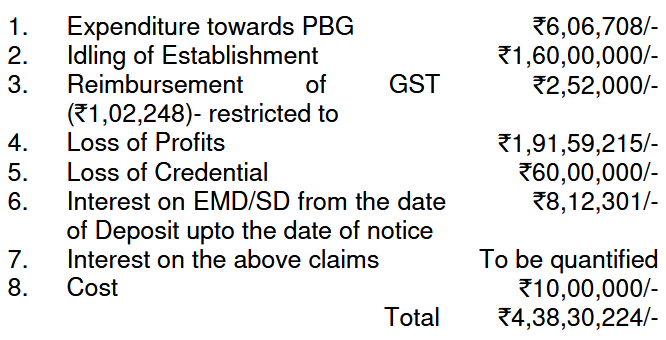
13. A plain reading of the statement of claims filed by the appellant indicates that the appellant's claims are, essentially, in the nature of seeking damages for breach of contract. The appellant had submitted a demand notice dated 07.07.2021 raising the following claims:
"The claimant submits that in the demand notice dated 07.07.2021, the claimant had raised the following claims:
14. The appellant claimed that it had mobilised funds to the extent of Rs.12,77,28,104/-, which were kept idle for a period of 50 months. It was alleged that the Railways had failed to fulfil their contractual obligations by failing to provide a hindrance-free site, which was essential for the appellant to execute the works.
15. The Arbitral Tribunal rejected the claims essentially on two grounds. First, that the appellant had failed to substantiate its claim and had not produced any evidence to establish that it had suffered any loss. And second, that the claimant had issued a NCC, and in terms of clause 43(2) of the Agreement, the appellant was debarred from making any claims after signing the NCC.
16. The learned counsel for the appellant contended that appellant had issued the NCC at the insistence of the Railways and was coerced into furnishing the same. Therefore, the appellant could not be precluded from claiming damages. Primarily, he focused his submissions on the claim for loss of profits for the unexecuted works. The appellant claimed that it had made investments with the hope of earning a return of 15% of the contract value of Rs.12,77,28,104/- and thus was entitled to a sum of Rs.1,91,59,215/- as loss of profits on the illegal determination of the contract.
17. The principal dispute centres on whether the Railways breached the terms of the Agreement and whether the delay in the execution of the work was attributable to them.
18. The Arbitral Tribunal examined the communications between the parties and concluded that the delay was due to the claimant's difficulties arising from the diversion of cables, pipelines, drainage, etc. The appellant had sought an extension of time for completion of the contract, and the Railways had extended the same from time to time.
19. The claimant had furnished a letter dated 23.02.2021 seeking an extension of the contract till 31.01.2022. Although the appellant had also stated in his letter that the work had been stopped at the instructions of the Railways, the Arbitral Tribunal found - on the basis of communications on record - that the work was delayed/stalled on account of various hindrances, which the appellant could not overcome.
20. Since the works were not completed despite extension of time on several occasions, the Railways held joint meetings and discussions and decided to foreclose the Agreement.
21. The appellant disputes that it had agreed to the foreclosure of the Agreement. However, there are documents on record, which indicate otherwise. The appellant had furnished the NCC dated 05.03.2021 but reserved the right to make claims as permissible under the contract and the law governing the same. However, subsequently, on 07.04.2021, the appellant furnished an NCC in the format described by the Railways (Ex.P20). The said certificate is set out below:
"To,
Divisional Railway Manager (works)
Southwestern Railway,
Bangalore Division,
Bangalore- 560 023.
(THROUGH ADEN/CENTRAL/SBC)
NO CLAIM CERTIFICATE
Sub: SBC widening of fountain circle RUB No.867 at Railway km 355/400-500 SBC station yard
Ref: 1) Agt No.61/SBC/2017 Dt. 27.04.2017
2) LOA No.B/W.496/6291 Dt. 30.03.2017
******
As per your request we herewith State that we have no claim against the South Western Railway administration in respect of the above cited subject and agreement except PVC claims.
Dated: 07.04.2021
Your's sincerely
Sd/-
Contractor"
22. Notwithstanding that the appellant had furnished the NCC, it sent a letter dated 08.06.2021, that is, two months after it had furnished the NCC, referring to its earlier letter dated 23.02.2021 seeking extension of the contract under Clause 17A(iii) of the GCC. The said letter had no reference to an earlier NCC or any other discussions between the parties. The said letter (Ex.P21) reads as under:
"08.06.2021
To,
Sr.DEN/East/SBC.
S.W.Railway
Bangalore-23.
Dear Sir
Sub: Position of My Agreement for the work, widening of Fountain circle RUB No.867 at Rly. Km 355/400-500 SBC
Agt.No.61/SBC/2017 Dt. 27.04.2017
******
With reference to the above subject, I have given letter for currency extension in 17A(iii) clause of GCC. Still I have not received any correspondence from your end. Hence I request you to please confirm the position of Agt. Please reply immediately for further process.
Thanking you
Your's faithfully
Sd/-
Contractor"
23. The Railways responded to the said letter on 09.06.2021. The said letter (Ex.P22) is set out below.
"SOUTH WESTERN RAILWAY
B/W/148/296 Divisional Office
Works Branch
Bangalore-23
Date: 09.06.2021
M/S N.N.CONSTRUCTIONS
No.425, 2nd Floor, 7th Main
14th Cross, Shastri Nagar
K.R.Road,
Bangalore- 560 028.
Sub: Widening of fountain circle RUB No.8367 at Rly.Km.355/400-500 in SBC yard
AGT No.61/SBC/17 Dt. 27.04.2017
LOA No.B/W.496/6291 Dt. 30.03.2017
REF: Your letter No. Nil dated 08.06.2021
******
With reference to your letter cited supra, this is to state that on receipt of your request for currency extension upto 31.01.2022 under 17A(iii) of GCC vide your letter No. Nil dated 23.02.2021, it was proposed for foreclosure of the agreement after meeting & discussions held jointly between you and railway officials. Accordingly, final measurements were taken with you jointly and on receipt of the No claim certificate and other necessary certificates from the field office, the proposal for foreclosure of the work was mooted and competent authority approval obtained.
The final bill has been submitted to Associate finance for passing on 25.05.2021. Meanwhile release of performance Guarantee has also been processed. On clearance of the final bill your security deposit deducted from the bill shall be released along with EMD.
Sd/-
Sr./DEN/E/SBC
Copy to ADEN/SBC for kind information."
24. The Arbitral Tribunal referred to the terms of the Agreement and noted that the Railways retained the right to determine the Agreement.
25. Additionally, the Arbitral Tribunal took note of a reply letter dated 30.07.2021 (Ex.P24) from the Railways disputing the appellant's claims. The Railways did not accept that the delay was attributable to them. They contend that the Railways had completed the work on adjacent Boxes 1 and 2 in April 2018, and that, due to hurdles faced by BBMP, the approach roads could be completed only in August 2019. The appellant was called upon to commence works immediately thereafter, but took no action to that end until 01.08.2020. The documents on record also support the said claim.
26. The Arbitral Tribunal examined the evidence on record and concluded that the Railways was not solely responsible for the delay in execution and completion of the works. The Arbitral Tribunal also concluded that the Agreement was mutually closed in consultation with the appellant. According to the Railways, it was necessary to do so because the contract had not been completed even after 4 years. The appellant was also not willing to execute the works at the rates quoted by it.
27. The aforesaid findings of the Arbitral Tribunal - that Railways was not solely responsible for the delay; that the parties had decided to foreclose the contract by mutual discussion; and that the appellant had voluntarily issued the NCC - are findings of fact. As noted above, the said conclusions are based on materials on record. The said findings hence will not to be held to be perverse or unreasonable in the sense of the Wednesbury principle of unreasonableness (In Associated Provincial Picture Houses Ltd. v. Wednesbury Corporation [1948] 1 KB 223, Lord Greene M.R. articulated the said principle in the following words: "If a decision on a competent matter is so unreasonable that no reasonable authority could ever have come to it, then the courts can interfere"). Thus, these findings cannot be held to vitiate the impugned award on the ground of patent illegality.
28. In the aforesaid view, it is not necessary to examine the separate claims made by the appellant. However, for the sake of completeness, we may refer to certain clauses of the Agreement, which were relied upon by the learned counsel for the appellant.
29. It was earnestly contended by the learned counsel that the appellant had sought for extension of contract under clause 17A(iii) of the Agreement and therefore, the appellant's right to claim damages was not foreclosed.
30. We may refer to Clause 17A(iii) of the GCC, which reads as under:
" 17-A Extension of Time in Contracts:
** ** **
(iii) Extension for Delay due to Railways: In the event of any failure or delay by the Railway to hand over the Contractor possession of the lands necessary for the execution of the works or to give the necessary notice to commence the works or to provide the necessary drawings or instructions or any other delay caused by the Railway due to any other cause whatsoever, then such failure or delay shall in no way affect or vitiate the contract or alter the character thereof or entitle the Contractor to damages or compensation therefor, but in any such case, the Railway may grant such extension or extensions of the completion date as may be considered reasonable."
31. As is apparent, the said clause expressly provides that any extension under clause 17A(iii) of the GCC, would not entitle the contractor to claim any damages or compensation.
32. The appellant's claim for interest on the security deposit of a sum quantified at Rs.8,12,301/- could also not be entertained, as payment of interest was expressly proscribed under clause 16(3) of the GCC. The said clause reads as under:
"16.(3) No interest shall be payable upon the Earnest Money and Security Deposit or amounts payable to the Contractor under the Contract, but Government Securities deposited in terms of Sub-Clause 16.(4)(b) of this clause will be payable with interest accrued thereon"
33. As noted earlier, the Arbitral Tribunal had found that the appellant had not produced any evidence to substantiate its claims. Thus, even if it is accepted that the appellant was not bound by its NCC, the appellant would not be entitled to any damages without substantiating the same.
34. The learned counsel appearing for the appellant did not seriously contest the rejection of the appellant's claim for damages under various heads. He focused his submissions mainly on the rejection of the claim for damages for loss of profits. He submitted that the appellant is entitled to reasonable profits in respect to the balance works that had been foreclosed, and such damages could be awarded on presumptive basis. He referred to the decision of the Supreme Court in M/s. AT Brij Paul Singh and others V. State of Gujarat ((1984) 4 SCC 59), and on the strength of the said decision, contended that in a case where the contract is wrongfully terminated, the contractor would be entitled to loss of profits on a presumptive basis. The Arbitral Tribunal had rejected the said claim with the following observations:
"34. In the present case, the claimant had executed work to an extent of Rs.12 lakh only and there was no further progress. No evidence is placed on record much less the acceptable evidence with regard to the investment made by the claimant for this project, men and materials deployed and the loss that he suffered because of other contracts being deprived. There is no independent contemporaneous evidence with regard to the potential projects that the contractor had in the pipeline that could have been undertaken if not for the delays, the total number of tendering the opportunities that the contractor received and being declined owing to the prolongation of the contract, financial statements, or any clauses in the contract related to delays, extension of time and compensation for loss of profits. As such, the decision rendered in the case of Unibros v. AIR mentioned above, is aptly applicable to the facts of the case. In this view of the matter, the claim for loss of profits needs to be rejected and is rejected."
35. There is some merit in the contention that the appellant's claim for loss of profit was not based on prolongation of the contract; it was based on the value of work that was not executed. If a contractor is prevented from executing the contract on account of reasons attributable to the employer, the contractor is not precluded from raising a claim for loss of profits for the unexecuted works. This cannot be conflated with the claim for loss of profits on account of loss of opportunity or on account of prolongation of contract. However, the contention that the contractor is not required to establish that it had suffered such loss is unmeritorious.
36. The decision of the Supreme Court in M/s AT Brij Paul Singh (supra) is not an authority for the proposition that no evidence is required to be led to prove the measure of damages on account of loss of profits. It would be erroneous to proceed on the basis that in all cases where the arbitral tribunal or court finds that the contracts have been terminated illegally, a loss of profits quantified at 15% of the balance works would be payable as damages.
37. In M/s AT Brij Paul Singh (supra), the Supreme Court had found that the respondent had breached the contract and thus, the appellant in the said case (M/s. AT Brij Paul Singh) was entitled to claim damages on account of loss of profits. Insofar as measure of damages is concerned, the Supreme Court noted that in another proceeding relating to a similar contract between the same parties, the High Court had accepted a claim for loss of profits computed at the rate of 15% of the value of the unexecuted works. It is on the facts of that case, that the Supreme Court concluded that the appellant therein was entitled to 15% of the value of the unexecuted works as damages.
38. In Edifice Developers and Projects Engineers Limited V. Essar Projects (India) Limited (2013 SCC OnLine Bom 5), the Division Bench of the Bombay High Court considered a challenge to an arbitral award where the arbitral tribunal had relied on the decision of M/s. AT Brij Paul Singh (supra) and had awarded a claim relating to overhead losses, even though the claimant had not produced evidence to establish the same. The learned Single Judge of the Bombay High Court had set aside the arbitral award, and the said decision was challenged before the Division Bench. In the aforesaid context, the Division Bench rejected the contention that award of overhead losses could be sustained without producing evidence. In the said case, the arbitral tribunal had awarded a claim of loss of profits at the rate of 10% of the value of the remaining works. The Bombay High Court faulted the arbitral tribunal for awarding a claim for loss of profits without any evidence to support the same. We consider it apposite to set out the following extract from the said decision:
"7. Learned senior counsel appearing on behalf of the Appellant submits that in the present case the Appellant had relied upon documentary material consisting of correspondence exchanged between the parties. It was urged that if the Appellant had sought to establish the claim for overhead losses on the basis of that correspondence, it would have become necessary to lead evidence in support of the claim set out by the Appellant in its letters. However, the Appellant sought to claim a lesser amount. Hence, it was urged that the Arbitrator was justified in taking recourse to Hudson's Formula. Moreover it was sought to be urged that the reliance which was placed on the judgment of the Supreme Court in Brij Paul Singh's case by the Arbitrator cannot be faulted.
8. The arbitral award, ex facie, demonstrates that the Arbitrator proceeded on the basis that the Appellant had not produced either the basis of the account or any oral evidence to prove the overhead losses caused to or suffered by it. Despite that finding the Arbitrator held that in the construction industry a contractor becomes entitled to overhead losses on the basis of Hudson's Formula, even in the absence of direct evidence to prove such losses when resources are mobilized and delay is caused in the execution of the work not attributable to the contractor. In holding this the Arbitrator relied upon the judgment of the Supreme Court in Brij Paul Singh's case (supra).
9. The Learned Single Judge, in our view, was justified in coming to the conclusion that the Arbitrator was manifestly in error in awarding the claim for overhead losses in spite of the fact that no oral evidence was adduced on behalf of the Appellant. In Brij Paul Singh's case the Supreme Court noted that it was not disputed that where in a works contract a party entrusted with the work commits a breach of the contract, the contractor would be entitled to claim damages for loss of profit which he expected to earn by undertaking the contract. The Supreme Court, however, noted that what must be the measure of the profit and what evidence should be tendered to sustain the claim are different matters. The judgment of the Supreme Court adverts to the fact that in that case the High Court had referred to Hudson's treatise on Building and Engineering Contracts. Hudson states there that in major contracts subject to competitive tender on a national basis, the evidence given in litigation on many occasions suggests that head office overheads and profits are between 3 to 7% of the total price of cost which is added to the tender. The High Court in that case had rejected the claim of the contractor. The Supreme Court noted that in an identical contract with regard to another portion of the same road and for the same type of work the High Court had accepted loss of profit at 15% of the price of the balance of work as a reasonable measure of damages if the State is guilty of a breach of contract. It was on this basis that the Supreme Court came to the conclusion that since for the same type of work, between the same parties involving a nearby portion of the same road a certain measure of damages had been adopted by the High Court, the same measure ought to have been adopted in that case as well.
10. Brij Paul Singh's case therefore does not stipulate as a doctrine of law that the formula which has been prescribed in Hudson's treatise must invariably be accepted in all cases as a measure of damages sustained on account of loss of overheads. On the other hand in the subsequent decision of the Supreme Court in McDermott International (supra), the Supreme Court has relied upon the following observations contained in the earlier decision in M.N. Gangappa v. Atmakur Nagabhushanam Setty & Co.3.
"In the assessment of damages, the court must consider only strict legal obligations, and not the expectations, however reasonable, of one contractor that the other will do something that he has assumed no legal obligation to do."
11. The judgment in McDermott International (supra) considers various formulae including Hudson's Formula, Emden Formula and Eichleay Formula. As regards Hudson's Formula the Supreme Court has noted, in the following extract, that although it has received judicial support in many cases, it has been the subject matter of criticism:
"(a) Hudson Formula : In Hudson's Building and Engineering Contracts, Hudson formula is stated in the following terms:
"Contract head office overhead & contract sum period of delay" profit percentage x --------------------- x contract period
In the Hudson formula, the head office overhead percentage is taken from the contract. Although the Hudson formula has received judicial support in many cases, it has been criticized principally because it adopts the head office overhead percentage from the contract as the factor for calculating the costs, and this may bear little or no relation to the actual head office costs of the contractor."
(emphasis supplied)
12. In McDermott International (supra) the Supreme Court has held that it is an accepted position that different formulae can be applied in different circumstances and the question as to whether damages should be computed by taking recourse to one or other formula, having regard to the facts and circumstances of a particular case, would fall within the domain of the Arbitrator. In the present case no other formula other than Hudson's formula has been considered in the arbitral award. In the present case the Arbitrator proceeded on the basis that it was only Hudson's Formula which was to be applied and that even though no direct evidence had been adduced on behalf of the Appellant, nonetheless the Appellant would be entitled to damages measured with reference to the aforesaid formula. This approach of the Arbitrator is manifestly in the teeth of the law laid down by the Supreme Court in McDermott International. Section 28(1)(a) requires that the Arbitral Tribunal shall decide a dispute submitted to arbitration in accordance with the substantive law for the time being in force in India. Section 28(3) requires the Arbitral Tribunal to decide in accordance with the terms of the contract and take into account the usages of the trade applicable to the transaction. The Arbitral Tribunal under Section 28(2) can act as amiable compositeur and can decide ex aequo et bono only if parties have expressly authorized it to do so. In the present case, the Learned Single Judge was correct in coming to the conclusion that the award of the Arbitrator proceeds on the manifestly misconceived notion that a contractor is entitled to claim overhead losses even in the absence of evidence on the basis of Hudson's Formula. Similarly, the Arbitral Tribunal proceeded on a misconceived premise that this formula is invariably adopted for quantification of claims for overhead losses in India. In the present case the Appellant produced no evidence in support of its claim; this has been so stated in the Award. The award of the claim is on the misconceived basis that the Hudson's Formula must be applied despite the absence of evidence. Since the fundamental basis that has permeated the award is contrary to law, the judgment of the Single Judge cannot be faulted in setting aside the arbitral award on that aspect.
13. The Arbitrator, as noted earlier, also awarded claims in respect of loss of profit, for under utilized plant and equipment and for reimbursement of infrastructure expenses. In respect of loss of profits, the Arbitrator merely held that a measure of 10% on the value of the remaining part of the works contract cannot be said to be unreasonable. The Arbitrator observed that a percentage representing 10% of the rate of profit is invariably accepted in the construction industry. Evidently save and except for an priori assumption, no evidence whatsoever was led before the Arbitrator in that regard. In P.R. Shah, Shares and Stock Brokers Private Limited v. B.H.H. Securities Private Limited4 the Supreme Court has held that while an Arbitral Tribunal cannot make use of its personal knowledge of the facts of the dispute, which is not a part of the record, the Tribunal can certainly use its expert or technical knowledge or the general knowledge about the particular trade in deciding a matter. That is why in many arbitrations, persons with technical knowledge are appointed since they may be well-versed with the practices and customs in the respective fields. The Arbitrator in the present case was not an arbitrator drawn from the trade. No basis whatsoever has been indicated in the award for accepting 10% as a measure representing loss of profits. No material was produced before the Arbitrator on the nature of the practice in the trade. During the course of the hearing no basis has been indicated to the Court from the record to suggest that any practice of that nature in the construction industry was brought to the notice of the Arbitral Tribunal. In the circumstances, the arbitral award to the extent that it allows the claim for loss of profits is based on pure conjecture and in the absence of any evidence whatsoever was correctly set aside. Similarly, in regard to the claim for underutilized plant and equipment and for reimbursement of expenses of infrastructure, it is evident that the Arbitrator has merely awarded a sum which he considered to be reasonable. No evidence whatsoever was led before the Arbitral Tribunal."
39. In Nandi Infratech Pvt. Ltd. Vs. R. K. Bararia and others 2024 SCC OnLine Del 4287., the Division Bench of the Delhi High Court (of which one of us Mr.Vibhu Bakhru J., was a member), had considered a case where the arbitral tribunal had awarded compensation for loss of profits on unexecuted works on the basis of a stipulation that rates for extra items would be fixed by including an allowance of 15% of the costs as overhead profits and establishment charges. In the aforesaid context, the court observed as under:
53. The fact that rates of extra items would include an all inclusive allowance of 15% of costs on account of "overheads, profits and establishment charges" does not establish that RKB would have earned 15% profit on execution of the contract in question.
54. The mark up on account of overheads, profit and establishment expenses in item rates cannot form the basis of awarding compensation for loss of profits that would have been earned by execution of the contract. This is essentially for three reasons. First, that analysis of rates of an extra item is not akin to execution of the contract of the works as a whole. The value of the contract is determined on the basis of the offer made by the contractor and there is no requirement for the contractor to align its estimated profit on the basis of analysis of rates of extra items. It is quite possible that a contractor, who has unutilized spare capacity, may agree to execute the works on marginal profits. On the other hand, a contractor that has no spare capacity may not accept a contract unless there is sufficient mark up to expand its capacity. The profit margin on which a contractor would agree to execute the works has no relation with the rate analysis for extra items.
55. Second, an inclusive allowance of 15% on the item of rates translates to an allowance of 13.04% on the value of item rate. This can be clearly illustrated by assuming the costs of a component of extra item at Rs.100/-, a 15% inclusive allowance would translate to an item rate of Rs. 115/-. A profit mark up of Rs. 15/- on the item rate of Rs. 115/- would translate into 13.04% (Rs. 15/115). Thus, if it is assumed that the balance work was akin to an extra item, the same would include an allowance of 13.04% on the value of the work as mark up on account of overheads, profits and establishment expenses. Thus, the assumption that the loss of profits is 15% of the remaining value of the work is ex facie erroneous.
56. Third, all inclusive allowance of 15% includes an allowance for overheads and establishment expenses in addition to an allowance for profits. RKB's claim was confined to loss of profits alone. Thus, in any event, it would not be apposite to assume a profit margin of 15% on the basis of analysis of rates for extra items. The said analysis would inapposite as the all inclusive allowance of 15% of costs also includes establishment expenses and overheads."
40. The Supreme Court had dismissed the special leave petition [SLP (C) No.20353/2024] filed against the said decision by an order dated 13.09.2024.
41. We find no infirmity with the decision of the Arbitral Tribunal to reject the claims for damages, including the claim for loss of profits, on the ground that the same were unsubstantiated.
42. In the given circumstances, we are unable to accept that the impugned award is vitiated by patent illegality and is thus liable to be set aside. In view of the above, the appeal is dismissed.