Case No : Writ Petition No. 15568 Of 2024 (S-KSAT)
Judges: THE HONOURABLE MR. JUSTICE S.G. PANDIT & THE HONOURABLE MR. JUSTICE K. RAJESH RAI
Parties : Anil Shreemant Nayak Versus The State Of Karnataka, Rep. by Its Secretary To Government, Bengaluru & Others
Appearing Advocates : For the Petitioner: Vijaya Kumar, Advocate. For the Respondents: R1, R3 & R5, K.R. Rajendra, AGA, R3, Naik Venkataraman Nagappa, Advocate.
Date of Judgment : 30-06-2026
Head Note :-
Constitution of India - Article 226 -
Judgment :-
(Prayer: This WP is filed under Article 226 of the Constitution of India praying to set aside the impugned order dated 14/10/2022 passed by the Hon'ble Karnataka State Administrative Tribunal, at Bengaluru in Application No.3810/2020 vide Annexure-A and allow the application as prayed for.)
CAV Judgment
K. Rajesh Rai, J.
1. The petitioner is before this Court challenging the order dated 14.10.2022 passed by the Karnataka State Administrative Tribunal (for brevity, "the Tribunal") in Application No.3810/2020, whereby his prayer to consider his candidature for appointment to the post of Sub-Inspector of Police (Civil), pursuant to Notification No.84/Nemakathi- 2/2019-20 dated 18.07.2019, and to appoint him from the date on which his immediate juniors in the select list were appointed, with all consequential benefits, has been rejected.
2. The factual matrix of the case is that a notification dated 18.07.2019 was issued by respondent No.2 calling for applications to the post of Police Sub-Inspector (Civil). The petitioner, being a degree holder in B. Tech. Agricultural Engineering, submitted his application online on 22.07.2019 under the "Scheduled Caste Category - Rural quota". However, while entering the particulars against the required data, in respect of Column No.23, which states, "Have you been
answered "No". Accordingly, his application was considered, and he was permitted to participate in the selection process.
3. Subsequently, his name was included in the provisional select list issued by respondent No.2 on 19.03.2020 at Sl. No.118. Later, a second provisional select list was published on 22.06.2020, wherein the petitioner's name was shown at Sl. No.15. However, on 27.02.2013, the Station House Officer of Sindagi Police Station, Vijayapura District, filed an FIR against 16 persons (the name of the petitioner was not included therein) for offences punishable under Sections 143, 147, 148, 149, 336, 332, 353, 354, 307, 427 and 120-B of the IPC, read with Section 2(b) of the Karnataka Prevention of Destruction and Loss of Property Act, 1981. Subsequently, the police filed a charge sheet in C.C. No.23/2013 (S.C. No.114/2014) against 122 persons, wherein the petitioner was arrayed as accused No.90.
4. In this background, the petitioner submitted a representation dated 08.07.2020 to respondent No.2 bringing to its notice his implication in the criminal case. Thereafter, respondent No.2 cancelled the candidature of the petitioner and issued the final select list on 07.08.2020, excluding the petitioner's name and including respondent No.3. An additional provisional select list was thereafter issued including the name of respondent No.4, and subsequently, respondent No.5, on 10.08.2020, issued appointment orders to the selected candidates.
5. Being aggrieved by the deletion of the petitioner's name from the selection list and inclusion of the names of respondent Nos.3 and 4 in the final list and additional list, the petitioner approached the Tribunal seeking a direction to set aside the final select list dated 07.08.2020 insofar as it relates to the deletion of the petitioner's name and the inclusion of the name of respondent No.3 in his place
6. The Tribunal, on assessment of the documents placed before it, dismissed the application filed by the petitioner. Challenge to the same is lis before this Court.
7. Learned counsel for the petitioner primarily contends that the deletion of the petitioner's name from the final select list is totally illegal and unsustainable in law, for the reason that, at the time of entering the particulars in the online application against Column No.23, the petitioner had erroneously misread the Kannada version "doshi/" and answered the same as "No". However, subsequently, having realised the mistake even before the select list could be finalised, he submitted representations dated 20.05.2020 and 08.07.2020 stating that the same was neither deliberate nor intentional, and that it was made under a bona fide impression that he had not been involved in any criminal case. Despite the same, respondent No.2 has not considered the said representations.
8. He would also contend that the petitioner was accused No.90 in C.C. No.23/2013 and was falsely implicated in the said case, without any iota of evidence or specific accusation in the charge sheet, except the allegation that he was a member of an unlawful assembly. The said aspect was brought to the notice of respondent No.2 by the petitioner vide representations dated 20.05.2020 and 07.07.2020. However, the fact remains that the petitioner has been acquitted in the criminal case, i.e., C.C. No.23/2013 (S.C. No.114/2014), by the Principal District and Sessions Judge, Bijapur, vide judgment dated 14.08.2023. Despite the same, respondent No.2 has not considered it and has deleted the name of the petitioner from the final select list. He would further contend that the petitioner was a student at the time when the notification was issued and was not involved in any such illegal act, and as such, he entered the particulars against Column No.23 stating that he was not an accused or guilty in any case.
9. To buttress his argument learned counsel has relied on the judgments of the Co-ordinate Bench of this Court in W.A.No.3030/2013 and W.P.No.45779/2018 and also on the judgment in the case of STATE OF MADHYA PRADESH Vs. BHUPENDRA YADAV - 2023 SCC Online Supreme Court 1181. Accordingly, he prays to allow the writ petition.
10. Per contra, Learned Additional Government Advocate would support the impugned order passed by the Tribunal and would contend that the petitioner, being a degree holder, submitted the online application by suppressing material information with respect to his antecedents, more specifically, his involvement in any criminal case. He would submit that, in the application, Column Nos.23 and 24 clearly state whether the candidate had been involved in any criminal case/departmental enquiry and whether he had been convicted in a criminal case. Such being the position, there was no scope for the petitioner to misread the word "doshi/" mentioned in the Kannada version of Column No.23 and to enter "No" against the said column.
11. He would further contend that the subsequent acquittal of the petitioner in the criminal case cannot be a ground to challenge the order passed by respondent No.2, and that all these aspects have been rightly considered and dealt with by the Tribunal. Accordingly, he prays for dismissal of the petition.
12. We have given our anxious consideration to the rival contentions urged by learned counsel for the respective parties and perused the material on record.
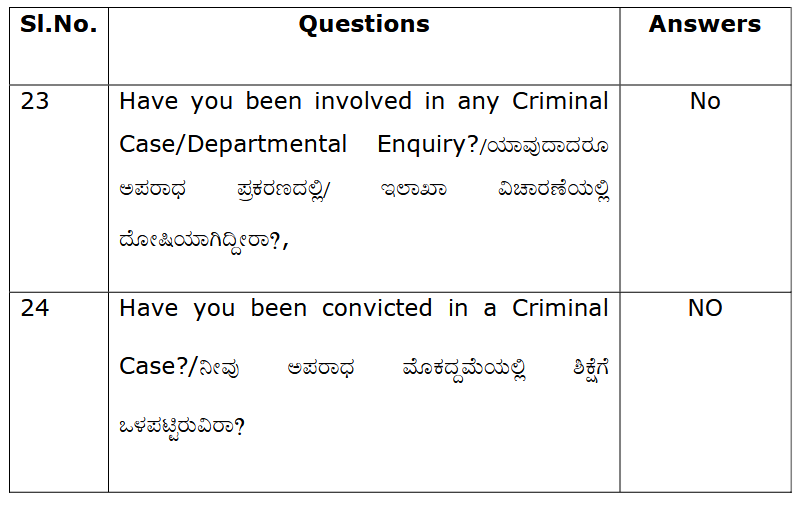
13. In the application submitted by the petitioner for the post of Sub-Inspector of Police (Civil), column Nos.23 and 24 depict as under:
14. A scrutiny of the aforesaid columns would indicate that, as regards Column No.23 with respect to involvement of the petitioner in any criminal case/departmental enquiry, the answer of the petitioner is "No". The said application was submitted online on 14.08.2019, i.e., after the charge sheet had been laid against the petitioner on 14.10.2014 in Crime No.68/2013 by Sindagi Police for the aforementioned offences. In the said charge sheet, the petitioner was arrayed as accused No.90. Thus, it is clear that as on the date of filing the application, the said criminal case was pending against the petitioner. In such circumstances, the petitioner, being a degree holder and a diligent candidate, cannot plead ignorance or inadvertence by stating that he misread the word ''doshi/'' in the Kannada version of Column No.24. No doubt, subsequently he was acquitted in the said case. However, the fact remains that as on the date of submitting his online application, a criminal case was pending against him, and non-disclosure of the same would clearly amount to suppression of material facts.
15. As regards the judgments relied upon by the learned counsel for the petitioner, it is submitted that in Mahadeva's case (W.A. No.3030/2013), the applicant was involved in his brother's case, wherein his brother had promised to marry the complainant, and later his name was dropped from the list of accused on the basis of the statement made by the complainant herself. Similarly, in Vishwanath Mudaraddi's case (W.P. No.45779/2018), the petitioner was an in-service candidate who had applied for the post of Police Sub-Inspector (Civil). In such circumstances, the Court considered the matter by placing reliance on the judgment of the Apex Court in AVTAR SINGH V. UNION OF INDIA, reported in 2016 (8) SCC 471. The facts and circumstances of the case in THE STATE OF MADHYA PRADESH AND OTHERS VS BHUPENDRA YADAV (CIVIL APPEAL NO.27301/2018) are different from those of the present case..
16. However, in the judgment in the case of Avtar Singh (supra), the Hon'ble Apex Court, after discussing various decisions, summarised the law by observing that the information given to the employer by a candidate as to conviction, acquittal or arrest, or pendency of a criminal case, whether before or after entering into service, must be true and there should be no suppression or false mention of the required information. Further, the employer shall take into consideration the Government Orders, instructions, and rules applicable to the employee at the time of taking the decision. It was further observed that while passing the order of termination of service or cancellation of candidature for furnishing false information, the employer may take notice of the special circumstances of the case, if any, while furnishing such information, and shall take into consideration the Government Orders, instructions, and rules applicable to the employee at the time of taking the decision.
17. Reference was also made to the decision in the case of DAYA SHANKAR YADAV V. UNION OF INDIA AND OTHERS reported in (2010) 14 SCC 103, wherein the Hon'ble Apex Court dealt with the purpose of seeking information with respect to the antecedents of a candidate and observed that the same is essential to ascertain the suitability for the post. It was further observed that disclosures made in the verification form relating to the character and antecedents of a candidate may result in various consequences; for instance, if the declarant has answered the questions in the affirmative and furnished details of any criminal case (wherein he was convicted or acquitted by giving benefit of doubt for want of evidence), the employer may refuse to offer him employment (or, if already employed on probation, discharge him from service), if he is found to be unfit having regard to the nature and gravity of the offence/crime in which he was involved.
18. On the other hand, if the declarant answers the questions in the negative and on verification it is found that the answers were false, the employer may refuse to employ the declarant (or discharge him, if already employed), even if the declarant had been cleared of the charges or acquitted. This is because suppression or non-disclosure of material information bearing on his character itself becomes a valid ground for non- employment of the declarant.
19. The law laid down in the above case makes it clear that if the declarant has suppressed material information and furnished false answers, the employer has every right to discharge him from service or not to select him for the post. In the instant case, as discussed supra, the petitioner-applicant, being a degree holder, had knowledge of the pendency of the criminal case as on the date of submitting his online application; however, he stated that there was no criminal case pending against him, which clearly amounts to suppression of material facts. In such circumstances, respondent No.2 has rightly deleted the name of the petitioner from the final select list and included the name of respondent No.3.
20. As such, the Tribunal has rightly dealt with the matter in detail. We, therefore, find no error in the impugned order warranting interference by this Court. Accordingly, the writ petition, being devoid of merit, is dismissed.



 " and answered the same as "No". However, subsequently, having realised the mistake even before the select list could be finalised, he submitted representations dated 20.05.2020 and 08.07.2020 stating that the same was neither deliberate nor intentional, and that it was made under a bona fide impression that he had not been involved in any criminal case. Despite the same, respondent No.2 has not considered the said representations.