(Oral):
1. The present petition has been filed under Article 226, read with Article 21 of the Constitution of India ("Constitution"), as well as Section 528 of the Bharatiya Nagarik Suraksha Sanhita, 2023 ("BNSS"), for issuance of writ of mandamus or any other writs, directing respondent nos. 1 and 2 to medically terminate the pregnancy of the petitioner.
2. Learned counsel appearing for the petitioner submits that the present petition has been filed by the petitioner, who is a minor girl of 15 years of age, through her father.
3. He further submits that the petitioner is a victim of rape, and is currently at an approximate 26-28 weeks gestational period. The petitioner, as well as her father, wish to terminate the pregnancy, since the continuation of the same would result in grave mental injury to the petitioner.
4. Thus, by way of the present petition, the intervention of this Court has been sought for termination of pregnancy of the petitioner, since the current gestational age of the petitioner is beyond the permissible limits under the Medical Termination of Pregnancy Act, 1971 ("MTP Act"), as amended by the MTP (Amendment) Act, 2021.
5. Learned counsel for the petitioner submits that the petitioner is invoking her "Right to Life" as enshrined under Article 21 of the Constitution, for conducting the medical termination of her pregnancy, as rejection of the said request would cause great mental injury to the petitioner, who is a victim of rape.
6. Attention of this Court has been drawn to the report issued by the All India Institute of Medical Sciences ("AIIMS"), New Delhi dated 19th June, 2026, which is reproduced as under:
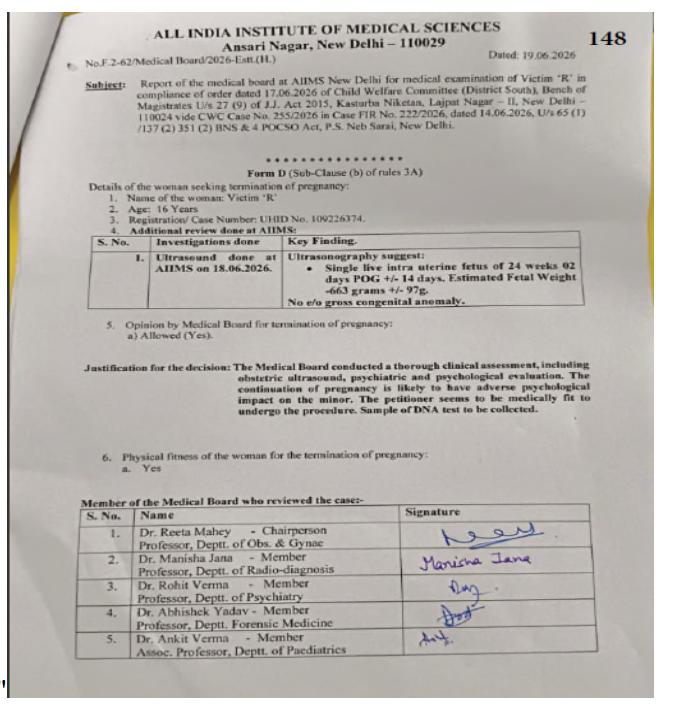
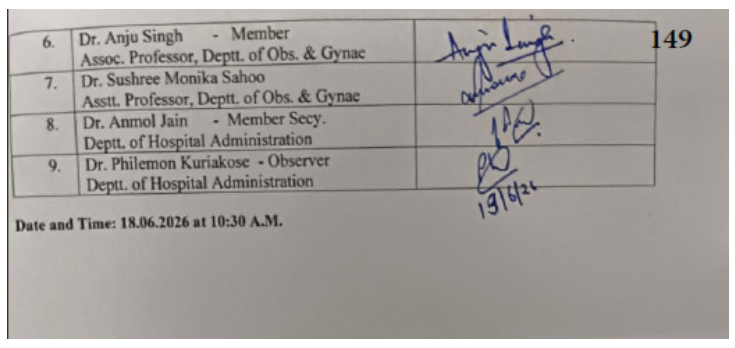
7. Perusal of the aforesaid report dated 19th June, 2026 shows that the Medical Board of AIIMS, New Delhi conducted a thorough clinical assessment of the petitioner, including obstetric ultrasound, psychiatric and psychological evaluation. After the clinical assessment, the Medical Board of AIIMS, New Delhi has clearly given its opinion that the termination of pregnancy can be allowed as continuation of the pregnancy is likely to have adverse psychological impact on the minor petitioner. Further, the petitioner has been declared to be medically fit to undergo the procedure of medial termination of pregnancy.
8. On a pointed query by this Court, learned counsel appearing for the Government of NCT of Delhi ("GNCTD") submits that in view of the clear report by AIIMS, New Delhi, they have no objection if the procedure for medical termination of pregnancy is carried out upon the petitioner.
9. None appears for respondent no. 2, i.e., AIIMS, New Delhi when the matter is called out.
10. However, the respondent no.1/GNCTD submits that necessary order can be passed by this Court, since the report of the Medical Board of the AIIMS, New Delhi is already before this Court.
11. At this stage, reference is made to the decision in the case of Minor J Thr Mother P Versus State and Another, 2026 SCC OnLine Del 3959, wherein, the Court permitted medical termination of pregnancy of a minor, who was a victim of sexual assault, having gestational period of around 26 weeks. The relevant portions of the said decision read as under:
"xxx xxx xxx
10. MTP Act does not provide for termination of pregnancy over the gestational age 24 weeks, except where there is detection of any substantial fetal abnormality and, therefore, the minor is compelled to file the present petition, through her mother.
11. There is no qualm with respect to the fact that the extraordinary jurisdiction of the Constitutional Courts can be invoked in such a situation and wherever found so permissible, the pregnancy can be directed to be terminated.
12. This Court in S v. State, 2025 SCC OnLine Del 3863 has observed as under:
".......
..........
27. This position was affirmed by the Hon'ble Supreme Court in case of A (Mother of X) v. State of Maharashtra: Civil Appeal No. 5194 of 2024, wherein the Court had allowed termination of pregnancy of more than 29 weeks being carried by a rape victim. Prior thereto also, in case of Venkatalakshmi v. State of Karnatka: Civil Appeal No. 15378 of 2017, the Hon'ble Supreme Court had permitted termination of a pregnancy at 26 weeks on the basis of severe mental trauma caused by rape.
28. This Court, including this Bench, has passed similar directions in other similar cases, where continuation of pregnancy beyond 24 weeks posed serious risks to the mental or physical health of the woman, especially in cases arising from sexual assault.
13. This Court has also gone through Venkatalakshmi v. State of Karnatka, 2017 SCC OnLine SC 2156 wherein also, the minor was subjected to a sexual assault and on her medical examination and investigation, she was found to be of 26 weeks gestation with mild anaemia and the Supreme Court, keeping in mind the overall facts of the matter and the fact that such minor was a victim of rape, directed termination of pregnancy, while also directing that every safety aspect would be kept in mind while terminating such pregnancy.
xxx xxx xxx
20. This Court very well comprehends and understands the grave mental injury and trauma inflicted upon the mind of a minor, on account of sexual assault in question. Reference be also made to C v. State (NCT of Delhi), 2024 SCC OnLine Del 5617 wherein Co- ordinate Bench of this Court has observed as under:
"16. The Petitioner's plea is also rooted in her fundamental rights under Suchita Srivastava v. Chandigarh Admn. (2009) 9 SCC 1 : (2009) 3 SCC (Civ) 570, (2023) 9 SCC 433 Article 21 of the Indian Constitution, which guarantees personal liberty. This liberty encompasses the right to make reproductive choices, including the termination of pregnancy under conditions that pose a risk to the woman's mental health and well-being. The Supreme Court of India has affirmed these rights, emphasizing the importance of considering the woman's current health, her life's conditions, and her future well-being while making such decisions. Therefore, it is clear that a pregnant woman's bodily autonomy and right of self- determination is an intrinsic part of her fundamental rights enshrined under Article 21 of the Constitution."
xxx xxx xxx"
(Emphasis Supplied)
12. Perusal of the aforesaid decision makes it clear that although the MTP Act does not provide for termination of pregnancy over the gestational age 24 weeks, the extraordinary jurisdiction of the Constitutional Courts can be invoked for termination of pregnancy in cases of rape, as in such cases, grave mental injury and trauma is inflicted upon the mind of the minor.
13. This Court also deems it apposite to refer to the order dated 24th April, 2026, passed by the Supreme Court in SLP(C) 14454/2026, titled as "S Versus The Union of India & Ors.", relevant portions of which, read as under:
"xxx xxx xxx
11.1 The right to make decisions concerning one's body, particularly in matters of reproduction, is an integral facet of personal liberty and privacy under Article 21 of the Constitution of India. This right cannot be rendered ineffective by imposing unreasonable restrictions, especially in cases involving minors and unwanted pregnancies, such as in the instant case.
11.2 No court ought to compel any woman and more so a minor child, to carry a pregnancy to full term against her express will. Such compulsion would not only disregard her decisional autonomy but could also inflict grave mental, emotional and physical trauma in case she is compelled to give birth. In these circumstances, denying the relief sought would compel the minor to endure irreversible consequences. Such an approach would be contrary to the constitutional ethos and the settled principles recognizing reproductive choice as a fundamental right. What is of relevance is the choice of the pregnant woman rather than the interest of an unborn child. It is easy to say that if the pregnant woman is not interested in raising the child, she may give away the child in adoption and therefore must be compelled into giving birth to the child. However, that cannot be the correct approach, particularly, in cases where the child to be born is unwanted. In such a situation, directing the pregnant woman to give birth to the child against her wishes and to forcefully continue her pregnancy would negate the welfare of the pregnant woman and make it subordinate to the child yet to be born.
11.3 We find that in cases of unwanted pregnancy, often the decision to terminate is made beyond the statutory period prescribed under the MTP Act owing to several reasons. It is under such circumstances that Constitutional Courts must weigh the circumstances in which a case in relation to the welfare of the pregnant woman has to be considered rather than the child to be born. In fact, under certain grounds, the MTP Act itself permits termination of pregnancy which is therefore recognised in law. The Constitutional Court is approached only when the statutory remedy is not available to a party. Can the Constitutional Court then say that since the statutory remedy is not available, no constitutional remedy would be available. That, in our view, cannot be the approach. A lack of remedy under a statute does not bar a constitutional remedy. The statute codifies a part of the constitutional remedy. If a case is not covered within the four corners of a statute then, can the constitutional relief be also denied? In our view, in such circumstances, the Constitutional Court ought to weigh all facts and circumstances from the lens of the party who intends to terminate the pregnancy and is willing to undertake the medical risk, rather than compelling her to complete the pregnancy term and give birth to an unwanted child. If the pregnant woman carrying an unwanted pregnancy is compelled to continue such a pregnancy, then the constitutional rights of the pregnant woman would be breached.
11.4 Further, if the Constitutional Court adopts the view that even an unwanted pregnancy must be continued, then instead of approaching the Court for permission, pregnant women would visit illegal abortion centres and secretly undergo termination of such pregnancies which would only make such women more vulnerable and expose them to more dangerous procedures. It is under such considerations that a Constitutional Court must decide what is best in the interest of the pregnant woman, particularly, when the pregnancy is unwanted as in the present case.
xxx xxx xxx
13. Further, the mental health of a pregnant woman carrying an unwanted pregnancy also must be borne in mind and given its due importance. If she is forced to continue her pregnancy and give birth the consequences would be adverse. An unwanted pregnancy and the effect thereof on the mindset of such a pregnant woman will also have a bearing on the child to be born. The decision not to continue a pregnancy and to seek termination with all attendant risks must be respected rather than compelling such a pregnant woman to continue such a pregnancy.
14. We may usefully refer to a three-Judge Bench judgment of this Court in X v. Health & Family Welfare Department, 2022 SCC OnLine SC 1321, wherein it has been authoritatively held that a woman's right to reproductive autonomy includes the right to choose whether and when to have children, the number of children to have, and the right to access safe and legal abortion and reproductive healthcare. This Court recognized that the decision to continue or terminate a pregnancy arises out of complex and deeply personal circumstances, which only the woman herself is best placed to evaluate. Reproductive autonomy, therefore, necessarily entails that every pregnant woman has the intrinsic right to decide whether to undergo an abortion. Importantly, this Court also observed that a mere clinical description of pregnancy cannot capture the profound physical and psychological consequences of forcing a woman to carry an unwanted pregnancy to term. Consequently, the decision to either continue or terminate a pregnancy is firmly rooted in the woman's right to bodily integrity and decisional autonomy, which are integral facets of her fundamental rights under Article 21 of the Constitution.
14.1 In the context of the present case, we may refer to the decision of A (Mother of X) v. State of Maharashtra & Others in Civil Appeal No.827 of 2026, where, on similar facts, this Court had allowed medical termination of pregnancy of 30 weeks of a minor girl. In that case too, the pregnancy in question arose out of a consensual relationship, and much like the present case, the continuation of the pregnancy was stated to be traumatic both mentally as well as physically to the minor girl as it was an unwanted pregnancy.
xxx xxx xxx"
(Emphasis Supplied)
14. Accordingly, considering the submissions made before this Court, in view of the desire of the minor as well as her father to terminate the pregnancy and the opinion of the Medical Board of AIIMS, New Delhi in this regard, the prayer in the petition to medically terminate the pregnancy of the petitioner is allowed, with the following directions:
I. The petitioner is permitted to get herself admitted at AIIMS, New Delhi on the strength of the present order for medical termination of her pregnancy.
II. Let the procedure for termination of pregnancy be carried out by a team of competent doctors in accordance with the provisions of MTP Act and the relevant Rules and Regulations and Guidelines prescribed for the aforesaid purpose.
III. Complete record of such procedure, performed upon the minor for the purpose of termination of said pregnancy, shall be maintained by the Medical Board.
IV. Respondent no. 2, i.e., AIIMS, New Delhi is directed to preserve the tissue of the foetus for the purposes of DNA testing, which would be required with reference to the criminal case which stands registered.
V. Needless to say, respondent no. 2, i.e., GNCTD shall bear all the expenses necessary for the termination of the pregnancy of the minor in question and her stay at the hospital during such period. The expenditure towards post-operative period shall also be borne by the State.
VI. In case the child is born alive, Medical Superintendent, AIIMS, New Delhi in conjunction with the State Authorities would ensure that medical support, as well as every possible and feasible assistance is offered to such child, and the child shall be kept in an incubator. Intimation in this regard shall be given to the concerned Child Welfare Committee ("CWC"), and as and when so required, further directions be sought from CWC.
VII. In that case, as per wish of minor and her father, such child be given in adoption as per prescribed procedure.
15. With the aforesaid directions the present petition stands disposed of.
16. Order Dasti under the signature of Court Master.



