Case No : R/First Appeal Nos. 77, 478 Of 1979, 4206 of 2024 With Civil Application (For Joining Party) No. 1 Of 2024
Judges: THE HONOURABLE MR. JUSTICE J.C. DOSHI
Parties : Heirs Of Mahant Dayaramdas- Bai Padma & Others Versus Charity Commissioner & Others
Appearing Advocates : For the Appellants: Mehul S. Shah, Percy Kavina, Sr. Advocate Assisted by Arpit A. Kapadia(3974), Bhagirath N. Patel(9016), Tejas P. Satta, Aishwarya, Advocates. For the Defendants: Dhwani R. Tripathi, AGP.
Date of Judgment : 22-06-2026
Head Note :-
Gujarat Public Trust Act, 1950 - Section 47 -
Judgment :-
CAV Judgment
To ensure a sound final judgment, let me first lay the cornerstone of the two Civil Applications for joining party.
ORDER IN CA NOs.1 of 2024
1. These Civil Application Nos.1 of 2024 filed in both the First Appeals, being First Appeal No. 77 of 1979 and First Appeal No. 478 of 1979, are for joining party. These two Civil Applications deserve a ruling before the captioned appeals take centerstage.
2. These two Civil Applications are filed by the persons, who have been appointed as Trustees of the Narsinhji Mandir Trust, Dhaman, having Registration No.A/265/Navsari by the 2nd Additional District Judge, Navsari in Civil Misc. Application (Trust) No.56 of 2017.
3. Heard learned Senior Counsel Mr. Percy Kavina assisted by learned advocate Mr. Tejas P. Satta for the applicants of the applications and learned Senior Counsel Mr. Mehul Shah assisted by learned advocate Mr. Arpit Kapadia appearing for the appellants of the captioned First Appeals.
4. Learned Senior Counsel Mr. Percy Kavina mainly argued that the applicants are appointed as Trustees by the 2 nd Additional District Judge in Civil Misc. Application (Trust) No.56 of 2017 in exercise of powers under Section 47 of the Gujarat Public Trust Act, 1950 (hereinafter referred to as the 'GPT Act').
4.1 He would further submit that though the appellants have challenged the judgment and order passed in Civil Misc. Application (Trust) No.56 of 2017 by way of First Appeal No. 4206 of 2024, whereby the coordinate Bench of this Court in Civil Application No.1 of 2024 stayed the execution and implementation of the judgment and order passed in the Civil Misc. Application, and it would not preclude the present applicants from joining the present appeals as they are necessary and essential parties under Order I Rule 10 of the Code of Civil Procedure, 1908 (hereinafter referred to as 'the Code').
4.2 Learned Senior Counsel Mr. Percy Kavina further submitted that the two First Appeals, being First Appeal No. 77 of 1979 and First Appeal No. 478 of 1979, were dismissed for non-prosecution more than once. The litigation, which was started by the devotees of Bhagwan Narsinhji, were also expired and in that circumstances, in the restoration applications filed by the appellants, the present applicants were joined as a party. Even before dismissal of the First Appeals on the ground of non- prosecution, the applicants had preferred Civil Applications for joining them as a party in the appeal proceedings. However, since the appeals were dismissed for non-prosecution, the Civil Applications filed by the present applicants were also dismissed.
4.3 He would further submit that, on 28.02.2023, First Appeal No. 77 of 1979 and First Appeal No. 478 of 1979 were restored, and at the relevant time, the applicants were given an opportunity to contest the restoration applications and further, while restoring the main appeals, had also been given the cost.
4.4 In this line of submission, learned Senior Counsel Mr. Percy Kavina submitted that the applicants are the Trustees of the Narsinhji Mandir Trust and, therefore, they are required to be joined in the matter and also, they are to be given the right of audience to agitate the contentions against the appellant's appeals.
4.5 Upon above submissions, it was submitted to allow both the Civil Applications.
5. Per contra, learned Senior Counsel Mr. Mehul Shah appearing for the original appellants mainly contended that the applicants have no locus standi to argue to defeat the appeals of the appellants and that the applicants are not the Trustees of the Narsinhji Temple Trust.
5.1 It is further submitted that when the proceedings of the First Appeals arose, some other devotees had initiated the proceedings. All of them have died and they were also deleted from the array of respondents in the appeals by orders passed below Civil Application No.1 of 2023 in both the First Appeals, and thereby, the First Appeals are only continued against the Charity Commissioner. The said applications were allowed by this Court vide order dated 21.01.2026. Thus, it makes it abundantly clear that the applicants have no locus standi to be impleaded in the First Appeals.
5.2 It is further argued that the judgment and order passed in Civil Misc. Application (Trust) No.56 of 2017 appointing the applicants as Trustees of the Narsinhji Mandir Trust, Dhaman, has been stayed by this Court vide order dated 20.01.2025, which makes it abundantly clear that the applicants have no locus standi to be impleaded in the First Appeals. Therefore, learned Senior Counsel Mr. Mehul Shah submitted that both the applications are bereft of merits and require to be dismissed.
6. Having heard learned Counsel for both the sides and considering the contentions raised before the Court, what could be noticeable that in the Civil Misc. Application (Trust) No.56 of 2017, the 2nd Additional District Judge, Navsari, in exercise of power and jurisdiction vested under Section 47 of the 'GPT Act', appointed the present applicants as Trustees of the Trust, although this order has been stayed by this Court in First Appeal No.4206 of 2024, it cannot be said that their presence in the appeal proceedings is unnecessary or that they are not relevant to decide the disputes.
7. What is also noticeable is that the applicants have been treated as respondents in Misc.Civil Application (For Restoration) No.1 of 2017 in both the appeals. They have been given the audience by the coordinate Bench while passing an interim order on 28.02.2023. The arguments of learned Senior Counsel Mr. Percy Kavina was heard by the coordinate Bench, who had objected to restoration of the First Appeals. The coordinate Bench ultimately allowed the Misc. Civil Applications for restoration, granting a cost of Rs. 25,000/- to the applicant of the Misc. Civil Applications.
8. It is equally relevant to note that at the time of filing the restoration applications, the appellants had chosen the applicants to be respondents on the ground that they were persons interested in the outcome of the appeals.
9. Now, in these circumstances, the appellants cannot blow hot and cold and can say that the applicants are not necessary parties in the appeal proceedings. The Principle of Approbate and Reprobate applies to the arguments of the appellants.
10. The appellants, who at their own wish and convenience, joined the applicants as respondents in the Misc. Civil Applications for restoration and also permitted them to argue the restoration applications, cannot now deny the applicants from joining as a necessary party in the appeal proceedings.
11. Order I Rule 10(2) of 'the Code' confers power upon the Court to add or strike out parties either suo-motu or upon the application of a party, and on such terms as may appear to the Court to be just. It further permits the Court to add a party if it finds that the presence of such party before the Court is necessary in order to enable the Court effectively and completely to adjudicate upon and settle all the questions involved in the suit.
12. In Savitri Devi v. District Judge, Gorakhpur, reported in 1999 (2) SCC 577, it has been held by the Honourable Supreme Court that Order I Rule 10 of 'the Code' enables the Court to add any person as a party if it is necessary for effective and complete adjudication and settlement of all questions involved in the suit and to avoid multiplicity of the proceedings. For determining whether a party is a necessary party or not, the two factors are to be satisfied. First, that there must be a right to some relief against such party in respect of the controversies involved in the proceedings, and second, no effective decree can be passed in absence of such party. Apt to note, the object of Order I Rule 10 of 'the Code' is to discourage the contests on technical pleas and to save honest and bonafide applicant from being non-suited. Under this Rule, a person may be added as a party to the suit in the case where, without their presence, the questions involved in the suit cannot be completely decided. It is in these circumstances, according to this Court, the applicants of the Civil Applications are necessary parties in the appeal proceedings and are required to be added as respondents in seriatim.
13. In the premises of the aforesaid reasons, the Civil Application No.1 of 2024 in both the appeals is allowed. The applicants of the Civil Applications are ordered to be joined as respondents, in seriatim, in both the appeals.
Necessary amendments be carried out forthwith.
ORDER IN FIRST APPEALS
1. In all, the three captioned appeals hereinabove involve identical issues connected with each other. Therefore, upon the urge of learned Counsel for both the sides, all the three appeals are heard and decided analogously by this common judgment.
2. In essence, it is a dispute between Lord Narsinhji and his Mahant Late Dharamdas Guru Govinddas. The latter, in dispute, claims that the idol of Lord Narsinhji is a private idol and the house where the said idol is placed is a personal temple, and all the properties situated in the various surrounding villages attached with the Narsinhji Temple are his personal properties.
2.1 Per contra, the devotees, however, claimed that the idol of Lord Narsinhji is a public idol and the place where the idol is placed is a public temple. Everyone from the general public has a right to worship and offer "pooja" and "aarti" and that, all the properties dedicated either by the erstwhile State of Baroda or by villagers, whether standing in the name of the Mahant or in the name of Lord Narsinhji or in any other name of Lord Narsinhji, are public properties and they are the part of the Trust's properties.
2.2 This dispute traces its origin to the year 1952. The devotees of Lord Narsinhji filed an application before the Deputy Charity Commissioner, Baroda Circle on 07.06.1952 claiming that the idol of Lord Narsinhji is a public idol and the house where it is placed is a public temple, and all the properties in the surrounding villages are public properties. The said application was registered as Civil Misc. Application No. 27 of 1952 by the Deputy Charity Commissioner, Baroda, who initiated an inquiry under Sections 19 and 20 of the 'GPT Act'.
2.3 This inquiry was allowed by the Deputy Charity Commissioner on 02.06.1954 after issuing notice to Late Mahant Dayaram Guru Govinddas. In the proceedings before the Deputy Charity Commissioner, Late Mahant Dayaram Guru Govinddas raised multiple contentions (Written statement at Exhibit-18) and claimed that the idol of Lord Narsinhji is a private deity and all the properties, including the place where the idol is kept are not the public properties, but are private properties.
2.4 Further, it is contended that even on the previous occasions, at multiple times, the different villagers being antagonistic to Mahant Dayaram had unsuccessfully filed various applications before different authorities to claim that Lord Narsinhji is a public deity and the place where he is placed is a public place.
2.5 In his contention, Mahant Dayaram claimed that his ancestors had brought the idol of Lord Narsinhji from Village Bharatpur. At the relevant time, there was no temple in Village Dhaman. The idol was kept in the private place and the ancestors of the defendants were offering worship, seva, pooja and aarti to the idol and, thereby, it is a private deity and all the properties are private properties.
2.6 As stated hereinabove, the Deputy Charity Commissioner, Baroda, allowed the application filed by the devotees having considered the revenue records produced on record and the depositions/statements of villagers recorded during the inquiry, and also recorded the admission of Mahant Dayaram that the old temple was opened for darshan to all people,and also referred to Exhibit-51, the list of the properties given by the Mahant himself.
2.7 The Deputy Charity Commissioner, Baroda, upon Exhibit-51, believed that the Mahant possessed the said properties and also other properties, which he purchased out of the sale proceeds of the lands, which were properties of the public trust, and therefore, held that all the properties including lands, buildings as well as movable properties inherited by the Mahant were trust properties.
2.8 Being aggrieved, the Mahant preferred Appeal No. 117 of 1954 before the Charity Commissioner, Bombay under Section 70 of the 'GPT Act'. Charity Commissioner heard the appeal and after giving opportunity of hearing to all relevant and concerned parties, Charity Commissioner, Bombay vide order dated 25.07.1955 dismissed the appeal filed by the Mahant.
2.9 Further being aggrieved, Late Mahant Dayaram filed an application under Section 72 of the 'GPT Act' before the District Court, Surat to set aside the decisions rendered by the Charity Commissioner as well as the Deputy Charity Commissioner on 21.09.1955. This challenge was registered as Misc. Civil Application No.70 of 1955. Subsequent thereto, on bifurcation of Surat District, Valsad District came to be separated from Surat District and, thereby, on change of territorial jurisdiction the Misc. Civil Application No.70 of 1955 came to be transferred to the District Court, Valsad at Navsari and was renumbered as Misc. Civil Application No.1 of 1964.
2.10 In the interregnum, three persons namely Haribhai Naranji, Govindbhai Kalyanji and Vallabhbhai Nagar, after obtaining the permission from the Charity Commissioner on 20.10.1954, filed Regular Civil Suit No.30 of 1954 before the District Court, Surat on 19.11.1954 under Section 50 of the 'GPT Act', claiming relief of removal of the Mahant Dayaram Guru Govinddas as a Trustee on the ground of malfunction and mismanagement of the trust as well as trust properties, and to appoint new Trustees and to set aside alienation of the trust properties made by Mahant Dayaram and for rendition of the accounts.
2.11 Alike transfer of the Misc. Civil Application filed under Section 72 of the 'GPT Act', on bifurcation of the Surat District, the Regular Civil Suit No.30 of 1954 filed before the District Court, Surat was also transferred to the District Court, Valsad and came to be renumbered as Regular Civil Suit No.3 of 1964.
2.12 To be noted that when the Regular Civil Suit under Section 50 of the 'GPT Act' was filed by public spirited persons and the devotees of Lord Narsinhji, the application filed by the Mahant before the Charity Commissioner vide Appeal No.117 of 1954 was pending. The Mahant having lost before the Charity Commissioner, as stated hereinabove, has filed the Misc. Civil Application, firstly before the District Court, Surat, which thereafter stood transferred to the District Court, Valsad at Navsari and was renumbered as Misc. Civil Application No. 1 of 1964.
3. At this juncture, the history of the temple, which seems to be lost in antiquity, requires a glance. Even as per the say of Late Mahant Dharamdas, one of his ancestors had come from Bharatpur. At that time, there was no temple in Village Dhaman. The ancestor (As per the Guru-Chela tradition and lineage), was doing a private Dev-Seva. The Guru Mahant Dharamdas had brought the metal idol of Lord Narsinhji, which was a portable image. The ancestor of Mahant Dayaram was living in a hut in Village Dhaman and later on, the temple at Village Dhaman had been set up by this founder.
3.1 The admitted genealogy of the Mahants of the temple shows that late Mr. Dharamdas was the first Mahant and he founded the temple. After Mahant Dharamdas, the Gadi devolved upon Mahant Santokdas, and thereafter came disciple Prabhudas, and then Laldas and then, Gopaldas and lastly, upon Mahant Dayaram.
3.2 The prerequisite of Mahantship, as per the custom and tradition, was that the Mahant must be 'celibate'. However, this tradition was not preserved and followed by the last Mahant Dayaram. He married after being appointed as Mahant. All the previous Mahants were celibates and the Mahantship had devolved from Guru to Chela (Spiritual teacher/master to Disciple) as per the established tradition. Meanwhile, some wills were executed by the Mahants (Exhibits-39 to 42). These will have some bearing on the decision and the dispute between the parties. However, it is discussed in the later part of the judgment, but to be observed that the two wills, Exhibits-41 & 42 were made by the then Mahant during the pendency of the dispute between the parties.
3.3 In a Regular Civil Suit No.3 of 1964, the public spirited persons and the devotees of Lord Narsinhji claimed Three categories of the properties to be part of the Public Trust. One category consists of the property, which were in actual possession and management of the Mahant. They are shown in Schedule-A. This schedule-A is sub-divided into Three parts. The first part consists of agricultural land scattered over in various villages. The second part consists of buildings and land appurtenant to the building. The third part consists of moveable properties.
3.4 The second category, i.e. Schedule-B, in which particulars of those immovable properties were shown, which have been alienated by the Mahant prior to or during the pendency of the litigation. This alienation is sought to be declared as void. The parties, who were in possession of the property of those alienated lands at the time of filing of the suit were joined as defendant Nos.4 to 27 in the suit proceedings.
3.5 The third category, i.e. Schedule-C, consists of agricultural land admeasuing 30 Bighas and Vasa land in Moje Village Chokhund, Taluka: Navsari, gifted by Mahant Dayaram to the defendant No.3 - Raghuvirdas Guru Govinddas. This gift is also sought to be declared as void.
3.6 In the Regular Civil Suit No.3 of 1964, following reliefs were claimed:-
"(1) that the defendant No.2 be removed as Mahant-trustee and Manager of the suit public trust and its properties;
(2) the defendant No.2 be ordered to render accounts of the management of the trust and its properties
(3) new trustees and/or manager/managers be appointed in place of the defendant No.2 and the trust properties be vested in them
(4) declare as to what properties of the trust or the interest therein shall be located to any particular object of the trust;
(5) declare that the properties mentioned in Schedules B and C are properties belonging to the suit public trust;
(6) direction be given to the new trustee or manager who may be appointed to do needful to recover the possession of the trust property in the hands of defendants Nos. 3 to 27 and also the proceeds of the suit properties
(7) a scheme be framed for the proper management of the trust properties ;
(8) that the defendant No.2 or any of the defendants Nos.3 to 27 be ordered to pay the costs of the plaintiffs or the costs be ordered to be paid from the trust estate; and
(9) any other further relief as the nature of the case may require."
3.7 The basis of filing the suit was the outcome of the inquiry proceedings conducted before the Deputy Charity Commissioner, confirmed by the Charity Commissioner. In that realm, the proceeding of Misc. Civil Application No.1 of 1964 and its fate thereof, conflated with the fate of Regular Civil Suit No.3 of 1964, and therefore, both the proceedings were consolidated and heard together.
3.8 Issues were also framed in both the proceedings. Voluminous evidence, both oral and documentary, were recorded in connection with all the issues. The District Court decided both the proceedings finally on 16.09.1971. The Misc. Civil Application No.1 of 1964 was allowed and the decision of the Charity Commissioner in appeal No.117 of 1954, confirming the decision of the Deputy Charity Commissioner in Inquiry No.27 of 1952, was upturned. The temple of Lord Narsinhji was held to be a private deity and the properties, which were held to be public trust properties by the Deputy Charity Commissioner and Charity Commissioner were declared to be private properties of the Mahant. In consequence of this finding, the Regular Civil Suit No.3 of 1964 came to be dismissed.
3.9 The dispute then reached to the High Court of Gujarat. Against common decision, the First Appeal No.803 of 1971 was preferred, challenging the judgment and decree passed in the Regular Civil Suit No.3 of 1964. The other First Appeal No.222 of 1972 was filed challenging the decision arrived in the Misc. Civil Application No.1 of 1964. The appeals were heard together by the Division Bench of this Court and by judgment dated 11/12.08.1977, the Division Bench of this Court (Coram: Hon'ble Mr. Justice J.B. Mehta and Hon'ble Mr. Justice P.D. Desai) quashed and set aside the common judgment and decree passed by the learned District Court and the finding that the temple of Lord Narsinhji was a private deity and that the property in question were not public trust properties, were reversed and set aside. The Division Bench of this Court held that the temple of Lord Narsinhji is a public trust under the 'GPT Act' and also gave the relevant observation and finding in regards to the nature and title of the properties belonged to Lord Narsinhji's temple and remanded the matter for disposal by the District Judge in light of the observation made in the judgment.
3.10 In substance, the Division Bench of this Court passed the aforesaid order in so far as the Misc. Civil Application No.1 of 1964 filed under Section 72 of the 'GPT Act' is concerned. As far as the RCS No.3 of 1964 is concerned, which was decided on the preliminary issues, the Division Bench of this Court gave the direction to decide the remaining issue in the suit.
3.11 The relevant finding of the Division Bench of this Court to remand the matter to decide that which properties are the private properties of the Mahant and which properties belongs to the public trust, reads as under:-
"As regards the properties movable and immovable of this public trust, three Schedules A to C had been given. In Schedule A the lands and buildings were mentioned. In Schedules B and C properties which have been alienated to various respondents and properties which were gifted to Raghuvirdas were mentioned in Schedule C. All these properties were held by the charity authorities to be public trust properties. As we have earlier shown as public trust properties, there would be no difficulty in holding the properties which were Barkhali lands or Dharmada Chakariyat lands or lands which had been gifted by Dharmada gift or by gifts for religious purposes or the objects or which were acquired from public offerings, which had the character of Sarvajanik properties even under the Baroda law. The same would be true of the other properties which were accretions to those properties or which had been acquired by conversion in money or by purchasing other properties from the sale proceeds, as such accretions or conversions would have the same character. As, however, the trial Court had disposed of both these matters only on the preliminary question as to whether the temple was a public temple or of private ownership and on that basis the question about the properties had been disposed of, once that finding of the temple being a public temple and not a private temple and, therefore, the public trust is given, the trial Court will have now to go into the question as to which properties in these Schedules are public trust properties and which are private properties as contended by the Mahant. The trial Court had disposed of the other companion suit because of these findings in the Application under sec. 72. Therefore, even in that matter now the suit would have to be disposed of on merits. So far as the three issues which were heard as preliminary issues -- issue No. 1 as to the maintainability of the suit; as to the defendants 3 to 27 being not necessary parties and issue No. 5 as to misjoinder of causes of action and parties, they had been already disposed of by giving a finding in favour of the plaintiffs and no grievance regarding these findings had been made before us. Therefore, it would be only the other issues which have not been determined which will have now to be disposed of by the trial Court in that companion suit in accordance with our findings on the preliminary question that the Narsinhji temple is a public trust and bearing in mind our observations as to which properties even under the Baroda law had the Sarvajanik character.
In the companion suit, it may be borne in mind that this is an ancient temple which seems to have a considerable following in this area and it has large properties and even there would be fairly good income both from the lands and properties as well as from the donations and offerings. Originally the institution was having Sadavrat and a Dharmashala as well which appear to have been closed since many years. The present suit is for claiming the various reliefs including the removal of the Mahant and for framing up of the proper scheme for management of the trust, including challenge to the various alienations and gifts of the properties in Schedules B and C and for accounts. The whole litigation has been pending since very long and the Mahant has also now expired. The trial Court would have, therefore, to bear in mind the need for expediting the hearing of this suit keeping in mind these broad facts, especially when we have now held this to be a public trust of this ancient temple with its considerable properties, where it was because of the large scale alienations and the other alleged acts of the deceased, that this suit had to be filed. Once this trust is found to be a public trust, the Court would have to approach the crucial problem, if the proper cause of action is made out before it, to frame proper scheme, bearing in mind the principles for guidance which are laid down by this Court in its decision in First Appeal No. 361 of 1962, where my learned Brother spoke for the Division Bench in that decision dated November 30, 1972 in the matter of Bahucharaji Mata temple. It was pointed out there that it was well settled that once the Court found that there existed a trust for public purpose, it was its duty to consider as to how best the interests of the public as well as of the trust would be served. In the case of a permanent charitable trust, it would be the duty of the Court to arrange for the proper administration of the trust and for the application of its funds in the best interest of the trust. If there was in existence any rule, custom or practice, in accordance with which the trust was being administered and its funds applied and the Court found that such rule, custom or practice was required to be altered on account of lapse of time or change of circumstances, in the interest of charity, it would be the duty of the Court to settle a scheme providing for the same as observed by the Privy Council in Srimati Prasadji v. Laxmidas, A.I.R. 1929 P.C. 271:
'The institutional trust must be respected; but the sect and body of worshippers for whose benefit it was set up have the protection of the Court against their property being the subject of abuse, speculation and waste.'
In settling a scheme the Court will be entitled to take into consideration not merely the wishes of the founder so far as that can be ascertained but also the past history of the institution and the way in which the management has been carried on heretofore, in conjunction with other existing practices that might have grown up since the foundation of the trust. The Court has while settling the scheme the power of giving any directions and laying down any rules which might facilitate the work of management.--(Vide Mahomed Ismail Ariff v. Ahmed Moolla Dawood, A.I.R. 1916 P.C. 132). It is in the light of this legal and factual position that the question whether a scheme is required to be settled in respect of the trust in question will require consideration. The Court would have to keep in mind the most essential aspect that the income of such religious foundation which is meant essentially for being used for pious use should not be allowed to be frittered away or wasted in any manner and the manifold needs of the institution and its ancillary activities like Sadavrat, Dharmashala, which were previously carried out could not be allowed to remain unsatisfied. The Court has to settle the scheme providing for the best method for fully and effectively carrying out the purposes for which the trust exists and the proper application of its funds to attain that objective. The scheme which may ultimately be framed would have to provide for the application of the funds of the temple in a manner consistent with the objects of the foundation and in the best interest of the trust. At the same time, in framing the scheme, the Court would also bear in mind the past history of the institution, the way in which the management has been carried on heretofore and would give due consideration to the established practice of the institution and consider whether in the context of the existing conditions the same requires to be rescinded or modified. After the proper case is made out, the District Court would have to settle the scheme in the light of these observations.
In the result, we have to allow both the appeals by reversing the decree of the learned District Judge by setting aside his findings that the temple in question was not a public trust and that these properties in question were not public trust properties. We substitute the finding that the temple in question is a public trust under the Act. As regards which properties are the public trust properties, the matter would have to go back to the trial Court for disposal in the light of the aforesaid observations, so far as the Misc. C.A. under section 72 is concerned.
As regards the companion suit, the trial Court having disposed of the matter only on the preliminary issue, we set aside that decree by substituting the aforesaid finding that the temple in question is a public trust under the Act and, therefore, the remaining issues shall now be answered in the light of the aforesaid observations. We surely hope that now the District Court will dispose of this litigation at an early date, preferably within six months period from the receipt of record of this Court. It will be open to the parties to seek proper interim relief, if necessary, for protecting interest of the public trust and the trust properties. Both the appeals are accordingly allowed with costs. The costs of the Charity Commissioner shall come out of the trust."
3.11.1 Thus, the Division Bench in the common order of First Appeal No.803 of 1971 and First Appeal No.222 of 1972, conclusively held that the temple of Lord Narsinhji is a public deity and that the temple is a public temple and has further held that persons from the general public have every right to offer pooja, seva and darshan, and also to celebrate all the festivals, which are celebrated within the premises of the temple.
3.12 As far as the issue in regards to whether the properties mentioned in Schedule-A, B and C are concerned, whether they prove to be public or private properties, after aforesaid observation, the Division Bench remanded the matter to learned District Court to decide afresh and also directed it to decide the remaining issues afresh.
3.13 The decision of the Division Bench in the aforesaid First Appeals is taken up to the Hon'ble Supreme Court by Mahant Dayaram by filing Special Leave Petition (Civil) Nos. 4249-4250 of 1978. On 02.05.1979, the Hon'ble Supreme Court permitted Mahant Dayaram to withdraw the SLP proceedings. The following order was passed by the Hon'ble Supreme Court:-
"Order on the Special Leave Petitions as prayed for in prayer (a) of the application for withdrawing S.L.Ps."
3.14 In a petition, which was tendered before the Hon'ble Supreme Court for seeking a permission to withdraw the SLP, in para A, the petitioner had prayed for the following relief/s:-
"a) give liberty to the petitioners to withdraw the present petition and with liberty to agitate the question raised in the present petition as and when the petitioners adopt proceedings against the Judgment of the High Court in the pending Appeal; and.
b) pass such other and further order or orders as may be deemed just and proper by the Hon'ble Court on the facts and in the circumstances of the case."
3.15 The aforesaid facet of the dispute unmistakeably implies that the decision of the Division Bench of this Court holding that the temple of Lord Narsinhji is a public trust remains unaltered till date. The late Mahant Dayaramdas reserved his right to question the decision as and when any proceedings arising from the judgment of the High Court is questioned.
3.16 It is in this backdrop the proceedings of Regular Civil Suit No.3 of 1964 were re-conducted. According to the finding and observation of the learned District Judge in the reconvened proceedings of Regular Civil Suit No.3 of 1964 (Exhibit-559) that, after receiving back the Record and Proceedings from the High Court, the District Court had issued notices to all the concerned parties. However, it was found that amongst the three original plaintiffs, only one was surviving, i.e. plaintiff No.2, whereas deceased plaintiffs Nos.1 and 3 were represented by their respective heirs and legal representatives, who were brought on record.
3.17 Mahant Dayaram, who had fought the litigation tooth and nail, died during the pendency of the appeals before the High Court and his heirs and legal representatives have been brought on record. The defendant No.3 - Raghuvirdas, also expired and his heirs and legal representatives were brought on record.
3.18 In the same manner, some other defendants also expired, and either their names were deleted or their heirs and legal representatives were brought on record.
3.19 According to the observations of the learned District Judge in the reconvened proceedings of the Regular Civil Suit, the matter, which was hotly contested till the decision of the Division Bench of the High Court and which came to be challenged before the Hon'ble Supreme Court as well, thereafter the heirs of Mahant Dayaram lost interest in the proceedings and, despite being served, they did not choose to appear and contest the reconvened proceedings of the Regular Civil Suit.
3.20 By the decision dated 11.09.1978, the learned District Judge passed following final order:-
"The Miscellaneous Application No. 1 of 1964 is dismissed with a slight modification in respect of the suit properties. The following are held to be the properties of the public trust named Shri Narsinhji Temple of village Dhaman, Taluka Navsari.
Category A, Part- I (Agricultural lands in actual possession of the deceased deft.No.2 Mahant)
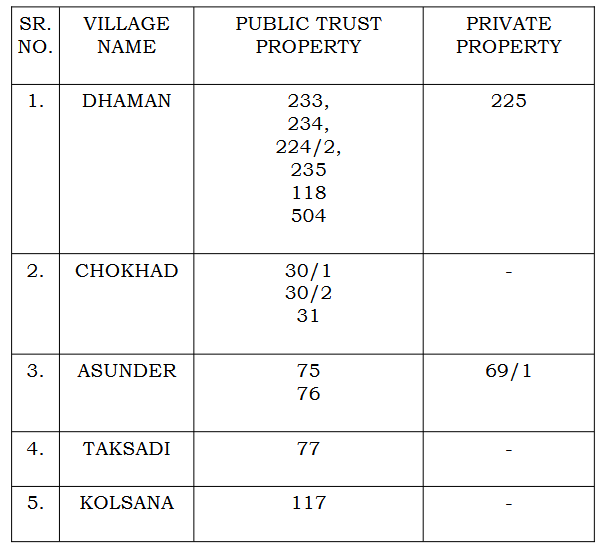
i) Survey Nos. 233, 234, 224/2, 235, 118, 504 of village Dhaman, Ta. Navsari.
ii) Survey Nos. 30/1, 30/2 and 31 of village Chokha, Ta. Navsari
iii) Survey Nos. 75 & 76 of village Asunder, Ta. Navsari
iv) Survey No. 77 of village Talsadi, Ta. Navsari.
v) Survey No. 117 of village Kolagna, Ta. Navsari.
vi) Survey No. 175 of village Astagam Taluka Navsari.
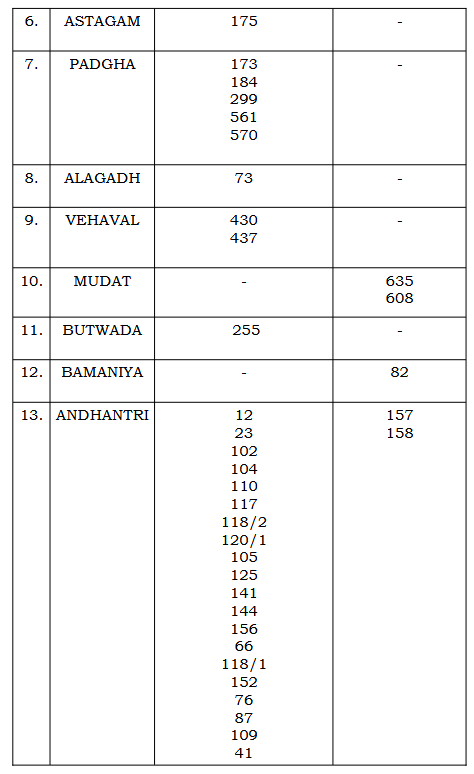
vii) Survey Nos. 173, 184, 299, 561 and 570 of village Pangha, Ta. Navsari.
viii) Survey Nos. 73 of village Algadh Taluka Mahuva.
ix) Survey No. 430 and 437 of village Vaheval, Ta. Mahuva.
x) Survey No. 255 of village Butwada, Taluka Mahuva.
xi) Survey Nos.12, 24, 102, 104, 110, 117,118/2, 120/1, 105, 125, 141, 144, 156, 66, 118/1, 152, 76, 87, 109 and 41 of village Anahati, Ta. Mahuva.
xii) Survey No. 22 of village Karohaka Taluka Bardoli..
xiii) Survey No. 106/of village Shanker-Talavani, Taluka Mahuva.
It is clarified that survey No.225 of village Dhaman, survey No.69/1 of village Asunder, survey No.635 and 608 of village Mat, Ta. Mahuva, Survey No.82 of village Bamaniya Ta. Mahuva an survey Nos. 157 and 158 of village Anahatri claimed to be the trust properties as shown in the Schedule A, Part I of the plaint are not held to be trust properties. To that extent, Misc. Application No.1 of 1964 shall be deemed to have succeeded.
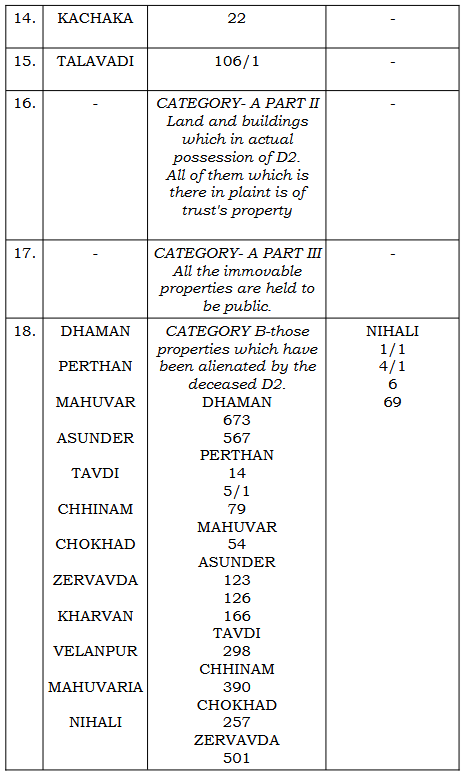
Category A, Part- II (Lands and buildings which were in actual possession of the deceased Mahant defendant No.2).
i) Buildings situate in the compound of the temple with compound bearing House No.55 at Dhaman.
ii) Buildings situate in the compound of Ram Rasayan Farmacy with compounds of house Nos. 67 an 68 at village Dhaman.
iii) Buildings with compounds bearing house No.70 let to the Co-operative Society at village Dhaman.
iv) The house in Dubarwada with compound bearing houses Nos. 7 to 10 at village Dhaman.
v) 1/6th part of the building of Ram-Rajya Flour Mill at village Dhaman with the machinery of the flour mill
vi) Buildings in Bavawala street being part of survey No.51 at village Dhaman.
vii) The buildings situate in village Chokhad with compound bearing house No.16.
These are all properties which are shown in Schedule-A, Part II of the plaint an all of them are held to be trust properties.
Category A, Part- III: (Movable properties in the hands of the deceased Mahant Defendant No.2).
All the movable properties worth Rs.15026-05p as listed in the Inventory prepared by the Charity Commissioner on 26-6-1954.
Category B properties: (Those which have been alienated by the deceased Mahant defendant No.2)
i) Survey Nos. 673 and 567 of village Dhaman.
ii) Survey Nos. 14, 5/1, 79 of village Perthan.
iii) Survey No. 54 of village Mahuvar Ta. Navsari.
iv) Survey Nos. 123, 126 and 166 of village Asundar
v) Survey No. 298 of village Tavai Taluka Navsari.
vi) Survey No.390 of village Chhinam, Ta. Navsari.
vii) Survey No. 257 of village Chokha
viii) Survey No.501 of village Zervavda
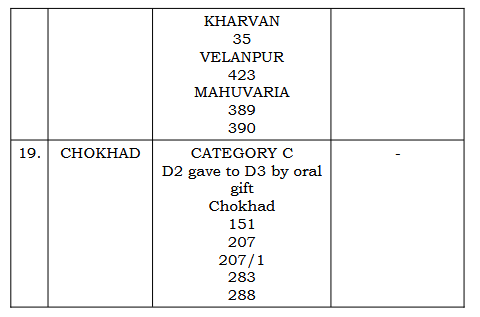
ix) Survey No.35 of village Kharvan Ta. Mahuva.
x) Survey No. 423 of village Velanpor, Taluka Mahuva.
xi) Survey Nos. 389 and 390 of village Mahuvaria, Ta. Mahuva
These are all the properties shown in Schedule B of the plaint attached to the suit excepting survey Nos. 1/1, 4/1, 6 and 69 of village Nihali. These four survey numbers of village Nihali are not held to be the trust property.
Category C properties: :- (Properties which the deceased defendant No.2 Mahant gave to the defendant No.3 Raghuvirdas by oral gift)
i) Survey numbers 151, 207, 207/1, 283 and 288. They are all the properties which are shown in Schedule 'C' of the plaint in the suit.
There shall be no order as to costs in Miscellaneous application No.1 of 1964 in view of the costs to be awarded in the suit.
Regular Civil Suit No. 3 of 1964 is decreed with following reliefs granted:-
(a) It is hereby directed that Govindji Dahyabhai Patel, Ranchhobhai Naranjibhai Patel, Ambelal Rambhai Patel, Ambelal Parshottam Patel and Govindbhai Kalyanbhai Patel, all of village Dhaman, Taluka Navsari shall be the trustees of the suit public trust by the name of Shri Narsinhji Temple, of village Dhaman. All the properties of this public trust as aforesaid shall vest in these trustees. The draft scheme for the administration and management of this public trust and its properties at Mark 546/l is approved. The names of the trustees shall be incorporated in this draft scheme. The plaintiffs shall provide the copy of the scheme with the names of the trustees incorporated therein with the signatures of the trustees obtained thereunder. The copy so provided under my signature shall form the part of the decree. One copy thereof shall be directly givento the Government Pleader on behalf of the Charity Commissioner for the record of the Charity Commissioner's Office. This scheme shall govern the administration and management of this public trust and its properties, subject to the provisions of the Bombay Public Trusts Act.
(b) The name of the deceased defendant No.2 Mahant shall be deleted from the public trust register and the entry regarding the mode of succession from Guru to Chela shall also stand deleted in view of this scheme frame.
(c) The possession of Parts I, II and III of Category A properties which were in possession of the deceased Mahant at the time the suit was filed shall be recoverable by the trustees from the heirs and legal representatives of the deceased defendant No.2 who are on record as defendants Nos. 2/1 to 2/6 or any other person who may be in possession of the same. The defendants Nos. 2/1 to 2/6 are directed to put the trustees in possession of the said properties.
(d) The trustees are directed to take necessary proceedings for recovering the possession of the properties of category B aforesaid and for any other appropriate relief.
(e) The properties of Category C aforesaid shall be recoverable by the trustees from the heirs and legal representatives of the deceased defendant No.3 or any person or persons who are found in possession of those properties. The defendant Nos. 3/1 to 3/6 being the heirs and legal representatives of the deceased Raghuvirdas are directed to deliver the possession of the Category C properties forth-with to the trustees.
(f) The costs of the plaintiffs and the costs of the Charity Commissioner shall come out from the estate of the public trust. So far as the advocate fees to be taxed for awarding the costs to the Charity Commissioner in the suit, it shall be taxed as a non-contentious proceeding viz. 1/4th of the schedule fees taxed for contentious matters. So far as the plaintiffs are concerned, the full advocate fees shall be faxed. All the defendants excepting the Charity Commissioner shall bear their own costs.
The decree in the suit shall be drawn in terms of the reliefs granted as aforesaid. All the categories of properties referred to in this order shall be specified in the decree by their description which shall include the survey number, the area of the land and the village in which situated. For this purpose, the reference can be had to the Schedules attached to the plaint in the suit."
3.21 Thus, at the end of the aforesaid decision, the immovable property of Survey No.225 at village Dhaman, land of Survey No.69/1 at village Asunder, land of Survey Nos.635 and 608 of village Mudat, land of Survey No.82 at village Bamaniya, land of Survey Nos.157 and 158 of village Andhantri, and land of Survey Nos.1/1, 4/1, 6 and 69 of village Nihali were held not to be properties of the public trust of Lord Narsinhji Temple Trust. Remaining all the properties mentioned in Schedules-A, B and C, including the immovable properties, were held to be immovable properties of the public trust.
3.22 Being aggrieved by the aforesaid decision, Mr. Vijay, the self-proclaimed Mahant and son of deceased Mahant Dayaramdas, filed the aforesaid two appeals, thereby carrying on the everlasting dispute before this Court once again.
3.23 The two appeals filed in the year 1979 weathered various terrains, which came to be dismissed twice for non- prosecution and were again restored and in that position, the appeals were tagged together.
3.24 During the pendency of the captioned two appeals of 1979, since the devotees and the public-spirited persons, who were fighting for the deity - Lord Narsinhji, have either lost interest in the litigation or passed away and some were deleted from the proceedings of the First Appeals. Some were represented through their legal heirs and representatives.
3.25 In this chequered situation, Mr. Bachubhai Chhotubhai Patel and four others filed an application under Section 47 of the 'GPT Act' to appoint the Trustees of the public trust. It was registered on 01.12.2017 before the District Judge, Navsari and came to be numbered as Civil Misc. Application (Trust) No.56 of 2017.
3.26 The opponents in the said Civil Misc. Application were the Charity Commissioner and the Assistant Charity Commissioner and following the order passed by the High Court of Gujarat in Special Civil Application No.13591 of 2018 dated 17.03.2020, Mr. Vijay Dayaram was joined as opponent No. 3 in the proceedings.
3.27 It is also to be noted that during the course of the hearing of Civil Application in First Appeal No.77 of 1979 and First Appeal No.478 of 1979, vide order dated 22.10.2024, the coordinate Bench of this Court has directed the District Court at Navsari to decide the CMA No.56 of 2017 within the time-bound manner and to deliver the judgment on or before 29.11.2024.
3.28 This order itself implies that the applicants of the CMA No.56 of 2017, who have preferred the CA for joining party in the aforesaid FAs, are the interested party and for effective adjudication of the two appeals, their presence is necessary.
3.29 Consequently, the learned 2nd Additional District Judge, Navsari, by judgment and order dated 29.11.2024, was pleased to allow the Civil Misc. Application and appointed the applicants of the said Civil Misc. Application as the Trustees of the Lord Narsinhji Temple Trust, registered as Trust No.A/265/Navsari and directed the Charity Commissioner as well as the Assistant Charity Commissioner to follow the order accordingly.
3.30 Being aggrieved, Mr. Vijay Dayaram preferred the third appeal being First Appeal No.4206 of 2024, raising multiple averments therein, but without claiming any relief thereof.
3.31 Vide order dated 20.01.2025, the coordinate Bench admitted First Appeal No. 4206 of 2024 and stayed the operation of the order passed in Civil Misc. Application (Trust) No.56 of 2017. Subsequently, by order dated 03.02.2025, the First Appeal No.4206 of 2024 was directed to be notified along with First Appeal No.77 of 1979 and First Appeal No.478 of 1979. It is in this backdrop that all the three appeals were tagged, heard and decided together.
3.32 It is also to be noted that during the course of the hearing of Civil Application in First Appeal No.77 of 1979 and First Appeal No.478 of 1979, vide order dated 22.10.2024, the coordinate Bench of this Court has directed the District Court at Navsari to decide the CMA No.56 of 2017 within the time-bound manner. This order itself implies that the applicants of the CMA No.56 of 2017, who have preferred the CA for joining party in the aforesaid FAs, are the interested party and for effective adjudication of the two appeals, their presence is necessary.
3.33 Essentially, the appeals of 1979 are filed under Section 72(4) of the 'GPT Act' and the First Appeal No.4206 of 2024 is filed under Section 47(6) of the 'GPT Act'.
4. Extensive, comprehensive and exhaustive argument of learned Senior Counsel Mr. Mehul Shah assisted by learned advocate Mr. Arpit Kapadia, were made assailing the impugned judgments and orders.
4.1 Firstly, learned Senior Counsel argued in regard to the scope of the appeal under Section 72(4) of the 'GPT Act'. Equating the scope of the appeal under Section 72(4) of the 'GPT Act' with the scope of second appeal under Section 100 of 'the Code', learned Senior Counsel Mr. Shah submitted that though the scope of interference is limited and normally, interference with the finding of fact is impermissible, but if the learned trial Court fails to consider the evidence on record, which, if considered, would have led to an opposite conclusion, such interference would be permissible.
4.2 He would further submit that the Court, which tried the trust suit in the case on hand, was under a duty to examine the entire relevant evidence on record and has to decide that whether the title of the property is religious or secular title, and whether the property was purchased by the Mahant from his own income or whether it was a deity's property.
4.3 He would further submit that if the learned trial Court has refused to consider important evidence having direct bearing on the disputed issue, and if such an error is of such magnitude that it gives birth to a substantial question of law, even under Section 72(4) of the 'GPT Act', which is pari-materia to Section 100 of 'the Code', the High Court has to examine the facts and further examine that, whether the learned trial Court failed to consider vital pieces of evidence or the learned trial Court relied upon inadmissible evidence while arriving at the conclusion impugned in the appeal. He would submit that impugned judgment and order are glaring example of non- application of mind, application of irrelevant consideration and non-consideration of evidence on record.
4.4 In support of the aforesaid submission, learned Senior Counsel Mr. Shah relied upon the judgment of the Hon'ble Supreme Court in the case of Ishwardas Jain (Dead) through LRs v. Sohanlal, reported in AIR 2000 SC 426, more particularly paragraphs 11 to 13, which reads as under:-
"11. There are two situations in which interference with findings of fact is permissible. The first one is when material or relevant evidence is not considered which, if considered would have led to an opposite conclusion. This principle has been laid down in a series of judgments of this Court in relation to Section 100, CPC after the 1976 amendment. In Dilbagrai Punjabi V/s. Sharad Chandra, 1988 Supp SCC 710 while dealing with a Second Appeal of 1978 decided by the Madhya Pradesh High Court on 20-8-81, L.M. Sharma, J. (as he then was) observed that :
'The Court (the first appellate Court) is under a duty to examine the entire relevant evidence on record an if it refuses to consider important evidence having direct bearing on the disputed issue and the err which arises as of a magnitude that it gives birth to a substantial question of law, the High Court is fu authorised to set aside the finding. This is the situation in the present case.' In that case, an admission by the defendant-tenant in the reply notice in regard to the plaintiff's title and the description of the plaintiff as 'owner' of the property signed by the defendant were not considered by the first appellate Court while holding that the plaintiff had not proved his title. The High Court interfered with the finding on the ground of non-consideration of vital evidence and this Court affirmed the said decision. That was upheld. In Jagdish Singh V/s. Nathu Singh, (1992) 1 SCC 647 : (1992 AIR(SCW) 1747 : AIR 1992 SC 1604), with reference to a Second Appeal of 1978 disposed of on 5.4.1991. Venkatachaliah, J. (as he then was) held :
'Where the findings by the Court of facts is vitiated by non-consideration of relevant evidence or by an essentially erroneous approach to the matter, the High Court is not precluded from recording proper findings.'
Again in Sundra Naicka Vadiyar V/s. Ramaswami Ayyar, 1995 Suppl (4) SCC 534 : (1993 AIR(SCW) 3978 : AIR 1994 SC 532), it was held that where certain vital documents for deciding the question of possession were ignored such as a compromise, an order of the revenue Court reliance on oral evidence was unjustified. In yet another case in Mehrunissa V/s. Visham Kumari, (1998) 2 SCC 295 : (1998 AIR(SCW) 3 : AIR 1998 SC 427) arising out of Second appeal of 1988 decided on 15.1.1996, it was held by Venkataswami, J. that a finding arrived at by ignoring the second notice issued by the landlady and without noticing that the suit was not based on earlier notices, was vitiated and the High Court could interfere with such a finding. This was in Second Appeal of 1988 decided on 15.1.1996.
12. The second situation in which interference with findings of fact is permissible is where a finding has been arrived at by the appellate court by placing reliance on inadmissible evidence which if it was omitted, an opposite conclusion was possible. In Sri Chand Gupta V/s. Gulzar Singh, (1992) 1 SCC 143 : (1991 AIR(SCW) 2813 : AIR 1992 SC 123), it was held that the High Court was right in interfering in Second Appeal where the lower appellate Court relied upon an admission of a third party treating it as binding on the defendant. The admission was inadmissible as against the defendant. This was also a Second Appeal of 1981 disposed of on 24.9.1985.
13. In either of the above situations, a substantial question of law can arise. The substantial question of law that arises for consideration in this appeal is : "whether the Courts below had failed to consider vital pieces of evidence and whether the Courts relied upon inadmissible evidence while arriving at the conclusion that the mortgage was sham and that there was no relationship between the plaintiff and the defendant as mortgagor and mortgagee but the real relationship was as landlord and tenant- Point 1 is decided accordingly."
4.5 Belaboring the impugned judgment and order, learned Senior Counsel took this Court through the entire record and proceedings of the case. He also took this Court through the judgments delivered by the Division Bench of this Court at the first instance and the judgments delivered by the Charity Commissioner, Assistant Charity Commissioner, Deputy Charity Commissioner as well as the District Courts and would submit that the villagers or devotees had filed the suit seeking removal of the Mahant and had also claimed the relief of framing the scheme.
4.6 He would further submit that along with the plaint filed before the District Court, three Schedules of different properties were attached with the plaint. However, the reliefs claimed in the suit proceedings indicate that the villagers or devotees, had sought for relief only in respect of Schedule 'B' and Schedule 'C' attached with the plaint, and no relief in regard to Schedule 'A' was ever prayed for.
4.7 He would further submit that the basic tenet of 'the Code' as well as the 'GPT Act' says that no relief can be granted by a Court if the same has not been prayed for by the plaintiff.
4.8 He would further submit that, ignoring this settled principle, the learned District Judge decreed the suit in favour of the villagers or devotees by holding that the properties mentioned in Schedule 'A' is of the character of a religious property and belonged to the deity or the trust.
4.9 He further submitted that this is a foundational error committed by the learned District Court while trying the suit.
4.10 In support of the aforesaid submission, learned Senior Counsel relied upon the judgments of the Hon'ble Supreme Court in Bharat Amrutlal Kothari v. Dosukhan Samadkhan Sindhi, reported in (2010) 1 SCC 234, more particularly paragraph 14, as well as in the case of Rohit Singh v. State of Bihar, reported in (2006) 12 SCC 734, more particularly paragraph 21.
4.11 It was further argued by the learned Senior Counsel that the devotees or the public spirited persons or the villagers claimed that various properties standing in the names of Mahant Dayaramdas or previous Mahants are the properties of the public trust as those properties are holding the religious character. He would submit that, in view of Sections 101 and 102 of the Evidence Act, 1872 (hereinafter referred to as the 'Evidence Act'), the burden lies upon such plaintiff to prove that the properties mentioned in Schedules-A, B and C are the properties of the deity/public trust having the religious character.
4.12 Taking this Court through the impugned judgments and orders, learned Senior Counsel takes the exception to the findings that the learned District Court, having clubbed both the proceedings in the remand matter, wrongly cast the burden upon Mahant Dayaram to establish that all the properties were of secular character and not of religious character and not belongs to the public trust.
4.13 He would submit that it is a completely erroneous and impermissible approach on the part of the learned District Court. The burden always lies upon the person, who claims relief before a Court of law to prove the facts he has asserted in the plaint by leading evidence.
4.14 He would further submit that, in absence of any proof indicating that the properties mentioned in Schedules-A, B and C belonged to Lord Narsinhji or possessed a religious character, merely on the assumption and presumption and taking a note that the property being the subject matter of the proceedings, passes through or succeeded under the Guru-Chela tradition, it would become the properties of Lord Narsinhji or the properties of the public trust, is a completely erroneous finding.
4.15 Learned Senior Counsel Mr. Mehul Shah, in regard to the Principle of Burden of Proof, relied upon the judgment in the case of Anil Rishi v. Gurbaksh Singh, reported in (2006) 5 SCC 558, more particularly para 8 to 10 as well as the judgment in the case of Adiveppa & Ors. v. Bhimappa & Ors., reported in (2017) 9 SCC 586, more particularly para 16 thereof.
4.16 Learned Senior Counsel, while reading the aforesaid judgments, submitted that the concepts of 'burden of proof' and 'onus of proof' are different and distinct.
4.17 He would further submit that, 'burden of proof' is defined under Section 101 of the 'Evidence Act' and it always lies upon the plaintiff, who claims such relief or asserts certain claims.
4.18 He would further submit that, in view of Section 101 of the 'Evidence Act', the burden of proving the facts lies upon the party, who substantially asserts the affirmative issue and seeks judgment upon it and not upon the person, who merely traverses the same.
4.19 He would further submit that pleading is not evidence, far less proof.
4.20 He would further submit that the issues, which are essentially raised upon the basis of the pleadings, if are not admitted or acknowledged by the defendant, the burden lies upon the party to prove such issue, if the party leading an evidence discharges the burden, the onus would be shifted upon the other side to prove the denial.
4.21 It is in this submission that learned Senior Counsel submitted that, in the case on hand, the villagers, devotees or public spirited persons, except pleading in the suit, have done nothing to prove that the properties, which are alleged to have been the properties of the public trust, is actually the properties of the deity, namely Lord Narsinhji, or the properties assumed the religious character.
4.22 Finding this to be a vital error on the part of the learned trial Court, learned Senior Counsel submitted to intervene in the impugned judgments and orders.
4.23 Learned Senior Counsel Mr. Mehul Shah referred to the judgment of the Hon'ble Supreme Court in the case of Kuldeep Chand & Anr. v. Advocate General to the Government of Himachal Pradesh & Ors., reported in (2003) 5 SCC 46, to submit that no instrument in writing is required for dedication of a property for religious and charitable purpose.
4.24 He would further submit that the Hon'ble Supreme Court, in the aforesaid judgment, laid down the prerequisites for deciding whether a trust is public or private and whether the property claimed is a property of the trust or private property.
4.25 Learned Senior Counsel heavily relied upon paragraphs 20, 21, 22, 23, 37, 38 and 46 of the judgment to submit that if the origin of the endowment is unascertainable, the question whether the user of the temple, a member of a public trust as of right, sold the property would be relevant.
4.26 He would further submit that if documents are available to prove the nature and origin of the endowment, and the recital of the document is available to show the endowment, such documents are the primary documents to showcase that in how and in which way, the endowment was made and whether it was a public or private endowment.
4.27 In addition thereto, learned Senior Counsel relied upon the judgment of the Hon'ble Supreme Court in the case of Bihar State Board Religious Trust, Patna v. Mahant Sri Biseshwar Das, reported in (1971) 1 SCC 574, and submitted that the Hon'ble Supreme Court in the said judgment laid down the factors to be considered while making a distinction that a property purchased in name of a Mahant is the temple's property or his private property. He would submit that the factors laid down by the Hon'ble Supreme Court pari-passu applies to the facts of the present case, as the multiple documentary evidence on record sufficiently says that the various parcels of the land were gifted by the villagers to the Mahant in his personal capacity, it maybe to Mahant Dayaramdas or his Guru, but all the parcels of land gifted by different villagers with a stipulation that the Mahant or his successor would be entitled to use these properties for their personal maintenance, clearly establishes that all such parcels of land were of a private and secular character.
4.28 Learned Senior Counsel further submitted that it is also evidenced that some of the Mahants were doing their own business. They were doing agricultural activities and even engaging in money-lending business and last Mahant was partner in floor-mill, which all are suffice to presume that the Mahants, in their individual capacity, had source to purchase the lands, and accordingly they also purchased the lands in their personal capacity.
4.29 Learned Senior Counsel would further submit that, admittedly, after obtaining the permission from the erstwhile Baroda State, the then Mahant had sold certain parcel of lands and thereafter purchased other lands from the proceeds they have received from the selling of the land. These are the important piece of evidence on record to show that the parcels of land belonged to and were owned by the Mahants, nor by Lord Narsinhj or by the public trust.
4.30 Learned Senior Counsel submitted that mere passing of the property from Guru to Chela would not by itself impart a religious character to the property.
4.31 Learned Senior Counsel referred to the judgment of Privy Council in the case of Pandit Parmanand v. Nihal Chand & Ors., reported in AIR 1938 Privy Council 195, and further submitted that the descent of property from Guru to Chela cannot by itself say that the property is of religious character or religious nature. Property, if acquired by the Mahant in his personal capacity, would be of a secular nature, and the descent of such property to a Chela does not warrant a religious nature.
4.32 In this regard, learned Senior Counsel also relied upon the judgment of Patna High Court in the case of Mahant Ramsharan Das v. Jairam Das, reported in AIR 1943 Patna 135. It was argued by the learned Senior Counsel that the learned District Court failed to appreciate the evidence produced by the Mahant in the suit proceedings and thereby erred in not making a distinction between the properties of secular nature and properties of religious nature.
4.33 Learned Senior Counsel submitted that once the Division Bench of this Court remanded the matter to the learned District Court to decide that whether the properties were public trust properties or private properties, the learned District Judge, instead of analyzing the evidence on record and appreciating the same in its true perspective, under the guise of implementing the judgment of the Division Bench, hurriedly, cursorily and superficially, in just a casual manner, decided the suit and, barring one or two properties, held that all the properties belongs to the public trust, and thereby, has committed serious and manifest error.
4.34 Learned Senior Counsel would further submit that in a matter which was remanded to the learned District Court to decide the nature of the properties, including the revenue entries, which consistently were standing in the name of the Mahant, learned District Court erroneously ignored them. He would submit that, ordinarily, the revenue entries may not create the title, but in the case on hand, the revenue entries were mutated pursuant to gift deeds executed by the villagers in favour of the Mahant or pursuant to the registered sale deeds executed in favour of the Mahant or by the State Government as a grant, removing the tenure of Barkhali lands and thereby, creates a strong presumption in favour of the Mahant that the properties, which are alleged to be public trust properties, is in fact the properties of a secular nature belonging to and owned by the Mahant.
4.35 Learned Senior Counsel further submitted that the persons, who have gifted the various parcels of the land to the Mahant or certain parcels of the land purchased by the Mahants by selling old parcels of the land, the transactions were never questioned either by the State Government i.e. the erstwhile State of Baroda, or by the persons, who were the previous title holders of the parcels of land. In these circumstances, he would submit that the revenue entries assumed great significance and importance, but the learned District Court, who was in a haste to decide the suit, in desultory and slipshod manner, decided the issue ignoring all the relevant evidence, including the revenue entries.
4.36 In support of the aforesaid argument, learned Senior Counsel relied upon the judgments of the Hon'ble Supreme Court in Union of India v. Robert Zomawia Street, reported in AIR 2014 SC 2721, more particularly para 14 and 15, as well as Digambar Adhar Patil v. Devram Girdhar Patil (Dead) & Ors., reported in AIR 1995 SC 1728, more particularly para 5 thereof.
4.37 It is also argued by learned Senior Counsel Mr. Mehul Shah that besides producing the exhaustive documentary evidence, Mahant has also deposed that how the idol of Lord Narsinhji came to village Dhaman. How the Guru Chela Tradition started and in which way the Chelas were appointed and how the properties were purchased by the different Mahants at different intervals of time, assumes the secular nature and not the religious nature. Even the idol of Lord Narsinhji was a private deity and not public. The place where the idol of Lord Narsinhji is placed is also a restricted place and not a place where the public at large, without taking any permission from the Mahant, could come and offer worship, Pooja, Aarti to Lord Narsinhji. However, all these exhaustive documentary as well as oral evidence have been discarded by the learned District Court.
4.38 He would further submit that the will executed by Guru to Chela at Exhibits-39-42 indicate, demonstrate and show that the properties, which have been declared as public trust properties or the properties in religious nature, were in fact succeeded from Guru to Chela on a secular nature. The will, which remained unimpeachable, was wrongly disbelieved by the learned District Court.
4.39 Mainly upon above submission, learned Senior Counsel Mr. Mehul Shah submits in regard to the appeals of 1979 that the learned District Court has committed gross, serious and patent error, and therefore, the impugned judgment and order is required to be reversed.
4.40 In regards to the inquiry, which was numbered as Misc. Civil Application No.1 of 1964 having been registered in the year 1952, learned Senior Counsel Mr. Mehul Shah submits that the few villagers, who were the devotee of Lord Narsinhji, filed this application before the Deputy Charity Commissioner under Sections 19 and 20 of the 'GPT Act'. Taking this Court through Sections 19 and 20 of the 'GPT Act', learned Senior Counsel Mr. Mehul Shah submits that neither of the provisions permits the Deputy Charity Commissioner to decide the title of the immovable properties.
4.41 He further submitted that, essentially, the title of immovable properties can only be decided by the Civil Court and so far as the trust properties is concerned, can only be decided by the District Court under Section 50(e) of the 'GPT Act'.
4.42 He would further submit that under Section 19 of the 'GPT Act', the jurisdiction of the Deputy Charity Commissioner or Assistant Charity Commissioner is limited to making an inquiry in regards to whether a trust exists and whether such trust is a public trust and whether any property in the property of such trust exists, etc., but it could not adjudicate the title of the property where conflicting claims are made.
4.43 He would further submit that, in the present case, the learned Assistant Charity Commissioner, who was deciding the inquiry proceedings, exceeded its jurisdiction and went on to decide the nature of the properties, and thereby, the decision in the inquiry proceedings itself is palpably wrong and erroneous.
4.44 Relying upon the Full Bench judgment of the Bombay High Court in Keki Pestonji Jamadar v. Rodabai Khodadad Merwan Irani, reported in 1971 SCC OnLine Bom 74, para 22 and 24 thereof, learned Senior Counsel submits that anything in excess of the jurisdiction vested under Sections 19 and 20 of the 'GPT Act' if has been done by the Deputy Charity Commissioner, such inquiry itself is non-est and does not create any precedential effect.
4.45 On the issue of production of the secondary evidence, learned Senior Counsel submitted that the photocopy of a document is no evidence unless the same is proved by following the procedure set out, more particularly under Section 65 of the 'Evidence Act'. Therefore, referring to the judgment of Tharamal Pithambaran v. T. Unni Krishnan, reported in AIR 2006 SC 938, he would submit that the learned District Court committed serious error, in relying on the photocopy of the documents.
5. As far as First Appeal No.4206 of 2024 filed under Section 47(6) of the 'GPT Act' questioning the legality and propriety of the judgment and order passed in Miscellaneous Civil (Trust) Application No.56 of 2017 is concerned, learned Senior Counsel referred to Section 47(4) of the 'GPT Act' and submitted that while appointing a trustee under sub-section (3) of Section 47 of the 'GPT Act', the Court was required to take into consideration the wishes of the author of the trust, if available; to the wishes of the person, if any, empowered to appoint new trustees or has to examine the question whether such appointment would promote or impede the execution of the trust, what are the customs and usages of the trust and what is the interest of the public or the section of the public, who are having interest in the trust.
5.1 Learned Senior Counsel Mr. Mehul Shah submits that the learned District Court, while exercising the powers under Section 47(3) in the aforesaid application, has missed to visit the aforesaid criteria and appointed the five persons as trustees, who were the petitioners, on the ground that some Gram Sabha was called and in the Gram Sabha, those five persons were unanimously elected as trustees of the Lord Narsinhji Mandir Trust.
5.2 He would further submit that it is not a recognized mode of appointing the trustees. However, the learned 2 nd Additional District Judge, while allowing the Misc.Civil Application, has failed to consider the aforesaid aspect.
5.3 In support of the submission, learned Senior Counsel Mr. Mehul Shah relied upon the judgment in the case of Pandit Vasudev Vyas (Dead) through LRs v. Board of Management, S.S.J.S. Peeth, reported in AIR 2006 Online SC 570.
5.4 He further submitted that as per the findings and observations of the Hon'ble Supreme Court in Pandit Vasudev Vyas (Dead) through LRs (Supra), the appointment of a trustee is a matter of great importance. The Charity Commissioner and consequently, the appellate Court, as the case may be, should have made every endeavour to give effect to the wishes of the founding trustee, if such wishes are available.
5.5 He would further submit that the heirs and legal representatives of the founding trustee, in the circumstances, may be permitted to step into his shoes and be appointed as a Mahant or trustee of the trust.
5.6 He would further submit that, in the present case, the appellant - Mahant Vijay is the son of deceased Mahant Dayaramdas. The wishes of the founding trustee, namely Dharamdas, though are not available in writing; however, the Guru-Chela tradition, which uninterruptedly continued throughout to settle the succession, indicates that the Guru always chose the Chela and in the present case, since disputes were going on, the last Mahant, i.e. Mahant Dayaramdas was contesting the proceedings before the High Court of Gujarat in two appeals, he could not appoint his Chela to administer the idol of Lord Narsinhji and the properties. However, since son of Mahant Dayaram, namely Mr. Vijay was permitted by the Courts to continue the proceedings, only he should have be appointed as Trustee by the learned 2nd Additional District Judge.
5.7 Lastly, learned Senior Counsel Mr. Mehul Shah relied upon the judgment of the Hon'ble Supreme Court in D.D.A. v. Skipper Construction Company(P) Limited, reported in AIR 1996 SC 2005, would submit that the judgment and order passed by the learned 2nd Additional District Judge in Civil Misc Application (Trust) No.56 of 2017 had been kept in abeyance by this Court and yet, the applicants therein and the respondents in First Appeal No.4206 of 2024, approached the Charity Commissioner and they mutated their names in the properties.
5.8 Learned Senior Counsel submitted that such approach on the part of the respondents and the original applicants was completely in defiance of the injunction order passed by this Court, which is a conscious contempt committed by the respondents and such deliberate contemptuous acts of the respondents should be punished either by invoking Order XXXIX Rule 2A of 'the Code' or by initiating the proceedings under the Contempt of Courts Act, 1971.
5.9 He would further submit that the contemptuous conduct of a party has nothing to do with the ultimate outcome of the matter, but it is in regards to the dignity and sanctity of the Court's orders and if the Court's orders are flouted or breached, regardless of the outcome of the matter or issue in dispute, the Court is required to punish the contemnor. Therefore, learned Senior Counsel submitted to allow the Civil Applications filed to take the action against the alleged contemnors.
5.10 In all, in his ad-nauseam arguments, learned Senior Counsel Mr. Mehul Shah submitted to allow all the three appeals and to quash and set aside the impugned judgments and orders and to hold that the idol of Lord Narsinhji is a private deity and that the movable and immovable properties are personal properties of the Mahant having secular character; and that the appointment of the five respondents as Trustees of Lord Narsinhji Temple Trust be set aside, and to take action against them for breaching the order of this Court.
6. Per contra, learned Senior Counsel Mr. Percy Kavina, assisted by learned advocate Mr. Tejas P. Satta, a fortiori argument that the Division Bench of this Court, in a common judgment in First Appeal No.803 of 1971 with First Appeal No.222 of 1972, conclusively decided that the temple of Lord Narsinhji is a public trust, which was registered in the year 1952 at Surat as Trust Registration No.A/1369/Surat and upon bifurcation of the Valsad District, a new registration number was assigned to the temple of Lord Narsinhji. Thereby, he submits that the issue that the temple of Lord Narsinhji is a public trust and that the idol of Lord Narsinhji is a public idol, where every devotee can offer worship, pooja and aarti, having been concluded, cannot be re-agitated in the present set of appeals.
6.1 He would further submit that the judgment and order passed by the Division Bench of this Court in First Appeal No.803 of 1971 and First Appeal No.222 of 1972 dated 11/12.08.1977 consciously has been carried to challenge by late Mahant Dayaramdas before the Hon'ble Supreme Court by filing Special Leave Petition (Civil) Nos.4249-4250 of 1978 and subsequently, withdrawn the same from the Supreme Court by placing a withdrawal purshis with a liberty to raise the questions already raised in the petition as and when the petitioner/appellant adopts the proceedings against the judgment of the High Court in the pending appeals. Therefore, he submitted that the issue that the temple of Lord Narsinhji is a public trust is no longer res-integra.
6.2 In his concise submission, learned Senior Counsel Mr. Percy Kavina further submitted that be it Mahant Dharamdas or be it the last Mahant Dayaramdas or any other Mahant, all of them were merely Pujaris and they were just the caretakers of the deity's property. A Pujari cannot convert deity's property into the personal property. However, here it is a completely opposite case, whereby the Pujaris consciously converted the deity's property into their personal property.
6.3 Learned Senior Counsel took this Court through various documents on record and submitted that devotees from the surrounding villages had idolatry faith, trust, devotion and religious adoration upon the idol of Lord Narsinhji, and therefore, they had gifted the various parcels of land to the Mahant, respecting them as a "Bawa", granted the various parcels of the land to maintain their livelihood. Therefore, these properties cannot be treated or considered as Mahant's personal properties. He would further submit that whatever properties received by Mahant were gifted or properties that they were keeping and maintaining Lord Narsinhji's temple as and in capacity of Mahant or Pujari, none of the gift is made in favor of the Mahant in their personal character.
6.4 He further submitted that if we go through the first two wills prepared by the then Mahants, it rather favors the case of the devotees and villagers that the properties were attached with the Temple and were not the properties of secular nature belonging personally to the Mahant.
6.5 He further submitted that the insatiable desire of the Mahants converted not only the properties or parcels of land gifted by the villagers, but also the Barkhali lands or the lands donated by the erstwhile Baroda State for maintenance and upkeep of the deity's temple were also converted into personal use and under the guise of obtaining permission to sell the properties, under the reign of corrupt practice, the Mahants have already sold huge chunks of the lands belonging to and owned by Lord Narsinhji.
6.6 Pointing towards the conduct of the appellant, learned Senior Counsel submitted that in Civil Application No.244 of 1979 in First Appeal No.77 of 1979, the Division Bench of the Gujarat High Court, while confirming the ad- interim relief, made the modification in the terms that the trustees may take the possession of the entire temple for management, and the appellant will work as a Pujari under the supervision of the Trustees and will be allowed to remain in possession of the portion occupied by them as a Pujari.
6.7 Secondly, it was ordered by the Division Bench of this Court regarding the other immovable properties, stay regarding possession would continue only on the condition that the security towards the satisfaction of the trial Court is furnished for mesne-profits within six weeks.
6.8 Learned Senior Counsel submitted that despite the ad-interim relief was confirmed with the specific modification in the aforesaid terms and conditions, by adopting a corrupt practice the appellant has sold out almost all the immovable properties being the subject matter of the appeals. He referred to a chart placed on record and submitted that several chunks of the parcels of lands were sold by the appellants at different interval of time. However, learned Senior Counsel Mr. Mehul Shah appearing for the appellant, disputed this chart.
6.9 Learned Senior Counsel referred to Exhibit-51 in the inquiry proceedings conducted under Sections 19 and 20 of the 'GPT Act' by the Deputy Charity Commissioner and submitted that the Mahant himself had furnished a list of the properties to be the private properties and public properties. The learned District Judge, while deciding the issue on remand, was pleased to refer to the solemn admissions made by the Mahant in Exhibit-51 and in backdrop of the surrounding circumstances, has decided the issue rightly, correctly and properly.
6.10 Learned Senior Counsel referred to the judgment of the Division Bench in First Appeal No.803 of 1971 along with First Appeal No.222 of 1972 and submitted that the coordinate Bench had comprehensively assigned reasons to decide the nature of the properties being religious in nature and not holding them to be of the secular one. However, since the learned District Judge, at the relevant time, had decided the suit by only deciding the few issues, the Division Bench was pleased to remand the matter for a limited purpose, namely to decide the other issues and to decide the nature of the properties finally.
6.11 He would further submit that, in a proceedings which took place on remand, Mahant Vijay, who is the appellant in the appeal, despite having been joined as party respondent and duly served, willfully and deliberately abstained from participating in the proceedings. The evidence, which was led in the suit proceedings and has been thoroughly discussed by the Division Bench in a common judgment in First Appeal No.803 of 1971 with First Appeal No. 222 of 1972, no further evidence was led in the remand proceedings. This evidence, therefore, remained unimpeachable as the appellant did not participate in the suit proceedings, clearly set the nature of all the properties as the properties of secular nature.
6.12 He would further submit that the appellant - Mr. Vijay, who did not contest the proceedings after it being remanded by the Division Bench of this Court, now cannot come out with some different and new contention.
6.13 In fine, he would submit that when the matter was remanded by the Division Bench of this Court to the learned District Court, the learned District Court was required to separate the private properties from the array of the immovable properties, nature of which had already been decided by the Division Bench and therefore, when the matter was remanded, the function of the learned District Court was limited, alike the executive function rather than the judicial function.
6.14 He would further submit that it is the Mahant, who was claiming that the properties are of a secular nature. Therefore, in view of the Principle of Burden of Proof, the Mahant was required to prove that whatever parcels of the lands were gifted to him or the Barkhali land, which were later on converted into the different tenure lands, were in fact his private properties. In absentia thereof, the presumption raised that it was a property of religious nature and was gifted to the idol of Lord Narsinhji or temple and in the name of the Mahant and Mahant was given the limited access to take the produce of the properties to maintain himself or the temple.
6.15 He would further submit that the grant of the various Barkhali land by the erstwhile State of Baroda and also monetary grant from the erstwhile State of Baroda, which later seized to be granted on the request of the Mahant, amplifies that everything was given to Lord Narsinhji or temple only. Even it was within the mind of the Mahant. Therefore, when some of the parcels of the land was sold, it was specifically stated therein in the sale deed that it is a land of Lord Narsinhji and being the Administrator of the Lord Narsinhji temple, the Mahant is selling the same. Therefore, if any land is purchased from such proceeds, it ipso-facto becomes the land of the temple.
6.16 Learned Senior Counsel Mr. Percy Kavina also submits that though the tenure of the land given by the erstwhile State of Baroda was changed to old tenure land, yet the then Mahant asked the permission the permission from the Revenue Officer of the erstwhile State of Baroda to sell the said land, indicates that he was fully knowing that these lands were belonging to the Lord Narsinhji temple and he being a Mahant, Pujari of the temple, is only to Administer or manage the properties. Therefore, all this evidence on record etched that the properties were public properties. The villagers have donated to the temple, and therefore, the learned District Judge has rightly decided the issue in the impugned judgment and order.
6.17 It is further argued by learned Senior Counsel Mr. Percy Kavina that the Mahant Dayaram, who hotly contested the entire proceedings and has also deposed endlessly in the inquiry proceedings, to claim that the properties are of a secular nature and belongs to him, failed to produce a single evidence on record to show that he had some separate and personal income. Even no evidence is produced on record to show or demonstrate that the erstwhile Mahant had their own source of income.
6.18 He would submit that though it is pleaded that the Mahants were doing the money lending business or one Mahant was a partner in the floor-mill, the pleadings are far less than the proof.
6.19 The Mahants, who are claimed to have their own personal or independent income, to prove the same, could have easily produced the books of account or account maintained by them, but except bare words, nothing has been produced or proved to claim any source of income or any independent income, which sufficiently establish that whatever the money was lying with the Mahants were only the donation given by the devotees.
7. As far as the First Appeal No.4206 of 2024 is concerned, it is argued by learned Senior Counsel Mr. Percy Kavina that the District Judge has followed the provision under Section 47(4) of the 'GPT Act' to appoint the Trustees under Section 47(3).
7.1 He would further submit that in absence of the wishes of the author of the Trust, the learned District Judge has taken the wishes of the persons from the Gram Sabha and further taken up the object of the trust and to promote or impede the object of the trust, has appointed the petitioners as trustees. He would further submit that the appointment of the trustee would be an ad-hoc appointment.
7.2 He would further submit that in a suit proceeding, the District Judge has also framed a scheme and also decided the mode of succession. However, in the appeal proceedings before the High Court, the judgment and order passed by the learned District Judge is stayed, appointing Mr. Mahant Vijay as the only Pujari.
7.3 He would further submit that by the order dated 22.08.1979, the Division Bench of this Court, while confirming the order of ad-interim relief passed on the 01.02.1979, handed over the possession of the entire temple to the trustees appointed under the judgment of the District Court. He would submit that unfortunately, by the passage of time, these persons have expired and the order of the District Court was stayed by this Court. Therefore, no new trustees were appointed.
7.4 Mr. Vijay - the appellant was appointed as a Pujari, continued such temple up to the year 2017, whereby every person was visiting and worshiping in the temple. It is in this situation that the applicant of Civil Misc. Application (Trust) No.56 of 2017 prayed to appoint the Trustees under Section 47 of the 'GPT Act'. The learned District Court took up the opinion from the public and appointed the five persons as Trustees. This would mean an ad-hoc appointment till the scheme comes into force.
7.5 He would further submit that the present appellant has no reason to challenge such an order.
7.6 Learned Senior Counsel Mr. Percy Kavina submits that by order dated 28.01.2025, the coordinate Bench while confirming the stay, directed the learned Assistant Charity Commissioner, Navsari to submit a report as regards the veracity of the Resolution of Gram Sabha dated 26.01.2016 as well as the credentials of the proposed trustees.
7.7 He would further submit that pursuant to the order passed by the coordinate Bench, the Assistant Charity Commissioner, Navsari has conducted a complete inquiry and found another Resolution pari-materia to the Resolution of Gram Sabha dated 26.01.2016, and also reported on the credentials of the present trustees. This all assumes the significance and states that the learned District Court has not committed any error in appointing the five persons as Trustees. Therefore, the appeal being a First Appeal No.4206 of 2024 is devoid of merit and requires to be rejected.
7.8 As far as breach of the order is concerned, he would submit that registering the name of the present respondent in an already registered trust, by any means, cannot be termed as a 'breach' or 'violation' of the injunction order, and therefore, such application filed with a view to exert the pressure deserves to be dismissed, and therefore, it is submitted to dismiss the Civil Application for taking action for breach of injunction.
7.9 In all, the learned Senior Counsel submits to dismiss the appeal and urges the Court to put an end to the endless litigation, the advantage of which has been taken only by the Mahants.
8. Ms. Dhwani R. Tripathi, learned AGP, places the written submission on record and supports the impugned orders, and submits that after the matter was remanded, the learned District Judge has taken the independent and judicial inquiry to decide the nature of the properties, be it secular or religious.
8.1 She would further submit that the exercise undertaken by the learned District Judge is found to be judicial on the ground that the learned District Judge has excluded multiple parcels of land from the array of public trust property and held it unequivocally to be the immovable properties of the Mahant, and that shows how an inquiry has been conducted independently, without any bias and only based upon the evidence on the record.
8.2 Relying upon the judgment of Dhaneshwarbuwa Guru Purshottambuwa Owner of Shri Vithalrukha v. The Charity Commissioner, State of Bombay, reported in AIR 1976 Supreme Court 871, she would submit that in absence of anything to the contrary of a convincing nature, grant by Government in favor of temple describing the property to be in charge of manager would lead to an unerring inference that property is public religious endowment.
8.3 She referred to para 43, 44, 45, and 46 of the judgment to buttress the contention that the erstwhile State of Baroda granted the Barkhali land to the temple of Lord Narsinhji, which is sufficient to establish the nature of the property. When it is a Barkhali land, it is bound to be a land granted for the seva/pooja of the temple.
8.4 She would further submit that the admitted evidence on record indicates that the erstwhile State of Baroda was also giving a grant to the temple, and later on, Mahant requested the State of Baroda not to extend the grant, which was accepted by the State of Baroda. This was a designed or strategic move to remove the Barkhali nature of the land and to convert them into the old tenure land. However, in view of Section 9 of the Baroda Nibandh, despite the nature of the land was changed to old tenure land, it remains of the character of Barkhali land given to the temple, whereby the Mahant was in charge. Thus, the immovable property given by the erstwhile State of Baroda remains to be a religious endowment and fasten a religious character upon the property.
8.5 Learned AGP Ms. Tripathi also referred to the judgment in Sri Gedela Satchidananda Murthy (D) By LRs v. Dy. Commnr., Endowments Deptt., A.P. & Ors., reported in (2007) 5 SCC 677.
8.6 She also referred to the recent judgment of the Supreme Court in the case of AP State Wakf Board through Chairperson v. Janaki Busappa, reported in 2026 INSC 413, to argue that the grant of land for rendering religious or charitable services to the temple (to a mosque in the judgment of the Supreme Court) would render the character of property as a religious or charitable endowment. Therefore, in view of the aforesaid submission, the learned AGP supporting the impugned judgment and orders, submits to dismiss these appeals with cost.
9. Regard being had to the rival submissions of the learned Counsel for both the sides and applying the mind to the voluminous record and proceedings and the litigation, which started since 1952 and the appeals in this Court firstly filed in the year 1971 and then it is again in 1979, at the outset let me examine the scope of the appeal under Section 72(4) of the 'GPT Act' as out of three appeals, appeals of 1979 are filed under Section 72(4) of the 'GPT Act'.
9.1 A coordinate bench of this Court, in the case of Sri R. Thanikeswalam v. Sri Keshanmugam, reported in First Appeal No. 3268 of 2018 (Neutral Citation: 2018 GUJHC 32254), grappled with the identical issue of whether an appeal under Section 72(4) of the Act of 1950 is a first appeal or a second appeal, and the said issue was examined in paragraphs 16 to 20 of the said judgment, which reads as under:-
"16. The short question of law is whether the appeal before me should be treated as a 'First Appeal' as understood under Section 96 of the Civil Procedure Code which deals with appeals from original decree or whether this appeal, though styled as 'First Appeal' in this Court, is in substance and effect a Second Appeal, subject to the limitations of Section 100 of the Civil Procedure Code where an appeal can be entertained only if the High Court is satisfied that the case involves a substantial question of law. Let me consider the law on the subject.
17. In D.R.Pradhan v. The Bombay State Federation of Goshalas and Panjarapoles, 1956 (58) BLR 894, though the question arose in a different context while deciding the issue of limitation for making an application for setting aside the decision of the Charity Commissioner under Section 72(1) of the Act, Chief Justice Chagla observed at page 896 as under-
"Now, although S.72(1) confers a right upon a person aggrieved by the decision of the Charity Commissioner to apply to the City Civil Court, we must look at and consider the real nature of the right that is conferred by this sub-section. In substance, if not in form, the right is in the nature of an appeal. The application is intended to set aside the decision of the Charity Commissioner and the City Civil Court must consider that decision, and if satisfied that the decision is erroneous, must set it aside and give the necessary relief to the party aggrieved by that decision. Therefore, in substance there is very little difference between an application contemplated by Section 72(1) and a right of appeal against the order of the Charity Commissioner."
18. The above observations make it clear that, in substance, the application made under Section 72(1) to the District Court in the case before me was in the nature of an appeal. In fact, it was an appeal against the order passed under Section 50A of the said Act.
19. A Division Bench of the Bombay High Court in the case of Shivprasad Shankarlal Pardeshi v. Leelabai Badrinarayan Kalwar, reported in AIR 1998 Bom 131, had the occasion to consider this issue in details. After an exhaustive review of various provisions of the Act and case- law on the subject, the Division Bench ruled that an appeal under Section 72(4) of the Act before the High Court will be subject to the same limitations as are prescribed under Section 100 CPC since there is nothing in Section 72(4) of the Act, 1950, which confers a wider jurisdiction upon the High Court while hearing such an appeal, though styled as a 'First Appeal'. I may quote the relevant observations thus :
"14. The question arose directly before the Apex Court in Ramchandra Govind Pandit v. Charity Commissioner, State of Gujarat, AIR 1987 SC 1598, wherein the Deputy Charity Commissioner had started a suo motu enquiry with regard to the nature of the properties in dispute. He held that the properties were of a public trust. Appeal against the said order was dismissed by the Charity Commissioner. Application to the City Civil Court was also dismissed. First Appeal filed in the High Court of Gujarat was dismissed by the High Court. The appellant then filed Letters Patent Appeal. It was also dismissed, holding that the appeal was not maintainable since the requisite certificate under clause 15 of the Letters Patent was not obtained by the appellant. It was against the dismissal of the Letters Patent Appeal, that the appellant moved the Apex Court. The Division Bench had dismissed the Letters Patent Appeal relying upon an earlier judgment rendered by another Division Bench in Hiragar Dayagar v. Ratanlal, (1972) 13 Guj LR 181 : (AIR 1973 Guj 15). The raio of the decision of Hiragar's case is that the single Judge who disposed of the appeal under Section 72(4) was hearing an appeal in respect of an order made in the exercise of appellate jurisdiction by a Court subject to the superintendence of the High Court and that, therefore, it was necessary for the appellant to obtain a certificate from the single Judge that the case was a fit one for appeal to the Division Bench under clause 15 of the Letters Patent Appeal. The Apex Court considered the contrary view expressed by the Division Bench of this Court in Khivaraj Chhagniram Zavar v. Shivshanker Basappa Lingashetty, AIR 1974 Bom 40. This Court had held that Section 72(1) of the Act provides a remedy by way of an application only. Though the functions of the District Judge under this section are similar to the functions performed by an appellate Court, the decision of the District Judge is not one in an appellate jurisdiction. Hence, where a single Judge hears an appeal from the decision of the District Judge under Section 72, he does not hear an appeal from the decision of an appellate Court within the meaning of clause 15 of the Letters Patent and an appeal against the decision of the single Judge in such a case can be filed without obtaining leave from him. In arriving at this conclusion in Khivraj's case, the Division Bench had distinguished the ratio of D. R. Pradhan's case which we have discussed above. The Apex Court case considered the conflicting views of this Court in D. R. Pradhan's case and in Khivaraj's case as also the views expressed by Gujarat High Court in Hiragar Dayagar's case. The Apex Court considered the scheme of the provisions of the Bombay Public Trusts Act and found it difficult to agree with the view expressed in Khivaraj's case. The Apex Court specifically agreed with the reasoning expressed by Chief Justice Chagla in D. R. Pradhan's case as also the view expressed in Hiragar's case. We find it convenient to reproduce the observations of the Apex Court in paragraphs 8 and 9 in Ramchandra Pandit's case at page 1600 and 1601 :
"8. We have considered the reasoning in the three judgments referred above. With respect, we find it difficult to agree with the reasoning in AIR 1974 Bom 40. We agree with the reasoning in the other two cases. The slender thread on which the appellant's arguments rest is the absence of the word "appeal" in S. 72(1). That alone cannot decide the issue. If the well-known word "appeal" had been used in this section that would have clinched the issue. It is the absence of this word that has necessitated a closer scrutiny of the nature, extent and content of the power under S.72(1).
9. The power of the District Court in exercising jurisdiction under S. 72 is a plenary power. It is true that the Commissioner is not subordinate to the District Court but the District Court has powers to correct, modify, review or set aside the order passed by the Commissioner. All the characteristics of an appeal and all the powers of an appellate Court are available to the District Court while deciding an application under S. 72. To decide this case we must be guided not only by the nomenclature used by the section for the proceedings but by the essence and content of the proceedings. That being so, we have no hesitation to hold that the proceedings before the District Court under S. 72(1) are in the nature of an appeal and that District Court exercises appellate jurisdiction while disposing of a matter under S. 72(1). Consequently, the single Judge of the High Court while deciding the appeal from the order of the District Court deals with a matter made by the District Judge in the exercise of an appellate jurisdiction by a Court subject to the superintendence of the High Court and hence Cl. 15 of the Letters Patent is directly attracted."
The ratio of the decision of Ramchandra Pandit's case leaves no doubt in our mind that all the powers of an appellate Court are available to the District Court while deciding an "application" under S. 72 and we must not decide these issues only by the nomenclature used by the section but by the essence and content of the power conferred upon the District Court or City Civil Court under Section 72 of the Act. That being the position, it would follow that the proceedings before the District Court under Section 72(1) are undoubtedly in the nature of an appeal and what the District Court does is to exercise appellate jurisdiction while disposing of the 'application' under Section 72(1). In Ramchandra Pandit's case the Apex Court dismissed the appeal on the ground that the High Court was right in coming to the conclusion that no Letters Patent Appeal was maintainable in the absence of a certificate under clause 15.
15. Since the question has been referred to us in the light of an apparent conflict between the judgments of some of the single Judges of this Court, we feel it necessary to make a brief reference to them.
16. In Govindrao Devabasappa Manthalkar v. Apparao Devabasappa Manthalkar, 1987 (3) Bom CR 493, A. C. Agarwal, J. was dealing with an identical question as to the nature of the proceedings before the District Court under Section 72(1) of the Act. The other question was as to whether the appeal filed against the order of the District Court, though styled in this Court as a 'First Appeal', should be treated as a 'Second Appeal' subject to the limitations imposed by Section 100 of the Civil Procedure Code. On construction of the relevant provisions of the Act and relying upon the decision of the Apex Court in Ramchandra Pandit's case, Agarwal, J. held that, if one considered the scope, ambit and content of the proceedings before the District Court it will have to be held that the District Court would be exercising appellate jurisdiction. The District Court while dealing with an application under Section 72(1) was given the power to confirm, revoke or modify a decision of the Charity Commissioner. In substance the application is intended to set aside the decision of the Charity Commissioner and one must consider the real nature of the right that is conferred by the sub-section. Consequently it was held that the appeal though styled as 'First Appeal' arises out of an order passed by the District Court in appeal and hence the same shall be treated as a second appeal which has to satisfy the requirements of Section 100 of the Code of Civil Procedure.
17. Maqbul Ahmed Miya Girav v. Hidayatulla Baldi, 1992 Mah LJ 1526, decided by one of us (Savant, J.), dealt with a similar question and relying upon the decision of the Apex Court in Ramchandra Pandit's case, AIR 1987 SC 1598 (supra) and of this Court in D. R. Pradhan's case, 1956 (58) BLR 894, it was held that the appeal under Section 72(4) of the Act to this Court, though styled as 'First Appeal' was in the nature of a 'Second Appeal' and will have to satisfy the requirements of Section 100, C.P.C.
18. In Godawaribai w/o. Manilal Trivedi v. Rambhau Madhaorao Fating, 1992 Mah LJ 230, M. S. Deshpande, J. while dealing with a similar question expressed a contrary view relying upon the judgment of a learned single Judge of the Gujarat High Court (A. M. Ahmadi, J., as His Lordship then was) in Miya Mohamed Abdul Karim v. Collector of Surat, 1977 (18) GLR 488. However, since the counsel agreed that the matter should be disposed of on the basis of the evidence and they would have no objection to the evidence being considered, as if it was a First Appeal, Deshpande, J. did not think it necessary to make a reference to a larger Bench.
19. Recently, R. G. Vaidyanatha, J. while disposing of a group of First Appeals (F.A. 1587 of 1996 and other Companion Appeals) on 13th March, 1997 held that though an appeal under Section 72(4) may be a second appeal under the Act, it does not come within the meaning of a Second Appeal under Section 100, C.P.C. Vaidyanatha, J. referred to the views expressed by other single Judges of this Court and though he agreed that the appeal was a second appeal, he came to the conclusion that, there were no words of limitation in sub-section (4) of Section 72 so as to restrict the powers of this Court as if it were a second appeal under Section 100, C.P.C.
20. At this stage, it is necessry to mention that the view expressed by the Apex Court in Ramchandra Pandit's case (supra) has been recently reiterated by the Apex Court n Nanabhai Dayabhai Patel v. Suleman Isubji Dadabhai, AIR 1996 SC 1184. The Apex Court was dealing with an appeal by Special Leave from the judgment of the Gujarat High Court in L.P.A. No. 10/76 decided on July 27, 1979. In that case the initial enquiry was before the Assistant Charity Commissioner under Section 18 of the Act. Against the order of registration the matter was carried in Appeal under Section 70 of the Act, which appeal was dismissed by the Charity Commissioner. The First Appeal to the High Court was allowed and a further Letters Patent Appeal was allowed by the Division Bench. On an Appeal by Special Leave to the Apex Court, the question arose as to whether the Letters Patent Appeal against the decision of the single Judge would lie, without obtaining the requisite leave under clause 15. In paragraph 4 of the judgment at page 1186, the Apex Court referred to its earlier decision in Ramchandra Pandit's case (supra), summarized the facts and the ratio in that case and concluded thus in para 5 of the judgment at page 1186 :
"5. Consequently, this Court had held that the Letters Patent Appeal against the decision of the learned single Judge did not lie. The same ratio applies to the facts in this case. Leave of the learned single Judge was admittedly not obtained for filing the appeal. Consequently, since the appeal of the learned single Judge arises under the Act by virtue of the statutory conferment of supervisory jurisdiction, by operation of earlier part of clause 15 of the Letters Patent Act would vest in him. The Letters Patent Appeal would not lie to the Division Bench unless the certificate of the learned single Judge has been granted for leave to appeal. In that view, the appeal to the Division Bench was incompetent and is accordingly set aside."
The above ratio of the Apex Court decision leaves no doubt in our mind that the appeal under Section 72(4) is in the nature of a second appeal against which alone, leave under clause 15 of the Letters Patent is required for a further appeal to the Division Bench. It is obvious that if the appeal under Section 72(4) to the High Court was, in substance, a 'First Appeal' and was not a 'Second Appeal', there was no question of insisting upon leave under clause 15 being obtained before filing a Letters Patent Appeal to the Division Bench.
21. There is yet another aspect of the matter which has not been considered in any of the judgments of this Court and we think it necessary to make a reference to the same. Sub-section (1) of Section 4 of the C.P.C. provides that, in the absence of any specific provisions to the contrary, nothing in the C.P.C. shall be deemed to limit or otherwise affect any special or local law now in force or any special jurisdiction or power conferred, or any special form of procedure prescribed by or under any other law for the time being in force. Sub-section (1) of Section 100 of C.P.C. provides that save as otherwise expressly provided in the body of the C.P.C. or by any other law for the time being in force, an appeal shall lie to the High Court from every decree passed in appeal by any Court subordinate to the High Court, if the High Court is satisfied that the case involves a substantial question of law. In our view, therefore, if a special law does not otherwise widen the scope of a 'second appeal', such a second appeal must conform to the limits imposed by Section 100 of the C.P.C. There may be cases where a special statute provides for the remedy of a second appeal and specifically confers power wider than those contemplated by Section 100, C.P.C. In such a case, it may be possible to contend that having regard to the opening words of sub-section (1) of Section 100, C.P.C., a second appeal on ground wider than those provided in Section 100, C.P.C., could be entertained if the special law so provides.
22. In Chunilal Vithaldas v. Mohanlal Motilal Patel, AIR 1967 SC 226, the question arose in the context of the provision for a second appeal under Section 28 of the Saurashtra Rent Control Act, 1951. The question was whether the appellate Court dealing with the second appeal was bound by the same restrictions as are imposed by Section 100, C.P.C. It was argued before the Apex Court that a second appeal under Section 28(1) of the Saurashtra Rent Control Act, 1951 meant an appeal from an appellate decree but the restrictions imposed by Section 100, C.P.C., upon the power of the High Court were not attracted to a "second appeal" under Section 28 of the Saurashtra Act. The Apex Court considered the scheme of the provisions of the Saurashtra Act, 1951 and of the C.P.C., and concluded in para 9 of the judgment that the Saurashtra Act had merely declared that the second appeal will lie to the High Court against the decrees or orders passed by the Courts exercising jurisdiction under Section 27, but thereby the essential character of a second appeal under the C.P.C. was not altered. There was nothing in the Special Act to conclude that the Legislature had intended to confer upon litigants a right of second appeal unhampered by the restrictions imposed by Section 100, C.P.C. The Apex Court concluded that in a second appeal under Section 28 of the Saurashtra Act, questions which cannot be raised in an appeal under Section 100, C.P.C., could not be raised. It was, therefore, held that a second appeal under Section 28 of the said Act may be entertained by the High Court within the limits prescribed by S. 100, C.P.C. and it is not open to the parties to demand reappraisal of the evidence by the High Court. Observations to this effect are also to be found in paras 10 and 12 of the said decision at page
23. We find the same principle enunciated by the Apex Court in State of Himachal Pradesh v. Maharani Kam Sundri, AIR 1993 SC 1162. This was a case where the special law gave wider powers to the High Court and by virtue of Section 104 of the Himachal Pradesh Abolition of Big Landed Estates and Land Reforms Act, 1953, the High Court was entitled to reappraise the evidence and come to its own findings even in a Second Appeal. Since the special law viz. the said Himachal Pradesh Act conferred wider powers by virtue of Section 104 on the High Court, it was held that the limitations imposed by Section 100, C.P.C. on the powers of the High Court to interfere with the findings of fact were not applicable and, hence, the High Court was entitled to reappraise the evidence and come to its own findings in view of the wider scope of Section 104 of the Special Act. These observations are to be found in para 3 of the judgment.
24. We may also refer to a Full Bench decision of the Punjab and Haryana High Court in Ganpat v. Smt. Ram Devi, AIR 1978 P and H 137. S. S. Sandhawalia, J. (as he then was) dealt with the provisions of Section 41 of the Punjab Courts Act, 1918 which were no way affected or curtailed by the amended provisions of Section 100, C.P.C. The provisions of Section 41 of the Punjab Courts Act were virtually in pari materia with the unamended provisions of Section 100, C.P.C. But, though provisions of Section 100, C.P.C. were amended by the Amending Act of 1976, there was no corresponding amendment to Section 41 of the Punjab Courts Act, under which the second appeal was entertained. Relying upon the provisions of sub-section (1) of Section 4 as also sub-section (1) of Section 100, C.P.C. the Full Bench came to the conclusion that if the special law had conferred wider jurisdiction on the High Court while dealing with the Second Appeal under Section 41 of the Special Law, the limits imposed by Section 100, C.P.C. could not curtail such powers. These conclusions are to be found in paras 11 to 14 of the judgment at page 140 of the report.
25. In view of the law laid down by the Apex Court in the two cases discussed in paras 22 and 23 above (Chunilal Vithaldas's case and Maharani Kam Sundri's case (supra)) as also the view expressed by the Full Bench of the Punjab and Haryana High Court in Ganpat's case (para 24 above) coupled with the fact that the ratio of the Apex Court decision in Ramchandra Pandit's case (supra) has been reiterated in Nanabhai Dayabhai Patel's case (supra) and having regard to the fact that Section 72(4) of the Bombay Public Trusts Act, does not confer any powers wider than those conferred by Section 100, C.P.C. while dealing with a second appeal, we are clearly of the view that the answer to the first part of first question referred by the learned single Judge must be in the affirmative. We, therefore, hold that an appeal filed under Section 72(4) of the Bombay Public Trusts Act, is subject to the restrictions and limitations imposed under Section 100, C.P.C. while entertaining a Second Appeal. Consequently it would follow that an appeal under Section 72(4) would lie to this Court only if the High Court is satisfied that the case involves a substantial question of law. In substance, such an appeal will be subject to the same limitations as are prescribed under Section 100, C.P.C. since there is nothing in Section 72(4) of the Bombay Public Trusts Act which confers a wider jurisdiction upon this Court while hearing such an appeal, though styled as a First Appeal."
20. I have to my advantage a Division Bench decision of this Court in the case of Parvez Rustamji Bharda v. Navrojji Sorabji Tamboly and others, AIR 2001 Gujarat 160. A Division Bench of this Court, in the above referred case, has taken the view that when a Single Judge of a High Court renders a judgment in exercise of jurisdiction under Section 72 of the Act, 1950, he exercises appellate jurisdiction against a decree passed or order made in exercise of an appellate jurisdiction. To put it differently, he exercises jurisdiction as a second appellate court and not as a first appellate court. Let me clarify that although the Division Bench decision of this Court was in a different context, i.e. with regard to right to file an intra court appeal to a Division Bench, yet the observations fortify the view taken by the Division Bench of the Bombay High Court, referred to above. I may quote the relevant observations thus :
'5. The question, therefore, before us is as to whether LPA against the order passed by the learned single Judge in FA under Section 72 of the Act would be competent. In our opinion, such appeal would not lie and the point is no more res-integra as it is covered by the Division Bench of this Court in Hiragar Dayagar (AIR 1973 Guj 15). In Hiragar Dayagar , almost in identical situation, the Court was called upon to consider the provisions of Sections 70 to 76 of the Act read with Clause 15 of the Letters Patent and maintainability of LPA.
Clause 15 of the Letters Patent of Bombay as applicable to this Court, reads thus :
"15. And we further ordain that an appeal shall lie to the said High Court of Judicature at Fort William in Bengal from the judgment (not being a judgment passed in the exercise of appellate jurisdiction in respect of a decree or order made in the exercise of appellate jurisdiction by a Court subject to the superintendence of the said High Court, and not being an order made in the exercise of revisional jurisdiction and not being a sentence or order passed or made in the exercise of power of superintendence under the provisions of Sec. 107 of the Government of India Act or in the exercise of criminal jurisdiction) of one Judge of the said High Court or one Judge of any Division Court, pursuant to Sec. 108 of the Government of India Act, and that notwithstanding anything hereinbefore provided an appeal shall lie to the said High Court from a judgment of one Judge of the said High Court or one Judge of any Division Court, pursuant to Sec. 108 of the Government of India Act made (on or after the first day of February, 1929) in the exercise of appellate jurisdiction in respect of a decree or order made in the exercise of appellate jurisdiction by a Court subject to the superintendence of the said High Court, where the Judge who passed the judgment declares that the case is a fit one for appeal; but that the right of appeal from other judgments of Judges of the said High Court or of such Division Court shall be to us. Our heirs or successors in Our or Their Privy Council, as thereafter provided."
6. In Hiragar Dayagar (AIR 1973 Guj 15), this Court observed that Clause 15 provides a right of appeal from a judgment of one Judge of the High Court to a Division Bench of the High Court. It, however, states that an appeal shall lie from "a judgment of one Judge of the High Court in the exercise of appellate jurisdiction in respect of a decree or order made in the exercise of appellate jurisdiction by a Court subject to the superintendence of the High Court where the Judge who passed the judgment declares that the case is a fit one for appeal". In other words, if a single Judge of the High Court exercises appellate jurisdiction against a decree passed in exercise of appellate jurisdiction and renders a judgment, no appeal as of right would lie against such judgment.
7. In Hiragar Dayagar (AIR 1973 Guj 15), ambit and scope of the expression 'appellate jurisdiction' was considered by the Division Bench. Referring to the relevant provisions of the Act, Bhagwati, C. J. (as he then was) observed (Para 3) :
"The argument of the appellants was that Sec. 72 sub-sec. (1) speaks only of an application to the Court to set aside the decision of the Charity Commissioner and it does not provide for an appeal against the decision of the Charity Commissioner. It is significant, pointed out the appellants, that though the legislature has used the word "appeal" in Secs. 70 and 71, it has departed from this nomenclature in Sec. 72 and while dealing with the proceedings under Sec. 72, it has deliberately and advisedly omitted to use the word "appeal" and characterised that proceeding as an application. The proceeding under Sec. 72 cannot, therefore, be regarded as an appeal to the District Court against the decision of the Charity Commissioner and when the District Court exercises its jurisdiction in relation to an application under Sec. 72, it does not exercise appellate jurisdiction but it exercises a special jurisdiction conferred upon it by Sec. 72. If, contended the appellants, the legislature intended to confer appellate jurisdiction on the District Court, the legislature would have used the well known and familiar expression "appeal" which it has used in Secs.70 and 71 but the legislature not having used this expression, the inference must be inevitably raised that the jurisdiction which the legislature intended to confer on the District Court under Sec. 72 was not appellate jurisdiction but jurisdiction of a special nature. The Charity Commissiner who is the fourth respondent before us supported this line of argument advanced on behalf of appellants. Respondents Nos. 1 to 3, however, urged that the nomenclature used by the legislature in Sec. 72 was immaterial. What was required to be considered was as to what was the real nature and character of the jurisdiction conferred on the District Court and this could be determined only on a proper consideration of the scope and ambit of the powers exercisable by the District Court in an application under Sec. 72. Respondents Nos. 1 to 3 pointed out that the powers conferred on the District Court while dealing with an application under Sec. 72 were, clearly appellate powers and though the words "appeal" was not used by the legislature, it was really appellate jurisdiction which was being exercised by the District Court while dealing with an application under Section 72. These were the rival contentions of the parties which we shall now proceed to consider."
8. Considering earlier decisions, the Court proceeded to state (Para 5) :
"Now, it may be noticed that the District Court in an application under Sec. 72 is given the power to confirm, revoke or modify the decision of the Charity Commissioner and there are no limits or fetters upon this power. The entire matter which was before the Charity Commissioner is at large before the District Court and the District Court has full and complete power to review the decision of the Charity Commissioner, either on law or on fact, in such manner as it thinks proper. If this be not an appellate power, it is difficult to see what else it can be. It is true that the Charity Commissioner is not subordinate to the District Court in the sense that the District Court has no power of superintendence over the Charity Commissioner but there can be no doubt that inter alia in the matter of his decisions under Sec. 70, the Charity Commissioner is inferior to the District Court in that the District Court has power to revoke or modify his decisions. What is of the essence of an appeal is that a superior Tribunal should have the power to review the decisions of the inferior Tribunal and that power of the District Court certainly has under Sec. 72. The District Court, as we have already pointed out, may confirm, revoke or modify the decisions of the Charity Commissioner on an application under Sec. 72. The District Court may also, in the exercise of its inherent power under Section 76 read with Sec. 151 of the Code of Civil Procedure, make an order of remand to the Charity Commissioner, if the District Court thinks it necessary to do so in a proper case. Vide Chandrakant v. Charity Commissioner, (1965) 6 Guj LR 649. We may point out that sub-section (1A) of Sec. 72 also reinforces the view that the power conferred on the District Court under Sec. 72 is an appellate power. The provision enacted in Sec. (1A) of Sec. 72 is in identical terms as Order 41, Rule 27 of the Code of Civil Procedure and it0 emphasizes that what the District Court is called upon to do under Sec. 72 is to review the correctness of the decision of the Charity Commissioner on the evidence which was before him and this is clearly a characteristic of appellate power. There can, therefore, be no doubt that though the word "appeal" is not used by the Legislature and the proceedings under Sec. 72 is designated as an application, the jurisdiction conferred on the District Court while dealing with such proceeding is appellate jurisdiction.
9. The Court thus concluded that when the District Court dealt with an application under Section 72 of the Act, it exercised appellate jurisdiction and when the learned single Judge heard an appeal against that order, he can be said to have exercised appellate jurisdiction against a decree passed in exercise of appellate jurisdiction and consequently, no LPA would lie without getting a certificate of fitness from the learned single Judge who decided the matter. Since in that case, no such certificate of fitness was obtained, LPA was held not maintainable.
10. It is no doubt true that the Division Bench of the High Court of Bombay in Khivaraj Chhagniram, (AIR 1974 Bombay 40) had taken a contrary view. But apart from the fact that the said judgment is not binding to this Court and Hiragar Dayagar (AIR 1973 Guj 15) is binding to us, reading Khivaraj Chhagniram, it is obvious that attention of the Court was not invited to the decision of this Court in Hiragar Dayagar. Moreover, the Division Bench of the Bombay High Court in Khivaraj Chhagniram did not consider relevant provisions of the Act. It was also of the view that Clause 15 of the Letters Patent must be construed in the light of the words and expressions used therein by giving natural meaning and one should not go beyond the express language of the said clause.
The Court stated :
"14. It may be remembered that a remedy like an appeal is a creature of law. Unless an appeal is so provided, there does not seem any right in a litigant to approach some higher Court or tribunal by way of an appeal. The expression "appeal" is also a term of an art. The legislature which is fully aware of the difference between the various remedies has chosen in the circumstances of this case, the expression may. . . apply' under Section 72 as against the expression 'an appeal' under Sections 70 and 71. Ordinarily, it is true that when original jurisdiction is being exercised the litigating parties have a right to lead evidence. It is a fundamental right of a party of being heard. The hearing which denies the right of leading evidence could hardly be described as hearing. However, we do not think how the legislature could not divide the right of being heard into different parts and provide a particular tribunal for leading evidence and another tribunal having a higher experience and position to re-examine the entire evidence recorded, by way of an independent remedy. Whether this remedy could be an appeal must depend upon the language used by the legislature. It may be that the functions performed by the Court under this remedy may have similarity with the functions performed otherwise by the appellate Courts. It may be that the legislature has resorted to this time saving device by directing evidence to be recorded before the Deputy or Assistant Charity Commissioner and a further examination of that evidence by way of an appellate remedy by a higher departmental officer viz. Charity Commissioner. However, when the first remedy to approach to a civil Court is made available the legislature has in terms provided an application and not an appeal. It would not be therefore proper to confuse the nature and the functions of the Court under Section 72 with the technical remedy of an appeal which has to be so provided by the legislature ."
11. The Court, therefore, concluded :
"16. In the present case, the narrow question is, whether the Letters Patent Appeal could be filed, as the language goes, as of right or must be filed only with the leave of the learned single Judge? Undoubtedly both are rights of appeal. In one case the party can directly approach a Division Bench and try its luck. In the other case, he has first to obtain leave of that Judge who had decided the matter and then file the appeal. Undoubtedly, the second remedy is more onerous and seeks to curtail the right of appeal to some extent. If it could be held in the present case that the Court under Section 72 was itself exercising the appellate jurisdiction, then undoubtedly, the present appeals filed without the leave of the learned single Judge are incompetent. Such appeals lie only with his leave and not otherwise. If otherwise it could be held, as the natural meaning of the expression suggests, that Section 72 provides a remedy by way of an application only, and though the inquiry held by the District Court seems to have some semblance of an appellate jurisdiction, it is not a jurisdiction created by the legislature as an appellate jurisdiction. It is only where the jurisdiction is appellate and a decision in exercise of such jurisdiction is given, and the High Court has also exercised the appellate jurisdiction, that the bar contemplated by Clause 15 of the Letters Patent of obtaining leave of the Court seems to come in."
12. On the basis of the above reasoning, the Court negatived the preliminary objection raised on behalf of the respondent and held that LPA was maintainable.
13. We may, however, state that after Hiragar Dayagar (AIR 1973 Guj 15) and Khivaraj Chhagniram (AIR 1974 Bombay 40), the point came up for consideration before the Supreme Court in Ramchandra Govardhan Pandit v. Charity Commissioner, State of Gujarat, AIR 1987 SC1598. The Apex Court was called upon to consider correctness or otherwise of two conflicting views - one of the High Court of Gujarat in Hiragar Dayagar and other of the High Court of Bombay in Khivaraj Chhagniram. Approving the view of the High Court of Gujarat and overruling the view of the High Court of Bombay, the Supreme Court observed :
"8. We have considered the reasoning in the three judgments referred above. With respect, we find it difficult to agree with the reasoning in AIR 1974 Bombay 40. We agree with the reasoning in the other two cases. The slender thread on which the appellants' arguments rest is the absence of the word "appeal" in S. 72(1). That alone cannot decide the issue. If the well known word "appeal" had been used in this section that would have clinched the issue. It is the absence of this word that has necessitated a closer scrutiny of the nature, extent and content of the power under S. 72(1).
9. The power of the District Court in exercising jurisdiction under S. 72 is a plenary power. It is true that the Commissioner is not subordinate to the District Court but the District Court has power to correct, modify, review or set aside the order passed by the Commissioner. All the characteristics of an appeal and all the powers of an appellate Court are available to the District Court while deciding an application under S. 72. To decide this case, we must be guided not only by the nomenclature used by the section for the proceedings but by the essence and content of the proceedings. That being so, we have no hesitation to hold that the proceedings before the District Court under S. 72(1) are in the nature of an appeal and that District Court exercises appellate jurisdiction while disposing case and hence Cl. 15 of the Letters Patent is directly attracted ."
14. The above view was reiterated by the Supreme Court in Naranbhai Dayabhai Patel v. Suleman Isubji Dadabhai, AIR 1996 SC 1184.
From the above discussion, in our judgment, the legal position is fairly well settled and it is that when a single Judge of a High Court renders a judgment in exercise of jurisdiction under Section 72 of the Bombay Public Trusts Act, 1950, he exercises appellate jurisdiction against a decree passed or order made in exercise of appellate jurisdiction. To put it differently, he exercises jurisdiction as a second appellate Court and not as a first appellate Court and hence, a party aggrieved by a 'judgment' rendered by the single Judge cannot, as of right, file an intra-Court appeal to a Division Bench of the same High Court without obtaining certificate of fitness from the single Judge who decided the matter.' "
Bearing in mind the scope of the present appeal as discussed, deliberated, and decided by the coordinate bench, the present appeals are to be decided accordingly.
9.2 First, let deal with the argument of Mr. Mehul Shah, learned Senior Counsel, on the aspect of substantial question of laws arise and if the learned trial Court had not considered evidence properly or considered irrelevant evidence. Let me take the worthy assistance from the judgment State Bank of India & Ors. v. S.N. Goyal, reported in (2008) 8 SCC 92, whereby the Supreme Court laid down the law what is substantial question of law and when it arises. It held as follows:-
"What is a substantial question of law?
13. Second appeals would lie in cases which involve substantial questions of law. The word 'substantial' prefixed to 'question of law' does not refer to the stakes involved in the case, nor intended to refer only to questions of law of general importance, but refers to impact or effect of the question of law on the decision in the lis between the parties. 'Substantial questions of law' means not only substantial questions of law of general importance, but also substantial question of law arising in a case as between the parties. In the context of section 100 CPC, any question of law which affects the final decision in a case is a substantial question of law as between the parties. A question of law which arises incidentally or collaterally, having no bearing in the final outcome, will not be a substantial question of law. Where there is a clear and settled enunciation on a question of law, by this Court or by the High Court concerned, it cannot be said that the case involves a substantial question of law. It is said that a substantial question of law arises when a question of law, which is not finally settled by this court (or by the concerned High Court so far as the State is concerned), arises for consideration in the case. But this statement has to be understood in the correct perspective. Where there is a clear enunciation of law and the lower court has followed or rightly applied such clear enunciation of law, obviously the case will not be considered as giving rise to a substantial question of law, even if the question of law may be one of general importance. On the other hand, if there is a clear enunciation of law by this Court (or by the concerned High Court), but the lower court had ignored or misinterpreted or misapplied the same, and correct application of the law as declared or enunciated by this Court (or the concerned High Court) would have led to a different decision, the appeal would involve a substantial question of law as between the parties. Even where there is an enunciation of law by this court (or the concerned High Court) and the same has been followed by the lower court, if the appellant is able to persuade the High Court that the enunciated legal position needs reconsideration, alteration, modification or clarification or that there is a need to resolve an apparent conflict between two view points, it can be said that a substantial question of law arises for consideration. There cannot, therefore, be a strait-jacket definition as to when a substantial question of law arises in a case. Be that as it may.
Procedure relating to second appeals
14. We may next refer to the procedure relating to second appeals as evident from section 100 read with order 42 Rules 1 and 2, of Code of Civil Procedure :
(a) The appellant should set out in the memorandum of appeal, the substantial questions of law involved in the appeal.
(b) The High Court should entertain the second appeal only if it is satisfied that the case involves a substantial question of law.
(c) While admitting or entertaining the second appeal, the High Court should formulate the substantial questions of law involved in the case.
(d) The second appeal shall be heard on the question/s of law so formulated and the respondent can submit at the hearing that the second appeal does not in fact involve any such questions of law. The Appellant cannot urge any other ground other than the substantial question of law without the leave of the court.
(e) The High Court is at liberty to reformulate the substantial questions of law or frame other substantial question of law, for reasons to be recorded and hear the parties or such reformulated or additional substantial questions of law.
15. It is a matter of concern that the scope of second appeals and as also the procedural aspects of second appeals are often ignored by the High Courts. Some of the oft-repeated errors are :
(a) Admitting a second appeal when it does not give rise to a substantial question of law.
(b) Admitting second appeals without formulating substantial question of law.
(c) Admitting second appeals by formulating a standard or mechanical question such as "whether on the facts and circumstances the judgment of the first appellate court calls for interference" as the substantial question of law.
(d) Failing to consider and formulate relevant and appropriate substantial question/s of law involved in the second appeal.
(e) Rejecting second appeals on the ground that the case does not involve any substantial question of law, when the case in fact involves substantial questions of law.
(f) Reformulating the substantial question of law after the conclusion of the hearing, while preparing the judgment, thereby denying an opportunity to the parties to make submissions on the reformulated substantial question of law.
(g) Deciding second appeals by re-appreciating evidence and interfering with findings of fact, ignoring the questions of law.
These lapses or technical errors lead to injustice and also give rise to avoidable further appeals to this court and remands by this court, thereby prolonging the period of litigation. Care should be taken to ensure that the cases not involving substantial questions of law are not entertained, and at the same time ensure that cases involving substantial questions of law are not rejected, as not involving substantial questions of law."
9.3 In Boodireddy Chandraiah and Ors. v. Arigela Laxmi and Anr., reported in (2007) 8 SCC 155, the Supreme Court laid down the principle relating to Section 100 of 'the Code' as under:-
"4. '...24. The principles relating to Section 100 CPC, relevant for this case, may be summerised thus:-
(i) An inference of fact from the recitals or contents of a document is a question of fact. But the legal effect of the terms of a document is a question of law. Construction of a document involving the application of any principle of law, is also a question of law. Therefore, when there is misconstruction of a document or wrong application of a principle of law in construing a document, it gives rise to a question of law.
(ii) The High Court should be satisfied that the case involves a substantial question of law, and not a mere question of law. A question of law having a material bearing on the decision of the case (that is, a question, answer to which affects the rights of parties to the suit) will be a substantial question of law, if it is not covered by any specific provisions of law or settled legal principle emerging from binding precedents, and, involves a debatable legal issue. A substantial question of law will also arise in a contrary situation, where the legal position is clear, either on account of express provisions of law or binding precedents, but the court below has decided the matter, either ignoring or acting contrary to such legal principle. In the second type of cases, the substantial question of law arises not because the law is still debatable, but because the decision rendered on a material question, violates the settled position of law.
(iii) The general rule is that High Court will not interfere with concurrent findings of the Courts below. But it is not an absolute rule. Some of the well recognized exceptions are where (i) the courts below have ignored material evidence or acted on no evidence; (ii) the courts have drawn wrong inferences from proved facts by applying the law erroneously; or (iii) the courts have wrongly cast the burden of proof. When we refer to 'decision based on no evidence', it not only refers to cases where there is a total dearth of evidence, but also refers to any case, where the evidence, taken as a whole, is not reasonably capable of supporting the finding'. "
9.4 Lastly, in Hero Vinoth v. Seshammal, reported in (2006) 5 SCC 545, the Supreme Court laid down the following principles in regards to an appeal under Section 100 of 'the Code', as under:-
"21. The phrase 'substantial question of law', as occurring in the amended Section 100 CPC is not defined in the Code. The word substantial, as qualifying 'question of law', means of having substance, essential, real, of sound worth, important or considerable. It is to be understood as something in contradistinction with-technical, of no substance or consequence, or academic merely. However, it is clear that the legislature has chosen not to qualify the scope of 'substantial question of law' by suffixing the words 'of general importance' as has been done in many other provisions such as Section 109 of the Code or Article 133(1) (a) of the Constitution. The substantial question of law on which a second appeal shall be heard need not necessarily be a substantial question of law of general importance. In Guran Ditta v. Ram Ditta [(1927-28) 5I5 IA 235 : AIR 1928 PC 172] the phrase substantial question of law as it was employed in the last clause of the then existing Section 100 CPC (since omitted by the Amendment Act, 1973) came up for consideration and their Lordships held that it did not mean a substantial question of general importance but a substantial question of law which was involved in the case. In Sir Chunilal case [1962 Supp (3) SCR 549 : AIR 1962 SC 1314] the Constitution Bench expressed agreement with the following view taken by a Full Bench of the Madras High Court in Rimmalapudi Subba Rao v. Noony Veeraju [AIR 1951 Mad 969 : (1951) 2 MLJ 222 (FB)] : (Sir Chunilal case [1962 Supp (3) SCR 549 : AIR 1962 SC 1314] , SCR p. 557)
'When a question of law is fairly arguable, where there is room for difference of opinion on it or where the Court thought it necessary to deal with that question at some length and discuss alternative views, then the question would be a substantial question of law. On the other hand if the question was practically covered by the decision of the highest court or if the general principles to be applied in determining the question are well settled and the only question was of applying those principles to the particular fact of the case it would not be a substantial question of law.' "
9.5 It is in this background, and applying the aforesaid law, this Court proceeds to decide the rival submissions of the learned Counsel for both the sides.
10. Let begin with observation and finding that the temple of Lord Narsinhji is a public trust and the deity is a public deity is no more res-integra. The issue was squarely decided by the Division Bench of this Court in the common judgment of First Appeal No.803 of 1971 with First Appeal No. 222 of 1972, whereby the challenge by way of SLP to this order was made before the Apex Court, which has been withdrawn with the liberty to reagitate the issue about the public trust when the order of the High Court is carried up to the Supreme Court. Thus, there is no substantial hue and cry on the factual position that the Lord Narsinhji's temple is a public trust. Even the order dated 22.08.1979 confirming the rule and interim- relief in First Appeal No.77 of 1979, abundantly makes it clear that the status of late Mahant Dayaram, who at the relevant time was the appellant, was no more than a Pujari of the temple and the respondents therein were held to be the trustees of the public trust. This order was never carried to challenge and makes it relevant to hold that the temple of Lord Narsinhji is a public trust. The present appellant - Mr. Vijay is neither legally appointed Poojari of the temple nor he is declared as a Chela of the late Mahant Dayaram.
11. In Dhaneshwarbuwa Guru (Supra), the question arose in background of the provision of the 'GPT Act' that whether a temple, a math, a wakf, a dharmada or any other religious or charitable endowment and society formed either for a religious or charitable purpose or may be registered under the Societies Registration Act, can be treated as a 'public trust'. The Supreme Court taking aid of Sections 2(13) and 2(17) of the 'GPT Act', examined the issue.
12. The law laid down in Dhaneshwarbuwa Guru (Supra), which refers the judgment in the case of Devki Nandan v. Murlidhar, reported in AIR 1957 SC 133, has been advantageously referred to by the Division Bench while passing the judgment dated 11/12.08.1977 in First Appeal No.803 of 1971 and First Appeal No.222 of 1972, relevant observation reads as under:-
The legal position in this connection is very well settled in Dhaneshwarbuwa Guru Purshottambuwa vs. Charity Commissioner, Bombay. A.I.R. 1976 S.C. 871. The question had arisen under the same provisions of the Bombay Public Trust Act, 1950. Section 2(13) defines a public trust to mean an express or constructive trust for either a public religious or charitable purpose or both and includes a temple, a math, a wakf(a dharmada) or any other religious or charitable purpose of for both and registered under the societies registration act, 1860. Section 2(17) defines a temple to mean a place by whatever designation known and used as place of public religious worship and dedicated to or for the benefit on or used as of right by the Hindu Community or any section thereof as a place of public religious worship. It is in the context of these definitions that their Lordships had to consider the contention that there was absolutely no evidence about dedication to the public or public user of the temple as a matter of right. First the sanad in question was examined under which the land as to continue as endowment in the temple of vithal Rukhmai on the condition that the manager shall continue to be the faithful subject of the British Government. The Government having recognised the Sanasthan with the temple as a public religious endowment by the state apart from the fact that the temple was to have a manager and not an owner as such, it was held that in the absence of anything to the contrary of a convincing nature, a grant by the Government in favour of the temple describing the property to be in charge of a manager led to an unerring inference that the property was a public religious endowment. Thereafter the history of the origin and devolution was examined as the Gadi went from Guru to chela. This sanad was examined as the Gadi went from Guru to Chelas. This sanad was, therefore, treated as a piece of evidence of the Government having treated the temple as a public religious endowment. Even though various documents were produced where the word "Malaki" or "Owner" was used, their Lordships refused to treat that word as showing absolute character of personal ownership. Various gift documents were examined which were really donations to the Devsthan and for the maintenance and lordship thereof, which were really for the benefit of the Hindu Public as whole. The settled legal position was thereafter examined on pages 876 and 878 by pointing out that the principles for determination of the question whether an endowment was public or private were fairly well settled because the distinction between a private and a public trust was that whereas in the former the beneficiaries were specific individuals, in the latter they were the general public or a class thereof. In the former the beneficiaries were the persons who were ascertained or capable of being ascertained, in the latter they constituted a body which was incapable of ascertainment. The ratio in Deoki Nandan V/s. Murlidhar, A.I.R. 1957 S.C. 133 was further referred to by pointing out that:-
'When once it is understood that the true beneficiaries of religious endowments are not the idols but the worshippers, and that the purpose of the endowment is the maintenance of that worship for the benefit of worshippers. The question whether an endowment is private or public presents no difficulty. The cardinal point to be decided is whether it was the intention of the founder that specified individuals are to have the right of worship at the shrine, or the general public or any specified portion thereof. In accordance with this theory, it has been held that when property is dedicated for the worship of a family idol. It is a private and not a public endowment, as the persons who are entitled to worship at the shrine of the deity can only be the members of the family and but that is the ascertained group of individuals. where the beneficiaries are not members of a family or specified individuals then the endowment can only be regarded as public, intended to benefit the general body of worshippers.'
Their Lordships further pointed out that where an endowment was in favour of the idol itself, and the point to be considered was whether it was private or public endowment, in such circumstances the proof of user by the public without interference would be cogent evidence that the dedication was in favour of the public. It was also unusual for the ruler to make grants to a family idol. Thereafter their Lordships referred to the various decision where evidence in regard to the foundation of the temple was not clearly available and where various tests were held to be relevant. At page 878 their Lordships pointed out as under:-
'When the origin of an endowment is obscure and no direct oral evidence is available, the court will have no resolve the controversy about the character of the trust on documentary evidence, if any, the object and purpose for which the trust was created, the consistent manner in which the property had been dealt with or manager by those in charge, the manner in which the property has long been used by the public, the contribution of the public to all intents and purpose, as a matter of right without the least interference or restriction from the temple authorities, to foster maintenance of worship the accretion to the trust property by way of grants from the state or gifts from outsiders of the property, are all important elements in determination of the question whether a property is a private of a public religious endowment.'
These tests were held to be satisfied in that case by pointing out that the following features were present in that case:-
(1) The deity installed in the temple was intended by the founder to be continually worshipped by an indeterminate multitude of the Hindu public.
(2) In order to facilitate worship by the public, the founder also intended that Bhajan, Kirtan and worship, shall be maintained and annual ceremonies and processions for pilgrimage shall be conducted by the saints in succession nominated by the reigning saint.
(3) There has been no evidence of any hindrance or restriction in the matter of continuous worship by the public extending over a long period.
(4) More than a century ago the temple in its own name was recipient of land by Royal grant and the same has been managed by the saints in succession as manager and not as personal or private property.
(5) Collection of subscriptions were made from house to house by taking Maharaj and also for "Gulal" ceremony.
(6) Gifts of land by members of the public from the Taluka and outside it in favour of the temple or of the Sansthan for the purpose of maintenance of the worship.
(7) Holding out of the Sansthan to all intents and purpose as a public temple.
(8) Treating of the Sansthan by those who are connected with the management as intended for user by the public without restriction.
(9) Absence of any evidence in the long history of the Sansthan to warrant that it had any appearance of, or that it was never treated as may private property.
It was, therefore, held that while each case of endowment as to its character depends on the particular history, traditions and facts, the presence of the above features let to an inescapable conclusion that Shri Vithal Rukmai Sansthan at Amalner was a public trust within the meaning of section 2 (13) of the Act."
13. It is admitted position from the document placed on record (Exhibit-244) that the Suit No.2 of 1897-98, the then late Mahant Laldas in eviction suit stated that in village Dhaman, the Lord Narsinhji Maharaj Sansthan exists and attached to it were various Barkhali Lands and other lands, which were in possession and the administration of the Mahant of the Sansthan for the time being. It is further stated that after the death of Guru Devidasji, he was doing the vahivat (administration) of the Sansthan as a Mahant. It is specifically averred that the land in village Dhaman is of Lord Narsinhji and the Mahant were, for the time being, acting as the administrator. This admission is material and relevant.
14. Barkhali lands referred to agricultural lands granted by the princely Rulers or Chieftans to individuals or institutions like temple for service, maintenance or religious purpose and they were exempted from paying the reduced land revenue.
15. The person, who holds the land were known as 'Barkhalidar' and this included religious institutions like Dharmada, Sansthan or Devsthans and the lands were granted for maintenance of the Dharmada, Sansthan or Devsthans. These lands were generally granted for performing village administrative service to the Dharmada or Devsthans and they are called 'Chakariyat'.
16. It also required to refer to Exhibit-245, a sale deed dated 31.07.1947 executed by the then late Mahant Dharamdas, the person who has filed the appeals. In this sale deed, he has recited that land belongs to Narsinhji Maharaj Sanstha and being a Vahivatdar (Administrator), he is selling it. Some other documents at Exhibits-361 to 363 are also relevant and material to see that the immovable properties belonged to the temple of Lord Narsinhji and are not the personal/secular property of the Mahants.
17. By Exhibits-361 to 363, the late Mahant Dayaramdas, having admitted that he is the eldest Chela, as per prevailing custom and tradition and as per the Rule in question, was appointed as a Mahant of the Lord Narsinhji temple and since he has not practiced celibacy, but got married and to keep harmony and peaceful relationship with the other Gurubhais, i.e. other Chelas of Guru Govinddas, he is executing this document relinquishing and transferring some of the properties, which belongs to the Lord Narsinhji temple.
18. This recital in Exhibits-361 to 363 transparently postulates that the Chelas of the Guru Govinddas have partitioned the properties, which belonged to the Lord Narsinhji temple. The alienation in favour of Gurubhai Radha Mohandas by the late Mahant Dayaram was conditional and usufruct transfer, which gives the only right to enjoyment and to obtain the income in lieu of performing Seva Puja at Mahuva Sansthan temple. Another beneficiary was Gurubhai Raghuvirdas. It also reflects that the property has been obtained as a Mahant of the institution and had been managed by late Dayaram as per the tradition and custom.
19. Besides Exhibit-244, Exhibit-245 also throws a light that the properties belonged to the temple institution, to which the Mahant for the time being was only an Administrator.
20. It is in this context, if we refer to some other documentary evidence, Exhibit-34 is an application made by the former Mahant Laldas dated 25.03.1950 to the Sarsuba of the erstwhile Baroda State in Barkhali Shakha, Devsthanam Branch, it is mentioned in the application that around 100 Bigha land in 33 villages is mentioned there in Navsari, Kamrej and Mahuva talukas. All lands were standing in the name of Bawa Laldas Guru Prabhudas being an administrator of Lord Narsinhji temple at Dhaman. It is also mentioned therein by the Mahant Laldas that the lands, which were Devsthanam and Dharmada Chakariyats, had been given by the princely erstwhile State of Baroda. However, these lands are not yielding any benefit or are not valuable. While grant was made by the princely State of Baroda, it was under the condition to maintain an account by taking the decision that Devsthanam was a Sarvajanik Sansthan and that the temple of Lord Narsinhji was established by the devotees and Government had no direct function therewith. The Barkhali lands were given with a typical scenario that it was to maintain the Sarvajanik Sansthan and thus, the Mahant Laldas prayed under Section 9 of the Baroda Act to grant the permission for the conversion of the Barkhali land as a Government land in his name on the payment of the full revenue assessment and to cancel the entry of this temple as a Sarvajanik Sansthan. Mahant Laldas in his aforesaid statement dated 25.03.1950, in unequivocal terms, stated that if the land was charged as a 'Khalsa land'. Khalsa land means land owned directly by the State or the ruling King, rather than being granted to feudal lords or private individuals. He would abide by the condition or restriction not to alienate or misuse that land and shall adhere to all the relevant Rules for the time being in force.
21. After the land was converted from Barkhali land and was standing in the name of Mahant, by Exhibit-92 in 1944-45, he sought permission to sell the land.
22. In the context of this application, the earlier order dated 30.07.1914 (Exhibit-30) had been produced along with the written statement by Mahant (Exhibit-18) to demonstrate that the Lord Narsinhji temple was held to be a public institution being aided by the State, whereby Mahant was ordered by the erstwhile state of Baroda to keep the budget as income of nearly Rs.307/-, which was generated from these Barkhali lands and Rs.100/- was granted by way of gift to the deity. The Mahant was also directed to produce the list of Devsthan. However, since Mahant had invoked the Notification under Section 9 of the Baroda Act issued on 29.04.1915, the supervision of Lord Narsinhji temple was stopped, accepting the request.
23. Further request of Mahant dated June, 1924 not to keep the visit book was also accepted. The character of all these proceedings being germane and unquestionable, echo that the temple of Lord Narsinhji was a public institution and the lands attached with it since the beginning, either were given by the erstwhile State for the maintenance of the temple which is a dedication by the erstwhile State, or some private devotees, again fall under the definition of 'dedication'. It was never an immoveable property of secular nature.
24. In the suit proceedings, Mahant relied upon certain application made by the devotees to remove Mahant Dayaram from the administration of the temple of Lord Narsinhji. The request was turned down by the concerned authority on the ground that no mal-administration has been found. However, the Prant Officer (Exhibit-45), in unequivocal terms, held that in view of Section 4(1) and 4 (2) of the Baroda law, the temple is a 'Sarvajanik Sanstha' and in absence of sufficient evidence to show that the Mahant was malfunctioning the administration of the Sarvajanik Sanstha, no reason arrived to remove him. These orders were confirmed up to the Chief Secretary of his Highness, but those orders do not reflect that it was a private temple or the property attached there were private properties.
25. At the earlier point of time, the Division Bench in First Appeal No.803 of 1971 and First Appeal No.222 of 1972, after examining the provision of the Baroda Act, held as follows:-
"The scheme of the aforesaid provisions would clearly show that such temples which are used by the public for more than thirty years without any obstruction would be sarvajanik sanstha and such properties like Barkhali lands and lands donated or obtained or acquired by such sanstha and even Dharmada donations even to individuals for such religious public purpose or for such religious purpose would be sarvajanik properties. Even grant can be given only to such sarvajanik sanstha by the Government and even when the grant is discontinued under sec. 9 on the application of the vahivatkarta that he did not desire continuance of the Government supervision, the right of the Government remained unaffected to look into the management of such institutions. Under the explanation to section 9 (ka). Restrains also operated under section 12 as regards alienations. Besides, the power which is given under section 6 and 7 for taking such Sarvajanik Sanstha under Government supervision by the order of the Suba after the necessary enquiry in that connection is not a power which is exercised for the purpose of adjudication property rights. Before taking over the supervision the suba may have to decide individually or collectively the question whether the institution is a Sarvajanik Sanstha or not. But that incidental finding given in such enquiry by the Prant Officer can never be treated as the decision of a competent court so as to invoke bar of res-judicata when such a dispute arises in a competent civil Court. There is no similarity with the scheme of the present Act where exclusive jurisdiction is vested in the authorities under the Act to decide these statutory question as to whether it is a public trust and the properties are of the public trust or not. That is why the aspect of res-judicata was rightly never canvassed. Even the authorities had rightly relied upon the finding decision in F.A. no. 1233 of 1949 decided on June 26, 1951 by the Division Bench consisting of Bhagvati and Vyas JJ. Interpreting the relevant scheme of the Baroda law. In that case the suba had by the order dated November 11, 1935 held the property to be private property of the Bava and the Sursuba had confirmed that decision in appeal on February 8, 1936. Thereafter within six or seven months a suit was filed by the plaintiffs for a declaration that the temple and the properties attached thereto were public religious and charitable trust and the Bavas were not the owners thereof. It was in terms held that the decision of the authorities under the Baroda law in control of the Devstan under the Baroda law, were not in any manner conclusive on the question before the court. When the matter was agitated before the court of law, these decision which were reached by the authorities in control of Devasthan may have some evidentiary value. However when there was cogent evidence adduced before the courts of law to lead to the conclusion one way or the other, these decisions were of no consequence and the courts were at liberty to arrive at any conclusion justified by the evidence on record. The matter was said to be clinched by the definition section under which a sarvajanik sanstha was defined to cover any temple which was for more than 30 years continued or used without any hindrance for the purpose of worship. So far as Barkhali lands were concerned. The definition section itself made these lands Sarvajanik Properties. Therefore, the temple and the properties were held to be public trust and public trust properties."
26. It is admitted position that all the Mahants, except the last one, Mahant Dayaram were celibate and the descent was passing from Guru to Chela. The mode of succession was from Guru to Chela and it continued to operate till Mahant Dayaram. It is also observed hereinabove that the three Chelas of Guru Prabhudas have partitioned the properties as the successor of Guru Prabhudas and it was effected by Mahant Dayaram, as he was the eldest Chela and he was appointed as the Mahant.
27. Apt to observe that, in a case on hand, the properties, which have been standing in the name of the Mahants, on their death, were descended through the Chelas on the succession mode of Guru to Chela succession. It never passed to the natural relatives, heirs and legal representatives of the Guru, as per personal law.
28. It is noticeable that Mahant Dayaram, who claims that the immovable properties are not Debutter, but his personal property or the property in secular nature and claimed that he or his Gurus were doing business or were involved in the money lending, this averment remains to be far less than the proof. No evidence or even a whisper of it has been produced on the record to show that any of the Mahant ever has done any business and had a independent source of income to purchase the land.
29. Learned Senior Counsel Mr. Mehul Shah relied upon the multiple documents annexed with Exhibit-16 (Page No.131 of the record) to claim that the multiple devotees have gifted the immovable properties and agricultural lands to the Mahant in their personal capacity and these gifts settled the title in favor of the Mahants, be it Bawaji Prabhudas Santokdasji or Bawaji Santokdasji, etc.
29.1 He referred to the recital there in the documents and submitted that according to these documents, it was a personal dedication or gift to the Mahants by the devotees and it forms the character of the private property or a secular property.
29.2 Learned Senior Counsel stressed upon the words "Vansh Khaye", and he submitted that these gifts were made with a view that these gifts would remain in everlasting use in favour of the successor of the Mahant. On perusing all these documents, which are merely pieces of paper, having not followed any procedure laid down under the Transfer of Property Act, 1882 (hereinafter referred to as the 'TP Act') are rather the gift to the almighty deity, Lord Narsinhji.
30. According to the recital of these documents, the multiple devotees, having no personal relationship with the Mahants of the temple, dedicated these properties with a stipulation that it would remain everlasting with the successor of the Mahant. It is with the recital that the properties were given to the 'Bawaji' and not in the personal name of any particular Mahant. Now, these two conditions, coupled with the factual aspect that these properties were never succeeded to by the natural heirs or relatives of the Mahants, abundantly makes it clear that these are dedicated properties given by the villagers to Lord Narsinhji, akin to the Barkhali lands granted by the erstwhile State of Baroda to the temple of Lord Narsinhji. Therefore, on the basis of such documents, the Mahant cannot claim that these properties are his personal and private properties. The plain reading and perusal of these documents in the simplest terms, exposes and reiterates that these are the dedications made to Lord Narsinhji in the name of the Mahant as an Administrator.
31. It was an incumbent duty upon the Mahant to establish that these were actual gifts or transfers through valid conveyance deeds in his favour, declaring the properties to be his personal properties. When the Mahant claims the title over these properties based upon these unregistered documents, except bare words, no other evidence has been produced on record to establish such aspects.
32. In Narayan Bhagwantrao Gosavi Balajiwale v. Gopal Vinayak Gosavi And Ors., reported in 1959 SCC OnLine SC 54, the Apex Court held that the vastness of the temple, the mode of construction, the lone use of the public is as of right, grant of land and cash by the Rulers taken along with other relevant factors, were indicative of and consistent only with the public nature of the temple (para 16).
33. I may also refer to the Constitution Bench judgment of the Supreme Court in the case of Mahant Shri Srinivas Ramanuj Das v. Surjanarayan Das, reported in AIR 1967 SC 256, more particularly paras 16, 23, 30, 37, 38, 40, 41 and 42, which reads as under:-
16. The distinction between a public trust and a private trust is, broadly speaking, that in a public trust the beneficiaries of the trust are the people in general or some section of the people, while in the case of a private trust the beneficiaries are an ascertained body of persons. The beneficiaries of a math are the members of the fraternity to which the math belongs and the persons of the faith to which the spiritual head of the math belongs, and constitute therefore at least a section of the public. Maths, in general, consequently, are public maths. We say nothing as to whether there can be a private math or not. Mukherjea states in his 'Law of Endowment', 1st Edition:-
'By private math should be meant those institutions where the head or superior holds the property not on behalf of an indeterminate class of persons or a section of the public but for a determinate body of individuals, viz., the family or descendants of the grantor.'
xxx xxx xxx
23. Another document of importance in this connection is the Will, Exhibit 140, executed by Mahant Mohan Dass in 1857 in favour of his disciple who was the subsequent Mahant by the name Mahant Raghunandan Das. This Will, besides speaking of the careful training given to Raghunandan Das making him fit to succeed to the gaddi, states :-
'After me the said Raghunandan as my successor in the Mahantai Gaddi shall become the Mahant, Malik and Gadanashin and shall continue to exercise ownership and possession in respect of all the properties as he is doing now and shall enjoy as the rightful owner and Malik of all the movable properties of and connected with this Math both within this part of the country and outside (Desh Bideshare) and shall continue to manage the rendering and supplying of the fixed Sheba Puja offerings and Bhog etc. of Shri Jagannath Mohaprabhu in accordance with the traditional customs and shall give food and shelter, as he is doing now, to Bhaishnab guests and other persons arriving in the Math (Abhyagata) etc., and committing no laches in this and remaining in observance of his own religion, shall manage all affairs'.
The last expression with respect to giving of food and shelter to Vaishnay guests and other persons arriving in the Math etc. indicates that visitors. belonging to the Ramanuj Sampraday, used to visit the Math when on a pilgrimage to the Lord Jagannath Temple and the Mathadhish of Emar Math used to give shelter and food to them and the will enjoined the nominee to continue that practice. Such a practice shows that the beneficiaries of the Math properties were again indeterminate in number. The gift being to the Math. though ostensibly in the name of the Mahant, the Mahant held the properties as a trustee for the indeterminate class of beneficiaries, viz., sishyas, anusishyas and visitors. This stamps the Math with the public character. It is significant to note that there is not a word in this document to the effect that Mahant Mohan Das possessed any private property and that such private property was to go to Raghunandan Das who was to succeed him on the gaddi or to somebody else, The only conclusion from such an omission can be that Mahant Mohan Das did not consider any, property, to be his own personal property. Whatever he possessed and over which he exercised ownership was considered to be the property of the Math or properties connected with the Math and that his successor was to exercise ownership and possession over all such properties.
xxx xxx xxx
30. Reference may be made to Sitaram Days Banasi v. H.R.E. Board Madras(1) and to Raghbir Lala v. Mohammad Said(1). In the former case, Varadachariar, J. said:-
'From the few sale deeds filed in the case, it no doubt appears that some of those properties were purchased in the name of the prior Mahant; but it being admitted that he was an ascetic and celibate and the head of the institution, the probabilities are that they were purchased with the funds of the institution.' and in the latter it was said:-
'No doubt if a question arises whether particular property acquired by a given individual was acquired on his own behalf or on behalf of some other person or institution with whom or with which he was connected the circumstance that the individual so acquiring property was a professed ascetic may have importance.'
xxx xxx xxx
37. Some properties have been shown to be purchased by the chelas of the Mahants previous to their occupying the gaddi of the Mahant, that is to say, such properties were purchased when they were mere chelas and not mahants. It is therefore submitted for the appellants that these properties could not be held to be math properties now. It is true that the presumption that the properties that were obtained during the period when they were not Mahants cannot be presumed to be properties purchased or acquired for the Math. But the fact remains that when they themselves became Mahants such self-acquired properties did not appear to have been treated in any separate manner. Proceeds from such properties were mixed up with the proceeds of the other property. Letters, Exhibits C & D, by Mahant Gadadhar Das to the Commissioner speak of the entire mingling of the accounts of the private and Math properties. Some witnesses of the plaintiff stated that Gadadhar Das told them later that he had made wrong statement in those letters for ulterior purposes. Courts below did not rightly believe such statements. Further, it may be noted that it appears from the sale deed, Exhibit 77, executed in favour of Gadadhar Ramanuj Das, Chela of Mahant Raghunandan Ramanuj Das in 1909, that the founder owed a sum of Rs. 400/- to the Mahant Guru of Gadadhar and that this sum was adjusted towards the purchase price of the property conveyed under this deed. Mahant Mohan Das, by his will Exhibit 140, permitted his Chela Raghunandan, who was nominated to succeed him to get his own name gradually mutated in respect of the lands and zamindaris standing in the name of the Mahant. It follows therefore that the mere fact that certain properties were ostensibly purchased by the chelas does not necessarily mean that those properties were either acquired as their personal properties' or that they continued to be their personal properties after they succeeded to the gaddi.
38. The plaintiff has failed to produce the expenditure accounts with respect to the income from the properties in suit. He has not produced the consolidated budget which is prepared. That could have indicated whether the income and expenditure over the property in suit was treated as of the Math or not. Accounts showing the sources of money from which the properties were acquired have not been produced. These omissions, together with statements in letters Exhibits C & D, are sufficient to support the findings of the Courts below that even these properties had been treated as Math properties.
xxx xxx xxx
40. We may now consider the properties in schedule Kha said to be the Amrut Manohi properties of Lord Jagannath and held by the plaintiff as marfatdar. The plaintiff alleges that these properties were acquired either by purchase or 'krayadan' or by way of gift subject to a charge of some offering to Lord Jagannath which depended upon the individual judgment and discretion of the plaintiff, and that the public had no concern with the enjoyment or management of the usufruct thereof. The Gazetteer makes a reference to such properties and states:--
"Both Saiva and Vaishnava Maths exist in Puri. The lands of the latter are known as Amruta Manohi (literally nectar food), because they were given with the intention that the proceeds thereof should be spent in offering bhoga before Jagannath and that the Mahaprasad thus obtained should be distributed among pilgrims, beggars and ascetics-, they are distinct from the Amruta Manohi lands of the Temple itself which are under the superintendence of the Raja".
This statement makes it clear that lands endowed to the temple of Lord Jagannath are distinct from the lands or property endowed to the Vaishnava Maths for the purpose of utilising the proceeds of those properties for offering bhoga before Lord Jagannath and the subsequent distribution of that Mahaprasad among pilgrims, beggars and ascetics, presumably visiting the Math, or approaching its authorities for a portion of the Mahaprasad. The mere fact that the proceeds of the properties were to be so used, would not justify the conclusion that these properties were not endowed to the Maths but were endowed to the temple of Lord Jagannath. Properties endowed to the temple of Lord Jagannath were, according to this statement, in the Gazetteer, not under the superintendence of any Math or Mahant but under the superintendence of the Raja of Puri himself.
41. As already stated, these Amrit Manohi properties are properties which are endowed to the Math by the devotees for a particular service, which is done to Lord Jagannath by the Mahant on behalf of the Math. The properties are therefore properties endowed to the Math and not merely gifted to the plaintiff or, as had been suggested to Lord Jagannath.
42. The properties in Schedule Ga are said to be endowed to private deities whose sole marfatdar was the Mahant. The properties in this schedule are 200 in number and entries about them refer them to be of many a deity. These properties too appear to be endowed to the Math in the, same way as Amrut Manohi properties had been endowed that is to say, the devotees of the Mahant provided for the offering of Bhog or any other seva to the various deities by the Mahant as representing the Math. There is nothing unusual about it as a Hindu's devotion is not necessarily limited to one particular deity, to whichever persuasion of the Hindu religion he may belong. The Mahant of a Math, and of such a well-renowned Math as the Emar Math, is not expected otherwise to be the marfatdar of so many deities as a result of properties endowed by a number of persons. The very fact that the Mahant of Emar Math took upon himself the marfatdari of so many deities indicate that his devotees could think of endowing properties to the Math for the purpose of doing seva of other deities as well.
34. I may also refer to the judgment of the High Court of Himachal Pradesh in Mahant Rajinder Giri v. The Commissioner, reported in 2007 (1) Shim. LC 134, paras 15 and 16 thereof reads as under:-
"15. Learned Counsel for the respondents placed reliance upon three judgments to support the findings of the trial Court and the first appellate Court that the property is to be presumed to belong to the shrine. The same are Raghunath Das v. Gajpat Rai and Ors. 1934 Punjab Law Reporter 443, Susil Chandra Sen and Anr. v. Gobind Chandra Das and Anr. AIR 1934 Patna 431 and (Manda) Appa Rao Pantulu Garu and Anr. v. Budankayala Vignesam Subudhi and Ors. AIR 1937 Madras 118. In Raghunath Das's case (supra), what has been held is that the property owned by an institution, like a Thakurdwara, is generally entered in the name of the Mahant or the trustees. The judgment does not say authoritatively that in every case the property entered in the name of a Mahant is to be presumed to belong to the institution. In any case, in the light of the evidence, particularly the entries in the record of rights, to which presumption of truth attaches, there was no need for resorting to the presumption. As already noticed the shrine and the Mahant are entered as two separate entities, owning and possessing separate properties, included in separate khataunies, even when forming parts of same khata.
16. In Susil Chandra's case (supra), it has been held that when the holder of a property is a person free from worldly attachments, is a celibate and has no family of his own, presumption is that what he holds or acquires is held or acquired on behalf of math, to which his life is entirely devoted. As already noticed, the suit property, as per entries in the record of rights is held by Mahant in his name, while the property belonging to the shrine, of which he is a Mahant, is entered in the ownership of the shrine and hence the question of drawl of any presumption does not arise."
35. Reference can also be made to the judgment in case of Jankidass & Anr. v. Mahant Dhangir & Ors., reported in 1990(2) Rajasthan LR 672, whereby the Rajasthan High Court held that the property belonging to a Math must have been held by the person, who was managing the Math as trustee, and could have alienated the property only for the benefit of the trust. It was further held that if a Sadhu acquires property and does not devote it to religious purposes, he remains absolute arbiter of the disposal of the property, but if the property has once passed to the Chela by virtue of his being a Chela, it is only reasonable to hold that the Chela must treat the property as religious.
36. In another judgment from the Rajasthan High Court, in Tara and Ors. v. State of Rajasthan & Anr., reported in AIR 2015 Rajasthan 179, it was held that lands acquired by a Mahant vest in the Math property and thereafter, the Chela/disciple had no authority to alienate the properties of Math and any transfer thereof would be null and void.
37. In a recent judgment of the Supreme Court in case of Kishan Chand (Dead) through LRs v. Gautam Gaur Hitkarak Sabha, Kota and Ors., reported in 2026 INSC 448, the Supreme Court held that the distinction between management of a religious institution and ownership of its properties is well recognized in law and the two cannot be conflated. The Supreme Court further held that the case rests largely upon inference drawn from the management practice and appointment of a Pujari, which in law are insufficient to establish proprietary rights over the immovable property. (Paras 16 and 18).
38. A worthy reference may be taken to the judgment of AP State Wakf Board (Supra). Para 25 thereof reads as under:-
"25. On a careful consideration of the material on record, it becomes evident that the suit property, being service inam, could not have been validly partitioned or subsequently alienated so as to confer title upon the predecessors of the Respondents. In this regard, it would be apposite to refer to the judgment of this Court in Sayyed Ali (supra) wherein it was categorically held that a grant of land for rendering religious or charitable services does not vest absolute title in the individual, and such grants, being for purposes recognised under Muslim law as pious, religious or charitable, would clothe the property with the character of Wakf. The said principle squarely applies in the present case, where the recital in the partition deed itself establishes the land as service inam attached to a mosque. The High Court, however, proceeded to treat the partition deed as conferring independent title, without adverting to its recitals in their proper perspective, which, in our opinion, constitutes a manifest error."
39. Now, it comes to the four wills relied upon by learned Senior Counsel Mr. Shah. Out of the four wills, the latter two wills were executed during the pendency of the dispute. Exhibits-41 and 42, these two wills were executed at an earlier point of time when no dispute was in existence.
40. Exhibit-42 is the will of late Mahant Prabhudas executed in Samvat Year 1925, Shervad Vad 5, which mentions that he had two disciples. However, as one of them, namely Laldas, was a minor, the other chela Devidas was permitted to take possession and carry out the Vahivat, and then to entrust the property to Laldas upon his attaining majority. It was further stated that the temple should be managed in the ownership rights by him and that he should perform seva/pooja of the Lord.
40.1 He has stated that he has got the properties from his Guru and had also acquired the properties himself. However, there is no evidence on record that which properties were acquired by him or by which mode. (The testator - Mahant Prabhudas did not mention what business, trade, or occupation he carried on at the time, which generated sufficient income to acquire personal properties.)
40.2 In the will, he has stated that he was receiving a 'Varsasan', i.e. annual contribution, from many villages, which must be utilized for the purpose. It also mentions that the villagers had faith in the institution and had donated lands, and that the Government had also given the lands, which were exempted from payment of revenue (Barkhali lands).
40.3 The next will, at Exhibit 41, of Devidasji in Samvat Year 1935, Magsar Sud 12, which mentions that the properties were acquired by his predecessors in the Guru-Chela lineage. It also refers to Varsasan i.e. annual income received from the villagers, which was required to be utilized for Sadavrat. It was further stated that village people had no concern in these properties and no account was required to be given. It was also mentioned that the Baroda Government has allowed certain lands as exempt lands, but that was acquired by him and none had any right over it. Thereafter, two wills, Exhibits-39 and 40 come, which are executed during the dispute. These wills were heavily relied upon by learned Senior Counsel Mr. Shah.
40.4 First of all, these wills do not confer any proprietary rights upon the propounder, who claims it. Secondly, when such wills are presented before a Court of law to establish proprietary rights, they must be proved in accordance with the provisions of the Indian Succession Act, 1925, and thirdly, the probate Court or the Court, under the testamentary jurisdiction, except only deciding the genuineness of the will, cannot decide anything in regards to the title of the bequeathed property.
40.5 Thereby, the wills at Exhibits-39 to 42 are material only to see that the Mahant had appointed a disciple as his Chela to be a successor Mahant and to be appointed following the rituals and customs. Besides this limited aspect, the wills have no evidentiary relevancy in deciding the title of the properties.
40.6 In the judgment of the Supreme Court in the case of Delhi Development Authority v. Mrs. Vijaya C. Gurshaney and Anr., reported in (2003) 7 SCC 301, the Supreme Court stated that the issuance of probate or letter of administration does not confer title over the property, but it merely enables administration of the estate of the deceased. It shall remain open for any person to dispute the title even after the probate or letters of administration have been granted. (Paras 8 and 10).
41. In the inquiry proceedings, late Mahant Dayaram in his own writing vide Exhibit-51, placed the list of the properties.
41.1 In the Serial No.1, he has placed the list of the properties, which were Devsthan Inami land (dedicated by the erstwhile State of Baroda at relevant time) and later on, converted into Khalsa land and then, the properties, which were sold by the Mahant as Administrator of the Lord Narsinhji Temple.
41.2 At Serial No.2, the list of the properties, which are purchased by the Mahant after selling the Government land/Barkhali land/Khalsa land.
41.3 At Serial No.3, he has listed the various immovable properties, which were Dharmada Chapri land and later on become Khalsa land and sold by the Mahant as Administrator of the Lord Narsinhji Temple, and lastly, it was a list of the private properties.
41.4 It is an important piece of evidence which specifies the slew of the lands running in name of Mahant, but granted by the State Government to maintain the Lord Narsinhji Temple and the lands, which were sold and purchased out of selling the granted land. In the list which was stated to be a private land or personal land, late Mahant Dayaram stated the lands of Survey Nos.75, 76 and 69/1 of Moje Asodar, land of Survey Nos.30/1, 30/2, 31, 207, 207/1, 151, 283 and 288 of Chokhat Taluka, land of Survey No.117 of Kolasna village, and land of Survey No.225 and 224/2 of Dhaman village as his private properties, but what could be noticeable that he has failed to produce documentary evidence to establish that these properties were personal properties purchased by him from his own source of income or were personally dedicated to him by the villagers and not for the purpose of maintaining the Mandir (temple) and that too, by executing an instrument or conveyance deed recognized by the 'TP Act'.
42. Now in light of this aforesaid finding, let examine the order passed by the learned District Court and how the issues were dealt by the learned District Court after the matter was remanded back.
42.1 In Misc. Civil Application No.1 of 1964, only one issue was framed, which reads as under:-
"(1) As to which properties are the properties of the Public Trust?"
(Finding of the issue was as per the final outcome of the impugned judgment).
42.2 In Regular Civil Suit No.3 of 1964, issues were framed at Exhibit-323. In all 21 issues were framed, which reads as under:-
"(1) Whether the suit as framed is not maintainable?
(2) Whether the suit is properly valued for purposes of court- fees, pleaders' fees and jurisdiction? If no, what order should be passed in that respect?
(3) Whether the suit is barred by law of limitation?
(4) Whether Defendants Nos. 3 to 27 are not necessary parties to the suit?
(5) Whether the suit is bad for misjoinder of causes of action and parties? or whether the suit is defective for want of necessary parties?
(6) Whether the plaintiffs prove that there is a public temple at Dhaman consecrated to the idol of Narsinhji?
(7) Whether the plaintiffs prove that the suit temple was managed by the Sadhus of the Nimanandi or Harbiasi Sampradaya as Mahant thereof?
(8) Whether it is open to the defendants to challenge the right of the persons to file the suit in view of the permission obtained from the Charity Commissioner?
(9) If yes, whether the plaintiffs prove that they are the Sevaks or worshippers of the alleged temple and whether they prove that they are entitled to sue?
(10) Whether the consent of the Charity Commissioner to the filing of the suits when the appeal filed by Defendant No.2 against the decision of the Deputy Charity Commissioner was pending before him valid in law?
(11) Whether the immoveable properties shown in the schedules to the plaint are properties dedicated to the alleged temple or idol?
(12) Whether the plaintiffs prove that any such offerings are made to the deity in the suit temple?
(13) Whether the plaintiffs prove that the alleged temple owns agricultural lands and other moveable and immoveable properties? If yes, what are proved to be such properties?
(14) What is proved to be the market value of the properties mentioned in the Schedules A, B and C to the plaint?
(15) Whether this court has jurisdiction to go into the validity of alienations in this suit?
(16) Whether the alienations are void as alleged?
(17) Whether the plaintiffs prove that defendant No.2 is doing money-lending business out of any funds of Public Trust as alleged?
(18) Whether the gifts of properties set out in Schedule C to the plaint in favour of Defendant No.3 illegal and unauthorised?
(19) If so, whether the said gift can be set aside in the present suit?
(20) What scheme, if any, be framed?
(21) What order?"
42.3 And the finding of the issues based upon the reasons and analysis of the evidence are as under:-
"(1) No more to be decided.
(2) First part in the affirmative Second part does not survive.
(3) In the negative.
(4) No more to be decided.
(5) No more to be decided.
(6) Does not survive in view of the decision of the High Court.
(7) Same in the case of issue No.6.
(8) In the affirmative
(9) In the affirmative
(10) In the negative
(11) The finding to this issue is governed by the finding on the issue in Misc. Application as recorded above.
(12) Does not survive in view of the decision of the High Court.
(13) Same as in the case of issue No.11.
(14) As stated in the plaint.
(15) In the negative.
(16) Does not survive.
(17) Does not survive in view of the decision of the High Court.
(18) In the affirmative.
(19) In the affirmative
(20) The draft scheme given by the plaintiff with the modifications directed
(21) As per final order."
43. In Misc. Civil Application No.1 of 1964, the Schedule of the property claimed to be a public trust property or the trust property of Lord Narsinhji Temple is attached. In the suit proceedings, the plaintiff attached Three different Schedules of the properties claimed to be public trust property. Vis-à-vis perusal of both the Schedules, barring minor inconsistencies, it was found that the properties shown in both the Schedules are similar.
43.1 The Schedule-A, which is attached with the suit proceedings, consists of three parts. The first part includes the agricultural land. The second part includes building and land appurtenant to the buildings and the third part consists of movable properties.
43.2 It was argued by learned Senior Counsel Mr. Mehul Shah that the learned District Court granted the relief, which is not claimed in the suit. Elaboration of the argument was that in a suit proceedings, the devotee have asked the relief in regards to property of Schedule-B and Schedule-C and not of Schedule- A, and yet, the District Court, while decreeing a suit, also granted a relief in terms of property shown in the Schedule-A and that was a complete miscarriage of justice.
43.3 This Court is unable to agree with or impress with such submission. Perusal of the relief claimed in the Regular Civil Suit, it indicates that the properties shown in Schedule-A is described to be in the actual possession and management of the Mahant and further, the first relief in the suit claimed by the devotees is to remove the Mahant Dayaram as a Mahant, Trustee and Manager of the temple, public trust and its properties. The relief to remove the late Dayaram as a Mahant, Trustee and Manager of the trust or lord Narsinhji's Temple, ipso-facto vests the properties described in Schedule-A to the newly appointed trustees or to the management of the public trust, and therefore, it is highly incorrect to say that the learned District Court committed error in granting relief not prayed for by the plaintiff.
43.4 Schedule-B relates to the agricultural land, which Mahant of the Lord Narsinhji Temple has alienated and were in possession of defendant Nos.4 to 27 of the suit at the time when the suit was filed and the Schedule-C deals with the properties, which have been gifted to Raghuvirdas Guru Govinddas by the Mahant.
43.5 The Schedule, which is attached with the Misc. Civil Application No.1 of 1964 was also consisting of alike narration. If we peruse the entire litigation, the solitary line of defense raised by the Mahant was that the temple of the Lord Narsinhji is a private deity and not a public trust or it has no public character or public Sansthan, and therefore, no question arises that the movable or immovable properties attached with the temple to be a property of religious nature.
44. The fallacy of the statement was fixed once the Division Bench of this Court in First Appeal Nos.803 of 1971 and 222 of 1972 held that the Lord Narsinhji's Temple is a public Sansthan (public trust) and that finding remains unassailed till date. The reason has been backed by the plethora of evidence on record that, at different points of time, the erstwhile State of Baroda dedicated the Barkhali lands for maintaining the land and even cash grant was also granted. The main line of defense once became obscure, the later line of the defense that the properties are property of secular nature, turned ipso-facto false. These are the properties, which were gifted by the villagers to Mahant in capacity of being a Mahant and not in a personal capacity, and which reflects from the recital of these different writings referred hereinabove. Thus, the Mahants were managing the properties of Lord Narsinhji. The Mahant's status cannot be more than a Poojari and cannot become the owner of the deity's property.
45. The learned District Court, after the remand of the matter, dealt with the title of the property elaborately and each list of the properties has been thoroughly examined. Para 13 to 26 of the impugned judgment and order are relevant, which reads as under:-
"13. Coming to Schedule A, part I, it may be mentioned that there are 7 survey numbers of Dhaman mentioned therein. These survey numbers are 233, 234, 235, 118, 504, 224/2 and 225. Now so far as survey No. 225 is concerned, it has not been held by the Deputy Charity Commissioner to be the property of the public trust. No appeal was preferred by the opponents against that part of the decision of the Deputy Charity Commissioner. The learned Charity Commissioner had probably thought of taking up that matter under his revisional jurisdiction under section 70A of the Bombay Public Trusts Act. However, it appears that no review was ever undertaken and that part of the decision of the Deputy Charity Commissioner has become final. Shri G.V. Patel, for the plaintiffs has fairly conceded that this, survey No. 225 of Dhaman cannot be included amongst the properties of the public trust. Out of the remaining survey numbers of Dhaman except the survey No. 224/2, all other survey numbers were Devasthani Inami lands. They were the lands left in the hand of the Mahant. There can be no difficulty in holding that these survey numbers 233, 234, 235, 118 and 504 were the trust properties. Then, the survey No. 224/2 is shown to have been purchased from the sale proceeds of land sold. The former numbers are shown in part I of the list attached with the Mahant's statement Exh.51. The survey No. 224/2 is shown in part II. It is purchased out of the sale proceeds of the Devasthan Inami land and so naturally it forms the part of the trust property.
14. Then, in Schedule-A, part I are included 3 survey numbers of village Chokhad, Taluka Navsari. They are survey numbers 30/1, 30/2 and 31. The Mahant claimed these lands to be his private properties on the ground that they were in his private Khata. They are shown in part IV of the list attached with Exh.51. It is an admitted position that the defendant No.2 had succeeded as the Mahant on being appointed by him as such under the will of his Guru. There were certain ceremonies also to be performed. It is also in evidence that the Mahants were as a rule to be celibate. The Mahant was in charge of the temple and its properties as a trustee. He was deemed to have renounced the world and worldly affairs. The properties of the temple came to his hand on the death of his Guru and on being appointed as the Mahant in his place. Whatever he acquired was acquired out of the property which he got on his succession to the Mahantship. It appears that after his having become the Mahant, he had started making manipulation about the properties of the temple. The evidence on record has disclosed that all the properties which he got on his becoming the Mahant were either the properties which were granted by the erst-while Baroda State to the temple as Devasthan Inami land or obtained from devotees by way of gift. The Mahant had not brought his own property and had no property of his own at the time he became the Mahant. It seems that he got some of the lands transferred in his private khata. Some lands were transferred from Devasthan Inami to Sarkhari Khalsa. However, by such manipulation, the character of the property cannot change. Even the properties which the Mahant acquired out of the other income such as money lending income would be also the trust properties. The Mahant had no money of his own. All that he had, had come to his hand on his becoming the Mahant. So, all the properties which came in his hand were the properties of the temple. So, all the properties subsequently acquired as accretion to the trust properties out of whatever the income that came to his hand from the properties in his hand are the trust properties. The Mahant Dayaram has testified before this Court. He has not been able to show that he had any source of income independent of what he got as the Mahant. So, all the properties whether they were entered as Devasthan Inami lands or Sarkari Khalsa lands or entered in the private khata of the Mahant are deemed to be the properties of the trust. That is the view taken by Their Lordships in the two above referred First Appeals arising out of the decision of this Court in these proceedings. It is therefore not necessary to enter all again into the discussion of the evidence on the point. Suffice it to say that the evidence on record examined in light of the observations of Their Lordships in the aforesaid decision puts beyond doubt that all the properties which stood in the name of the Mahant irrespective of the fact as to what name was given to their Khatas are all the properties of the public trust of the Narsinhji Temple. So, survey Nos. 30/1, 30/2 and 31 of village Chokhad are held to be the properties of the public trust.
15. Then, there are 3 survey numbers of village Asunder shown in Schedule A, part I. These survey numbers are 69/1, 75 and 76. Out of these 3 survey numbers, survey No.69/1 is not held to be the part of the public trust property by the Deputy Charity Commissioner. This part of the decision of the Deputy Charity Commissioner has become final as in the case of survey No.225 of village Dhaman, as discussed earlier. So, this survey No.69/1 is to be deleted. Shri G.V.Patel, for the plaintiffs, has fairly conceded to this position. Then, the remaining two survey numbers 75 and 76 of village Asunder are shown to be in the private Khata of the Mahant and included in part IV of the list attached with Exh.51. As in the case of three survey numbers of village Chokhad, they are held to be the trust properties.
16. Then, there is survey No.77 of village Tarsadi which is shown to be Sarkari Khalsa. Then, Survey No.117 of village Kolsana is shown to be as of private khata of the Mahant. Then, survey No.175 of Astagam is also shown to be Sarkari Khalsa. For the reasons already stated earlier, these three survey numbers of different villages have to be held to be the properties of the public trust.
17. Then, there are 5 survey numbers of village Padgha. They are shown in part II of the list attached with Exh.51. They are shown to be the lands purchased out of the sale proceeds of the lands of the temple sold. So, they are necessarily the properties of the public trust. Then, the survey no. 73 of village Algadh is shown in part I of the list with Exh.51. It is Devasthani Inami land left in the hand of the Mahant as such. So is the case of survey No.437 of village Vaheval and survey No. 255 of village Butwada. They are therefore necessarily the public trust properties. Then, survey No. 430 of village Vaheval is shown to be Sarkari Khalsa which was originally Devasthani Inami land or Barkhali given to the temple by the erstwhile Baroda State. So, it is also a public trust property.
18. Then, two survey numbers of village Mudat are shown in Schedule A, part I. They are survey Nos. 635 and 608. They are not shown in the list attached with Exh.51. It is the case of the Mahant that these two survey numbers are the properties of another trust viz. Ramji Mandir of Mahuva which is separately registered. The other side does not dispute this position. In any case, the other side has produced no evidence to show that these survey numbers were standing in the name of the Mahant or in the name of the temple. Shri G.V. Patel for the plain-tiffs has fairly conceded that these two survey numbers of village Mudat are to be deleted. So, is the case with survey No.82 of village Bamaniya. That survey number is a part of the property of Madan Mohan Mandir of Mahuva. It is also to be therefore dropped. So these three survey numbers would not form the part of the trust properties.
19. Then, 22 survey numbers of village Andhatri are shown in Schedule-A, part I. They are survey numbers 12, 24, 41, 66, 76, 87, 102, 104, 105, 109, 110, 117, 118, 118/2, 120/1, 125, 141, 144, 152, 156, 157 and 158. The last two numbers are not shown in the list Exh.51. They are not the lands purchased by the Mahant. They are the lands purchased by defendant No.3 Raghuvirdas from Soma Naran. So, these two survey numbers do not form the part of the trust properties. The remaining 20 survey numbers of village Andhatri are purchased from the sale proceeds of the lands of the trust. They are shown in part II of the list Exh.51. They are therefore necessarily the trust properties.
20. Then, survey No. 161 of Shanker Talavdi is one of the survey numbers shown in part II of the list Exh.51. It is a part of the land purchased from the sale proceeds of the lands of the trust. So, it is necessarily the part of the trust properties. Then, one survey number of village Karajka is the last one to be considered out of schedule A, part I. It is a small survey number a measuring 12 vasas. The Mahant has not claimed as to how it was not the trust property. I therefore take it to be the trust property as it stands in his name.
21. Thus, as discussed above, except a few survey numbers indicated above, all the lands shown in Schedule A part I attached to the plaint are the properties of the public trust of the Narsinhji temple.
22. Then, in regard to the Property shown in the Schedule A, part II, it may be mentioned that item No.1 consists of buildings situate in the compound of the temple with compound of which the house No. is 55. It is situated in village Dhaman. It is a big property with the area of land a measuring 10 bighas. These properties are part and parcel of the temple of Shri Narsinhji which is held to be the public trust. So, there should be no difficulty in holding this property to be the trust property. No doubt, the Mahant has said that he and his family have been using some part of the building. That makes no difference. As a Mahant, he was entitled to use the building for his residence as long as he continued as Mahant. Then, item No.2 consists of buildings situate in the bound of Ram Rasayan Pharmacy with compounds bearing house Nos. 67 and 68. This property is also in village Dhaman. Then, third item consists of buildings of two chals with compound bearing house No. 70 situate in village Dhaman. Then, item No. 4 consists of the houses of Dhalvada with compounds bearing houses Nos. 7 to 10 situate in village Dhaman. Then, the next item is 1/6th share in the property comprised in building of Ram Raj Flour Mill with the machinery of the flour mill situate in village Dhaman. Then, the item following it consists of buildings situate at Bavavali street being part of survey No. 51 in village Dhaman. Then, the last item consists of building situate in village Chokhad with compound bearing house No. 16. The case put up by the Mahant was that all these properties were his private properties. He has not indicated the source of independent income other than as the Mahant of the temple for acquiring these properties. Even in his evidence before the court at Exh. 130/32 on the record of Miscl. application No. 1 of 1964, he does not enlighten us or elaborate as to how he could have money of his own to acquire these properties. Regarding share in the Ram Raj Rice and Flour mill, he said that he had entered into partnership. However, he does not say that he had invested capital by borrowing from somebody or from source independent of his being the Mahant of the temple. As already discussed earlier, the Mahant is simply trustee of the temple and its property, though he is entitled to manage the same by the customs and usage of the institution. All the Mahants in succession upto the last Mahant viz. the defendant No. 2 since deceased, were the trustees and all the properties they held were as trustees. All the properties purchased out of the income which they received as Mahants form the part of the trust properties. One, becoming the Mahant amounts to renounciation of the worldly affairs for his personal gains. He works for the welfare of the institution of which he is the head and for spritual benefit of the devotees. So, all the properties which the previous Mahants acquired and all that the defendant No. 2 acquired during his life time as the Mahant while he was Mahant of the temple were all the properties of the trust. Thus, all the properties mentioned in schedule B were trust properties.
23. Then, as to the moveable properties shown in schedule A, part III, it may be mentioned that the plaintiffs have shown in this part moveable properties worth Rs. 1,00,000/-. However, the Mahant has stated in his application Exh.1 of Miscl. Application No.1 of 1964 that the moveables which he had in his possession were worth Rs. 15026-05p. He has stated that on 26-6-1954, the Charity Inspector in presence of village people had prepared an inventory and listed the movable properties which were in his possession. There is no dispute about this fact. So, that inventory will be the basis as to what the moveable properties are. As to the fact that they are trust properties, there can be hardly any dispute. They are the temple properties and the temple being the public trust, those properties are necessarily public trust properties.
24. Then comes the Schedule B. As already mentioned earlier, they are the agricultural lands which have been sold by the deceased Mahant, the original defendant No.2, to various parties. Except survey Nos. 1/1, 4/1, 6 and 6/1 of village Nihali, all the properties were admittedly the properties which the defendant No.2 Mahant sold to, various parties. They were out right sales. Regarding those properties, the only defence taken by the applicants was that they were his private properties because either they stood in his private khata or they were shown as Sarkari Khalsa. However, as already discussed above, the defendant No. 2 Mahant and his predecessors had made so many manipulations about the proper-ties of the temple. Devasthani Inami and Barkhali lands which were received as grants from the erst-while Baroda State were converted into Sarkari Khalsa. The lands which they got in donation from devotees were sought to be shown in private khata or lands acquired by money lending business were also sought to be shown in the private khata. However, such manipulation as the defendant No. 2 Mahant did or his predecessors did cannot/change the character of the property which was originally the trust properties. Some of the lands were acquired from the trust properties and then again sold. In any case, as soon as they were acquired, those lands became the properties of the trust irrespective of the fact as to the change of the nature of the tenure or as to whether standing in the name of the private khata of Mahant or acquired by the Mahant from the income of the money lending or any other business. For all the acquisition, the source was one and that was the income which they got in their hands as Mahants or trustees of the temple. So the original characters of all these properties would remain to be the public trust properties. The question as to whether this Court can go into the question regarding the validity or otherwise of such alienations will be considered later on while deciding other issues arising in the suit. For the present, suffice it to say that those properties were the properties of the public trust. Now so far as survey numbers 1/1, 4/1, 6 and 6/1 of village Nihali are concerned, they were not the properties which were acquired as owner. The defendant No. 2 Mahant has stated in his application that they were properties which were mortgaged and have been reconveyed to the mortgagors on their having redeemed the properties. The plaintiffs have not been able to show in anything otherwise. Shri G.V. Patel, for the plaintiffs has fairly - conceded that those properties cannot be included in trust properties. Thus, all the properties of Schedule B excepting survey numbers 1/1, 4/1, 6 and 6/1 of village Nihali are held to be public trust properties.
25. Then, comes the Schedule C. In this schedule are include 5 survey numbers of village Chokhad. They are survey numbers 151, 207, 207/1, 283 and 288. These are the properties which are shown to have been gifted by the defendant No.2 Mahant to the defendant No.3 Raghuvirdas. Leaving aside the question of the validity or otherwise of the gift which is to be considered later on, these properties were the properties of the public trust. They are shown to be the properties of the private khata of the defendant No.2 Mahant. For the reasons as already stated earlier, all the properties though shown in the private khata of the Mahant were the properties of the temple of which he was the Mahant. Hence, these properties are also held to be the properties of the public trust.
26. The above discussion ends the issue which has arisen in the Misc. Application No.1 of 1964. The properties indicated above are held to be the trust properties. So, the finding to the issue is recorded accordingly."
46. The learned Senior Counsel Mr. Mehul Shah tried and argued to show that the learned District Court has committed error, much less patent error, in dealing with properties as of religious nature; however, I find no substance in the submission.
47. In plurality, the issues are discussed hereinabove by the learned District Court as well as by this Court and the main bastion of evidence claiming the property to be of a Mahant's own property has been thoroughly discussed hereinabove to arrive at the conclusion that the learned District Court has not committed any error, much less error of evaluating the evidence.
48. The recital in the plain papers, which by no means, treated as an instrument recognized by the 'TP Act' or the wills, cannot be the basis to believe that the properties were purchased by the Mahant from his own fund. All the recitals in all the plain papers, including the sale deed made by the Mahant of the Temple, vociferously exposes that the Mahant acted as an Administrator or Manager of Lord Narsinhji's property or Lord Narsinhji's Temple Sansthan, but it is his mortal greed and insatiable desire, which carries this long lasting litigation.
49. Learned Senior Counsel Mr. Mehul Shah also argued that late Mahant Dayaram was a partner in the floor-mill, which shows that he had income from his own source, and that was his personal income. However, merely producing a partnership deed without producing any account cannot infer that Mahant Dayaram had any personal income.
50. It is further material to observe that after the matter was remanded to the learned District Court to re-decide the issue, since late Mahant Dayaram was expired, his son - Mr. Vijay, who is the appellant herein, did not put forward his case/line of defense or any further or fresh evidence to buttress the claim that the properties are of personal title.
51. Again, at the cost of repetition, let me note that the appellant - Mr. Vijay is not appointed as a Mahant of the Temple either by any instrument or by the custom and rituals recognized to be followed for appointing the Mahant. He is fighting the issue only on the ground that he is the son of late Mahant Dayaram.
52. It is equally of importance that the properties, for which the super-duper fight is going on, has been succeeded or descent from Mahant/Guru to Chela. All Gurus and Mahant, except late Mahant Dayaram were celibate. Late Mahant Dayaram was a Hedonist or Sybarite, who got married, and did not practice celibacy like the former Mahants. Moreover, there was no personal succession, i.e. a succession in favour of the natural relative or natural heir. It is only a succession from Guru to Chela. Then, in that circumstances, how can the appellant claim that the properties which belonged to and were in the name of late Dayaram, can be inherited under the personal law in his favour. This question remain unanswered. Mr. Vijay - appellant could not settle this dust by leading evidence before the learned District Court or by showing any evidence during hearing of these appeals.
53. At the end of the detailed discussion on the subject that which property is of secular character and which property is of religious character, the learned District Court, after remand, has decided that few of the properties are of secular character and belonged to the Mahant. It also has left out to decide the properties of Mahuva Sansthan to be a public property and allowed to keep the same in name of the Mahant, as those properties were not included in the Schedule.
For convenience, the breakup of property, which are held to be a public trust property and private property, are shown in the following table:-
54. Now let examine the oral evidence. The Mahant has examined himself and two disciples, whereas the original plaintiff have examined devotees. In this oral deposition, the Mahant entered into the witness-box at Exhibit-32 (Exhibit- 130/32 at page No.578 of the paper book).
55. In his chief-examination it is more or less support of his line of defense, however, in cross-examination, he admitted that all the Mahants were unmarried and Celibate and they have renounced the worldly affairs and became Sadhu, except him. He also accepted the descent of the property from Guru to Chela and a partition between the Chelas of Guru Govindasji. He also accepted that till his Guru Govindas expired, none of his four Chelas had married and that they married subsequently. The relinquishment deed was executed between him and his Gurubhais.
56. Mahant Dayaram was confronted with his previous statement recorded during the inquiry proceedings and in most of the reply to his confrontation, he has stated that he might have deposed something at that relevant time, but it was out of error and now is deposing some different words. This inconsistency in two statements of the late Mahant Dayaram itself stifles the legitimacy and evidentiary value of his statement.
57. In the cross-examination, as far as the personal source of income of either Mahant Dharamdas or Santokdas is concerned, he stated that he has no documentary evidence. He has further admitted that he has no evidence to establish that both the Mahants were engaged in money-lending business. He changed his version from the earlier statement produced at Exhibit-41/47 in the proceeding after admitting that he has received some parcels of the land belonging to Bholadas Ishwardas and Keshavdas Kalidas from will. He stated that he has registered the same in another Trust.
58. He has further stated that he was never appointed as a Mahant of the Lord Narsinhji Temple, but was a successor of the Lord Narsinhji Temple. He was confronted with his previous statement at Exhibit-41/80, whereby he has stated that he was appointed as a Mahant of the Narsinhji temple as per the rituals and customs, but in the same breath, he clarified that it was his error.
59. After showing Exhibit-41/80, Mahant Dayaram was asked that in an earlier statement he had stated that several parcels of the land were received by the Lord Narsinhji Temple as a Dharmada Chhakariyat and Dharmada Devsthan. In the deposition he denied it, but with the further deposition that he does not recollect that whether he has stated that the several parcels of the land were received as Dharmada Chhakariyat and Dharmada Devsthan in Exhibit-41/80.
60. He also deposed that in Exhibit-41/80, his previous statement, he has stated about the Barkhali land dedicated by the erstwhile State of Baroda. He has further admitted that several parcels of the land were received as a Dharmada Chhakariyat and Dharmada Devsthan land, but he could not recollect which parcel of the land was registered in whose name.
61. He further stated that whatever exists in the record is true and correct. He has further stated that he cannot say whether these lands are running in name of the Lord Narsinhji or otherwise.
62. He has admitted that despite Barkhali land was converted into the Khalsa land in the name of the Mahant, he has sought permission from Sur-Suba to sell the immovable property, although he was not required to take any permission.
63. He was confronted with the document, i.e. registered sale deed, and in a cross-examination was asked that in this sale deed, it was stated that the parcels of the land stand in name of Lord Narsinhji. He accepted the same, but then in the second breath he stated that it is the property of personal ownership. For some parcels of the land, he admitted that there is no documentary evidence to show that he has received this land as a personal or secular property, but then says that it was received as an oral gift.
64. Thus, what can be noticed that the Mahant, who expected to renounce the world and worldly affairs and being far from the monetary or property transaction, rather has exploited the system and taken the advantage of his name, although as an Administrator of the immoveable properties of a deity, have dealt with those properties treating it as personal property. In fact, by egregious abuse of the process of law, the Mahant has taken full exploitation of the deity's properties.
64.1 In aforesaid reasons, both the appeal of year 1979 fails.
65. Next is to draw decision in the appeal being First Appeal No. 4206 of 2024, whereby Mr. Vijay s/o. of late Mahant Dayaram questioned the legality and propriety of the judgment and order passed by the 2nd Additional District Judge, Navsari.
66. While deciding the Civil Misc. Application No.56 of 2017 in exercise of the jurisdiction under Section 47 of the 'GPT Act', District Court was pleased to appoint the respondents as Trustees of the Lord Narsinhji Temple Trust, Dhaman and directed the Charity Commissioner and Assistant Charity Commissioner to give the effect of the order.
67. What has been principally argued by the learned Senior Counsel Mr. Mehul Shah to belabour the impugned judgment that the learned District Court, while appointing the Trustees under Section 47(3) of the 'GPT Act', did not follow the mandatory provision under Section 47(4) of the 'GPT Act'.
67.1 He further submitted that the learned District Judge has taken the assistance from the meeting alleged to have been called on 26.01.2016, popularly known as a "Gram Sabha", whereby around 150 persons were present, and have had appointed the Five Petitioners (Respondents in the present matters) to be the Trustees of the Lord Narsinhji Temple Trust on the ground that the other public spirited persons, who initiated the proceedings to declare the Trust as a 'public trust' have died and new Trustees are required to be appointed, to manage affairs.
67.2 Learned Senior Counsel submits that this procedure, which is taken as base by the learned District Court to appoint the Trustees is foreign to the provision of Section 47(4) of the 'GPT Act'. At the cost of repetition, learned Senior Counsel submits that, in all, five modes are available under Section 47(4) of the 'GPT Act' to appoint the Trustees. None of the modes, since have been followed by the learned District Judge while passing the impugned judgment, passing of judgment thereof to appoint respondent, is no less than the miscarriage of justice.
67.3 He also referred to an order dated 20.01.2025 passed in Civil Application for stay by coordinate Bench of this Court and submitted that even at the first blush, the coordinate Bench was pleased to observe that the Charity Commissioner has not conducted the inquiry in its true prospective and did not evaluate the proper evaluation of the evidence.
67.4 Learned Senior Counsel would refer to para 16 of the order and submit that the inquiry is conducted under Section 47(2) and Section 47(3) of the 'GPT Act' contemplates the policy measures to be taken for such exercise and therefore, looking to these facts and circumstances, he would submit that the learned District Court has committed serious and manifest error in exercising his jurisdiction under Section 47(3) of the 'GPT Act', ignoring the provision of the law stated in Section 47(2) of the 'GPT Act' and Section 47(4) of the 'GPT Act'. Therefore, learned Senior Counsel Mr. Mehul Shah submitted that the order passed by the learned District Judge is patently perverse and is to required to be set aside.
67.5 Learned Senior would further submit that the learned District Court, without examining the veracity of the character of the five persons, appointed them as Trustees.
67.6 Lastly, he would further submit that two to three of the persons appointed as Trustee are not living in the village Daman, but they are now Non-resident India (NRIs) and some of them have also filed an application before the American Government to grant the permanent visa/citizenship. Therefore, they were not fit person/s to be appointed as a Trustee of the Trust.
67.7 In line of above discussion, learned Senior Counsel Mr. Mehul Shah submitted to upturn the judgment and order passed in Civil Misc. Application (Trust) No.56 of 2017 and consequently, to dismiss the said application.
68. Per contra, learned Senior Counsel Mr. Percy Kavina and learned AGP Ms. Dhwani R. Tripathi supported the impugned judgment and order and submitted that the learned District Judge was constrained to pass the impugned judgment and order on the ground that the scheme, which was framed earlier by the learned District Judge, Navasri, has been stayed by the Gujarat High Court in the appeal proceedings being First Appeal No. 77 of 1979 and First Appeal No. 478 of 1979.
68.1 By interim order, Mahant Dayaram appointed only as a Pujari and the management of temple trust was kept with the public spirited persons, who had initiated the proceedings.
68.2 Unfortunately, during the pendency of the proceedings, the public spirited persons and the devotees, who had initiated the proceedings, have expired and the public trust of the Lord Narsinhji Temple left in lurch. No one was taking care of it, and therefore, the Five petitioners (The respondents herein) had preferred an application to appoint new trustees.
68.3 This Court, in the hearing of the first appeals of 1979, directed the learned District Court to decide the same as early as possible within a time-bound manner and accordingly, the Civil Misc. Application for appointing the Trustees was decided.
68.4 Learned Senior Counsel Mr. Percy Kavina and learned AGP Ms. Dhwani R. Tripathi further submitted that when this Court has passed the order on 17.03.2021 to complete the hearing of the Civil Misc. Application within 06 months, no contention was raised by the appellant and in view of that the contention raised by the appellant that the learned District Court exceeded the permissible jurisdiction is not entertainable.
68.5 It was further submitted that as soon as the scheme, which was approved in the judgment of the Regular Civil Suit No.3 of 1964 would come in existence, the appointment of the new Trustees would take place as per the scheme till then respondents are appointed as Trustees, which are in nature of ad-hoc Trustees, and therefore, he submitted that the appeal is bereft of merit.
68.6 They would submit that, even otherwise, Mr. Vijay, who is the appellant herein, who even is not qualified to be the Pujari of the Temple, has no reason to file this appeal.
68.7 Learned Senior Counsel would further submit that pursuant to the order passed by this Court dated 20.01.2025, whereby the Assistant Charity Commissioner, Navsari, was directed to submit a report as regards to the veracity of the Resolution of the Gram Sabha dated 26.01.2016, he would further submit that pursuant to which, an inquiry was conducted and a report was tendered by the Assistant Charity Commissioner and again, in the Gram Sabha, it was reiterated that these five applicants to be appointed as Trustees. Therefore, learned Senior Counsel submits that the impugned judgment passed by the learned District Court is far from interference, and thus, it is submitted to dismiss the appeals.
69. At the outset, few facts, which are necessary to reconsider or regurgitate that in a Regular Civil Suit No.3 of 1964, the District Judge beside passing several orders, also ordered to frame the scheme in exercise of powers under Section 50 of the 'GPT Act'.
70. The Division Bench of this Court on 22.08.1979 passed the following final order:-
"Ad-interim relief confirmed subject to modification in the following terms:-
1. Trustees may take possession of entire temple for management. Appellant will work as Pujaris under supervision of Trustees and will be allowed to remain in possession of the portion occupied by them as Pujaris.
2. Regarding other immovable properties stay regarding possession only on condition that security to the satisfaction of trial Court is furnished for mesne profits within six weeks.
3. Main Appeal to be posted for hearing in December, 1979. Appellants shall supply five Books meanwhile."
71. Thereby, the Division Bench of this Court, while staying the order of framing scheme of the trust, was pleased to permit the trustees to take the possession of the entire temple for management and the appellant - Mahant Dayaram was permitted to work as a Pujari under the supervision of the trust. Unfortunately, the respondents of the aforesaid appeals, who were allowed to be the Trustees and to take the possession of the entire temple for management, were expired and at different intervals, upon request of the appellant, they were deleted.
72. Consequently, the management of the trust and the temple entirely fell in vacuum. Nobody was there to take care of the trust or the temple.
73. Being guilty of repetition, let me say that Mahant Dayaram's status was just of a Pujari and nothing beyond it. This order dated 22.08.1979 was not challenged by any of the parties concerned.
74. When matter was remanded back to the learned District Court in the decision of First Appeal No.244 of 1979 with First Appeal No.77 of 1979, Mahant Dayaram was already expired, so also some of the trustees.
75. It is known and established procedure that the next Mahant is to be appointed by the previous Mahant under the Guru-Chela tradition. Mahant Dayaram was a married person and present appellant - Mr. Vijay is his son. He was never appointed as Mahant either by late Mahant Dayaram or by any tradition or custom. In fact, Mr. Vijay is not appointed Mahant, but he is self-proclaimed Mahant.
76. Mahant Dayaramdas has carried the entire proceedings in capacity of being appointed as a Mahant following the Guru-Chela tradition, he was appointed as a Mahant by his Guru Govinddas as he was the eldest Chela.
77. There are some other traditions and customs to be followed to appointed a Mahant. It is coming from the record. However, after the death of Mahant Dayaram, no such procedure was carried out. It is not a case of appellant - Mr. Vijay that his father, Mahant Dayaram, has appointed him as a Mahant as he was his Chela, nor any rituals, reference of which is given in the earlier part of the judgment, was followed.
78. The succession of Mahantship, which took place in the tradition of Guru to Chela, has been converted into the personal mode of succession by Mr. Vijay - appellant, . In the case on hand, now Mr. Vijay claim right as per the Hindu Succession Act, when entire succession took place as per Guru- Chela parampara or tradition. Whether he is entitled to or not, this is a moot question. Unfortunately, it has been lost sight of in a voluminous litigation.
79. Mr. Vijay has been permitted to carry the litigation, but the question remains that when the District Judge is exercising the power under Section 47(3) of the 'GPT Act' to appoint the Trustee, can he be an opposer, or can he be the person questioning the appointment?
80. I may again reiterate fact that Mr. Vijay is neither a Mahant or Pujari of the Lord Narsinhji Temple or Trust. His status is just limited to being the son of Mahant Dayaram. On the principle of Hindu Succession Act, 1956, he cannot step in the shoes of Mahant Dayaram and claim to be even a Pujari of the Lord Narsinhji Temple.
81. Significant to note that, at no point of time, in the aforesaid proceedings he urged this Court to appoint him as a Pujari of the Lord Narsinhji Temple in place of his father. In all, it can be said that the present appellant - Mr. Vijay is carrying the litigation only to satisfy his mortal greed and insatiable desire to take away the deity's property.
82. In Civil Misc. Application for appointing a Trustee, upon rival pleading, the learned District Court framed the following issues:-
"(1) Whether the applicants are entitled to be appointed as trustees of Shri Narsinhji Mandir Public Trist, dhaman in view of the approved draft scheme for adminstration and management of public trust as per the judgment passed by the Hon'ble District Judge, Valsad in Regular Civil Suit No. 3/64 and Misc Civil Application No.1/64 dated 11/09/1978?
(2) Whether the opponent no.1 proves that as per clause-8 of the scheme regarding future appointment of trustees, the Assistant Charity Commissinor, surat is entitled to appoint the competent persons as trustees?
(3) Whether the opponent no 3 proves that the application does not fall within the scope of section-47 of the Gujarat Public Trust act, 1950?
(4) Whether the applicants are entitled to relief prayed for?
(5) What order?"
Issue Nos.1 & 4 were answered in affirmative, whereas Issue Nos. 2 & 3 were answered in negative and Issue No.5 was answered as per the final order.
83. While answering the aforesaid issues, the learned District Judge recorded the following finding:-
"9. Considering the documents and representations produced in connection with the present application, the learned District Judge, Valsad, in Regular Civil Suit No.3/64, passed an order in favour of the plaintiffs and held that the disputed property belonged to a public trust and directed that the plaintiffs be appointed as trustees and vested all interests pertaining to the properties of the trust in the plaintiff-trustees. Further, the applicants have produced a photocopy vide Exhibit-25 of the resolution passed in the meeting of members of Samasta Dhaman Gaam Parivar convened for the works of Narsinhji Mandir Trust. Considering the same, a resolution was passed in the said meeting appointing the applicants of this case as trustees. Thus, considering the documents produced, it has come on record that the appointment of the aforesaid applicants was made in the Gram Sabha. It is true that a judgment has been passed in favour of the previous trustees in Regular Civil Suit No. 3/64. However, the said judgment has been challenged in appeal by the defendant in the present case. Merely on that ground, this Court does not hold that the proposed trustees cannot be appointed as trustees in the present case. Considering the provisions of Section 47 of the Bombay Public Trusts Act, whenever a trustee dies, the Court may, upon an application, appoint any person as a trustee. While making such appointment, the Court is required to take into consideration the provisions contained in sub-section (4) of Section 47. In the present case, the aforesaid applicants have been selected as trustees by the Gram Sabha. Further, considering the draft scheme produced vide Exhibit-26, it is found that Clause 6 thereof deals with the number of trustees and Clause 8 deals with the future appointment of trustees. As per Clause 6, the number of trustees has been prescribed as five. Further, Clause 8, regarding the future appointment of trustees, provides as under:- "If any trustee dies or any trustee resigns or any trustee is sentenced to imprisonment for more than one month for a criminal offence or any trustee becomes mentally or physically incapable of functioning as a trustee, then the vacancy so caused shall be filled by the remaining trustees by a unanimous resolution within three months of the occurrence of such event. If the remaining trustees are unable to fill the vacancy unanimously, then such vacancy shall be filled by the Assistant Charity Commissioner, Surat, by appointing a suitable person from amongst the servants of the temple as trustee."
Thus, considering the draft scheme, when a trustee dies, the remaining trustees are required to fill the vacancy within three months by passing a unanimous resolution. In the present case, all the trustees have expired and therefore, the vacant posts of trustees could not be filled. It is true that if all the remaining trustees are unable to fill the vacant position of trustee unanimously, then the Charity Commissioner, Surat, shall appoint a suitable person from amongst the saints of the temple as trustee of the temple. Appointment of any new trustee in place of the deceased trustees or any application submitted to this Court by the Charity Commissioner under Section 47 has not been kept on record.Furthermore, considering the application of the applicants, the applicants are residents of Dhaman village by birth and hold agricultural land as well as residential houses and claim that they are qualified to fulfill the purpose and intent of the aforementioned public trust, as well as to protect the interests of the beneficiaries and interested persons, and they assure and instill confidence in the Court regarding the same. They have also stated that they will perform their responsibilities and duties with utmost sincerity, honesty, and seriousness for the purpose and intent of administering and managing the property according to the provisions of the public trust scheme, and for the protection of the interested persons and beneficiaries of the said trust. Considering all these submissions, appointing the applicants as trustees appears just and proper in accordance with the Approved Draft Scheme as per Issue No. 1 and the order passed by the Ld. District Judge, Valsad, in Regular Civil Suit No. 3/64 and Civil Miscellaneous Application No. 1/64.
10. Respondent No. 1, the Charity Commissioner, Ahmedabad, has made submission that according to Clause-8 of the scheme, only the Assistant Charity Commissioner can appoint a trustee. This Court is humbly of the opinion that according to the aforementioned clause, if the remaining trustees cannot fill the vacancy unanimously, the Assistant Charity Commissioner, Surat, shall appoint a suitable person as a trustee from among the worshippers / servants of the temple for the said vacancy. In this case, since all the trustees have expired, the question of unanimity among the trustees does not arise, and under such circumstances, this Court believes that the Assistant Charity Commissioner cannot appoint any person as a trustee. Thus, as discussed, the respondent has failed to prove that the Assistant Charity Commissioner, Surat, alone can appoint a trustee as per Clause-8 of the draft scheme concerning the appointment of future trustees. Furthermore, as discussed earlier, the present application has been made under Section 47 of the Bombay Public Trusts Act, 1950 (under the provisions of the Gujarat Public Trusts Act, 1950). According to the said provisions, when any trustee dies, as per the provision of Section 47(1)H, in any instance mentioned in Chapter-3 where a trustee is not found to manage the administration of the trust, any person having an interest in that public trust or the Charity Commissioner may file an application before the Court to appoint a new trustee. Thus, an application must be made to the Court under Section 47 for appointment as a trustee, and the Court must keep in mind the provisions of Section 47(4) of this Act. According to this, it must be considered whether the appointment as a trustee will advance or impede the execution of the trust, and due regard must be given to the interest of the people who have an interest in the trust, or the interest of a section of the people. In this matter, a village resolution has been produced vide Exhibit-25, wherein around 150 persons were present and appointed the current applicants as trustees to work in the interest of the trust; even then, the respondents have failed to prove that the present application does not fall within the purview of Section 47 of the Gujarat Public Trusts Act.
11. Inevitably, the respondents in this matter have filed an appeal before the Honorable High Court of Gujarat against the order passed in Regular Civil Suit No. 3/64, which is currently pending for adjudication before the Honorable High Court of Gujarat. A submission has been made on behalf of the respondents that since the Honorable High Court of Gujarat has stayed the order passed in the aforementioned Regular Civil Suit No. 3/64 during the pendency of that appeal, this Court does not derive the jurisdiction to proceed with the present application.
This Court has taken into consideration the order dated 17/03/2021 passed by the Honorable High Court of Gujarat, wherein the Honorable High Court of Gujarat directed to conduct the present application expeditiously and conclude it within six months.
Furthermore, the Honorable High Court of Gujarat, in its order dated 22/10/2024, has also directed to hear and decide the present application. Moreover, the respondents have relied upon the orders of the Honorable High Court of Gujarat produced vide document Mark-57/2; upon reading them, although the Honorable High Court of Gujarat has ordered to stay the proceedings in Regular Civil Suit No. 3/64 until further orders, this Court humbly believes that as per the aforementioned orders dated 17/03/2021 and 22/10/2024 of the High Court of Gujarat, this Court has acquired the authority to hear the present application."
(Translated from Gujarati to English for better understanding)
84. It is visualized that the learned District Court, while appointing the petitioners as a Trustee, not only referred the proceedings taken place in "Gram Sabha" dated 26.01.2016, but also referred to some clauses of the draft scheme approved by the District Court in a judgment of Regular Civil Suit No. 3 of 1964. It is in these circumstances, let refer Section 47 of the 'GPT Act', which reads as under:-
"47. Power of Court to appoint new trustee or trustees, as the case may be.-
(1) Any person interested in a public trust or the Charity Commissioner may apply to the Court for the appointment of a new trustee, when a trustee of such trust-
(a) disclaims or dies;
(b) is for a continuous period of six months absent from India without the leave of the Charity Commissioner or Deputy or Assistant Charity Commissioner or the officer authorised by the State Government in this behalf;
(c) leaves India for the purpose Of residing abroad;
(d) is declared an insolvent;
(e) desires to be discharged from the trust;
(f) refuses to act as a trustee;
(g) becomes in the opinion of the Court unfit or physically incapable to act in the trust or accepts a position which is inconsistent with the trust; or
(h) in any of the cases mentioned in Chapter III is not available to administer the trust.
(2) No such application shall be entertained,-
(a) unless the trustee who on account of any of the reasons mentioned in clauses (a) to (h) of sub-section (1) is not fit or available to administer the trust is the sole trustee or unless by the vacation of office by one or more trustees on account of any of the said reasons the minimum number of trustees required by the instrument, scheme, order or decree of the Court or usage or custom of the trust for the administration of the trust is reduced;
(b) (i) until the expiration of a period of three months from the date on which the trustee is not so fit or available to administer the trust; and (ii) if a new trustee has been appointed in the said office during the said period in accordance with the instrument, scheme, order or decree of the Court, or custom or usage of the trust.
(3) The Court after making an inquiry [may by order appoint] the Charity Commissioner or any other person as the trustee to fill up the vacancy.
(4) In appointing the trustee under sub-section (3) the Court shall have regard-
(a) to the wishes of the author of the trust;
(b) to the wishes of the person, if any, empowered to appoint a new trustee;
(c) to the question whether the appointment will promote or impede the execution of the trust;
(d) to the interest of the public or the section of the public who have interest in the trust; and
(e) to the custom and usage of the trust.
(5) Where the Charity Commissioner is appointed a trustee, he shall be the sole trustee.
(6) The [order] of the Court under sub-section (3), shall be deemed to be the decree of the Court and an appeal shall lie therefrom to the High Court."
85. In view of sub-section 47(1)(a), if a trustee dies leaving behind no other trustees, it gives the power to entertain the application for appointing the new trustees. Exactly the same scenario happened in the present case.
86. As observed hereinabove, the public spirited persons and devotees have initiated the proceedings and were allowed to take the management of the temple and trust, but they died during the proceedings. No new trustees were appointed. Since the appeals were filed by the Mahant Dayaram and now Mr. Vijay, on their own convenience, they have deleted the various trustees, who have been appointed to take the management of the temple, on their death.
87. In this conundrum, which created the vacuum or hollowness in the management of the trust, this Civil Misc. Application came to be filed and even this Court, taking the cognizance of such aspect, passed the order on 17.03.2021 directing the District Court to decide the proceedings for appointment of the Trustees within a time-bound manner after six months.
88. It is true that under Section 47(3) of the 'GPT Act', the Court was required to make the inquiry to fill up the vacancy of trustees, but the word 'inquiry' has not been defined in the 'GPT Act'.
89. Section 2(10) of the 'GPT Act', defines the person having interest, and it is an inclusive definition, which reads as under:-
"2. Definitions.- In this Act, unless there is anything repugnant in the subject or context:-
(10) "person having interest" [includes]-
(a) in the case of a temple, person who is entitled to attend at or is in the habit of attending the performance of worship or service in the temple or who is entitled to partake or is in that habit of partaking in the distribution of gifts thereof,
(b) in the case of a math, a disciple of the math or a person of the religious pursuasion to which the math belongs,
(c) in the case of a wakf, a person who is entitled to receive any pecuniary or other benefit from the wakf and includes a person who has right to worship or to perform any religious rite in a mosque, idgah, imambara, dargah, maqbara, or other religious institution connected with the wakf or to participate in any religious or charitable institution under the wakf,
(d) in the case of a society registered under the Societies Registration Act, 1860, any member of such society, and
(e) in the case of any other public trusts, any beneficiary;"
90. The word 'inquiry', as per the Black's Law Dictionary, 9th edition, means, 'A request for information, either procedural or substantive'. According to the Judicial Officers Law Lexicon, 2nd Edition, 'Inquiry' means:- "inquiry includes the investigation into facts, causes, effects, and relations generally; to inquire, according to the New Standard Dictionary, inquiry means to 'exert oneself to discover something'. Chambers 20th Century Dictionary lays down that the meaning of the term 'to inquire' is 'to ask, to seek' ."
91. In this background, according to this Court, the learned District Court was not required to conduct the trial, but was required to make the inquiry to ascertain the truth or to seek the opinion that who could be best person whose appointment would be in interest of the public or the section of the public, who have interest in the trust, as wishes of the author of the trust or wishes of the person empowered to appoint a new trustee is not available in the matter.
92. The learned District Court examined the Resolution of the Gram Sabha dated 26.01.2016 and also examined the different clauses of the draft scheme approved in the judgment of the Regular Civil Suit No.3 of 1964 and found the five applicants (Respondents herein) to be the fit persons to be appointed as Trustees.
93. Pursuant to the order passed by the coordinate Bench dated 20.01.2025, a fresh inquiry was conducted by the Charity Commissioner and forwarded his report to this Court with an affidavit in compliance dated 01.02.2025.
94. In a fresh inquiry, the people of village Daman were called to the Office of the Gram Panchayat on 30.01.2025. Copies of the notice were served and one copy was pasted upon the notice board of the Gram Panchayat. The Charity Commissioner also took a photograph to show the pasting of notice on the Gram Panchayat notice board and the persons, who attended the Gram Sabha. Such photographs shows that it was a mixed crowd of young and old, female and male, etc. where minutes were also drawn. This Gram Sabha was conducted in the hall of the primary school by the Assistant Charity Commissioner. The minutes of this meeting has been signed by as many as 71 persons' statements of the people were also recorded, and ultimately, the Charity Commissioner opined as under:-
"At the conclusion of the inquiry, my opinion is as under:-
Regarding the meeting held on 26/01/2016.
Out of the total 60 members present for the agenda resolution dated 26/01/2016, in the meeting held at Dhaman Gram Panchayat on 30/01/2025, 32 members remained present, 22 members remained absent and 6 members had expired.
As all the members who remained present expressed their consent regarding the meeting held on 26/01/2016 as well as regarding the appointment of trustees, it is my clear opinion that the representation that a meeting was held on 26/01/2016 and that trustees were appointed therein is true.
Regarding the eligibility of the trustees:
Considering the statements of the villagers of Dhaman Village, the Talati-cum-Mantri of Dhaman Village, the Sarpanch of Dhaman Village, the Deputy Sarpanch of Dhaman Village and the trustees, as well as the documents produced on 30/01/2025, it is found that
* Proposed trustees are permanent residents of Dhaman Village, Taluka and District Navsari.
* Proposed trustees possess movable as well as immovable properties in Dhaman Village, Taluka and District Navsari.
* Proposed trustees are reputed persons of Dhaman Village, Taluka and District Navsari.
* Proposed trustees are rendering services in other institutions as well as cooperative societies.
* Proposed trustees are not involved in any criminal activities.
Therefore, it is my opinion that the proposed trustees possess the requisite qualifications for holding the office of trustee.
The report as above and the above mentioned statements for the purpose of inquiry and other relevant material documents are enclosed herewith and sent for further proceedings, which may be noted.
Sd/-
Assistant Charity Commissioner,
Navsari Region, Navsari.
Enclosures:
1) Notice and photographs, Pages Nos. 1 to 11.
2) Statements of persons who remained present in the meeting, Pages Nos. 12 to 19.
3) Statements of the Sarpanch, Deputy Sarpanch and Talati-cum-Mantri, Pages Nos. 20 to 22.
4) Statements of the trustees and identity cards, Pages Nos. 23 to 34."
(Translated from Gujarati to English for better understanding)
95. As against the aforesaid opinion of the Charity Commissioner, which confirms the finding of the learned District Court, learned Senior Counsel Mr. Mehul Shah failed to bring any adverse material, except bare words. According to this Court, the inquiry to appoint the Trustee twice has been conducted, firstly by the learned District Court and then by the Assistant Charity Commissioner, following the command of this Court, but the result in both the exercise remains one and the same. In view of that, the appeal found to be completely meritless.
96. Before parting with the judgment, let me deal with the judgments relied upon by learned Senior Counsel Mr. Mehul Shah.
96.1 The judgment in Ishwardas Jain (Dead) through LRs (Supra) deals with the scope of Section 100 of 'the Code'. The said judgment has been dealt with hereinabove.
96.2 So far as three other judgments in the case of Anil Rishi (Supra), Adiveppa (Supra) and Kuldeep Chand (Supra) are concerned, they are on the Principle of Burden of Proof.
96.3 As far as the three other judgments in the case of Bihar State Board (Supra), Pandit Parmanand (Supra) and Mahant Ramsharan Das (Supra) are concerned, they are dealing with how to consider that the trust is a public or private trust.
96.4 Learned Senior Counsel Mr. Mehul Shah heavily relied upon the judgment of Bihar State Board (Supra) to submit that merely the Mahant did not produce the copy of the Sanad, it cannot be held that the properties are of a public nature for a religious and charitable trust. This judgment can be factually distinguished as this Court has examined the gift given by the devotees or villagers to Bawa respecting them as a Manager or Pujari of the Lord Narsinhji temple in the words that his successor would be entitled to enjoy the properties, where succession runs in as per Guru-Chela tradition and not under the personal succession. Therefore, once a Guru-Chela tradition is established for a mode of succession and the properties are transferred from Guru to Chela, it is to be presumed that it was a dedication to the deity and the property has a charitable purpose and in that event, the Mahant was to establish that the properties were his personal gain, otherwise it is implied that it is the properties of the public trust.
97. In the case on hand, in the inquiry proceedings, by producing Exhibit-51, a list of the properties, the Mahant Dayaram himself has accepted that several properties are properties of religious nature, dedicated to Lord Narsinhji.
98. Further, it is also established fact that the temple of Lord Narsinhji is held to be a public trust. It is true that descendant of private properties of the Mahant to the Chela may not warrant its nature as religious, but in the case on hand, several parcels of the land were granted by the erstwhile State of Baroda in the tenure of Barkhali land and these lands admittedly were the land granted for the purpose of maintaining the temple of Lord Narsinhji. Later on, these lands were converted for the private purpose and sold to third parties by the Mahant as an Administrator of the temple, clearly gives the idea that all these are the dedication to the temple and not to the Mahant.
99. Even a private gift, though not executed by a mode recognized under the 'TP Act', are far from establishing that it is a private gift to the Mahant.
100. Two judgments, i.e. judgment in the case of Union of India (Supra) and Digambar Adhar Patil (Supra) were pressed for a proposition that the revenue entries hold an evidentiary value, there is no doubt on this proposition. However, when the revenue record is traversed with other unimpeachable documentary evidence on record, the revenue entries by itself, cannot be a definite to prove absolute title.
101. Reliance placed on the judgment in case of Bharat Amrutlal Kothari (Supra) and Rohit Singh (Supra) are misconceived. Learned District Court has not granted relief beyond what is prayed for by the original plaintiff.
102. As far as the judgment in the case of Keki Pestonji Jamadar (Supra) delivered by the Bombay High Court is concerned, again let me say that, the proceedings of Misc. Civil Application No.1 of 1964 remained within the bounds of Section 19 of the 'GPT Act' and has not gone beyond it. The proceedings of inquiry under Section 19 of the 'GPT Act' since was clubbed with the suit proceedings under Section 50 of the 'GPT Act', Schedule of the properties stated in the inquiry proceedings under Section 19 of the 'GPT Act' being analogous to the Schedule of the properties stated in the suit proceedings. Thus, the Inquiry report and the suit proceedings had conflated with each other under one final decision.
103. In view of above, for the foregoing reasons, all the three appeals are arid of merits, rather it is an end result of deliberate stretching of appeals over more than four decades, which egregiously displays abuse of the judicial process. Probably it was a calculated approach that turns a mechanism for justice into a weapon of attrition, actively exploiting systematic backlogs to wear down the very purpose of declaring Lord Narsinhji's temple as a public trust.
104. The Civil Application filed to take punitive action against the respondents for alleged breaching of the order, is perhaps a part of the designed tactics to prolong the litigation.
105. Filing of the Darkhast and seeking registration of the Trustee pursuant to the impugned judgment, maybe stayed by this Court, would not ipso-facto be a violation or breach of the order and such cannot be questioned by Mr. Vijay, who has no status of being a Pujari or Trustee of the Trust.
106. The four decade prolonging of proceedings secures an unfair advantage to appellant, denying the fruits of the decision rendered way back in 1971, is atrocious to the Rule of Law.
107. The strategic procrastination weaponizes the judicial proceedings to exhaust the opponent's life, finance and patience. Continuously engineering the delays, actively denies the finality to justice and reduces the judicial proceedings to a tool for personal gain. Their carrying out litigation for forty years turned legal redress into a travesty of justice.
108. In the wake of the above reasons, all the three appeals deserve no consideration and are required to be dismissed. Accordingly, they are dismissed. Decree to be drawn forthwith.
i) Interim-relief, if any, granted earlier is vacated forthwith.
ii) Connected Civil Applications are accordingly dismissed.
iii) Registry to maintain the copy of the judgment in all the appeals and with the further direction that the Record & Proceedings be sent back to the concerned Court forthwith.
In response to the request of learned Senior Counsel Mr. Mehul Shah to keep in abeyance the judgment and order passed in FA Nos.77 and 478 of 1979, learned Senior Counsel Mr. Percy Kavina appearing for the newly added respondents in seriatim submits that for Six (06) weeks, the newly added respondents shall not execute the judgment and order passed by this Court today. Learned AGP Ms. Dhwani Tripathi also joined the statement of learned Senior Counsel Mr. Percy Kavina.
In view of above, the request of learned Senior Counsel Mr. Mehul Shah is disposed of accordingly.