(Prayer: This Writ Appeal is filed under Section 4 of Karnataka High Court Act 1961, praying to set aside the impugned order passed in W.P. No. 104739/2026 dated 11.06.2026 and consequently allow the writ petition thereby allowing all the prayers sought in the writ petition & etc.)
Oral Judgment
S. Sunil Dutt Yadav, J.
1. The present writ appeal is filed by the person externed who had challenged the order of externment dated 04.06.2026 in the writ proceedings.
2. In terms of the order of externment dated 04.06.2026 the authority concerned in exercise of power under Section 56 of the Karnataka Police Act, 1963 (for short 'K.P. Act') has passed the order whereby the petitioner was externed for a period of six months between 04.06.2026 to 03.12.2026 with a restriction on his entry in Belagavi District and externed to Bagalkot District. Further permission was granted to enter the territorial limits of Courts where pending proceedings relating to the petitioner were being heard.
3. The order of externment refers to the cases pending against the petitioner which were taken note of. Relevant extract of the order of externment referring to the cases pending against the petitioner and are found in the table which is a part of the order of externment. The said table is extracted as below.
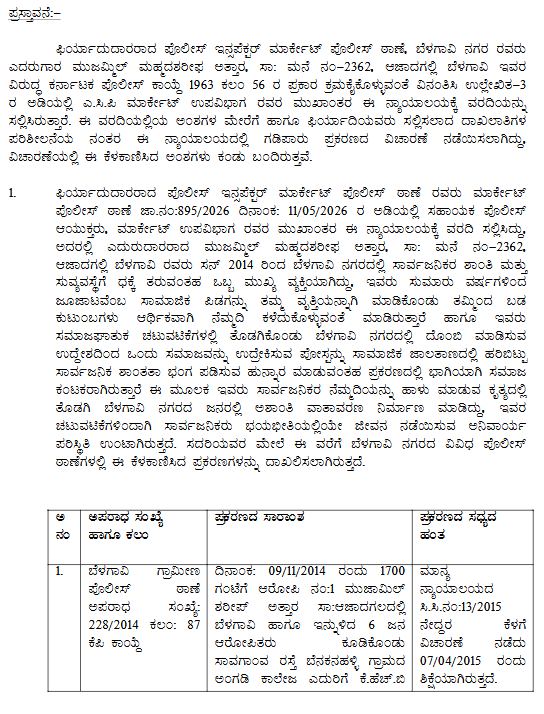
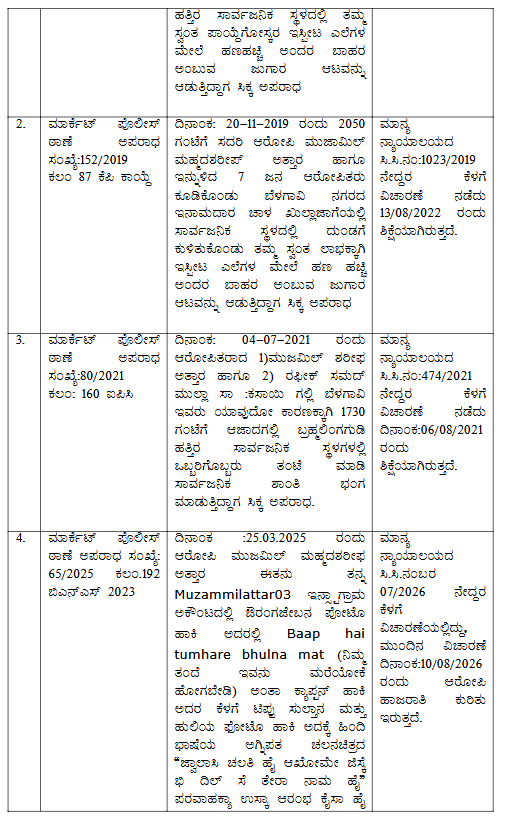
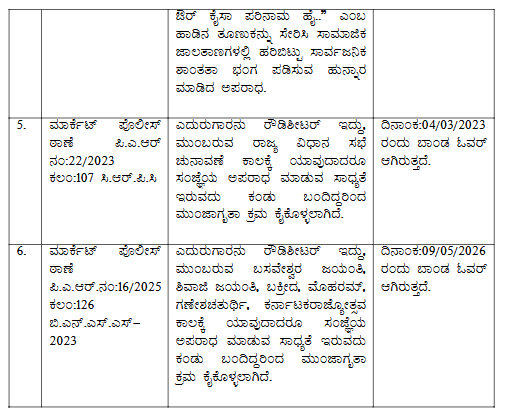
4. Learned Single Judge had rejected the writ petition observing that an efficacious remedy is available u/S 59 of the K.P. Act and accordingly had relegated the petitioner to avail such statutory remedy and without entering into the merits has rejected the writ petition. The observations made by the learned Single Judge at paragraph Nos. 2 to 5 reads as hereunder:
2. The petitioner's counsel reiterating the grounds has tried to pursued this Court demonstrating that even if allegations and report are accepted in entirety, no case is made out under Section 56 of K.P.Act, 1963.
3. Learned Additional Government Advocate has raised the primary objection contending that petitioner was heard and he has contested the proceedings and therefore, he has to be relegated to avail a remedy under Section 59 of K.P.Act, 1963.
4. Though this Court grants indulgence where externment orders, being drastic measures, are passed in gross violation of the principles of natural justice, it is not a fit case to grant such indulgence since the petitioner was afforded an opportunity and the order was passed by the authority only after hearing the petitioner. The petitioner's contention that the order is palpably erroneous cannot be a ground to entertain the petition when there is an efficacious remedy under Section 59 of the K.P. Act, 1963. Therefore, this is a fit case to relegate petitioner to avail a remedy of an appeal.
5. For the foregoing reasons, the petition stands dismissed reserving liberty to the petitioner to avail remedy under Section 59 of the K.P.Act, 1963."
6. Learned counsel for the appellant would submit that the learned Single Judge ought to have entertained the writ petition in light of order of externment affecting his fundamental right including the right under Article 21 of the Constitution and the Court ought not to have relegated the petitioner to avail of the statutory remedy.
7. It is submitted that the order of externment was an order passed without jurisdiction insofar as the cases involving the petitioner involve offences under the provisions of IPC and Cr.P.C which do not fall within the categories of cases stipulated under Section 56 of the K.P. Act and it is contended that the order is one without jurisdiction and accordingly the restriction regarding entertaining a writ petition would not be applicable. It is further submitted that the power vested in Article 226 of the Constitution could be exercised while waiving of the statutory remedy if exceptions made out for exercise of writ jurisdiction are made out which would include entertaining a writ petition when an order is passed without jurisdiction.
8. Learned Government Advocate on the other hand would contend that the learned Single Judge has merely relegated the petitioner to avail of the remedy of appeal u/S 59 of the K.P. Act and if that were to be so the relegation of the petitioner to avail of the statutory remedy was correct course of action and no interference is called at this stage. Further it is submitted that the petitioner admittedly is a rowdy sheeter and Court ought not to exercise any discretion in entertaining the present writ appeal while relegating the petitioner to avail of statutory remedy.
9. Heard both sides.
10. At the outset learned counsel for the petitioner would submit that in the writ petition his relief was not only for setting aside order of externment but for setting aside order whereby the petitioner was included in the Rowdy Sheeter Register. It is however submitted that the challenge to his inclusion in the Rowdy Sheeter Register is not being pressed in the present proceedings. In the light of the same the present writ appeal is being taken up only insofar as challenge of the petitioner as regards the order of externment.
11. The points for consideration are:
(i) Whether the Writ Court in exercise of power under Article 226 of the Constitution could entertain the writ petition even despite availability of statutory remedy u/S K.P. Act?
(ii) Whether the order of externment passed is one without jurisdiction and could be construed to be an exception whereby there could be waiver of statutory remedy and entertaining of a writ petition?
(iii) Whether the order of externment would fall within the categories of cases contemplated u/S 56 (A to H) of the K.P. Act?
12. It must be noticed that the order of externment passed u/S 56 of the K.P. Act is appealable in terms of Sec. 59 of the K.P. Act. Insofar as such existence of appellate remedy the same is not in dispute. This Court while considering the question of existence of alternative remedy vide order in reference in Criminal Petition No. 200012/2023 and connected matters, in the context of order passed u/S 56 of the K.P. Act had in its order dated 25.07.2025 considered a reference placed before the Division Bench by orders of the Hon'ble Chief Justice dated 05.04.2023. The Reference Court while referring to the provisions u/S 59 of the K.P. Act has adverted to the existence of alternative remedy by way of a writ petition in paragraph no. 13 onwards. The relevant extract of the order in Reference at paragraph nos.13 to 15 reads as follows:
"13. Insofar as remedy against an order of externment by way of a Writ Petition under Article 226 of the Constitution, it is clear that if the externment order may have the effect of deprivation of liberty by a procedure contrary to law, in such event, remedy of writ proceedings could be had recourse to. Further, even where an alternative remedy is available, exceptions have been carved out for entertaining a writ petition and among such exceptions is a category of cases where writ petitions are filed for enforcement of fundamental rights.
14. Though Section 60 of the Karnataka Police Act provides for finality of orders, it is a settled position that even if an order is stated to be final, the remedy of judicial review by resort to Article 226 of the Constitution remains untouched. The Apex Court in Sangram Singh v. Election Tribunal, Kotah and Another, has held that even when a statute declares a decision to be final, the High Court's power under Article 226 of Constitution remains intact and that the judicial review is part of the rule of law and no statute can completely bar it. The relevant observations are as follows:
"8. It was urged that that cannot be so in election matters because of Section 105 of the Representation of the People Act of 1951 (Act 43 of 1951), a section which was not considered in the earlier case. It runs thus:
"Every order of the tribunal made under this Act shall be final and conclusive."
It was argued that neither the High Court nor the Supreme Court can itself transgress the law in trying to set right what it considers is an error of law on the part of the court or tribunal whose records are under consideration. It was submitted that the legislature intended the decisions of these tribunals to be final on all matters, whether of fact or of law, accordingly, they cannot be said to commit an error of law when, acting within the ambit of their jurisdiction, they decide and lay down what the law is, for in that sphere their decisions are absolute, as absolute as the decisions of the Supreme Court in its own sphere. Therefore, it was said, the only question that is left open for examination under Article 226 in the case of an Election Tribunal is whether it acted within the scope of its jurisdiction.
9. But this, also, is no longer open to question. The point has been decided by three Constitution Benches of this Court. In Hari Vishnu v. Ahmad Ishaque [AIR 1955 SC 233, 249] the effect of Section 105 of the Representation of the People Act was not considered, but the Court laid down in general terms that the jurisdiction under Article 226 having been conferred by the Constitution, limitations cannot be placed on it except by the Constitution itself: see pages 238 and 242. Section 105 was, however, considered in Durga Shankar Mehta v. Raghuraj Singh [AIR 1954 SC 520, 522] and it was held that that section cannot cut down or affect the overriding powers of this Court under Article 136. The same rule was applied to Article 226 in Raj Krushna Bose v. Binod Kanungo [(1954) SCR 913, 918] and it was decided that Section 105 cannot take away or whittle down the powers of the High Court under Article 226. Following those decisions we hold that the jurisdiction of the High Court under Article 226 is not taken away or curtailed by Section 105.
10. The jurisdiction which Articles 226 and 136 confer entitles the High Courts and this Court to examine the decisions of all tribunals to see whether they have acted illegally. That jurisdiction cannot be taken away by a legislative device that purports to confer power on a tribunal to act illegally by enacting a statute that its illegal acts shall become legal the moment the tribunal chooses to say they are legal. The legality of an act or conclusion is something that exists outside and apart from the decision of an inferior tribunal. It is a part of the law of the land which cannot be finally determined or altered by any tribunal of limited jurisdiction. The High Courts and the Supreme Court alone can determine what the law of the land is vis-a-vis all other courts and tribunals and they alone can pronounce with authority and finality on what is legal and what is not. All that an inferior tribunal can do is to reach a tentative conclusion which is subject to review under Articles 226 and 136. Therefore, the jurisdiction of the High Courts under Article 226 with that of the Supreme Court above them remains to its fullest extent despite Section 105."
15. As the order of externment may impinge upon liberty of an individual, it is always open to challenge the validity of such order by contending violation of Article 21 of the Constitution of India by taking recourse to an appropriate writ under Article 226 of the Constitution. No doubt, Writ Petition would be maintainable, albeit whether the Court would entertain the petition or direct the petitioner to avail of substantive remedy under the statute is a matter within the judicial discretion of the Court before which a Writ Petition is filed."
13. The Division Bench after a detailed consideration has observed that even where alternative remedy is available, externment has been carved out entertaining a writ petition and such exceptions are recognized while referring to the order of the Apex Court in the case of Whirlpool Corporation Vs. Registrar of Trade Marks (1998 [8] SCC 1).
14. The Division Bench at paragraph no. 15 in the order of reference has observed that as an order of externment may impinge upon liberty of an individual, it is always open to challenge the validity of such order by contending violation of Article 21 of the Constitution of India by taking recourse to Article 226 of the Constitution. But observed that whether the Court in exercise of writ jurisdiction would entertain the petition or direct the petitioner to avail remedy under the statute, is a matter within judicial discretion of the Court and has referred to observation made by the Apex Court in M/s Godrej Sara Lee Ltd. Vs. The Excise and Taxation Officer-cum-Assessing Authority & Ors. (2023 SCC Online SC 95). Thus it is clear that there is no absolute bar for entertaining of writ petition. However whether a writ petition would be entertained is a matter left to the judicial discretion of this Court. In the case of Whirlpool Corporation Vs. Registrar of Trade Marks, the exception for entertaining a writ petition have been detailed. The exceptions include wherein enforcement of fundamental rights are sought or where proceedings are wholly without jurisdiction.
The observation at paragraph nos. 13 to 15 reads as follows:
13. Learned counsel for the appellant has contended that since suo motu action under Section 56(4) could be taken only by the High Court and not by the Registrar, the notice issued to the appellant was wholly without jurisdiction and, therefore, a writ petition even at that stage was maintainable. The appellant, in these circumstances, was not obliged to wait for the Registrar to complete the proceedings as any further order passed by the Registrar would also have been without jurisdiction.
14. The power to issue prerogative writs under Article 226 of the Constitution is plenary in nature and is not limited by any other provision of the Constitution. This power can be exercised by the High Court not only for issuing writs in the nature of habeas corpus, mandamus, prohibition, quo warranto and certiorari for the enforcement of any of the Fundamental Rights contained in Part III of the Constitution but also for "any other purpose".
15. Under Article 226 of the Constitution, the High Court, having regard to the facts of the case, has a discretion to entertain or not to entertain a writ petition. But the High Court was imposed upon itself certain restrictions one of which is that if an effective and efficacious remedy is available, the High Court would not normally exercise its jurisdiction. But the alternative remedy has been consistently held by this Court not to operate as a bar in at least three contingencies, namely, where the writ petition has been filed for the enforcement of any of the Fundamental Rights or where there has been a violation of the principle of natural justice or where the order or proceedings are wholly without jurisdiction or the vires of an Act is challenged. There is a plethora of case-law on this point but to cut down this circle of forensic whirlpool, we would rely on some old decisions of the evolutionary era of the constitutional law as they still hold the field."
15. In the present case the counsel for the petitioner has contended that the order is one without jurisdiction as the order of externment refers to the cases against the petitioner and the provisions of law under which such cases have been filed do not fall within the categories of cases contemplated u/S 56 (a to h) of the K.P. Act.
16. A perusal of the cases made out against the petitioner is in terms of the table extracted supra. The cases against the petitioner relate to offence u/S 87 of the K.P. Act insofar as the case at Sl. Nos.1 and 2 of the table extracted supra. Such offence does not fall within the offences contemplated under Section 56 of the K.P. Act.
17. Insofar as the cases u/S 160 of the IPC, at sl. No. 3 of the table such case does not fall within the category of offence stipulated at 56(a) of the K.P. Act. Insofar as the offence mentioned in the case at sl. No. 4 relating to Sec. 192 of the BNS the said case would also not fall in the category of Sec. 56 (a to h) and even if the corresponding Section of IPC is taken, Sec. 192 of BNS would correspond to Sec. 153 of IPC and such offence falls in Chapter VIII of the IPC. Such offence does not fall within the category of offence u/S 56 (a) of the K.P. Act.
18. Insofar as the offence at sl. No. 5, the offence made out is 107 of Cr.P.C. Such offence is not enumerated in Sec.56 (a to h) of the K.P. Act. Insofar as case at sl. No. 6 the offence made out is 126 of BNSS which correspond to Sec.107 Cr.P.C. Even as regards such offence we find that such offence does not fall within the category of Section 56 (a to h) of the K.P. Act.
19. Learned Government Advocate is not in a position to controvert the contention of the petitioner that the offences mentioned in the table which have been relied upon by the authority in passing the externment order do not fall within the category of Sec. 56 (a to h) of the K.P. Act.
20. Learned Government Advocate submits that the petitioner is involved in number of offences, details of which are mentioned in the table and has been convicted in three of the cases at sl. Nos. 1 to 3 of the table extracted above. However that by itself will not clear the jurisdictional defect. An order u/S 56 of the K.P. Act must relate to the categories of the offences mentioned u/S 56 (a to h) of the K.P. Act in the absence of which the special power conferred for externment which in effect amount to curtailment of fundamental right including Article 21 of the Constitution must be in accordance with the provisions of law whereby a restriction is sought to be placed. No order of externment could be passed de hors u/S 56 (a to h) of the K.P. Act.
21. Clearly the order passed is one without jurisdiction. Accordingly we find that when an order is without jurisdiction the Court could entertain a writ petition and proceed to adjudicate taking note the violation of fundamental right. Noticing the order is one without jurisdiction the writ petition is maintainable and we deem it proper to entertain the petition. Accordingly, the order of the learned Single Judge is set aside.
22. We have also gone into the correctness of the order impugned taking note that there would be undue delay and no purpose is served by remanding the matter to the learned Single Judge in the light of clear observation that the order passed is one without jurisdiction. Accordingly the impugned order at Annexure-A is set aside and the writ appeal is disposed of in terms of the discussion made above and the appellant is directed to be released forthwith. The points for consideration raised are answered accordingly.
Needless to state power of the authority to take fresh action as per law is reserved.



