


Anil Kshetarpal, J.
1. Through the present Petition, the Petitioner by invoking writ jurisdiction of this Court under Article 226 of the Constitution of India, essentially seeks directions to treat its bid for Coal Bed Methane (CBM) Block SR-ONHP(CBM)-2025/2 in Raniganj Coalfield, West Bengal, as validly submitted in the Special CBM Bid Rounder-2025 and to consider the same along with other bids, or, in the alternative, to reconduct the bidding process for the said block.
2. The primary grievance of the Petitioner is that its bid could not be completed due to an alleged technical malfunction/error that arose at the critical stage of online price bid submissions on the e-bidding portal, which displayed that the net worth of the Petitioner was insufficient.
3. The question that arises in the present case is as to whether the Petitioner stood deprived of opportunity to submit its financial bid owing to a technical malfunction in the bid portal?
4. To answer the aforesaid question, it would be appropriate to understand the turn of events that took place. Pursuant to the Hydrocarbon Exploration and Licensing Policy (‘HELP’), Respondent No.1 through Respondent No.2, floated a Notice Inviting Offers (‘NIO’) dated 15.04.2025 under the Open Average Licensing Policy (‘OALP’), thereby inviting online bids for three Onland CBM Blocks, including the subject CBM Block, on a revenue sharing basis.
5. The NIO prescribed, inter alia, minimum net worth requirements, architecture of bidding process and the twin requirement of valid bid submission, namely, timely online submission through the DGH/Respondent No.2 e-portal, and mandatory submission of hard copies of documents along with bid bond and supporting Bank Guarantee or Insurance surety Bond in lieu of net worth. Additionally, in terms of the NIO, where the net worth of a bidder was less than the prescribed minimum net worth, the bidder had the option of topping up the same through a Bank Guarantee. However, the bid including the financial bid was requested to be uploaded online.
6. Initially, the deadline for closure of bid submission was 18.02.2026, however, the same was extended till 05.03.2026 (12:00 hrs.) for all bidders. Upon closure of the bidding window, the online bids were opened by the Respondents and four entities namely, Oil India Limited, Essar Oil and Gas Exploration and Production Limited, Consortium of: Oilmax Energy Pvt. Ltd. and SAS Infotech Pvt. Ltd. and lnvenire Petrodyne Limited were found to have submitted their complete bid.
7. It may be noted that while the system displayed the status of other bidders as submitted on the portal, the Petitioner’s status reflected as not submitted.
8. It is the Petitioner’s case that on 05.03.2026, after physically submitting the mandatory documents, it proceeded to complete the e- filing formalities on the e-portal. However, during the course of submission, the e-bidding portal allegedly closed, resulting in termination of the Petitioner’s session and consequent non-submission of its bid.
9. Immediately thereafter, the Petitioner on the same date addressed an email communication to Respondent No.2, alleging a technical malfunction in the bidding portal and requesting consideration of its bid. Upon receipt of the said representation, Respondent No.2 sought comments from C-1 India Private Limited [hereinafter after referred to as the ‘Portal Operator’], the operator of the e-bidding portal. In response, the Portal Operator furnished an Audit Trail Report detailing the sequence of events recorded on the system logs with the following comments:
"Dear Sir,
With reference to the concern raised regarding bid submission, the matter has been examined.
"As per the system Audit logs (Attached), the vendor initiated the bid on 05-03-2026 at 09:43:15 and updated the Techno-Commercial details, which is the first step for initiating the bid submission process.
Subsequently, the vendor paid the tender fee and uploaded the reference copy of the fee on 05-03- 2026 at 11:01:02. Thereafter, the vendor uploaded the technical documents as required by DGH until 05-03-2026 at 11:47:26.
Further, the vendor started filling the price bid at 05-03-2026 at 11:51:56, which continued until 11:59:32.
Additionally, another vendor, Mis Invenire Petrodyne Limited, also submitted their bid around the same time on 05-03-2026 at 11:47:10, which indicates that the system was functioning smoothly during the bid submission period.
Regards,
Sandeep Bhandari"
10. Subsequently, the representation made by the Petitioner was considered and in view of the aforesaid response of the Portal Operator, the allegations raised by the Petitioner were found to be unsubstantiated. Consequently, when the Petitioner visited the office of the Respondent No.2, seeking reconsideration of its bid, the said request was declined. Aggrieved thereby, the Petitioner approached the Court seeking interference.
11. Learned senior counsel representing the Petitioner has contended that, its net worth as on 31.03.2025 was USD 86.60 million, far exceeding the prescribed minimum net worth requirement of USD 2.5 million as well as its own committed work programme bid of USD 41.65 million for 40 wells.
12. It has also been urged that the Petitioner had obtained and submitted requisite bid bond Bank Guarantee in favour of Respondent No.1 in the amount of USD 1,05,000, to Respondent No.2 on 05.03.2025, against which a Document Submission Receipt (DSR) was also issued.
13. In substance, it is the Petitioner’s case that it had abided by all the terms and conditions provided in the NIO to qualify as a bidder and it was solely due to the malfunction of the e-bidding portal that it could not proceed further and submit its bid.
14. Per contra, learned ASG representing the Respondents has argued that the entire process was a system driven programme and there is no material on record to prove that it was on account of any technical glitch, that the Petitioner failed to upload its financial bid.
15. While relying upon the portal logs and the Audit Trail Report furnished by the Portal Operator, it has been urged that no system side error or malfunction was recorded during the relevant period, particularly when other bidders had successfully uploaded their bids during the same timeframe as the Petitioner.
16. At the outset, we deem it necessary to briefly highlight that, learned senior counsel representing the Petitioner is, in essence, inviting this Court to resolve a technical and fact-intensive dispute between a bidder and tendering authority. However, such scrutiny would necessarily require examination of the correctness and completeness of activity logs maintained by the Portal Operator and internal computational logic applied by the system while processing the financial data of the Petitioner, thereby generating the alleged message of insufficient net worth.
17. Learned senior counsel representing the Petitioner has contended that the Petitioner had manually entered the correct figures reflecting a net worth of USD 86.60 million and a bid value of USD 41.65 million. On the other hand, learned senior counsel representing the Respondent, has urged that the system recorded no error and other bidders had successfully completed their submissions on the portal, more so, at the same time frame as that of the Petitioner.
18. The aforesaid submissions, if taken into consideration for the purpose of adjudication in the present case, would lead to delving into a detailed scrutiny of factual matrix of the case, which, as evident, remains disputed. Such an exercise would be inconsistent with the restraint ordinarily observed by a Writ Court in judicial review of contractual and tender matters, where the Court is concerned primarily with the decision-making process rather than the merits of competing factual positions.
19. The contention of learned senior counsel representing the Petitioner that its bid should be considered since it has already submitted the hard copy of the mandatory documents is devoid of merit. The NIO mandated submission of bids both online through the e-bidding portal as well as in physical form with requisite documents, thereby making compliance with both requirements essential. As is evident, the Petitioner has failed to submit its financial bid. Additionally, since the submission of mandatory documents in hard copies, did not contain the submission of financial bids, the twin requirement of the bid process remained incomplete at the behest of the Petitioner, thereby making it ineligible for participation in the bidding process of the NIO.
20. In this regard, we shall also advert to the terms of the NIO, governing the entire bidding process. While Clause 7 of the NIO provided for rejection upon non-submission of hard copies, the same cannot be read in isolation or to the exclusion of Clause 1(iv) which provides that an e-bidding portal has been specifically set up for the purpose of the NIO, as well as Clause 4(i), which mandates submission through the said portal. The above stated inclusions in the NIO, makes it crystal clear that online submission remained a sine qua non for participation in the bidding process.
21. The main contention of the learned senior counsel for the Petitioner that Respondents’ inaction against the malfunction of their own portal is in violation of Article 14 of the Constitution, is equally devoid of merit. To deal with the said contention, reference is to be made to the emails dated 17.02.2026, 24.02.2026, 26.02.2026 and 03.03.2026 issued to bidders by the Respondents, intimating them about the last date for submission of the bids, i.e., on 05.03.2026, thereby also requesting them to complete registration. Despite these communications, the Petitioner commenced the bidding process only on 05.03.2026, i.e., on the last date of submission.
22. In order to deal with the aforesaid contention of the learned senior counsel, it further becomes imperative to highlight the activities performed by the Petitioner as well as other bidders on the portal, marking a completion, or in case of the Petitioner non-completion, of the bidding process. Set out below, in tabular format, are the activities undertaken by the bidders, on the basis of the Audit Trail Report provided by the Portal Operator:
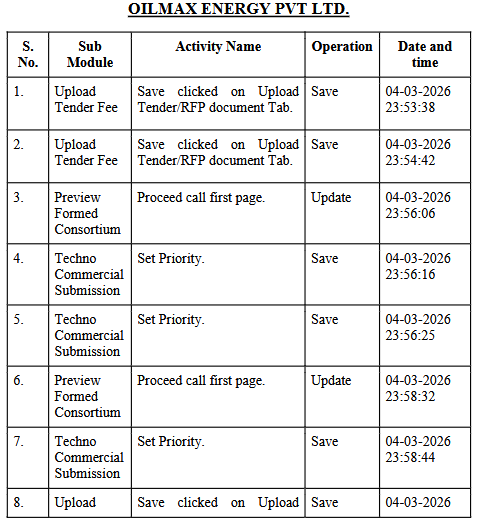
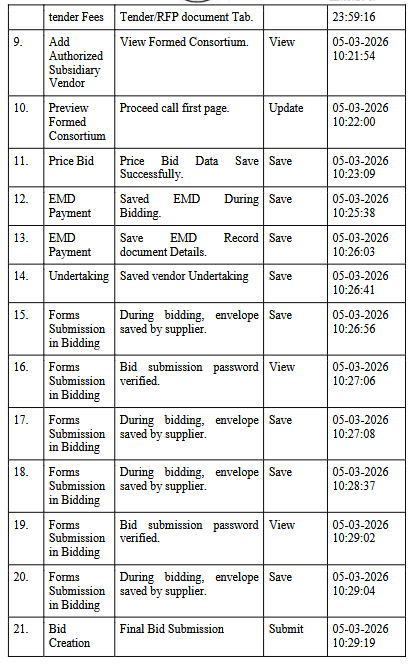
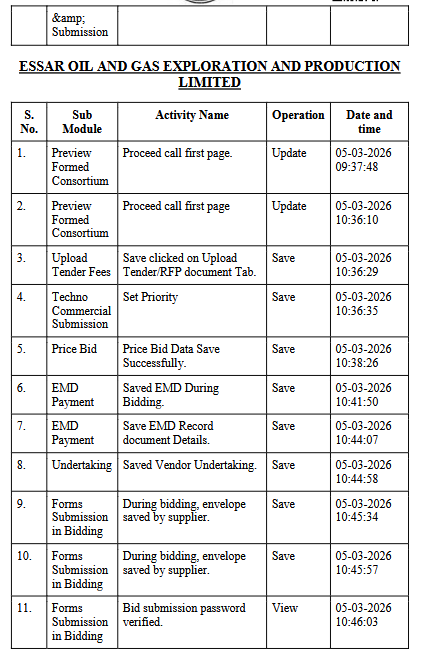
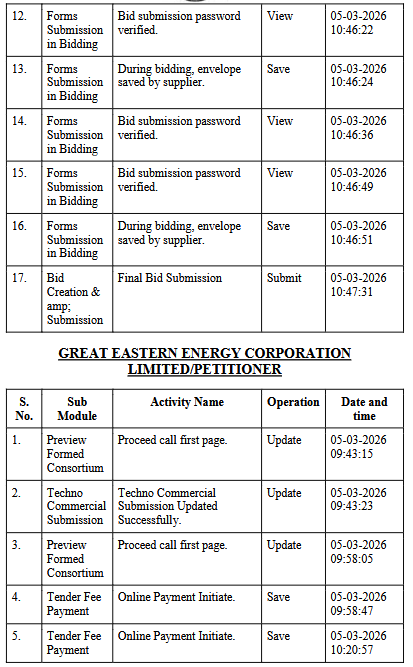
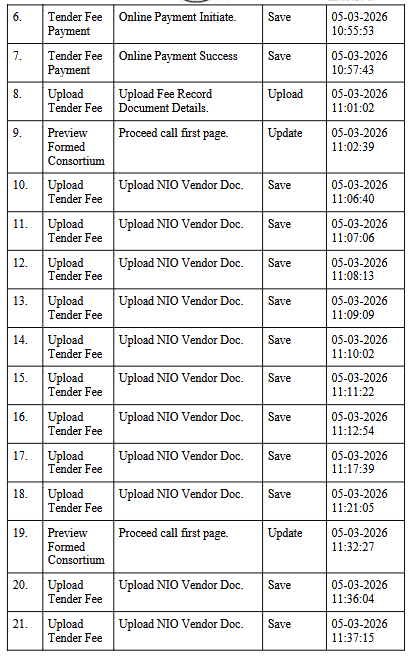
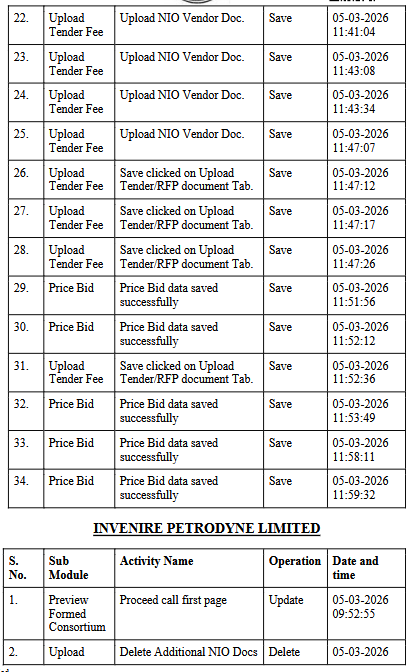
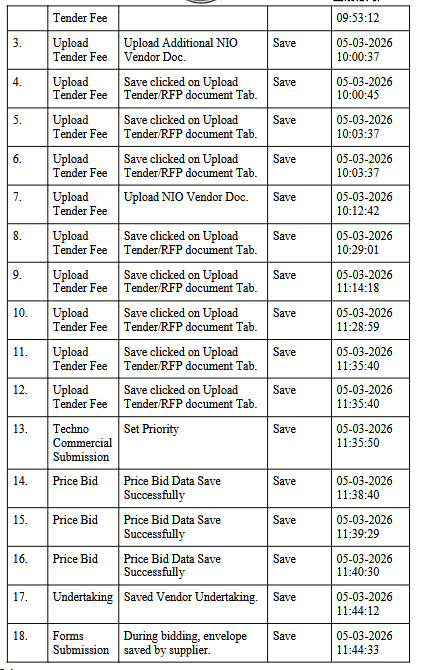
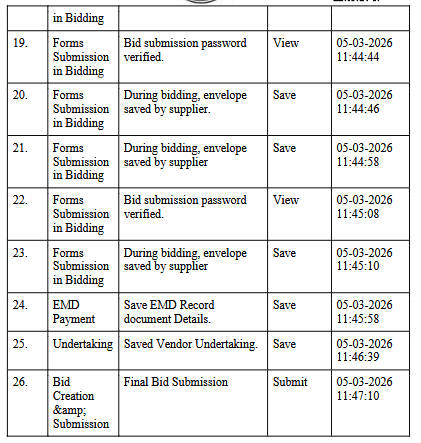
23. Upon perusal of the above produced tables, it is evident that after the price bid data was saved successfully, the bidders were to carry out the following activities, "save vendor undertaking during bidding, envelop to be saved by supplier, bid submission password was to be verified, envelop was to be saved by the supplier, password verified, envelop saved by the supplier, EMD to be saved, during bidding, save EMD Record document details (which could be done at any time either prior or post the price bid submission) and after the completion of the above steps, the final bid submission was to take place". However, as is apparent from the above table, in relation to the Petitioner’s activities, neither of these subsequent steps were ever taken by the Petitioner.
24. At this stage, the activities undertaken by the Petitioner, in comparison with the other bidders, also merit consideration. A perusal of the table reflects that Oilmax (Supra) commenced its process on 04.03.2026 at 23.53.38 hours and concluded the activities relating to upload of tender fees at 23:59:16 hours on the same date. Thereafter, it logged into the portal again on 05.03.2026, starting at 10:21:54 hours and successfully submitting its final bid by 10:29:19 hours.
25. Similarly, Essar Oil (Supra), commenced its bid process, including uploading of documents, on 05.03.2026 at 09:37:48 hours and successfully completed the bid process at 10:47:31 hours. Likewise, Invenire (Supra) initiated the process on 05.03.2026 at 09:52:55 hours and successfully submitted its final bid at 11:47:10 hours.
26. However, when the timeline of activities performed by the Petitioner is examined, the same does not persuade the Court to accept that it acted with due diligence and bona fide intent while completing its bidding process, which is evident from the sequence of events, reflected in the Audit Trail Report.
27. The Petitioner initiated the process on 05.03.2026 at 09:43:15 hours but completed the online payment only at 10:57:43 hours. Thereafter, there was a gap of nearly 10 minutes before the Petitioner commenced uploading its "NIO Vendor Documents" at 11:06:40 hours. The said activity continued till 11:21:05, subsequently, an entry reflecting "proceed call first page" was recorded at 11:32:27 hours, whereafter the Petitioner again reverted to the activity of uploading "NIO Vendor Documents" at multiple instances between 11:36:04 hours and 11:47:07 hours, showing an approximate time of 41 minutes being consumed for upload of NIO documents alone.
28. The Petitioner, while making its case has not provided any explanation whatsoever for the aforesaid delay, nor has it argued that such delay was caused on account of the malfunction of the portal. Even otherwise, Invenire (Supra) was able to successfully complete its final bid submission, around the same time stamp, i.e., 11:47:10 hours, thereby, indicating that there was no error in the portal.
29. Moreover, the Audit Trail Report reflects that the Petitioner, at 11:47:12 hours, under the sub module "upload tender fee", performed the activity "save clicked on upload tender document/RFP document tab", which was also reflected at multiple time stamps of 11:47:17 hours, 11:47:26 hours and again at 11:52:36 hours. Notably, after 11:47:26 hours, an activity reflecting "Price Bid data save successfully" has been recorded at 11:51:56 hours, 11:52:12 hours, 11:53:49 hours, 11:58:11 hours and 11:59:32 hours.
30. The significance of the above-mentioned timestamps lies in the fact that despite successful saving of "price bid submission" recorded at 11:51:56 hours and 11:52:12 hours, the portal recorded an activity of "save clicked on upload tender document/RFP document tab" again at 11:52:36 hours. Whereafter, the activity of "Price Bid Data Save Successfully", was again registered till its active last time stamp of 11:59:32 hours. The Petitioner has also failed to furnish any explanation for the change in activity back to the sub-module of "upload tender fee", after price bid success.
31. Despite the aforesaid sequence of incomplete and repetitive activities, the Petitioner, while arguing its case, has made an attempt to alter its original stand. For the first time, in its Rejoinder Affidavit, the Petitioner has claimed that it was forcibly logged out at 11:59:32 hours, i.e., prior to 12:00 hours, a stand which was never taken by it in its representation or the Writ Petition. Such plea, in our considered opinion, is clearly an afterthought. The same is also evident from the communication dated 05.03.2026, addressed by the Petitioner to the Respondent, wherein the Petitioner merely referred to an alleged technical error at the final stage and made no assertion regarding any forcible logout from the portal.
32. Be that as it may, what is of utmost importance is that despite the continuous and rather inconsistent activities recorded on part of the Petitioner, it has only argued that it was wrongly logged out a few seconds prior to the closure of the bidding deadline. However, such a plea cannot be considered as it lacks merit. Firstly, the Audit Trail Report clearly reflects multiple fragmented and incomplete activities on the part of the Petitioner, coupled with substantial lapses of time between one stage and another, despite being fully aware that the deadline for bid submission was imminently approaching. The aforesaid action of the Petitioner clearly demonstrates a clear lack of diligence in completing the bidding process within the prescribed time.
33. Secondly, the Petitioner has evidently attempted to alter its stand, by taking a new plea in its Rejoinder Affidavit. In these circumstances, the conduct of the Petitioner does not inspire confidence so as to persuade this Court to accept the allegation of forcible logout or technical malfunction as the cause for non- submission of the bid.
34. Upon a perusal of the material placed on record, in particular the Audit Trail Report, it remains undisputed that the session of the Petitioner remained active and bid related activities were carried out until 11:59:32 hours, though no completed submission was ultimately recorded. However, what remains disputed is whether the session termination and alleged failure to submit the bid was attributable to a genuine technical malfunction in the portal or connectivity issues at the behest of the user/Petitioner or the normal operation of a session/time-out mechanism.
35. In view of the detailed examination undertaken in the preceding paragraphs, we are convinced that the Petitioner has not shown any bona fide intent in its attempt to submit the final bid. Moreover, the detailed examination of record in Audit Trail Report, tends to negate any systematic malfunction, a position which remains uncontroverted by the Petitioner, especially in respect of successful submission of one of the bidders.
36. As such, the Petitioner’s allegation of a bid value or net-worth validation error is neither manifestly corroborated nor disproved by the logs as provided by the Portal Operator. Accordingly, in absence of material to prove that the Petitioner was prevented from submitting its bid successfully on account of technical glitch or forcible logging out, it would not be appropriate to order re-tender. More so, the existence and cause of the claimed technical glitch remain a live factual controversy rather than an established fact.
37. The contention made by the Petitioner that the issuance of DSR and acknowledgment of its active session till shortly before the deadline amount to an admission supporting its case is also liable to be rejected. While the aforesaid circumstances show participation on account of the Petitioner, and also remain uncontested by the Respondents, they fall short of constituting an admission that the portal malfunctioned or that the Petitioner’s bid ought to be deemed as successfully submitted online despite the record reflecting a contrary position. There is no occasion to draw presumption in favour of the valid and completed submission bid of petitioner’s bid in absence concrete supporting material.
38. During the course of arguments, learned senior counsel representing the Petitioner contended that, since the bids of other bidders allegedly did not include the Bank Guarantee in lieu of shortfall of net worth, the Petitioner’s case stands on a pari materia footing and ought to be considered. The said contention, however, is legally untenable. The User Guide for CBM Tender Bidding specifically identifies ‘BG in lieu of shortfall of Net Worth vis-à-vis value of Bid Work Programme, as applicable’ as a mandatory document required to be uploaded online.
39. In this regard, it also becomes important to note that, as per the Compliance Affidavit filed by the Respondent, the remaining four bidders had submitted their bids without furnishing any Bank Guarantee. Consequently, there was no occasion for the portal to insist upon the Petitioner uploading a Bank Guarantee, a case originally made out by the Petitioner.
40. Significantly, the Note appended thereto expressly stipulates that where any mandatory document is not relevant or applicable to a bidder, a self-certified declaration stating ‘Not Applicable’ is required to be uploaded against the concerned document. It further clarifies that the system would not permit submission of the bid if any mandatory document field was left blank. It is pertinent to note that each of the concerned bidders complied with the said stipulation by uploading a self-certified declaration marked "Not Applicable". In contrast, the Petitioner has failed to bring to the notice of this Court any self- certified declaration abiding by the said requirement.
41. In view of the aforegoing, the argument of learned senior counsel representing the Petitioner that the alleged e-portal malfunction was attributable to the Respondents lacks merit and has no nexus with the material placed on record. In particular, the logs provided by the Portal Operator show that another bidder, who had initiated the process later than the Petitioner, was nevertheless able to successfully complete bid submission within the stipulated timeline.
42. In exercise of writ jurisdiction, the Court is expected to examine matter within the limited contours of judicial review. The Respondents, having taken a considered decision on the basis of the contemporaneous system records, cannot be faulted, especially when the entire bidding process was automated and system-driven rather than manual.
43. Learned senior counsel’s reliance on the judgment passed in W.P.(C) 9183/2022 captioned Adani Welspun Exploration Limited v Union of India, is misplaced. It is evident that vide order dated 07.10.2022, the same Division Bench clarified that the said judgment is in the peculiar facts of the case. Thus, it cannot be read as an authority for the proposition that, in every case where a portal error is alleged, the writ Court must assume the mantle of a technical fact-finding tribunal and investigate server logs and algorithms. In the present case, the divergence between the parties on the core factual narrative is far too wide to permit summary adjudication.
44. Similarly, the reliance placed on Cineom Broadcast India Ltd. v Municipal Corporation of Gr. Mumbai 2022 SCC OnLine Bom 1178, is also misplaced. In the said case, the Court found an undisputed, unresolved portal malfunction not attributable to the bidder, combined with the authority’s failure to invoke its own curative three-day intimation clause and therefore granted a one-time opportunity to participate without rewriting the tender. On the contrary, in the instant case, the NIO contained no equivalent curative notice clause, and the Respondent No.2, after seeking technical assistance from the Portal Operator, has ruled out the technical glitch narrative.
45. Likewise, the reliance placed on L&T Hydrocarbon Engineering Ltd. v Oil and Natural Gas Corporation Ltd. & Anr. 2018 SCC OnLine Del 9254 is also misplaced, since it is an electronic commerce case on when an already dispatched electronic bid is deemed received under Article 15 of the Model Law, in a situation where the tender conditions and statutory framework accommodate that construct. On the contrary, the present case concerns an admittedly non-submitted bid under the NIO which makes online submission of bids a condition precedent.
46. Keeping in view the aforesaid discussions, no ground for interference under Article 226 of the Constitution of India is made out.
47. Accordingly, the present Petition is dismissed. The pending applications also stand closed.

 |
This Product is Licensed to , |