


(Prayer: This Regular First Appeal is filed u/S.96 r/w Order XXXXI Rule 1 of CPC against the judgment and decree dated 23.3.05 passed in O.S.No.33/2002 on the file of the Civil Judge (Sr.Dn), Kudligi, dismissing the suit for declaration and permanent injunction.
This RFA.Crob in RFA No.977/2005 filed under Section 96(1) read with Order 41 Rule 22 Of CPC, praying to set aside the impugned judgment and decree dated 23.3.2005 passed in Os No.33/2002 (Old Os No.43/1997) by the Senior Civil Judge at Kudlgigi and remand the suit for fresh disposal in accordance with law by affording an opportunity to all parties to put forth their defences/claims by permitting them to file their written statement and to adduce their oral and documentary evidences in accordance with law by allowing this cross appeal as well as RFA No.977/2005, in the interest of justice and equity.)
CAV Judgment
Shivashankar Amarannavar, J.
1. This appeal is filed by appellants -plaintiff's praying to set aside the judgment and decree dated 23.03.2005 passed in O.S. No.33/2002 by Civil Judge (Senior Division), Kudligi.
2. The said suit is filed seeking declaration of title of the plaintiffs to the suit lands mentioned in the schedule and consequently restraining defendants from trespassing into the suit lands by an order of permanent injunction. Properties contained in the schedule are as under:
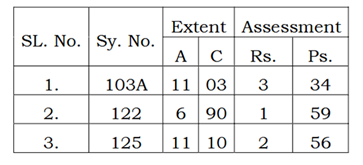
Note: Item No.1 property was deleted as per order on memo dated 11.07.2002.
3. The case of the plaintiffs as stated in the plaint is as under
a. Plaintiff Nos.1 to 3 are brothers and plaintiff No.4 is widow of cousin brother - Veerabhadrappa of the plaintiffs. The ancestor of plaintiffs is one Sri Goni Mallappagari Patil Danappa. The resettlement register extract shows the names of the plaintiffs to the schedule lands along with other lands. Subsequent to the death of ancestor, lands have devolved in favour of his two sons, namely Doddamallayya and Sannamaalayya. Those two persons enjoyed the property by exercising their rights over them. The Encumbrance Certificate for the period from 01.01.1930 to 26.01.1997 discloses that both brothers i.e., Doddamallayya and Sannamaalayya mortgaged the lands in question to one Siddayyankote Sannabasappa for Rs.500/- on 18.02.1930. The said Encumbrance Certificate does not disclose any alienation of the suit lands during the said period.
b. The record of rights for the period from 1968-69 and 1973-74 to 1978-79 and for the period 1996-97 discloses that during 1994- 1995 the name of Sri.Rajashekharappa of G. B. Hatti (Gaddaboraiahnahatti) finds place. The said Sri.Rajashekharappa is plaintiff No.3. The lands in question belong to all plaintiffs. The name of plaintiff No.3 is alone entered in the record of rights. Plaintiff No.3 consents for declaration of title of the said lands in favour of all the plaintiffs. Lands are being managed by all the plaintiffs.
c. Defendant No.1 has nothing to do with the suit lands. He is not the resident of either Chirathagundu village where the lands are situated or G. B. Hatti village. He is the resident of Rayapura village of Malakalamuru Taluk in Chitradurga District.
d. Defendant No.2 is not in good terms with the plaintiffs and he has an evil eye over the suit lands, intended to grab the suit lands with the assistance of defendant No.1, taking advantage of the name of Sri.Rajashekharappa, the father of defendant No.1.
e. The defendants approached the Tahsildar for mutation of the lands in favour of defendant No.1 taking advantage of his father's name i.e., Sri.Rajashekharappa. The Tahsildar has arbitrarily ordered mutation in favour of defendant No.1 in his proceedings No.R.O.R 11/1996-97 on 03.06.1997. The same has been challenged in appeal before the Assistant Commissioner, Hosapete. Defendant No.1 is respondent in the said appeal.
f. Defendant No.1 taking advantage of order of Tahsildar has attempted to dispossess plaintiffs from suit lands on 12.04.1997 and 24.05.1997 and plaintiffs have resisted the same. Plaintiffs are in possession of suit lands.
g. Plaintiffs got issued notice on 11.10.1996 to defendants. The same has been acknowledged by defendant No.1.
4. Defendant No.1 has filed written statement and contented as under:
a. The allegation that plaintiff Nos.1 to 3 are brothers and plaintiff No.4 is widow of cousin brother - Veerabhadrappa is true and correct. The genealogy shown in the annexure is totally false and incorrect. Late Dodda Mallappa was having three sons by name 1) Mallaiah, 2) Sharanaiah and 3) Rudraiah and the said Dodda Mallappa was not having the son by name Veerabhadrappa. The said Rudraiah was having two sons by name Veerabhadraiah and Danaiah, so also late Sanna Mallappa was not having sons by names Virupakshappa and Rajashekharappa and he was having only two sons by name Tippeswamy and Veeranna.
b. The allegation that the name of plaintiff No.3 is finding place in record of rights from 1968 to 1969 is false. Pahanis are standing in the name of father of defendant No.1. The father of defendant No.1 has paid land revenue to the Government. Defendant No.1 has also paid land revenue to the Government. Plaintiff No.3 is aged 30 years and his name cannot be written in record of rights in the year 1968 and 1969 as he was not born at that time.
c. Lands in question belonging to plaintiffs are totally false. Plaintiffs have to establish that they have acquired the suit lands. Plaintiffs have no right over the suit lands.
d. The other legal heirs of deceased -Dandappa are proper and necessary parties. The suit of plaintiffs is not maintainable for non-joinder or necessary parties.
e. The said Patil Sanna Mallappa and Dodda Mallappa have executed a sale deed in the year 1946 in the name of wife of great grandfather of defendant No.1 by name Goudara Sanna Basanna(defendant No.1's father's mother's father) The Sub-Treasury, Kudligi has also ordered to transfer of R.T.R in the name of wife of great grandfather of defendant No.1 on 18.09.1946. At the time of preparing the pahanis, the title and possession of defendant No.1 is considered and the name of father of defendant No.1 is entered. The father of defendant No.1 is the absolute owner and in possession of the suit lands. After the death of the father of defendant No.1, defendant No.1 has applied for change of mutation in his name. The Deputy Tahsildar, Nadakacheri has passed the order for mutation in the name of defendant No.1 vide its No.Pahani/11/1996- 97 dated 06.03.1997. The Pahanis of suit lands are standing in the name of defendant No.1. Defendant No.1 is the absolute owner of the suit lands.
f. Defendant No.1 is cultivating the suit lands personally with the help of defendant No.2 as a labour. Defendant No.2 is only working as a labour under defendant No.1 and he has been added as a party unnecessarily.
g. The allegation that defendant No.1 is trying to dispossess the plaintiffs from suit lands is false because plaintiffs are not at all in possession of suit lands. Defendant No.1 has not received any legal notice.
5. On the basis of the above pleadings, the trial Court has framed the following issues:
1) Whether the plaintiff proves their alleged exclusive, full and absolute title to the suit schedule lands?
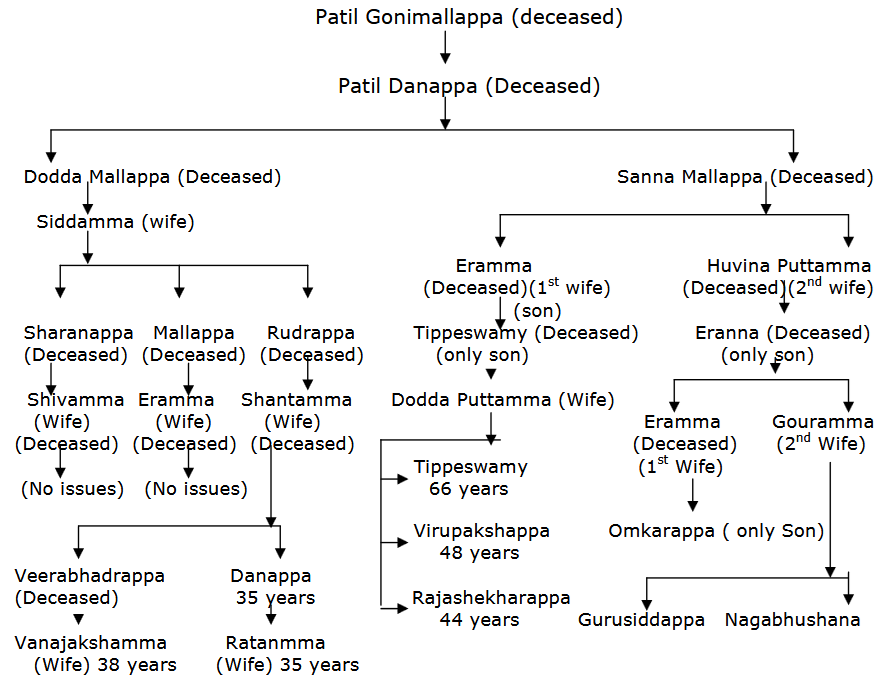
2) Whether the plaintiffs further prove their alleged exclusive, lawful and possession and enjoyment of the suit lands as on the date of the suit?
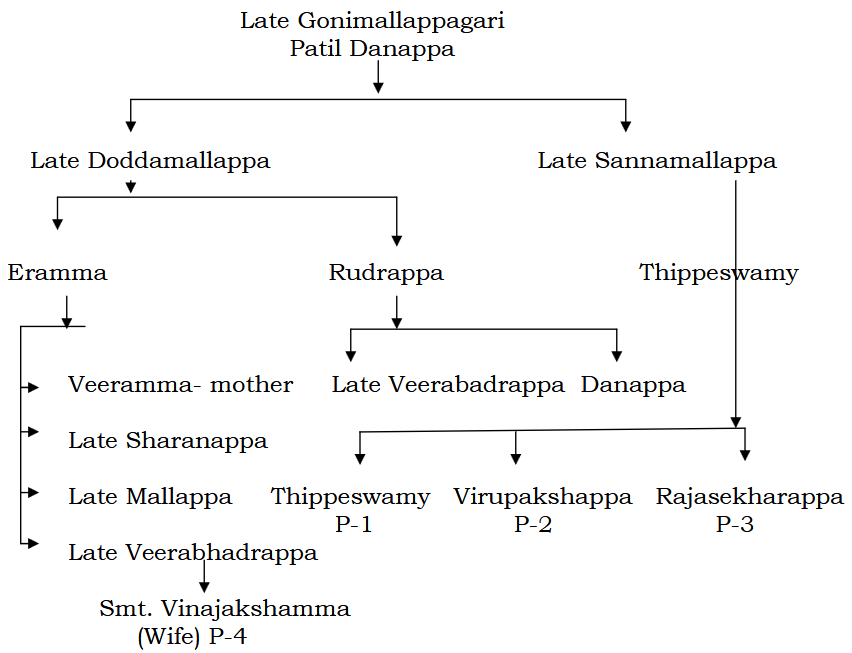
3) Whether the plaintiffs have paid proper and sufficient court fee?
4) Whether the plaintiffs prove the alleged obstruction by the defendants?
5) Whether the plaintiffs are entitled to the relief of declaration and injunction as prayed for?
6) What order or decree?
6. In order to prove the case plaintiff No.1 has been examined as P.W.1 and got marked documents as Ex.P1 to P8. On behalf of plaintiffs, P.W.2 to P.W.7 have been examined. Defendant No.1 has been examined as D.W.1 and marked documents as Ex.D1 to D28. In view of death of defendant No 2, his son Sri.Palayya has been examined as D.W.2. Defendants Nos.3 to 5, who are added subsequently have not led any evidence. The trial Court, after hearing the arguments and appreciating the evidence on record has answered Issue Nos. 1, 2, 4 and 5 in the negative and Issue No.3 in the affirmative and dismissed the suit under the impugned judgment and decree dated 23.03.2005. The said judgment has been challenged by plaintiffs in the present appeal.
7. This Court by order dated 24.06.2025 has allowed IA No.2/2005 filed by appellants -plaintiffs under Order 41 Rule 27 CPC praying to led additional evidence enclosing with two documents and directed the trial Court to record the evidence and send back the evidence with report. The trial Court has recorded the evidence of P.W.8 and marked Ex.P9 and P10 and sent the same along with its report. Thereafter, respondent No.3 -Danappa, respondent No.6 -Gurusiddappa and respondent No.5(a) -Gouramma have filed cross-objection in RFA Cr.Ob. No.100011/2025 praying to set aside the impugned judgment passed in O.S.No.33/2002 dated 23.03.2005 and remanding the suit for fresh disposal for affording an opportunity to all the parties to put forth their contentions and adduce oral and documentary evidence.
8. Heard arguments of learned counsel for appellants, learned counsel for cross-objectors and learned counsel for respondent No.1.
9. Learned counsel for appellants would contend that the defendant No.1, who claims title to the suit of properties under sale deed executed in favour of his ancestor has not produced the same. Doddamallappa and Sannamallappa, who were the owners of the suit properties have executed mortgage deed (Ex.P9) dated 18.02.1930 in favour of Sannabasappa son of Goudar Sannabasaaih ancestor of defendant No.1. Accept the said mortgage deed, there are no other transactions or alienations of suit properties and it can be found in Ex.P1 -encumbrance certificate. The evidence of P.W.2 to 7 establishes that plaintiff's ancestor is Patil Danappa and they are in possession of suit properties. Ex.P10 -genealogy issued by Village Accountant establishes relationship pleaded by plaintiffs. The name of defendant No.1 entered in the RTC of suit properties is in the year 1997 and there is no basis for entry of his name except that he is legal heir of Rajashekharappa. The said Rajashekharappa, who is the father of defendant No.1 had no right, title and interest over suit property. The Rajashekharappa, whose name is entered in column No.9 of the RTC is plaintiff No.3. The evidence on record will establish that the plaintiffs and defendants Nos.3 to 6 are joint owners of the suit properties and therefore they are entitled to reliefs sought for.
10. Learned counsel for cross objectors would contend that defendants Nos.3 to 6 have been added to the suit as parties in the year 2004. They have not filed written statement since sufficient time is not granted to them in that regard. Except Ex.P9 -mortgage deed, there are no other registered documents with regard to suit properties in favour of either defendant No.1 or his ancestors. The documents produced by defendant No.1 does not establish any right, title or interest over the suit properties. Defendant No.1 is residing in Rayapura Village in Malakalamuru Taluk of Chitradurga District and suit properties are situated in Chirathgundu Village and plaintiffs and defendants Nos.3 to 6 are residing in G.B. Hatti village which is situated near Chirathagundu Village. Defendant No.1 is the resident of Rayapura and he never resided in G.B.Hatti village. The name Rajashekharappa entered in suit property records is plaintiff No.3 and not the father of defendant No.1.
11. Learned counsel for respondent No.1 would contend that the name of defendant No.1 has been mutated to the suit properties, as he is legal heir of Rajashekharappa, whose name is entered in Cl.No.9 of RTC. The plaintiffs are Jangamas and their names will end with 'ayya' and 'swami' and therefore, Rajashekharappa is not the family member of plaintiffs and plaintiff No.3 as his name is Rajeshekharappa and he is father of defendant No.1. In the RTC dispute, after hearing, order has been passed by Deputy Tahsildar, Nadakacheri to enter name of defendant No.1 to the suit properties after the death of Rajashekharappa as he is his legal heir. P.W.2 to 7 have admitted the possession of defendant Nos.1 and 2 over the suit properties in their cross- examination. The name of father of defendant No.1 is found in Voter's List, 1995 -Ex.D5, and even the name of mother of defendant No.1 is entered in it. The name of Rajashekharappa is entered and that entry is based on RTR 606/1954-55 (Ex.D16). Ex.D22 tax paid receipts of suit properties indicate the possession of defendant No.1 over suit properties. Even Ex.D25 -Patta book with regard to suit properties is in the name of defendant No.1 and it is pertaining to all these three suit properties. The endorsement -Ex-P28 issued by Tahsildar indicates that records of RTR No.605/1954-55 and another RTR are not found in their office. The typed copy of Ex.P9 stated to be mortgaged deed has not been marked and in its absence Ex.P9 cannot be read or it is not readable. Ex.P10 genealogy has been marked as subject to proof and therefore, plaintiffs have to prove the same by independent evidence. The plaintiffs have not sought for possession of the suit properties and therefore, they are not entitled to relief of declaration of title. The learned counsel for respondent No.1 has placed reliance on the following decisions:
1. Smriti Debbarma(dead) through Lrs Vs. Prabha Ranjan Debbarma (In AIR 2003 SC 379)
2. State of Andra Pradesh Vs B. Ranga Reddy (D) by LRs In AIR Online 2019 SC 1150
3. Vasantha (Dead) through Lrs Vs Rajalakshmi @ Rajam (Dead) through Lrs In 2025 INSC 109C
12. He further contended that the cross objectors are legal heirs of defendant Nos.4 and 5, were ex -parte in the suit and they remained absent in the appeal also. Therefore, the cross-objection is belated and no application is filed seeking condonation of delay. With this, he prays to dismiss the appeal and cross objection.
13. Having heard learned counsels and on perusal of records, the following points arises for consideration:
i) Whether plaintiffs have established that they have inherited the suit properties from their ancestor Patil Danappa and they are in possession of the same?
ii) To what reliefs plaintiffs are entitled to?
14. Point No.1: It is the specific case of the plaintiffs that they have inherited the suit properties from Patil Danappa. The said Patil Danappa had two brothers namely Doddamallappa and Sannamallappa. The said Patil Danappa is the ancestor of plaintiffs. The said properties were standing in their name since decades. The said Patil Danappa and his sons, Doddamallappa and Sannamallappa have not alienated the suit properties. The said Sannmallappa and Doddamallapa have mortgaged the suit item Nos.2 and 3 properties along with other properties under registered deed dated 17.02.1930 in favour of Sannabasappa son of Siddaiahnakote Goudar Channabassappa resident of Rayapura in Molakalamuru Taluk for Rs.500/-. Except the said mortgage transaction, there are no other transactions with respect to Item Nos.2 and 3 of suit properties.
15. It is specific case of the defendant Nos.1 and 2, that Patil Sannamallappa has executed sale deed in year 1946 in the name of wife of great grandfather of defendant No.1 by name Goudar Sannabassanna. It is their further case that the Sub-Treasury, Kudalagi has ordered to transfer of the RTR in the name of wife of the great grandfather of defendant No.1 on 18.04.1946. The name of father of defendant No.1 that is Rajeshekharappa has been entered in the record of rights of the suit property. After death of his father, defendant No.1 got entered his name to the suit properties by the order of Deputy Tahsildar, Nadakacheri vide pahani No.11-1996/97 dated 06.03.1997. Since then the record of rights of the suit properties are standing in the name of defendant No.1 and therefore he is the absolute owner of the suit properties.
16. Ex.P2 is the extract of re-settlement register of Chirathagundu Village dated 08.07.1956 wherein suit properties are in the name of Goni Mallappagari Patil Danappa. The said Goni Mallappagari Patil Danappa is the ancestor of the plaintiffs and defendant Nos.3 to 6. Ex.P1 is the encumbrance certificate of the suit properties for the period from 01.01.1930 to 26.01.1997. There are no any sale transactions pertaining to the suit properties during the said period between 01.01.1930 to 26.01.1997. One of the transactions mentioned in the said Ex.P1 -encumbrance certificate is the execution of mortgage deed dated 18.02.1930 by Doddamallappa and Sannmallappa in favour of Siddayyankote Sannbasappa by registered deed No.193/1930. The said mortgage deed, as per the said encumbrance certificate mentioned in Ex.P1 was for Rs.500/- and it is in respect of properties in Survey No.122, 123, 124, 119, 125, 135B and 150. Ex.P9 is certified copy of said mortgage deed dated 18.02.1930. Even though Ex.P9 cannot be properly read but on perusal of Ex.P1 -encumbrance certificate and averments of Ex.P9 - mortgage deed, it can be very well said that the suit properties and other properties have been mortgaged by Doddamallappa and Sannamallappa in favour of Siddayyankote Sannabasappa resident of Rayapur village by the registered deed dated 18.02.1930. Ex.P2 - resettlement register extract, Ex.P1 - encumbrance certificate and Ex.P9 -mortgage deed, establish that the suit properties are of the ownership of Goni Mallappagari Patil Danappa and 2 sons Doddamallappa and Sannamallappa. They have not executed any sale deed in favour of Goudar Sannabasappa (father's mother's father of defendant No.2)
17. Defendant No.1 in order to establish his contention that Patil Sannamallappa and Doddamallappa have executed sale deed in the year 1946 in favour of Goudar Sabasappa has not produced any such sale deed or entry of name of said person in the revenue records. Defendant No.1 claims mutation on the basis of RTR No.2002/46-1945/46 and RTR No.605/1954-55 to suit properties. Defendant No.1 has not produced the records pertaining to the said two RTR's but has produced an endorsement -Ex-D28 issued by the Tahsildar, Kudalagi that the said RTR's are not available.
18. Ex.D26 is the stated to be a document containing details of RTR No.2002/1945-46. The said document is not readable, it appears that it is in some other language. Defendant No.1 has not produced the translated copy of Ex.D26 or typed copy of the same.
19. It is the case of the defendant No.1 that his father's name Rajashekharappa has been entered in the record of rights of the suit properties. After his death, he got his name mutated as he is one of the sons, by the order of the Deputy Tahsildar, Nadakacheri and certified copy is at Ex.D4. The said order -Ex.D4 has been challenged by plaintiffs before the Assistant Commissioner. The Assistant Commissioner passed order dater 23.10.1997 in the said appeal and the certified copy of which is at Ex.D9. Assistant Commissioner closed the said appeal stating that the said mutation in the name defendant No.1 is subject to the findings in O.S.No.43/1997 pending on the file of Civil Court, Hosapete. The said, O.S.No.43/1997 is the present suit. The old number of the present suit is O.S.No.43/1997 and new number is O.S.No.33/2002. Therefore, the said revenue entry in the name of defendant No.1 by virtue of order of the Deputy Tahsildar, Nadakacheri is subject to the findings in the present suit under appeal.
20. Ex.D1 to Ex.18 are RTCs of suit properties for the years 1968-1969 to 1988-1989. The name of one Rajashekharappa has been entered in column No.9 of the said RTCs. It is the claim of defendant No.1 that the said Rajashekharappa is his father and suit properties belongs to his father. The claim of the plaintiffs is that, plaintiff No.3 is Rajashekharappa and as one of the legal heirs of Doddmallappa and Sannamallappa, his name has been entered in the revenue records.
21. What is the basis of entry of name of Rajashekharappa in the record of rights of suit properties is not brought on record either by plaintiffs or by defendants. 'G.B.Hatti' is mentioned below the name of Rajashekharappa in the RTCs of suit properties. Ex.D8 -extract of voters' list for election of Member of Legislative Assembly for the year 1995. The name of one G. T.Rajeshekharaih, Gauramma Rajashekaraih and G. T. Mallikarjun is mentioned as resident of G.B.Hatti. Plaintiff No.3 - G.Rajeshekharaih son of Tippeswamy is the resident of G.B.hatti. Gouramma and G.T.Mallikarjun are mother and brother respectively of defendant No.1 is not brought on record. D.W.1 (defendant No.1) has not deposed regarding name of his mother and brother in his evidence. Considering the said aspect, Ex.D8 voter list pertains to plaintiff No.3. Defendant No.1 is resident of Rayapur village in Molakalamuru Taluk in Chitradurga District. In order to show that Rajashekharappa, the father of defendant No.1 was residing in G.B.hatti, no documents have been produced.
22. It is contented that the said Rajeshekharappa i.e., plaintiff No.3, who is aged 40 years in the year 1995 was aged 18 or 19 years in the year 1968 to 1969 and therefore, his entry in the RTC's of suit properties is doubtful. It is trite to say that there is no bar to enter the name of minor also to the property and there is no age bar/limit to enter the names in RTCs.
23. Defendant No.1 in order to establish that the suit property has been purchased in the year 1946 by Goudar Sannabasabba from Patil Sannamallappa and Doddamallappa, no document is produced in that regard. Except the said sale deed pleaded by defendant No.1, defendant No.1 or his ancestors have not claiming the suit properties on any other basis. As per plaintiff's contention, the suit properties were mortgaged to Siddayyankote Sannabasappa for Rs.500/- through registered deed dated 18.02.1930. The said Siddayyankote Sannabasappa is shown to be resident of Rayapur in Molakalamuru Taluk. Defendant No.1 is also resident of Rayapur in Molakalamuru Taluk. Except the mortgage deed dated 18.02.1930, there is no other transaction between the family of Dodaamallappa and Sannmallappa with the ancestors of defendant No.1 as per encumbrance certificate -Ex.P1. Considering the above aspects, the plaintiffs have established that the suit properties are belonging to their ancestors Doddamallappa and Sannamallappa who inherited them from Patil Danappa. Defendant No.1's claim over the suit properties has not been established.
24. The name of defendant No.1 has been mutated to suit properties as per the order of the Deputy Tahsildar, Nadakacheri vide pahani No.11/1996-97 dated 06.03.1997. The plaintiffs have filed objections to the application filed by defendant No.1 to enter his name. The name of defendant No.1 has ordered to be mutated to the suit properties only as legal heir of Rajashekharappa and as plaintiffs have not produced any documents before the Deputy Tahsildar. The plaintiffs have filed appeal before the Assistant Commissioner. The Assistant Commissioner in order has held that the said entry is subject result of the suit in O.S.No.43/1997 which re-numbered as O.S.No.33/2002. Defendant No.1 is not having any right, title or interest over the suit properties. Even defendant No.1 who has been examined by D.W.1 has denied the suggestion that Doddamallappa and Sannamallappa have executed mortgage deed infavour of Sannabassappa who was his father's grandfather. Ex.P9 is certified copy of the said mortgage deed. Once mortgage always mortgage and mortgagee will not become owner of the mortgaged property. Defendant No.1 has not produced any sale deed for having his ancestors purchasing the suit properties.
25. Plaintiffs have enclosed a genealogy with the plaint. The plaintiffs have also produced genealogy issued by Village Accountant which is at Ex.P10. Even though Ex.P10 is issued by Village Accountant, relationship has to be established by independent evidence. The Village Accountant who has issued Ex.P10 has not been examined and the said Village Accountant had issued Ex.P10 as per the statement made by plaintiff No.1.
26. There are discrepancies about relationship as contained in genealogy tree enclosed to the plaint and genealogy tree - Ex.P10. The genealogy which is enclosed with the plaint is as under
27. With regard to genealogy which is enclosed to the plaint, defendant No.1 in his written statement has pleaded as under:
3. The allegation that, plaintiff No.1, 2 and 3 are brothers and plaintiff No.4 is the widow of cousin brother of the Veerabhadrappa is true and correct. The Genology shown in the annexure is totally false and incorrect. The Late Dodda Mallappa was having 3 sons by name (1) Mallaiah, (2) Sharanaiah and (3) Rudraiah and the said Dodda Mallappa was not having the son by name Veerabhadrappa. The said Rudraiah was having two sons by name Veerabhadraiah and Danaiah, so also, Late Sanna Mallappa was not having sons by name Virupakshapa and Rajashekhrappa and he was having only two sons by name Thippeswamy and Veeranna. Hence, the plaintiff is put to strict proof of the Genealogy shown in the annexure to the plaint.
28. Considering the said pleading of defendant No.1, it is admitted that plaintiff Nos.1 to 3 are brothers and they are children of Tippeswamy. Doddamallappa was having three sons by name Mallaih, Sharannaih and Rudraiah. Veerbadraiah and Danaiah are two sons of Rudraiah. The said Danaiah (Danappa) has been added as defendant No.3 in the suit. It is also admitted that plaintiff No.4- Vanajakshamma is the wife of Veerabhadrappa who is the cousin brother of plaintiff Nos.1 to 3. The said admission pleaded by defendant No.1 also establishes that Sannamallappa had two sons by name Tippeswamy and Veeranna. Plaintiff Nos.1 to 3 are the children of said Tippeswamy, who is one of the sons of Sannamallappa. Considering the above aspects, the relationship of plaintiffs Nos.1 to 3, defendant No.3 with Doddammallappa and Sannamallappa has been established.
29. In the additional evidence, plaintiff No.3 has been examined as P.W.8. On perusal of cross-examination of P.W.8, it is elicited that Sannamallappa had two wives No.1 Iramma and No.2 Kuttiramma and it has been mentioned in Ex.P10. Sannairamma is the wife of the Veeranna and she has been added as defendant No.4 in the suit subsequently. It is also elicited in the cross-examination of P.W.8 that plaintiff No.1's father has three daughters and three sons and the names of those three daughters are Rudramma, Anusuyamma and Gangamma and it has not been mentioned in Ex.P10. It is also elicited in the cross-examination of P.W.8 that second wife of Sannamallappa i.e., Kuttiramma has a son by name Veeranna. The said Veeranna is having two daughters and two sons and names of two daughters are Shiba and Iramma and two sons are Gurusiddappa and Nagabhushana. The said Nagabhushana and Gurusiddappa have been added as dependent Nos.5 and 6 in the suit. It is also elicited in the cross-examination of P.W.8 that Doddamallappa has three sons by name Sharanappa, Mallappa and Rudrappa and he is having no daughters. The said Rudrappa is having wife by name Shantavva. The above said elicitation in the cross-examination of P.W.8 is in order to establish that there are legal heirs of Tippeswamy the father of plaintiffs and Iranna sons of Sannamallappa and their names are not being shown in the genealogy tree - Ex.P10.
30. It is contented that plaintiffs are Jangamas and their names are ends with the word 'Ayya' or 'Swami' and further contented that the name of Rajashekharappa mentioned in the records of rights of suit properties if plaintiff No.3 ought to have been mentioned as Rajashekharayya. The said contention appears to be not correct since Jangamas names in all cases does not end with 'Ayya' or 'Swami'.
31. Considering the above aspects, it is clearly established that the suit properties are the properties of Doddamallappa and Sannamallappa who are sons of Goni Malappagari Patil Danappa. Plaintiff Nos.1 to 4 and defendant Nos.2 to 6 are some of legal heirs of Doddamallappa and Sannamallappa sons of Patil Danappa. The suit properties are in the name of Goni Mallappagari Patil Danappa as per Ex.P2 and they have been mortgaged by Doddamallappa and Sannamallappa as per Ex.P9. Defendant No.1 failed to prove his contention that the suit properties have been purchased by their ancestors namely Goudar Sannabasanna and he has inherited the same. The case of the plaintiffs is more probable than the case of the defendant. In civil disputes, the standard of proof is a preponderance of probability.
32. P.W.2 to P.W.7 who are the residents of G.B.Hatti have deposed that Patil Danappa is assertor of plaintiffs. P.W.2 to 7 also deposes that their lands are situated near suit lands and plaintiffs are in possession of suit properties. P.W.2 to 7 also deposes that defendant Nos.1 and 2 are trying to interfere in plaintiffs possession of the suit properties. Plaintiffs have produced tax paid receipts of the suit properties at Ex.P8 and date of tax paid receipts is 07.01.1997.
33. Learned counsel for respondent No.1 has placed reliance on the decision of the Hon'ble Apex Court in the case of Smriti Debbarma (Supra) has held as under:
"30. In the above factual background, for the plaintiff to succeed, she has to establish that she has a legal title to the Schedule 'A' property, and consequently, is entitled to a decree of possession. The defendants cannot be dispossessed unless the plaintiff has established a better title and rights over the Schedule 'A' property. A person in possession of land in the assumed character as the owner, and exercising peaceably the ordinary rights of ownership, has a legal right against the entire world except the rightful owner. A decree of possession cannot be passed in favour of the plaintiff on the ground that defendant Nos.1 to 12 have not been able to fully establish their right, title and interest in the Schedule 'A' property. The defendants, being in possession, would be entitled to protect and save their possession, unless the person who seeks to dispossess them has a better legal right in the form of ownership or entitlement to possession.
31. The burden of proof to establish a title in the present case lies upon the plaintiff as this burden lies on the party who asserts the existence of a particular state of things on the basis of which she claims relief. This is mandated in terms of Section 101 of the Evidence Act, which states that burden on proving the fact rests with party who substantially asserts in the affirmative and not on the party which is denying it. This rule may not be universal and has exceptions, but in the factual background of the present case, the general principle is applicable. In terms of Section 102 of the Evidence Act, if both parties fail to adduce evidence, the suit must fail. Onus of proof, no doubt shifts and the shifting is a continuous process in the evaluation of evidence, but this happens when in a suit for title and possession, the plaintiff has been able to create a high degree of probability to shift the onus on the defendant. In the absence of such evidence, the burden of proof lies on the plaintiff and can be discharged only when he is able to prove title. The weakness of the defence cannot be a justification to decree the suit. The plaintiff could have succeeded in respect of the Schedule 'A' property if she had discharged the burden to prove the title to the Schedule 'A' property which squarely falls on her. This would be the true effect of Sections 101 and 102 of the Evidence Act. Therefore, it follows that the plaintiff should have satisfied and discharged the burden under the provisions of the Evidence Act, failing which the suit would be liable to be dismissed. Thus, the impugned judgment the High Court had rightly allowed the appeal and set aside the judgment and decree of the trial court. We, therefore, uphold the findings of the High Court that the suit should be dismissed. We clarify that we have not interfered or set aside any observations of the High Court in re the Tripura Land Revenue and Land Reforms Act, or defendants' claim etc. Notably, M/s. Hotel Khosh Mahal Limited is not a party to the present proceedings."
34. The plaintiffs have sought declaration of title and injunction. It is already held that the plaintiffs have proved their title over the suit property and defendant No.1 who is respondent No.1 herein has not established his title over the suit schedule property. The plaintiffs and other co-owners have established their title over item Nos.2 and 3 of the suit schedule property.
35. Learned counsel for respondent No.1 has also placed reliance on the decision of the Hon'ble Apex Court in the case of State of Andhra Pradesh Vs. D.Rangareddy (supra) wherein it is held as under:
"36. We find that the High Court has failed to draw the distinction between the decree and a finding on an issue. It is the decree against which an appeal lies in terms of Section 96 of the Code. Decree in terms of Section 2(2) of the Code means formal expression of an adjudication conclusively determining the rights of the parties. The defendants-State could not file an appeal against a decree which was of a dismissal of a suit simpliciter. The findings on Issue No.1 against the State could be challenged by way of cross-objections in terms of amended provisions of Order XLI Rule 22 of the Code but such filing of cross-objections is not necessary to dispute the findings recorded on Issue No.1 as the defendants have a right to support the ultimate decree passed by the trial court of dismissal of suit on grounds other than which weighed with the learned trial court. Even in terms of Order XLI Rule 33 of the Code, the Appellate Court has the jurisdiction to pass any order which ought to have been passed or made in proceedings before it."
36. The cross-objectors are the joint owners of the suit properties and they are also aggrieved by the dismissal of the suit. As such they have right to file cross-objections. The cross-objectors are sailing with the plaintiffs and therefore, cross-objections filed by them challenging the decree of dismissal of the suit is maintainable.
37. The learned counsel for respondent No.1 has placed reliance on the decision of the Hon'ble Apex Court in the case of Vasanta (supra) wherein it is held as under:
"30. In Venkataraja and Ors. v. Vidyane Doureradjaperumal (Dead) thr. LRs (2-Judge Bench), the purpose behind Section 34 was elucidated by this Court. It was observed that the purpose behind the inclusion of the proviso is to prevent multiplicity of proceedings. It was further expounded that a mere declaratory decree remains non-executable in most cases. This Court noted that the suit was never amended, even at a later stage to seek the consequential relief and therefore, it was held to be not maintainable. This position of law has been reiterated recently in Akkamma and Ors. v. Vemavathi and Ors. (2-Judge Bench)
31. This Court in Executive Officer, Arulmigu Chokkanatha Swamy Koil Trust, Virudhunagar v. Chandran and Others (2-Judge Bench)33 while reversing the High Court decree, observed that because of Section 34 of the SRA, 1963, the plaintiff not being in possession and claiming only declaratory relief, ought to have claimed the relief of recovery of possession. It was held that the Trial Court rightly dismissed the suit on the basis that the plaintiff has filed a suit for a mere declaration without relief for recovery, which is clearly not maintainable."
38. The plaintiffs have sought decree of declaration of title over the suit properties and also sought for injunction. It is already held that the plaintiffs have proved their possession over the suit properties by the evidence of PWs.2 to 8 coupled with the documents namely, the tax paid receipts. Therefore, the claim of the plaintiffs is not only declaration of title but also for injunction. When the plaintiffs have proved that they are in possession of the suit properties, there is no question of they seeking relief of recovery of possession.
39. Considering the above aspects, plaintiffs have established that plaintiff Nos.1 to 4, defendant Nos.3 to 6 and other legal heirs of Sannamallappa are joint owners and in possession of suit properties. Even though the plaintiff Nos.1 to 4 have sought declaration of title that they are the owners of the properties, in view of establishing the fact that there are other joint owners, the relief sought by plaintiffs requires little modification. The plaintiffs are entitled to declaration that plaintiff Nos.1 to 4, defendant Nos.3 to 6 and other legal heirs of Sannamallappa are the joint owners of the suit Item Nos.2 and 3 properties. Defendant Nos.1 and 2 and their legal heirs are trying to interfere in possession of the suit property. The plaintiffs are entitled to relief of injunction restraining the defendant Nos.1 and 2 and their legal heirs from interfering with the joint possession of plaintiffs over the suit item Nos.2 and 3 properties. Accordingly, point Nos.1 and 2 are answered.
40. In view of the above, the following
ORDER
i) The appeal and cross objections are allowed in part.
ii) The impugned judgment and decree dated 23.03.2005 passed in O.S.No.33/2002 (old number 47/1997) is set aside.
iii) The suit of the plaintiffs is decreed as under:
a) Plaintiff Nos.1 to 4, defendant Nos.3 to 6 and other legal heirs of Doddamallappa and Sannamallappa are joint owners and in possession of suit Item Nos.2 and 3 properties.
b) Defendant Nos.1 and 2 and their legal representatives are restrained from interfering in possession of the suit properties.
c) Draw decree accordingly.
d) The parties to bear their cost.

 |
This Product is Licensed to , |