


(Prayer: This Criminal Petition is filed u/S.482 of the Code of Criminal Procedure, 1973, praying to quash the impugned private complaint dated 12.06.2023 as per Annexure-F and subsequent registration of impugned Criminal Case proceedings in Cc No. 371/2023 (arising out of PCR No.50/2023) pending on the file of II Additional Civil Judge and JMFC, Ballari as per Annexure-G for the alleged offences U/S.138 of NI Act, 1881 insofar petitioners No. 1 to 4/Accused No. 1 and 3 to 5 are concerned and etc.)
CAV Order
1. This criminal petition is filed by the petitioners/accused Nos.1, 3, 4 and 5 under Section 482 of Code of Criminal Procedure (Cr.P.C.)/528 of Bharatiya Nagarika Suraksha Sanhita, 2023 (BNSS) praying to quash the criminal proceedings initiated against them, with the following prayer:
"PRAYER
WHEREFORE, on the above stated grounds and any other grounds that may be submitted at the time of hearing of the present case it is most respectfully prayed that:
i. The Hon'ble Court be pleased to quash the impugned private complaint dated 12.06.2023 as per ANNEXURE-F and subsequent registration of impugned criminal case proceedings in CC No. 371/2023 (arising out of PCR No.50/2023) pending on the file of Hon'ble II Addl. Civil Judge and JMFC, Ballari as per ANNEXURE-G for the alleged offences u/s 138 of Negotiable Instrument Act, 1881 insofar Petitioners No. 1 to 4/Accused No. 1 & 3 to 5 are concerned.
A. Grant any other may kindly be passed that the Hon'ble Court deems fit in the interest of justice."
2. The case made out as per the private complaint averments filed under Section 200 of Cr.P.C. that respondent No.1/complainant, being the proprietor of M/s. Biswa Cotton Ginning and Pressing Factory, is engaged in the manufacturing of cotton spinning materials and is also carrying out the purchase and sales of cotton from various farmers. Accused No.1/petitioner No.1 is a company and petitioner Nos.3 to 5, who are accused, were directors of petitioner No.1/company.
3. Petitioner No.1/accused has placed certain orders of lint cotton bales made out of raw cotton with respondent No.1/complainant. Respondent No.1/complainant has supplied lint cotton bales to petitioner No.1/company as stated below:
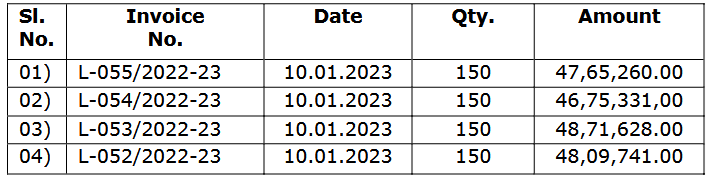
4. It is stated that petitioner No.1/company was in receipt of indent orders placed to the tune of Rs.1,91,21,960/- from respondent No.1/complainant and petitioner No.1/company had made payment of Rs.65,00,000/- and balance of Rs.1,26,21,960/- is still due from petitioner No.1/company. As per request made by the complainant/respondent No.1, the petitioners/accused have issued four cheques worth Rs.1,26,21,960/- as stated below:
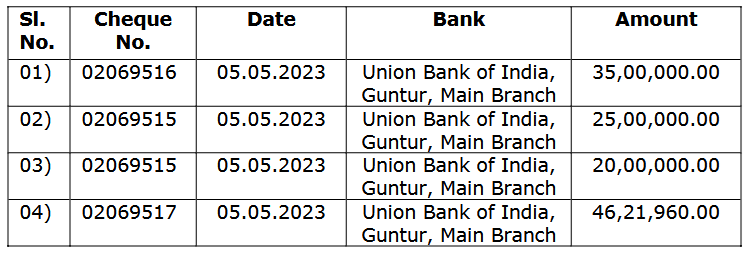
5. It is the case of respondent No.1/complainant that the said cheques were presented to the bank, but they were dishonored due to insufficient funds. Therefore, respondent No.1/complainant has issued a legal notice, but the petitioners/accused have issued evasive reply; therefore, it is the case of respondent No.1/complainant that the accused having knowledge that there were no sufficient funds in the account of the petitioners, issued cheques. Thus, they are amenable for the offences under Section 138 read with Section 141 of the Negotiable Instruments Act, 1881 ('NI Act, 1881' for short) and the amended Act, 2000. Hence, a private complaint was filed before the learned Magistrate under Section 200 of Cr.P.C. and the learned Magistrate has initiated the proceedings.
6. Questioning the same, the petitioners/accused have filed this instant petition for quashing the entire proceedings.
7. Heard the arguments of learned counsel appearing on behalf of the petitioners/accused and learned counsels appearing on behalf of respondent Nos.1 and 2 and perused the materials produced before the Court at this stage.
8. Learned counsel appearing on behalf of the petitioners/accused submitted that respondent No.1/complainant is ill-motivated. Respondent No.1/complainant has not made out a legally enforceable debt and mere issuance of a cheque is not sufficient to proceed with for the offences under Section 138 of NI Act, 1881. It is further argued that the complainant does not have prima facie case so as to proceed against the petitioners/accused and respondent No.1/complainant has not produced documents to establish that the petitioners have placed orders of indent with respondent No.1/complainant and that respondent No.1/complainant has supplied the materials and the same were received by petitioner No.1/company.
9. It is further submitted that issuance of the cheque in question is disputed and seal of petitioner No.1/company is not found on the cheque. There is no existing legally enforceable debt and the cheques in question have been issued by accused No.2. Accused No.2 might have made transactions with respondent No.1/complainant and these petitioners/accused do not have any knowledge about the transactions between accused No.2 and respondent No.1/complainant.
10. Further contended that some of the directors have tendered resignation from the post of directors and have not issued any cheques towards discharge of debt. Petitioner Nos.3 and 4/accused Nos.4 and 5 have tendered resignation from the post of directors of petitioner No.1/company; therefore, they have been discharged from the respective posts they were holding. Hence, continuing the impugned criminal proceedings is abuse of process of the Court. Thus, prayed to quash the proceedings initiated against them.
11. Further submitted that, respondent No.1/company is represented by a General Power of Attorney (GPA) and whether the GPA holder has personal knowledge is the question to be considered; therefore, the complaint filed is not maintainable. The cheques were issued by accused No.2 in collusion with the respondent/company. Accused No.2 has tendered resignation from the post of director before issuance of cheques and therefore, whatever alleged cheques are stated to have been issued by accused No.2 were without having any competency and capacity as a director of petitioner No.1/company. Hence, prima facie offence is not attracted; therefore, prays to quash the proceedings.
12. Further submitted that petitioner Nos.2 to 4 are not responsible for the day to day affairs of the company and it is not pleaded in the complaint.
13. In support of the arguments, the learned counsel appearing on behalf of the petitioners/accused places reliance on the following citations:
i. MR. SUJITH SUDHAKARAN VS. MR. LALU JACOB MAMMEN Crl.P.No.10408 of 2023 dated 06.01.2026.
ii. SIBY THOMAS VS. M/S. SOMANY CERAMICS LTD., Special Leave Petition (Crl.) No.12 of 2020 dated 10.10.2023
iii. SUSELA PADMAVATHY AMMA VS. M/S BHARTI AIRTEL LIMITED Special Leave Petition (Crl.) No.12390-12391 of 2022 dated 15.03.2024.
iv. A.C. NARAYANAN AND OTHERS VS. STATE OF MAHARASHTRA AND OTHERS Criminal Appeal No.73 of 2007 and Criminal Appeal No.1437 of 2013 (Arising out of SLP (Crl.) No.2724 of 2008) dated 13.09.2013.
v. B.P.L. LTD., BPL WORKS VS. INFRASTRUCTURE LEASING AND FINANCIAL SERVICES LIMITED Criminal Petition No.1467 of 2006 dated 24.04.2009.
vi. KIRAN VITTAL POOJARY AND ORS. VS. PRISMATIC ENGINEERING PRIVATE LIMITED AND ORS. Criminal Petition Nos.5404 of 2017, 4509, 4510, 4511/2018 and 8672/2017
14. On the other hand, learned counsel appearing on behalf of respondent No.1/complainant submitted that the complainant supplied materials to the accused/company and initially the accused/company had paid a sum of Rs.65,00,000/- and discharged part of the debt, but for the remaining amount of Rs.1,26,21,960/-, the accused/company has issued four cheques, but the same were returned by the bank as "funds insufficient" upon presentation.
15. It is further submitted that whether some directors had resigned or not is a question of disputed fact and cannot be considered at this stage as per Section 168 of the Companies Act, 2013.
16. There are certain procedures for resignation from the post of directors and for consideration of the same by the Registrar of Companies as per the provisions of the Companies Act, 2013, and these are disputed facts to be considered in the trial. Therefore, merely because it is stated in the petition that some of the directors have tendered resignation is not a ground to quash the entire legal proceedings. It is further submitted that it is stated in the complaint that petitioner No.1/company and petitioner Nos.2 to 5 are the directors and they are having responsibilities of day to day affairs in the company and had knowledge about the affairs of the company and transactions in full and with full consciousness they have decided to issue cheques towards payment of the amount to respondent No.1/complainant for having supplied the materials. Hence, the proceedings initiated against petitioners/accused cannot be quashed; thus prays to dismiss the petition.
17. In support of the arguments, learned counsel appearing on behalf of respondent No.1/complainant places reliance on the following judgments:
i. AMBIKA NARANG VS. SHIVAM SHUBHAM FASHIONS PRIVATE LIMITED AND OTHERS 2023 SCC Online Del 2615. (Ambika Narang case)
ii. HDFC BANK LIMITED VS. STATE OF MAHARASHTRA AND ANOTHER (2025) 9 SCC 653.
18. Upon considering the submissions made by learned counsels appearing for the parties and upon perusal of the materials produced at this stage, it is an allegation that respondent No.1/complainant is engaged in trading and manufacturing of cotton and spinning materials and is also carrying out purchase and sales of cotton from various farmers across India. It is the case of respondent No.1/complainant that accused No.1/company has placed orders with the complainant for purchasing cotton materials, lint cotton bales and petitioner Nos.2, 3 and 4, who are accused Nos.3, 4 and 5 and another accused No.2 were in charge of the affairs and transactions of accused No.1/company. Thus, accused No.1/company through accused No.2 has made part payment of Rs.65,00,000/- towards discharge of the materials supplied to accused No.1/company, but for remaining balance of Rs.1,26,21,960/-, accused No.1/company having its directors continuing accused Nos.2, 3 and 4 has issued four cheques, but they were returned with an endorsement as "funds insufficient". Therefore, upon filing the complaint, there are specific averments made in the complaint that accused No.1 being a company and petitioner Nos.2 to 4 and accused No.2 are the directors and have responsibility and participated in day to day affairs of the company; hence, they are having knowledge about the transactions. Therefore, the legal requirement is met in the complaint as per Section 141 read with Section 138 of NI Act, 1881.
19. Learned counsel appearing for the petitioners/accused Nos.1, 3, 4 and 5 submitted that the cheques are not issued by accused No.1/company, but are issued by accused No.2 on his individual capacity as there is no seal of company on the cheques. Upon considering this argument, the copies of cheques are perused as produced by the petitioners/accused Nos.1, 3, 4 and 5. Considering the copies of cheques, the cheques are issued on behalf of accused No.1/company, may not be found with seal on the cheques, but there is name of the company printed on the cheques, who is the drawer. Hence, the cheques were found to be issued for and on behalf of accused No.1/company.
20. When there is an averment in the complaint that the accused are responsible and are participating in the company's day to day affairs and having knowledge about the transactions and affairs, these constitute sufficient material to attract Section 141 along with 138 of NI Act, 1881. There is no need to minutely examine the working and functions of its directors. The directors have their specific roles in the company in day to day affairs of petitioner No.1/company. For the complainant, it is not expected that the complainant should know the minute roles played in the company. Therefore, it is sufficient to plead in the complaint that the directors are responsible for day to day affairs of the company and they are having knowledge of the transactions of the company and this is found in the complaint filed by the complainant. Hence, the legal requirements are met with in this regard.
21. Further, when the petitioners have taken the contention that some of the directors have resigned from the post of directors before issuance of the cheque, the same would be considered in the course of trial. Tendering resignation is a question of fact to be considered in the trial. Just because some letters are produced along with the petition is not sufficient to constitute quashing of proceedings.
22. Section 168 of the Companies Act, 2013 stipulates as follows:
"168. Resignation of director.--(1) A director may resign from his office by giving a notice in writing to the company and the Board shall on receipt of such notice take note of the same and the company shall intimate the Registrar in such manner, within such time and in such form as may be prescribed and shall also place the fact of such resignation in the report of directors laid in the immediately following general meeting by the company:
Provided that a director shall also forward a copy of his resignation along with detailed reasons for the resignation to the Registrar within thirty days of resignation in such manner as may be prescribed.
(2) The resignation of a director shall take effect from the date on which the notice is received by the company or the date, if any, specified by the director in the notice, whichever is later:
Provided that the director who has resigned shall be liable even after his resignation for the offences which occurred during his tenure.
(3) Where all the directors of a company resign from their offices, or vacate their offices under section 167, the promoter or, in his absence, the Central Government shall appoint the required number of directors who shall hold office till the directors are appointed by the company in general meeting."
23. Further, the High Court of Delhi in the case Ambika Narang (supra), at Paragraph No.13, it is held as follows:
"13. The issues regarding date of resignation, including as to whether or not or when the resignation letter was actually sent to Board of Directors, or as to when were the details qua resignation updated on the MCA website are all triable issues, especially in view of lack of certain relevant documents as discussed in preceding paras, in the present case. The material placed on record by the petitioner is not sterling incontrovertible material or unimpeachable material to show that petitioner was not involved either in day to day activities of the company or had no role in issuance of cheque in question."
24. During the proceedings initiated under Section 482 of Cr.P.C., if some documents are produced showing that the directors have tendered resignation, the same alone does not constitute quashing of proceedings based on the said documents. The issue regarding determination of tendering resignation is a question of fact to be considered during the trial. There is a procedure prescribed under Section 168 of the Companies Act, 2013 for tendering resignation. The dates of events enumerated under Section 168 of the Companies Act, 2013 regarding tendering resignation are facts to be established in the trial. When such disputed facts arise, they cannot be determined in a petition filed under Section 482 of Cr.P.C.
25. The date of resignation, issuance of legal notice, consideration of the resignation by the Registrar of Companies, the date on which the resignation came into force and all other aspects are questions of fact to be considered in the trial. Therefore, just because some letters have been produced along with the petition stating that the directors have resigned from the post of directors is not a ground for quashing the proceedings.
26. Further, when an offence is alleged under Section 138 of NI Act, 1881 and it is pleaded in the complaint that its directors are responsible for the day to day affairs and the transactions, it is sufficient legal requirement as per Section 141 of the NI Act, 1881. Petitioner No.1/complainant is outside the company. It is not expected from the complainant/company to know each specific role of each director to be mentioned in the complaint and the same is also unwarranted. Therefore, wherever a pleading is made in the complaint that the directors are responsible for day to day affairs of the company that constitutes sufficient compliance of Section 141 read with Section 138 of NI Act, 1881 and that is what is made in the complaint. Hence, having considered the materials at this stage made available to this Court and for the reasons above stated there are no sufficient grounds made out so as to quash the proceedings. Thus, this Court does not find anything in the petition what is to give effect to the Court or to show what is the abuse of process of the Court so as to quash the proceedings and also the petition fails to demonstrate what is to secure the ends of justice by entertaining this petition. Therefore, none of the ingredients enumerated under Section 482 of Cr.P.C. to warrant quashing of the proceedings is made out. Thus, the petition is liable to be dismissed.
27. Accordingly, the petition is dismissed.
The observations made herein are solely for the purpose of adjudicating the present petition and shall not, in any manner, influence or affect the merits of the trial. Liberty is granted to the petitioners to urge all grounds raised in the present petition during the course of the trial. The trial Court shall consider the same on merits and pass appropriate orders in accordance with law.

 |
This Product is Licensed to , |