


CAV Judgment
Vimal K. Vyas, J.
1. The present appeal under Section 378(1)(3) of the Code of Criminal Procedure, 1973, has been preferred by the appellant- State and is directed against the judgment and order of acquittal dated 17.01.2003 passed by the learned Additional Sessions Judge, Navsari, in Sessions Case No.90 of 1997, whereby the learned Sessions Judge acquitted the respondents - original accused nos.1 to 4 from the charges levelled against them for the offences punishable under Sections 307, 323, 504, 506(2) read with Section 114 of the Indian Penal Code.
PROSECUTION'S VERSION IN NUT-SHELL :
2. It is the case of the prosecution that the complainant Harshadbhai Chimanbhai Panchal had filed a complaint, inter alia, stating that on 14.06.1997 at around 4 O'clock in the evening, since it was raining, the complainant and his family had gone to visit the house of his brother-in-law Mahendrabhai Narsinhbhai Mistry, and in the late night, the complainant's brother Ashokbhai and his wife Binduben had come to their house. It is stated that on the next day in the morning, the sister-in-law of the complainant, namely, Binduben, had gone to Vasi and his brother Ashokbhai had gone to the workshop. It is further stated that on 15.06.1997 at around 4:30 in the evening, the relative and cousin brother of the complainant, namely, Maheshbhai Vallabhbhai (i.e. the accused no.1), who resides in the neighborhood, had obstructed the storm-water drainage in the chowk (common area) by placing bricks, causing water blockage, and upon objection raised to it by the complainant's brother Ashokbhai, the accused No.1 Maheshbhai, along with his wife Ilaben (accused No. 3) and his father Vallabhbhai (accused No. 2), acted with severe agitation, verbally abused and threatened the complainant's brother Ashokbhai of dire consequences. Subsequently, at around 6 O'clock in the evening, when the complainant returned home, the incident was reported to him by his brother Ashokbhai, and when he and his brother Ashokbhai proceeded to remove the obstruction, the accused no.1 Maheshbhai, with premeditated malice, inflicted a direct blow with an iron pipe on the chest of Ashokbhai, due to which, Ashokbhai fell down unconscious on the ground and sustained injuries. Thereafter, when the complainant attempted to intervene and rescue his brother, all the three accused - Maheshbhai, Ilaben and Vallabhbhai, acting in furtherance of their common intention, assaulted the complainant with kicks and fists, and extended death threats stating, "You and Ashok will be killed". Thereafter, upon arrival of several individuals from the locality, namely, Arvindbhai Gandhi, Jiteshbhai Panchal, Rameshbhai Lad, as well as the complainant's mother Manharben, the accused persons fled away from the scene of offence.
3. It is the case of the prosecution that the injured was rushed to the hospital, and thereafter the complainant (PW-3) Harshadbhai Chimanbhai Panchal had filed the complaint before the Chikhli Police Station on 16.06.1997.
4. On the basis of the complaint, an offence came to be registered against the respondents-accused for the offences punishable under Sections 307, 323, 504, 506(2) and 114 of the Indian Penal Code vide I-CR No.82 of 1997 registered before the Chikhli Police Station. Thereafter, the investigation commenced and recorded the statement of the relevant witnesses.
5. After completing the investigation, charge-sheet came to be filed against the respondents-accused before the learned Judicial Magistrate, First Class, Chikhli, which was registered as Criminal Case, and since the case was exclusively triable by the Sessions Court, the same was committed to the Court of the learned Additional Sessions Judge, Valsad, under Section 209 of the Code of Criminal Procedure, which was numbered as the Sessions Case No.90 of 1997. Since the respondents-accused pleaded innocence, the trial was held.
6. To prove the guilt against the respondents-accused, the prosecution has examined in all 08 witnesses and produced 09 documentary evidence, which are as follows :-
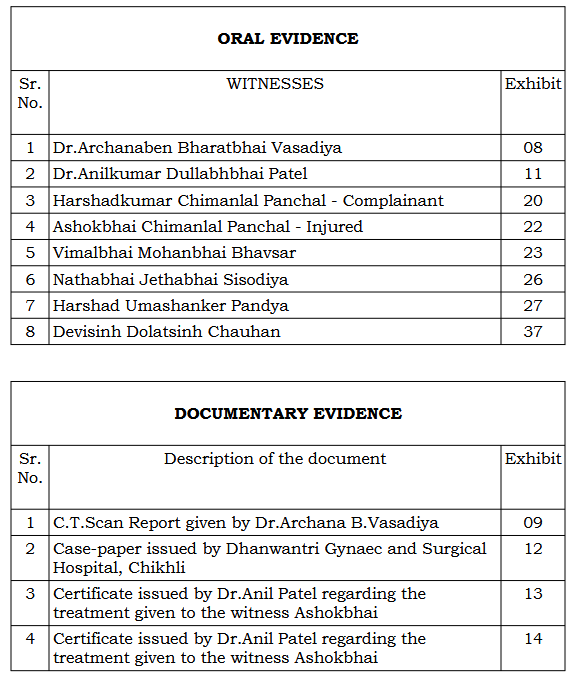
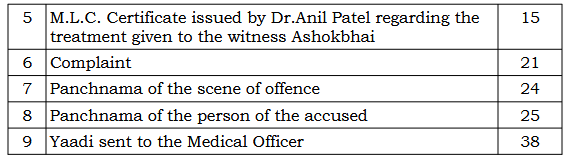
7. At the end of the trial, after recording the further statement of the accused persons under Section 313 of the Code of Criminal Procedure and after considering the arguments canvassed on behalf of the prosecution and the defence, the learned Additional Sessions Judge, Navsari, vide judgment and order dated 17.01.2003, acquitted the respondents-accused from all the charges.
8. Being aggrieved and dissatisfied with the aforesaid judgment and order of acquittal, the appellant-State has preferred the present appeal.
9. Heard learned APP Ms.Shruti Pathak appearing for the appellant-State and learned advocate Mr.Adil R.Mirza appearing for the respondents nos.1 to 3 - accused. Though served, none appeared on behalf of the respondent no.4 - accused.
SUBMISSIONS ON BEHALF OF THE APPLICANT - STATE :
10. Learned APP Ms.Pathak appearing for the appellant-State has vehemently contended that the impugned judgment and order passed by the learned Additional Sessions Judge, Navsari, is against the provisions of law and the learned Sessions Judge has not properly appreciated the evidence led by the prosecution. Moreover, on a bare perusal of the provisions of law itself, it is established that the prosecution has proved the offence against the respondents-accused by leading cogent evidence.
11. Learned APP Ms.Pathak, while taking this Court through the oral as well as the documentary evidence, has submitted that the evidence of the injured (PW-4) Ashokbhai Chimanbhai Panchal and the complainant (PW-3) Harshadkumar Chimanbhai Panchal, who himself is an injured eyewitness, clearly establishes the complicity of the respondents-accused in the alleged offence. Learned APP has submitted that the evidence of the aforesaid witnesses are duly corroborated by the medical evidence. Learned APP Ms.Pathak has further submitted that the star witnesses, in their respective evidence, have described the incident and also stated the details as to who had inflicted injuries to them. It is submitted that the version of the star witnesses, i.e. the complainant and the injured, is also supported by two other chance witnesses, namely, (PW-6) Nathabhai Jethabhai Sisodiya and (PW-7) Harshad Umashanker Pandya. Hence, there remains no doubt about the complicity of the respondents-accused in the alleged offence.
12. Learned advocate Ms.Pathak has further submitted that the evidence of the complainant (PW-3) Harshadkumar Chimanbhai Panchal and the injured (PW-4) Ashokbhai Chimanbhai Panchal, if read in juxtaposition with the medical evidence, it clearly establishes that the accused Maheshbhai had inflicted pipe blows on the injured Ashokbhai, whereas, the other accused persons had inflicted kick and fist blows on the injured and the complainant. Learned APP Ms.Pathak has, therefore, submitted that the trial court has given undue importance to the minor omissions and contradictions in the evidence of the witnesses. She has, therefore, submitted that there was no reason for the trial court to disbelieve the case of the prosecution and to acquit the respondents-accused.
SUBMISSIONS ON BEHALF OF THE RESPONDENT-ACCUSED:
13. The entire incident occurred on a trivial issue. There was no intention or even knowledge or premeditation. It is submitted that there was no mens rea and actus reus. Therefore, the elements to constitute the offence punishable under Section 307 are not attracted. Further, there are material omissions and contradictions in the evidence of the star witnesses and two chance witnesses, which casts shadow on the version of the prosecution. It is submitted that it appears from the complaint itself that during the incident upon arrival of the witnesses Arvindbhai Gandhi, Jiteshbhai Panchal, Rameshbhai Lad, as well as the complainant's mother Manharben, the accused fled away from the scene of offence. However, for the reasons best known to the prosecution, none of the aforesaid witnesses have been examined. It is submitted that the prosecution has failed to prove the case beyond reasonable doubt. It is further submitted that the entire evidence is inconsistent with the version/story narrated by the prosecution and the same is doubtful. It is also submitted that as per the settled legal position, the benefit of doubt always goes to the accused, and the learned Sessions Judge, after appreciating the entire evidence, has rightly acquitted the accused by giving them the benefit of doubt. Therefore, no interference is warranted.
14. At the outset, it is required to be noted that the principles which would govern and regulate the hearing of appeal by this Court against an order of acquittal passed by the trial court have been very succinctly explained by the Supreme Court in a catena of decisions. In the case of M.S. Narayana Menon @ Mani vs. State of Kerala & Anr, reported in (2006) 6 SCC 39, the Supreme Court has narrated about the powers of the High Court in appeal against the order of acquittal. In para 54 of the decision, the Supreme Court has observed as under:
"54. In any event the High Court entertained an appeal treating to be an appeal against acquittal, it was in fact exercising the revisional jurisdiction. Even while exercising an appellate power against a judgement of acquittal, the High Court should have borne in mind the well-settled principles of law that where two view are possible, the appellate court should not interfere with the finding of acquittal recorded by the court below."
15. Further, in the case of Chandrappa vs. State of Karnataka, reported in (2007) 4 SCC 415, the Supreme Court laid down the following principles:
"42. From the above decisions, in our considered view, the following general principles regarding powers of the appellate court while dealing with an appeal against an order of acquittal emerge :
[1] An appellate court has full power to review, re- appreciate and reconsider the evidence upon which the order of acquittal is founded.
[2] The Code of Criminal Procedure, 1973 puts no limitation, restriction or condition on exercise of such power and an appellate court on the evidence before it may reach its own conclusion, both on questions of fact and of law.
[3] Various expressions, such as, 'substantial and compelling reasons', 'good and sufficient grounds', 'very strong circumstances', 'distorted conclusions', 'glaring mistakes', etc. are not intended to curtain extensive powers of an appellate court in an appeal against acquittal. Such phraseologies are more in the nature of 'flourishes of language' to emphasize the reluctance of an appellate court to interfere with acquittal than to curtail the power of the court to review the evidence and to come to its own conclusion.
[4] An appellate court, however, must bear in mind that in case of acquittal there is double presumption in favour of the accused. Firstly, the presumption of innocence is available to him under the fundamental principle of criminal jurisprudence that every person shall be presumed to be innocent unless he is proved guilty by a competent court of law. Secondly, the accused having secured his acquittal, the presumption of his innocence is further reinforced, reaffirmed and strengthened by the trial court.
[5] If two reasonable conclusions are possible on the basis of the evidence on record, the appellate court should not disturb the finding of acquittal recorded by the trial court."
16. Thus, it is a settled principle that while exercising appellate power, even if two reasonable conclusions are possible on the basis of the evidence on record, the appellate court should not disturb the finding of acquittal recorded by the trial court.
17. Even, in the case of State of Goa vs. Sanjay Thakran & Anr. reported in (2007) 3 SCC 75, the Court has reiterated the powers of the High Court in such cases. In para 16 of the said decision the Court has observed as under :
"16. From the aforesaid decisions, it is apparent that while exercising the powers in appeal against the order of acquittal the Court of appeal would not ordinarily interfere with the order of acquittal unless the approach of the lower Court is vitiated by some manifest illegality and the conclusion arrived at would not be arrived at by any reasonable person and, therefore, the decision is to be characterized as perverse. Merely because two views are possible, the Court of appeal would not take the view which would upset the judgement delivered by the Court below. However, the appellate court has a power to review the evidence if it is of the view that the conclusion arrived at by the Court below is perverse and the Court has committed a manifest error of law and ignored the material evidence on record. A duty is cast upon the appellate court, in such circumstances, to re-appreciate the evidence to arrive to a just decision on the basis of material placed on record to find out whether any of the accused is connected with the commission of the crime he is charged with."
18. It is also a settled legal position that in acquittal appeal, the appellate court is not required to re-write the judgement or to give fresh reasoning, when the reasons assigned by the court below are found to be just and proper. Such principle is laid down by the Apex Court in the case of State of Karnataka vs. Hemareddy, reported in AIR 1981 SC 1417, wherein it is held as under :
".....This court has observed in Girija Nandini Devi vs. Bigendra Nandini Chaudhary (1967)1 SCR 93 : (AIR 1967 SC 1124) that it is not the duty of the appellate court when it agrees with the view of the trial court on the evidence to repeat the narration of the evidence or to reiterate the reasons given by the trial court expression of general agreement with the reasons given by the Court the decision of which is under appeal, will ordinarily suffice."
19. Thus, in case the appellate court agrees with the reasoning and the opinion given by the lower court, then the discussion of evidence is not necessary. Keeping in mind the aforesaid principles, the Court has to appreciate the evidence on record.
20. We have given our thoughtful consideration to the judgement and order passed by the trial court. We have also perused the oral as well as documentary evidence led by the trial court and also considered the submissions made by learned APP for the appellant-State. It is settled position of law, as well as the basic requirement for the prosecution, to prove the case against the accused beyond reasonable doubt. It is, therefore, expected that the evidence led by the prosecution must inspire confidence.
21. While appreciating the oral as well as the documentary evidence, we found some serious discrepancies and contradictions in the evidence of the witnesses.
22. Considering the Charge at Exh.2 and the original complaint at Exh.21, it transpires that the complainant and the accused no.1 Maheshbhai Vallabhbhai are paternal cousin brothers, and they reside adjacent to each other with their families. According to the prosecution, the entire incident occurred on 15.06.1997 in two parts. The first incident took place at around 4:30 in the evening. It is alleged that the accused Maheshbhai had obstructed the storm-water drainage in the common chowk by placing bricks, thereby causing water blockage, and upon raising objection to it by the complainant's brother Ashokbhai, the accused Maheshbhai, his wife Ilaben and his father Vallabhbhai got enraged/infuriated and started abusing him verbally. However, as the complainant's brother Ashokbhai was alone at that time, he did not respond.
23. The second part of the incident is alleged to have occurred on the same day at around 6 O'clock in the evening, when the complainant returned home and his brother Ashokbhai informed him about the earlier incident. Therefore, the complainant and his brother Ashokbhai proceeded to remove the obstruction put by the accused Maheshbhai in the storm-water drainage, at that time, the accused no.1 Maheshbhai inflicted an iron pipe blow on the chest of Ashokbhai, due to which, he fell down on the ground and sustained injuries. Therefore, the complainant intervened and came to his rescue. In the meantime, the father of the accused no.1, namely, Vallabhbhai, and the wife of the accused no.1, namely, Ilaben, arrived at the scene of offence and started assaulting the complainant with kick and fist blows and also administered threats upon the complainant and his brother Ashokbhai to face dire consequences. Subsequently, certain persons from the locality, namely, Arvindbhai Gandhi, Jiteshbhai Panchal, Rameshbhai Lad, who are having their shops opposite to the place of the occurrence, and the complainant's mother Manharben arrived at the scene of offence, therefore, the accused persons fled away from the scene of offence.
24. Considering the aforesaid and also considering the evidence adduced by the prosecution, it appears that the complainant (PW-3) Harshadkumar Chimanbhai Panchal and the injured (PW-4) Ashokbhai Chimanbhai Panchal are the star witnesses and, therefore, their evidence require careful scrutiny in conjunction with the medical evidence and the deposition of two chance witnesses, namely, Nathabhai Jethabhai Sisodiya (PW-6) at Exh.26 and Harshad Umashanker Pandya (PW-7) at Exh.27. At this juncture, it is significant to observe that in the original complaint at Exh.21, neither their presence nor their involvement has been mentioned. Furthermore, there reference is not there either in the testimony of the complainant or the injured witness.
25. The complainant Harshadkumar Chimanbhai Panchal, in his evidence at Exh.20, while supporting the case of the prosecution, has stated that on 15.06.1997, the accused no.1 Maheshbhai Vallabhbhai had unlawfully obstructed the storm- water drainage in the chowk by placing bricks, causing water blockage, and when his brother Ashokbhai, apprehending ingress of storm-water into their house, raised objection to it, the accused No.1 Maheshbhai, along with his wife Ilaben (accused No. 3) and his father Vallabhbhai (accused No. 2) got enraged/infuriated, and after hurling abuses, they assaulted Ashokbhai with kick and fist blows. Thereafter, at around 6 O'clock in the evening, when he returned home, Ashokbhai informed him about the incident, and when he and his brother Ashokbhai proceeded to remove the obstruction, at that time, all the four accused persons arrived at the spot and indulged into further altercation. The accused no.1 Maheshbhai assaulted his brother Ashokbhai with an iron pipe, causing injuries on his head and left lower part of his chest, due to which, his brother Ashokbhai collapsed, and when he came to his rescue, the accused persons also assaulted him with kick and fist blows and also administered threats to face dire consequences. Subsequently, on arrival of several individuals from the locality, namely, Arvindbhai Gandhi, Jiteshbhai Panchal, Rameshbhai Lad, as well as the complainant's mother Manharben, the accused persons fled away from the scene of offence.
26. It is pertinent to note here that as per the original complaint at Exh.21, at the time of the alleged incident, when the complainant's brother Ashokbhai raised his objection, the accused had merely abused him verbally. However, the complainant (PW-3) Harshadkumar Chimanbhai Panchal, in his evidence at Exh.20, has made exaggerated statement alleging that at the time of the alleged incident, the accused had also assaulted his brother Ashokbhai with kick and fist blows. At this stage, it is noteworthy that the complainant's brother Ashokbhai, in his own deposition, has not stated any such fact.
27. During the cross-examination of the complainant (PW-3) Harsadbhai Panchal, he has admitted that after the incident he took his injured brother Ashokbhai to the hospital of Dr.Anil Patel, and both of them, did not disclose the name of any assailant. He further admitted that although the police station is situated at a walkable distance from his residence, neither he nor any member of his family reported the incident to the police station immediately or even during the night of the occurrence. He has also admitted that his complaint contains no allegation against the accused No.4, and acknowledged an ongoing property dispute between him and the accused. Furthermore, he has admitted he did not inform the police about the incident even when his brother was taken to the Chikhli Hospital at about 6.30 pm.
28. The prosecution has thereafter examined the injured (PW- 4) Ashokbhai Panchal, i.e. the complainant's brother. He, in his evidence at Exhibit 22, has deposed that on the day of the incident at about 4.30 pm, the accused Maheshbhai had obstructed the storm-water drainage by placing bricks causing water blockage, and upon objection raised by him, all the four accused persons entered into a quarrel with him. He, thereafter, called his mother and, subsequently, at about 6.00 pm, after due deliberations with his mother and brother, they proceeded to remove the obstruction from the storm-water drainage. At this juncture, all the four accused persons assaulted him with fist and kick blows, and the accused Maheshbhai, inflicted pipe blows on his head and left side of his chest, causing serious injuries, which rendered him unconscious. He was, thereafter, taken to the hospital of Dr.Anil Patel, where, during the course of treatment, he underwent surgery and his spleen was removed.
29. During the cross-examination of the injured (PW-4) Ashokbhai Panchal, he admitted that there exists a road in front of his house and, immediately thereafter, a pond is situated which serves as a channel for the storm-water drainage. He further admitted that he did not disclose the names of the assailants to the doctor at the hospital. He also acknowledged that the accused are relatives and there is a property dispute going on between them, in respect of which litigation was also pending before the court at the time of the incident.
30. Considering the evidence of the complainant and the injured witness, the medical evidence assumes significance. The prosecution has examined the Medical Officer (PW-2) Dr.Anilkumar Dullabhbhai Patel, who, in his evidence at Exh.11, has stated that on 15.06.1997, the patient Ashokbhai was brought to his hospital for treatment without a police yadi. On examination, he noticed contusion of 5 inch x 1.5 inch on the left side of the head of the injured and a contusion of 6 inch x 1.5 inch on the lower left side of his chest and also pain on the left side of the abdomen. He has further deposed that while a CT scan did not disclose any internal head injury, the sonography revealed a ruptured spleen, necessitating surgical intervention. He has also stated that the patient Ashokbhai informed him that the injuries were caused with an iron rod. In his opinion, the injuries were grievous in nature. The MLC certificate in this regard is produced at Exh.15.
31. During his cross-examination, the Medical Officer (PW-2) Dr.Anilkumar Dullabhbhai Patel has admitted that the injuries caused by a stick or a rod typically appear in parallel lines like a railway track and further conceded that no such parallel contusion marks were seen on the person of the injured.
32. The prosecution has, thereafter, examined two chance witnesses, namely, (PW-6) Nathabhai Jethabhai Sisodiya and (PW-7) Harshad Umashanker Pandya. According to the case of the prosecution, the witness Nathabhai Sisodiya was proceeding ahead towards a temple, whereas the witness Harshad Pandya was on his way to get his hair cut, when they allegedly witnessed the incident. Both these witnesses, in their respective depositions at Exhibits 26 and 27, while trying to support the case of the prosecution, have similarly stated that while they were passing near the place of the incident, they saw the accused persons abusing and assaulting the complainant and the injured witness with kick and fist blows. At that time, the accused Ilaben brought an iron pipe and handed it over to the accused Maheshbhai, who, then inflicted pipe blows on the head and chest of the injured Ashokbhai, due to which Ashokbhai fell down unconscious on the ground.
33. During the cross-examination of both the chance witnesses, namely, (PW-6) Nathabhai Jethabhai Sisodiya and (PW-7) Harshad Umashanker Pandya, it has been emerged that these witnesses are the relatives of the complainant and the injured. It has also been emerged that a large number of people had gathered at the scene of the offence.
34. It is settled that the evidence of a chance witness is not inadmissible, but it requires a close scrutiny. In the case of Satbir vs. Surat Singh with State of Haryana vs. Surat Singh, reported in (1997) 4 SCC 192, the Supreme Court in paragraph-11 has observed thus :
"......The evidence of a chance witness is not necessarily incredible or unbelievable but it only requires cautious and close scrutiny."
35. In the case of Jarnail Singh vs. State of Punjab, reported in (2009) 9 SCC 719, the Supreme Court, in paragraph 22, has elaborately explained the reliability of a chance witness, which reads thus :
"The evidence of a chance witness requires a very cautious and close scrutiny and a chance witness must adequately explain his presence at the place of occurrence (Satbir v/s. Surat Singh (1997) 4 SCC 192; Harjinder Singh v/s. State of Gujarat (2004) 11 SCC 253; Acharaparambath Pradeepan & Anr. v/s. State of Kerala (2006) 13 SCC 643; and Sarvesh Narain Shukla v/s. Daroga Singh and Ors. (2007) 13 SCC 360). Deposition of a chance witness whose presence at the place of incident remains doubtful should be discarded (vide Shankarlal v/s. State of Rajasthan (2004) 10 SCC 632)."
36. In light of the aforesaid decision, if the evidence of the aforesaid chance witnesses is considered, it is noteworthy that in the original complaint (Exh.21), the complainant has nowhere stated that the aforesaid two witnesses were present at the time of the incident. Furthermore, even in the deposition of the complainant (PW-3) Harsadkumar Panchal and the injured witness (PW-4) Ashokbhai Panchal, there is no mention whatsoever that these two witnesses were present at the relevant point of time at the scene of the offence. It is pertinent to note that one of the so-called chance witnesses (PW-6) Nathabhai Sisodiya has stated in his deposition that after the occurrence, he had visited the hospital to inquire about the condition of the injured Ashokbhai. However, neither the complainant Harsadbhai Panchal nor the injured witness Ashokbhai, has made any such reference in their respective testimonies. Thus, the presence of these two witnesses at the scene of the offence appears to be doubtful.
37. It is further pertinent to note here that both these witnesses have deposed that while they were passing near the place of occurrence, they saw the accused person abusing the complainant and his brother Ashokbhai and assaulting them with fist and kick blows, and at that time, the accused Ilaben had brought a pipe and handed it over to the accused Maheshbhai who, then inflicted, pipe blows on the head and chest of the injured Ashokbhai. Admittedly, this is not the case of the prosecution, and it is contradictory since no such facts have been stated either in the original complaint (Exh.21) or in the deposition of the complainant and the injured witness. Therefore, the evidence of both these chance witnesses appears to be wholly unreliable and doubtful.
38. At this juncture, it is also relevant to note that as per the case of the prosecution, at the time of the incident, the complainant's mother Manharben as well as Arvindbhai Gandhi, Jiteshbhai Panchal and Rameshbhai Lad had arrived at the occurrence. However, the prosecution has failed to examine any of these witnesses, which further raises serious doubt about the veracity of the case of the prosecution.
39. Thus, from the overall assessment of the evidence of the star witnesses adduced by the prosecution, it becomes evident that the alleged incident arose out of a sudden quarrel over a trivial issue, and it was not premeditated. There is no material on record to indicate that the assault upon the injured was caused with a prior intention or the knowledge that such act would likely to cause death.
40. It also establishes from the evidence that neither the complainant nor the injured witness disclosed the name of the alleged assailant to the doctor at the hospital. It is further borne out from the record that despite the police station being situated in the close proximity to the residence of the complainant, no complaint or intimation was given to the police until the evening on the following day. Moreover, there is no evidence to show that the hospital authority intimated the police about the said incident. Admittedly, the complaint (Exh.21) came to be lodged on the next day in the evening. Further, as discussed earlier, the presence of both the chance witnesses at the scene of the offence and the version deposed by them appears to be doubtful. It is also pertinent to note that as per the prosecution's own case, at the time of the incident, the complainant's mother and three other independent and neutral witnesses had arrived at the occurrence. However, they have not been examined by the prosecution.
41. Thus, on the overall appreciation of the evidence led by the prosecution, it appears that the incident may have occurred but not in the manner as alleged by the prosecution.
42. Upon careful examination of the judgment of the trial court (Exh.42), it is evident that even the trial court has also observed the aforesaid inconsistencies and contradictions in the evidence of the chance witnesses and arrived at the conclusion that the prosecution failed to prove its case beyond reasonable doubt.
CONCLUSION :
43. Upon reassessment of the entire evidence of the prosecution, this Court is of the opinion that the prosecution has failed to prove the case beyond reasonable doubt and the learned APP is not in a position to show any evidence to take a contrary view of the matter or that the approach of the trial court is vitiated by some manifest error or illegality or that the decision is perverse or that the trial court has ignored material evidence available on record.
44. Before parting with the judgment, it would be apt to refer to the judgment of the Supreme Court in the case of Mallappa vs. State Of Karnataka, reported in (2024) 3 SCC 544, wherein the Supreme Court has observed thus :-
"26. It may be noted that the possibility of two views in a criminal case is not an extraordinary phenomenon. The two- views theory has been judicially recognized by the Courts and it comes into play when the appreciation of evidence results into two equally plausible views. However, the controversy is to be resolved in favour of the accused. For, the very existence of an equally plausible view in favour of innocence of the accused is in itself a reasonable doubt in the case of the prosecution. Moreover, it reinforces the presumption of innocence. And therefore, when two views are possible, following the one in favour of innocence of the accused is the safest course of action...."
45. On the overall appreciation of the evidence as well as considering the impugned judgment and order, this Court is of the considered opinion that the findings recorded by the trial court do not suffer from any perversity or illegality. The findings recorded by the trial court are absolutely just and proper, and in recording the same, no illegality or infirmity has been committed by the trial court. This Court is in complete agreement with the findings, ultimate conclusion and the resultant order of acquittal recorded by the trial court. Hence, no interference is warranted.
46. On the facts and in the circumstances of the case, the Appeal, therefore, fails, and the same is hereby dismissed. Records and proceedings be sent back to the concerned trial court.

 |
This Product is Licensed to , |