


1. The Additional Sessions Judge, Sausar, District Chhindwara, referred the matter along with necessary documents in compliance with the directions issued by the Coordinate Bench of this Court vide order dated 20.02.2025 passed in WP No. 5184/25. Suo moto cognizance of the matter was taken and it was registered as WP No.15571/2026. The Additional Session Judge, Sausar vide latter dated 23.04.2026, informed that an FIR bearing Crime No. 467/2025 has been registered at Police Station Lodhikheda, District Chhindwara, for offences punishable under Sections 137(2) and 64(2)(m) of the BNS, and Sections 5(L), 5(j)(ii)/6 of the POCSO Act. It was further informed that the victim is pregnant for more than 24 weeks. Accordingly, the Chief Medical Officer was directed to constitute the Board for examination of the victim. The Medical Board, comprising two gynecologist, reported that the victim is carrying a pregnancy of approximately 28 -30 weeks. The fetus is alive with cardiac activity. The Medical Board has opined that it is advisable to allow the pregnancy to continue to full term delivery. The opinion of the Medical board is reproduced-
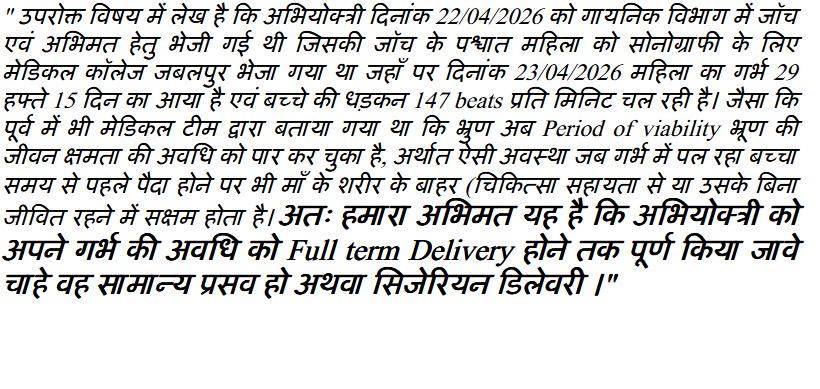
2. The order sheet of the proceedings before the learning Additional Sessions Judge, Sausar reveals that the victim and her parents were heard and they desired to keep the child and not to terminate the pregnancy.
3. The Medical Termination of Pregnancy Act, 1971 provides as under:-
"3. When pregnancies may be terminated by registered medical practitioners- (1) Notwithstanding anything contained in the Indian Penal Code (45 of 1860), a registered medical practitioner shall not be guilty of any offence under that Code or under any other law for the time being in force, if any pregnancy is terminated by him in accordance with the provisions of this Act.
(2) Subject to the provisions of sub-section (4), a pregnancy may be terminated by a registered medical practitioner,-
(a) where the length of the pregnancy does not exceed twenty weeks, if such medical practitioner is, or
(b) where the length of the pregnancy exceeds twenty weeks but does not exceed twenty-four weeks in case of such category of woman as may be prescribed by rules made under this Act, if not less than two registered medical practitioners are, of the opinion, formed in good faith, that-
(i) the continuance of the pregnancy would involve a risk to the life of the pregnant woman or of grave injury to her physical or mental health; or
(ii) there is a substantial risk that if the child were born, it would suffer from any serious physical or mental abnormality.
Explanation 1. For the purposes of clause (a), where any pregnancy occurs as a result of failure of any device or method used by any woman or her partner for the purpose of limiting the number of children or preventing pregnancy, the anguish caused by such pregnancy may be presumed to constitute a grave injury to the mental health of the pregnant woman.
Explanation 2.-For the purposes of clauses (a) and (b), where any pregnancy is alleged by the pregnant woman to have been caused by rape, the anguish caused by the pregnancy shall be presumed to constitute a grave injury to the mental health of the pregnant woman.
(24) The norms for the registered medical practitioner whose opinion is required for termination of pregnancy at different gestational age shall be such as may be prescribed by rules made under this Act.
(2B) The provisions of sub-section (2) relating to the length of the pregnancy shall not apply to the termination of pregnancy by the medical practitioner where such termination is necessitated by the diagnosis of any of the substantial foetal abnormalities diagnosed by a Medical Board.
(2C) Every State Government or Union territory, as the case may be, shall, by notification in the Official Gazette, constitute a Board to be called a Medical Board for the purposes of this Act to exercise such powers and functions as may be prescribed by rules made under this Act.
(2D) The Medical Board shall consist of the following, namely:-
(a) a Gynaecologist;
(b) a Paediatrician;
(c) a Radiologist or Sonologist; and
(d) such other number of members as may be notified in the Official Gazette by the State Government or Union territory, as the case may be.
(3) In determining whether the continuance of a pregnancy would involve such risk of injury to the health as is mentioned in sub-section (2), account may be taken of the pregnant woman's actual or reasonably foreseeable environment.
(4) (a) No pregnancy of a woman, who has not attained the age of eighteen years, or, who having attained the age of eighteen years, is a mentally ill person, shall be terminated except with the consent in writing of her guardian.
(b) Save as otherwise provided in clause (a), no pregnancy shall be terminated except with the consent of the pregnant woman."
4. The Medical Termination of Pregnancy Act, 1971 provides as under :-
" 5 Sections 3 and 4 when not to apply - (1) The provisions of Section 4, and so much of the provisions of sub-section (2) of Section 3 as relate to the length of the pregnancy and the opinion of not less than two registered medical practitioners, shall not apply to the termination of a pregnancy by a registered medical practitioner in a case where he is of opinion, formed in good faith, that the termination of such pregnancy is immediately necessary to save the life of the pregnant woman"
5. The Hon'ble Supreme Court in a series of judgments had an occasion to consider the aspect of termination of pregnancies exceeding 24 weeks and in the case of X vs Principal Secretary, Health and Family Welfare Department reported in AIR 2022 SC 4917, the Hon'ble Supreme Court has considered the aforesaid aspect of the matter including the choice of the woman to get the pregnancy terminated and other socio-economic factors including the physical health condition of the woman has permitted for terminating the pregnancy. The aforesaid judgment was again followed by the Hon'ble Supreme Court in the case of XYZ vs State of Gujarat and others, reported in 2023 SCC OnLine SC 1573, wherein the Hon'ble Supreme Court taking note of several aspects of the matter has permitted for termination of pregnancy. It has been held as under :
"17. More recently, in the case of X v. The Principal Secretary, Health and Family Welfare Department, Government of NCT of Delhi, AIR 2022 SC 4917; this Court, in another three-judge Bench lead by Dr. D.Y. Chandrachud, J. (as the learned Chief Justice then was) observed that a woman can become pregnant by choice irrespective of her marital status. In case the pregnancy is warranted, it is equally shared by both the partners. However, in case of an unwanted or incidental pregnancy, the burden invariably falls on the pregnant woman affecting her mental and physical health. Article 21 of the Constitution recognizes and protects the right of a woman to undergo termination of pregnancy if her mental or physical health is at stake. Importantly, it is the woman alone who has the right over her body and is the ultimate decision-maker on the question of whether she wants to undergo an abortion.
18. In the context of abortion, the right of dignity entails recognising the competence and authority of every woman to take reproductive decisions, including the decision to terminate the pregnancy. Although human dignity inheres in every individual, it is susceptible to violation by external conditions and treatment imposed by the State. The right of every woman to make reproductive choices without undue interference from the state is central to the idea of human dignity. Deprivation of access to reproductive healthcare or emotional and physical well-being also injures the dignity of women.
19. The whole object of preferring a Writ Petition under Article 226 of the Constitution of India is to engage with the extraordinary discretionary jurisdiction of the High Court in exercise of its constitutional power. Such a power is vested with the constitutional courts and discretion has to be exercised judiciously and having regard to the facts of the case and by taking into consideration the relevant facts while leaving out irrelevant considerations and not vice versa.
20. In view of the above discussion and on perusal of the latest medical report we permit the appellant to terminate her pregnancy. We direct the appellant to remain present before the KMCRI Hospital, Bharuch, Gujarat during the course of the day, today (21.08.2023) or 09 : 00 A.M. tomorrow (22.08.2023) as she deems fit so that the termination of pregnancy could be carried out preferably during the course of the day today (21.08.2023) or tomorrow i.e. 22.08.2023.
21. Subsequently to the medical procedure to be carried out either today or tomorrow, in the event, the foetus is found to be alive, the hospital shall give all necessary medical assistance including incubation either in that hospital or any other hospital where incubation facility is available in order to ensure that the foetus survives. Further, in case the foetus survives, then State shall take steps for ensuring that the child could be adopted in accordance with law.
22. At this stage, learned Senior Counsel for the appellant sought a direction to the concerned doctors to preserve evidence for subsequent DNA Test Report by drawing tissues from the foetus in order to use it as a piece of evidence in the ensuing trial to be prosecuted by the appellant herein. We direct the concerned medical experts to have regard to the feasibility of such a procedure being done, in the event of the foetus being alive or in the event the foetus not being alive or is still born and accordingly take steps as sought for by the appellant herein.
23. It is needless to observe that in the event tissues are drawn for the purpose of DNA test the same shall be handed over to the investigating agency by the concerned hospital.
24. A copy of this order passed today be handed over to learned Senior Counsel for the appellant and learned Standing Counsel for the State of Gujarat.
25. The appeal is allowed in the aforesaid terms.
26. Pending application(s), if any, shall stand disposed of.
6. Section 3(4)(b) of the MTP Act clearly mandates that "no pregnancy shall be terminated except with the consent of the pregnant woman". In the present case, the victim and her parents have specifically requested before the Trial Court that the pregnancy be continued and not terminated.
7. Considering the aforesaid aspects of the matter, this Court is of the considered opinion that medical termination of pregnancy in this matter against the will of victim and her parents and contrary to the experts medical opinion would be inappropriate. Consequently, this petition is disposed of with the following directions :-
(1) The victim shall be provided medical assistance for her pregnancy and delivery as and when required at the expense of the State Government.
(2)The delivery shall be conducted in presence of gynecologist/obstetrician experts and pediatrician. The Chief Medical Officer of the concerned District shall ensure proper medical supervision and facilities for the same.
(3) The post delivery care be extended to the victim.
(4) If the victim and her parents are not willing to keep the delivered child, the child will be handed over to the Child Welfare Committee or State authorities of the concerned District after a period of 15 days from the date of delivery. The child shall remain with the mother for initially 15 days under the medical supervision and assistance.
(5) The CWC will again verify the Will of the mother after expiry of 15 days and thereafter proceed to undertake the procedure for adoption of the child in accordance with law.
(6) The identity of the victim shall be kept strictly confidential ensuring her privacy.
8. Let a copy of this proceeding be forwarded to the SHO Sausar and the Superintendent of District Chhindwara, the Chief Medical Officer, Chhindwara and to the Additional Sessions Judge, Sausar, District Chhindwara for intimation and necessary action.
9. With the aforesaid, the present petition stands disposed of. Certified copy as per rules.

 |
This Product is Licensed to , |