


Sanjay Karol, J.
Leave Granted.
2. Rajendra Singh Bora - the employee challenges a decision of the High Court of Judicature at Allahabad, passed in Writ A No. 20783 of 2013 on 11.04.2018 whereby he had requested the Court to issue a mandamus to the States of Uttar Pradesh and Uttaranchal, thereby effecting his change of cadre from Uttar Pradesh to Uttarakhand, on account of the fact that when he appeared for the Combined Lower Subordinate Service Examinations in 1995, he had opted for 'hill region' posting, which was rejected.
3. The facts giving rise to the present appeal lie in a narrow compass. The appellant appeared for and cleared the competitive exam mentioned above, conducted by the Uttar Pradesh Subordinate Services Selection Commission, Lucknow, with what could be considered good marks i.e., 672 in total out of 900. The mark-sheet reflecting the said result as obtained is Annexure-P-3. While opting for, Sub-Deputy Inspector of Schools, his preference was the 'hill area of Uttar Pradesh'. Despite such a situation, the appellant was not appointed for the reason that he only submitted his B.Ed (Bachelor of Education marksheet) at the time of interview and not with the application form. Naturally, those below him in the merit list were appointed. Aggrieved thereby, the appellant approached the High Court by way of Writ Petition No. 16613 of 1997 which came to be allowed on 13.02.2004. The reasoning given by the learned Single Judge in allowing this petition was that Condition No. 7 of the Advertisement, pursuant to which the appellant applied for the position stated that candidates applying for the said position should annex the B.Ed marksheets, but it did not say that those applications which does not annex the same, will be rejected. Moreover, it was noted that the production of marksheets at the time of interview is an admitted fact. Given the remote area from where the appellant hailed, the Court observed that a hyper-technical view should not be adopted and as such allowed the appellant to be appointed from the same date as the other candidates, along with consequential benefits except for arrears and salary.
4. The State of Uttar Pradesh appealed[Special Appeal No. 781 of 2004] against these findings but the same came to be dismissed by order dated 07.10.2009. He was finally appointed by the Director (Basic) Uttar Pradesh, Allahabad, to the position of Sub Deputy Inspector of Schools notionally from 11th June 1997. He joined the said service on 26th July 2011 in Kashi Ram Nagar, Uttar Pradesh. He submitted representations to the above said Authorities on 20th May 2012, 19th July 2012 and 13th October 2012 respectively requesting that he be granted the 'hill cadre' as originally requested. A further ground for making such an application was that his son was cognitively disabled. The record does not reveal the respondent-State of Uttar Pradesh to have responded to the representations made by the appellant.
5. It is in these circumstances that the writ petition, in which the order impugned before us, was passed, came to be filed. The High Court dismissed the petition, observing that once the appellant was allotted the Uttar Pradesh Service, no question arose about the transfer to Uttaranchal/Uttarakhand.
6. We have heard the learned counsel for the parties and perused the record. We may record at the outset that we do not agree with the determination made by the High Court. The reasoning in law, shall come forth in the following paragraphs.
7. First, the distinction between a transfer and a change in cadre is plain and does not admit confusion. The two operate in entirely different domains and carry different legal and administrative consequences. A transfer refers to a change in the place of posting of an employee within the same cadre or service. The individual continues to belong to the same service structure, governed by the same rules, with no impact on seniority or substantive status. It is an incident of service, routinely exercised by the administration for functional, administrative, or public interest considerations. In essence, only the location or assignment changes, not the identity of service to which the employee belongs. A change in cadre, by contrast, involves a shift from one cadre to another and, therefore, alters the very framework within which the employee's service is regulated. It is not a mere relocation but a structural change that may affect seniority, promotional avenues, and applicable service conditions. Such a change is exceptional in nature and typically requires specific statutory authority or higher-level approval, given its far-reaching implications. The difference, therefore, is clear and substantive. A transfer is a matter of administrative convenience within the same service, whereas a change in cadre entails a reconfiguration of the employee's service identity itself.
8. Second, the exam for which the appellant appeared dated prior to the reorganization of the States, and while giving his preference, he had asked for the 'hill cadre'. There is no reason forthcoming on record to show that if his appointment after the exam had not run into the roadblocks which it did, he would have been appointed to the hill cadre, and which, with the passage of time, would have translated into appointments with the State of Uttarakhand. The Department of Personnel and Training[DOPT] explains the cadre allocation process as follows:
"Criteria of Allocation
The broad principle of allocation of State cadre employees which inter alia include allocation first by option, followed by domicile (Home District) and lastly by inclusion of junior most personnel in the reverse order of seniority. If the number of posts allocated to a successor States are more than the total number of optees and domicile (Home District), in order to fill up the balance posts, the employees lower down in the seniority position in the cadre are considered for allocation even against their options. Option once exercised by the employees is not reversible. Keeping in view the resentment expressed by the employees who were allocated on domicile and juniority basis against their willingness, several exceptions were made to the guidelines to facilitate certain class of employees to be allocated to the States of their option.
The following are the exceptions to the above mentioned policy:
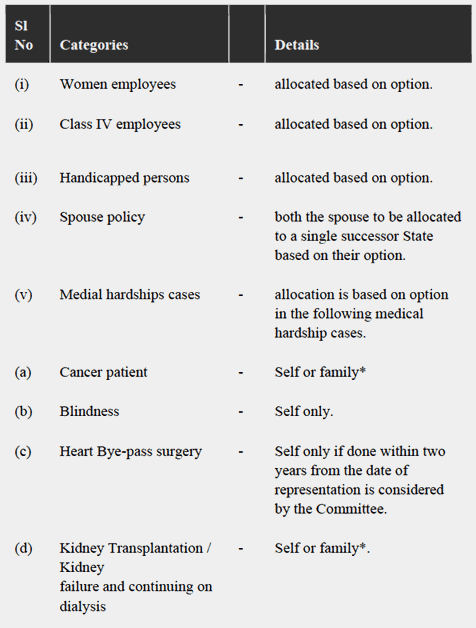
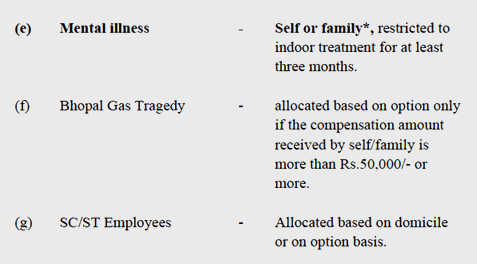
* family include spouse, dependent children and dependent parents. (emphasis supplied)"
9. This above extract itself makes clear that the cadre allocation process is governed by three criteria: option, domicile and inclusion of junior most personnel in reverse order of seniority. The present appellant had been granted notional appointment from 11th June 1997 and has also submitted, in various representations, that he is a resident of present-day Uttarakhand. On both these counts the request for reallocation of cadre ought to have been acceded to, if at all it can be called as such.
10. Third, even if both these reasons are kept aside, there is yet another reason that would justify the appellant being sent to the Uttarakhand State Services. His son has been declared to be cognitively challenged with little or no scope for improvement/betterment in his condition. The Medical Certificate testifying such a position has been placed on record. The above extracted exceptions to the allocation policy have an exception for persons with 'mental illness' which does include the family members also. When such an exception applies, the allocation to be made is as per the option exercised by the employee. On this count also, the appellant's appointment in the hill cadre taken from the original date, should have been translated into an appointment with the successor State.
11. On a cumulative assessment of the above factors, the appeal deserves to be allowed. Ordered accordingly. The impugned judgment with particulars in paragraph 1 stands set aside. The Chief Secretary, State of Uttar Pradesh, is directed to facilitate forthwith the reallocation of the appellant to the State of Uttarakhand. While doing so, his seniority and all relevant benefits shall be protected. A copy of this judgment also be sent to Chief Secretary, State of Uttarakhand, for necessary follow up action.12. Before parting with the matter, we must record that a deep sense of anguish troubled us in dealing with this matter. The appellant became eligible to be appointed in the year 1997 but was only actually appointed in 2011, and even today in 2026 he continues to fight for his rights. Once the High Court had, in 2004 cleared the way for his appointment, he should have at least been appointed, subject to the outcome of the appeal, if any, that would have been filed by the State. That did not happen. The appeal was dismissed in 2009 yet formal appointment came only in 2011. From 2011 onwards, he is being made to run from pillar to post to fructify the needs/preferability of being posted in his home State. This is in no way, shape or form, anything other than apathy on part of the State. This becomes clearer if the issue is looked at in terms of absolute numbers. The person was appointed with effect from June 1997 and today we are in April of 2026. Only now will he get something that he had opted for right from the start. Even if we exclude the initial few years till his appointment was confirmed by the High Court in the first writ petition which was in February 2004, even from that point onwards 22 years have passed. The entire time that being close to family would have been a great sense of support in raising his son, he has spent away from family at least since 2011. In the attending facts and circumstances as discussed above, we award cost to the appellant, to be paid by the respondent State of Uttar Pradesh, to the tune of Rs.1,00,000/- (Rupees One lakh only). The cost be deposited into the bank account of the appellant within four weeks. Counsel for the appellant shall furnish to the counsel for the respondent State, the necessary details within one week.
13. It is difficult to think that there are not many other cases where on account of long pendency of service dispute the party in question would be approaching superannuation as the case may also be here. As such, it is requested that the learned Chief Justice of the High Court, ascertain the number of such cases long pending and endeavour to have them decided expeditiously by possibly by distributing them across benches which would ensure that they are taken up and decided within a comparatively shorter span of time.
Pending application(s), if any, shall stand disposed of.

 |
This Product is Licensed to , |