


1. Invoking Article 226 of the Constitution of India, the petitioner has challenged in this petition, the appointment order of respondent no.3 dated 22.03.2021, (Annexure P/1) whereby she has been appointed on the post of Assistant Professor (Law). The petitioner has also prayed for a direction to the respondents to appoint her on the post reserved for OBC (woman) candidate with all consequential benefits including seniority. It has also come on record that during the pendency of this petition, the petitioner has also been appointed on the post in question and, therefore, the only issue remains is for her seniority from the date respondent no.3 was appointed.
2. An advertisement was issued by the Madhya Pradesh Public Service Commission (PSC) on 12.02.2017 inviting applications for the post of Assistant Professor in various faculties including 158 posts of Assistant Professor (law). Out of these 158 posts, 19 posts were reserved for OBC category amongst which 6 posts were allocated to OBC (women). The petitioner and respondent no.3, alongwith others, applied as OBC (women) category candidates. The written examination was held on 27.06.2018 and the results were declared on 10.08.2018 wherein the petitioner secured 288 marks and respondent no.3 scored 290 marks. The cut off marks for OBC (women) was 290 marks. The respondent no.3 was thus placed at serial no.6 of the merit list prepared for OBC (women) candidates.
3. The final select list was revised subsequently pursuant to order passed by this Court in writ petition filed by aggrieved candidates. For purposes of decision of this case, suffice it to mention that in revised select list, the respondent no.3 was placed at serial no.34 while petitioner was at serial no.35. The respondent no.3 was given appointment on the post vide impugned order, dated 22.03.2021, while the petitioner was kept at serial no.1 in waiting list. Subsequently, during the pendency of this petition, the petitioner has also been given appointment on 20.06.2023. She has accordingly joined on the post in Govt. Law College, Sheopur on 22.06.2023.
4. It is the grievance of the petitioner that respondent no.3, though an OBC, but belongs to Creamy Layer as her husband is a Civil Judge Class-I (2008 Batch) and she herself has been earning Rs.30,000/- per month as Guest Faculty. Therefore, the total income of the family exceeds Rs.12 lakh per annum. It is her case that respondent no.3 had wrongly claimed the benefit of OBC and if she was not given the benefit of OBC, the petitioner would have been appointed in the year 2021 itself in place of respondent no.3. After when the petitioner is also appointed, she claims that if appointed in 2021, she would have drawn her seniority from the earlier date.
5. The learned senior counsel for petitioner submitted that as per Corrigendum dated 23.02.2018 (Annexure P/7) issued by the PSC, the annual income of creamy layer is determined as Rs.8 lakh and above. He submitted that the petitioner's husband is working as Civil Judge Class-I (2008 batch) and is drawing about Rs.1 lakh salary per month. In addition, the petitioner is also working as Guest Faculty and is getting Rs.30,000/- salary per month. He thus submitted that the salary of family exceeds Rs.8 lakh and, therefore, the respondent no.3 was not entitled to appointment on post reserved for OBC candidates. The learned counsel thus submitted that the respondent no.3 was not entitled to be appointed as Assistant Professor and if she was not there, the petitioner would have been appointed. He thus prayed for setting aside of appointment order of respondent no.3 and for grant of appointment to petitioner with effect from 22.03.2021 and consequently seniority on the post.
6. On the other hand, the learned counsel for respondent no.3 refuted the submissions made by counsel for petitioner. He submitted that the Circular, dated 28.05.2016, issued by General Administration Department, modifying its earlier circular, clarifies that it is only the income of the mother and father of the incumbent that can be looked into to determine whether the candidate belongs to creamy layer. It is his submission that the income of husband and the candidate herself cannot be taken into consideration. He also submitted that as per circular issued by Govt., the income of Class-I officer alone can be looked into whereas the husband of the petitioner is holding the post of Civil Judge, Class I which is a Class II post. He also submitted that the mother of respondent no.3 has been a housewife while her father, Shri P.S. Rathore, was appointed as Sub-Engineer, a Class III post, in M.P. Housing Board on 26.11.1981. He retired from the said post in the year 2023.
7. The learned counsel also submitted that the respondent no.3 do not belong to creamy layer and has been rightly given the benefit of OBC. It is his further submission that the caste certificate of respondent no.3 has been issued by competent authority after verification of all relevant facts and based upon the same, she is entitled to get the appointment on the post. He thus submitted that the challenge to the appointment order of respondent no.3 is wholly unfounded and the petition deserves to be dismissed.
8. The learned Govt. Advocate for respondent no.1 also supports the contentions of counsel for respondent no.3. In addition, he submitted that the husband of respondent no.3 is working as Civil Judge, Class-I which is not a Class-I post as alleged by petitioner but is a Class-II post. He submitted that, as per circular, dated 25.08.2012, (Annexure R/1) issued by GAD, it is only when a woman candidate is married to a person holding Class-I post, then she would be treated to be in creamy layer and is not entitled to OBC status. It is his submission that the appointment of respondent no.3 is given only after verification of her documents including caste certificate.
9. Shri Shashank Indapurkar, learned counsel for respondent no.2 supports the contentions made by counsel for respondent no.3 and Govt. Advocate and justified her appointment on the post in question being an OBC candidate. It is his submission that circular, dated 23.02.2018 (Annexure P/7) is only a corrigendum to the earlier circular dated 25.02.02003. As per his submission for purposes of determination of creamy layer status of a candidate, the income of parents alone is required to be considered.
10. Considered the arguments and perused the records.
11. The Apex Court in the case of Indra Sawhney Vs. Union of India reported in 1992 Supp (3) SCC 217, observed in para 741 that "For assuring equality of opportunity, it may well be necessary in certain situations to treat unequally situated persons unequally. Not doing so, would perpetuate and accentuate inequality". In order to ensure equality of opportunity, the concept of 'creamy layer' was introduced. The creamy layer is aimed at ensuring that reservation benefits are not extended to those who are no longer backward. The Apex Court in Indra Sawhney Vs. Union of India reported in (2000)1 SCC 168, explained the rationale underlying the rule of exclusion of the creamy layer, holding that "non-exclusion thereof would amount to discrimination and violation of Articles 14 & 16, inasmuch as unequals cannot be treated as equals". To sustain the spirit of the constitutional provisions of equality, it is obligatory on the State to identify the most deserving candidates, as the State is obliged to remove inequalities and backwardness from society. If non-deserving candidates are given the benefit NEUTRAL CITATION NO. 2026:MPHC-GWL:11101 6 WP-8426-2021 of reservation, it would breach the spirit of the constitutional provision. In Ashok Kumar Thakur Vs. Union of India reported in (2008)6 SCC 1 , the Apex Court held that "the Government should not proceed on the basis that once a class is considered backward, it should continue to be backward for all times, as such an approach would defeat the very purpose of reservation".
12. In view of aforesaid legal proposition, it is evident that the object of excluding the creamy layer is to ensure that socially advanced sections within the OBCs do not appropriate benefits meant for the genuinely backward. The guidelines in the shape of circulars are therefore, issued by Govt. of India as also by State Govt. in order to ensure that the intended benefits of reservation reach the truly deserving candidates among the backward classes. A perusal of the ratio of various judgments of Apex Court as also that of circulars issued by Govt. of India and State Govt., it comes out that the status of creamy layer is not to be determined solely based upon the financial status but is basically to be determined based upon the social status of the candidate.
13. The guidelines prescribing criteria for exclusion of candidate belonging to creamy layer, has been issued by Govt. of India as also by State Govt. from time to time. Initially, Ministry of Personnel, Public Grievance and Pension, Govt. of India, issued circular, dated 08.09.1993, (Annexure R- 3/5) pertaining to reservation for OBC. Similar guidelines were initially issued by General Administration Department of Govt. of M.P. vide circular, dated 25.02.2003, (Annexure R-3/6) containing similar criteria. Various circulars have been issued from time to time supplementing the criteria for determination of creamy layer status.
14. Consolidating all the criteria issued from time to time in past, the State Govt. through GAD, issued circular, dated 25.08.2012, (Annexure R- 3/8). The provisions of this circular, which are relevant for decision of this case, are reproduced hereunder:
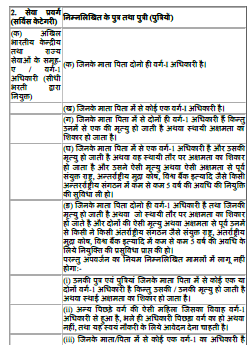
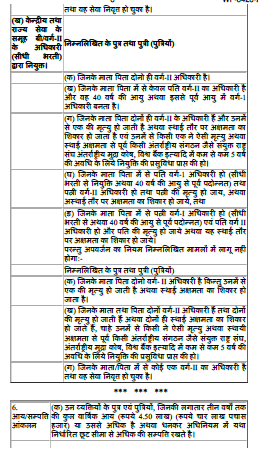
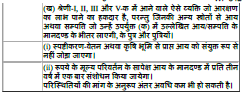
15. From the aforesaid guidelines issued by GAD, following position emerges:
i. the income of only parents of candidate is to be looked into while determining his/her status of creamy layer;
ii. the self-income of candidate is not relevant for the said purpose;
iii. the income of husband can be looked into only when the candidate is married to a Class-I Officer, whether or not such officer belong to OBC category;
iv. the candidate is excluded when both, father and mother of candidate, are Class-II Officer;
v. the candidate is excluded also when only father is Class-II Officer and is promoted as Class-I Officer before the age of 40 years;
vi. Clause 6 of circular also applied only in relation to income of parents and not to the income of candidate himself. Further, this clause is not applicable when the income is from salary.
16. The aforesaid pointers have been narrated looking to their relevancy for decision of this case. They are thus not exhaustive. From the aforesaid, it is evident that while determining the status of creamy layer of a candidate, the income of his parents alone is required to be seen. The income of his husband (who is not Class-I Officer) and/or his own income is not relevant for the said purpose.
17. The issue with regard to income of parents was under consideration before Apex Court in the case of Siddarth Saini vs. State of Haryana reported in (2001)10 SCC 625 . After considering the relevant circular/guidelines, the Court held as under:
"3. Pursuant to the judgment of this Court in Indra Sawhney v. Union of India [1992 Supp (3) SCC 217 : 1992 SCC (L&S) Supp 1 : (1992) 22 ATC 385] the Haryana Government vide notification dated 12-10-1993 had set up the Haryana Second Backward Classes Commission. The terms of reference of the Commission were to entertain, examine and recommend upon requests for inclusion and complaints of overinclusion and under inclusion in the list of Backward Classes. Vide notification dated 26-5-1994, the Commission was also assigned the function of specifying the basis, applying the relevant and requisite socio-economic criteria to exclude socially advanced persons/sections (creamy layer) from Backward Classes. A perusal of the criteria referred to above shows persons falling in certain categories as belonging to creamy layer. In this case, we are not concerned with any other category, except the category of government servant Class II post. The father of the appellant was directly recruited as Assistant Engineer (SDO) on Class II post, in the Irrigation Department of Haryana. The father of the appellant still continues to be a member of Class II service only. According to the affidavit filed by the father of the appellant, his source of income is only salary and he derives income from no other source. The Government of Haryana issued Clarification Order No. 22/36/2000-3GS III dated 9-8-2000 for issuance of NEUTRAL CITATION NO. 2026:MPHC-GWL:11101 11 WP-8426-2021 certificate to OBCs in Haryana on 9-8-2000. In the said order it has been clarified that income from salary is not required to be taken into account for the purpose of income/wealth test in respect of service category and while calculating income or wealth tax of a government employee of a Backward Class who is not covered under Annexure A description of Categories I, II (a, b, c, d), III and IV he would become entitled to the benefit of reservation under Backward Classes category; his salary shall not be included but his other sources of income/wealth, be included for income/wealth test.
4. In the present case, it is the admitted case of the appellant that the only source of income of the father of the appellant is his salary. It is also not disputed that the father of the appellant is a Class II officer and that the mother of the appellant is not a Class II officer. The amount of gross salary received by the father of the appellant, for the purpose of grant of benefit to the OBCs is irrelevant. This being the position, which has been clarified by the Government of Haryana itself, by government order dated 9-8-2000, it is obvious that the appellant should not have been refused the OBC certificate by taking the salary of the father of the appellant into account. The order of the Deputy Commissioner dated 24-6-1999, refusing grant of OBC certificate, is clearly erroneous. The judgment of the High Court, impugned before us, which upholds the order of the Deputy Commissioner is, in view of what we have said above, not sustainable."
18. Further, the Apex Court was considering the issue as to whether the income of individual candidate can be considered while determining creamy layer status in the case of Surinder Singh Vs. Punjab SEB reported in (2014)15 SCC 767 . After considering the similar provisions of OM, dated 08.09.1993, issued by Govt. of India, Ministry of Personnel, Public Grievances & Pension (Department of Personnel & Training), the Court held as under:
"6. In the present appeal, the appellant seeks to assail the aforesaid determination rendered by the High Court. It was the vehement contention of the learned counsel for the appellant, that the judgment referred to by the High Court, for arriving at the conclusion, that the personal income of the individual concerned had to be taken into consideration, was a misreading of the judgment rendered by this Court. It is in the aforesaid background, that we shall endeavour to examine the policy instructions regulating the determination of the backwardness of candidates, and the judgments relied upon by the High Court.
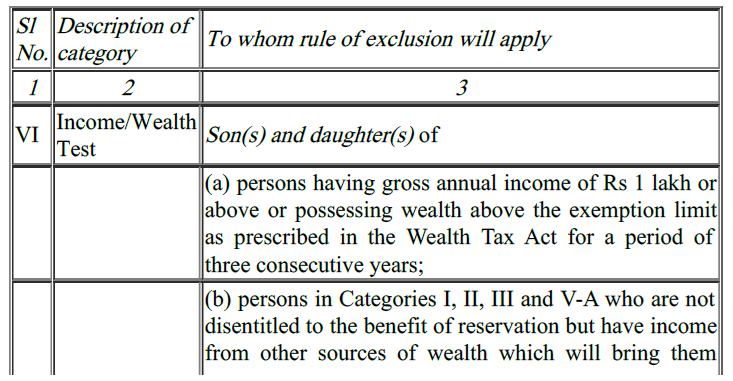
7. First and foremost, reference needs to be made to the Office Memorandum dated 8-9-1993 issued by the Government of India, Ministry of Personnel, Public Grievances and Pension (Department of Personnel and Training). It is not a matter of dispute between the rival parties, that the aforesaid office memorandum is applicable to the present controversy. Under the Office Memorandum dated 8-9-1993, the claim of the appellant for grant of a backward class certificate was determinable under Category IV thereof, since it is not a matter of dispute that the appellant is a qualified Chartered Accountant. However, in Column 3 to the Schedule relating to Category IV, it is mentioned that the criteria specified against Category VI would be applicable to those who fall under Category IV. In the above view of the matter, our interpretation on the eligibility of the appellant for being declared as belonging to the backward class, would be determinable on the basis of the description relatable to Category VI. Category VI and the depiction to whom the same would be applicable, are being extracted hereunder:
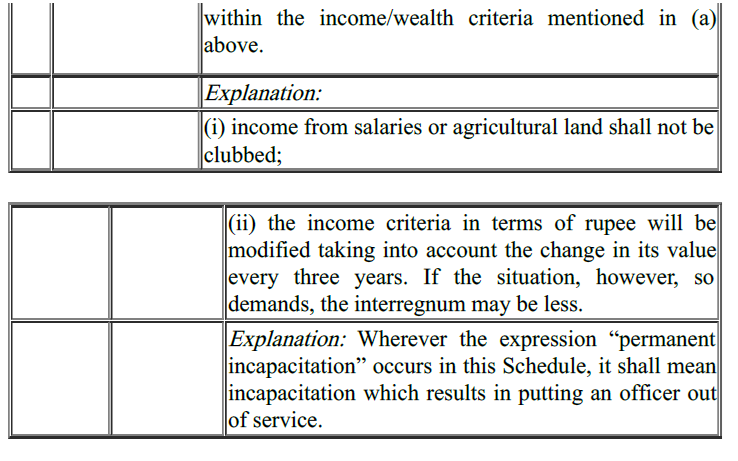
(emphasis supplied)
Having minutely examined Category VI, as also the description contained in the Schedule, to whom the same would apply, there is really no room for any doubt, that in clauses (a) and (b) thereof, it is the income/wealth of the parents of the individual concerned, which is of relevance. The description is clearly silent about the individual's own income. It is not possible for us to accept, that the individual's own income could have been taken into consideration. The above determination of ours, is with reference to Categories IV and VI. Therefore, even with reference to Category IV, which includes professionals, the income of the professional, has not been included. Thus viewed, we are satisfied, that on the plain reading of Category VI of the Office Memorandum dated 8-9-1993, that it was not the income of the individual concerned, but that of his parents, that would determine whether he would fall within the creamy layer or not."
19. The challenge to the candidature of respondent no.3 in this case is only based upon income of her husband. The same is not relevant unless the husband is a Class-I Officer. As discussed above, the husband of respondent no.3 is working as Civil Judge Class-I which is a Class-II post. Thus, the objection raised by petitioner is not acceptable.
20. Even though the objection with regard to income of her parents has not been raised, the respondent no.3 has clarified in return that her father was a Class-III officer and has retired as such in the year 2023. Her mother was also housewife. Thus, in either case, the respondent no.3 does not fall in any of the excluded category of creamy layer. She was thus entitled to and has rightly given the benefit of her status as an OBC candidate.
21. The petition thus fails and is dismissed.

 |
This Product is Licensed to , |