


(Prayer: This Writ Appeal is filed u/S 4 of the Karnataka High Court Act praying to set aside the order of the learned Single Judge passed in W.P. No.5824/2020 dated 20.09.2022.)
CAV Judgment
Anu Sivaraman, J.
1. This Writ Appeal is filed challenging the order dated 20.09.2022 passed by the learned Single Judge in Writ Petition No.5824/2020 (L-KSRTC), setting aside the award dated 11.04.2018 of the Principal District Judge, Tumkur ('Labour Court' for short) in I.D.No.4/2015.
2. We have heard Shri. M.C. Basavaraju, learned counsel appearing for the appellant and Smt. H.R. Renuka, learned standing counsel appearing for the respondent.
3. The appellant was employed as a driver in the Karnataka State Road Transport Corporation ('KSRTC' for short) on 07.06.1997. It was the case of the KSRTC in the writ petition that he had a history of unauthorized absences for which fines were imposed on him multiple times. He was once dismissed from service for unauthorized absence which was challenged in I.D.No.16/2011. The dismissal order was set aside and the appellant was directed to be reinstated in service with reduction of four increments with cumulative effect. Thereafter, he was again unauthorisedly absent from 18.01.2013. The Articles of Charge were issued to him on 07.10.2013. A disciplinary enquiry was conducted and the charge of unauthorized absence was found proved. A second show-cause notice was issued by the Disciplinary Authority and after complying with due procedure, an order of dismissal was issued on 10.07.2015. The order was challenged by the appellant herein in I.D.No.4/2015.
4. The Labour Court held that the enquiry was fair and proper but set aside the dismissal, directing the KSRTC to consider the appellant's application for voluntary retirement, which had allegedly been submitted during the enquiry proceedings.
5. Aggrieved by this direction, the KSRTC filed the writ petition. It was the contention of the KSRTC that once the Labour Court had held the domestic enquiry to be fair and proper and since the appellant had failed to show any valid medical or other justification for his unauthorised absence, the setting aside of the dismissal order solely on the ground that the appellant had submitted an application for voluntary retirement was highly improper. It was contended that there is no vesting right in any employee to have an application for voluntary retirement considered favorably, since repeated disciplinary proceedings had been initiated against the employee, his application for voluntary retirement could not have been considered at all. Therefore, it was asserted that the Labour Court's reasoning suffered from legal infirmities.
6. The learned Single Judge allowed the writ petition and observed that despite having been given a second chance through the Labour Court's earlier order in I.D.No.16/2011, which led to his reinstatement on 11.09.2012, the appellant again remained absent from 18.01.2013 to 07.10.2013. It was found that the appellant had a repeated history of unauthorized absence, and this was the second dismissal imposed on him. It was held that once the Labour Court had found the enquiry to be fair and proper and there was no evidence to justify the appellant's absence, the Labour Court could not have set aside the dismissal order. The appellant, aggrieved by the order of the learned Single Judge has filed the present appeal.
7. It is contended by the learned counsel appearing for the appellant that his absence with effect from 18.01.2013 was neither intentional nor deliberate. He was suffering from "R Lower Limb Buerger Disease and Low Back Ache", for which doctors advised continuous treatment, bed rest and to do light work. Despite submitting representations he was not assigned light duties. Due to his medical condition, he could not report to duty 18.01.2013, but he regularly sent leave applications with medical certificates to the Depot Manager. The Depot Manager ignored the requests and submitted a false report against him, though he had sufficient leave balance, the Authority failed to verify the leave register before dismissing him.
8. The Labour Court had properly considered these aspects and had directed the KSRTC to consider his voluntary retirement application. It is further submitted that all original leave letters and medical certificates were produced during the enquiry and he also applied for voluntary retirement on medical grounds. The KSRTC, instead of acting on his application, referred him to a Medical Board but after receiving the Medical Board Report, proceeded to dismiss him from service. The learned Single Judge failed to consider this crucial aspect.
9. It was further submitted that in similar cases of unauthorized absence, the KSRTC had taken a lenient view and imposed lesser punishments. Imposing the ultimate punishment of dismissal amounted to discrimination, unfair labour practice and victimization. Although the Labour Court could not mark many documents since they were photocopies, it nevertheless considered his voluntary retirement request and the nature of his medical disability, and partly allowed the dispute. The learned Single Judge however, did not record any findings on the medical evidence or the Medical Board Report nor address the voluntary retirement application. Instead, the learned Single Judge relied on the appellant's previous records and upheld the dismissal. The appellant emphasized that his dismissal rendered him unemployed, caused severe financial hardship and pushed his family into distress. Therefore, the impugned order of the learned Single Judge is unsustainable and liable to be set aside.
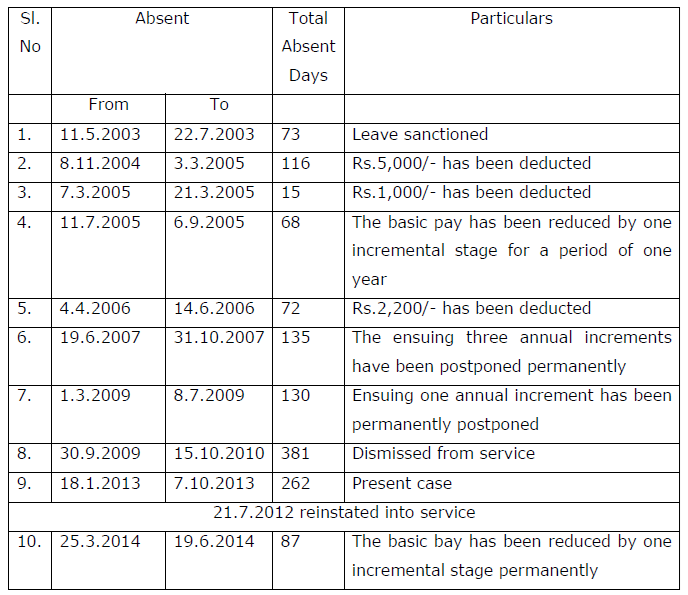
10. The learned standing counsel appearing for the respondent - KSRTC, on the other hand, submitted that the appellant was unauthorisedly absent on repeated occasions and the history of his unauthorised absence is placed before this Court as under:-

11. It is submitted that the learned Single Judge had clearly considered the contentions raised on either side and had also specifically taken note of the fact that there was no procedural irregularity or error in the conduct of the disciplinary proceedings which ended in the order of dismissal. It was found that the submission of an application for voluntary retirement cannot be a ground to remain unauthorisedly absent without submitting proper leave applications. It was also found that no request or representation referable to Section 47 of the Rights of Persons with Disabilities Act, 2016 had been submitted by the appellant. It is contended that it was in the above circumstances that the learned Single Judge had set aside the order of the Labour Court.
12. We have considered the contentions advanced. It is an admitted fact that the appellant was appointed as a driver in the KSRTC on 07.06.1997. The uncontroverted materials on record show that there were several instances of unauthorised absence from the year 2004 onwards for which fine was imposed on the appellant. In the year 2005, his basic pay was reduced by one incremental stage for one year on account of his unauthorised absence. Thereafter, punishment of withholding of increments was imposed on two occasions. In the year 2010, he was dismissed from service for continuous unauthorised absence for more than a year. The Labour Court had interfered with the punishment and had substituted the punishment with bar of four annual increments with cumulative effect. The appellant was reinstated in service on 11.09.2012. Thereafter also, he remained unauthorisedly absent from 18.01.2013 onwards. Even thereafter, it is submitted that there have been continued instances of unauthorised absence on the part of the appellant.
13. We notice that the main ground urged by the appellant before the Labour Court was that he had filed an application for voluntary retirement which was not considered by the KSRTC. Further, it was contended that it was on account of ill-health and medical conditions that the appellant could not be present for work and that he is entitled to the benefit of Section 47 of the Rights of Persons with Disabilities Act. However, the learned Single Judge had specifically considered these contentions. It was found that the appellant had been given repeated warnings and punishments but he continued his history of unauthorised absence. It was found that an earlier dismissal order was set aside by the Labour Court and the appellant was reinstated on 11.09.2012. However, soon thereafter he remained unauthorisedly absent from 18.01.2013 onwards.
14. We notice from the award of the Labour Court that the history of unauthorised absence was noticed by the Labour Court as well. The Labour Court had not relied on the documents sought to be produced in support of the contention that the appellant had medical reasons for remaining unauthorisedly absent. It was found that only a xerox copy of a Medical Certificate was produced which was not marked in evidence. It is on the short ground that an application under the 'Voluntary Retirement Scheme' had been submitted by the appellant that the Labour Court set aside the order of dismissal.
15. Having considered the contentions advanced, we notice that the submission of an application for voluntary retirement does not, as of right, entitle the applicant to be granted a voluntary retirement from service. The appellant could not substantiate his case that he had made proper leave applications with Medical Certificates before the appropriate authorities. If his absence was on account of medical reasons, there is no reason why he did not submit proper applications with Medical Certificates before the employer. Moreover, apart from blandly stating that he is entitled to the benefit of Section 47 of the Rights of Persons with Disabilities Act, nothing is placed on record to prove that any request had been made at the relevant time for assignment of light duties on account of any physical incapacity.
16. In the above factual situation, we are of the opinion that the learned Single Judge was perfectly justified in interfering with the order of the Labour Court. In a case where the employee has a continuous history of unauthorised absence which is specifically taken note of by the Labour Court, the Labour Court ought not to have ordered the reinstatement or the consideration of the Voluntary Retirement Scheme application.
17. In the above view of the matter, we are of the opinion that there are no grounds made out for interference with the order of the learned Single Judge. The appeal fails and the same is accordingly dismissed.
Pending interlocutory applications shall stand disposed of.

 |
This Product is Licensed to , |