


1. This petition, under Article 226 of the Constitution of India, has been filed seeking the following reliefs:-
"(i) That, impugned orders Annexure P-1 and P-2 may kindly be declared as illegal and the same may kindly be quashed. Respondents may further be directed not to recover any amount from the salary of petitioner.
(ii) Any other relief which this Hon'ble Court may deem fit and proper in the circumstances of the case may also be given to the petitioner along with costs."
2. Learned counsel for the petitioner submits that at the relevant point of time, petitioner was posted as a Line Helper in Area Stores of respondent No.1. A Store Manual has been prepared for the purpose of fixing the duties and responsibilities of the officers looking after the Stores and as per Store Manual, it is clear that the Storekeeper/Junior Engineer (Receipt), Storekeeper (Custody and Issue), stock verifier and Section Officer were responsible for the management of Stores and Line Helper has no role to play either in receipt of material or issuance of the same. Without considering the aforesaid, a show cause notice which was issued alleging that in physical verification of stocks, 6440 liters of transformer oil has been found short hence a recovery of Rs.4,40,000/- is contemplated against the petitioner and other employees. Thereafter, petitioner was not at all responsible for the alleged short stock of oil but without conducting any regular departmental enquiry in the matter, a show cause notice has been issued to the petitioner on 23.03.2010, alleging that 18600 liters transformer oil has been found less in stocks valued at Rs.11,84,262/- and thus a recovery of proportionate amount of Rs.51,515/- is contemplated against the petitioner from his salary. Petitioner has submitted reply dated 08.04.2010 and in reply, petitioner asked relevant documents relating to his responsibility and his role in alleged loss on the basis of which the proposed recovery has been ordered. Without considering the reply submitted by the petitioner and without supplying the documents, impugned order dated 11.06.2010 has been issued by the respondents. Thereafter, petitioner has preferred writ petition No.7122/2010 that has been decided by order dated 28.09.2011 (Annexure P/3) and respondents are directed to decide the appeal of petitioner. Thereafter, petitioner has preferred appeal under Rule 23 of M.P. Civil Services (Classification, Control and Appeal) Rules, 1966 (Annexure P/10).
3. It is further submitted by learned counsel for the petitioner that although various facts and grounds were raised in the appeal, the same were not considered by the respondent while passing the appellate order dated 31.01.2012 rejecting the appeal. At the time of imposing the punishment of recovery of Rs. 51,515/-, neither the Disciplinary Authority nor the Appellate Authority considered the facts and grounds mentioned in the reply/appeal. Consequently, both authorities have passed non-speaking and unreasoned orders. Learned counsel for the petitioner further submitted that as the respondents/Disciplinary Authority has not assigned reasons for rejecting the petitioner's reply is contrary to judgment reported in M/S Kranti Asso. Pvt. Ltd. & Anr vs Masood Ahmed Khan & Ors reported in (2010) 9 SCC 496. Learned counsel for the petitioner submitted that thereafter petitioner preferred an appeal and that appeal has also been rejected by impugned order dated 07-10-2011.
4. Per contra, learned counsel for the State submitted that there is no infirmity in the order of punishment since petitioner was found guilty of dereliction of duties and therefore after ascertaining the charges it was found that petitioner had failed to discharge the duties, therefore, aforementioned orders passed by the authority is absolutely proportionate and warrants no interference. It is further submitted that the appellate authority has also examined the entire record and on perusal of the material, the order of the competent authority was affirmed by the appellate authority. Hence after having proper adjudication of the matter by the appellate authority nothing remains to be interfered in the present matter and petition prima-facie being devoid of substance deserves to be dismissed.
5. Heard the learned counsel for the parties and perused the record.
6. Important part of the punishment order dated 11.06.2010 is quoted herein below:-
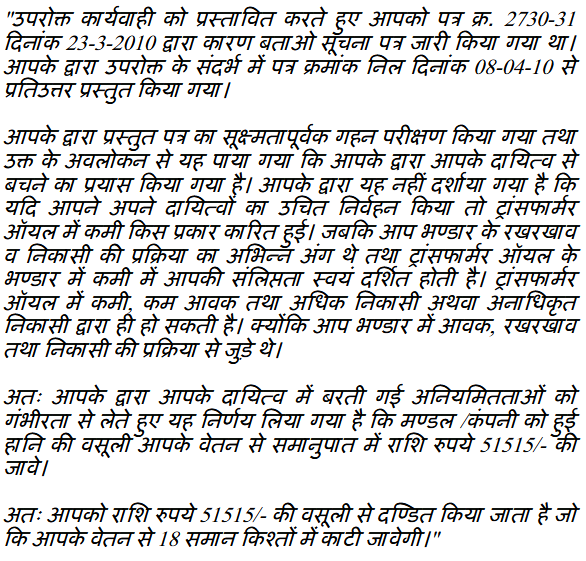
7. From perusal of the punishment order issued by the Disciplinary Authority dated 11.06.2010, it is clear that the Disciplinary Authority while passing an order imposing punishment upon the petitioner, is exercising quasi judicial power and even the quasi judicial order must be a speaking order. The Disciplinary Authority must apply its mind to the entire facts and circumstances and record valid and justifiable reason and all grounds in support of its conclusion.
8. On perusal of the appeal rejection order dated 31.01.2012, it does not appear to be a speaking one and important part of the appeal rejection order is quoted herein below:-
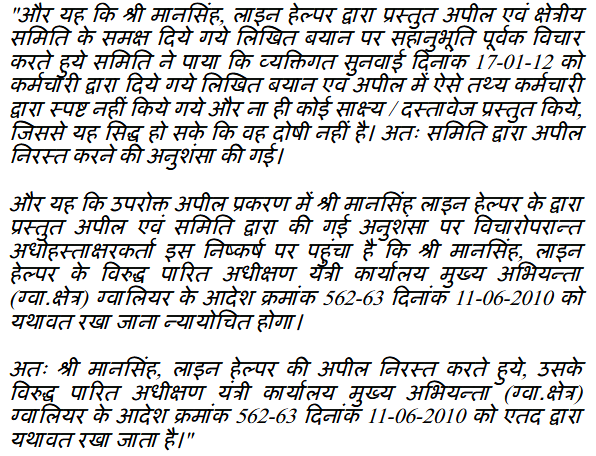
9. It is a settled position in law that when a discretion is vested in an authority to exercise a particular power, the same is required to be exercised with due diligence, and in reasonable and rational manner. The Hon'ble Supreme Court in catena of decisions has reiterated time and again the necessity and importance of giving reasons by the authority in support of its decision. It has been held that the face of an order passed by a quasi-judicial authority or even by an administrative authority affecting the rights of parties must speak. The affected party must know how his case or defence was considered before passing the prejudicial order.
10. The decision of the Hon'ble Supreme Court in the case of State of Punjab v/s. Bandip Singh and others reported in (2016) 1 SCC 724 is relevant to quote. In the said decision it had been held by the Hon'ble Supreme Court that every decision of an administrative or executive nature must be a composite and self-sustaining one, in that it should contain all the reasons which prevailed on the official taking the decision to arrive at his conclusion.
11. In the same judgment in paragraph 7, the Hon'ble Supreme Court clarifies that the Government does not have carte blanche to take any decision it chooses to; it cannot take a capricious, arbitrary or prejudiced decision. Its decision must be informed and impregnated with reasons. Paragraph 7 of the said decision is quoted as under:-
"7. The same principle was upheld more recently in Ram Kishun v. State of U.P. (2012) 11 SCC 511 : (2013) 1 SCC (Civ) 382. However, we must hasten to clarify that the Government does not have a carte blanche to take any decision it chooses to; it cannot take a capricious, arbitrary or prejudiced decision. Its decision must be informed and impregnated with reasons.
This has already been discussed threadbare in several decisions of this Court, including in Sterling Computers Ltd. v. M & N Publications Ltd (1993) 1 SCC 445, Tata Cellular v. Union of India (1994) 6 SCC 651, Air India Ltd. v. Cochin International Airport Ltd. (2000) 2 SCC 617, B.S.N. Joshi & Sons Ltd. v. Nair Coal Services Ltd. (2006) 11 SCC 548 and Jagdish Mandal v. State of Orissa (2007) 14 SCC 517".
12. Also the decision of the Hon'ble Supreme Court in the case of Kranti Associates Pvt. Ltd. and another v/s Masood Ahmed Khan and others cited in (2010) 9 SCC 496 highlights this point. The Hon'ble Supreme Court in paragraph 15 opined that the face of an order passed by a quasi judicial authority or even an administrative authority affecting the rights of parties, must speak. It must not be like the inscrutable face of a sphinx. In paragraph 47 the Honb'le Supreme Court summarized its discussion. The relevant sub- paragraphs of the said summary are quoted as under:-
"47. Summarising the above discussion, this Court holds:
(f) Reasons have virtually become as indispensable a component of a decisionmaking process as observing principles of natural justice by judicial, quasi-judicial and even by administrative bodies.
(h) The ongoing judicial trend in all countries committed to rule of law and constitutional governance is in favour of reasoned decisions based on relevant facts. This is virtually the lifeblood of judicial decision-making justifying the principle that reason is the soul of justice.
(i) Judicial or even quasi-judicial opinions these days can be as different as the judges and authorities who deliver them. All these decisions serve one common purpose which is to demonstrate by reason that the relevant factors have been objectively considered. This is important for sustaining the litigants' faith in the justice delivery system.
(n) Since the requirement to record reasons emanates from the broad doctrine of fairness in decision-making, the said requirement is now virtually a component of human rights and was considered part of Stasbourg Jurisprudence. See Ruiz torija v. Spain (1994) 19 EHRR 553, at 562 para 29 and Anya v. University of Oxford 2001 EWCA Civ 405 (CA), wherein the Court referred to Article 6 of the European Convention of Human Rights which requires,"adequate and intelligent reasons must be given for judicial decisions".
13. As disciplinary authority has issued a non-speaking and unreasoned order dated 11.06.2010, therefore, in absence of reason in the punishment order dated 11.06.2010 cannot be compensated by disclosure of reason in the appellate order, therefore, the argument of counsel for respondent is not sustainable that the appellate order is reasoned and speaking order. Even the appeal rejection order is non-speaking and unreasoned order, as the petitioner had preferred a detailed appeal running into 16 pages, raising eight specific grounds, none of which have been considered or dealt with by the Appellate Authority. The Hon'ble Supreme Court in the case Oryx Fisheries Pvt.Ltd vs Union Of India & Ors; (2010) 13 SCC 427 has held as under:-
"41. In M/s Kranti Associates (supra), this Court after considering various judgments formulated certain principles in para 51 of the judgment which are set out below
a. In India the judicial trend has always been to record reasons, even in administrative decisions, if such decisions affect anyone prejudicially.
b. A quasi-judicial authority must record reasons in support of its conclusions.
c. Insistence on recording of reasons is meant to serve the wider principle of justice that justice must not only be done it must also appear to be done as well.
d. Recording of reasons also operates as a valid restraint on any possible arbitrary exercise of judicial and quasi-judicial or even administrative power.
e. Reasons reassure that discretion has been exercised by the decision maker on relevant grounds and by disregarding extraneous considerations.
f. Reasons have virtually become as indispensable a component of a decision making process as observing principles of natural justice by judicial, quasi-judicial and even by administrative bodies.
g. Reasons facilitate the process of judicial review by superior Courts.
h. The ongoing judicial trend in all countries committed to rule of law and constitutional governance is in favour of reasoned decisions based on relevant facts. This is virtually the life blood of judicial decision making justifying the principle that reason is the soul of justice.
i. Judicial or even quasi-judicial opinions these days can be as different as the judges and authorities who deliver them. All these decisions serve one common purpose which is to demonstrate by reason that the relevant factors have been objectively considered. This is important for sustaining the litigants' faith in the justice delivery system.
j. Insistence on reason is a requirement for both judicial accountability and transparency.
k. If a Judge or a quasi-judicial authority is not candid enough about his/her decision making process then it is impossible to know whether the person deciding is faithful to the doctrine of precedent or to principles of incrementalism.
l. Reasons in support of decisions must be cogent, clear and succinct. A pretence of reasons or `rubber-stamp reasons' is not to be equated with a valid decision making process.
m. It cannot be doubted that transparency is the sine qua non of restraint on abuse of judicial powers. Transparency in decision making not only makes the judges and decision makers less prone to errors but also makes them subject to broader scrutiny. (See David Shapiro in Defence of Judicial Candor (1987) 100 Harward Law Review 731-737).
n. Since the requirement to record reasons emanates from the broad doctrine of fairness in decision making, the said requirement is now virtually a component of human rights and was considered part of Strasbourg Jurisprudence. See (1994) 19 EHRR 553, at 562 para 29 and Anya vs. University of Oxford, 2001 EWCA Civ 405, wherein the Court referred to Article 6 of European Convention of Human Rights which requires, "adequate and intelligent reasons must be given for judicial decisions".
o. In all common law jurisdictions judgments play a vital role in setting up precedents for the future. Therefore, for development of law, requirement of giving reasons for the decision is of the essence and is virtually a part of "Due Process".
42. In the instant case the appellate order contains reasons. However, absence of reasons in the original order cannot be compensated by disclosure of reason in the appellate order.
43. In Institute of Chartered Accountants of India v. L.K. Ratna and others,(1986) 4 SCC 537, it has been held:
"......after the blow suffered by the initial decision, it is difficult to contemplate complete restitution through an appellate decision. Such a case is unlike an action for money or recovery of property, where the execution of the trial decree may be stayed pending appeal, or a successful appeal may result in refund of the money or restitution of the property, with appropriate compensation by way of interest or mesne profits for the period of deprivation. And, therefore, it seems to us, there is manifest need to ensure that there is no breach of fundamental procedure in the original proceeding, and to avoid treating an appeal as an overall substitute for the original proceeding."
44. For the reasons aforesaid, this Court quashes the show cause notice as also the order dated 19.03.2008 passed by the third respondent. In view of that, the appellate order has no legs to stand and accordingly is quashed."
14. The Hon'ble Apex Court, in the case of O.K. Bhardwaj vs. Union of India & Ors. (2001) 9 SCC 180, has held as under:-
"3. While we agree with the first proposition of the High Court having regard to the rule position which expressly says that "withholding increments of pay with or without cumulative effect" is a minor penalty, we find it not possible to agree with the second proposition. Even in the case of a minor penalty an opportunity has to be given to the delinquent employee to have his say or to file his explanation with respect to the charges against him. Moreover, if the charges are factual and if they are denied by the delinquent employee, an enquiry should also be called for. This is the minimum requirement of the principle of natural justice and the said requirement cannot be dispensed with."
15. Even in the case of a minor penalty an opportunity has to be given to the delinquent employee to have his say or to file his explanation with respect to the charges against him. Moreover, if the charges are factual and if they are denied by the delinquent employee, an enquiry should also be called for. This is the minimum requirement of the principle of natural justice and the said requirement cannot be dispensed with. As disciplinary authority has issued a non-speaking and unreasoned order, therefore, in absence of reason in the punishment order cannot be compensated by disclosure of reason in the appellate order, and charges are factual and they are denied by the delinquent/petitioner, an enquiry should also be called for and as there is no enquiry regular departmental enquiry has been conducted before awarding the minor punishment.
16. In view of the above discussions and the facts and circumstances of the case, I am left with no choice but to set aside impugned punishment order dated 11.06.2010 (Annexure P/2) and appeal rejection order dated 31.01.2012 (Annexure P/1).
17. Consequently, respondents are directed to to give all consequential benefits to the petitioner within a period of three months from the date of receipt of certified copy of this order and as petitioner has already retired, therefore, no liberty is granted to the respondents to take action against the respondents.
18. With aforesaid observations and directions, preset Writ Petition is hereby disposed of.
19. All pending interlocutory applications, if any, are also disposed of.

 |
This Product is Licensed to , |