


(Prayer: This Writ Appeal is filed under Section 4 of the Karnataka High Court Act praying to set aside the order dated 13/10/2025 in W.P. No.27139/2024 passed by Learned Single Judge of this Hon'ble Court and grant the reliefs as prayed for in the W.P. No.27139/2024, on the file of Learned Single Judge.)
CAV Judgment:
Vibhu Bakhru, CJ.
1. The appellant, Bandhrehalli Milk Producers Co-operative Society Limited, has filed the present appeal impugning a common order dated 13.10.2025 passed by a learned Single Judge of this Court in W.P.No.27139/2024 (CS-EL-M) and connected matters.
2. The appellant is a co-operative society registered under the provisions of the Karnataka Co-operative Societies Act, 1959 [KOS Act]. The present appeal is confined to the impugned order insofar as it relates to the writ petition, W.P.No.27139/2024.
3. The appellant had filed the said petition, inter alia, impugning the list of ineligible voters inasmuch as it placed the appellant in the said category for the elections of the office bearers of respondent No. 5, the Tumkuru District Milk Producers Co-operative Societies Union Limited [the Union], scheduled to be held on 10.11.2024. The Union is a Federal Society constituted by the members who are primary milk producers co-operative societies.
4. The appellant is a member of the Union. The appellant claims to have been supplying milk to the Union since its establishment. The Union had issued show cause notices dated 21.12.2023, 29.01.2024 and 01.07.2024 calling upon the appellant to show cause why its name should not be included in the list of ineligible voters for violation of bye-law Nos.15.2 and 15.3 on the ground that it had failed to utilise the services/facilities for two co- operative years out of the five prior co-operative years.
5. The appellant claimed that it had responded to the said show cause notices, affirming that it had supplied milk more than 150 Kgs. for 270 days during the last five co-operative years. However, one of the sitting directors of the Union had colluded with the staff at the chilling centre to adulterate the Solids-Not-Fat [SNF] test results of the milk supplied, resulting in the value of certain quantities of milk supplied by the appellant, being below 8.5%. Notwithstanding the reply, the Union had included the name of the appellant in the list of ineligible voters on the ground that it had violated Bye-law No.15.2 for not supplying the requisite quantity of milk during the co-operative years 2020-2021 and 2022-2023.
6. The appellant contested the said allegation and claimed that it had supplied the minimum quantity of milk for each co-operative year, and none of the milk supplied had been rejected or returned. Additionally, it claimed that there was skin tag disease and more than 90 cattle had expired from August 2022 to March 2023, resulting drop in the milk production.
7. The appellant had challenged the decision to declare it ineligible to vote in the election, inter alia, on the following grounds:
i) that the decision was contrary to bye-law No.15.2 of the Union;
ii) that it is contrary to clause (a-v) of Sub-section 2 of Section 20 of the KOS Act;
iii) that the respondents had applied B;ye-law No.15.2 of the Bye-laws of the Union without considering Bye-law No.15.3 and clause (a-v) of Sub-section 2 of Section 20 of the KOS Act; and
iv) The requirement of supplying milk with the minimum SNF value of 8.5% was merely a condition put in a circular and not a precondition for recognising the supply of milk for the purposes of determining the eligibility to vote under Bye-Laws Nos.15.2 and 15.3 of the Bye-Laws of the Union.
8. The learned Single Judge had considered the bye-laws of the Union and further noted that the Apex Milk Union had prescribed the quality of milk to be supplied by the primary societies. It is not disputed that the minimum SNF value of the milk supplies was required to be about 8.5% or above.
9. The learned Single Judge also noted that the quantities of milk supplied by the appellant have been brought on record and found that the appellant was ineligible to cast its vote in the election, and consequently, the decision to include the appellant's name in the list of ineligible voters was not interfered with.
10. The learned Single Judge did not find the allegation of collusion between the officials of the Union to adulterate the milk relevant, as there was no allegation that the milk supplied by the appellant was adulterated.
11. The learned Single Judge also held that the scope of interference under Article 226 of the Constitution of India is limited. It is only in cases where the prescribed procedure for treating a member as ineligible to participate in the elections is not followed that the courts may consider entertaining a writ petition. However, as far as other issues are concerned, the parties were relegated to the remedies under Section 70(2)(c) of the KOS Act.
12. The learned Single Judge found that, in the present case appropriate notice/s were issued under Rule 13-D(2-A) of the Karnataka Co-operative Societies Rules, 1960 and the said Rule was complied with before the name of the appellant was included in the list of ineligible voters. Accordingly, the appellant's writ petition was dismissed.
13. Prof. Ravi Varma Kumar, the learned Senior Counsel appearing for the appellant, had advanced his submissions essentially on three grounds. First, he submitted that Bye-law No. 15.2 had been amended on 07.05.2024 and thus would have no retrospective application. Second, he submitted that the data of milk supplied as relied upon by the Union, clearly establishes that the appellant had supplied the requisite quantity of milk; that is, an average of 150 Kgs. per day for at least 270 days in every co- operative year for the past five years. Thus, the appellant could not be held ineligible to vote in the elections. Third, he submitted that an SNF of less than 8.5% would not render the supply of milk non- est. He also claimed that the milk supplied by the appellant had not been rejected and therefore, no part of the supplied quantity could be excluded for the purpose of determining the quantity of milk supplied during the year.
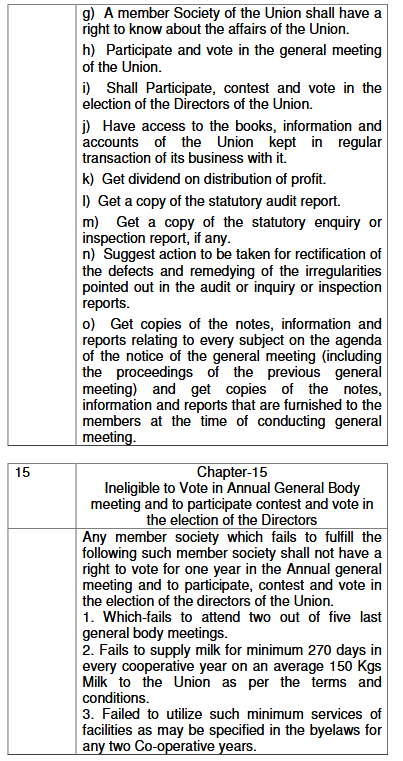
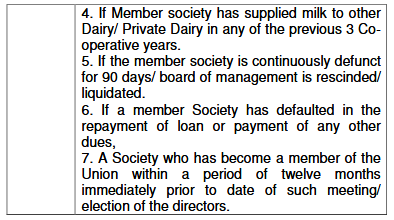
14. At the outset, it may be necessary to extract the relevant bye-laws. Bye-law 13 and 15 of the byelaws of the Union, as set out in the impugned order are reproduced below:
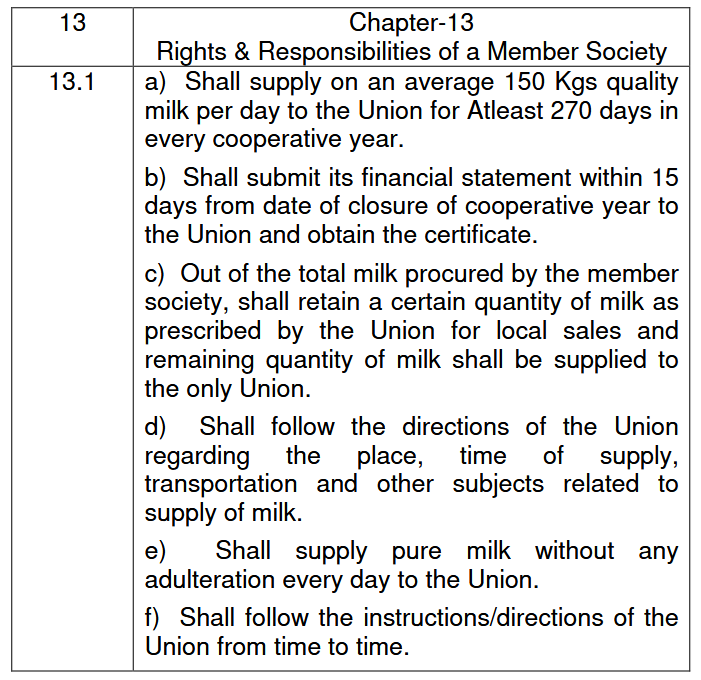
15. In terms of clause 13.1(a) of the bye-laws, the appellant was obliged to supply on an average 150 Kgs. of quality milk per day to the Union for at least 270 days in every co-operative year.
16. The expression "quality milk" is of some significance. There is no dispute that the milk supplied by the appellant was required to conform to the SNF value of 8.5% or above. Although the learned counsel for the appellant also mentioned that the quality of milk would also take into account the fat value of the milk, there is no unequivocal statement that the milk supplied was not required to conform to the SNF of 8.5% and above. Thus, the supply of milk with SNF of less than 8.5% cannot be considered as "quality milk", which the appellant is obliged to supply in terms of byelaw 13.1(a) of the byelaws of the Union.
17. Clause 15.2 of the bye-laws provides that a member who fails to fulfil the criteria specified would be ineligible to vote for one year in the Annual General Meeting and to participate, contest and vote in the election of Directors of the Union.
18. Bye-law No.15.2 mentions that the society that fails to supply milk for a minimum of 270 days in every co-operative year, on an average of 150 kg of milk to the Union as per the 'terms and conditions', would incur the disqualification. The expression "terms and conditions", prima facie, includes the requirement to supply "quality milk".
19. In view of the above, we are unable to accept the contention that the decision of the Union to exclude supplies, which did not conform to the requisite standards, from the quantity supplied for the purposes of determining the conditions as specified under Bye- law No.15.2 of the bye-laws was arbitrary.
20. The data of milk supplied by the appellant as set out in the reasons for holding the appellant ineligible for participating in the elections in question, is set out below:

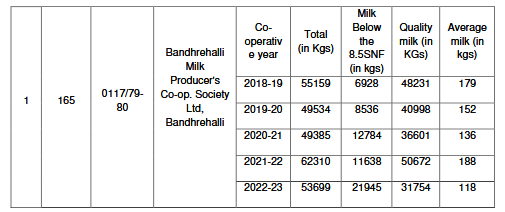
21. The appellant contested the said authenticity of the said data. It produced the data of the quantities of the milk supplied, as Annexure-C to the memorandum of the appeal and also raised the questions in the manner in which the Union had calculated the quantities of the milk supplied by the appellant.
22. The learned Single Judge had found that the quantity of milk supplied by the appellant had been reduced to exclude the commensurate quantity of milk that was below the specified SNF value.
23. We find no grounds to interfere with the said view. Once it is accepted that the milk of SNF below 8.5% is to be excluded, the only question that survives is the method of determining the same. The method of reducing the quantity in proportion to the SNF value, cannot be stated to be arbitrary.
24. We may note that there is no dispute that the method adopted by the Union has been uniformly applied. In this view, we are unable to accept that any interference with the manner in which the quantity of milk is to be determined warrants any interference by this Court in these proceedings.
25. It is not necessary to decide the question whether Bye-law 15.2 is ultra vires Section 20(2)(a-v) of the KOS Act, in this case. This is because the decision to hold the appellant as ineligible to participate in the election is based on the express wordings of clause (a-v) of Sub-section (2) of Section 20 of the KOS Act. However, we clarify that the said contention shall remain open to examination in an appropriate case where disqualification is imposed, other than in a manner consistent with clause (a-v) of Sub-section 2 of Section 20 of the KOS Act.
26. The learned Senior Counsel has also advanced submissions on the interpretation of clause (a-v) of Sub-section (2) of Section 20 of the KOS Act. The said issue is covered by a decision of this Court in W.A.No.1811/2025 and connected matters, delivered today.
27. For the reasons stated above, as well as in the order passed in WA 1811/2025, the present appeal is dismissed.

 |
This Product is Licensed to , |