


Oral Judgment
Ilesh J. Vora, J.
1. This conviction appeal is directed against the judgment and order of conviction dated 25.01.2017, passed by the Additional Sessions Judge, at Jamnagar, in connection with Sessions Case No.13 of 2014, by which, the sole accused Khorban @ Kurbal @ Dinesh @ Sardar Lalubhai Nayak was convicted under Section 302 of Indian Penal Code and sentenced to suffer life imprisonment and fine amount of Rs.1000/- and in default in payment of fine, to suffer simple imprisonment of 30 days.
2. The case of the prosecution, leading to conviction of the appellant accused is as follows:
2.1 On 25.09.2013, FIR came to be registered with Kalavad Police Station on the statement made by Manjaliben - wife of Vestabhai for the murder of her daughter Kinjaliben. It was stated in the complaint that, the marriage of the appellant-accused and her daughter was solemnized before 20 years of the incident and after the marriage, the entire family used to work as farm labourers in the different districts of State of Gujarat. It was further stated that, due to illness of the appellant-accused, the deceased wife had tried her level best by administering necessary medicines, however, the appellant-accused was having suspicion that, due to attempt of his wife-deceased, his health is further deteriorated. It was further stated by the complainant that, on the day of incident, the entire family including the appellant and deceased came to Village: Pithadiya at Kalavad for doing farming activities and their stay was at the farm of one Prafulbhai Vashrambhai. The appellant-accused took the deceased wife in the field under the pretext to cutting woods and taking care of cotton crops and while they were in the field, the appellant-accused inflicted axe blows on the head of the deceased and killed her. It was stated in the FIR that, after hearing the screaming, the family members came to rescue, but, before they could reach, the deceased was done to death. The weapon axe was taken family members from the appellant. The deceased was taken to nearby hospital and Ambulance where on arrival, she was declared dead.
2.2 On the basis of aforesaid FIR, the offence being C.R. No.I-88 of 2013 for the offence punishable under Section 302 came to be registered against the appellant. The I.O. (PW.18) was entrusted with the investigation and during the investigation, he sent the dead body of the deceased for post-mortem, recorded the statements of material witnesses, drew the panchnama of scene of offence, seized and recovered the weapon axe, arrested the accused-appellant, sent the seized articles to the FSL and on receiving the report of Forensic Science Analysis, the chargesheet came to be filed before the Jurisdictional Magistrate and the same was committed to the court of sessions for the trial.
3. The Trial Court framed the charges which the appellant accused denied the charges and claimed to be tried.
4. The prosecution, in order to examine the case against the accused, examined as many as 20 witnesses and exhibited 28 documents, as per the below mentioned tabular:
Oral evidence – 20
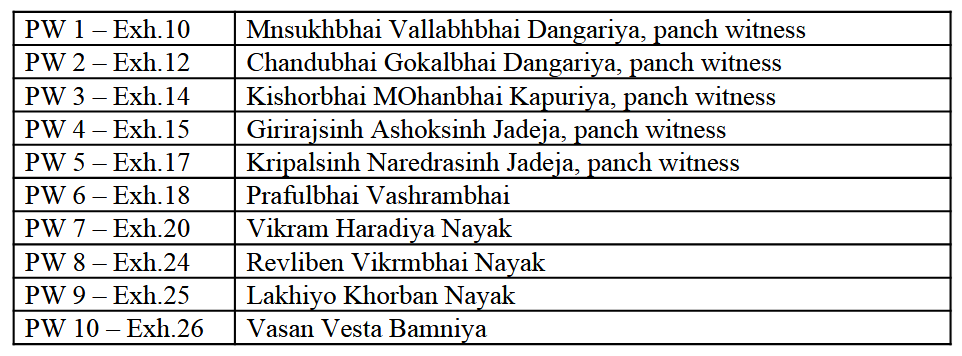
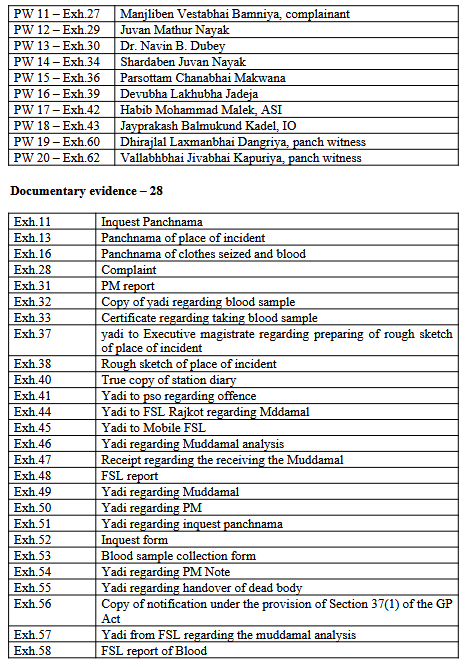

5. After closure of the prosecution evidence, the appellant accused was questioned under Section 313 Cr.P.C., to which, he stated that he is innocent and is falsely implicated in the charge of murder.
6. Though opportunity was extended, no evidence was tendered from the side of the appellant accused.
Trial Court's finding:
7. The learned Trial Court, after considering the oral and documentary evidence, as well as the submissions made on behalf of the parties, found the appellant guilty under Section 302 of the Indian Penal Code and sentenced his to undergo life imprisonment. The learned Trial Court while recording the conviction mainly relied upon the evidence of hostile witnesses and police officers.
8. Being aggrieved by, and dissatisfied with the judgment of conviction and sentence, the appellant has come up with present appeal.
9. Evidence adduced by the prosecution:
We would like to have a cursory look at the evidence adduced by the prosecution through its witnesses:
9.1 Dr. Navin Bardriprasad Dube (PW.13): This witness being a medical officer, associated with the Kalavad CHC, Jamnagar, had conducted post-mortem on the body of the deceased and prepared a post-mortem report (Exh.31). During the post-mortem, the following external and internal injuries were noticed by the P.M. Doctor:
External Injuries:
* A clean cut wound on overhead left temporal occipital 6 c.m. long.
* A clean cut wound on overhead temporal 3 c.m.
* Fracture on left hand.
* Fracture on Atlanto Occipital joint of neck.
* A cut injury on right ear.
Internal injuries as per Para-19 of the Post Mortem Note are as under:
* Fracture on left hand.
* Fracture of Albuto Occipital joint.
As per Post Mortem Note (Ex.31), all injuries were ante-mortem and in Para-23 of the Post Mortem Note, PW-13- Dr.Dubay opined as under about the cause of death;
"Cause of death due to Neuroganic sock due Assaulter head injury and fracture of Atlanto Occipital joint."
9.2 Prafulbhai Vashrambhai (PW.6): This witness had employed the appellant-accused and his family for farming purpose and being a farm owner, the prosecution has tried to establish the necessary facts of the incident. However, the fact remains that, at relevant time, he was not present in the farm where the incident occurred. The only fact proved is that, the deceased and the appellant-accused were employed by him to undertake agricultural process in the farm and the said facts are undisputed.
9.3 Vikram Haradiya (Nayak) (PW.7): This witness being a relative of the appellant and deceased, was examined to prove that, after the incident of murder, he was called upon at the place of occurrence where he came to know that, the deceased was killed by the appellant-accused. Admittedly, he had not witnessed the incident and on the aspect of involvement of the accused, even on the hearsay evidence, he did not have supported to the case of prosecution.
9.4 Revliben Vikrambhai Nayak (PW.8): This witness is the hearsay witness and at relevant time, she along with her husband, were working at the different farm and on the aspect of who had killed the deceased and what was the motive for killing, the witness has not stated in the chief-examination, nor admitted the case of the prosecution in the cross-examination after declaring her as a hostile witness by the prosecution.
9.5 Lakhiyo Khorban Nayak (PW.9): This witness is the son of deceased and as per his version, he had seen the dead body of the deceased allegedly lying in the farm where he was also working. In the chief-examination, he has not supported to the case of prosecution and denied that, his father has killed his mother. The witness has been declared as hostile witness. In the cross- examination, the witness has not supported to the case of prosecution and has denied the contents of his police statement recorded under Section 161 of the Cr.P.C.
9.6 Vasan Vestabhai Bamaniya (PW.10): This witness is the brother in law of the accused and according to prosecution case, he had witnessed the incident. In the chief-examination, the witness has denied the factum of incident and involvement of the accused, as a result, he has been declared hostile and during cross-examination as a hostile witness, he has not supported to the case of the prosecution.
9.7 Manjaliben Vestabhai Bamaniya (PW.11): This witness is the mother-in-law of the appellant and mother of the deceased. After the incident, she had lodged an FIR with Kalavad Police Station, alleging that, the appellant had killed her daughter, by using weapon axe and when the alleged incident was being occurred in the farm of PW-6 Praful Vasrambhai. However, in the chief- examination, the witness complainant did not have supported to the case of the prosecution, nor admitted the contents of the complaint Exh. 28. The only thing she admits is, the presence of the accused in the field but so far as causing injury to the deceased is concerned, the witness has denied that, her daughter was killed by the appellant herein. Even after declaring her hostile, she has not supported to the case of the prosecution.
9.8 Juvan Mathurbhai Nayak (PW.12): This witness is the son-in- law of the appellant. The witness has denied the motive behind killing of the deceased and has denied that the appellant being a father-in-law, has killed the deceased. The witness has been declared hostile and in cross-examination, he has not supported on the aspect of involvement of the appellant as well as his presence at the place.
9.9 Shardaben Juvansing Nayak (PW.14): This witness is the daughter of the deceased as well as appellant herein. The witness has stated in her chief-examination that, after hearing the screaming of witness Varsang, she went to the farm of Prafulbhai, where she had saw the dead body of the deceased lying in the cotton field and saw her father standing at some distance. The witness has denied the involvement of the appellant in the crime and she plead ignorance about the incident. The witness has been declared hostile and during the cross-examination, she has not admitted the factum of incident as well as the contents of her police statement.
9.10 Jayprakash Balmukund Kadel (PW.18): This witness being a Police Inspector, posted with Kalavad Police Station, Jamnagar, was entrusted with the investigation of the case. The witness in his chief-examination has stated that after registration of the offence, he was entrusted with the investigation of the case and during the investigation, he visited the place of incident and in the presence of mobile FSL, drew the panchnama of scene of occurrence, sent the dead body of postmortem, recorded the statement of the witnesses, arrested the accused, seized and recovered the axe and after receiving the necessary reports from the FSL, the chargesheet against the accused for the offence of murder came to be filed. In the cross-examination, the witness has denied that he has arrested the accused without any material and filed a false chagesheet.
Submissions:
10. Mr. Pratik Barot, learned counsel appearing for and on behalf of the appellant-accused while assailing the impugned judgment and order of sentence, made the following submissions:
(i) That the learned trial court grossly erred while convicting the accused, without appreciating the evidence in the right prospective.
(ii) That there is no direct evidence pointing towards the guilt of the accused. All the material witnesses had not supported the case of the prosecution. Despite of this, the trial Court placing reliance of the evidence of hostile witnesses namely PW-11 Manjaliben and PW-14 Shardaben, held guilty the accused. These two witnesses, on the aspect of causing injury to the deceased by the appellant, have not supported to the case of the prosecution. The only admission on their part, is the presence of the accused. However, merely presence of the accused, without there being any further evidence, proving his active role in the alleged incident, the conviction based on solely on such testimonies is not sustainable in eye of law.
(iii) That the trial Court based on the FIR and statement of witnesses recorded during the course of investigation, held guilty the appellant. It is settled position of law that, it is the statement made on oath in the court, which has to be foundation of conviction. The conviction of an accused cannot be based of statement of witnesses recorded under Section 161 Cr.P.C., or even under Section 154 Cr.P.C., especially, when the witnesses resile from their statements while appearing in the court and make a completely different statement in the court. In support of said contention, heavy reliance has been placed on the case of Renuka Prasad Vs. State (2025 SCC OnLine 1074).
11. In such circumstances as referred above, Mr. Barot, learned counsel has submitted that, the burden of proving the case beyond reasonable doubt by adducing cogent and reliable evidence has not been discharged by the prosecution and the judgment of conviction and order of sentence is not sustainable in eye of law and he further prayed that, there being merits in this appeal and same may be allowed and the appellant-accused may be acquitted of charges of murder.
12. Mr. Ronak Raval, learned Additional Public Prosecutor vehemently opposed the appeal and contended that, the accused and the deceased were found alone in the farm where the incident occurred and presence of the accused was also established when the incident occurred and therefore, the evidence of hostile witness on this aspect has been rightly believed by the trial court and in absence of any explanation on the part of the accused that in what manner and in what circumstances, deceased had died, the reasonable inference can be drawn regarding guilt of the accused. The circumstances constituting a complete chain without a gap, pointing towards the guilt of the accused and the accused none else, has committed the murder. In such circumstances, Mr. Raval, prays that, there being no merits in the appeal and the same may be dismissed.
13. We have perused the case records and proceedings and considered the submissions made at the bar and the findings of conviction recorded by the trial court.
14. In the present case, post-mortem report (Exh.31) being proved by Dr. Navin Dube (PW.13) which established the homicidal death and to this extent, prosecution version is unchallenged. There is no dispute about the date of occurrence and place where the dead body of the deceased found. The appellant-accused is the husband of the deceased. On the day of incident, the husband wife and other family members came at the Village: Kalavad-Pithadiya for farming work in the farm of Praful Vashrambhai (PW.6).
15. In the facts and circumstances of the present case, the issue falls for our consideration as to whether the appellant-accused is the author of crime or not. The eye witnesses who are near relatives and family members of the appellant-accused have not supported to the case of prosecution. Even, after declaring them hostile, they have not admitted the facts of the police statement recorded under Section 161 of the Cr.P.C., nor, the involvement of the accused in the alleged crime. There was no dispute that, the appellant-accused was not present when the incident occurred. On careful examination of the evidence and findings of the trial court, it appears that, the trial court, on relying on the testimony of the hostile witnesses, held that, the accused was in the field and standing nearby the deceased. The trial court in the judgment, has referred the settled law on the aspect of evidence of hostile witnesses. The Supreme Court in its various judgments, time and again, held and observed that, "credible evidence even of a hostile witness can form the basis for conviction in a criminal trial and evidence of such witness cannot be treated as effaced or washed off the record altogether, but, the same can be accepted to the extent their version is found to be dependable on a careful scrutiny thereof. It is for the Judge of fact to consider in case whether as a result of such cross-examination and contradiction, the witness thoroughly discredited or can still be believed with regard to a part of its testimony. If the Judge finds that, in the process, the credit of witness has not been completely shaken, he may after reading and considering the evidence of a witness as a whole with due caution and care accept in the light of other evidence on record, that part of testimony which he finds to be creditworthy and act upon it. (Syad Akbar vs. State of Karnataka AIR 1979 SC 1848).
16. In light of the law propounded by the Supreme Court, the only facts established from the evidence of hostile witnesses is the presence of the accused at the field. The incident allegedly occurred in the open field. In the field, the other persons were also there. In such circumstances, when the presence of the accused is not in dispute, then, the evidence of hostile witnesses on this aspect does not throw light on the issue about his involvement in the crime. The learned trial court has observed that, the accused-appellant has not offered any explanation that how and in what manner the deceased received the injuries. In our opinion, the invocation of Section 106 of Evidence Act for drawing adverse inference against the accused is against the settled principle of law. The Supreme Court has time and again on the applicability of Section 106, has observed and held that, " Section 106 is designed to meet certain exceptional cases in which it would be impossible for the prosecution to establish certain facts which are particularly within the knowledge of the accused. Section 106 would apply to cases where the prosecution could be said to have succeeded in proving facts from which a reasonable inference can be drawn regarding guilt of the accused and the section is not intended to relieve the prosecution of its burden to prove the charge beyond reasonable doubt against the accused and is not in anyway modified by provisions contained in Section 106. The section 106 cannot be used to support conviction, unless the prosecution has discharged its burden."(Nagendra Sah Vs. State of Bihar (2021) 10 SCC 725).
17. In the aforesaid discussions, in our opinion, when the witnesses have not deposed against the appellant and merely presence of the accused in the open field could not be a ground to infer the guilt of the accused as the prosecution failed to prove the charge of killing his wife by acceptable and cogent evidence. Thus, therefore, the evidence of hostile witnesses does not in any manner, prove the involvement of the accused in the crime and therefore, the question does not arise to draw an adverse inference with the aid of Section 106 of the Evidence Act.
18. We have also examined the findings of the trial court. The oral version of the I.O. (PW.18) is being considered while recording the findings of conviction. It is observed by the trial court that, the prosecution story as disclosed in the statement of the witnesses recorded under Section 161 being narrated by the I.O. and there is no motive for the I.O. to falsely implicate the accused and considering the contents of the statement as stated by the I.O., the trial court held that, the accused was the author of the crime. In our opinion, the statements under Section 161 and 162 Cr.P.C. are not admissible in evidence except for the limited purpose as provided in Section 157 of the Evidence Act and same may be used for contradicting the witness in the manner provided under Section 145 of the Evidence Act and the courts cannot use such statements as a corroboration of the statement made in the court. (Kali Ram vs. State of H.P. (1973) 2 SCC 808) and R. Shaji vs. State of Kerala ((2013) 14 SCC 266).
"In Rajendra Singh Vs. State of U.P. ((2007) 7 SCC 378), it was held that, a statement under Section 161 is not substantial piece of evidence. In the case before the Supreme Court, the Allahabad High Court relied upon the statement of six witnesses recorded by the I.O. under Section 161 Cr.P.C. to enter a finding that, the respondent could not have been present at the scene of crime as he was present in the meeting of Nagar Nigam at Allahabad. It was unequivocally held that, a statement under Section 161 is not substantial piece of evidence and it can be used only for limited purpose of contradicting the maker thereof in the manner laid down in the proviso of Section 162 Cr.P.C. Recently, the Supreme Court in the decision of Renuka Prasad vs. State represented by Assistant Superintendent of Police ((2025) 7 S.C.R. 160), on the evidentiary value of police statement recorded under Sections 161 and 162 Cr.P.C., in para-26 of the judgment, clearly laid down thus:
"26. The statements made by the IOs regarding the motive, conspiracy and preparation comes out as the prosecution story, as discernible from the Section 161 statements of various witnesses who were questioned by the police during investigation; which statements are wholly inadmissible under Section 162 of the Cr.P.C. Merely because the IOs spoke of such statements having been made by the witnesses during investigation, does not give them any credibility, enabling acceptance, unless the witnesses themselves spoke of such motive or acts of commission or omission or instances from which conspiracy could be inferred as also the preparation, established beyond reasonable doubt. We are unable to find either the motive, the conspiracy or the preparation or even the crime itself to have been established in Court, at the trial through the witnesses examined before Court. The witnesses had turned hostile, for reasons best known to themselves. The only inference possible, on the witnesses turning hostile is that either they have been persuaded for reasons unknown or coerced into resiling from the statements made under Section 161 or that they had not made such statements before police officers. Merely because the story came out of the mouth of the IO, it cannot be believed and a legal sanctity given to it, higher than that provided to Section 161 statements under Section 162 of the Cr.P.C."
19. Reverting back to the facts of the present case, the trial court mainly relied on the contents of the police statements, spoken by the I.O. in his deposition. The trial court has adopted a wrong path while considering the deposition of the I.O., more particularly to prove the factum of incident as he was not witness of the incident. The eye witnesses have resile from their police statements and did not support to the case of prosecution. Thus, therefore, the findings of conviction on the basis of inadmissible evidence are not sustainable in law as conviction can never be based on FIR or statements of witnesses recorded during the course of investigation and the Investigating Officer cannot indirectly prove what the witnesses have failed to prove.
20. Looking at the overall facts and circumstances of the present case and the discussions made hereinabove, we are of the view that, the prosecution has failed to prove its case with sufficient oral and documentary evidence, beyond all reasonable doubts and the reasons assigned by the trial court to hold accused guilty for the offence are not plausible, convincing and acceptable and seems to be settled principles of criminal jurisprudence. Accordingly, the accused- appellant is acquitted from all charges.
21. Resultantly, this conviction appeal is allowed. The judgment of conviction and order of sentence dated 25.01.2017 passed by the Additional Sessions Judge, Jamnagar, in Sessions Case No.13 of 2014, is set aside. The fine amount, if any paid, be refunded to the appellant-accused. The appellant-accused is in jail. The jail authority is directed to set him free henceforth, if he is not required in any other case. The Registry shall send back the R & P to the concerned court. Direct service permitted.

 |
This Product is Licensed to , |